
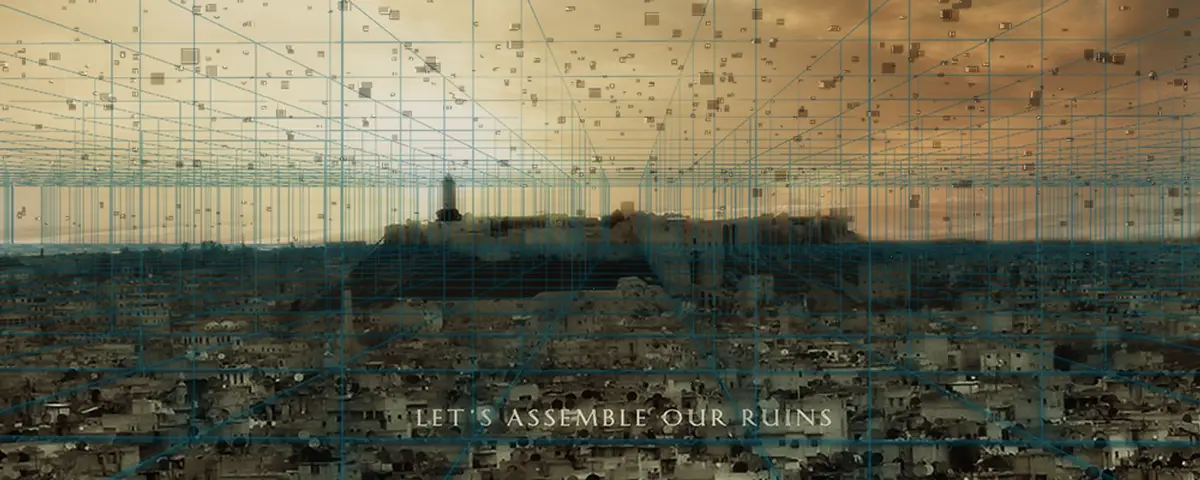
Let's Assemble Our Ruins to Make Memories: Rebuilding Aleppo Through Collective Space
A memorial plaza in Aleppo's historic core transforms war-torn fragments into a layered public landscape of healing and cultural rebirth.


What do you do with a city whose scars are also its identity? In Aleppo, where collapsed structures and fragmented neighborhoods define the post-war landscape, the impulse to wipe clean and start over is powerful. But erasure is its own kind of violence. This project takes the opposite stance: it gathers the ruins, frames them, and turns them into the raw material for a public plaza that functions simultaneously as memorial, social infrastructure, and foundation for a new urban identity.
Designed by Omid Ramezani Golshan, Seyed Mohammad Razavizadeh, and Hamed Kamalzadeh, Let's Assemble Our Ruins to Make Memories is sited in Aleppo's historic downtown, a district shaped by countless cultures and layered histories now marked by the Syrian war's devastation. The proposal doesn't treat post-war architecture as a repair job. It treats it as a medium through which people reclaim memory, belonging, and agency over their own cultural landscape.
A Turquoise Grid Suspended Over a Wounded City
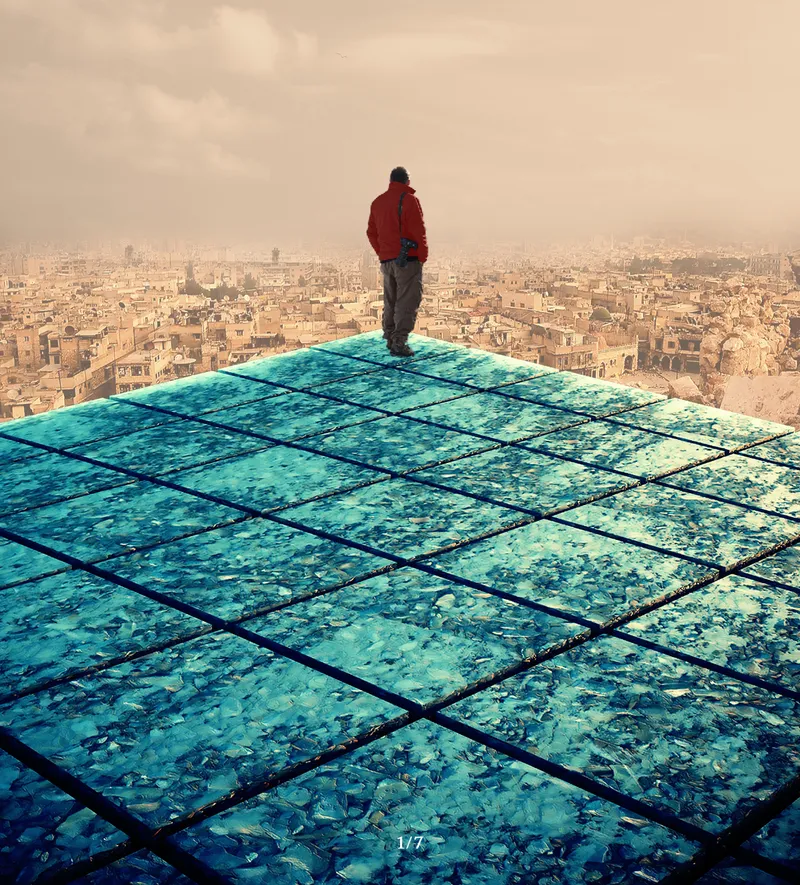
The opening image is arresting: a lone figure in a red jacket stands on a gridded surface of turquoise glass panels, suspended above the dense, scarred fabric of Aleppo. The elevated platform literalizes the project's core ambition, to give Syrians a new vantage point from which to witness their own cultural landscape. The grid is porous, transparent enough to reveal the city below, opaque enough to establish a distinct plane of occupation. It is a threshold between ruin and reconstruction, between looking back and stepping forward.
This rooftop condition sets up the project's spatial logic: elevated surfaces, open-air walkways, and axes aligned with historic structures create what the designers call an "urban choreography of remembrance." The plaza is not a sealed monument. It is an inhabited frame that encourages circulation, pause, and reorientation within the city's broader context.
A Canopy Between the Historic Tower and the Palms
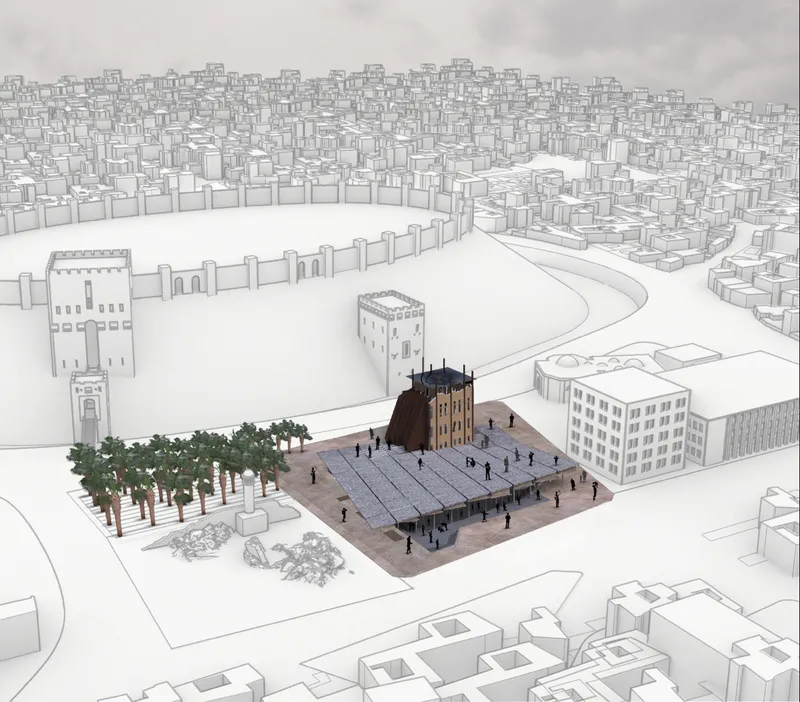
The axonometric drawing reveals the plaza's spatial ambitions clearly: a canopy structure stretches between a historic tower and a line of palm trees, mediating between the existing urban fabric and new programmatic ground. The canopy does not compete with the tower; it defers to it, creating a covered public space that reads as an extension of the city's layered identity rather than an imposition upon it.
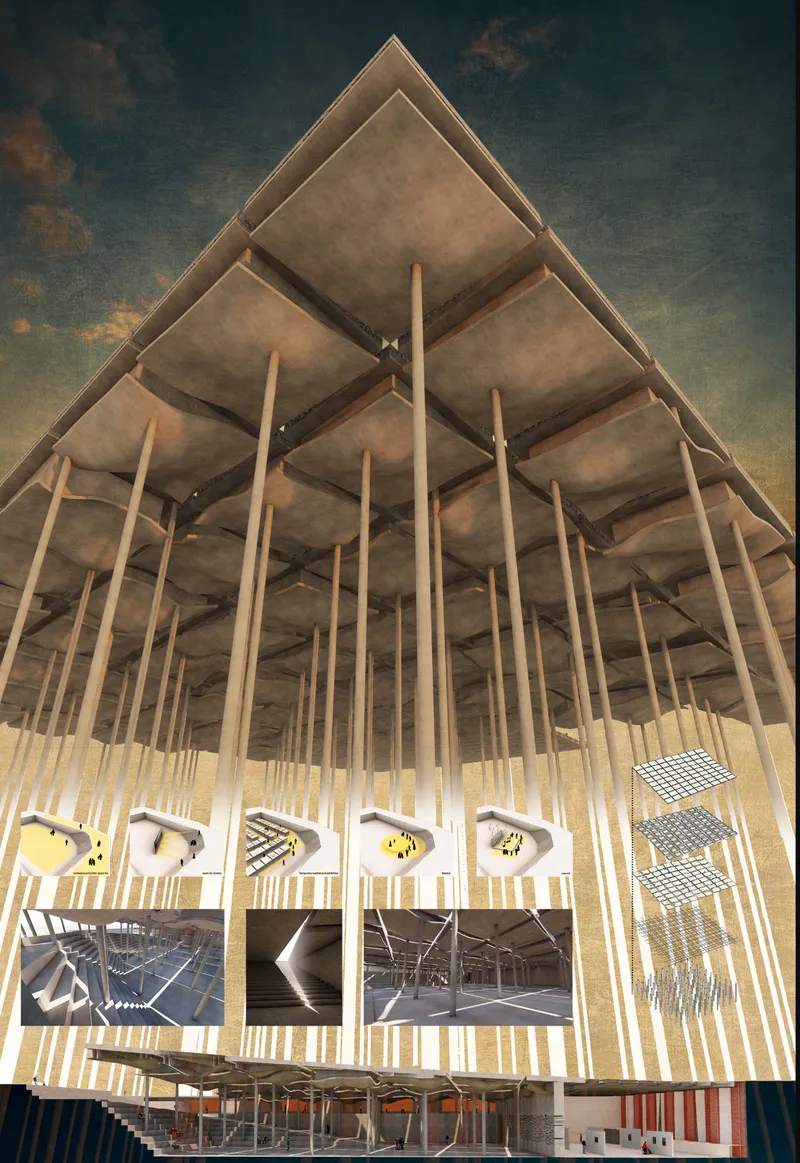
The presentation board digs into the structural system: a pyramidal timber column-and-beam assembly that gives the canopy its form. The detail photos and perspective renderings show how the timber skeleton creates a warm, legible structure beneath which social life can reassemble. There is an honesty to this choice of material and form. Timber is reparable, tactile, and human-scaled. Against the masonry ruins of Aleppo, it signals something new without pretending to be permanent.
Circulation, Collection, and Program Woven Into One System
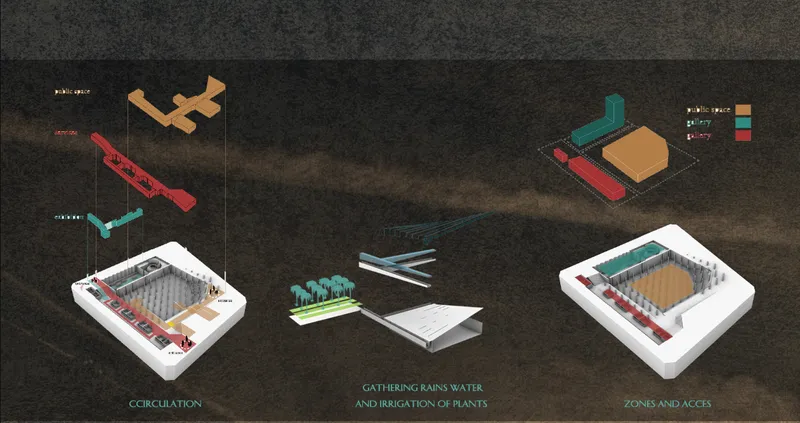
The isometric diagram breaks the project into its operational components: circulation pathways, rainwater collection systems, and programmatic zones, each color-coded for legibility. What stands out is how tightly integrated these systems are. Rainwater collection is not bolted on as a sustainability gesture; it is embedded in the structural and spatial logic of the canopy. Circulation is not simply functional routing but a curated sequence that moves visitors from solitary corridors into communal gathering spaces.
The designers describe vertical and horizontal planes creating layered circulation that symbolizes the many layers of Syrian cultural identity. In practice, this means visitors experience the plaza at multiple elevations, encountering different relationships to the ruins, the sky, and each other as they move through the site. Light gaps, shadow lines, and elevated grids introduce moments of contemplation, controlling illumination to reveal the site's complexity gradually rather than all at once.
Eight Blades, Eight Years of War
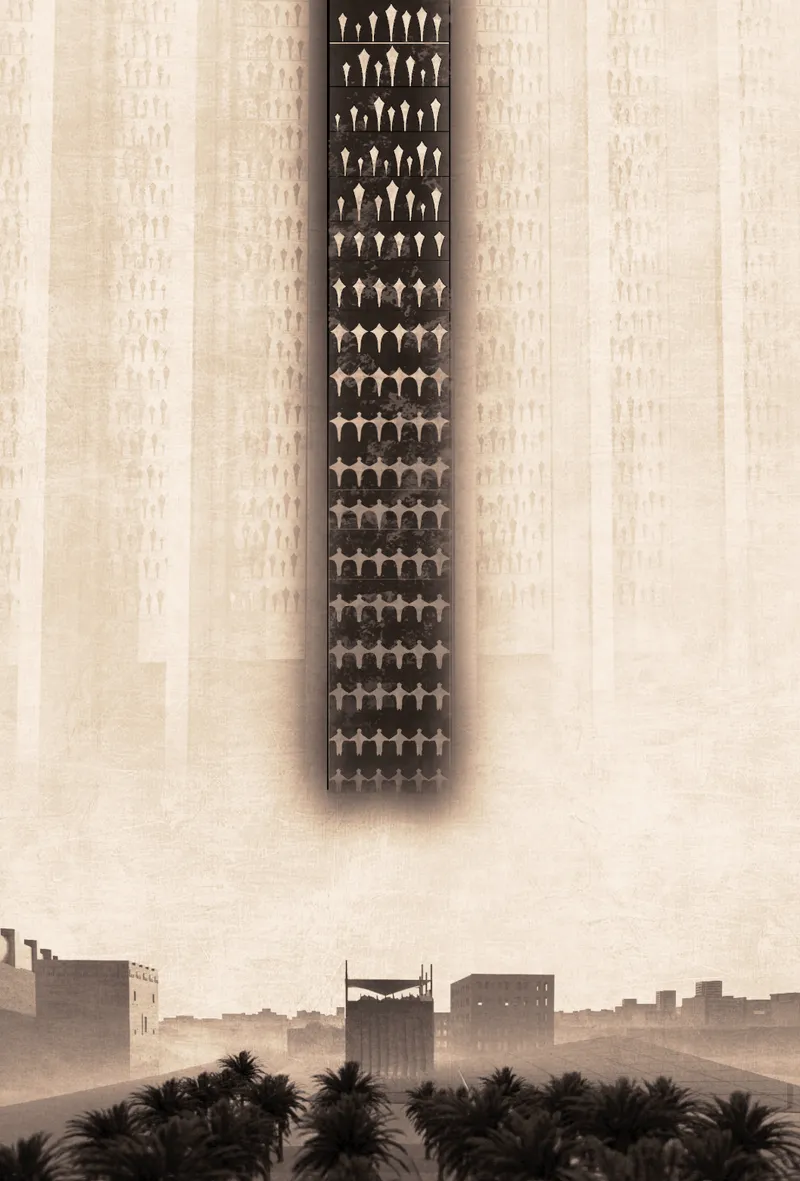
The dusk elevation rendering captures what may be the project's most emotionally charged element: a tower flanked by light masonry facades, its surface defined by a vertical perforated screen. This is part of the installation of eight tall blades, each creating a solitary pathway through the memorial. At sunset, the blades cast long shadows that intensify the visitor's encounter with the site. The number is deliberate: each blade represents one of the eight years of the Syrian war, standing for countless human stories, struggles, and sacrifices.
Curtains hung between the blades diffuse sunlight into soft red hues reminiscent of the Syrian dusk. As visitors pass through, the curtains move gently, a physical register of the fragility of memory and the resilience required to walk through it. The spatial narrative works on two registers: first immersing visitors in individual introspection, then guiding them toward the communal plaza where personal experience folds into a collective framework.
Subterranean Chambers and the Tilted Volume Above
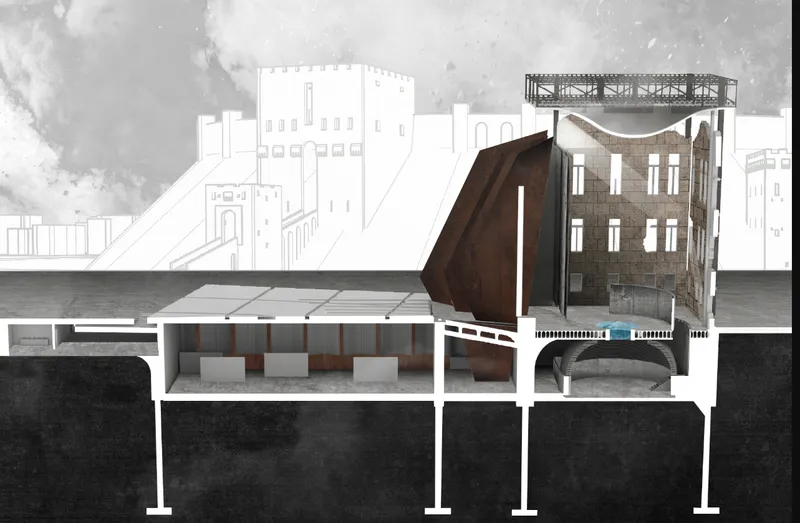
The section drawing reveals a dimension invisible from the surface: subterranean chambers carved beneath the canopy, topped by a tilted masonry volume and exposed structure above. The below-grade spaces extend the project's program downward, creating rooms for reflection, exhibition, or gathering that sit physically within the archaeological strata of Aleppo itself. The tilted volume above punctures the ground plane, signaling the presence of something beneath while refusing to sit neatly within the plaza's horizontal order.
This sectional strategy captures the project's philosophy in a single cut: the past is not buried and forgotten but architecturally accessed, framed, and made available for encounter. The exposed structure reads as both skeleton and scaffold, a building caught between states, neither ruin nor finished monument. It is an architecture that insists on incompleteness as a design position, acknowledging that the process of healing, like the process of building, is ongoing.
Why This Project Matters
Post-war reconstruction too often defaults to one of two modes: nostalgic replication of what was lost, or tabula rasa modernization that treats history as an obstacle. This proposal for Aleppo rejects both. By preserving fragments of war-torn structures and integrating them into a new architectural language, the design treats ruins not as liabilities but as cultural assets, evidence of survival that can anchor a community's forward motion.
The strength of the project lies in its refusal to separate memorial from daily life. The plaza is not a solemn precinct cordoned off from the city; it is a working public space where rainwater is collected, circulation unfolds at multiple levels, and the fort, the clustered housing, and the historic streets of Aleppo are reintroduced to their own citizens through carefully orchestrated views. Golshan, Razavizadeh, and Kamalzadeh demonstrate that healing does not require forgetting. It requires assembling what remains and making something inhabitable from it.
View the Full Project
About the Designers
Designers: Omid Ramezani Golshan, Seyed Mohammad Razavizadeh, Hamed Kamalzadeh
Enter a Design Competition on uni.xyz
uni.xyz runs architecture and design competitions year-round that reward proposals with spatial conviction and real site intelligence.
Project credits: Let's assemble our ruins to make memories. by Omid Ramezani Golshan, Seyed Mohammad Razavizadeh, Hamed Kamalzadeh.


Popular Articles
Popular articles from the community


David Macias Steps a Doorless Stone and Plaster House Down a Tropical Colombian Hillside
In the humid hills of Colombia, Threshold House replaces the front door with an open void and terraces its 850 m² down the slope instead of fighting it.

longwave studio Reorganizes a 112 m² Tainan Apartment Around the Daily Routines of a Family and Two Cats
In Tainan, Taiwan, birch plywood, rust-red furniture and a freestanding plaster wall link arrival, storage, work and family life in one apartment.

Juan García Correa, John González and Claudia Rueda Sink a Circular Amphitheater into a Manizales Engineering Building
On the La Nubia campus in Manizales, Colombia, the S1 Building folds labs and offices into a hillside of ramped lawns that double as a campus route.

U.GA Architects Wraps an Oval Rooftop Pool in Curved Board-Formed Concrete on Busan's Jeollidan-gil
In Busan's Jeonpo-dong, a 454 m² mixed-use block stacks a neighborhood facility, guest rooms and an oval rooftop pool inside spiraling concrete walls.

Similar Reads
You might also enjoy these articles


Aquadapt: An Underwater Habitat That Rewrites Its Rooms by the Hour
Curved modules ring the seabed while one shell shifts from breakfast room to cinema, farm and football pitch as residents' needs change.

Play: Fragments of Their World: Remembered Architecture Rebuilt as a Modular Playground for Refugee Camps
Tom Gardner abstracts domes, arches and towers from the homelands of displaced families into a kit of child-scaled play parts for camp settlements.
REBIRTH: A Circular Settlement Where Afghan Widows and Their Children Rebuild Life Together
A shortlisted Resile entry turns the circle into a protective ring of timber and brick, gathering homes, classrooms and gardens around a shared landscape.
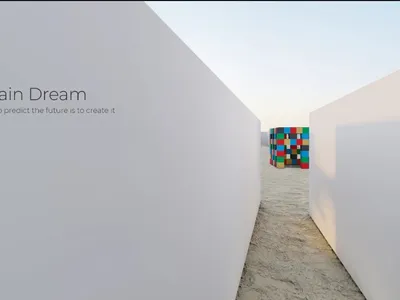
The Main Dream: A Recycled Plastic Kit That Lets Refugee Children Build Their Own Playground
Thirty-centimetre interlocking cubes that connect on three axes turn play into construction, letting children author the spaces they occupy.

Explore Architecture Competitions
Discover active competitions in this discipline

Challenge to reimagine the Iron Throne

Photograph architecture without architects

Illustrate the lost glory of Angkor Wat - Render Challenge

Design challenge to reuse E-waste
Comments (0)
Please login or sign up to add comments
No comments yet. Be the first to comment!