
L’horizon Vertical: A Model for Sustainable Housing Architecture in Montpellier
A sustainable housing architecture in Montpellier that blends intergenerational living, community spaces, and climate-responsive design.


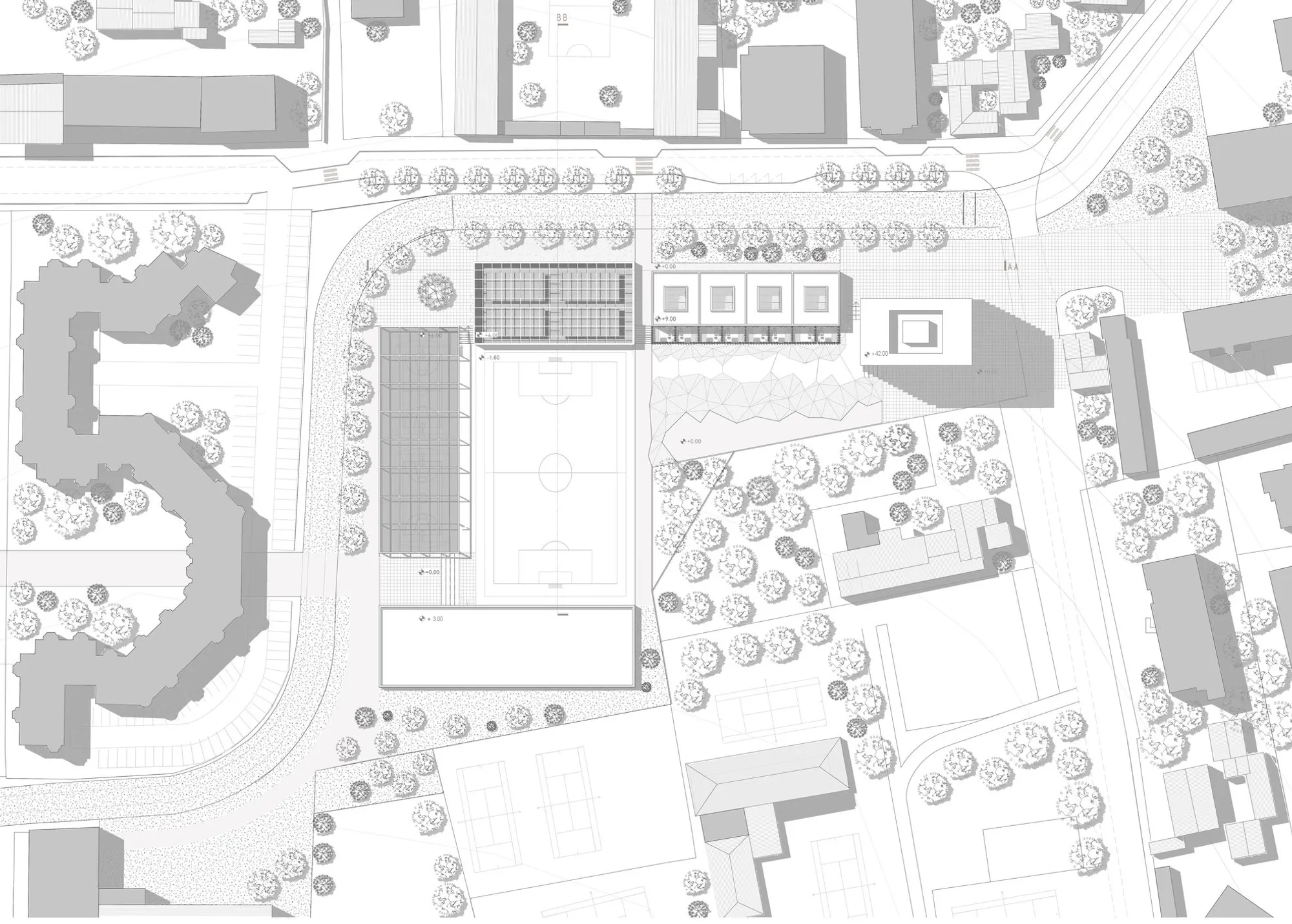
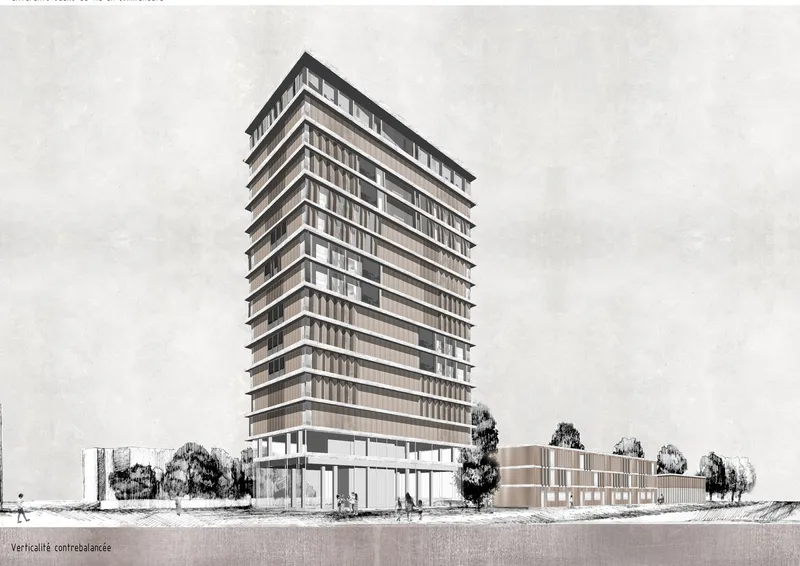
Located at the intersection of Rue du Jeu de Mail des Abbés and Rue Beau Séjour in Montpellier, L’horizon Vertical presents a compelling exploration of sustainable housing architecture through a hybrid urban model that integrates residential, social, and public programs. Designed by Laura Beaini, this shortlisted entry for Habitats '20 redefines collective living by merging intergenerational housing with a rich network of communal and recreational infrastructure.
At its core, the project responds to the evolving demands of contemporary urban life, where density, diversity, and sustainability must coexist. The program includes 74 intergenerational community housing units and 8 townhouses, complemented by a sports facility, market, daycare center, and children’s park. This multi-layered composition positions the project as a microcosm of urban life, fostering interaction across age groups and social strata.
Urban Strategy and Spatial Organization
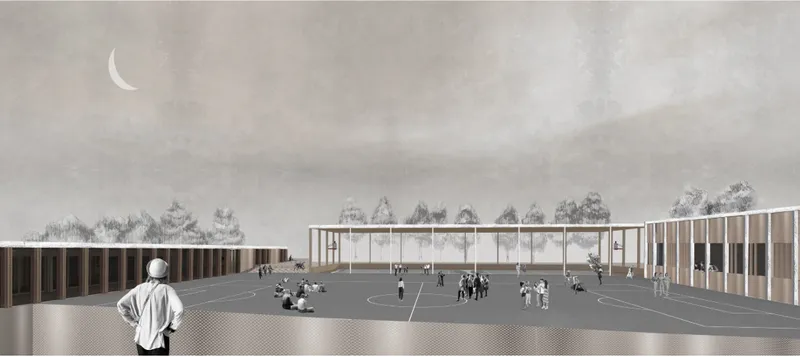
The masterplan reveals a carefully structured layout that balances built form with open space. The project is organized around a central axis of activity, where public and semi-public functions anchor the ground plane. Sports courts and open recreational zones create a dynamic interface between architecture and landscape, encouraging active engagement.
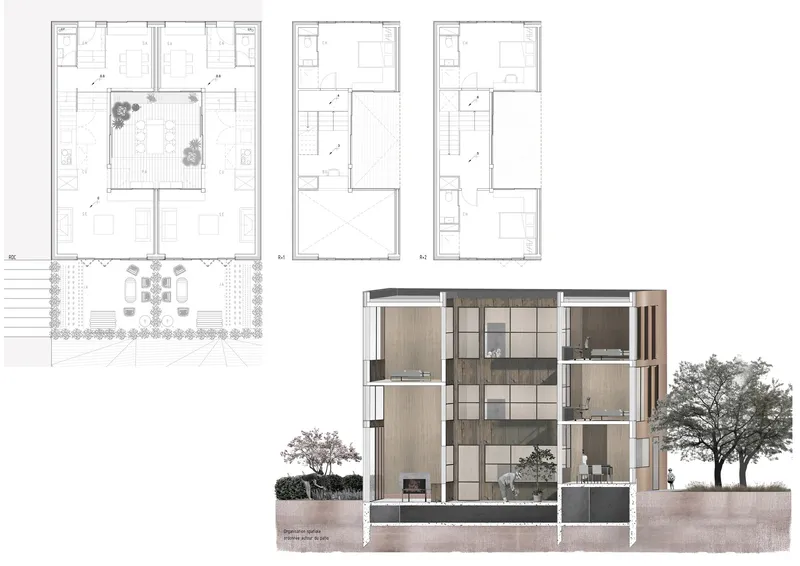
Residential blocks are arranged to maximize both privacy and connectivity. The inclusion of townhouses introduces a gradient of domestic scales, from collective living to more individual family units. This typological diversity is a key feature of sustainable housing architecture, as it accommodates varying lifestyles within a single cohesive framework.
The spatial sequencing ensures a clear hierarchy between public, semi-public, and private domains. Circulation pathways are designed to promote incidental encounters, reinforcing the social dimension of the project. The integration of landscape elements further softens transitions, creating a porous and accessible environment.
Intergenerational Living as a Design Driver
A defining aspect of L’horizon Vertical is its focus on intergenerational housing. The architectural layout facilitates interaction between different age groups while maintaining functional independence. Shared courtyards, communal terraces, and semi-open circulation zones act as social condensers, encouraging daily exchanges.
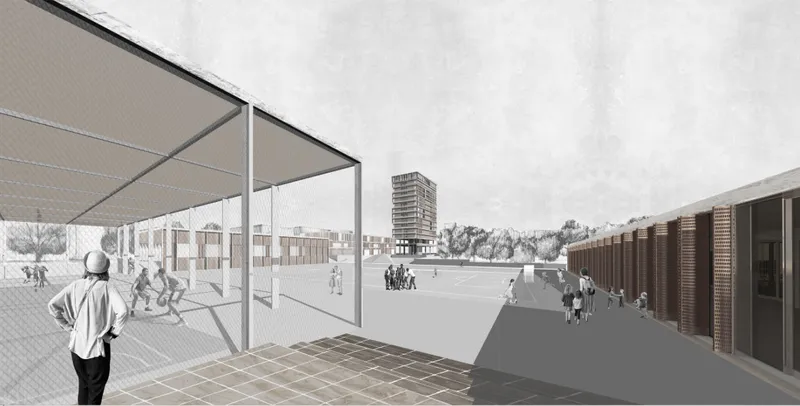
This approach addresses one of the key challenges in contemporary housing design: social isolation. By embedding opportunities for interaction within the spatial fabric, the project enhances community resilience and well-being. The daycare center and children’s park are strategically positioned to activate the site, while proximity to residential units ensures constant visual and social connectivity.
Architectural Expression and Materiality
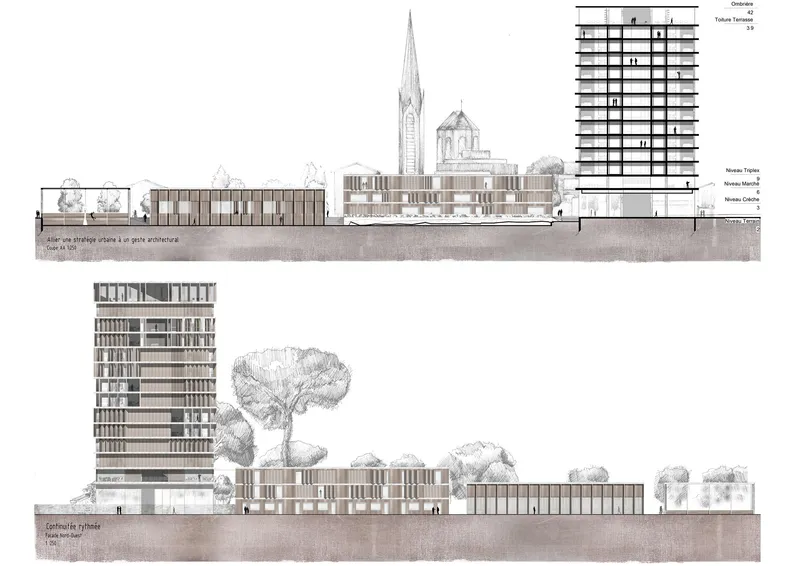
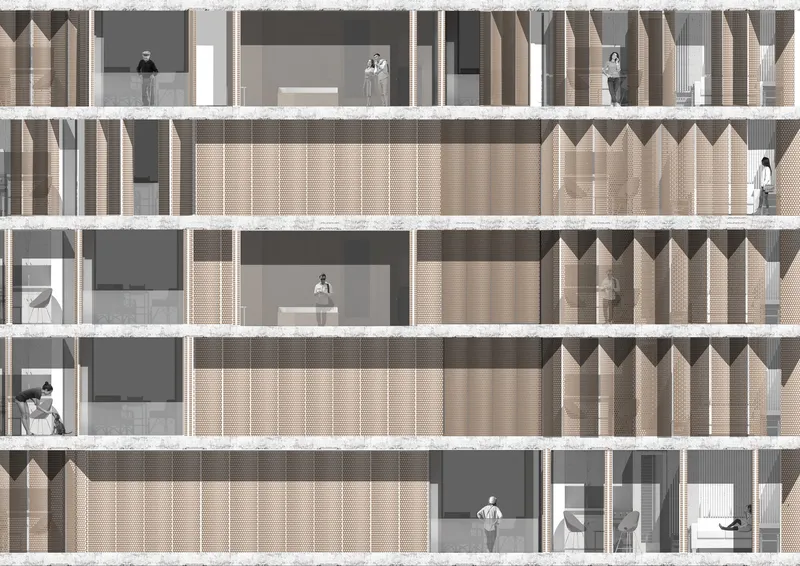
The architectural language of the project is defined by a restrained palette and a strong emphasis on modularity. The facade system employs a rhythmic arrangement of perforated panels and vertical elements, which serve both aesthetic and environmental functions. These screens regulate sunlight, enhance privacy, and contribute to passive climate control strategies.
Sectional drawings reveal a layered spatial organization, where interior spaces are articulated through variations in height, depth, and enclosure. The use of natural materials and neutral tones reinforces the project’s commitment to sustainability, while also creating a warm and tactile living environment.
The building envelope is designed to respond to climatic conditions, reducing reliance on mechanical systems. Cross-ventilation, shading devices, and optimized orientation are integral components of the sustainable housing architecture strategy.
Integration of Public Infrastructure
Beyond housing, L’horizon Vertical functions as an urban catalyst by incorporating essential community infrastructure. The market introduces an economic layer to the project, supporting local activity and daily needs. The sports facility and open courts activate the site throughout the day, transforming it into a vibrant social hub.
This integration of mixed-use programs is critical in contemporary urban design, as it reduces dependency on external infrastructure and promotes walkability. The project effectively bridges the gap between private living and public life, creating a seamless urban experience.
A Prototype for Future Urban Living
As cities continue to grow and densify, projects like L’horizon Vertical offer valuable insights into the future of housing. By combining intergenerational living, mixed-use programming, and climate-responsive design, the project exemplifies the principles of sustainable housing architecture.
It moves beyond the conventional notion of residential design to propose a holistic urban model, where architecture acts as a framework for social interaction, environmental responsibility, and spatial adaptability.
In doing so, L’horizon Vertical not only addresses current housing challenges but also sets a precedent for inclusive and sustainable urban development.



Popular Articles
Popular articles from the community


The Musturak Paradise: Senior Living Architecture for a Connected Future in Temara, Morocco
The Musturak Paradise reimagines senior living architecture in Temara via private homes, social spaces, culture, community, and shared care.

Co-life: Sustainable Architecture for Age-Friendly Community Living
Co-life reimagines sustainable architecture for seniors through courtyards, rammed earth, shared gardens, and spaces designed for belonging.

Hill & Cross Opera: Sculptural Opera House Architecture Shaped by Tallinn’s Landscape and Identity
Hill & Cross Opera reimagines opera house architecture in Tallinn through its sculptural hill, civic plaza, glass wave and a luminous cross.

The Ocean Hive: Sustainable Architecture for a Self-Sufficient Civilization at Sea
The Ocean Hive imagines sustainable architecture at sea, where modular habitats, algae, wave power and ocean waste sustain a growing colony.

Similar Reads
You might also enjoy these articles

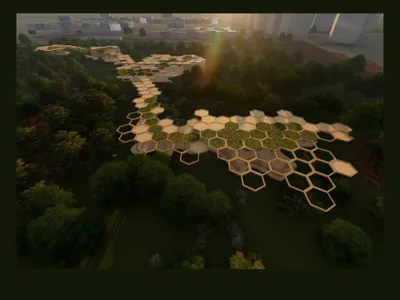
Eco Chapel: A Green Architecture Pavilion Designed in Symbiosis with the Forest
Eco Chapel uses green architecture to weave prayer, learning and reuse into a forest pavilion shaped by modular hexagonal canopies for life.
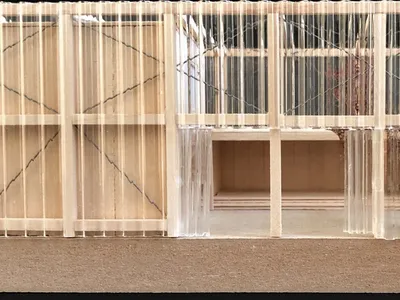
Kaffeebühnen: Coffee Shop Architecture Designed as a Civic Stage Between Vienna’s City and Park
Kaffeebühnen turns coffee shop architecture into a civic stage, linking Vienna’s park edge, urban life, warm timber yards, and coffee craft.
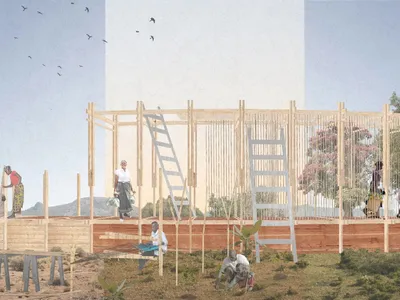
Healing Façade: Sustainable Architecture for Reforestation, Community, and Sacred Ecology in Ethiopia
Healing Façade reimagines sustainable architecture as a living wall that restores soil, catches water and renews Ethiopia's forest churches.


Urban Forest: A Vertical Ecosystem for 5,000 Workers in Singapore's Changi Business Park
Radially stacked pods and layered green decks turn a 7-acre plot into 47 acres of ecological workspace projected for 2040.


Explore Architecture Competitions
Discover active competitions in this discipline



Challenge to reimagine the Iron Throne


Photograph architecture without architects


Illustrate the lost glory of Angkor Wat - Render Challenge


Design challenge to reuse E-waste
Comments (0)
Please login or sign up to add comments
No comments yet. Be the first to comment!