

Library Pavilion by FELT: A Wedge-Shaped Reading Retreat in the Belgian Countryside
Library Pavilion by FELT is a compact, steel-clad reading retreat with timber shelving, framing garden views and embracing quiet reflection.


Set on the edge of a quiet suburban neighborhood in Nazareth, Belgium, the Library Pavilion designed by FELT offers a poetic response to the needs of a retired art book publisher. Conceived as a compact, standalone extension, the 60 m² volume elegantly merges architecture, landscape, and personal memory, transforming a corner of a residential property into a contemplative cultural retreat.

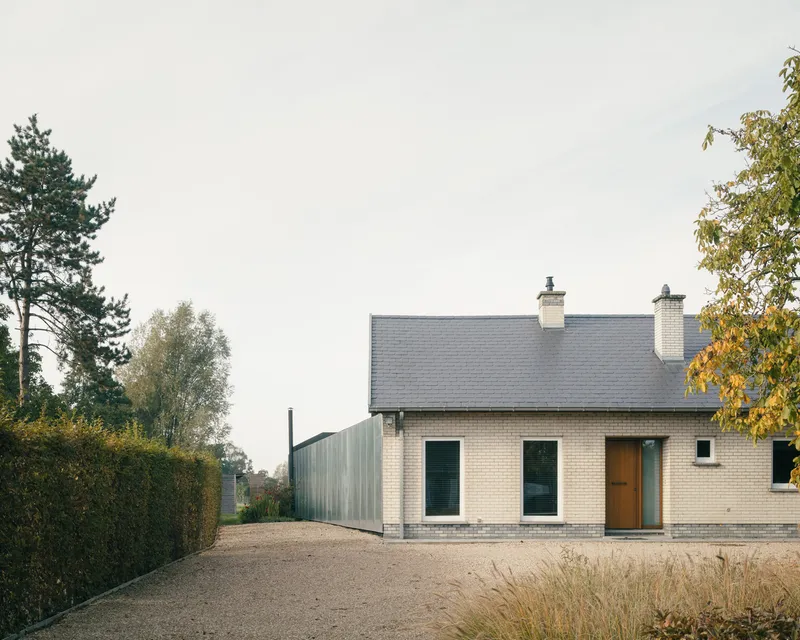
A Personal Sanctuary for Books and Nature
The client envisioned a dedicated space to house his extensive collection of art books, preferring an architectural expression distinct from the main house. FELT responded with a wedge-shaped pavilion, tucked into the side of a typical Flemish dwelling, clad in galvanized steel that references local agricultural architecture. This low-profile strategy maintains the detached-house typology when viewed from the street, preserving the neighborhood’s visual continuity.

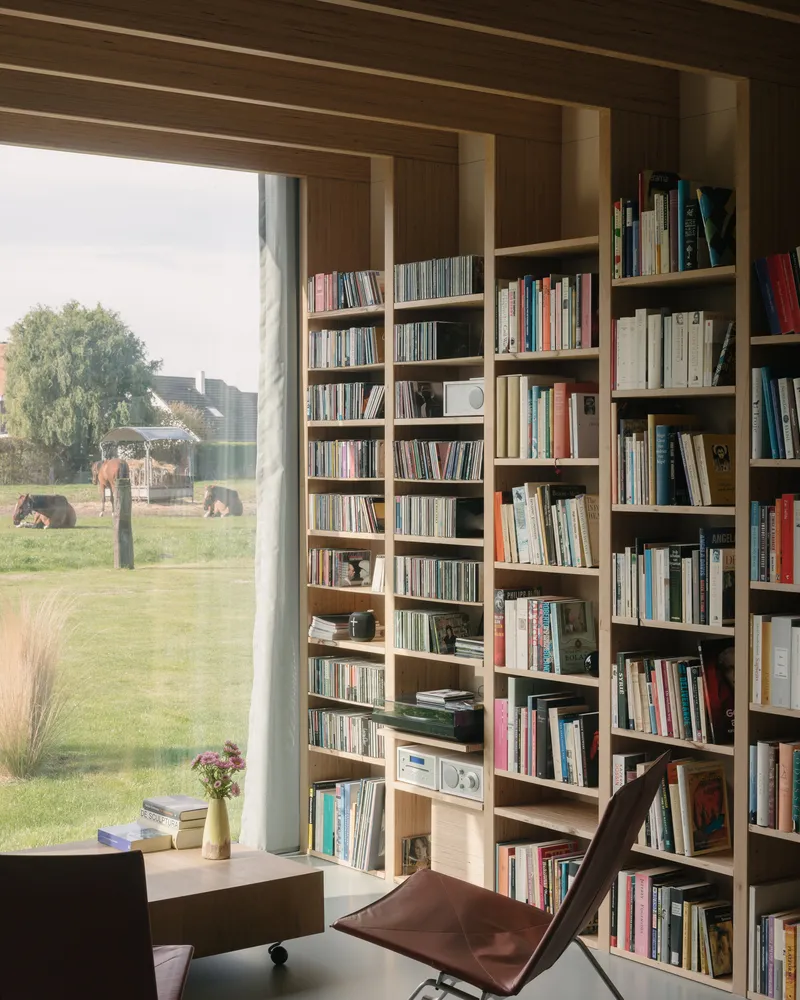
The resulting structure is both modest and poetic—a private library pavilion immersed in views of a wildflower garden and distant meadows. It is as much a reading room as it is a space of quiet retreat, entirely wrapped in floor-to-ceiling timber shelving that holds not only books, but also the weight of the roof structure itself.

Architecture that Frames and Disappears
From the street, the new volume gently disappears due to its oblique orientation and low-slung form. From within, the pavilion opens dramatically toward the back garden through a full-width picture window, offering uninterrupted views of the landscape. A skylight placed where the extension meets the original house ensures that natural light remains abundant in both old and new spaces.


The design carefully navigates between visibility and intimacy—connected to the main house via a converted existing window, yet visually and emotionally distinct. The oblique geometry enables the structure to appear smaller than it is, subtly dissolving into the surrounding greenery while maximizing interior spatial experience.
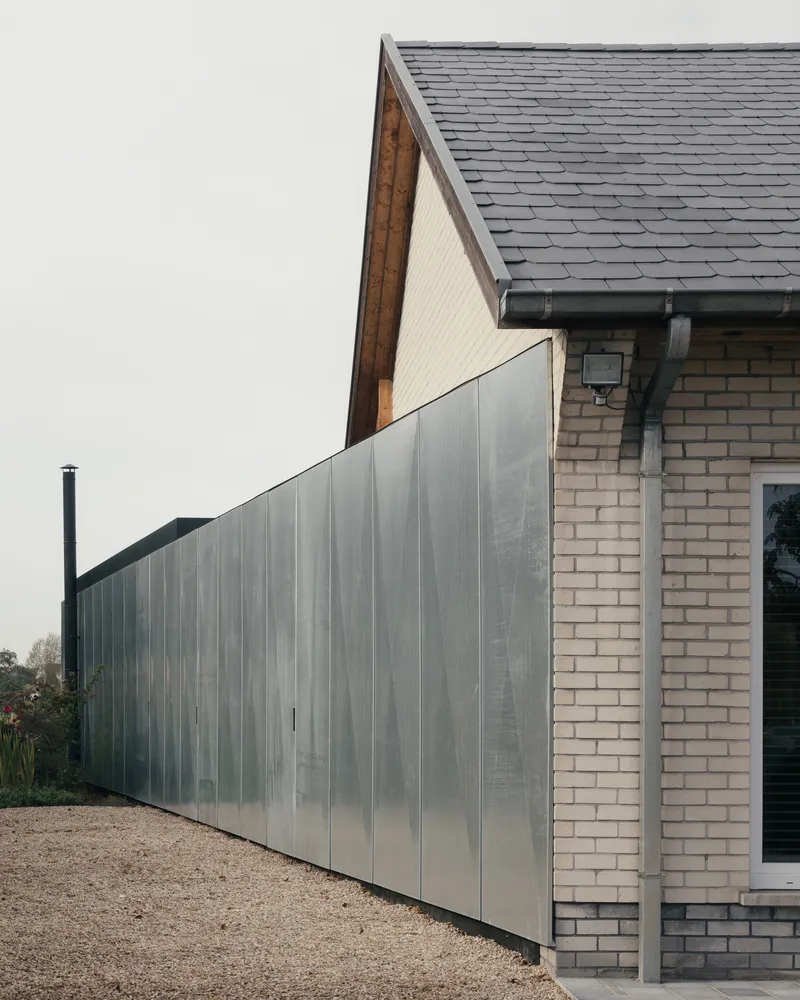

Functional Minimalism and Tactile Clarity
The facades are clad in vertically arranged galvanized steel sheets, establishing a subtle rhythm that conceals doors for storage and access. These materials evoke the barn doors of rural Belgium, grounding the design in its regional agricultural context. Their reflective quality allows the pavilion to shift in appearance with the changing light and weather—mirroring sky tones, tree lines, and seasonal transitions.
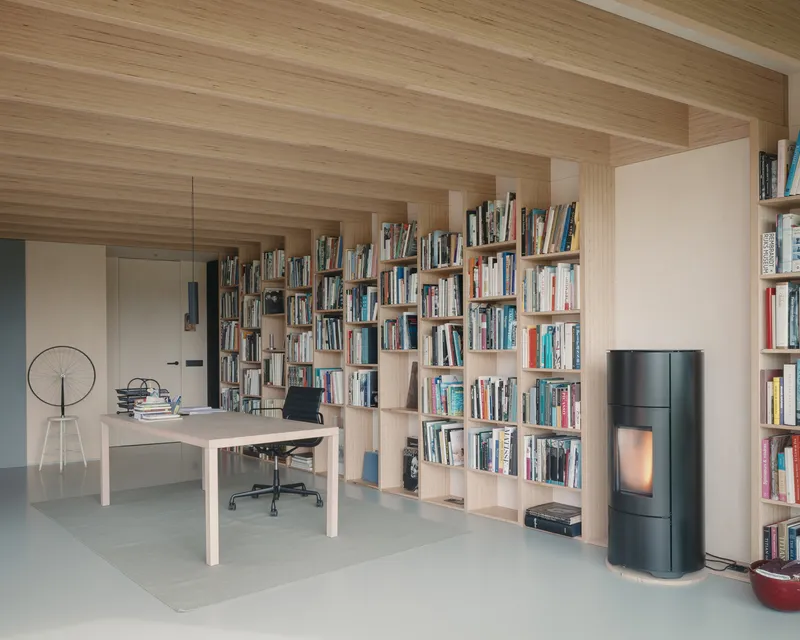

Inside, every surface is devoted to the purpose of reading, storing, and reflecting. With warm wooden textures, carefully controlled light, and a seamless visual connection to the outdoors, the space fosters solitude, inspiration, and retreat.


The design was also accompanied by the planting of a wildflower garden and installation of a bee hive, reinforcing the pavilion’s eco-conscious and place-based sensibility.

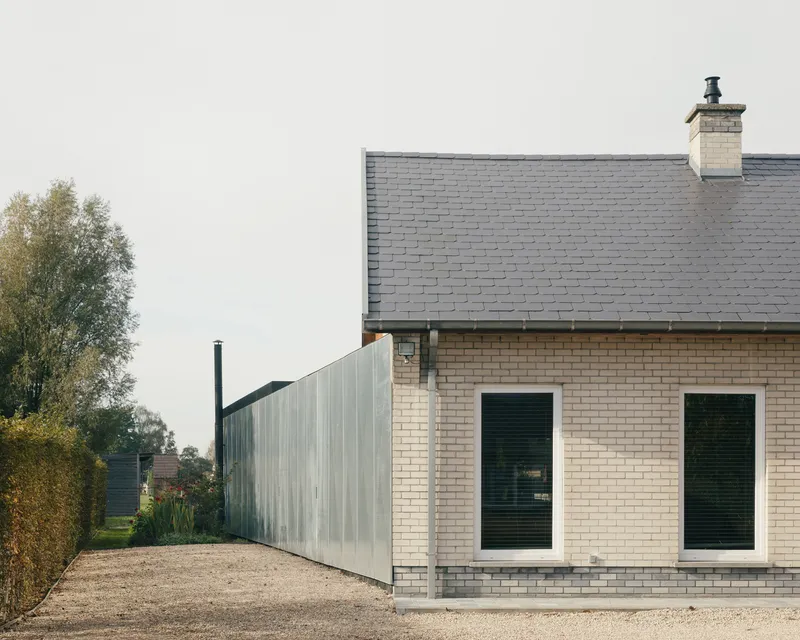
All the photographs are works of Stijn Bollaert


Popular Articles
Popular articles from the community


Tsunami Convergenics: Turning Catastrophic Ocean Forces into Underwater Housing Infrastructure
A speculative underwater settlement off the coast of Onagawa, Japan, treats tsunamis and typhoons as energy sources rather than threats.

Cloaked Colonization: A Mobile Underwater Habitat That Moves Like a Fish
Micah Abaya's shortlisted EHC Pacific entry reimagines ocean settlement as a dispersed network of self-sustaining architectural organisms.

Singing Woman: An Opera House That Performs Before the Curtain Rises
Ovidiu Cristian Pavel's conceptual opera house translates Estonia's choral identity into a sculpted waterfront landmark facing the Baltic Sea.
Opera by the Sea Estonia: Three Shells Dissolving Architecture into Tallinn's Coastline
A winning opera house proposal replaces monumental form with interconnected shells that blur the boundary between building, park and Baltic Sea.

Similar Reads
You might also enjoy these articles


Hodi-Mandai Geram
Project Function: Preservation and revitalization of the Intangible heritage and socio-spatial identity of the Hodi by Housing, Cultural Memory Center, Sacred Grove, landscape, local tourism economy


Olio Towers: A Mid-Rise for Performers That Fuses Housing, Rehearsal, and Stage
Located blocks from Houston's Theater District, this modular tower stacks living units around a central performance atrium.

Oasis: Modular Green Housing Carved into Dhaka's Urban Fabric
A shortlisted Plugin Housing entry reclaims unauthorized settlements in Dhaka with stepped concrete volumes, green roofs, and ventilation-driven design.

Black Hole: A Floating Megastructure for the Post-Physical Era
Emiliano Mazzarotto envisions a spherical, self-scaling arena where e-sports, digital hotels, and holographic stadiums replace traditional public space.

Explore Reading Room Competitions
Discover active competitions in this discipline

Challenge to design public laboratory

Challenge to reimagine the Iron Throne

Photograph architecture without architects

Illustrate the lost glory of Angkor Wat - Render Challenge
Comments (0)
Please login or sign up to add comments
No comments yet. Be the first to comment!