

Libre House by Mário Martins Atelier: A Harmonious Retreat Blending Concrete, Light, and Landscape in Lagos, Portugal
Libre House blends exposed concrete, minimalist design, and Mediterranean landscape, offering serene, sustainable living with panoramic sea views.


Set on a sun-drenched hillside overlooking the breathtaking bay of Lagos, Portugal, Libre House by Mário Martins Atelier is a refined architectural expression of contemporary minimalism, sustainable living, and contextual design. Completed in 2022, the 416-square-meter single-story residence combines the raw beauty of exposed concrete with delicate landscaping and seamless spatial transitions, offering its inhabitants both intimacy and openness in perfect balance.

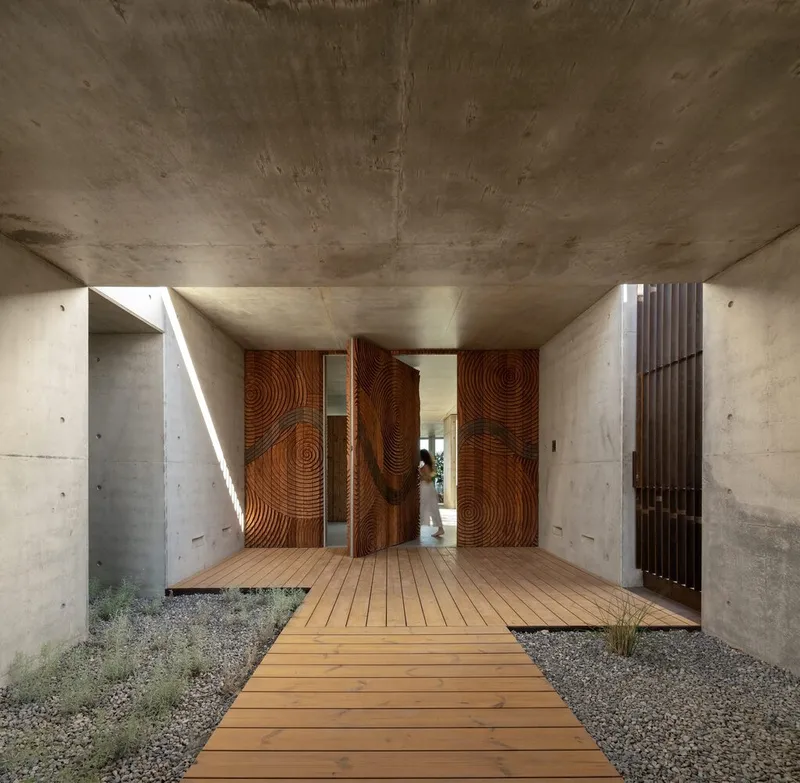
A Courtyard-Centric Architectural Concept
The house’s spatial organization revolves around an inward-facing patio—a central courtyard that provides both orientation and identity to the project. This patio, anchored by a mature carob tree, is not only a design focal point but also a climatic device, creating ventilation, natural light, and visual relief. It clearly delineates the social areas—living room, dining space, and kitchen—oriented to the south and facing the ocean, from the private realm of four bedrooms in the east wing. The garage, technical, and utility spaces are placed along the north and west peripheries for discreet functionality.
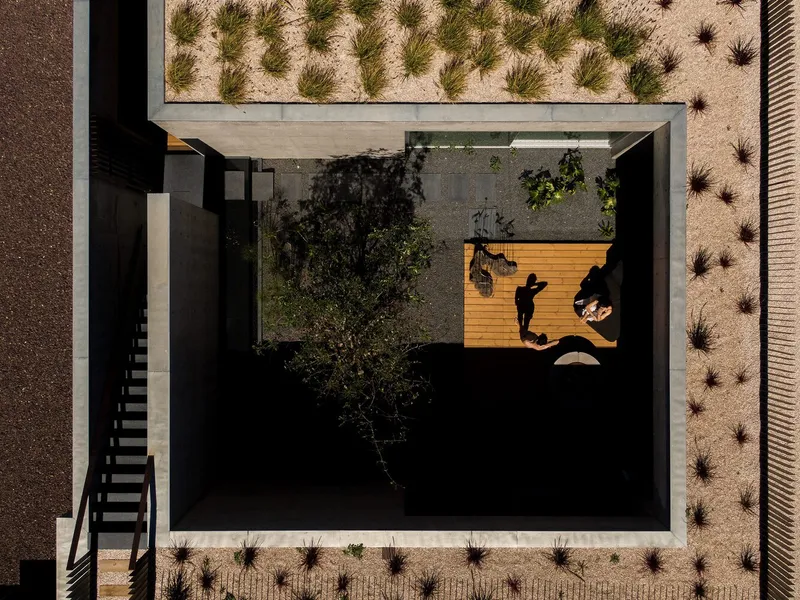

Architectural Form: Lightness in Concrete
Despite being constructed predominantly in exposed concrete, Libre House feels far from monolithic. Its clean, cubic geometry is softened by the use of transparent glazing, wooden detailing, and a strikingly thin cantilevered canopy that extends over a shaded outdoor deck. This slender concrete slab blurs the boundaries between indoor and outdoor space while offering shade and visual continuity. It leads seamlessly to a linear black infinity pool that runs parallel to the living areas, reflecting the architecture and the surrounding landscape like a minimalist sculpture.


Materiality, Landscape, and Sustainability
Libre House is deeply rooted in its Mediterranean climate and regional material palette. The surrounding landscape is minimally designed using drought-tolerant native vegetation, which gradually reclaims the built form, weaving through patios and encroaching gently on outdoor spaces. The rooftop is accessible and landscaped, offering another layer of interaction with the environment, enhancing thermal insulation and providing expansive views of the sea.
Internally, the use of natural materials such as solid wood for doors and detailing adds warmth to the otherwise minimalist interiors. Concrete planes are sliced with pathways, creating framed vistas and light shafts that animate the home with dynamic shadows throughout the day.

Environmental Performance and Design Philosophy
The project reflects a deep commitment to energy-efficient architecture and environmentally responsible design. Local materials were prioritized to reduce carbon footprint, and high-performance systems and equipment were integrated to reduce energy consumption. This thoughtful approach results in a house that is not just a visual icon but a functional, sustainable home.
At its core, Libre House represents the freedom of creative architectural exploration—where rigorous formal logic, tactile materials, and sensitivity to place converge into a living space that is both poetic and pragmatic.


Popular Articles
Popular articles from the community


David Ortega Stacks a Two-Story Mexico City Penthouse Around a Steel Stair and a Pergola-Shaded Roof Terrace
In Colonia Roma, a 300 m² penthouse uses oak joinery, a planted steel stair and a slatted roof pergola to make a new-build apartment feel like a house.

David Macias Steps a Doorless Stone and Plaster House Down a Tropical Colombian Hillside
In the humid hills of Colombia, Threshold House replaces the front door with an open void and terraces its 850 m² down the slope instead of fighting it.

Jaramillo Van Sluys Arquitectura and Urbanismo Turn a Demolished Registry Lot in Quito into an Orchard Plaza
In Quito's Centro Histórico, a 2,800 m² plaza exposes the San Agustín convent wall and redraws its lost Augustinian orchard in volcanic stone.

U.GA Architects Wraps an Oval Rooftop Pool in Curved Board-Formed Concrete on Busan's Jeollidan-gil
In Busan's Jeonpo-dong, a 454 m² mixed-use block stacks a neighborhood facility, guest rooms and an oval rooftop pool inside spiraling concrete walls.

Similar Reads
You might also enjoy these articles


Hodi-Mandai Geram
Project Function: Preservation and revitalization of the Intangible heritage and socio-spatial identity of the Hodi by Housing, Cultural Memory Center, Sacred Grove, landscape, local tourism economy


Olio Towers: A Mid-Rise for Performers That Fuses Housing, Rehearsal, and Stage
Located blocks from Houston's Theater District, this modular tower stacks living units around a central performance atrium.

Oasis: Modular Green Housing Carved into Dhaka's Urban Fabric
A shortlisted Plugin Housing entry reclaims unauthorized settlements in Dhaka with stepped concrete volumes, green roofs, and ventilation-driven design.

Black Hole: A Floating Megastructure for the Post-Physical Era
Emiliano Mazzarotto envisions a spherical, self-scaling arena where e-sports, digital hotels, and holographic stadiums replace traditional public space.

Explore Architecture Competitions
Discover active competitions in this discipline

Challenge to reimagine the Iron Throne

Photograph architecture without architects

Illustrate the lost glory of Angkor Wat - Render Challenge

Design challenge to reuse E-waste
Comments (0)
Please login or sign up to add comments
No comments yet. Be the first to comment!