
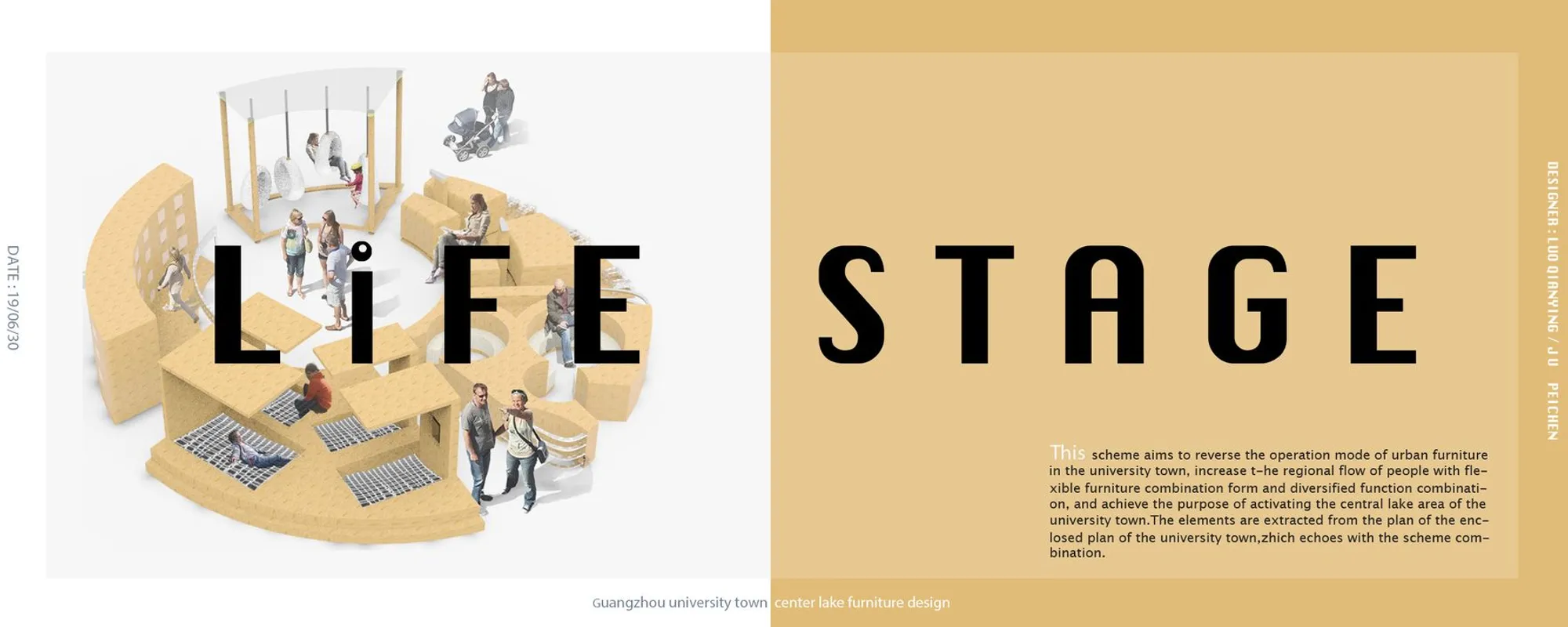
Life Stage: Modular Urban Furniture Reactivates a Dormant Lakefront in Guangzhou
Five timber furniture modules turn an underused university lake into a continuous loop of rest, play, and social exchange after dark.


A lake in the middle of a university town should be the social heart of the campus, not a dead zone after sunset. Yet that is exactly the condition the designers found at the central lake of Guangzhou University Town: sparse pedestrian activity, fragmented paths, no functional amenities, and harsh subtropical sun that drove people away rather than drawing them in. Life Stage treats public furniture not as scattered objects but as a continuous architectural system, a sequence of modular timber stations that turn the lakefront into a looping social circuit active from morning jog to midnight conversation.
The project is the work of Luo Qianying, Ju Peichen, Yuru Chen, and Summer Wang. Grounded in behavioral mapping and climate analysis specific to Guangzhou's humid, high-temperature conditions, the scheme replaces the lakefront's silence with five distinct furniture components that collectively offer storage, shade, seating, hydration, and play. The name "Life Stage" is literal: each module is a small platform where a fragment of daily life can unfold, and together they compose a stage set for community.
An Undulating Roof that Mirrors the Water
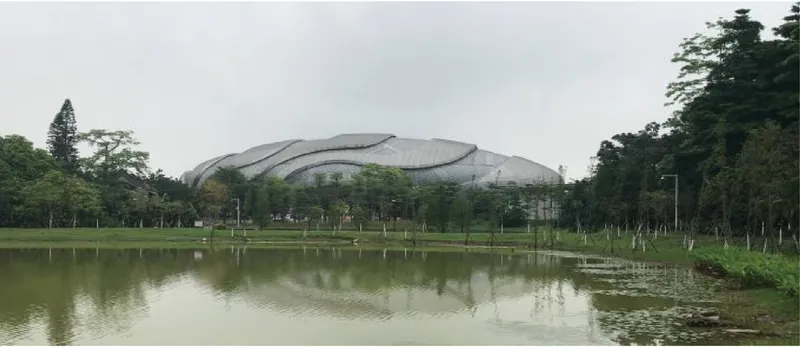
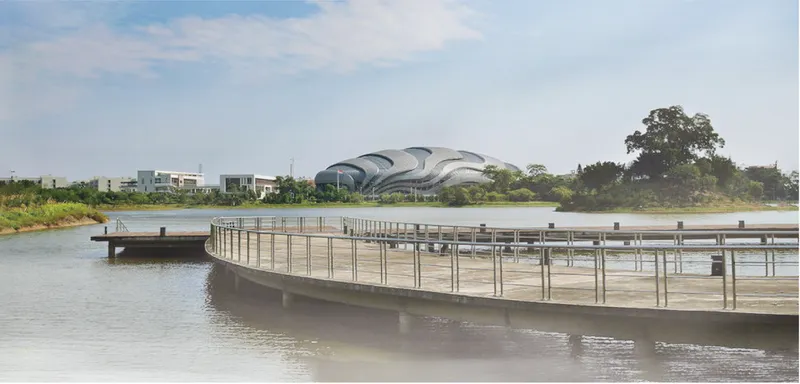
The defining gesture is a curving shell roof that stretches along the lakefront, its undulations echoing the surface of the reflecting pond it faces. Seen from across the water and lawn, the structure reads as landscape rather than building, its low profile deferring to the mature trees already on site. The timber floating boardwalk that extends toward it reinforces that reading: you approach on foot, over water, and the architecture rises only enough to shelter you from Guangzhou's relentless sun. The afternoon light in the rendering reveals how the roof doubles as a thermal device, channeling ventilation while casting deep shade across the seating zones beneath.
By keeping the roof form continuous, the designers avoid the typical problem of isolated park benches that sit unused because they belong to no coherent spatial logic. Here, the roof stitches the five furniture modules into a single experiential sequence. You are always under something, always oriented toward the lake, always aware that the next station is a short walk ahead.
Five Components, One Continuous Loop
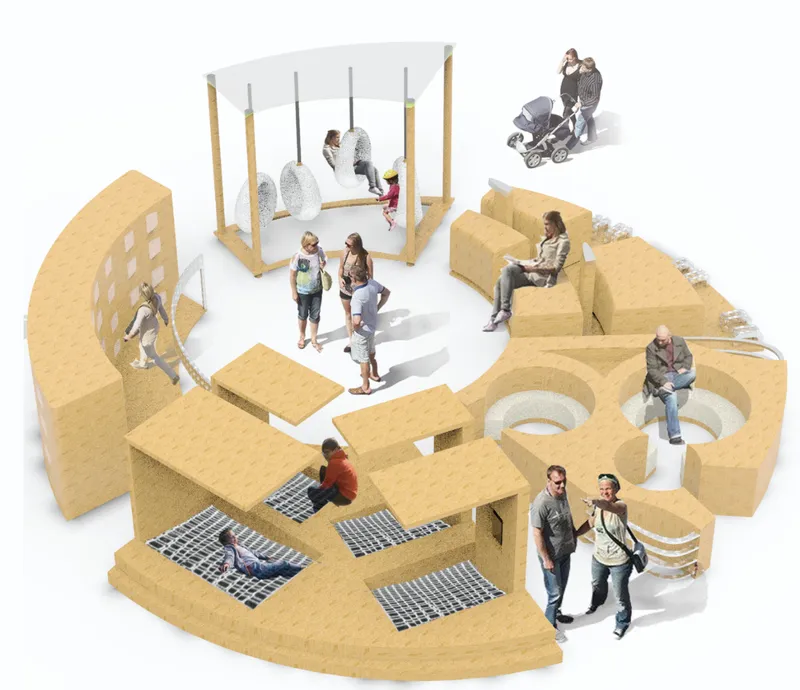
The axonometric drawing reveals the full inventory. Component one provides lockers and rails for runners who need secure storage before a lap around the lake. Component two is a hammock lounge with integrated sockets and lighting, acknowledging that rest and device charging are now inseparable activities. A circular seating module, component three, creates an enclosed form that encourages face-to-face conversation while maintaining a degree of acoustic and visual privacy. Component four combines a drinking water station with a bicycle dock, serving commuters and active users in a single stop. The fifth element is the most expressive: a sculptural entertainment frame fitted with hanging swing seats that inject playfulness into what could otherwise be a purely utilitarian sequence.
What makes the system convincing is not any single piece but the logic of arrangement. The modules are distributed along the lakeside to match the activity rhythms the team documented during their behavioral research: morning exercise near the lockers and water station, daytime relaxation at the hammock lounge and circular seating, nighttime socializing at the lit swing frame. Each component is modular, meaning it can be reconfigured or replicated as usage patterns evolve.
Timber Modules Grounded in the Landscape
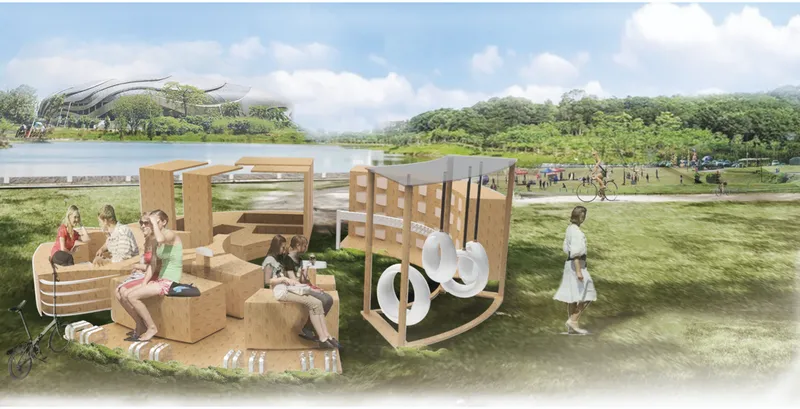
The ground-level rendering shows the furniture in use, and the material choice becomes clear. Timber dominates, warm and tactile against the green lawn and the cooler palette of the lake. The stepped and curved seating elements are sized for small groups, two or three people rather than long anonymous benches. People gather informally, some perched on edges, others stretched across surfaces, which suggests the designers succeeded in creating forms that invite multiple postures rather than dictating a single one. The roof structure hovers in the background, connecting the foreground furniture to a larger architectural ambition without overwhelming it.
Diagramming the System: From Lockers to Swing Frames
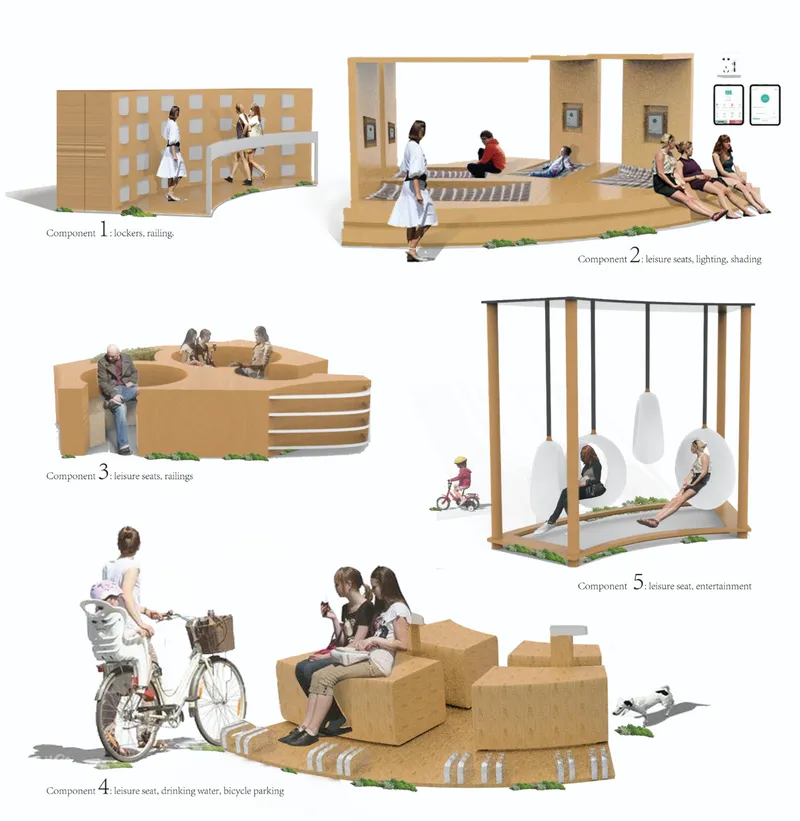
The component diagram isolates each of the five types, showing lockers, stepped seating, curved benches, and swing frames as discrete but visually related objects. The consistent timber language and structural logic across all five pieces is the glue: you can tell they belong to the same family even when separated by dozens of meters along the lakefront. The diagram also reveals how each module addresses a different body position and social configuration, standing at the locker rail, reclining in the hammock, sitting in the round, leaning at the water station, swinging at the entertainment frame. That range of postures is what turns a furniture catalogue into an inhabitable public space.
Why This Project Matters
Life Stage is a sharp reminder that public space activation does not always require landmark buildings or major infrastructure investment. Sometimes it requires a careful reading of how people already move through a site, followed by a precisely calibrated set of interventions at furniture scale. The designers' behavioral research, from crowd movement mapping to climate analysis, gives the project a specificity that generic "smart bench" proposals almost always lack. Every module has a reason tied to an observed pattern of use.
The broader lesson is about continuity. Isolated benches fail because they ask people to choose a single spot and commit to it. A looping sequence of diverse stations, connected by a sheltering roof and a boardwalk, reframes the lakefront as a journey rather than a destination. That shift in spatial logic, from point to line, from object to system, is what gives Life Stage its persuasive power and its relevance beyond Guangzhou University Town.
View the Full Project
About the Designers
Designers: Luo Qianying, Ju Peichen, Yuru Chen, Summer Wang
Enter a Design Competition on uni.xyz
uni.xyz runs architecture and design competitions year-round that reward proposals with spatial conviction and real site intelligence.
Project credits: Life Stage by Luo Qianying, Ju Peichen, Yuru Chen, Summer Wang.




Popular Articles
Popular articles from the community


The Musturak Paradise: Senior Living Architecture for a Connected Future in Temara, Morocco
The Musturak Paradise reimagines senior living architecture in Temara via private homes, social spaces, culture, community, and shared care.

The Ocean Hive: Sustainable Architecture for a Self-Sufficient Civilization at Sea
The Ocean Hive imagines sustainable architecture at sea, where modular habitats, algae, wave power and ocean waste sustain a growing colony.

Lunar Spiral: Space Architecture Shaped by the Mathematics of the Universe
Lunar Spiral reimagines space architecture through Fibonacci geometry, lunar regolith, levitating habitats, and self-sustaining Moon living.

The Earth Pod: 3D Printed Homes for Resilient Refugee Communities
The Earth Pod reimagines refugee housing through 3D printed homes made from clay, combining resilience, self-sufficiency, and rapid shelter.


Similar Reads
You might also enjoy these articles
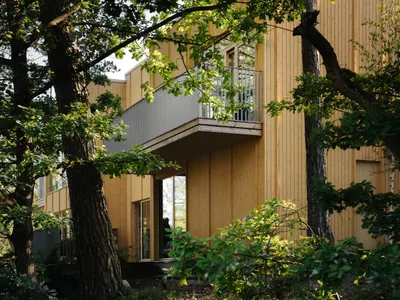
Sustainable Architecture Design: Embracing Nature and Modernity at Villa Solsidan
The article explores Villa Solsidan by AndrénFogelström, showcasing its sustainable architecture design and integration with the natural surroundings in Saltsjöbaden, Sweden.
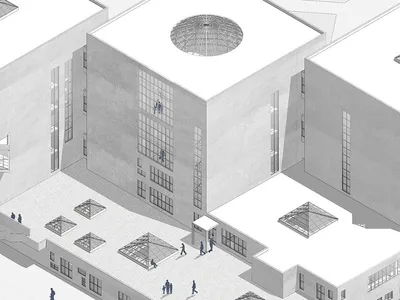
Scientific and Educational Monitoring Center of the Yenisei, Krasnoyarsk
Architecture as an instrument for ecological research, education, and environmental awareness along Russia’s largest river.
Development of Andretta Artist’s Village, Palampur, Himachal Pradesh, India
Reimagining Andretta as a living cultural landscape where art, architecture, and community converge to shape a global creative village.
Street Children Rehabilitation Center: A Model of Social Architecture for Community Rehabilitation
An inclusive social architecture project that transforms streets into nurturing environments, restoring dignity, identity, and opportunity for vulnerable children.


Comments (0)
Please login or sign up to add comments
No comments yet. Be the first to comment!