

Lifespring: A Recycled Water Loop Disguised as a Waterfront Park
Terraced wetlands and a tulip-inspired water cycle turn stormwater runoff into a publicly accessible ecological system along the waterfront.


What if every drop of stormwater that runs off a city street could be caught, cleaned, and returned to the landscape before it ever reached a drain? Lifespring proposes exactly that: a waterfront park designed around a fully closed recycled water loop. Stormwater and street runoff are collected, filtered through constructed wetlands and multiple levels of planted terraces, then reused on site. The entire hydrological process is made visible to visitors, turning infrastructure into interaction. The project's organizing metaphor is the life cycle of the tulip, a seasonal arc of growth and renewal that maps onto the water's continuous passage through the system.
Lifespring is a shortlisted entry in the Ripple competition on uni.xyz, designed by Pei Li. The project addresses urban water sustainability head-on, embedding filtration, biodiversity support, and public engagement into a single landscape system. Rather than hiding the mechanics of water management below grade, the design stages every phase of the cycle across terraced beds, flowering meadows, and interactive water features where visitors can observe, touch, and learn.
Water as Play: Making Filtration Tangible

The opening rendering shows children splashing through a linear water feature flanked by planted terraces and mature trees. It is a disarmingly simple scene, but the water underfoot is part of a larger filtration sequence. By routing cleaned stormwater through interactive channels at ground level, the design collapses the distance between ecological infrastructure and everyday park life. Visitors encounter the water cycle not through signage but through direct physical contact, an approach that makes Lifespring function as both public space and educational tool.
Terraced Wetlands Meeting the Waterfront Edge
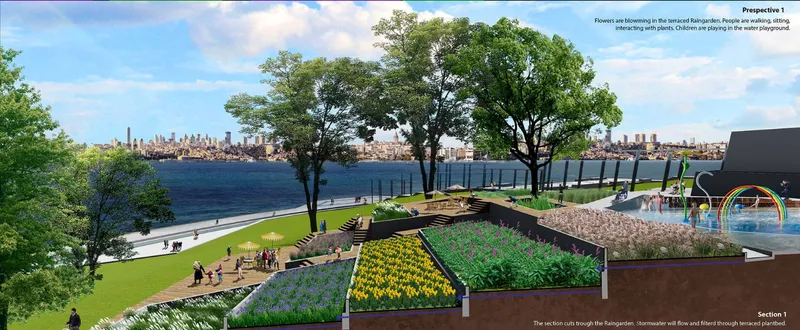
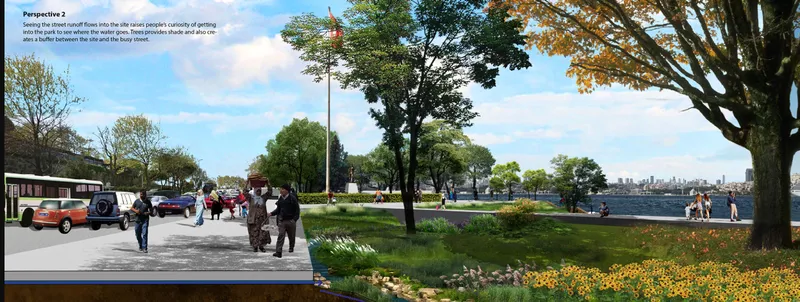
A section drawing reveals how the park steps down through terraced planted beds toward a waterfront edge, with a distant cityscape providing urban context. Each terrace serves a purpose in the filtration chain: vegetation layers absorb pollutants, slow runoff velocity, and support biodiversity in constructed wetland conditions. The rendering of the waterfront park in bloom reinforces this reading. Flowering meadows and mature trees frame views to the water, softening the transition between urban hardscape and the ecological systems that do the real work beneath the surface. The layered planting strategy is not decorative; it is the engine of the recycled water loop.
Looping Paths and the Tulip Metaphor
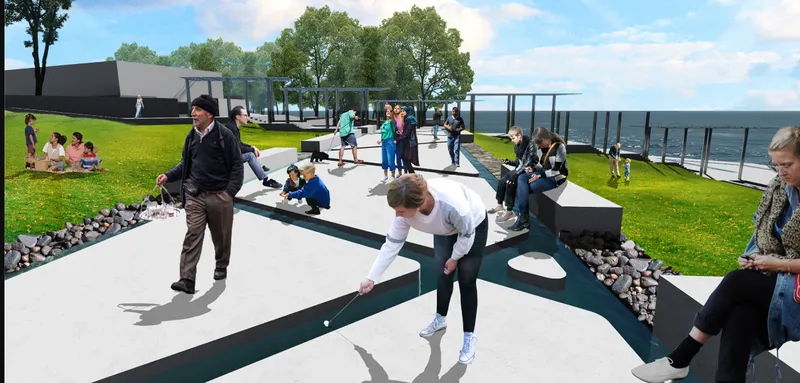
A white looping pathway traces a continuous route across grassy lawns beside the water, its curving geometry echoing the cyclical logic of both the tulip's life cycle and the water loop itself. Pedestrians move through the park along this path without encountering dead ends, reinforcing the idea of a self-sustaining cycle. The circulation design does double duty: it organizes public movement while keeping visitors in close proximity to different stages of the water filtration process. The result is a walk that is simultaneously recreational and didactic, though it never feels like a lesson.
Canopy Structure as Civic Landmark
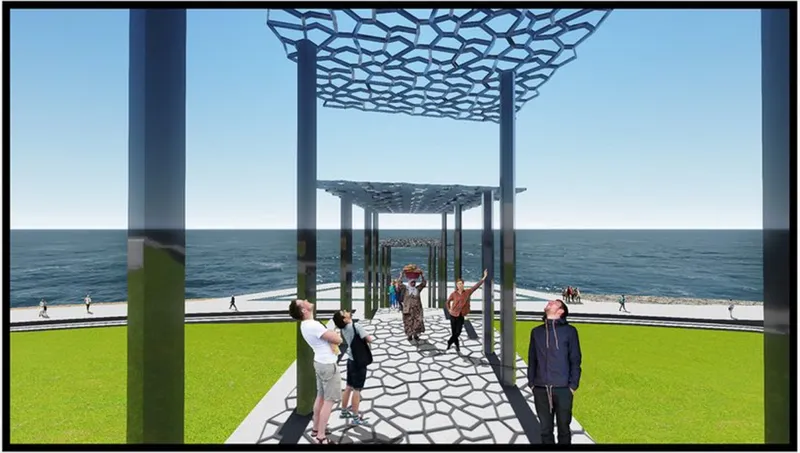
A covered pavilion with an organic patterned canopy supported by slender columns gives the park a vertical marker and a gathering point. Its perforated roof filters light in a way that recalls the dappled shade of a tree canopy, blurring the line between built structure and natural systems. Positioned overlooking the waterfront, the pavilion offers a shaded vantage point from which visitors can take in the full extent of the terraced landscape and its water features. It anchors the park's public program without competing with the ecological systems that define the site.
Reading the System: Plans and Sections
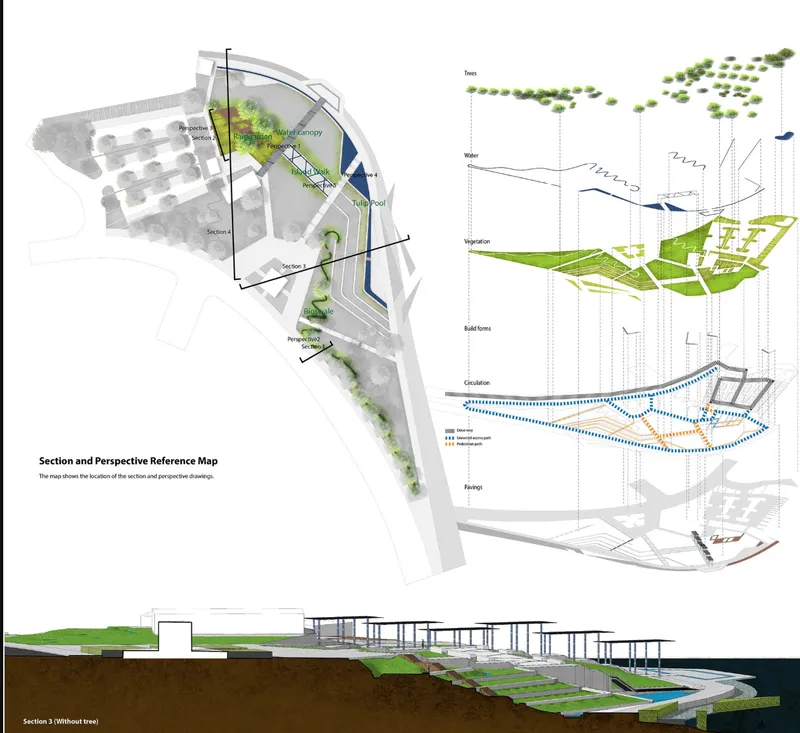
The plan and section drawings lay bare the logic of Lifespring's terraced landscape. Water circulation routes are traced from collection points through successive vegetation layers and constructed wetlands before returning to the loop. The drawings make legible what the renderings suggest: that every planted bed, every grade change, and every channel plays a specific role in the closed hydrological system. This level of integration between landscape form and water management function is what elevates the project beyond a conventional green infrastructure proposal.
Why This Project Matters
Lifespring takes the increasingly familiar language of green infrastructure and pushes it toward something more ambitious: a public park where the ecological processes are not hidden or relegated to engineered subsurface systems but staged as the primary experience. The multiple levels of filtration, the constructed wetlands, the interactive water features are all visible, all accessible. This transparency is the project's strongest move, because it turns a technical water management strategy into a civic amenity that people actually want to spend time in.
Pei Li's design demonstrates that water conservation does not need to be an invisible act of engineering. By organizing the entire park around a recycled water loop and making every stage of that loop publicly legible, Lifespring argues that the most effective urban sustainability strategies are the ones people can see, touch, and understand. In a competition focused on water's potential to shape space, this entry makes a convincing case that infrastructure and delight are not mutually exclusive.
View the Full Project
About the Designers
Designer: Pei Li
Enter a Design Competition on uni.xyz
uni.xyz runs architecture and design competitions year-round that reward proposals with spatial conviction and real site intelligence.
Project credits: Lifespring by Pei Li Ripple (uni.xyz).


Popular Articles
Popular articles from the community


LT2A and OPEN Architectes Thread a Brick and Glass High School Through a Wooded Belgian Campus
In Braine-l'Alleud, a 3,000 m² wing for Collège Cardinal Mercier pairs pale brick with a glazed colonnade, deferring to a small chapel and a dense wood.

Jaramillo Van Sluys Arquitectura and Urbanismo Turn a Demolished Registry Lot in Quito into an Orchard Plaza
In Quito's Centro Histórico, a 2,800 m² plaza exposes the San Agustín convent wall and redraws its lost Augustinian orchard in volcanic stone.

David Macias Steps a Doorless Stone and Plaster House Down a Tropical Colombian Hillside
In the humid hills of Colombia, Threshold House replaces the front door with an open void and terraces its 850 m² down the slope instead of fighting it.

longwave studio Reorganizes a 112 m² Tainan Apartment Around the Daily Routines of a Family and Two Cats
In Tainan, Taiwan, birch plywood, rust-red furniture and a freestanding plaster wall link arrival, storage, work and family life in one apartment.

Similar Reads
You might also enjoy these articles

Gil Mello Arquitetura Tilts a Single Roof Toward the Waterfalls on a Plateau Above Aiuruoca, Brazil
In Aiuruoca, Minas Gerais, a 200 m² house of local labor and reclaimed poles pairs a low valley veranda with a tall mountain one.

U.GA Architects Wraps an Oval Rooftop Pool in Curved Board-Formed Concrete on Busan's Jeollidan-gil
In Busan's Jeonpo-dong, a 454 m² mixed-use block stacks a neighborhood facility, guest rooms and an oval rooftop pool inside spiraling concrete walls.

Felipe Hess Arquitetos Turns a Blind Stone Wall to the Street and Opens a Brazilian House onto a Courtyard and Canal
A canal-front house in Brazil hides behind painted stone and planting, then opens to an olive-tree courtyard, a reed-ceilinged porch and a curving pool.
David Macias Steps a Doorless Stone and Plaster House Down a Tropical Colombian Hillside
In the humid hills of Colombia, Threshold House replaces the front door with an open void and terraces its 850 m² down the slope instead of fighting it.


Comments (0)
Please login or sign up to add comments
No comments yet. Be the first to comment!