

Young Architects Perch a Pavilion Treehouse on a Steep New Zealand Coastline
A 163-square-meter bach house fragments its mass into timber and concrete pavilions above the golden sands of Ligar Bay.


The New Zealand bach, that modest coastal holiday shack, has been quietly reinventing itself for decades. Young Architects pushes the typology further at Ligar Bay on the upper South Island, where a 163-square-meter retreat climbs a steep, geologically unstable hillside as a sequence of linked pavilions rather than a single house. The result sits somewhere between a jungle treehouse and a high-end campground, with separate sleeping pods connected by open walkways that make every trip to the kitchen feel like a walk through the bush.
What makes the project worth studying is the discipline of its fragmentation. Breaking a small house into multiple volumes on a difficult slope is a risky move: it multiplies foundations, increases envelope area, and complicates circulation. Lead architect Greg Young justifies the strategy by turning each of those liabilities into an asset. More envelope means more glass and more cross-ventilation. Multiple foundations allow each pavilion to step with the terrain instead of fighting it. And the exposed walkways between volumes deliver the very experience of wandering through a canopy that defines the project's identity.
Stacked Into the Hillside
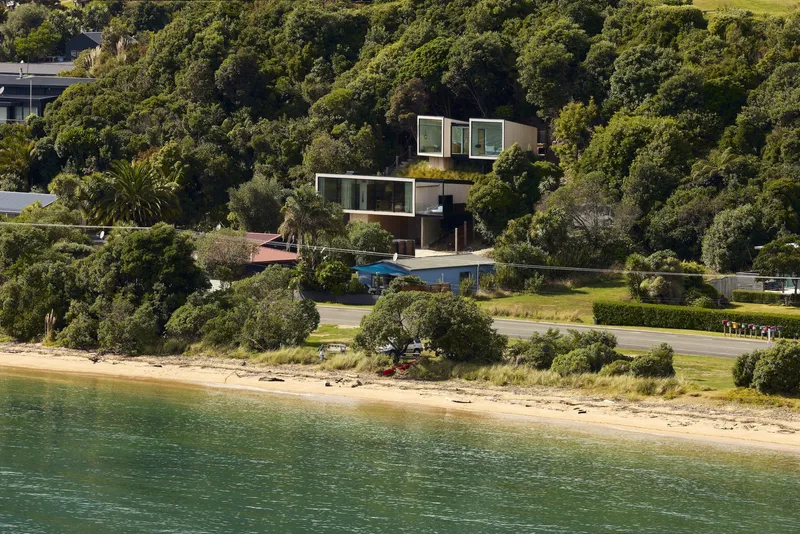
Seen from the water, the house reads as a series of stacked timber and concrete volumes threaded into the native bush. The vertical Abodo cladding, a thermally modified timber that will silver over time, already recalls the grey bark of surrounding trees. Upper modules cantilever past lower ones, punching out toward the bay while keeping most of the building's footprint tucked against the slope. The effect is of a building that is growing out of the hillside rather than sitting on top of it.
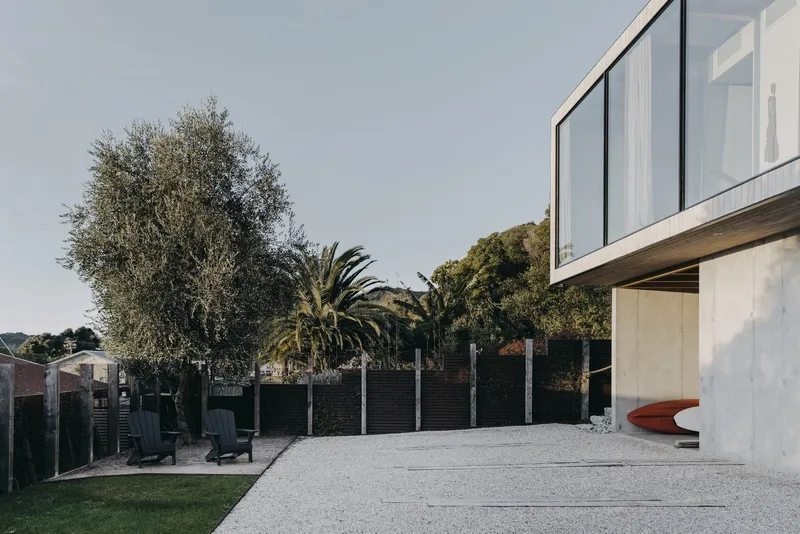
From the gravel drive, the cantilevered upper volume announces the building's ambition without overwhelming it. Glass walls set within custom steel frames recessed into the envelope dissolve the corners, so the mass that felt solid from the shoreline reads as transparent from the entry. It is a smart trick: the house presents shelter to the sea and openness to its occupants.
Living Under Macrocarpa
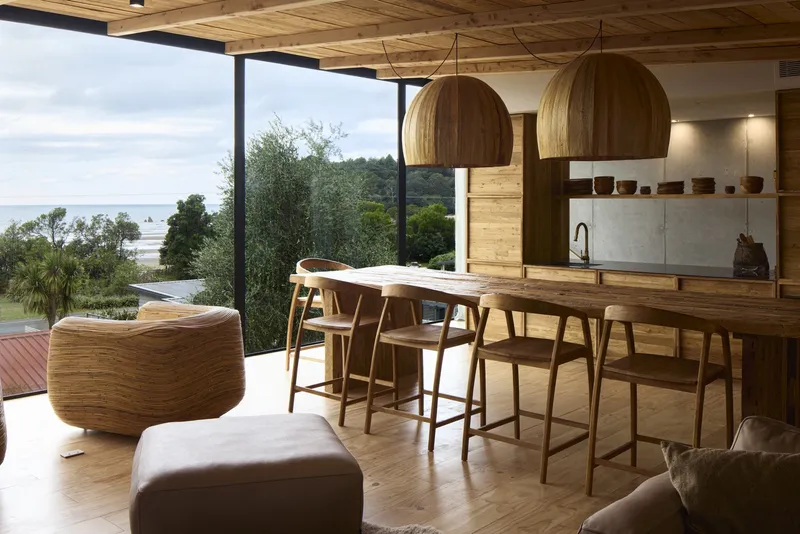

Inside the main living pavilion, the macrocarpa ceiling becomes the dominant material. Its warm grain runs continuously across the open kitchen and dining area, pulling the eye out through floor-to-ceiling glazing toward the coastal vegetation beyond. Plywood floors keep the palette honest and light, while exposed concrete walls provide both thermal mass and visual weight. There is no plasterboard in sight. Every surface does structural or environmental work, or both.
The concrete wall dividing the bedroom from the stair demonstrates the project's commitment to raw material honesty. A slender brass handrail is the only applied element; the rest is poured Golden Bay cement, a low-carbon product sourced locally. The timber ceiling overhead and the polished concrete below establish a material rhythm that repeats across every pavilion: warm above, cool below, glass at the edges.
Outdoor Rooms and the Canopy Deck

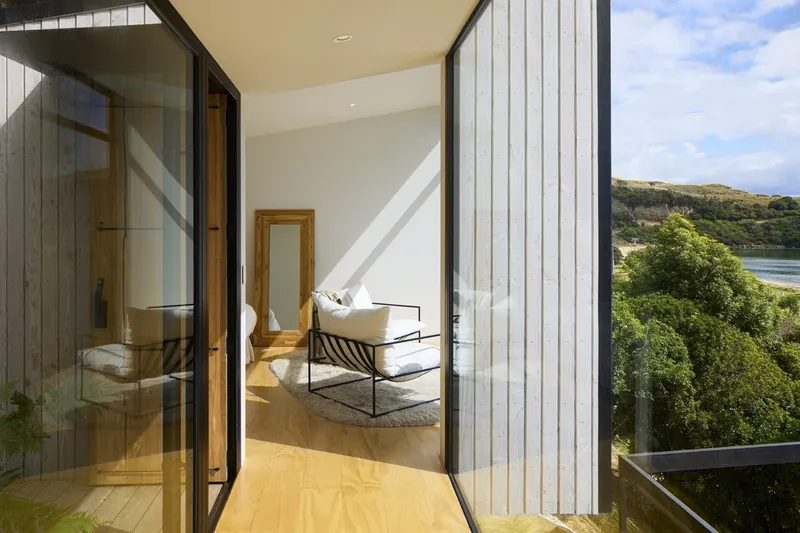

The outdoor spaces are as carefully considered as the interiors. A timber deck with a circular daybed sits beneath a cantilevered pergola, framing the planted hillside like a stage set. This is the campground analogy made literal: you are sleeping outside, but the architecture shields you from wind and direct sun. Higher up, an upper-level balcony clad in vertical metal panels provides a second vantage point, this time with a panoramic sweep of the bay and the vegetated slopes beyond.
Between the pavilions, a timber-clad courtyard planted with ferns captures a fragment of ocean view through a gap in the metal roof. It is a transitional space that slows circulation, forces a pause, and reconnects occupants with the bush. These in-between moments are the real architecture of the project. The rooms are simple; the movement between them is where the experience lives.
Passive Strategies That Earn Their Keep

Young Architects dedicated serious attention to mitigating thermal bridging across the custom steel frames, and the payoff is a house that demands very little mechanical heating. Low-carbon concrete walls absorb solar energy during the day and radiate it back at night, working as passive thermal batteries. Operable skylights positioned at the highest points of each pavilion function as natural chimney vents, pulling warm air upward and out while cooler air enters through the open walls below.
Pivoting walls off the main downstairs living area convert the interior into a breezeway on warm days, a strategy that works precisely because the house is fragmented. Wind passing through the narrow gaps between pavilions accelerates, driving cross-ventilation through the living spaces without any mechanical assistance. The steep site, so often cited as a constraint, turns out to be the engine of the cooling strategy.
The Bathing Pavilion
The bathroom deserves its own moment. A sunken tub finished in polished plaster sits at the corner of the volume, flanked by two glass walls that open directly onto the hillside landscape and a sliver of distant water. There is no frame visible at the glass corner joint, so the eye reads an unbroken panorama. Interior design by We Wabi keeps the palette minimal: concrete, timber, and plaster, with Indonesian hardwood joinery providing the only dark accent.
It is a room designed for one activity and one view, and it commits fully to both. The absence of clutter is not minimalism for its own sake; it is the logical result of a material strategy that leaves every surface exposed. When the walls are concrete and the ceiling is macrocarpa, there is nothing to hide.
Why This Project Matters
The Ligar Bay Bach House argues that breaking a small house into pieces can make it both more sustainable and more experiential. Fragmentation increases the building's surface-to-volume ratio, which in conventional energy calculations is a liability. Here, it becomes the mechanism for passive ventilation, daylight penetration, and a heightened sense of moving through landscape. Every environmental strategy, from the chimney-vent skylights to the pivoting breezeway walls, depends on the pavilion plan. Form and performance are genuinely inseparable.
It also offers a model for building on sensitive coastal sites without bulldozing them into submission. The steep, historically significant terrain at Ligar Bay, which carries evidence of pre-European occupation, is treated as a collaborator rather than an obstacle. Native landscaping by New Vision Landscapes will continue to knit the building into its context as the bush matures and the Abodo cladding silvers. In a decade, the house will be harder to spot from the water than it is today. That kind of patience, designing for a future you will not photograph, is the most convincing form of sustainability there is.
Ligar Bay Bach House by Young Architects (Lead Architect: Greg Young, ANZIA), with interior design by We Wabi and landscape design by New Vision Landscapes. Ligar Bay, New Zealand. 163 m². Completed 2023. Photography by Jason Mann Photography.
About the Studio
Share Your Own Work on uni.xyz
If projects like this are the kind of work you want to make, uni.xyz is a place to publish your own, find collaborators, and enter design competitions.


Popular Articles
Popular articles from the community


Cube Design Draws an Ecological Corridor Between Two Shenzhen Hills with the Nankai Building
Beside Shenzhen's container docks, the Nankai Building pairs stacked balconies with a climbing green screen to connect two hillsides across its height.

GROUP A Strips a 1969 Rotterdam Harbor Headquarters to Its Frame and Wraps It in Timber Louvers
In Rotterdam's M4H harbor district, Ferro Offices reuses a 1969 frame, adds one timber storey and reaches BREEAM-NL Outstanding.

LT2A and OPEN Architectes Thread a Brick and Glass High School Through a Wooded Belgian Campus
In Braine-l'Alleud, a 3,000 m² wing for Collège Cardinal Mercier pairs pale brick with a glazed colonnade, deferring to a small chapel and a dense wood.

U.GA Architects Wraps an Oval Rooftop Pool in Curved Board-Formed Concrete on Busan's Jeollidan-gil
In Busan's Jeonpo-dong, a 454 m² mixed-use block stacks a neighborhood facility, guest rooms and an oval rooftop pool inside spiraling concrete walls.

Similar Reads
You might also enjoy these articles


Hodi-Mandai Geram
Project Function: Preservation and revitalization of the Intangible heritage and socio-spatial identity of the Hodi by Housing, Cultural Memory Center, Sacred Grove, landscape, local tourism economy


Olio Towers: A Mid-Rise for Performers That Fuses Housing, Rehearsal, and Stage
Located blocks from Houston's Theater District, this modular tower stacks living units around a central performance atrium.

Oasis: Modular Green Housing Carved into Dhaka's Urban Fabric
A shortlisted Plugin Housing entry reclaims unauthorized settlements in Dhaka with stepped concrete volumes, green roofs, and ventilation-driven design.

Black Hole: A Floating Megastructure for the Post-Physical Era
Emiliano Mazzarotto envisions a spherical, self-scaling arena where e-sports, digital hotels, and holographic stadiums replace traditional public space.

Explore Living with Nature Competitions
Discover active competitions in this discipline

Challenge to reimagine the Iron Throne

Photograph architecture without architects

Illustrate the lost glory of Angkor Wat - Render Challenge

Design challenge to reuse E-waste
Comments (0)
Please login or sign up to add comments
No comments yet. Be the first to comment!