

Archer + Braun Wraps a Grade-Listed Edinburgh Villa in a Portland Stone Pavilion
A fossilized limestone extension and timber courtyard bring Californian openness to a Victorian conservation area in central Edinburgh.


Buying a flat in a Victorian villa and converting it into a five-bedroom family home is ambitious enough. Discovering, mid-design, that the building has just been granted Grade C listed status turns ambition into a high-wire act. That is the situation Archer + Braun inherited with Limestone House, a project in an Edinburgh conservation area that demanded total fluency in heritage regulation and an equally sure hand with contemporary construction. What they delivered is a single-storey pavilion clad in Portland stone, a fossilized limestone whose silver-grey tone and embedded shell markings distinguish it from the buff sandstone that blankets most of the city's Georgian and Victorian streetscapes.
The genuinely interesting move here is the refusal to touch the historic fabric in any heavy-handed way. Rather than grafting the new volume onto the old walls, the architects physically separated the two with a narrow timber-clad courtyard, a green corridor that acts as both a visual buffer and a light well. The extension then wraps around the rear of the property, its floor-to-ceiling glazing invoking the mid-century Californian Case Study House program. The result is a house that reads as two clearly legible episodes, Victorian formality at the front and glass-and-stone horizontality at the back, connected by a carefully choreographed sequence of steps, a study, and a library.
A Pavilion That Hovers Above the Garden


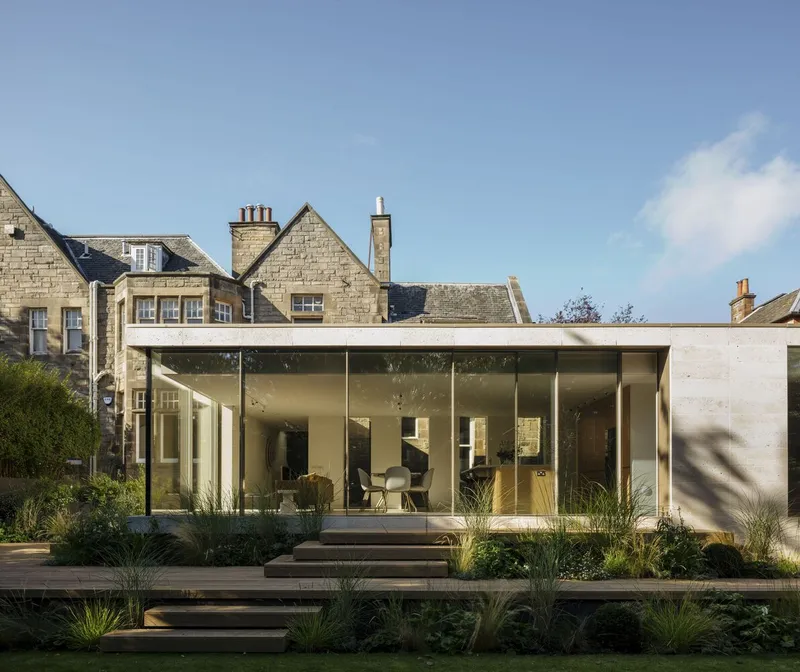
Edinburgh's rear gardens are rarely flat, and the sloping site behind the villa presented both a problem and an opportunity. Archer + Braun addressed the grade change with a series of stone terraces and timber-decked platforms, allowing the extension to partially cantilever over the descending terrain. The effect, especially in low afternoon light, is of a pale stone box hovering just above a carpet of ornamental grasses.
From the garden, the pavilion reads as an emphatically horizontal counterpoint to the gabled rooflines and chimney stacks of the original house. A sedum-planted roof, visible from the upper floors and in aerial views, softens the volume further, tucking it into the canopy of surrounding mature trees as though it has always been there.
The Green Corridor: Old and New Held Apart
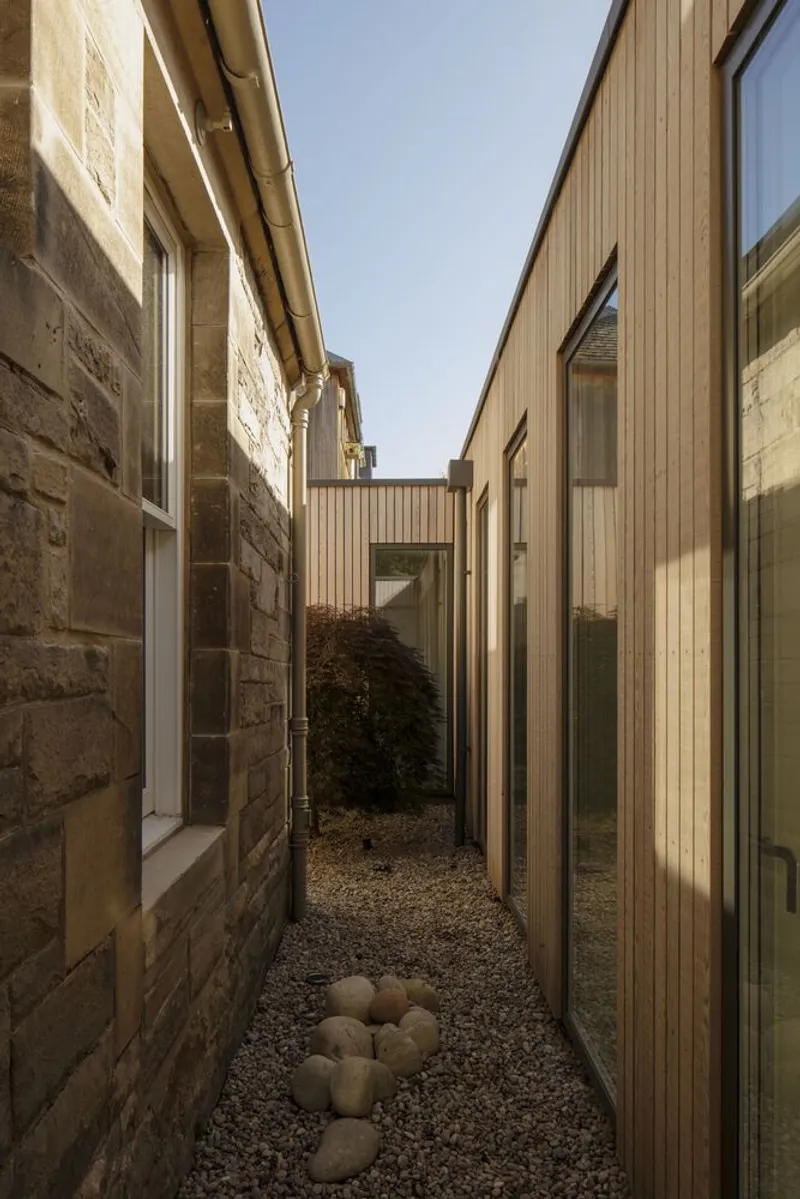


The narrow courtyard between the existing masonry wall and the new timber-clad volume is the project's conceptual hinge. Gravel underfoot, climbing plants overhead, and frameless glazing on the extension side give the corridor a cloistered quality. You are simultaneously aware of the rough-cut sandstone of the Victorian house and the precise vertical grain of the new timber cladding. The duality is deliberate: heritage regulations required the addition to be visually and structurally distinct from the listed building, and the courtyard accomplishes this while creating a genuinely atmospheric threshold.
Full-height glass panels along the courtyard ensure that the original stone walls remain visible from inside the extension's living spaces, a dual-aspect arrangement that turns the old fabric into a kind of living elevation, textured by weather and time, framed by the clean lines of the new build.
Fossilized Stone and Minimalist Detailing

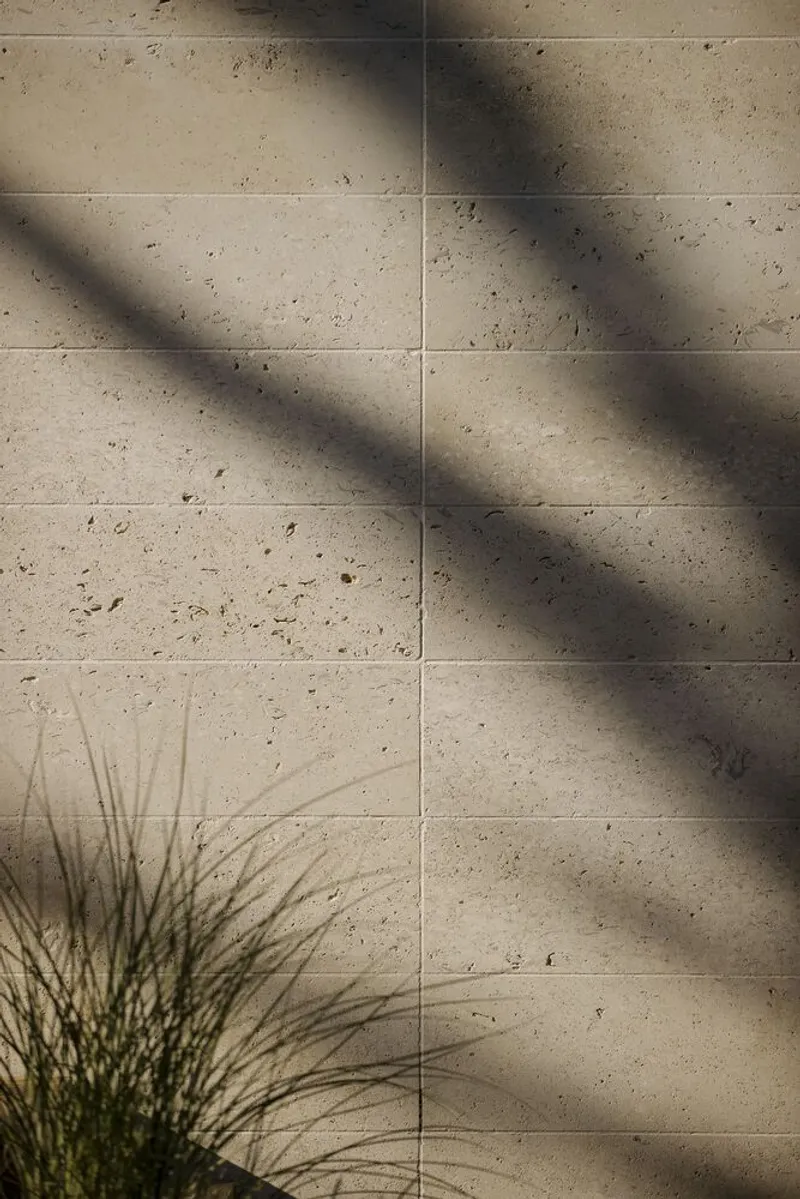
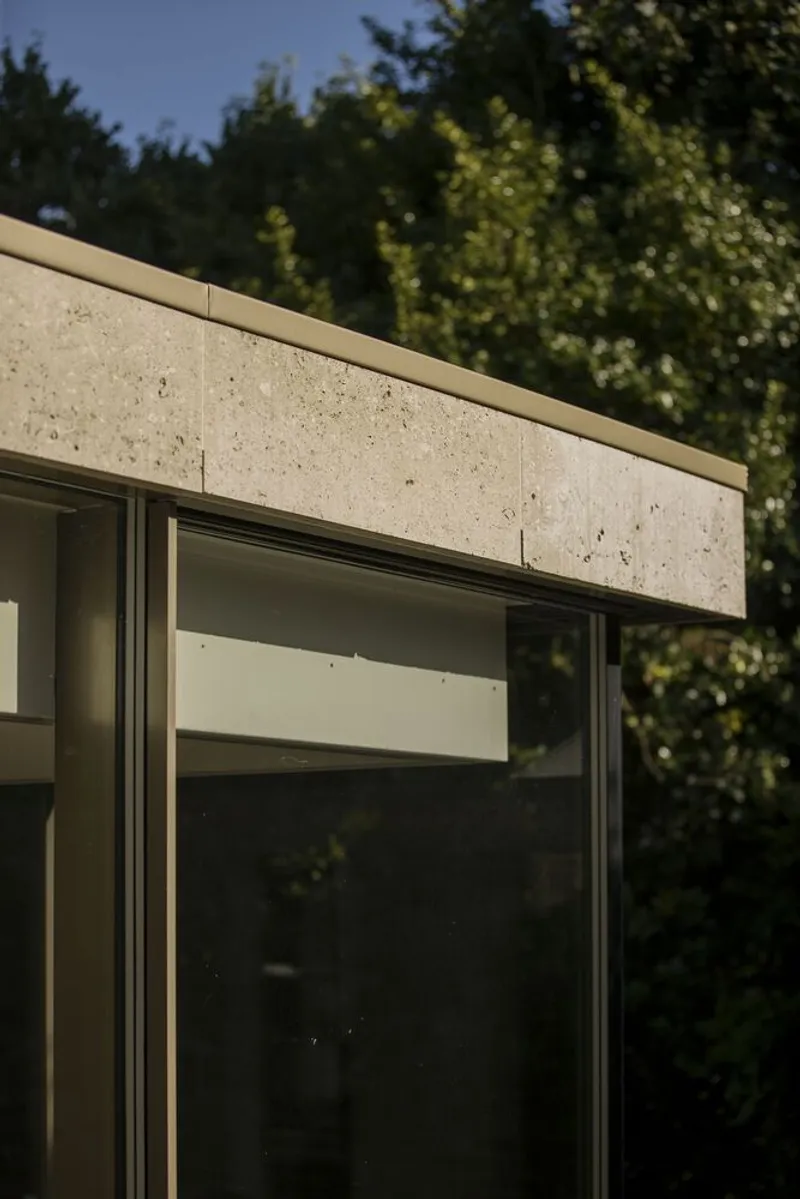
Portland stone is a loaded material in British architecture; it clads the Cenotaph, the British Museum, and half of Whitehall. Using it on a domestic extension in Edinburgh is a statement. The fossil inclusions visible in close-up give each panel a geological narrative that no engineered cladding could replicate. Archer + Braun mixed the same stone into the mortar between panels, producing a near-monolithic surface where joint lines recede and the texture of ancient shell beds takes over.
The decision to avoid Edinburgh's ubiquitous buff sandstone was partly pragmatic. Portland stone weathers well in Scotland's wet climate, developing a silver patina rather than the dark staining common on softer sandstones. But it is also a conceptual choice: the extension is not pretending to be part of the original house, and its material should announce that.
Glass, Light, and the Case Study Influence

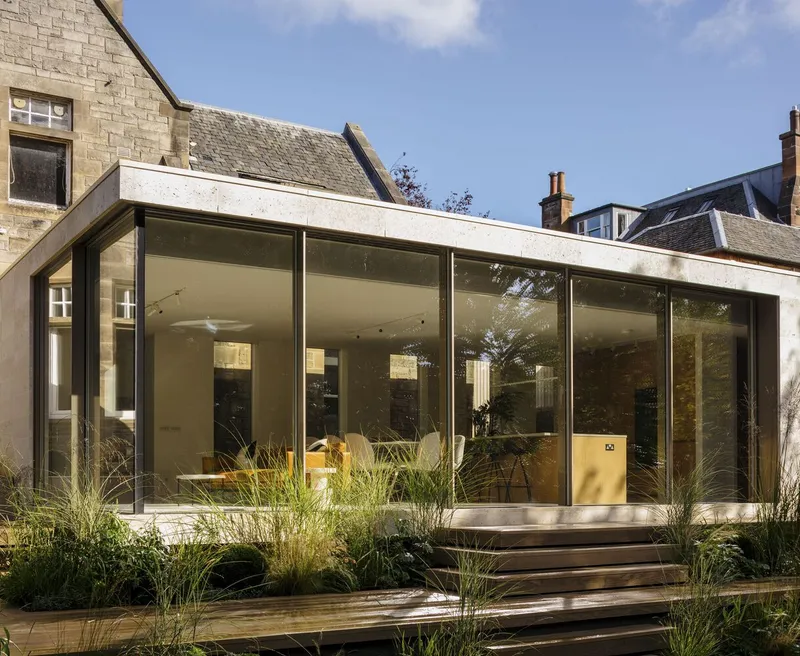

The Case Study House reference is more than stylistic pastiche. John Entenza's postwar program in Los Angeles championed the idea that architecture should dissolve the boundary between interior and landscape using off-the-shelf industrial materials. Archer + Braun apply the same principle in a very different climate: the extension's floor-to-ceiling glazing, concrete fascia beams, and flat roofline echo the vocabulary of Craig Ellwood or Pierre Koenig, transplanted to a city where daylight is precious and rain is constant.
What makes the translation work is the planted surroundings. Ornamental grasses press against the glass, and the terraced garden steps down into established trees. From inside, the effect is immersive and green, a far cry from the internal dimness of the original Victorian rooms.
Victorian Rooms, Quietly Restored
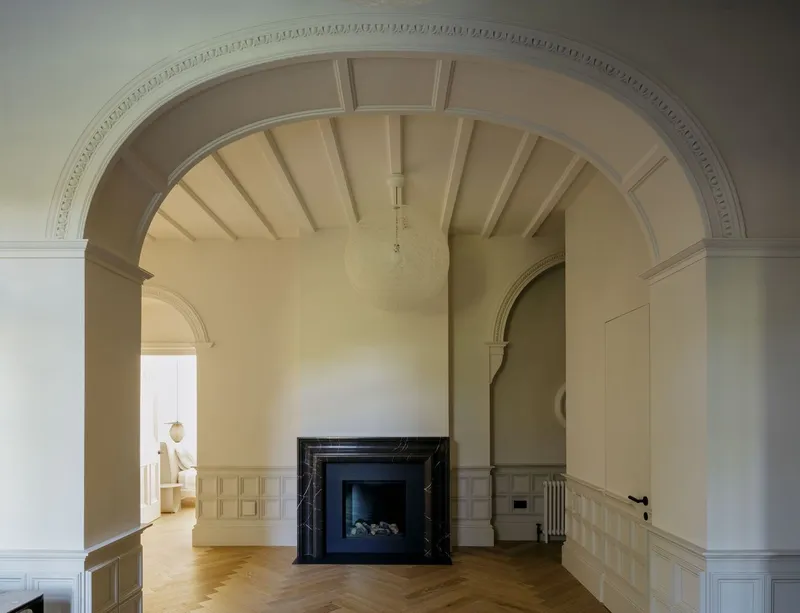
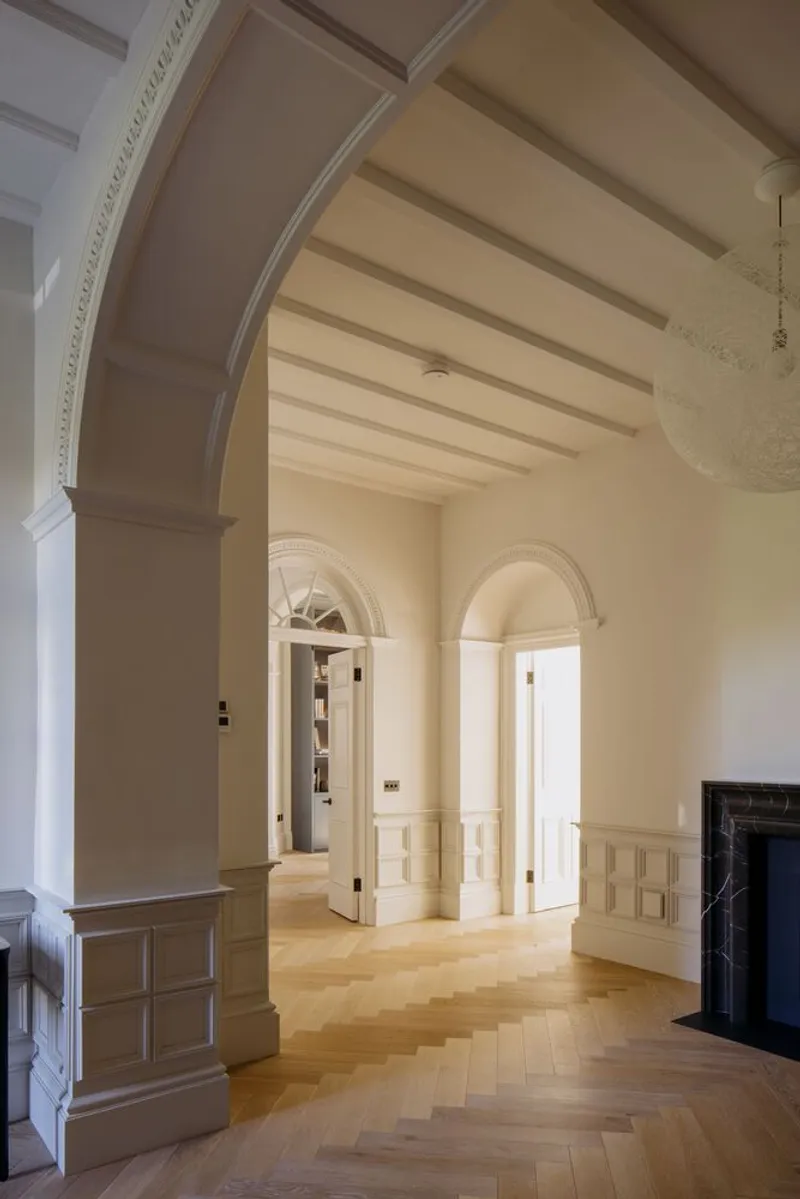
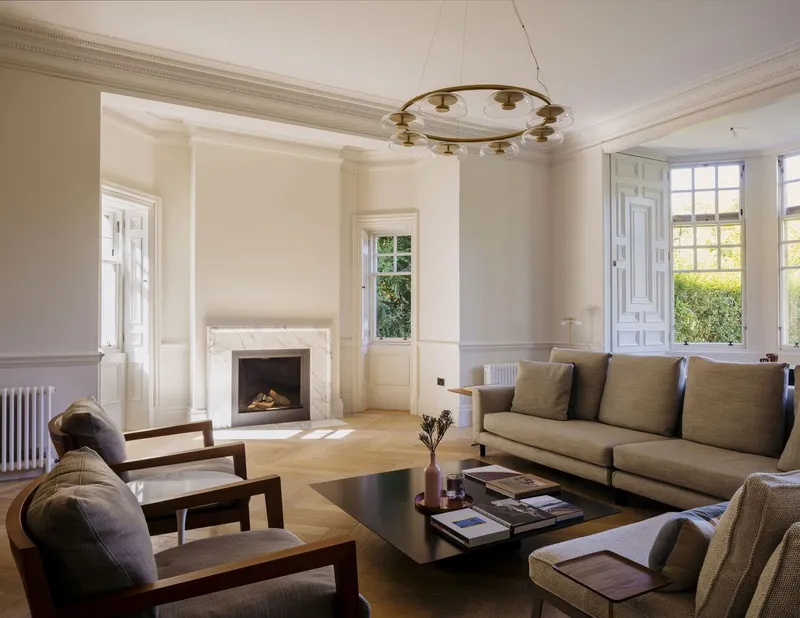
Inside the listed portion, Archer + Braun adopted a restrained palette of warm whites and soft plaster tones to let the original cornicing, panelled wainscoting, and arched doorways speak for themselves. The sequence of three arched openings with exposed ceiling beams and herringbone oak floors is a standout moment: no new element competes with the existing geometry, and the subtle shadows across raised mouldings provide all the ornament the rooms need.
The former kitchen and servants' quarters were reimagined as a snug, a domestic use that suits the scale and proportions of the original rooms. A study and library, fitted with black shelving and a rolling ladder, act as the connective tissue between old and new, guiding inhabitants down a gentle flight of stairs into the open-plan extension.
Kitchen and Living Spaces in the Extension


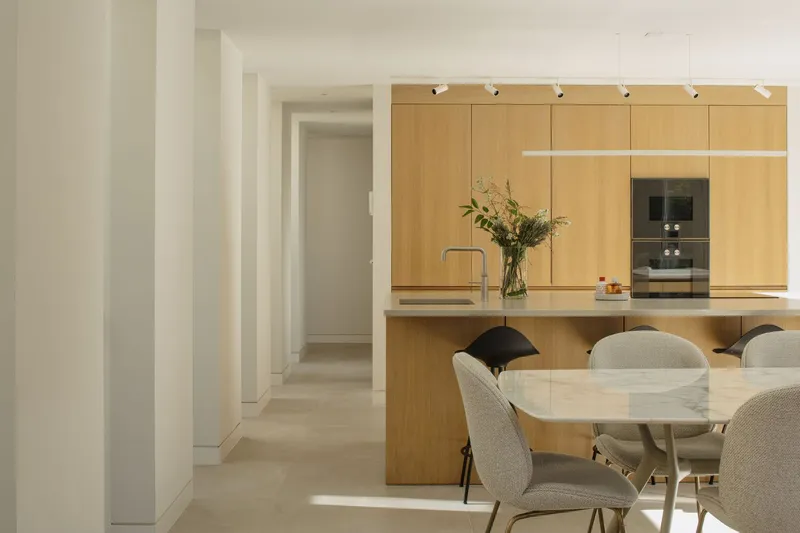
The open-plan kitchen, dining, and living area occupies the full length of the new pavilion. Oak millwork runs along one wall in a continuous band, housing integrated appliances behind vertical-grain veneer panels with recessed handles. A white stone countertop island anchors the kitchen zone, while a marble dining table marks the shift toward the living area. Track-mounted cylindrical lights provide even illumination without cluttering the clean ceiling plane.
What elevates the space beyond competent open-plan design is the view in both directions. On one side, floor-to-ceiling glass opens onto the terraced garden. On the other, narrower glazing frames the courtyard and, through it, the original sandstone wall of the Victorian house. You cook dinner looking at fossils on one side and a 150-year-old masonry wall on the other.
Bedrooms, Bathrooms, and Considered Details
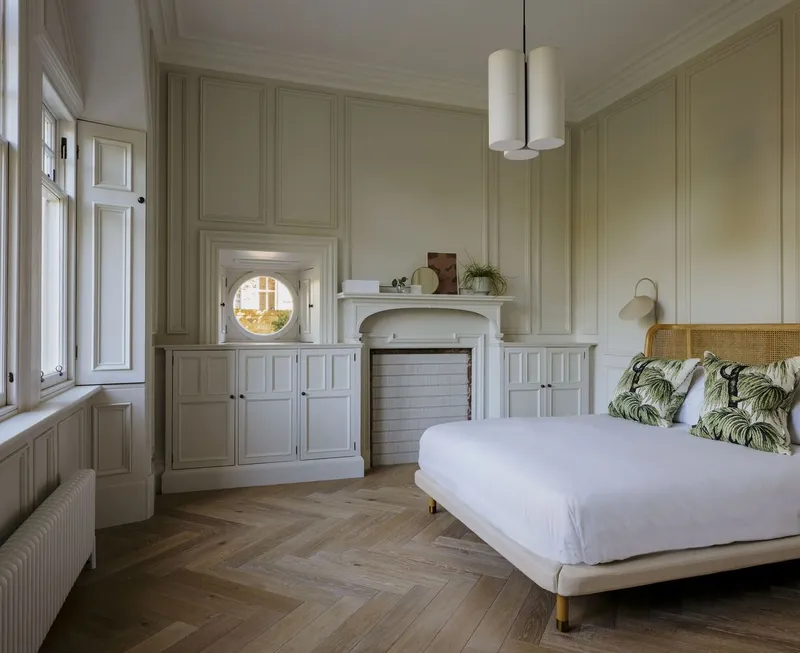

The bedrooms within the original villa retain their generous proportions and period features, including fireplaces, panelled wall cabinetry, and circular windows. New interventions are limited to carefully placed en-suite bathrooms and updated finishes. Herringbone oak flooring runs throughout, providing continuity between rooms that might otherwise feel disparate.
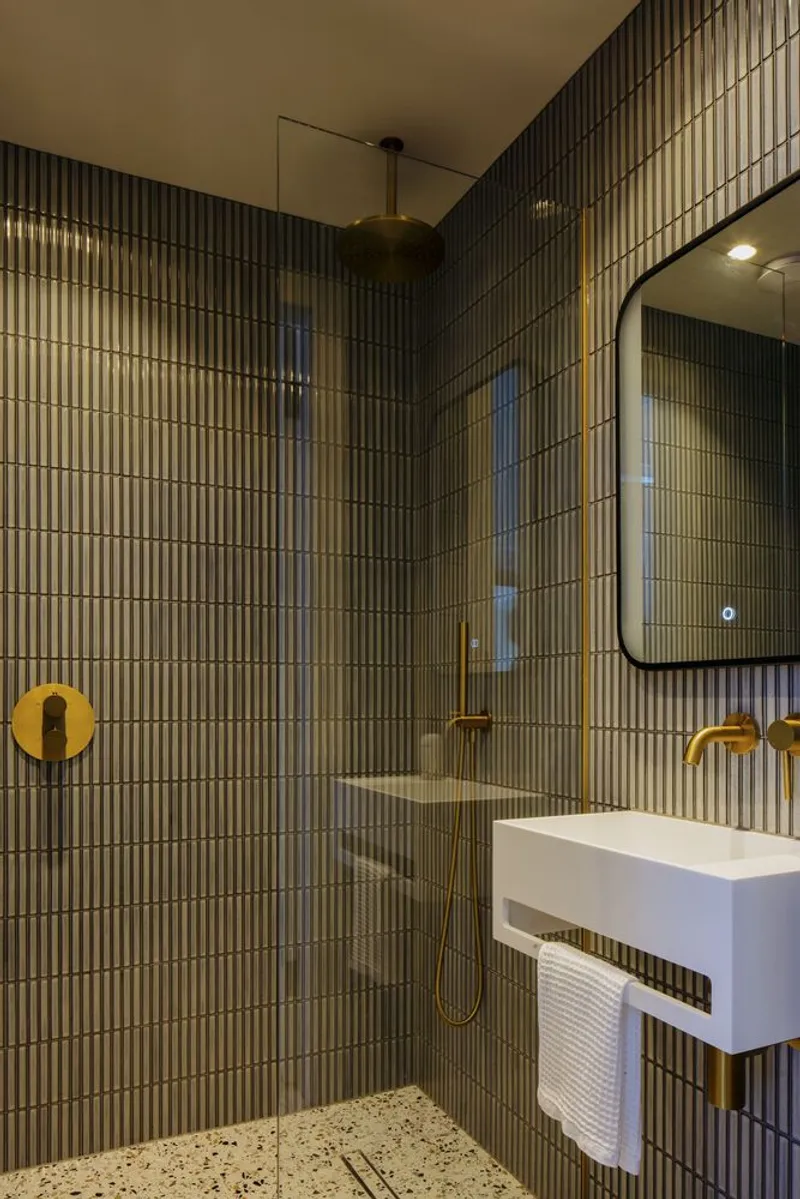
Bathroom detailing is where Archer + Braun's material confidence is most evident. Vertical fluted tiles, terrazzo floors, brass fixtures, and marble-clad walls appear across the house in varying combinations, each bathroom distinct yet part of a coherent family. A curved mosaic floor with alternating bands of grey, tan, and cream tiles at one threshold is a small flourish that rewards close attention.
Plans and Drawings
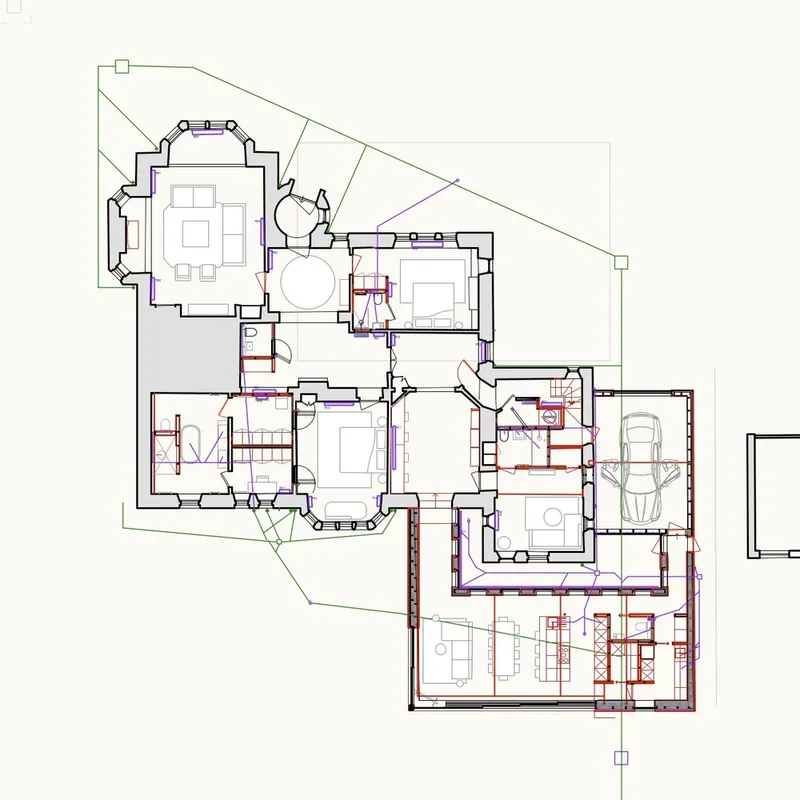
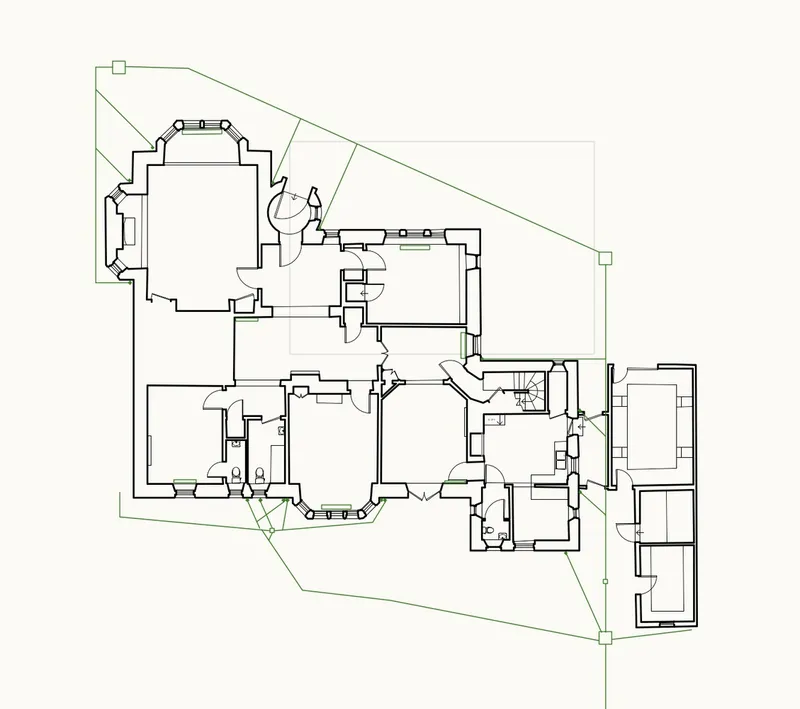
The floor plans reveal the full complexity of the scheme. The extension wraps around the rear in an L-shaped footprint, with the courtyard carving a deliberate gap between old and new. Circulation moves from the original villa's central hallway through the study and library, then steps down into the pavilion. At the front, the former garage has been replaced by a two-storey guest suite, adding usable area without altering the street-facing elevation. The plans also make legible the site's slope: ground levels shift significantly from front to back, and the terraced landscape strategy is clearly annotated.
Why This Project Matters
Limestone House matters because it demonstrates that working within heritage constraints does not require timidity. The listed status that arrived mid-design could have flattened the project into a cautious rear infill. Instead, Archer + Braun used the constraint as a design generator, producing a scheme whose most distinctive feature, the courtyard separation between old and new, exists precisely because of the regulatory requirement for physical detachment. The Portland stone cladding, the Case Study House glazing, and the sedum roof are all bold choices, but they succeed because they are structurally and visually independent of the Victorian villa.
In a city where conservation areas can feel hostile to contemporary architecture, the project offers a persuasive counter-argument. You can honour a listed building's character without mimicking its materials or proportions. You can introduce Californian spatial ambitions into a Scottish garden. You can clad a domestic extension in the same stone as the Cenotaph. What you cannot do, and what Archer + Braun wisely avoided, is pretend the two eras are the same. The gap between them is narrow, planted, and full of light. It is, arguably, the best room in the house.
Limestone House by Archer + Braun, Edinburgh, United Kingdom. Photography by Will Scott Photography.
About the Studio
Share Your Own Work on uni.xyz
If projects like this are the kind of work you want to make, uni.xyz is a place to publish your own, find collaborators, and enter design competitions.


Popular Articles
Popular articles from the community


GROUP A Strips a 1969 Rotterdam Harbor Headquarters to Its Frame and Wraps It in Timber Louvers
In Rotterdam's M4H harbor district, Ferro Offices reuses a 1969 frame, adds one timber storey and reaches BREEAM-NL Outstanding.

David Ortega Stacks a Two-Story Mexico City Penthouse Around a Steel Stair and a Pergola-Shaded Roof Terrace
In Colonia Roma, a 300 m² penthouse uses oak joinery, a planted steel stair and a slatted roof pergola to make a new-build apartment feel like a house.

Cube Design Draws an Ecological Corridor Between Two Shenzhen Hills with the Nankai Building
Beside Shenzhen's container docks, the Nankai Building pairs stacked balconies with a climbing green screen to connect two hillsides across its height.

LT2A and OPEN Architectes Thread a Brick and Glass High School Through a Wooded Belgian Campus
In Braine-l'Alleud, a 3,000 m² wing for Collège Cardinal Mercier pairs pale brick with a glazed colonnade, deferring to a small chapel and a dense wood.

Similar Reads
You might also enjoy these articles


Hodi-Mandai Geram
Project Function: Preservation and revitalization of the Intangible heritage and socio-spatial identity of the Hodi by Housing, Cultural Memory Center, Sacred Grove, landscape, local tourism economy


Olio Towers: A Mid-Rise for Performers That Fuses Housing, Rehearsal, and Stage
Located blocks from Houston's Theater District, this modular tower stacks living units around a central performance atrium.

Oasis: Modular Green Housing Carved into Dhaka's Urban Fabric
A shortlisted Plugin Housing entry reclaims unauthorized settlements in Dhaka with stepped concrete volumes, green roofs, and ventilation-driven design.

Black Hole: A Floating Megastructure for the Post-Physical Era
Emiliano Mazzarotto envisions a spherical, self-scaling arena where e-sports, digital hotels, and holographic stadiums replace traditional public space.

Explore Architecture Competitions
Discover active competitions in this discipline

Challenge to reimagine the Iron Throne

Photograph architecture without architects

Illustrate the lost glory of Angkor Wat - Render Challenge

Design challenge to reuse E-waste
Comments (0)
Please login or sign up to add comments
No comments yet. Be the first to comment!