
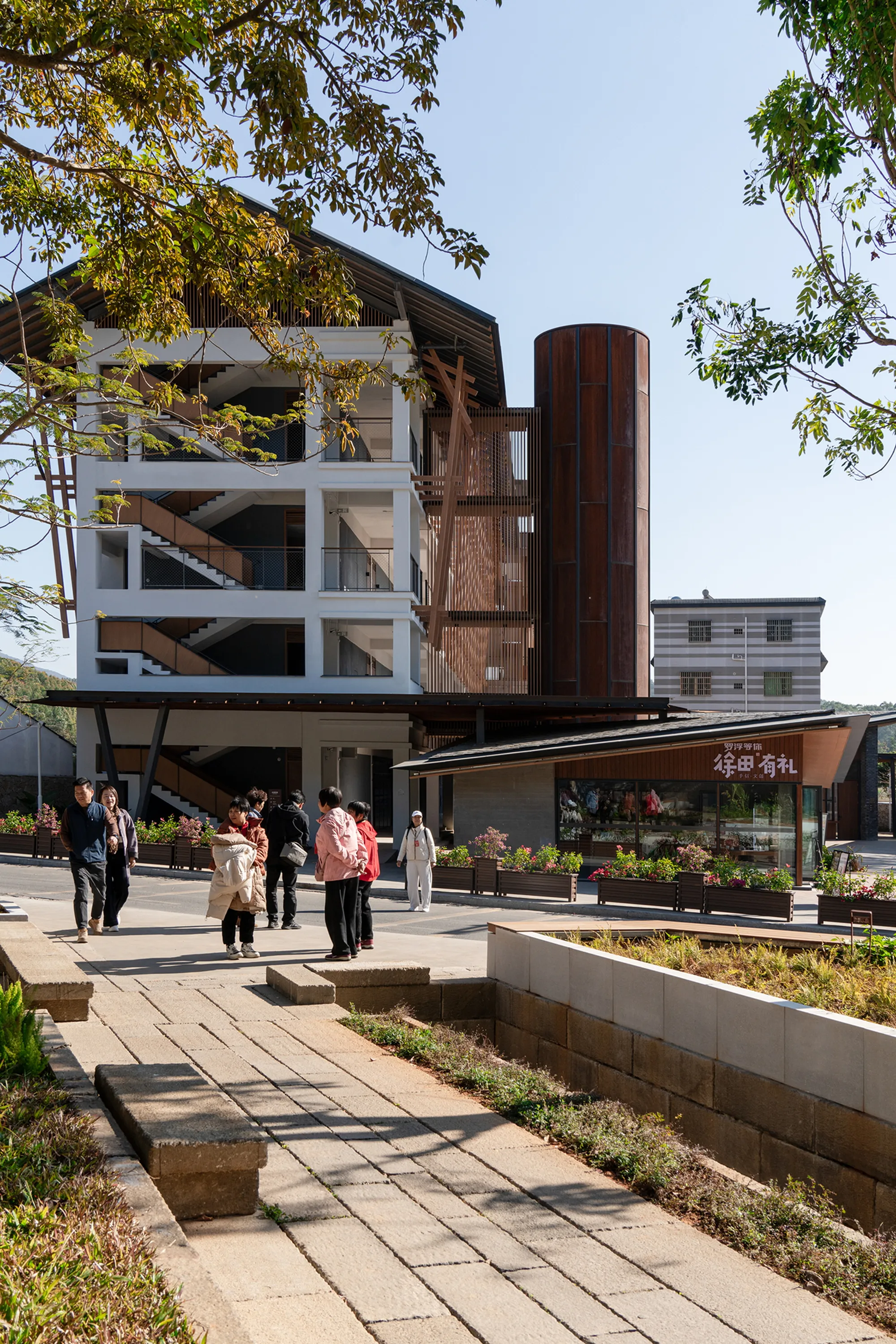
line+ studio Converts an Abandoned Village School into a Hakka Community Gateway in Huizhou
A 300-year-old Hakka settlement at the foot of Mount Luofu gains a concrete and timber civic heart where a primary school once stood.


Xutian is a 300-year-old Hakka village tucked against the southern foothills of Mount Luofu in Huizhou, Guangdong. It is the kind of place that provincial rural development pilots are designed to save: culturally rich, physically intact, and economically precarious. When line+ studio was tasked with designing a new community center on the site of an abandoned primary school, the fundamental question was not about style but about whether a single building could function as a social catalyst for an entire settlement.
The answer, completed in 2025 under lead architect Fanhao Meng, is a 3,358 square meter compound that reads less like a singular building and more like a condensed fragment of the village itself. A cluster of low pavilions gathers around courtyards and a preserved mature tree, anchored by a slender tower that marks the complex from a distance. The project does not attempt to mimic Hakka vernacular. Instead, it borrows its organizational logic: tight-knit volumes, shared outdoor rooms, hierarchies of public and semi-private space. The result is a civic building that feels like it belongs to the grain of Xutian rather than being imposed upon it.
A Village Skyline, Not a Landmark
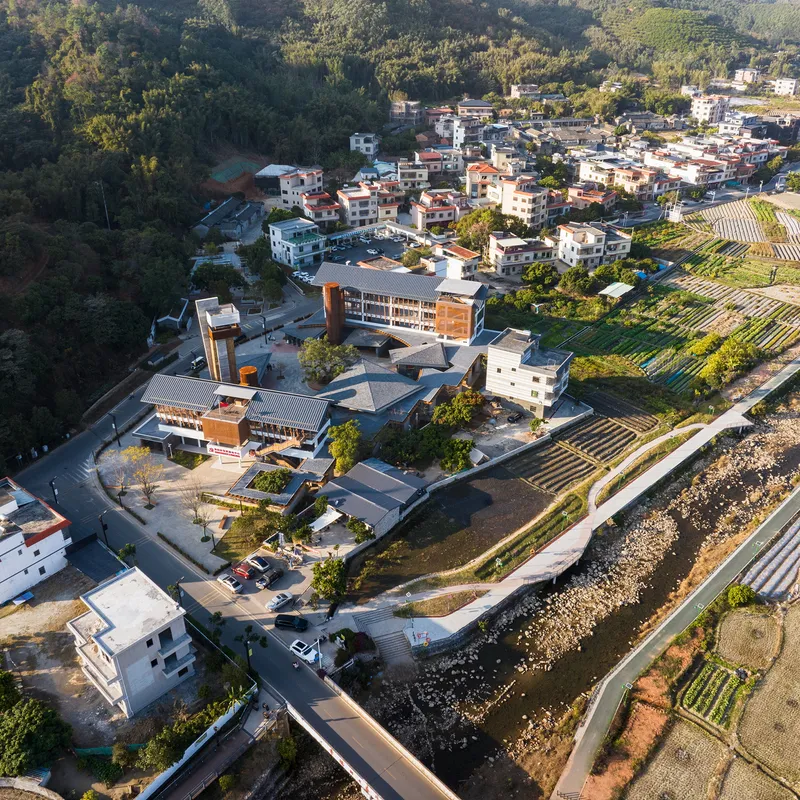
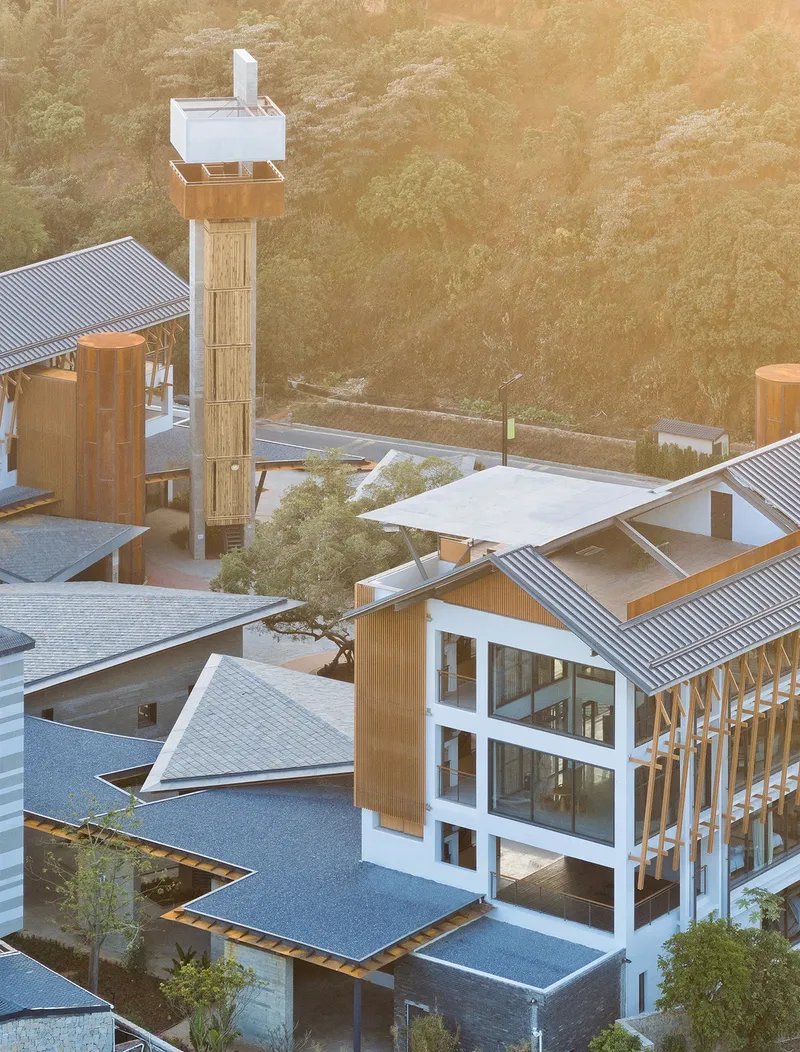
From the air, the community center dissolves into its surroundings. Corrugated metal and timber-clad roofs sit at roughly the same pitch and scale as the tiled village roofs around them. Only the tower, a compact vertical stack of concrete and timber, breaks the roofline. It works not as a grand gesture but as an orienting device, visible above the settlement fabric and the surrounding agricultural fields.
This restraint in height and massing is the project's smartest move. Rural community centers often announce themselves with an oversized roof or a single dramatic volume. Here, the compound's fragmented plan allows the building to participate in the village's existing rhythm of solid and void, built and grown. At golden hour, when the corrugated roofs catch the same light as the neighboring farms, the boundary between old and new nearly disappears.
The Tower as Vertical Anchor
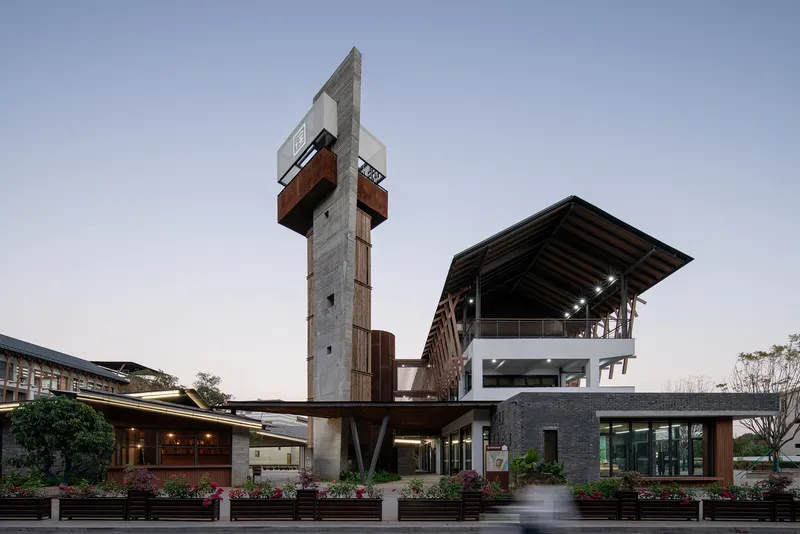
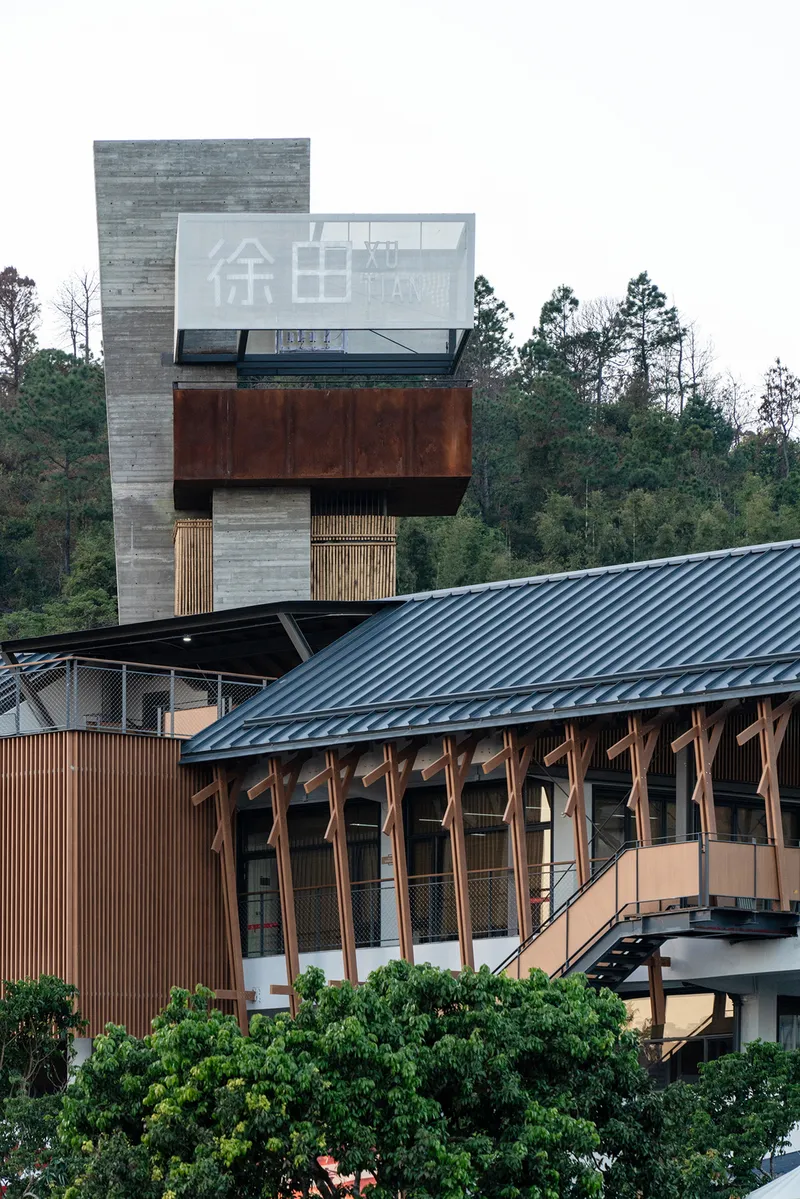
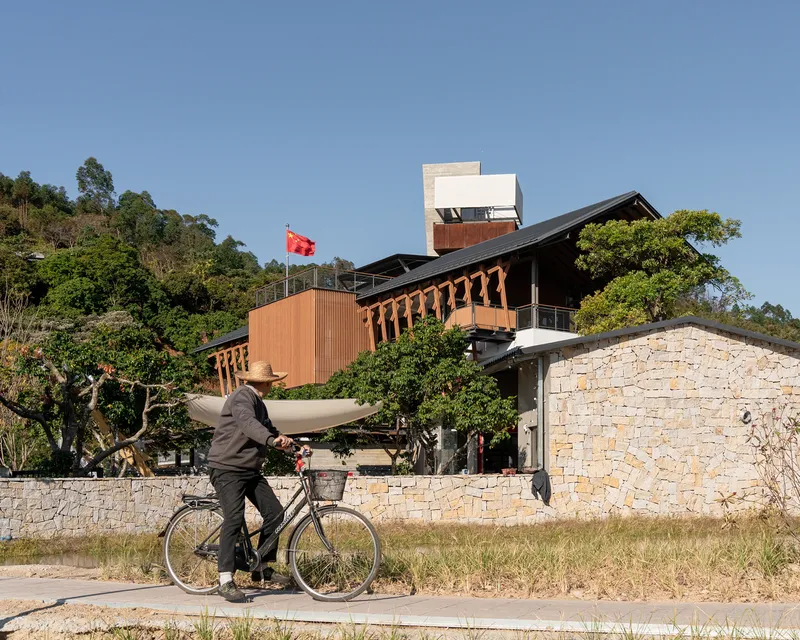
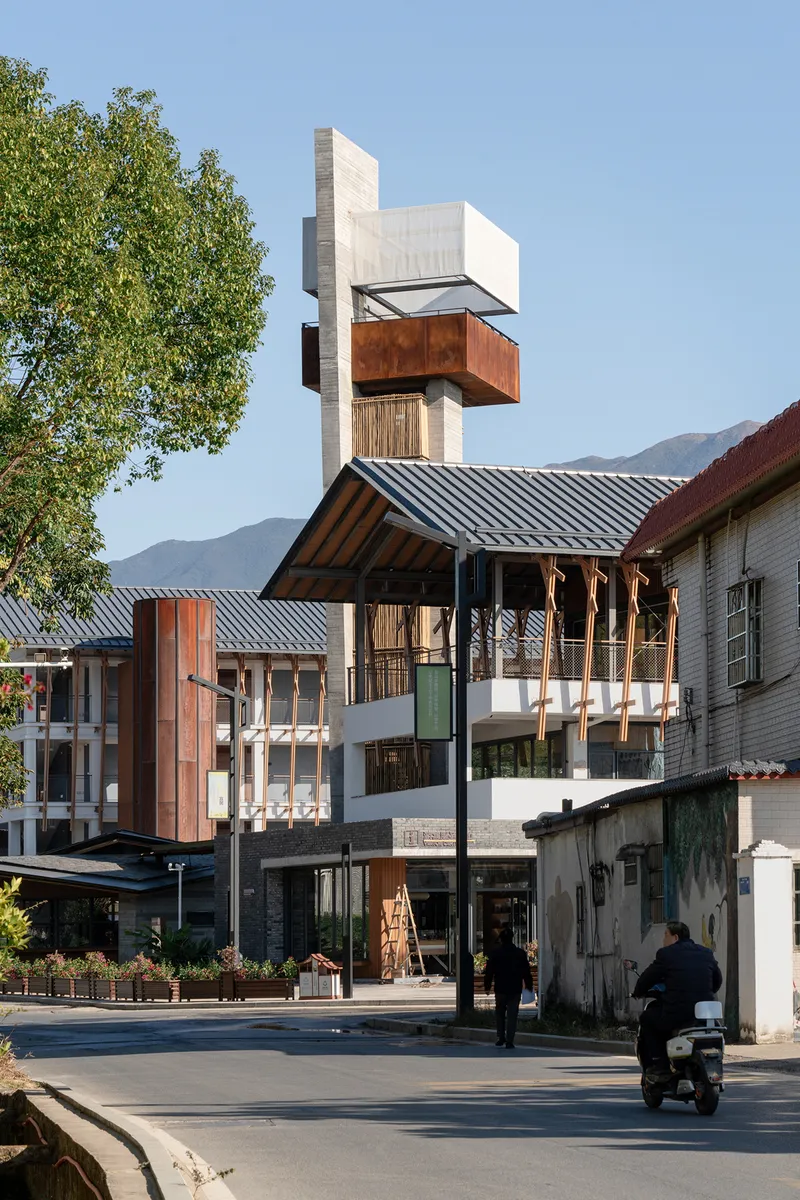
The tower is the one element that refuses to be polite. Board-formed concrete at its base gives way to cantilevered weathered steel volumes and timber-clad upper stories. It stacks materials the way a geological outcrop layers sediment: the heaviest at the bottom, the lightest at the top. Against the forested hillside, the weathered steel reads as a warm rust echo of the earth tones in the surrounding landscape.
From the street, a motorcyclist or cyclist passing by sees the tower rising above the village's traditional tiled roofs, a quiet signal that something public and new exists here. It is neither overbearing nor shy. That balance is difficult to achieve in a rural context, where any multi-story structure risks looking like an intrusion. The tower earns its height by offering something the village otherwise lacks: a vantage point, a marker, a sense of collective aspiration.
Courtyards Organized Around a Living Center
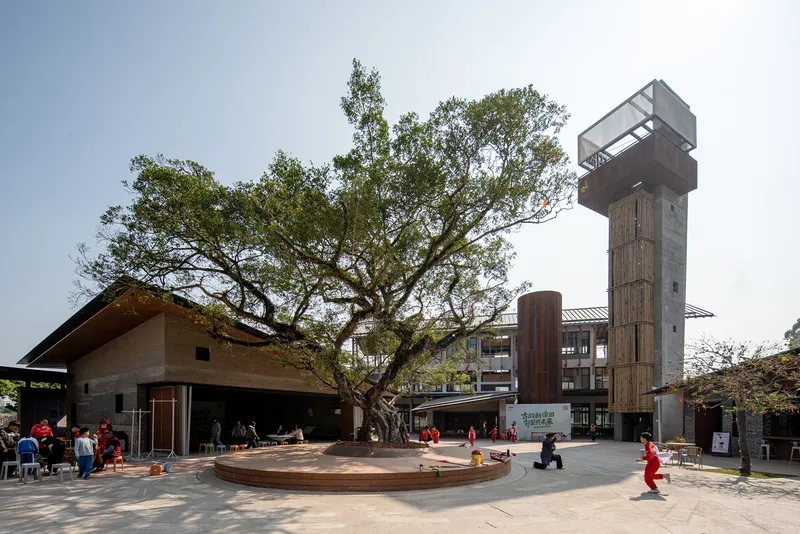
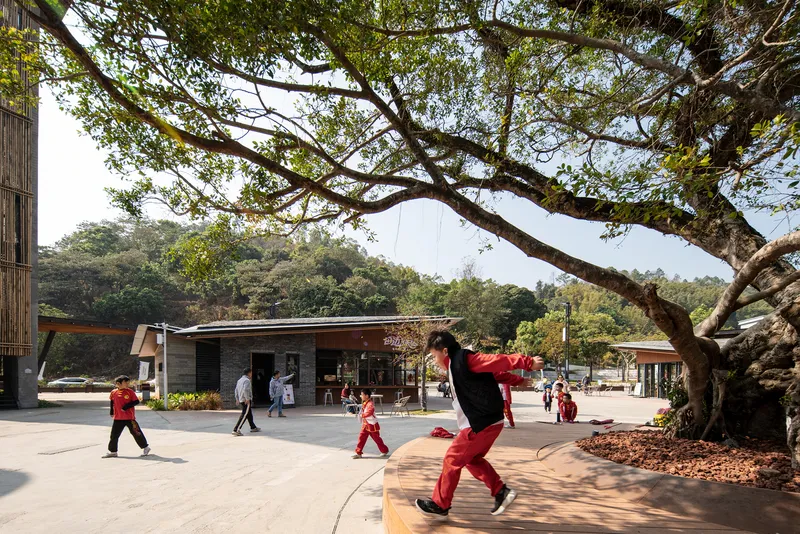
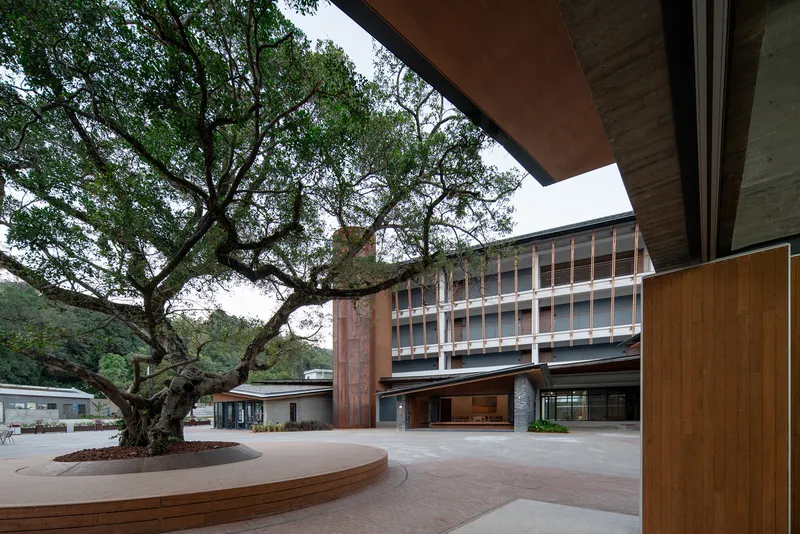
The preserved tree at the heart of the compound is not decorative. It is the organizational spine. A circular timber bench rings its trunk, and the surrounding pavilions orient their openings, window bands, and covered walkways toward it. Children play beneath its canopy. Community members sit on benches under its shade. The tree predates the building and will, with luck, outlast it. line+ studio wisely treats it as the site's most important existing structure.
The courtyards around the tree graduate from fully public to semi-sheltered. Timber-screened facades filter views between interior rooms and the outdoor gathering spaces, giving occupants the option of watching the courtyard life without being fully immersed in it. Horizontal window bands frame the tree from interior spaces, ensuring that even from deep within the building, the living center of the compound remains visible.
Material Honesty in a Rural Frame
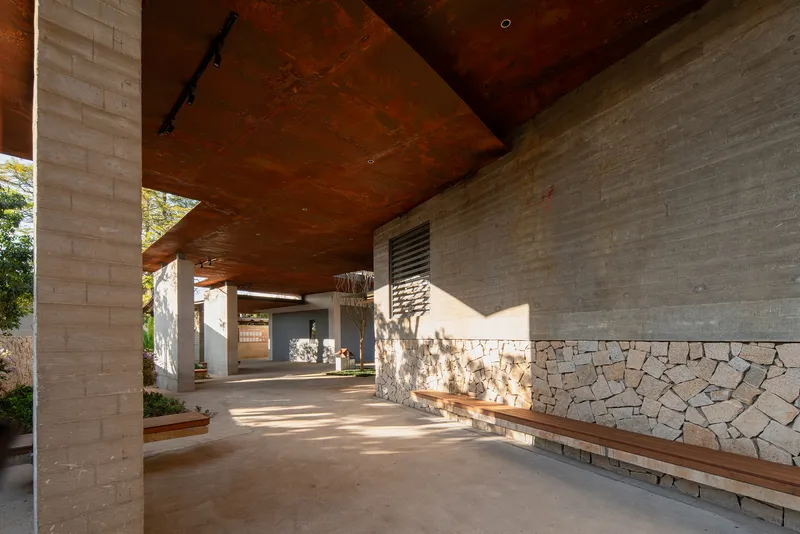
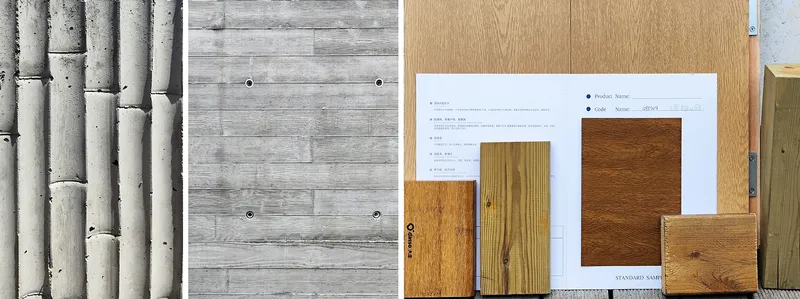
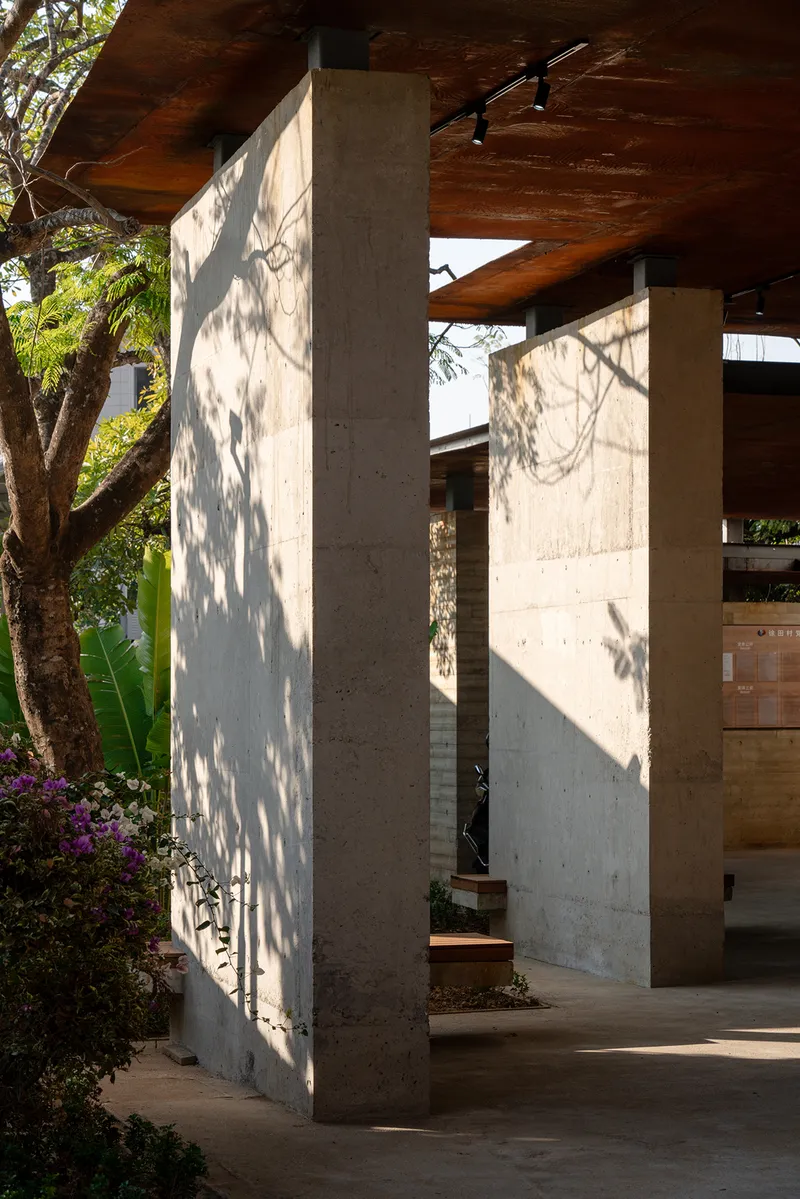
The material palette is legible and unpretentious: board-formed concrete (some with bamboo formwork textures), weathered steel, local stone, dark brick, and timber plank soffits. A material sample board visible in the documentation confirms the deliberateness of the choices. Bamboo-textured concrete panels sit alongside wood veneer swatches, suggesting a careful process of matching industrial materials to local craft traditions.
In the covered walkways, stone and brick walls meet weathered steel ceilings. Concrete columns receive dappled tree shadows beneath timber soffits. None of these materials require specialized maintenance or imported supply chains. They will age gracefully in Huizhou's subtropical climate, gaining patina rather than losing composure. For a community center in a village that cannot afford a dedicated facilities team, this pragmatism is itself a design virtue.
Gathering Beneath the Canopy
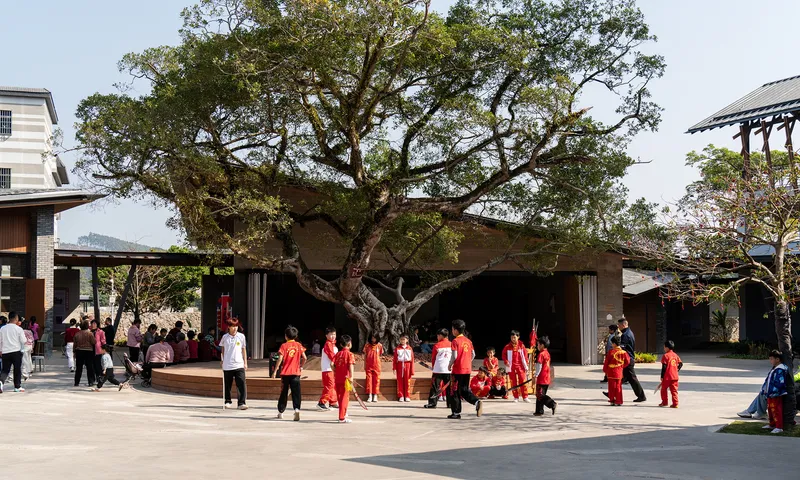
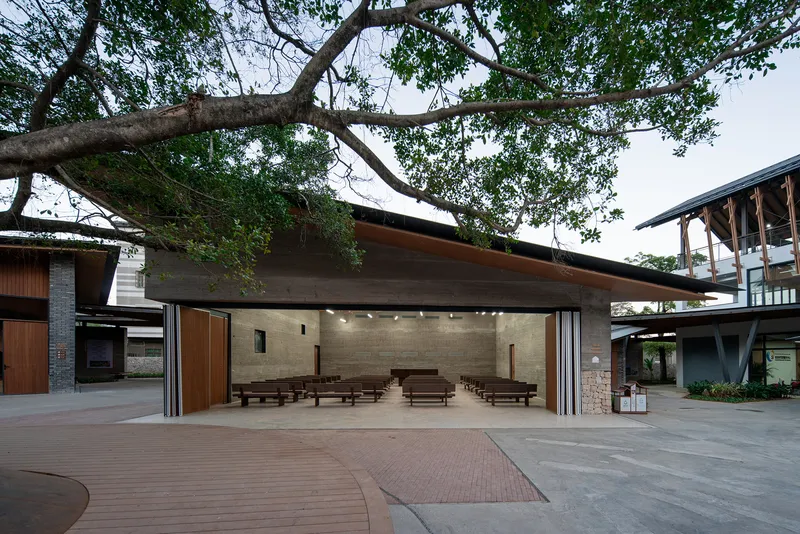
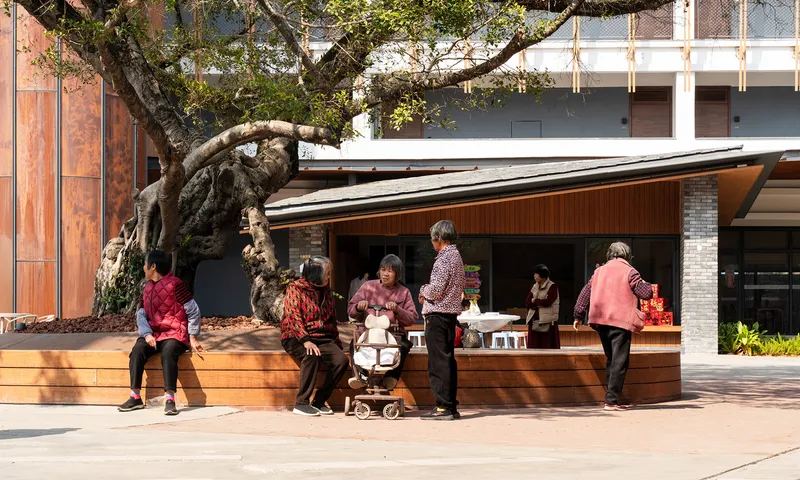
Several of the most compelling moments in the project are not rooms at all but covered outdoor spaces where village life unfolds under cantilevered roofs. In one image, performers in red gather on the plaza beneath a low pavilion sheltered by a large tree. In another, rows of benches fill an open-air assembly space framed by mature branches overhead. These are not leftover gaps between buildings. They are the primary social spaces, designed with as much care as any enclosed room.
The timber deck with bench seating beneath an overhanging roof captures the project's essential proposition: that a rural community center should be more veranda than auditorium, more shade structure than sealed enclosure. In Guangdong's heat, the ability to gather outdoors in comfort is not a luxury but a functional necessity. line+ studio treats the roof as the most important civic element, and the walls as optional.
Interior Light and Inhabited Thresholds
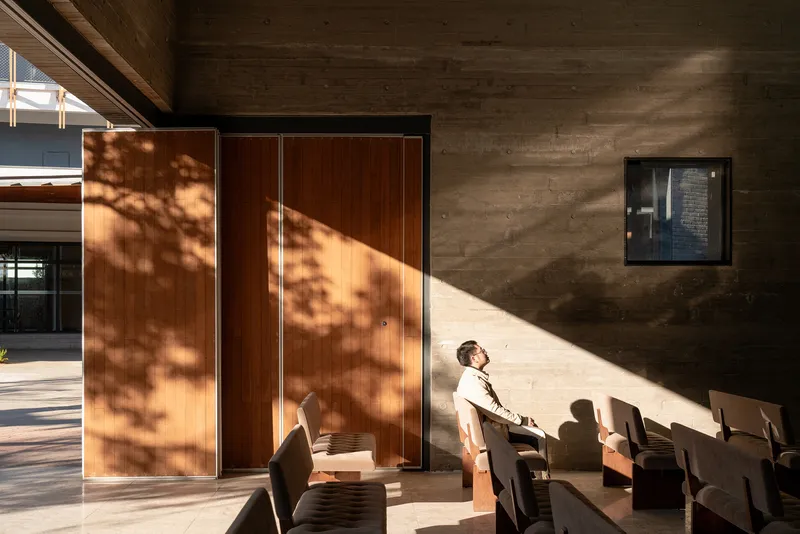
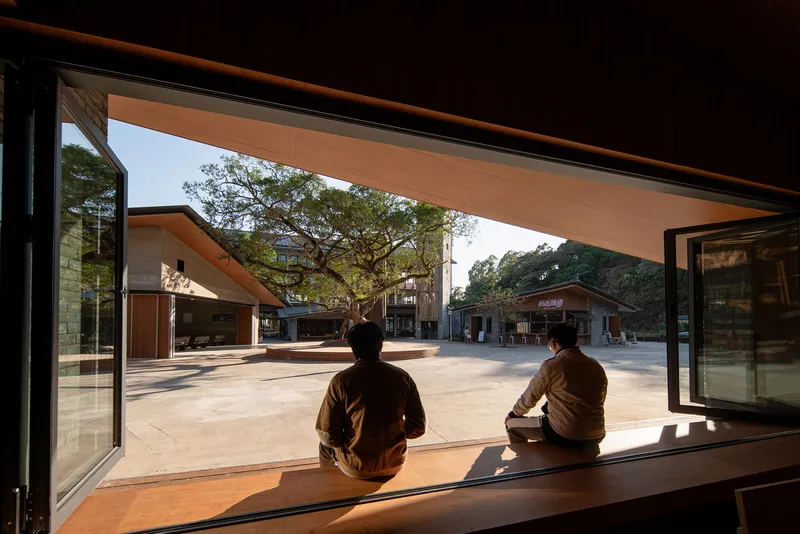
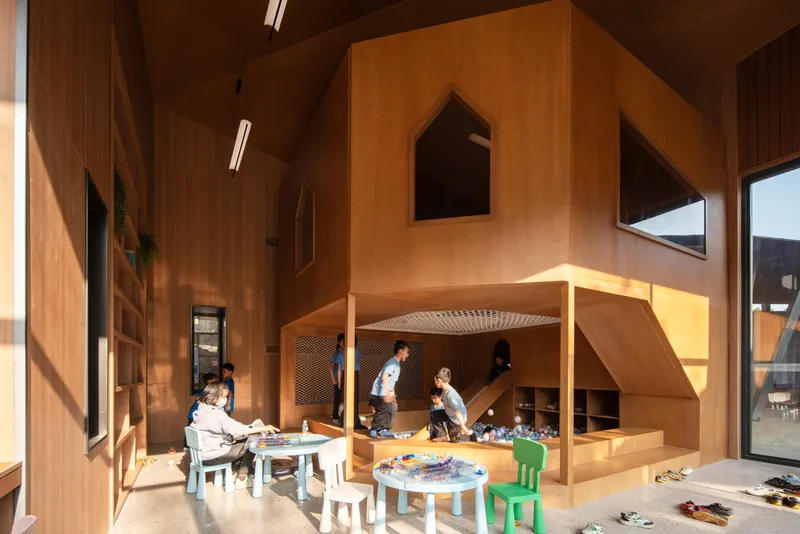
Inside, the quality of light is precise and varied. A board-formed concrete wall receives a sharp diagonal slash of sunlight and tree shadows through a clerestory, turning a simple seating area into something almost sacral. Elsewhere, a corner pavilion opens through full-height glazing onto the courtyard, where two seated figures watch the dusk settle. The double-height children's space, clad in plywood with pendant lights, feels warm and domestic rather than institutional.
These interiors succeed because they are designed as thresholds rather than sealed rooms. Every significant interior space has a direct visual or physical connection to an adjacent courtyard. The boundary between inside and outside is deliberately porous, reinforcing the compound's logic of nested outdoor rooms. You are never more than a few steps from the sky, the tree, or the sound of other people.
Structure and Shadow
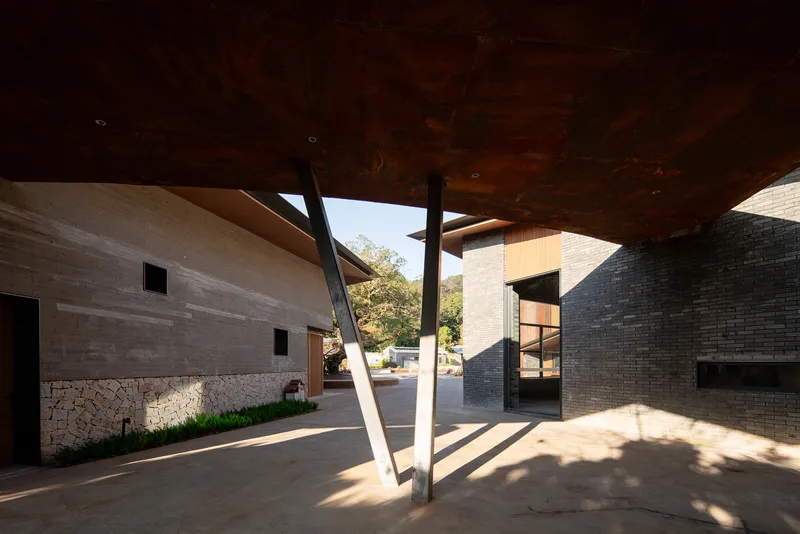
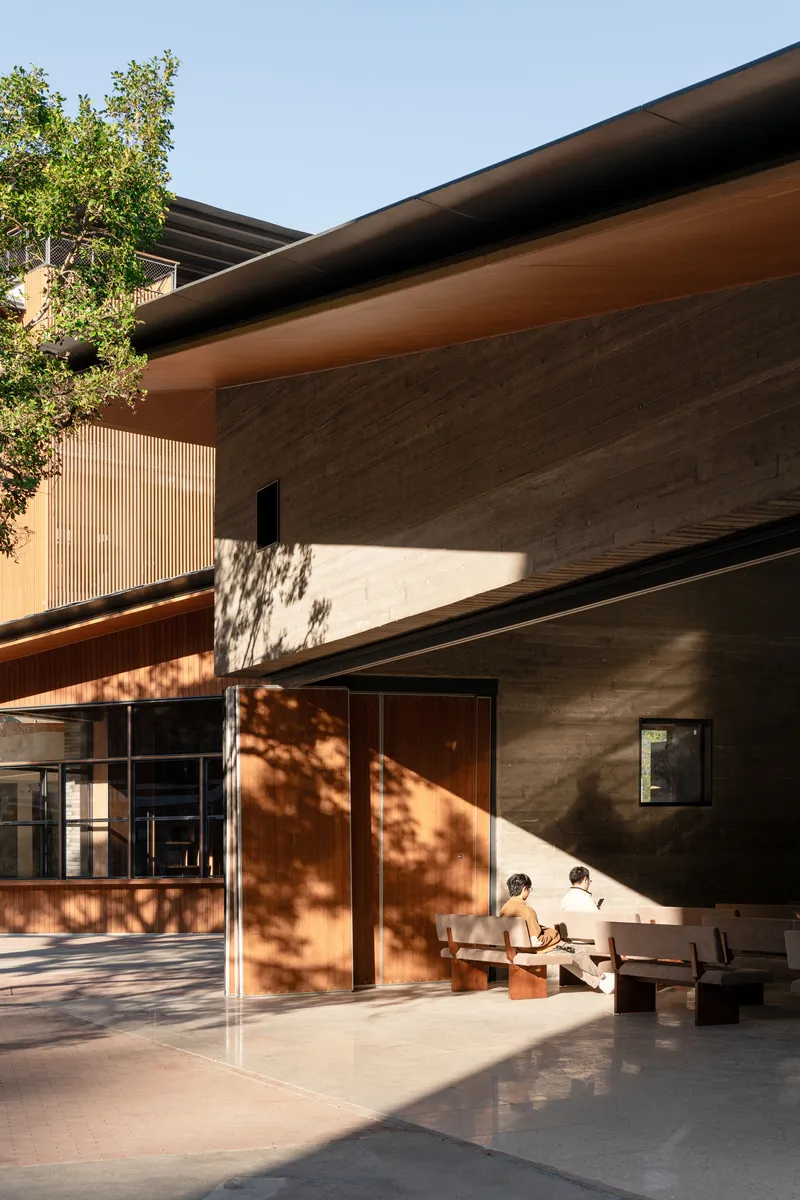
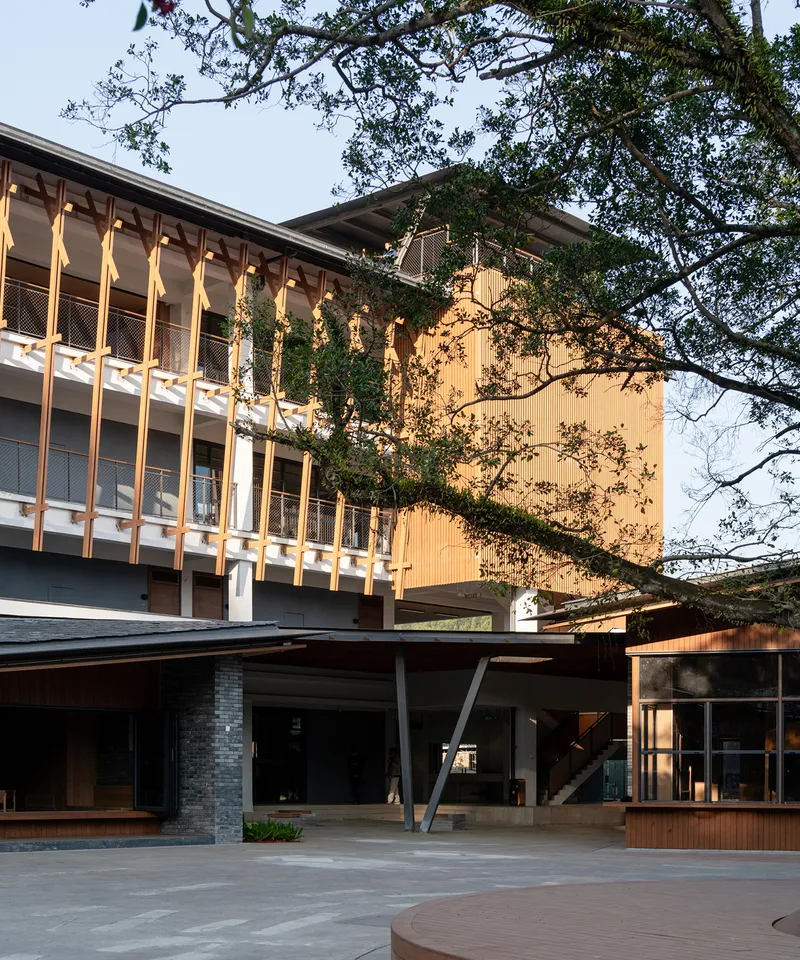
Angled steel columns in the covered courtyard plaza support timber soffits and create a forest of shadows that shift throughout the day. Concrete walls collect tree shadow like a screen. Timber screen balconies on the exterior facades produce layered depth at dusk, when interior light begins to glow through the slats. The structural system is not hidden or celebrated for its own sake. It is deployed as a tool for controlling the play of light and shade across communal surfaces.
In a subtropical climate, shadow is a building material as essential as concrete. The architects seem to understand this intuitively. The columns are angled not for formal novelty but to expand the shadow footprint. The soffits are spaced to admit filtered light rather than full sun. The result is a building that performs thermally through its geometry, reducing reliance on mechanical systems while enriching the spatial experience.
Plans and Drawings
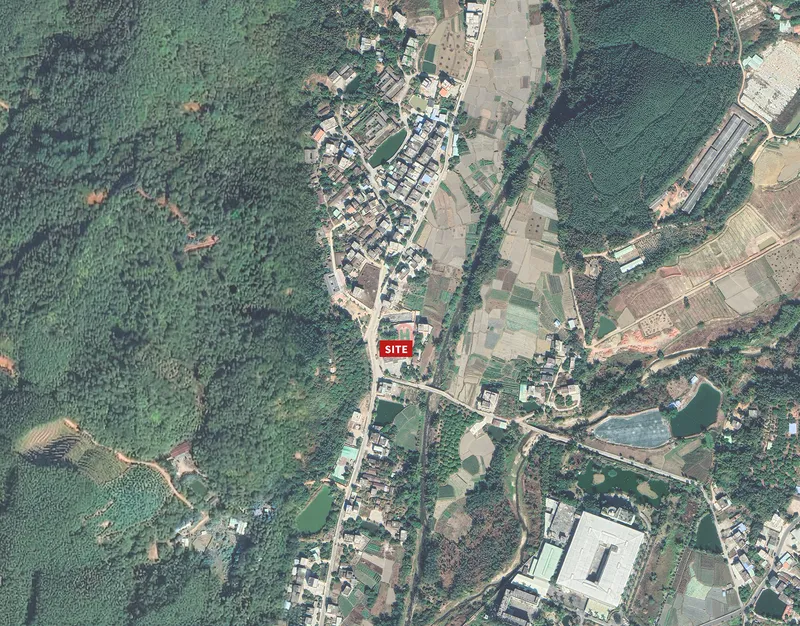
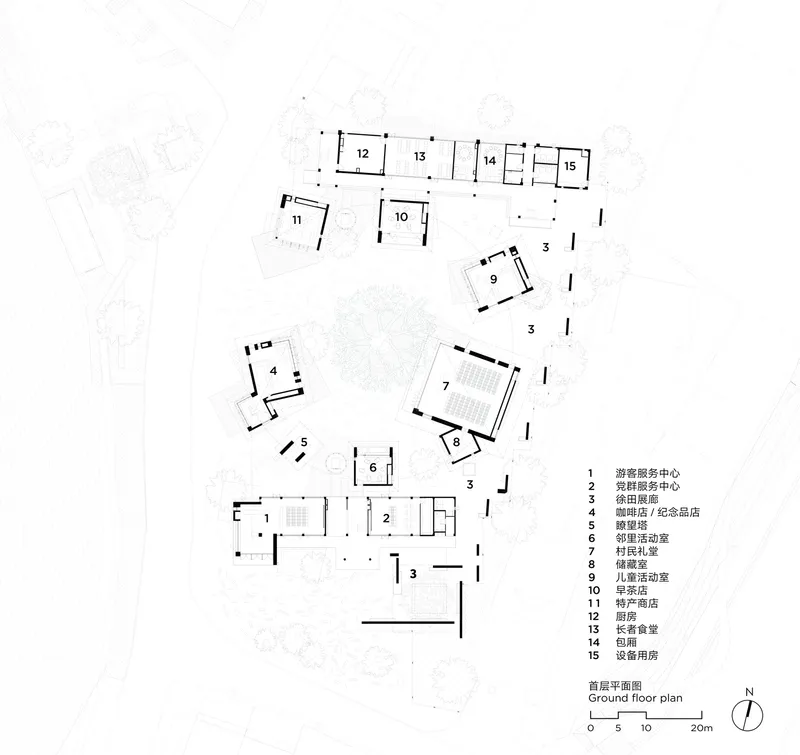
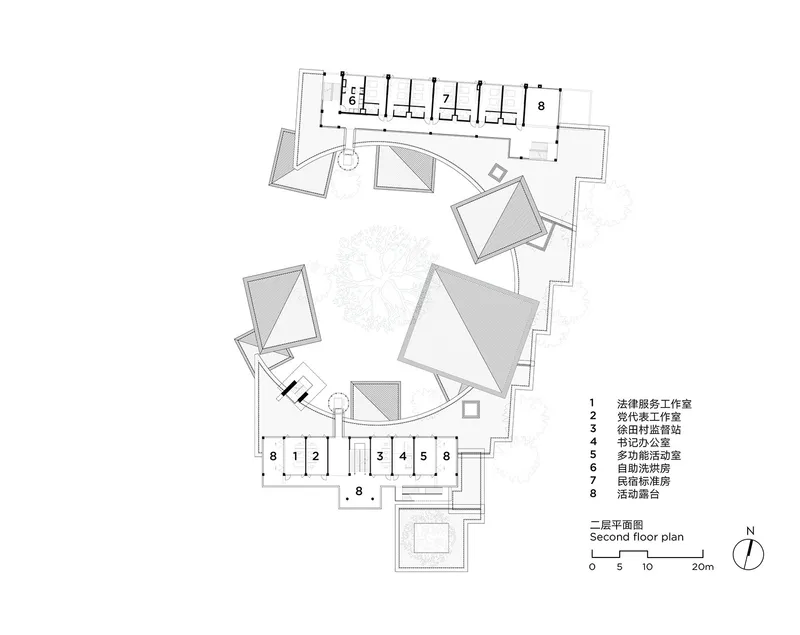
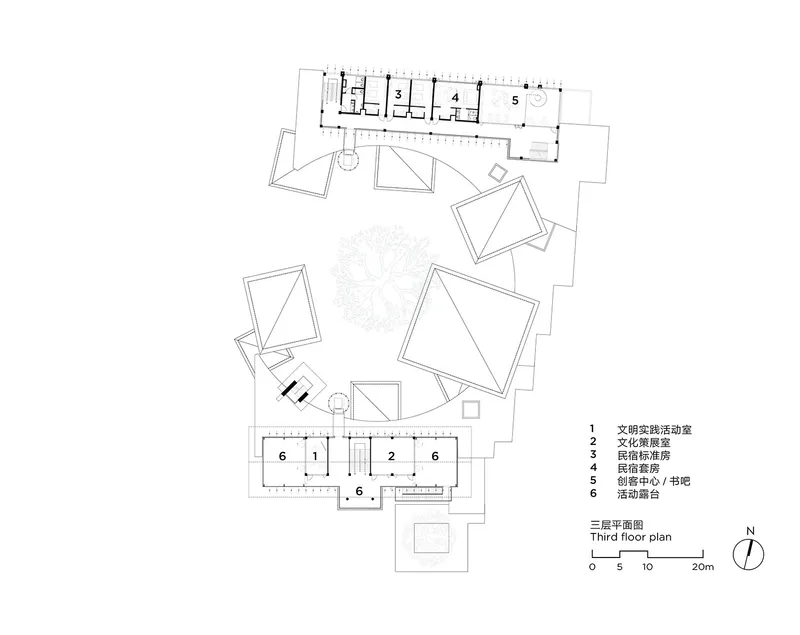
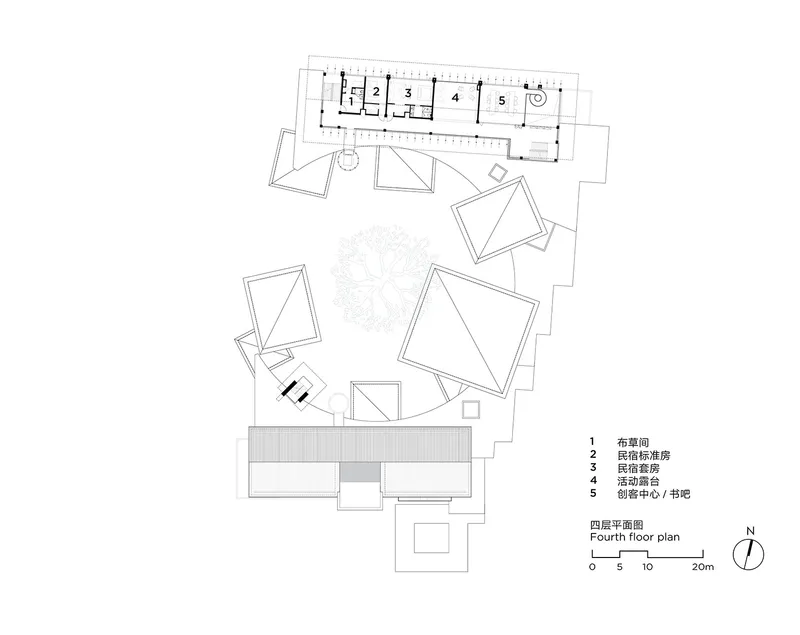
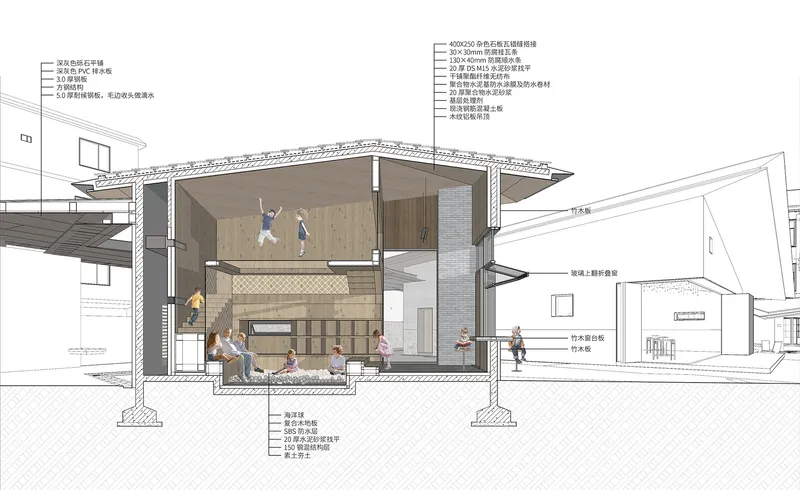
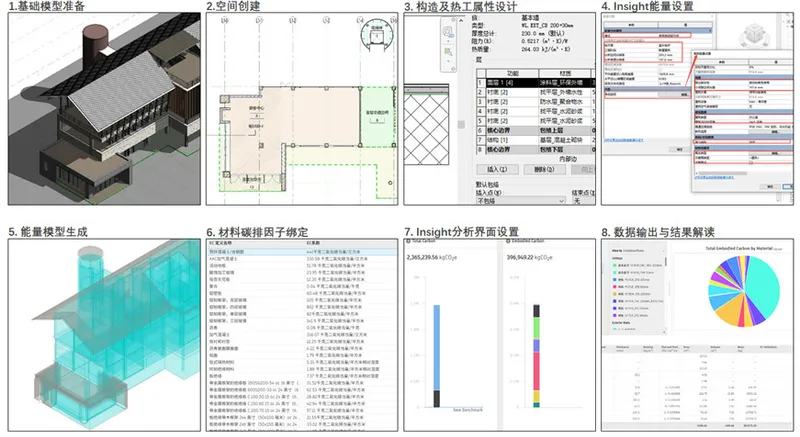
The site plan confirms what the aerial photographs suggest: the compound occupies a precise seam between the existing village fabric and the open agricultural fields to the south. The ground floor plan reveals how the pavilion volumes cluster around open courtyards, with room designations indicating a mix of programmatic uses. Upper floor plans show the pyramidal roofed volumes arranged around the central courtyard and its preserved tree, with a terrace at the southern edge opening toward the landscape.
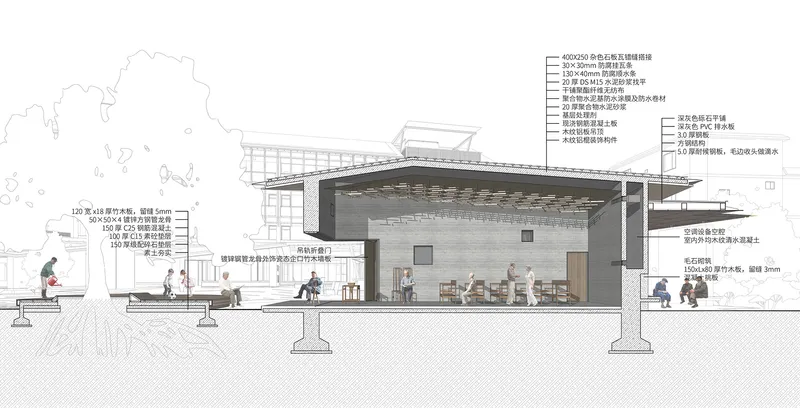
The section drawings are particularly revealing. They show double-height interior spaces with exposed timber roof structures and brick construction alongside board-formed concrete. Annotated construction specifications suggest a level of detail unusual for rural projects. The technical diagram panel, with its axonometric views, energy analysis charts, and building data tables, indicates that the project was conceived not just as an architectural statement but as a replicable model for rural community infrastructure.
Why This Project Matters
China's rural revitalization projects have produced no shortage of photogenic buildings in picturesque villages. Many of them function as cultural tourism props rather than genuine community infrastructure. What distinguishes Xutian is the disciplined refusal to treat the community center as a spectacle. The massing defers to the village. The courtyards defer to the tree. The materials defer to climate and maintenance reality. The tower, the one assertive gesture, is earned through its functional role as an observation point and wayfinding marker.
The real test will come over time: whether the open-air assembly spaces fill with village meetings, whether the children's room stays in daily use, whether the plaza under the tree becomes a genuine social center rather than an architectural set piece. The design makes a strong case. By converting an abandoned school into a compound that amplifies the spatial patterns Hakka villagers have used for centuries, line+ studio has given Xutian a building that feels less like a gift from outside and more like something the village might have built for itself, given the resources and the opportunity.
Xutian Village Community Center by line+ studio, lead architect Fanhao Meng. Huizhou, China. 3,358 m². Completed 2025. Photography by line+.
About the Studio
Share Your Own Work on uni.xyz
If projects like this are the kind of work you want to make, uni.xyz is a place to publish your own, find collaborators, and enter design competitions.


Popular Articles
Popular articles from the community


Co-life: Sustainable Architecture for Age-Friendly Community Living
Co-life reimagines sustainable architecture for seniors through courtyards, rammed earth, shared gardens, and spaces designed for belonging.

The Musturak Paradise: Senior Living Architecture for a Connected Future in Temara, Morocco
The Musturak Paradise reimagines senior living architecture in Temara via private homes, social spaces, culture, community, and shared care.

Play: Fragments of Their World
Familiar architecture becomes modular playground design, creating safe spaces where displaced children can learn, connect, imagine and play.

The Ocean Hive: Sustainable Architecture for a Self-Sufficient Civilization at Sea
The Ocean Hive imagines sustainable architecture at sea, where modular habitats, algae, wave power and ocean waste sustain a growing colony.


Similar Reads
You might also enjoy these articles

Bao Huynh Watercolor Atelier: A Serene Art Retreat in Hội An
Bao Huynh Watercolor Atelier in Hội An blends multifunctional art spaces, sustainable design, local materials, and family-friendly living in a serene environment.

Atelier Macri Concept Store Interior Design by CASE-REAL
Atelier Macri store features a "ko" counter, walnut wood details, cork displays, blending retail, gallery, and seamless customer experiences.

Manuel Vargas Izquierdo Stadium and High-Performance Sports Center: Architectural Excellence in Jalpa de Méndez
The Manuel Vargas Izquierdo Stadium blends sustainable design, inclusive sports facilities, and cultural-inspired architecture, revitalizing Jalpa de Méndez’s public spaces.

KAKR Buluh Awar Hall: Revitalizing Community and Ecology Through Bamboo Architecture
Community built bamboo hall revitalizes Buluh Awar village, empowering youth, restoring ecology, celebrating vernacular craftsmanship through sustainable architecture and culture.





Comments (0)
Please login or sign up to add comments
No comments yet. Be the first to comment!