
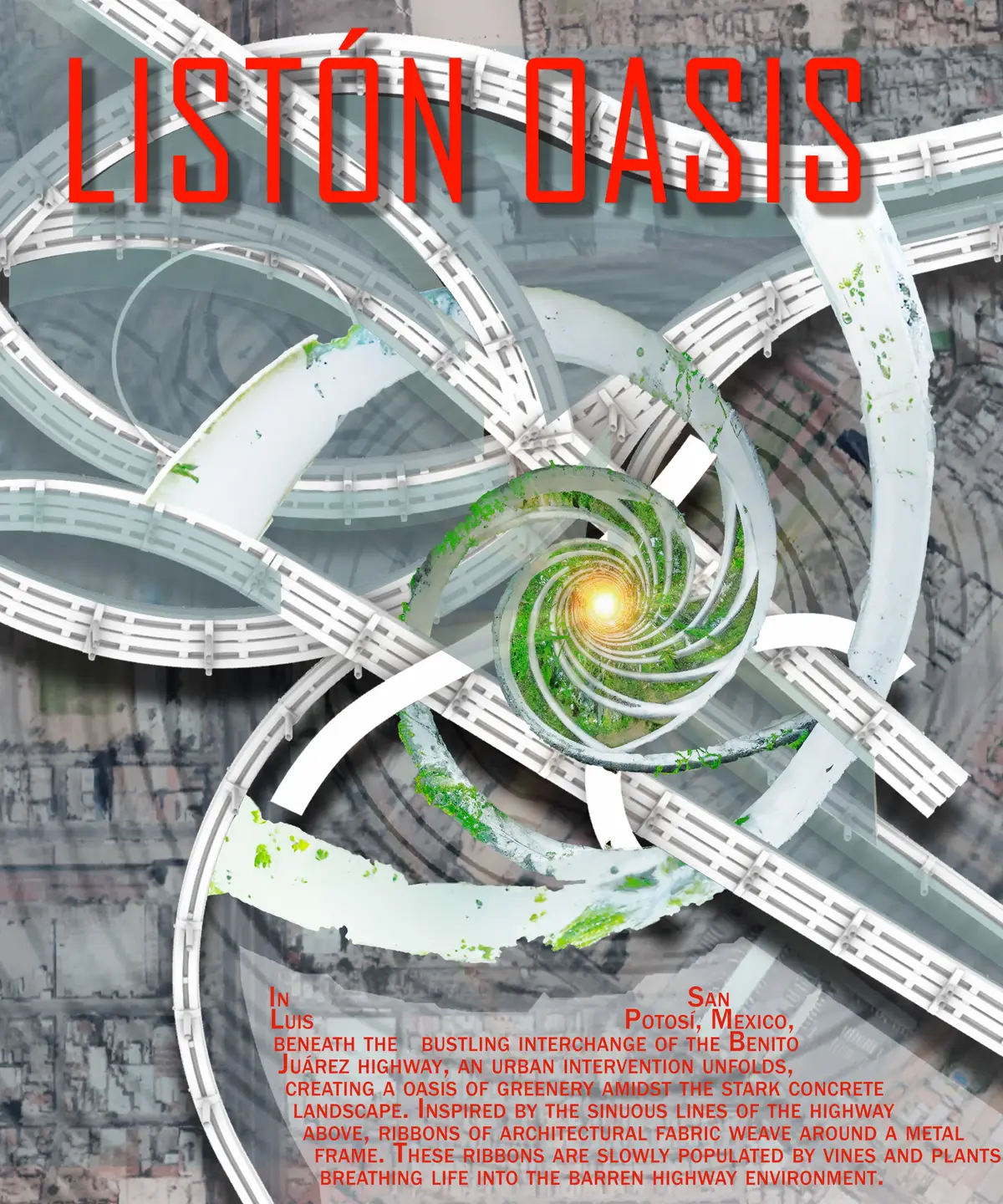
Liston Oasis
Weaving a Vibrant Urban Tapestry in San Luis Potosi

Ribbons, with their intricate patterns and versatile uses, offer a compelling metaphor for understanding how diverse cultural elements interweave to form a vibrant and cohesive urban community. This metaphor becomes particularly relevant when applied to San Luis Potosí, a city characterized by its rich cultural tapestry and dynamic urban landscape. Just as ribbons can be used in art, connection, and celebration, they symbolize the artistic and creative spirit that permeates a city. The metaphor extends to the Liston Oasis project, which aims to transform underutilized spaces into a vibrant urban sanctuary, reflecting the harmonious integration of cultural elements within the city.
Ribbons are often associated with art, where they are used to create beautiful and intricate designs. This artistic application of ribbons symbolizes the way various cultural elements in a city come together to form a cohesive whole. In San Luis Potosí, the diverse communities and traditions contribute to a rich and vibrant urban environment. The city’s cultural landscape is like a canvas where different ribbons—each representing a unique cultural thread—intertwine to create a dynamic and harmonious design. This interplay between various cultural elements mirrors the sinuous lines of ribbons, which flow and merge to produce a unified artistic expression.
The sinuous lines of highways in San Luis Potosí provide a direct inspiration for the ribbon metaphor. These highways, with their curving paths and intricate intersections, echo the way ribbons weave through a design. The metaphor suggests that, just as ribbons twist and turn to create complex patterns, the cultural threads within the city intertwine to form a rich and cohesive community. The dynamic interplay between these cultural elements reflects the fluidity and adaptability of ribbons, highlighting how different cultural influences can come together to enhance the urban fabric.
The Liston Oasis project exemplifies this metaphor in action. Situated beneath the shadow of the highways, the site often remains overlooked or underutilized. However, by drawing inspiration from the ribbons’ ability to connect and reach out, the project aims to transform these shadowed voids into a vibrant urban oasis. The design envisions a space where the artistic and cultural threads of San Luis Potosí can come together, much like ribbons that are morphed and twisted to create a cohesive whole. The oasis seeks to revitalize these underutilized areas, turning them into a welcoming space that offers a unique blend of tranquility and vibrancy.
The Liston Oasis is more than just a physical space; it represents a symbolic and literal transformation of the urban environment. The project aims to create a moment of relaxation and rejuvenation in the midst of the bustling city. By providing a serene retreat beneath the highways, the oasis offers visitors a different aspect of the city—one that feels both disconnected from and intimately tied to the surrounding urban environment. This juxtaposition of tranquility and vibrancy reflects the dynamic interplay of cultural elements within San Luis Potosí.
In addition to its role as a physical space, the Liston Oasis also serves as a metaphorical hub where diverse cultural elements can come together and interact. Just as ribbons can be tied to connect different parts of a design, the oasis functions as a knot or central point where various cultural threads of San Luis Potosí converge. The project highlights how different cultural influences can blend and enrich each other, creating a harmonious and cohesive urban environment. The space within the oasis acts as a multifunctional space, where it can be used for a variety or events. The goal was to be flexible in the programming to create this hub for many communities to be able to use it.

Popular Articles
Popular articles from the community


Cube Design Draws an Ecological Corridor Between Two Shenzhen Hills with the Nankai Building
Beside Shenzhen's container docks, the Nankai Building pairs stacked balconies with a climbing green screen to connect two hillsides across its height.

longwave studio Reorganizes a 112 m² Tainan Apartment Around the Daily Routines of a Family and Two Cats
In Tainan, Taiwan, birch plywood, rust-red furniture and a freestanding plaster wall link arrival, storage, work and family life in one apartment.

Jaramillo Van Sluys Arquitectura and Urbanismo Turn a Demolished Registry Lot in Quito into an Orchard Plaza
In Quito's Centro Histórico, a 2,800 m² plaza exposes the San Agustín convent wall and redraws its lost Augustinian orchard in volcanic stone.

David Ortega Stacks a Two-Story Mexico City Penthouse Around a Steel Stair and a Pergola-Shaded Roof Terrace
In Colonia Roma, a 300 m² penthouse uses oak joinery, a planted steel stair and a slatted roof pergola to make a new-build apartment feel like a house.

Similar Reads
You might also enjoy these articles


Vereda Arquitetos Renovates a 40-Square-Meter Apartment Inside Niemeyer's Copan Building
A compact unit in São Paulo's most iconic residential tower gets a material overhaul that pairs exposed concrete with bold blue Formica.

Shakur's House: Exposed Brick as an Interior Organiser in a 168 m² Mashhad Residence
Brick moves indoors in this Mashhad residence, where masonry walls, glass partitions and teal planes sequence a compact home without closing it off.

Day and Night Park: A Time-Based Urban Newsstand in Beijing
A temporary urban newsstand in Beijing blending travel, light, and reading through poetic colors, compact form, and community-focused design.

Modernist Patio Renovation in El Masnou, Barcelona by Oliver Segura Arquitectura + Cebrià Arquitectura
Modernist patio renovation blending tradition and innovation with a movable pool, leveled floors, and Catalan materials in El Masnou.

Comments (0)
Please login or sign up to add comments
No comments yet. Be the first to comment!