
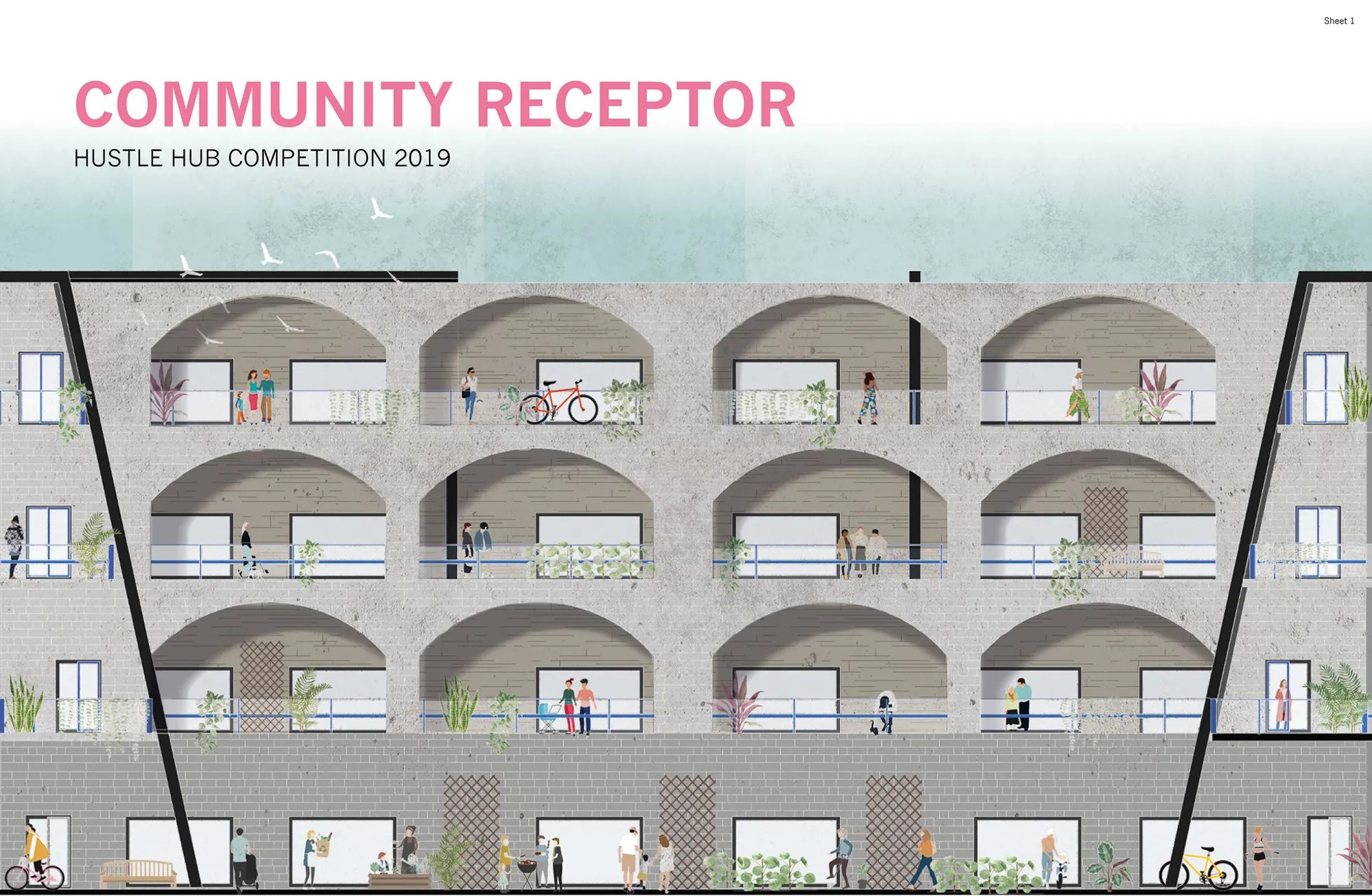
Living Affinity: A Grid, a Colonnade, a Garden
A co-living complex built from a 12m square grid where arched colonnades, cluster gardens, and a residential tower create a replicable neighbourhood.


A 12 by 12 metre grid is a simple thing. But when you repeat it across a site, fill some squares with housing, leave others as gardens, and connect them with arched colonnades, you get a neighbourhood. Living Affinity (also called Community Receptor), designed by Gulmeena Barlas, Ngan Phan, and Marie-Helene Lesiege, builds an entire co-living complex from this one module.
Shortlisted in the Hustle Hub '19 competition on uni.xyz, the project proposes a self-sufficient urban block with a residential tower, a public amenity building, a greenhouse, cluster gardens, and a pop-up market, all organised on a replicable square grid. The grid is the plan. Everything else follows from it.
The Grid: 12 Metres as a Module
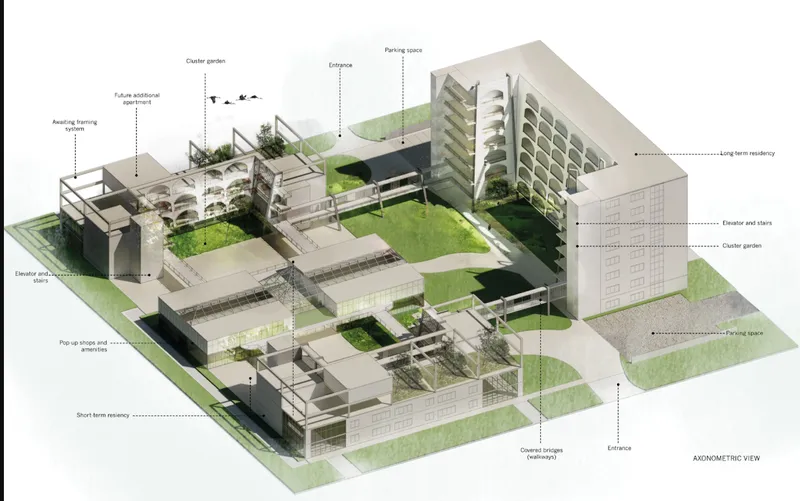
The labelled axonometric shows the full complex. The 12m grid creates a chessboard of built and open squares. The residential tower occupies several grid cells stacked vertically. The public building (Building B) sits at the centre. Cluster gardens fill the gaps between buildings. A greenhouse and pop-up market area activate the edges. Every element has a clear position because the grid assigns it one.
The strength of a grid-based plan is replicability. This complex can be built once and repeated on adjacent sites without redesigning. The grid tiles. The gardens connect. The colonnades extend. The result is not a single building but a system that can grow into a neighbourhood.
The Colonnade: Arches as Public Space
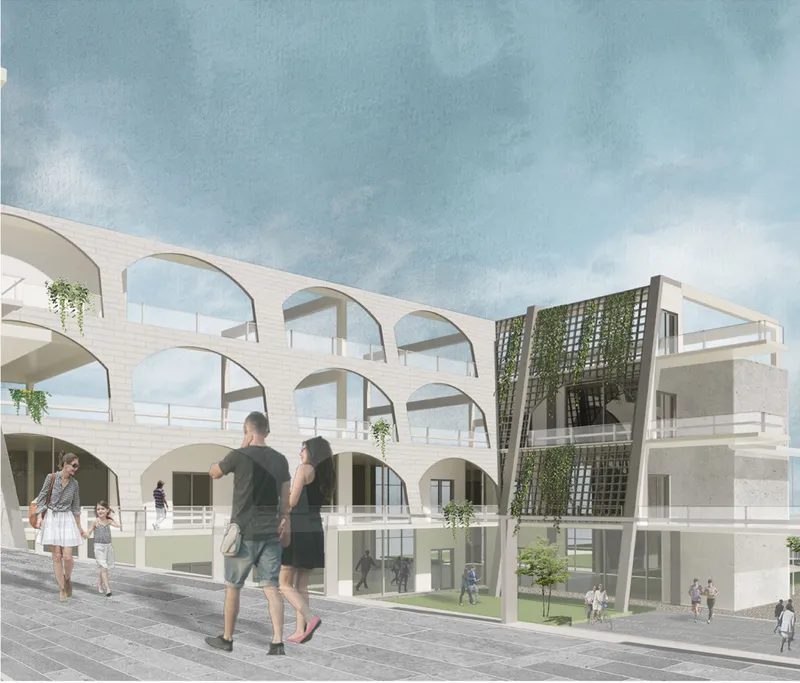
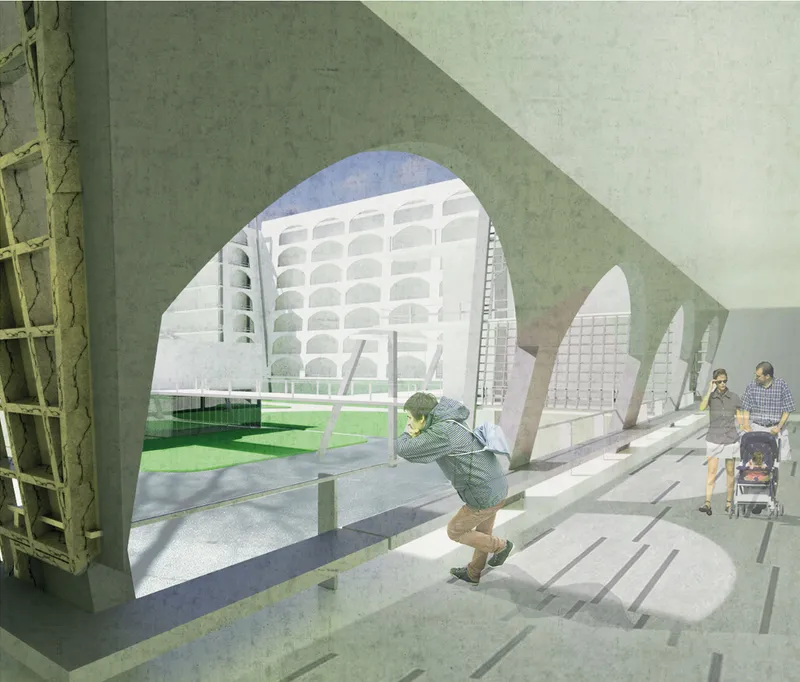
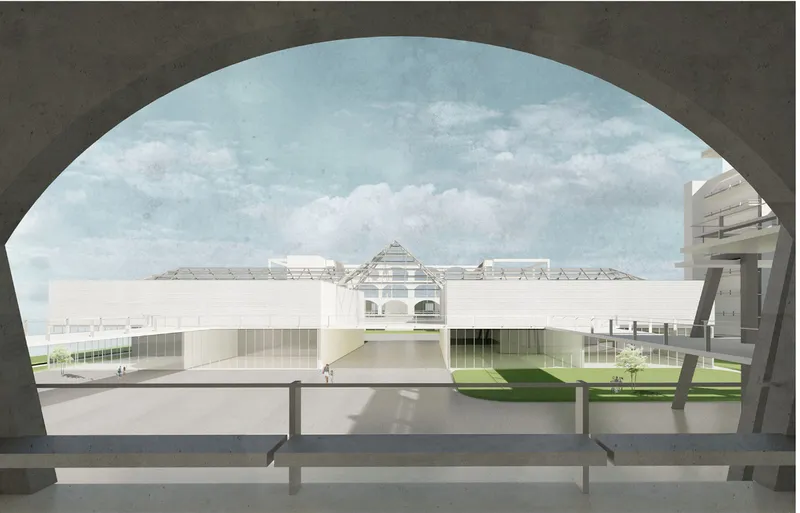
The most architecturally distinctive element is the arched colonnade that runs along the ground floor. The arches create a covered public passage: open to the air, connected to the courtyards, and large enough for a skateboarder, a cyclist, and a pedestrian to share. The arches frame views of the gardens and the residential blocks beyond, making every walk through the ground level a sequence of composed views.
The colonnade is not decoration. It is the social infrastructure of the complex. Markets can set up under it. Residents can sit in it. Events can occupy it. The arched form handles rain and sun without closing the space off. It is simultaneously indoor and outdoor, public and residential, structure and amenity.
The Cluster Garden: Shared Green at Every Level
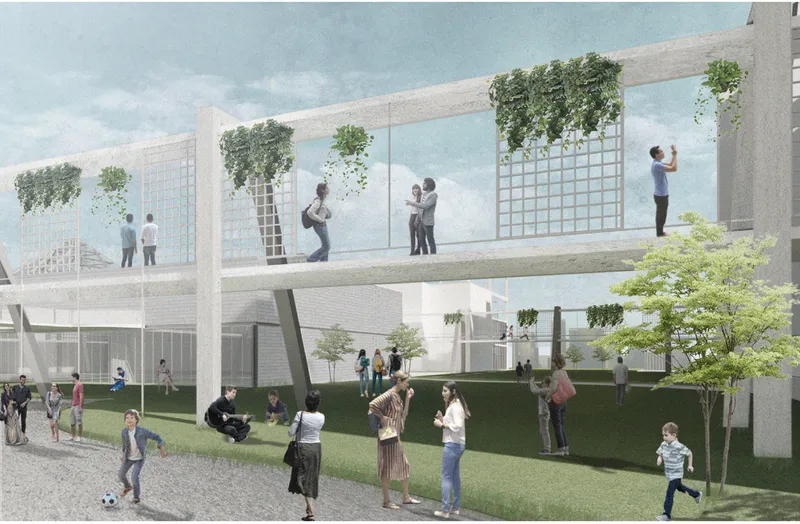
The cluster gardens are the project's communal heart. At ground level, they are grass lawns where residents gather. Above, glass balconies with hanging plants extend the green vertically. The gardens are not residual space between buildings. They are the primary programme: the reason the grid leaves squares empty is to create gardens, not to create setbacks.
The view through an arch shows the greenhouse and public buildings framed by the garden. The complex reads as a landscape punctuated by buildings rather than buildings surrounded by landscape. This inversion of figure and ground is what makes the project feel like a village rather than a housing block.
The Section: Tower, Greenhouse, Public Building
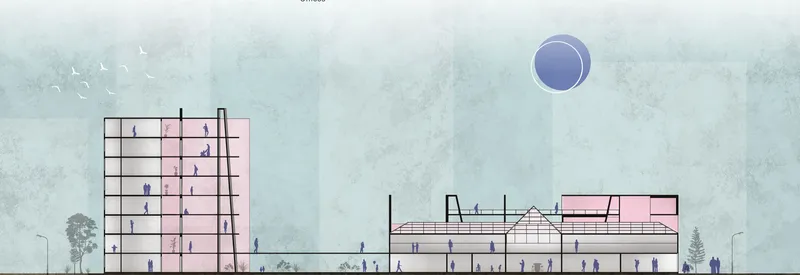
The watercolour section shows the three main building types side by side. The pink residential tower on the left contains stacked apartments. The greenhouse in the centre provides year-round food production and a public winter garden. The low-rise public building on the right houses the collective kitchen, daycare, and event spaces. The three types serve different functions but share the same grid and the same ground.
The section also reveals the height strategy. The tower is the only tall element. Everything else stays low. This means the tower gets views and light while the gardens and public spaces stay human-scale. The contrast between the tower and the low-rise is not accidental. It is the plan's way of giving density and intimacy to the same site.
Why This Project Matters
The Hustle Hub competition produced co-living entries that were circular, organic, terraced, and digital. Living Affinity is the most classical: a grid, a colonnade, a garden, a tower. These are the oldest tools in urban design. The project proves that they still work. A 12m grid produces variety if you leave enough squares empty. An arched colonnade produces public life if you make it generous. A cluster garden produces community if you put it at the centre.
For anyone studying grid-based urbanism, colonnade architecture, or replicable housing systems, this project is a clear demonstration that the simplest spatial tools, applied with discipline, can produce the richest results.
View the Full Project
About the Designers
Designers: Gulmeena Barlas, Ngan Phan, Marie-Helene Lesiege
Enter a Design Competition on uni.xyz
If grid-based urbanism, colonnade architecture, or replicable co-living systems are the kind of work you want to explore, uni.xyz runs competitions year-round that reward disciplined, buildable spatial thinking.
Project credits: Living Affinity (Community Receptor) by Gulmeena Barlas, Ngan Phan, Marie-Helene Lesiege. Shortlisted, Hustle Hub '19 (uni.xyz).




Popular Articles
Popular articles from the community


Hill & Cross Opera: Sculptural Opera House Architecture Shaped by Tallinn’s Landscape and Identity
Hill & Cross Opera reimagines opera house architecture in Tallinn through its sculptural hill, civic plaza, glass wave and a luminous cross.

Riyadh For All: Intergenerational Urban Design for Active Aging in Rabat
Riyadh For All reimagines urban design in Rabat with intergenerational co-living, adaptive courtyards, and Moroccan cultural exchange today.

Co-Life: Senior Housing Design That Reconnects Older Adults With the City
Co-Life reimagines senior housing design through healing gardens, shared streets, workshops, and a sustainable community across generations.

The Ocean Hive: Sustainable Architecture for a Self-Sufficient Civilization at Sea
The Ocean Hive imagines sustainable architecture at sea, where modular habitats, algae, wave power and ocean waste sustain a growing colony.


Similar Reads
You might also enjoy these articles

Day and Night Park: A Time-Based Urban Newsstand in Beijing
A temporary urban newsstand in Beijing blending travel, light, and reading through poetic colors, compact form, and community-focused design.

Modernist Patio Renovation in El Masnou, Barcelona by Oliver Segura Arquitectura + Cebrià Arquitectura
Modernist patio renovation blending tradition and innovation with a movable pool, leveled floors, and Catalan materials in El Masnou.

Alto Residencial Coop: Cooperative Housing Development in Santiago de Compostela by Carbajo Barrios Arquitectos
A linear cooperative housing complex blending white volumes and perforated metal façades, enhancing community living, natural light, privacy, and urban integration.
Vil Genis School by BPA ARCHITECTURE – Massy, France
Vil Genis School in Massy, France, features sustainable design, south-facing classrooms, community integration, accessible spaces, and modern educational architecture.

Comments (0)
Please login or sign up to add comments
No comments yet. Be the first to comment!