

Living Around: A Hollow Cylinder That Refuses to Pick a Front Door
Katarzyna Zabielska's circular residential building eliminates hierarchy through geometry, wrapping compact living units around a shared courtyard landscap


What happens when a residential building has no front and no back? The question sounds abstract until you see it resolved in plan: a hollow cylinder sitting on its site with equal composure in every direction, refusing to privilege one façade over another. Living Around is a housing project built on the premise that geometry itself can encode social values. A circle has no hierarchy, and neither does this building.
Designed by Katarzyna Zabielska, the project proposes a circular residential typology for an expanding urban district where it would stand as one of the first architectural interventions. Rather than dictating future development patterns with a conventional block or bar, the cylinder allows surrounding structures to emerge organically. The hollow form splits the site into two zones: a publicly accessible outer ring and a semi-public inner courtyard reserved for residents. Three primary unit types repeat around the circumference, stacking private rooms above a ground floor of collective amenities.
A Courtyard That Functions as a Metropolitan Living Room
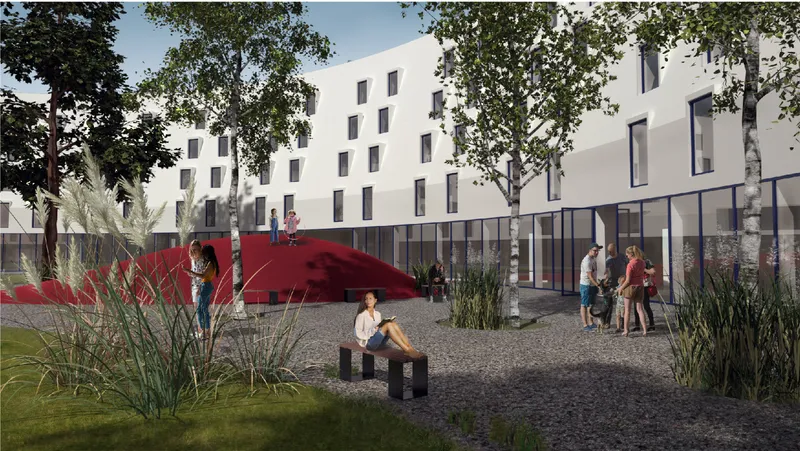
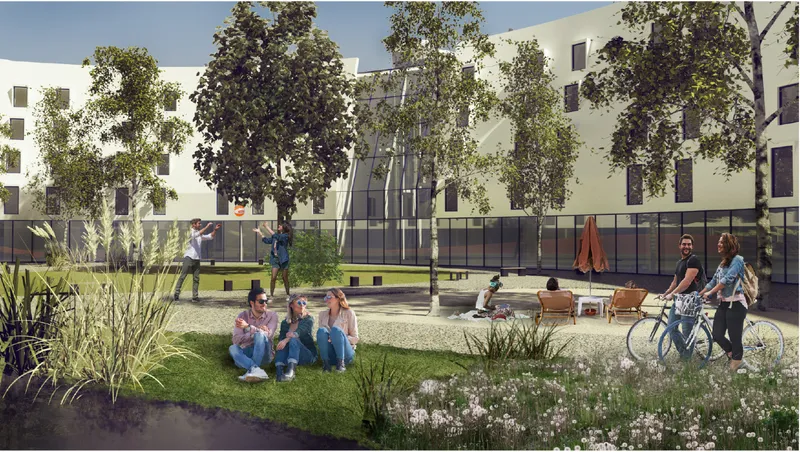
The hollow core of the cylinder is not empty space; it is the building's social engine. Soft mounds, tree clusters, gravel pathways, ponds, and seating areas compose a micro-park that Zabielska treats as a communal living room at metropolitan scale. Residents can exercise, dine outdoors, or drift into impromptu gatherings without ever leaving the enclosure of their building. The courtyard images reveal carefully placed elevation shifts and planted clusters that carve semi-private pockets within the open landscape, a strategy that lets social life unfold without collapsing into constant exposure.
What makes this courtyard work is its specificity. The gravel paving and red sculptural mound in the first view establish a textural identity distinct from a generic park, while the second image shows mature trees providing shade for informal gathering. These are not decorative gestures layered onto leftover space. They are programmed landscapes designed to absorb the daily rhythms of cooking, resting, socializing, and solitude.
Reading the Circle in Plan and Section
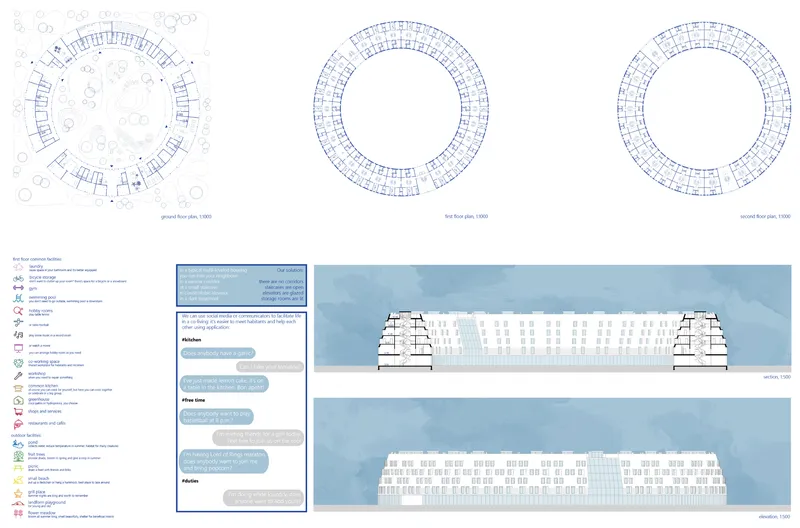
The floor plans and elevation drawings expose the logic of the repeating unit module. Three primary unit types radiate from the cylinder's circumference, each containing a mix of bedroom typologies and shared living spaces. Inner-facing rooms overlook the courtyard, reinforcing visual and social connectivity, while the building's central spiral staircase provides vertical circulation and doubles as a sculptural element visible through the core. Corridors are eliminated entirely, replaced by shared open spaces that become sites for spontaneous interaction.
The circular plan also delivers a practical benefit that rectangular buildings struggle to match: consistent sunlight distribution across all units. No apartment is condemned to a north-only orientation. No entrance is secondary. The symmetry does not produce monotony because the interior programme varies floor by floor, from the collective ground level to the modular accommodation above. As one of the first structures in its district, the building's refusal to impose an axis or a preferred direction is a deliberate urban strategy, leaving the surrounding fabric free to develop without subordination.
Rooftop Production and the Fifth Façade
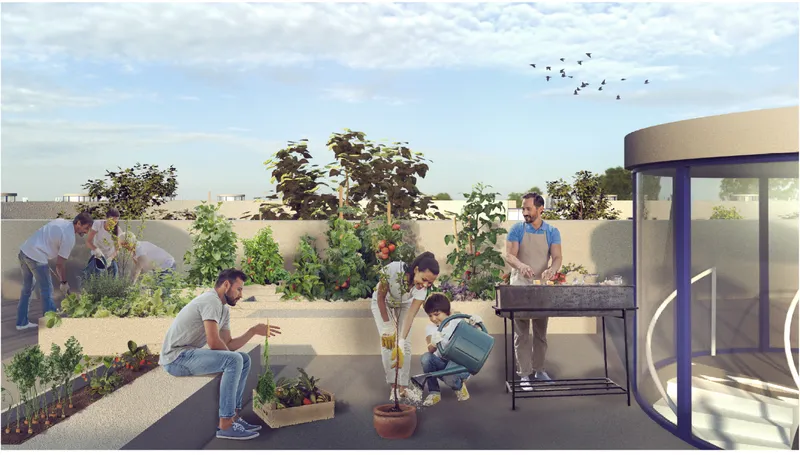
The rooftop terrace extends the building's collective programme upward with raised planting beds where residents tend vegetables under open sky. In a project so committed to shared resources, the productive roof is a logical conclusion: it transforms the fifth façade from dead infrastructure into active community space. The image shows residents engaged in cultivation, reinforcing Zabielska's thesis that architecture can structure everyday encounters, whether at the kitchen counter, the hobby workshop, or a garden bed six storeys up.
Compact Units with Double-Height Ambition
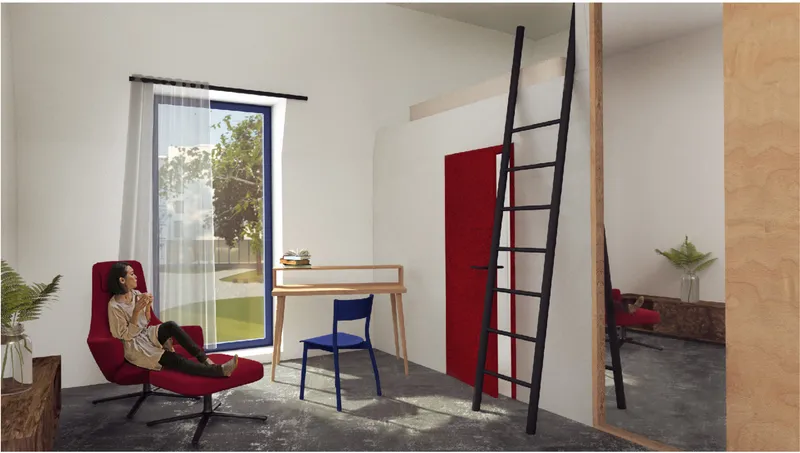
Individual rooms range from 11.30 square metres to over 20 square metres, with bathrooms between 3.00 and 5.60 square metres. These are tight footprints, but the interiors avoid feeling compressed. Mezzanine levels introduce extra usable area within the section, while generous glazing pulls light deep into each unit. The plywood desk and black ladder leaning against a red door in one view suggest a material palette that is warm, direct, and affordable: no marble, no polished concrete, just honest surfaces that age well.
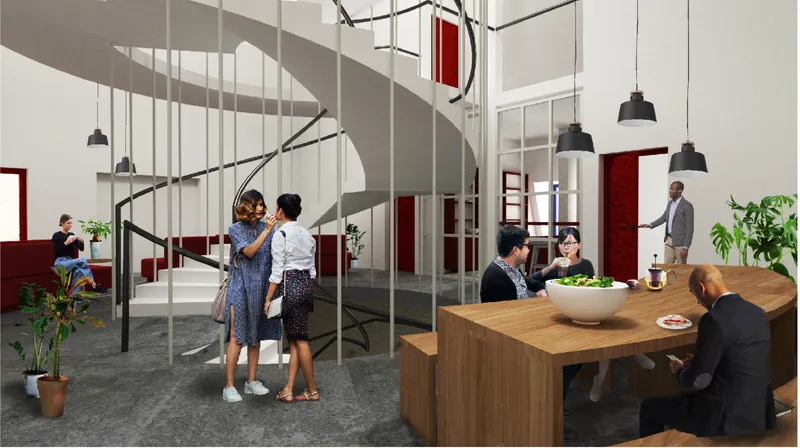
The double-height common room captures the social core of each residential cluster. A spiral staircase connects levels while residents share a timber dining table below. Shared kitchens and living rooms inside each unit act as domestic hubs where cooking, meeting, and relaxing overlap. The ground floor amplifies this further with a swimming pool, co-working areas, workshop and hobby rooms, laundry facilities, and shops for controlled internal use. The programme reads less like a conventional apartment building and more like a residential cooperative, one where the architecture actively sponsors community rather than merely permitting it.
Why This Project Matters
Circular plans are not new in architecture, but they are rare in housing for good reason: they complicate structure, they resist standard construction grids, and they make furniture placement awkward. Living Around confronts these difficulties because the circle solves a problem that rectangles cannot. In a district with no established urban grain, the non-directional form avoids premature decisions about street hierarchy, orientation, and adjacency. It is a building that waits for its neighbours rather than commanding them.
Zabielska's contribution is not simply formal. The project integrates spatial strategy, programmatic generosity, and landscape design into a coherent argument about how collective living can operate at the scale of a single building. The courtyard, the rooftop garden, the eliminated corridors, the mezzanine bedrooms: each decision reinforces a thesis that affordable density and genuine community are not competing goals. They are the same goal, expressed through geometry.
View the Full Project
About the Designers
Designer: Katarzyna Zabielska
Enter a Design Competition on uni.xyz
uni.xyz runs architecture and design competitions year-round that reward proposals with spatial conviction and real site intelligence.
Project credits: Living Around by Katarzyna Zabielska.


Popular Articles
Popular articles from the community


Singing Woman: An Opera House That Performs Before the Curtain Rises
Ovidiu Cristian Pavel's conceptual opera house translates Estonia's choral identity into a sculpted waterfront landmark facing the Baltic Sea.

Manzana Morphosis: Stretching Barcelona's Grid into a Living Landscape for 2050
A radical reworking of the Eixample manzana turns density into a tool for generous public space, vertical ecology, and environmental performance.
Temporary Home for Dogs: A Reversed Zoo Rethinks Animal Shelter Architecture
In Bucharest, a sinuous corridor and freed landscape flip the logic of containment, designing a shelter that works to make itself unnecessary.

Cloaked Colonization: A Mobile Underwater Habitat That Moves Like a Fish
Micah Abaya's shortlisted EHC Pacific entry reimagines ocean settlement as a dispersed network of self-sustaining architectural organisms.

Similar Reads
You might also enjoy these articles

Play: Fragments of Their World: Remembered Architecture Rebuilt as a Modular Playground for Refugee Camps
Tom Gardner abstracts domes, arches and towers from the homelands of displaced families into a kit of child-scaled play parts for camp settlements.
REBIRTH: A Circular Settlement Where Afghan Widows and Their Children Rebuild Life Together
A shortlisted Resile entry turns the circle into a protective ring of timber and brick, gathering homes, classrooms and gardens around a shared landscape.
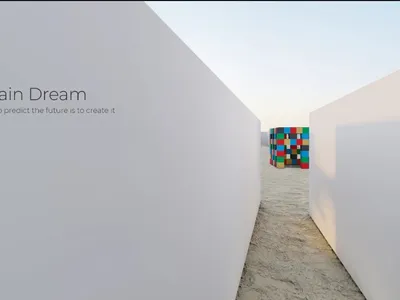
The Main Dream: A Recycled Plastic Kit That Lets Refugee Children Build Their Own Playground
Thirty-centimetre interlocking cubes that connect on three axes turn play into construction, letting children author the spaces they occupy.

Lunar Spiral: A Fibonacci-Driven Moon Settlement Rising from Shackleton Crater
Golden-spiral geometry organises buried infrastructure and orbiting habitable spheres into a lunar base designed to grow as life on the Moon expands.

Explore Living Building Competitions
Discover active competitions in this discipline

Challenge to reimagine the Iron Throne

Photograph architecture without architects

Illustrate the lost glory of Angkor Wat - Render Challenge

Design challenge to reuse E-waste
Comments (0)
Please login or sign up to add comments
No comments yet. Be the first to comment!