

Living With The Land: Closing the Loop Between Food and Urban Form
A shortlisted Urban Meal Mine entry designs a circular food hub where agriculture, architecture, and community ownership converge in one civic anchor.


Cities are remarkably efficient at distributing food and remarkably terrible at connecting people to its origins. "Living With The Land" confronts that gap head-on, proposing a central community hub where growing, processing, distributing, and consuming food all happen within a single architectural framework. The result is not a farm stapled onto a building but a genuine civic space organized around circular material flows: food waste becomes compost, compost feeds greenhouses, greenhouses supply a market hall, and knowledge loops back to surrounding households.
Designed by Jason Brij and Matthew Lau, the project was shortlisted in the Urban Meal Mine competition, which asked entrants to rethink sustainable farming within an urban context. Brij and Lau answered with a masterplan that places a flexible central hub at the heart of a network of greenhouses, growing fields, workshops, and rental spaces for vendors, artists, and small businesses, all connected by clearly mapped exchange loops to the neighborhoods around them.
A Masterplan Organized Around Exchange Loops

The axonometric site plan lays out the project's logic with diagrammatic precision. Labeled programmatic zones, from greenhouse clusters to composting areas, radiate outward from the central hub while circulation diagrams in the surrounding panels trace the four key exchange loops: food production and processing, consumer interaction, waste recycling and composting, and knowledge distribution back to households. Nothing here is incidental; every arrow implies a material or social transaction that keeps the system self-sustaining.
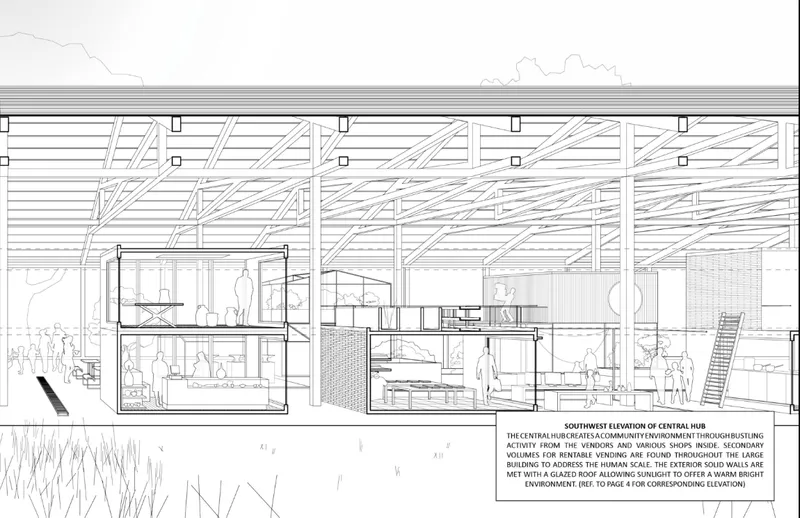
The section drawing peels the roof off the central hub to reveal its structural skeleton: an exposed timber frame that supports a glazed canopy, allowing daylight to flood the vending and workshop spaces below. By choosing timber as the primary structural element and glazing for the roof, Brij and Lau reduce reliance on artificial lighting while giving the interior a warm, market-hall character. Secondary volumes tuck beneath the main structure, providing the flexibility to host fresh produce stalls one morning and a sustainability workshop the next.
Brick, Timber, and a Planted Edge
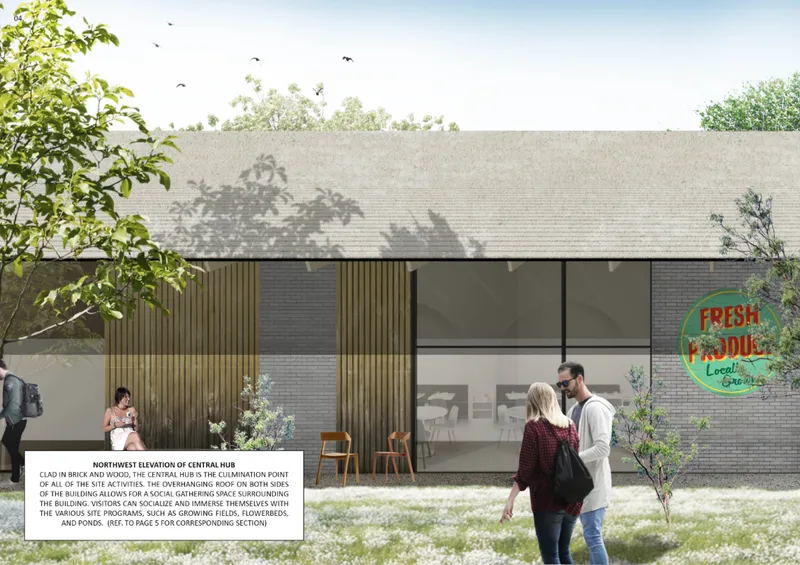
At street level the project presents a facade of brick and timber vertical slats, a material palette that grounds the building in familiar urban textures while signaling its agricultural program through the planted edge running alongside the pedestrian path. The adaptive cladding strategy means each building volume develops its own identity, but the recurring material vocabulary, brick for mass, timber for warmth, glazing for transparency, holds the ensemble together. Pedestrians drift along the planted boundary, which functions as both a buffer zone and an invitation to enter.
Market Hall as Civic Forum
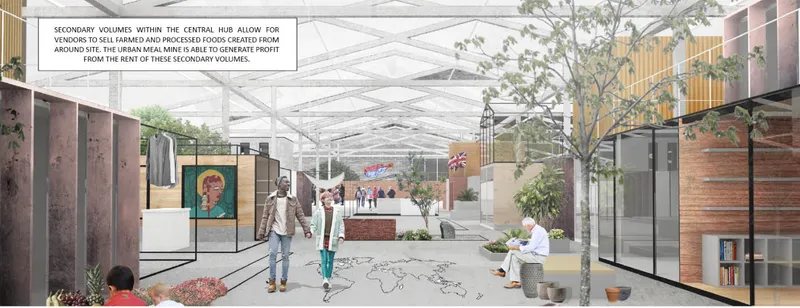
The interior rendering captures the spirit of the project more than any diagram can. Under the glazed canopy, vendor stalls line both sides of a generous central aisle punctuated by full-grown planted trees, an unexpected move that blurs the line between indoor market and public garden. People browse, linger, and talk. The space reads simultaneously as marketplace, gathering hall, and educational venue, exactly the kind of programmatic overlap that transforms a food hub into a genuine cultural anchor.
Communal cooking areas, exhibition zones, and workshop rooms are embedded in the plan so that visitors leave with more than groceries. Brij and Lau's argument is that participation in the food cycle, from seed to plate to compost, generates a sense of community ownership that passive consumption never will. The architecture's openness, both spatially and programmatically, is what makes that participation feel natural rather than instructional.
Neighborhood Connectivity and Circular Flows
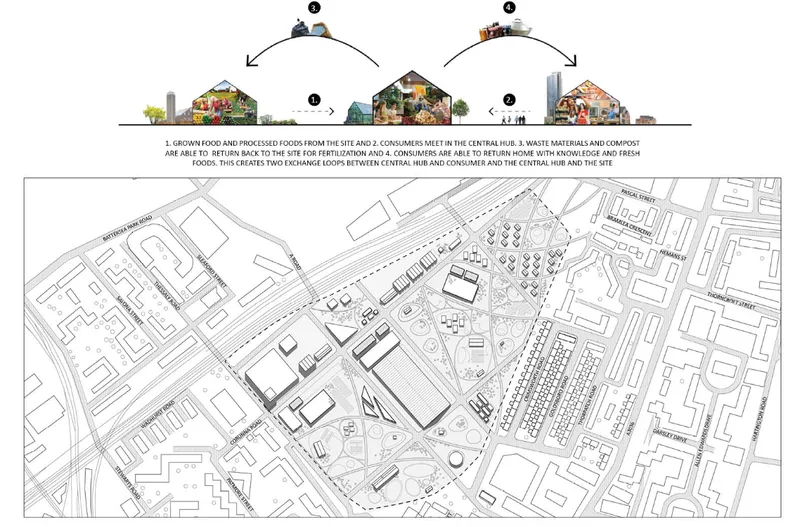
The final site plan zooms out to show how the hub relates to the broader urban fabric. A circulation diagram above the plan traces looping paths that connect the central hub to surrounding neighborhoods, reinforcing the idea that the project is not an isolated compound but a node in a larger urban food network. Composting loops feed nutrients back into growing fields; distribution loops carry produce outward; knowledge loops draw residents inward for classes and workshops. The diagram is simple, but its implications for urban resilience are significant: embed food systems directly into the architecture, and cities become meaningfully more self-reliant.
Why This Project Matters
"Living With The Land" succeeds because it refuses to treat urban agriculture as a bolt-on amenity. Instead, it builds the entire architectural proposition around circular food flows, letting the logic of production, consumption, and waste recovery shape the plan, the section, and the public life of the building. The central hub is not a market that happens to have a greenhouse; it is a food ecosystem that happens to produce architecture.
For designers working on the increasingly urgent problem of urban food security, Brij and Lau offer a clear lesson: the spatial strategy matters as much as the sustainability strategy. Glazed roofs, composting infrastructure, and greenhouse integration are all necessary, but they only become transformative when organized around social exchange. By making the hub a place people want to be, not just a place food needs to go, the project turns a logistical challenge into a civic opportunity.
View the Full Project
About the Designers
Designers: Jason Brij, Matthew Lau
Enter a Design Competition on uni.xyz
uni.xyz runs architecture and design competitions year-round that reward proposals with spatial conviction and real site intelligence.
Project credits: Living With The Land by Jason Brij, Matthew Lau Urban Meal Mine (uni.xyz).


Popular Articles
Popular articles from the community


The Amber Palace Opera: A Geological Fiction Surfaces on Tallinn's Baltic Waterfront
Pierre Brillard reimagines a Baltic legend as a public landscape, opera house, and waterfront promenade rooted in Tallinn's coastal identity.

Manzana Morphosis: Stretching Barcelona's Grid into a Living Landscape for 2050
A radical reworking of the Eixample manzana turns density into a tool for generous public space, vertical ecology, and environmental performance.

Temporary Home for Dogs: A Reversed Zoo Rethinks Animal Shelter Architecture
In Bucharest, a sinuous corridor and freed landscape flip the logic of containment, designing a shelter that works to make itself unnecessary.

Singing Woman: An Opera House That Performs Before the Curtain Rises
Ovidiu Cristian Pavel's conceptual opera house translates Estonia's choral identity into a sculpted waterfront landmark facing the Baltic Sea.

Similar Reads
You might also enjoy these articles

Pixel Gardens: One Repeated Module Stacked Into a Terraced Social Housing Tower for Famagusta
Salem Bader's shortlisted housing tower builds a vertical neighbourhood from one repeated module, offsetting units to carve terraces, light and air.

Bao Huynh Watercolor Atelier: A Serene Art Retreat in Hội An
Bao Huynh Watercolor Atelier in Hội An blends multifunctional art spaces, sustainable design, local materials, and family-friendly living in a serene environment.

Atelier Macri Concept Store Interior Design by CASE-REAL
Atelier Macri store features a "ko" counter, walnut wood details, cork displays, blending retail, gallery, and seamless customer experiences.

Manuel Vargas Izquierdo Stadium and High-Performance Sports Center: Architectural Excellence in Jalpa de Méndez
The Manuel Vargas Izquierdo Stadium blends sustainable design, inclusive sports facilities, and cultural-inspired architecture, revitalizing Jalpa de Méndez’s public spaces.

Comments (0)
Please login or sign up to add comments
No comments yet. Be the first to comment!