
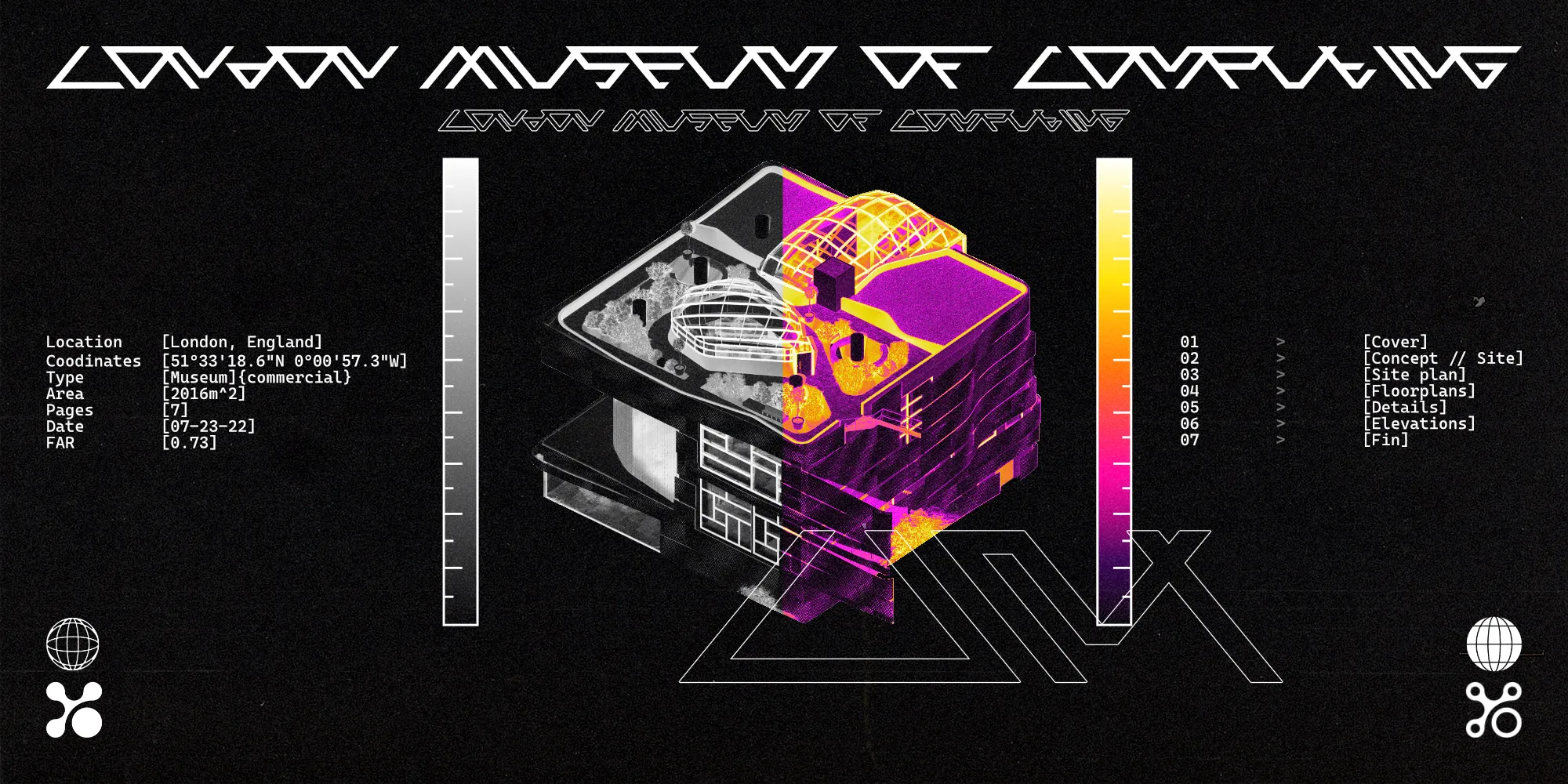
London Museum of Computing
The future is behind us

\<Concept>
The London Museum of Computing is a computer in itself where you are immersed in a seemingly endless space of engagement. From computer illiterate to computer genius, anyone can find enjoyment in viewing the history of what is now a staple in our lives.
The premise of this concept is not only to showcase computations' incredible journey through time, but also to guide it in the right direction for the future. Computers are far from fully evolved and people receive first hand experience with this when it comes to electronics seemingly outdating themselves after a year or two of regular use. Electronics aren't an apple core where you can just throw it out the window of your car. It deserves the proper attention to ensure it receives a second life. In the case of the London Museum of Computation, it will hold a small electronics drop off, where people will both have peace of mind their hardware is being put to good use, and also cash in their pockets as many goods can be post-processed into raw minerals for other uses. Recycling is what inspired the entire project, from the flooring to the facade, to every material. Consistency in being eco friendly was key to the project as a whole since computers get a bad wrap for being environmentally detrimental. While being immersed in a world of technology, sometimes your mind needs a break, thus where the roof terrace comes in. Although greenery may not seem like a proper connection to our computational world, it lies as a reminder to never let our natural world succumb to it, because in the end that is where all the materials come from.
[Site]
The site is located in London, England within Stratford. The museum will showcase many of the inventions and progressions of Alan Turing and Charles Babbage; two London natives who were two of the most vital contributors to computational technology in history.The surrounding area consists primarily of large commercial spaces including the Lee Valley VeloPark and London Stadium. Just a few blocks away in every direction lies residential and green areas. Because of this, the site is a massive hub for both residents and tourists alike
{Materials}
The flooring for the majority of the museum is composed first by a layer of fixed recycled electronics, specifically motherboards, cpu's, and graphics cards. Epoxy resin is then poured over top, giving a transparent and reflective visualization of the components. Facing north on the second and third floors is a thermal viewer. From the outside you can view the silhouettes of people inside the museum in that specific area. Because of humans naturally emitting body heat, the people indoors will be shown in a different tone than the surroundings. This is achieved by placing thermal imaging cameras indoors at numerous angles and then projecting it onto the curvilinear LED screen outdoors. The display can easily change its temperature palette to suit the occasion. There are an infinite amount of possibilities in terms of colour, however the most common ones are Rainbow HC, White Hot, Ironbow, Arctic, Black Hot, Lava, and finally Isotherms which are used to distinguish any temperature beyond a certain point.
The facade is made up of 50 organic shaped flowing panels symbolizing the internal structure of a cord system. They are made of melted down electronic's silver. Low-emissivity glass is used whilst also being covered by the panels. This allows for a consistent internal temperature within the museum while also allowing artistic streaks of light to enter. On the north-west and north-east sides, there are levers which can be manually controlled to bring the covering area of those windows out to the side to let in more light and give a better view of the outdoors. Along with the radiant ceilings, the facade aids in the stack effect, where hot air flows out the top of the windows and in the space between the walls and facade, being naturally replaced by cool air. This allows the structure to be almost entirely self-reliant.
/Sketches
The concept went through many many iterations, each being drastically different from one another, and the forms I ended up choosing were mostly due to the site and how it relates to the area. Through time, the museum will gain new attractions as well as keeping the historic ones. Technology is constantly evolving so a museum is possibly the best thing to showcase that with revolving exhibits. The London Museum of Computing shows us that the future we see is behind us, and society will reinvent technology as we see it today.




Popular Articles
Popular articles from the community


Conexión: Biophilic Design Reimagines High-Rise Living in Hong Kong
Conexión reimagines high-rise living in Hong Kong through biophilic design, green facades, shared spaces, daylight, water and nature within.

Co-Life: Senior Housing Design That Reconnects Older Adults With the City
Co-Life reimagines senior housing design through healing gardens, shared streets, workshops, and a sustainable community across generations.

Lunar Spiral: Space Architecture Shaped by the Mathematics of the Universe
Lunar Spiral reimagines space architecture through Fibonacci geometry, lunar regolith, levitating habitats, and self-sustaining Moon living.

Co-life: Sustainable Architecture for Age-Friendly Community Living
Co-life reimagines sustainable architecture for seniors through courtyards, rammed earth, shared gardens, and spaces designed for belonging.


Similar Reads
You might also enjoy these articles

The Rhythm of Seasons
A Farmers' Market Connecting Nature and the City

More Than a Building-Designing a Living System
More Than a Building-Designing a Living System
Base Beyond
DESERT COMPOUND ARID: TOURISM OF ABSENCE AND ABUNDANCE


Comments (0)
Please login or sign up to add comments
No comments yet. Be the first to comment!