
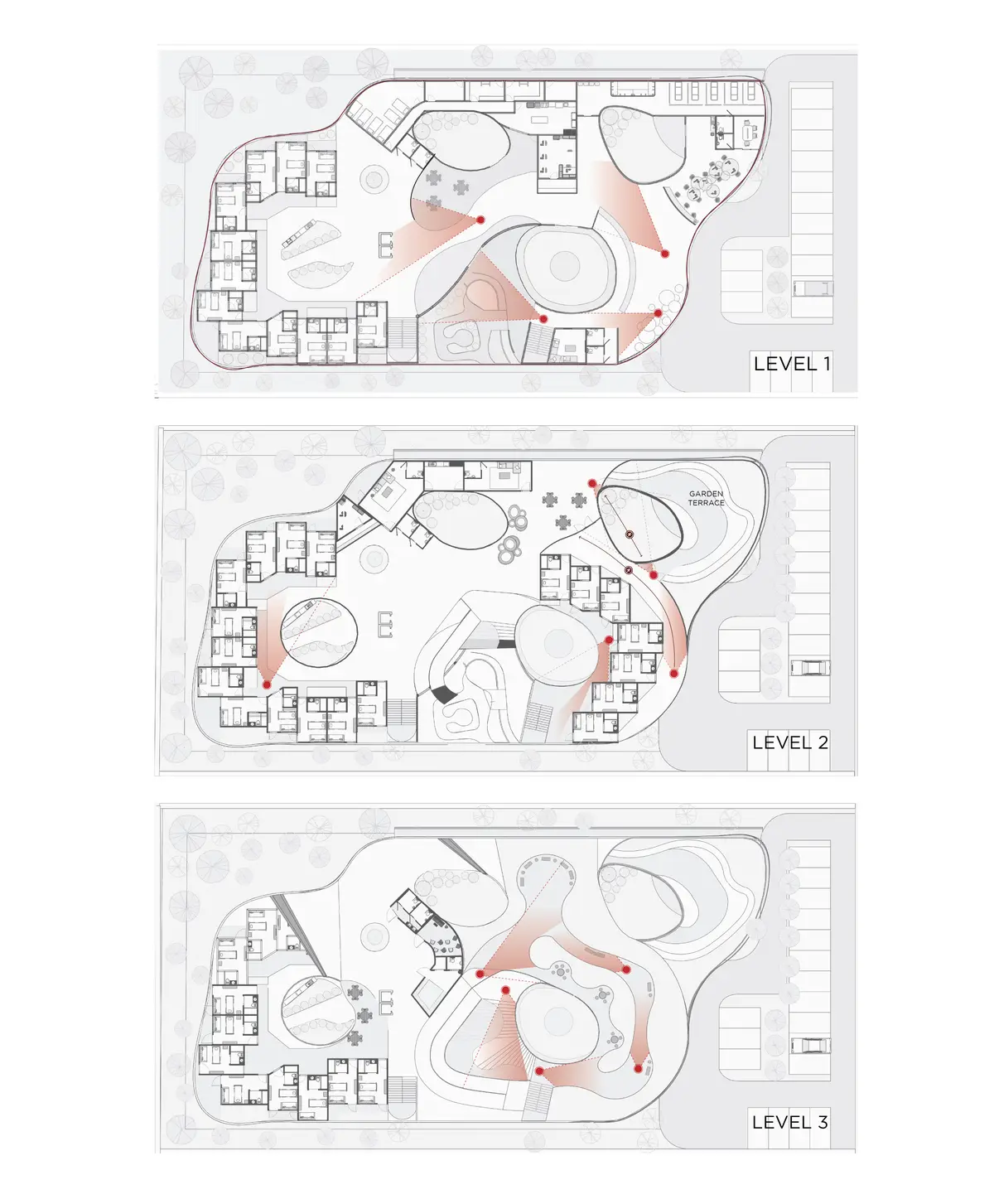
"Lorem Ipsum" Hospice Curve Diagram
Curves explanation and drawing

We wanted the whole activity space to connect without too many walls to separate one space from another. However, with the lack of partition, there comes the disadvantage of less privacy, the feeling of being under the constant watch of other people, which goes against the very notion of hospice to create a relaxing space for its residents. The use of curves become a solution to ensure enough privacy while also attaining the feeling of openness and connectivity.
"Loren Ipsum" Hospice's four main gardens are connected by curvy circulation that also acts as view obstruction. The idea is that life and the future will always remain unknown from our current standpoint view. Therefore every individual must embrace every possibility, including death itself. Only if we dare to walk forward will we find out and see what lies before us.
Curves on the first floor obstruct the view of people coming from the outside to help ensure security within the building. Therefore, the different spaces and activity zones will slowly be visible as visitors walk further inside. In the residential area or also known as "Home", the placement of the curves allow residents to relax, obstructed from public view, yet remain connected.
On the second floor, the geometry of the curves creates a condition that limits the amount of direct line of sight. Although the residential area’s corridor is seemingly linear, what lies up ahead is concealed due to the physical form of the curve.The residential terrace is opened up to encourage interaction between the neighbours. However, privacy can still be obtained by limiting the field of view through the curved layout of the rooms.
On the third floor, the curves allow the stroll garden on the third floor to be divided into three different zones - smaller private cubicles, large pockets for public and community gathering, and narrow pathways to stroll around the garden. Each zone is nearly concealed from the others due to the curved positioning of green areas and plantations.

Popular Articles
Popular articles from the community


Faces of the Soviet Avant-Garde: Turning Moscow's Street Names into an Open-Air Museum
A network of sculptural installations across a Moscow residential district transforms forgotten architect names into spatial encounters with cultural memor

The Amber Palace Opera: A Geological Fiction Surfaces on Tallinn's Baltic Waterfront
Pierre Brillard reimagines a Baltic legend as a public landscape, opera house, and waterfront promenade rooted in Tallinn's coastal identity.

Temporary Home for Dogs: A Reversed Zoo Rethinks Animal Shelter Architecture
In Bucharest, a sinuous corridor and freed landscape flip the logic of containment, designing a shelter that works to make itself unnecessary.

Cloaked Colonization: A Mobile Underwater Habitat That Moves Like a Fish
Micah Abaya's shortlisted EHC Pacific entry reimagines ocean settlement as a dispersed network of self-sustaining architectural organisms.

Similar Reads
You might also enjoy these articles

Shakur's House: Exposed Brick as an Interior Organiser in a 168 m² Mashhad Residence
Brick moves indoors in this Mashhad residence, where masonry walls, glass partitions and teal planes sequence a compact home without closing it off.

Day and Night Park: A Time-Based Urban Newsstand in Beijing
A temporary urban newsstand in Beijing blending travel, light, and reading through poetic colors, compact form, and community-focused design.

Modernist Patio Renovation in El Masnou, Barcelona by Oliver Segura Arquitectura + Cebrià Arquitectura
Modernist patio renovation blending tradition and innovation with a movable pool, leveled floors, and Catalan materials in El Masnou.

Alto Residencial Coop: Cooperative Housing Development in Santiago de Compostela by Carbajo Barrios Arquitectos
A linear cooperative housing complex blending white volumes and perforated metal façades, enhancing community living, natural light, privacy, and urban integration.

Comments (0)
Please login or sign up to add comments
No comments yet. Be the first to comment!