
LR-Architetti Raises a Pink Brick Church from the Ruins of an Earthquake in Pegognaga
A terracotta and timber sanctuary near Mantua transforms seismic destruction into an architectural palimpsest of layered memory.


In 2012 an earthquake severely damaged the parish church of Santa Maria Assunta in Pegognaga, a small town near Mantua. A decade later, LR-Architetti completed its replacement: the Church of the Holy Spirit, a 1,145 square meter building that does not simply occupy the same site but actively excavates and re-presents the memory embedded in it. Ground investigations during construction uncovered a complex stratigraphy of worship structures reaching back to the late Baroque church of San Giorgio. The architects chose not to erase those traces but to build around them, cutting slots into the floor that can be opened on special occasions to reveal the archaeological layers below.
What makes the project genuinely interesting is its refusal to treat reconstruction as either nostalgic replica or clean-slate modernism. The building is an architectural palimpsest operating on multiple registers: brick fragments and gold tiles salvaged from the demolished church resurface in a mosaic executed in the opus scutulatum technique; the footprint of the old nave becomes a courtyard garden rather than a new enclosure; and the orientation of the gabled hall follows that of the long-vanished San Giorgio, turning the congregation back toward the town center. Every decision layers the new over the old without pretending either one doesn't exist.
A Facade That Speaks in Terracotta
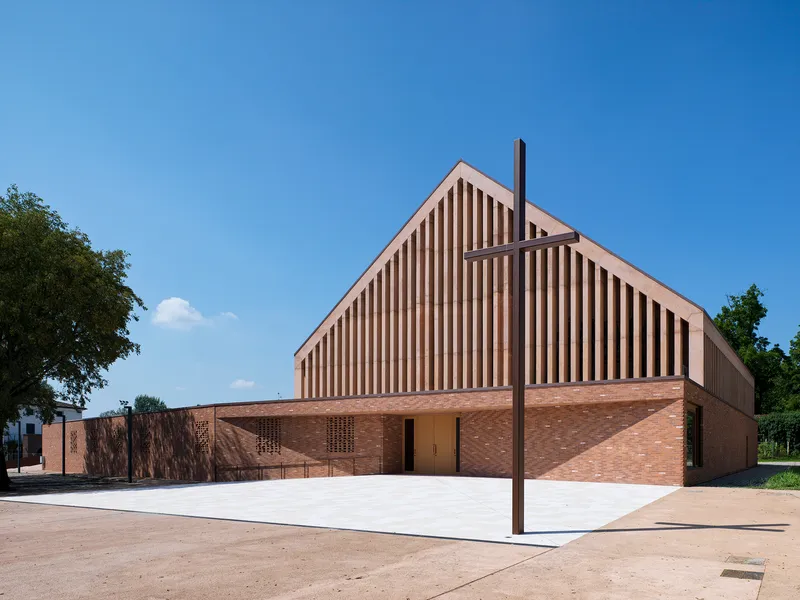
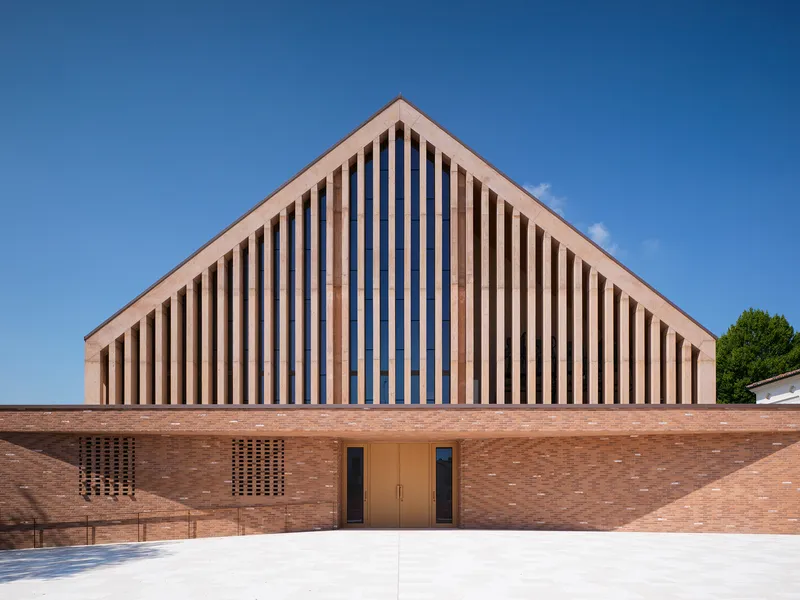
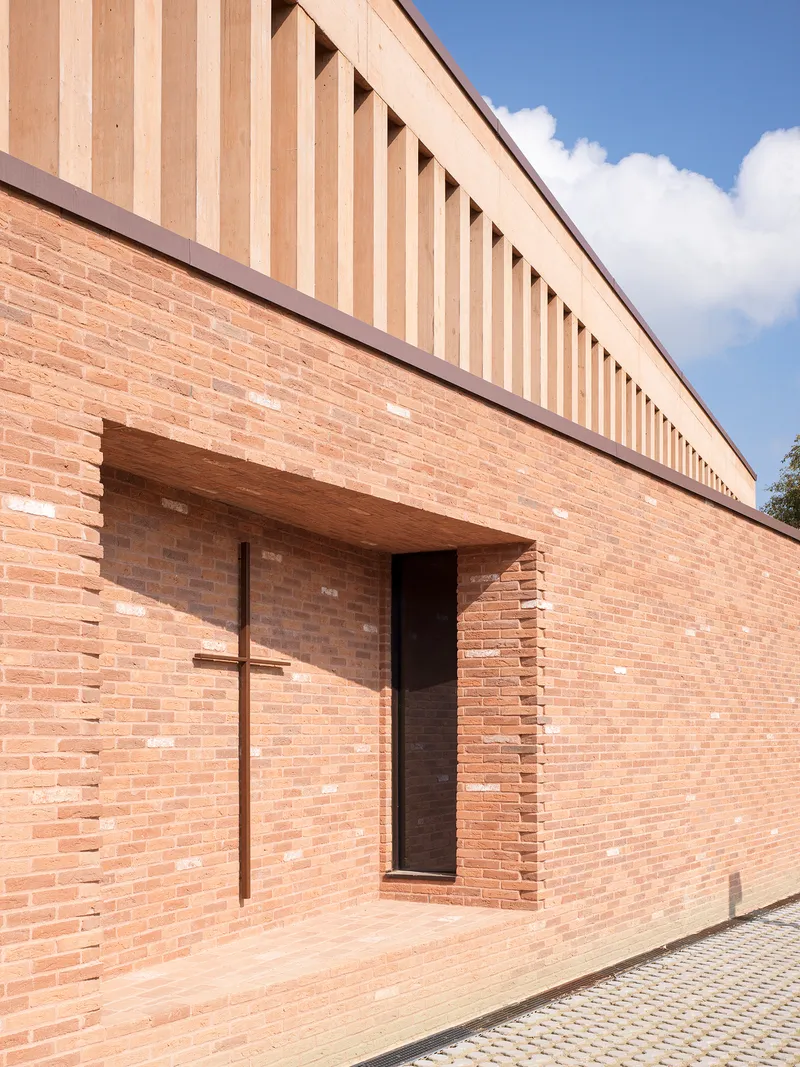
The front elevation announces the building's material thesis immediately. Handmade soft-paste bricks produced by Terreal Italia clad the base in tones that shift from red to cocciopesto, giving the walls a warm, granular texture that reads differently in morning and afternoon light. Above the brick datum, vertical timber louvers screen the gable end, filtering daylight and modulating the scale of what is, structurally, a straightforward pitched volume. A steel cross in the forecourt marks the threshold without competing with the facade.
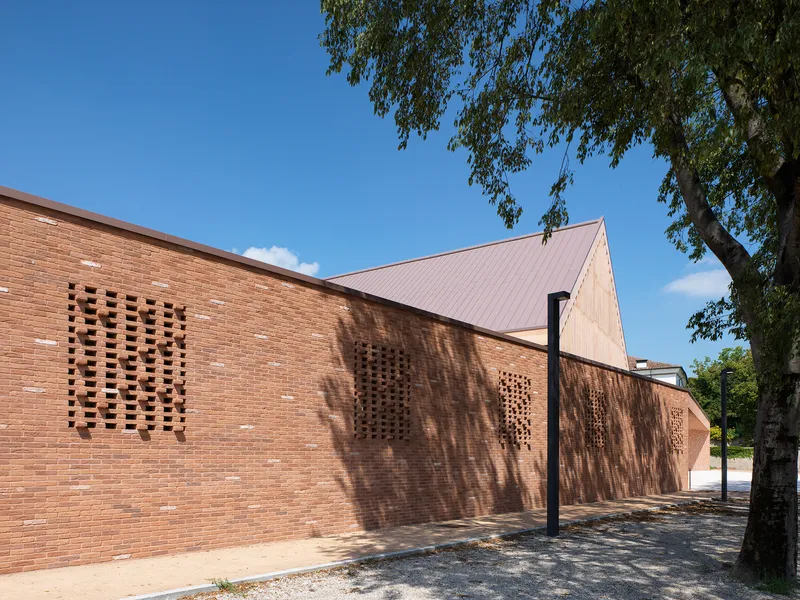
The perforated brick surfaces on the flanks add another register. Where the front is about framing entry, the sides are about admitting light and air. The angular gable roof, clad in titanium-zinc seamed sheets with staggered transversal joints, sits atop this brick base with a precision that makes the junction look almost weightless. LR-Architetti hid the gutter by lowering the ridge, a detail that keeps the roofline clean and lets rainwater disappear without the usual visual clutter.
Threshold and Approach
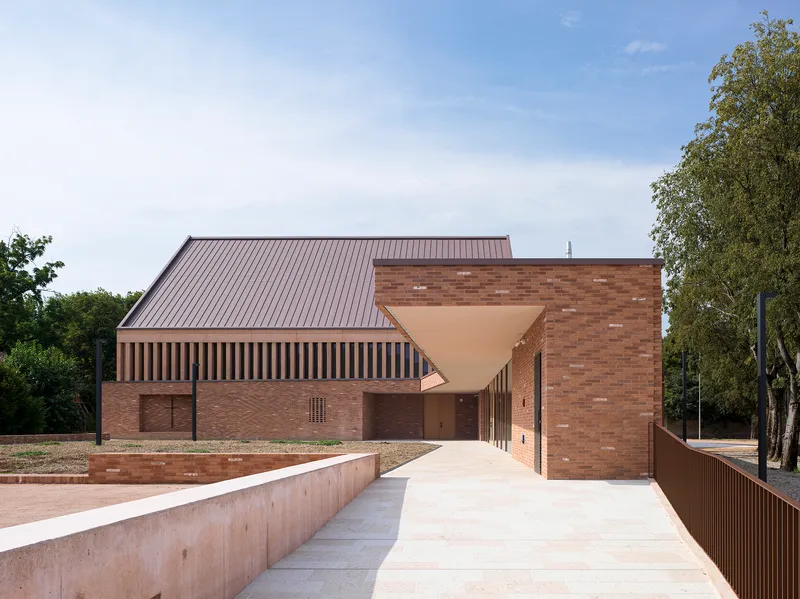
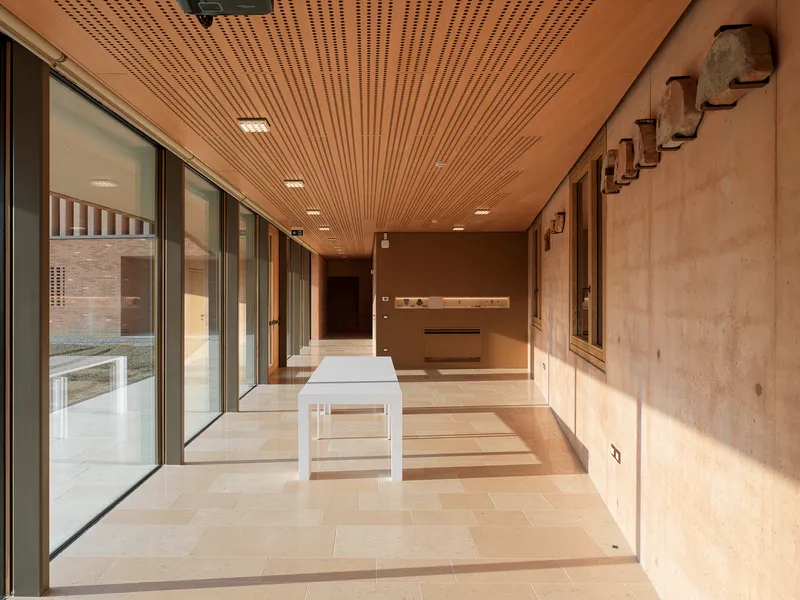
The entrance sequence is deliberate and slow. A cantilevered canopy leads visitors through a corridor of brick walls and vertical timber screens before reaching the doors. The covered walkway between the sanctuary and the low wing features slatted wood ceilings and glazed walls that frame the courtyard garden, the former footprint of the demolished nave. Pink Lessinia stone paves both the exterior parvis and the interior floor in a coarse-to-smooth gradient, a single material carpet that blurs the boundary between outside and in.
A recessed timber cross set into the brick wall beside a narrow entrance opening catches daylight at an oblique angle. It is an understated gesture, more shadow than object, and it sets the tone for a building that favors suggestion over assertion in its iconography.
The Sanctuary in Timber and Light
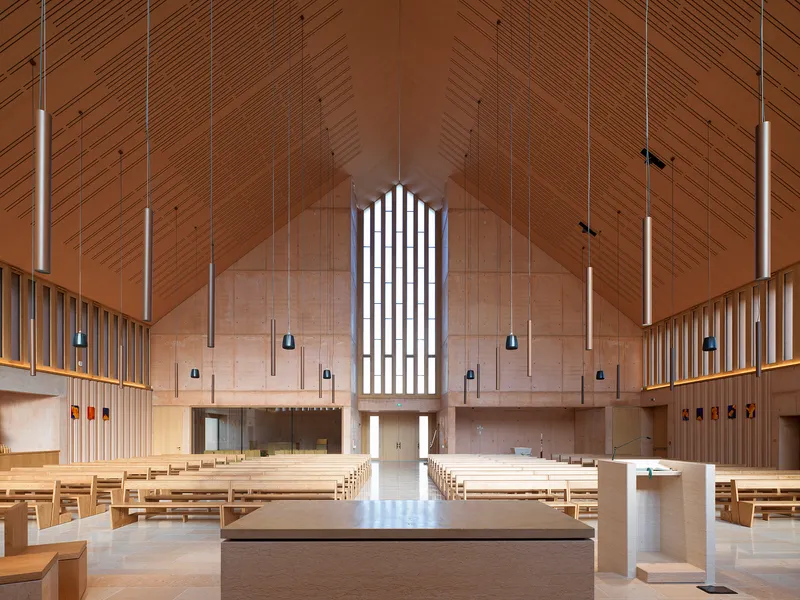
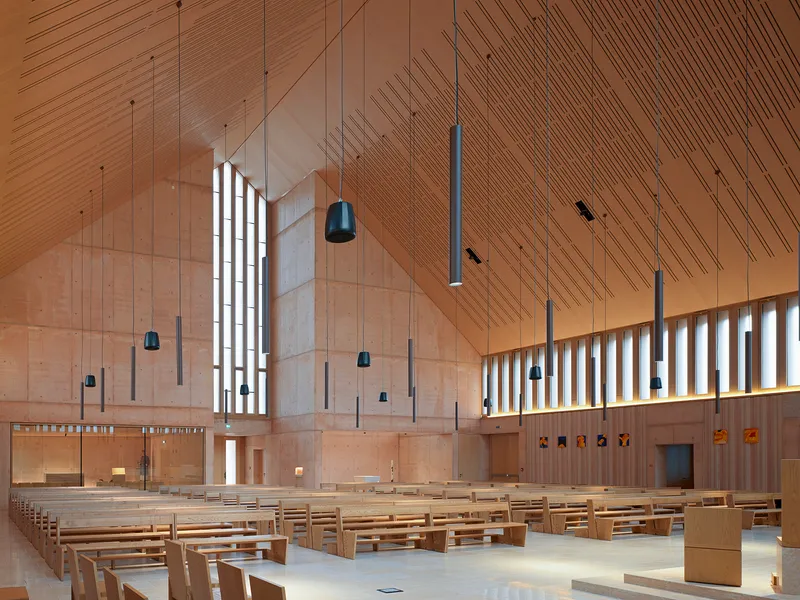
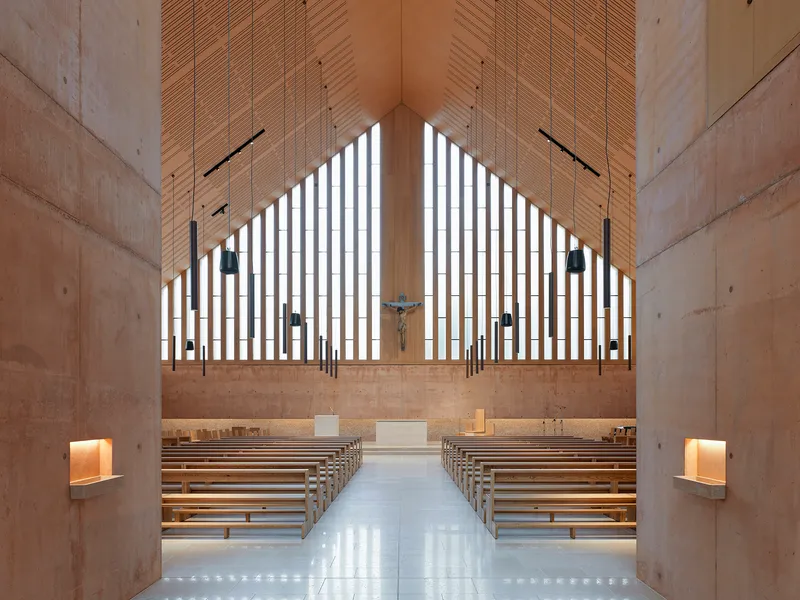
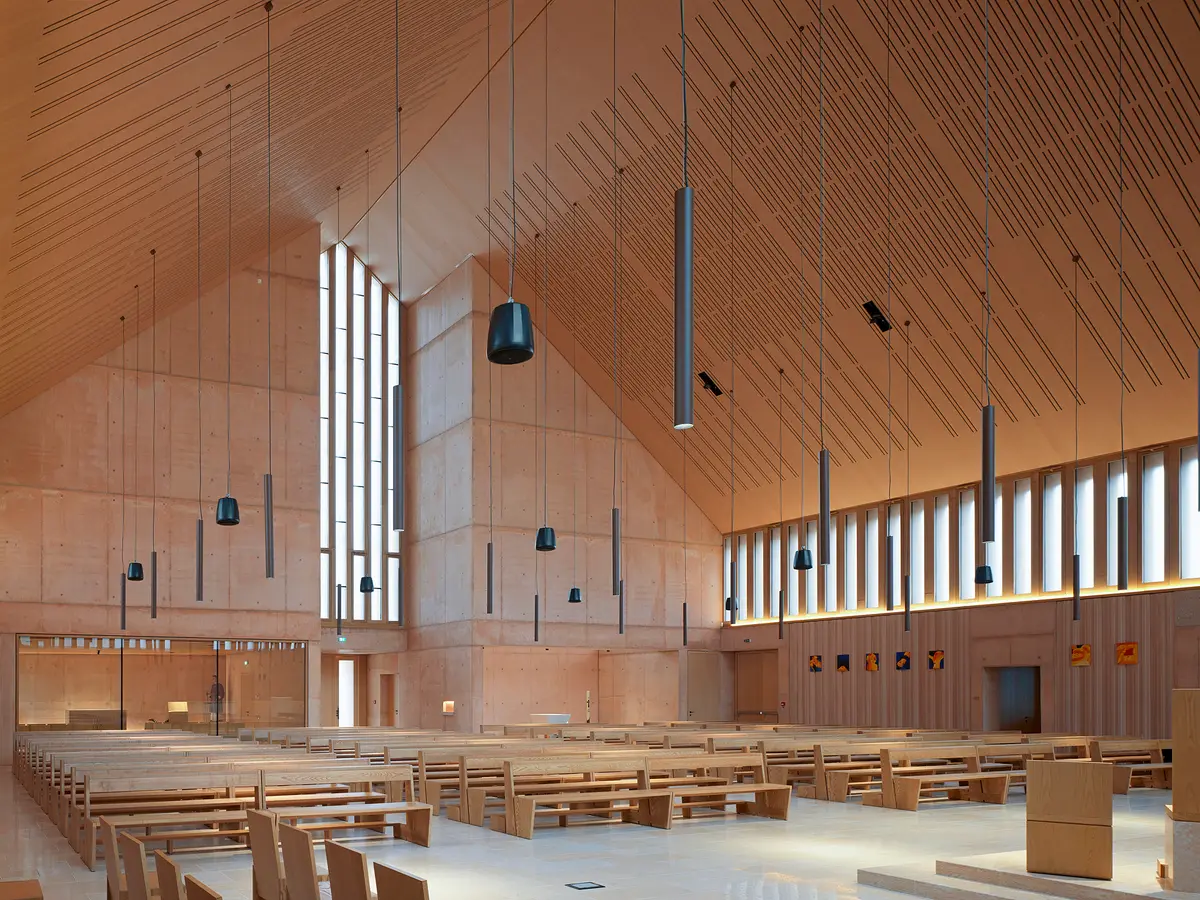
Inside, the sanctuary resolves into a single tall room under a timber-clad pitched ceiling supported by steel beams on terracotta-colored concrete pillars. The pillars are dense and slender, cast with iron oxide pigments in an opus signinum mix that gives them a warm, almost geological presence. Pendant lights drop from the ridge at regular intervals, their suspension cables drawing thin vertical lines against the angled planes of wood above.
Vertical light slots run along the perimeter, pulling daylight down the walls in controlled strips. The effect is cinematic: pews sit in a consistently tempered ambient glow while the altar wall receives more concentrated illumination, especially from a hidden skylight that washes the mosaic at the chancel. Rows of wooden pews face a vertical slatted window wall at the far end, so the congregation looks toward light rather than darkness, a liturgical choice reinforced by the building's orientation toward the town center.
Altar and Liturgical Elements
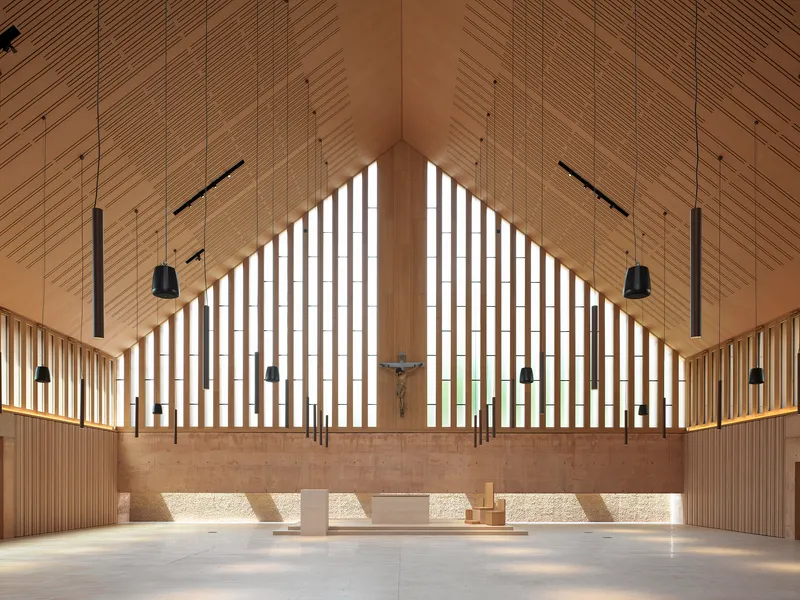
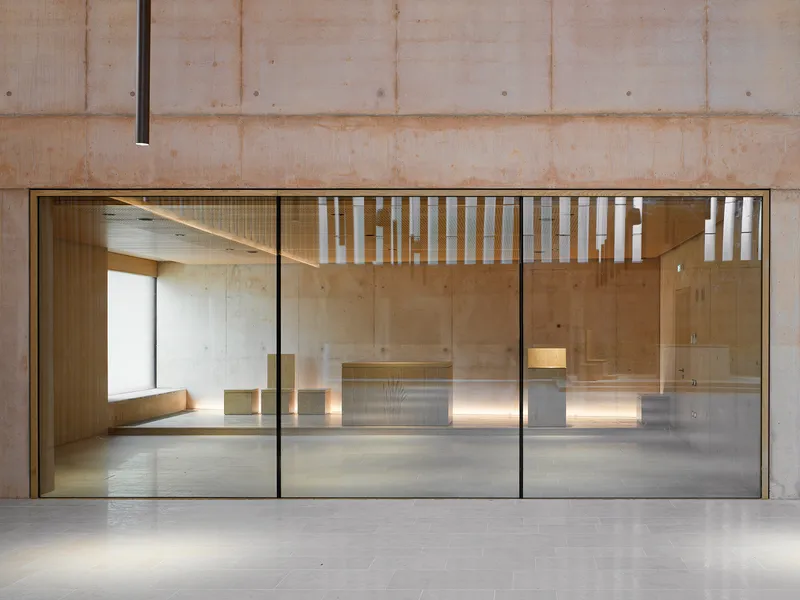
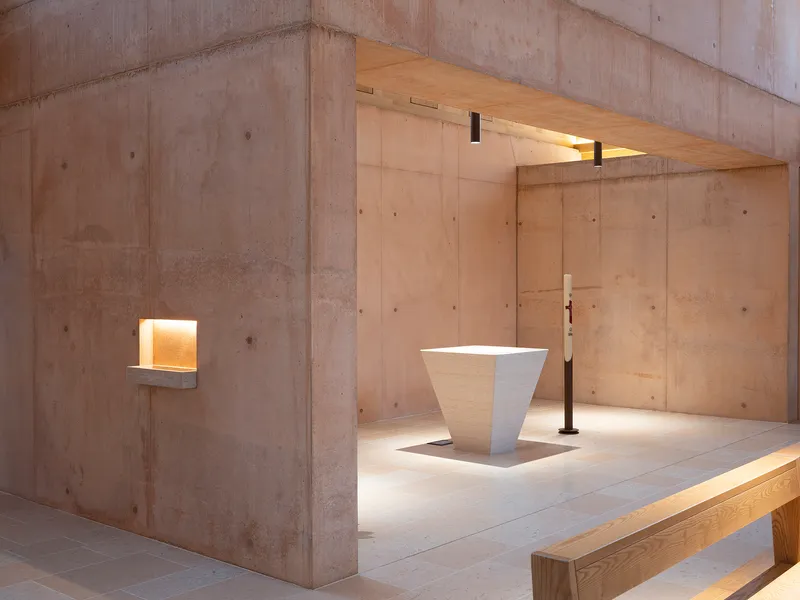
The altar wall layers vertical timber screens, a crucifix, and suspended lighting beneath the pitched wood ceiling. It is restrained to the point of austerity, relying on proportion and the quality of filtered light rather than ornamental excess. Liturgical furniture integrates spoils from the old parish church, so the altar platform carries physical fragments of the building it replaced. Viewed through a glass partition from the lower level, the sanctuary appears to float above a zone of concrete and uplighting, a glimpse that connects the basement parish hall to the worship space without merging them.
The baptismal font, carved from white stone and set on a raised platform beneath exposed concrete beams, occupies its own niche. Recessed wall niches surround it with a geometry that recalls early Christian baptisteries without quoting any one precedent directly. The concrete here is left exposed, its acoustic panels lined with vertical grooves that serve double duty: controlling reverberation in the basement volume and giving the walls a tactile, almost textile quality.
Artifacts and Memory
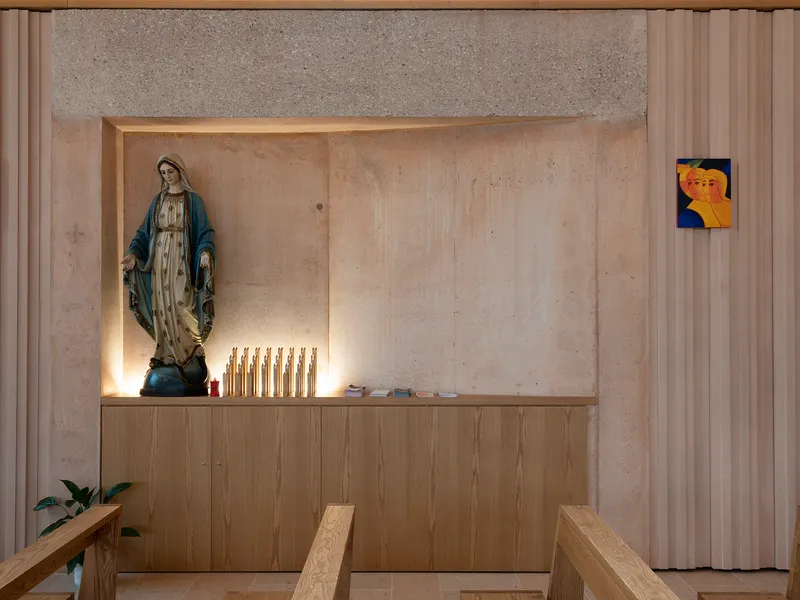
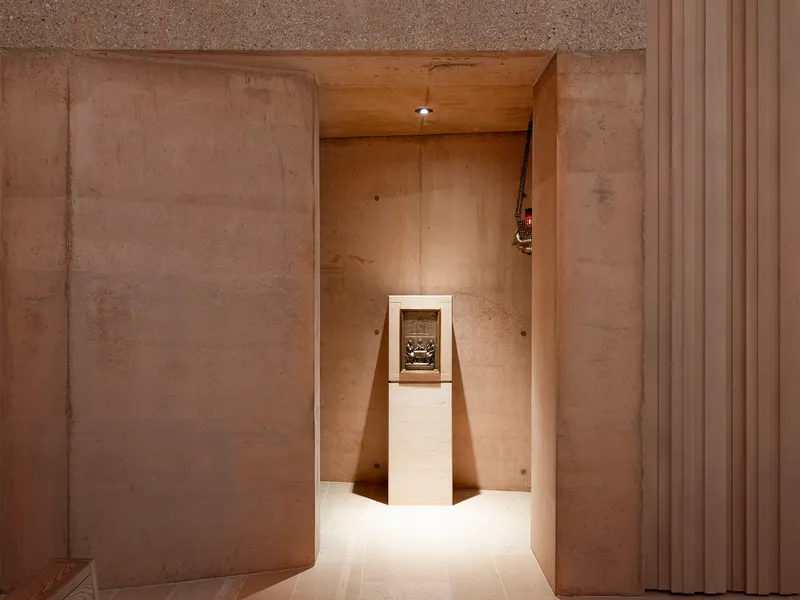
Scattered through the building are moments where the past surfaces physically. A niche in a concrete wall holds a religious statue flanked by candles and timber cabinetry, domestic in scale and deliberately informal compared to the sanctuary's austere planes. Elsewhere, a narrow plywood-lined alcove displays a framed artifact under recessed lighting, presented with the care of a museum vitrine. These small insertions treat the remnants of the previous churches not as relics to be venerated but as evidence to be read.
The earth mosaic on the sloping chancel wall, made from gold tiles and brick fragments recovered from the demolition, functions as the building's most explicit symbol of continuity. Executed in the opus scutulatum technique, it turns rubble into an image of resurrection, a theological idea given literal material form.
The Gabled Volume in Its Setting
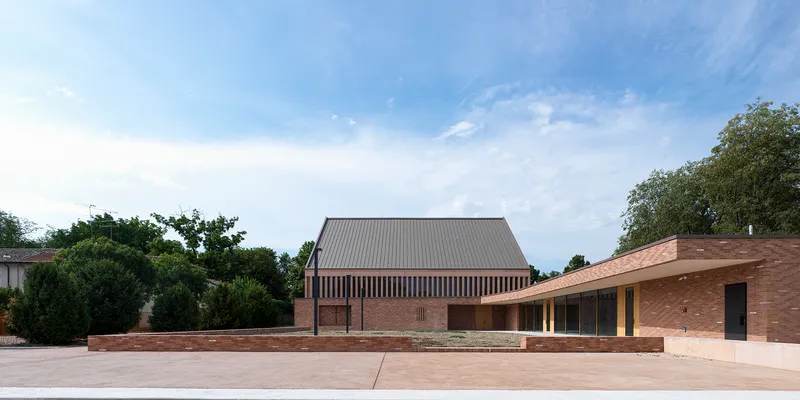
From the side, the church reads as a simple gabled roof rising behind low brick wings, surrounded by trees. The building maintains continuity with a neighboring seventeenth-century villa along the street front, matching its eave height and brick materiality without mimicry. The courtyard garden that occupies the old nave's footprint introduces planting and open sky into what was previously roofed space, reversing the expected logic of reconstruction. Instead of filling the void, LR-Architetti left it open and built the new hall where the former transept stood.
Plans and Drawings
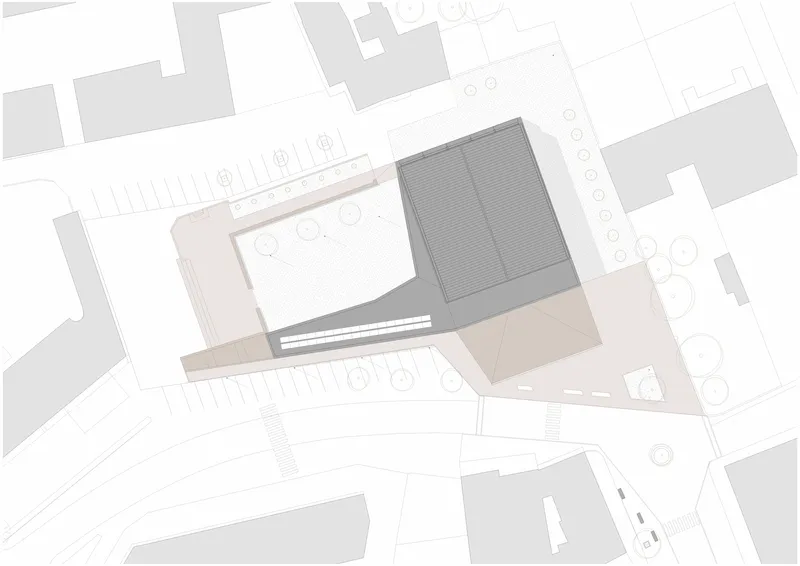
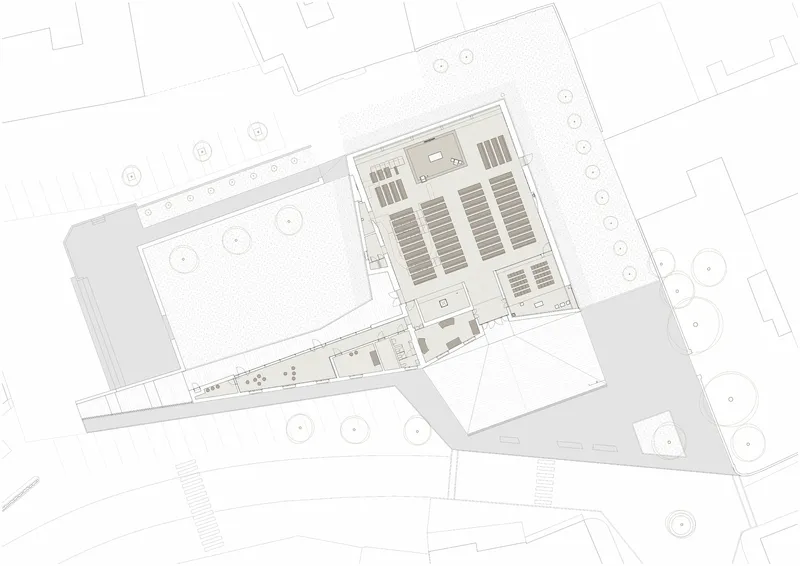
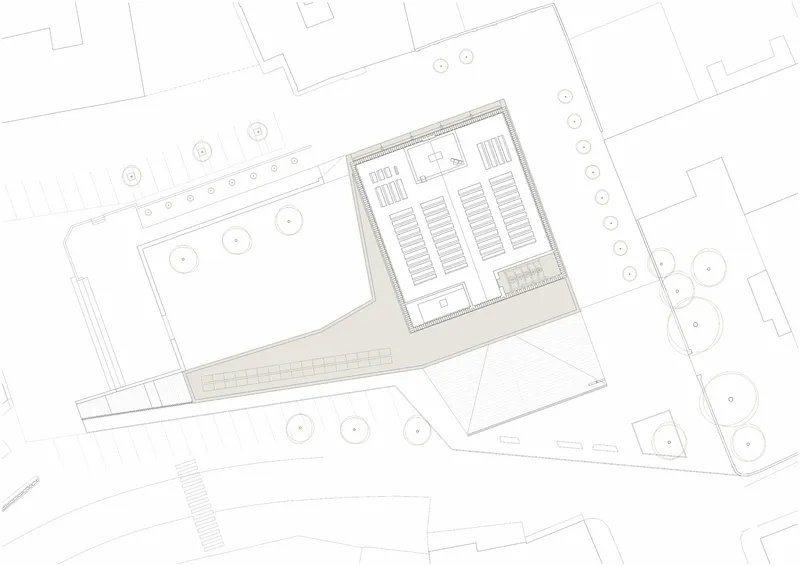
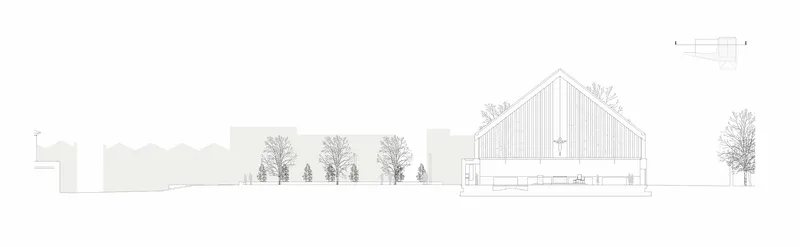
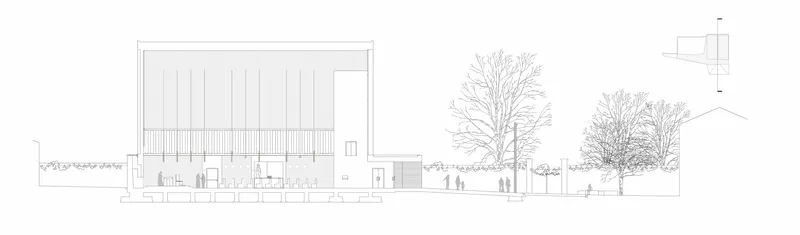
The site plan reveals the two-volume strategy clearly: a gabled sanctuary and a low flat-roofed wing connected by the covered corridor, with the courtyard garden occupying the gap between them. Floor plans show the sanctuary's free central space organized around rows of pews facing the altar wall, with circulation pushed to the perimeter. The basement plan accommodates the parish hall and activity rooms beneath the worship level. The section drawing exposes the steel beam roof structure anchored to robust foundations with tie rods, a seismic strategy that keeps the interior column-free.
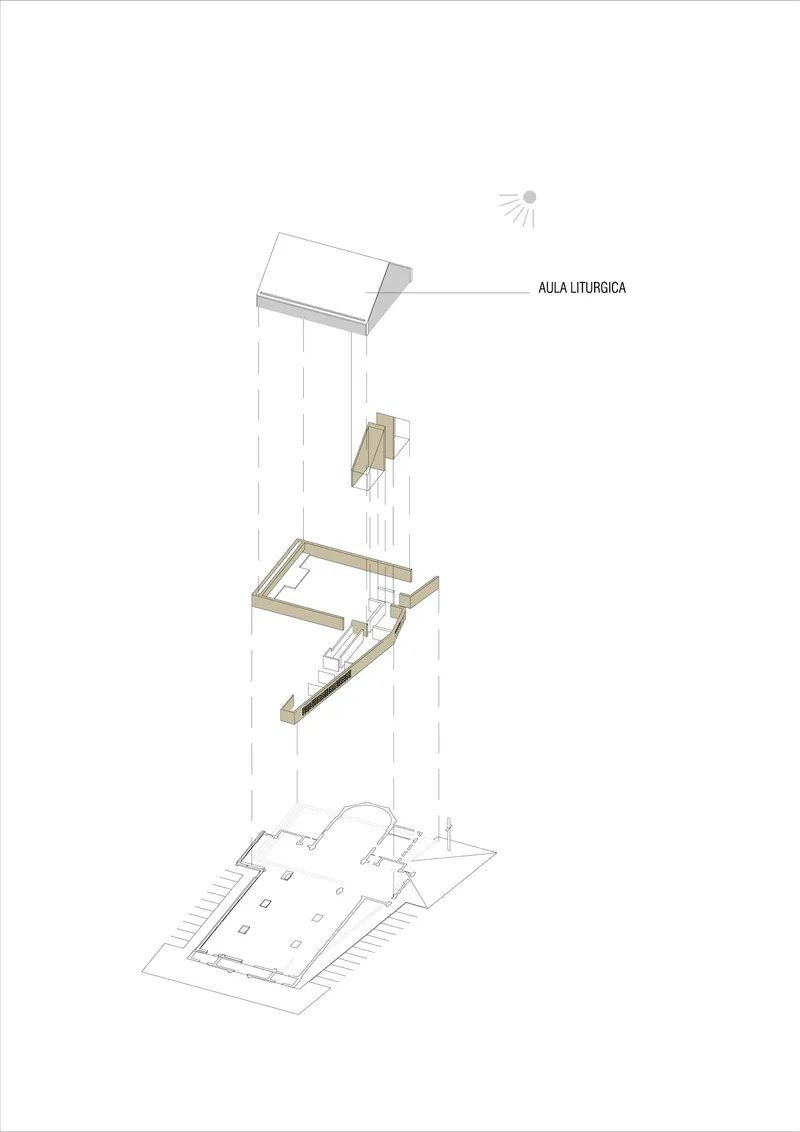
The exploded axonometric is particularly revealing. It separates three stacked levels: the archaeological substratum, the ground floor plan with its stone carpet, and the timber mezzanines and roof structure above. Read together, the drawings make the palimpsest concept legible in a way the photographs alone cannot. Each layer exists independently but gains meaning from the ones adjacent.
Why This Project Matters
Post-disaster reconstruction in Italy too often defaults to one of two modes: faithful replication of what was lost, or a generic contemporary box that could be anywhere. LR-Architetti's Church of the Holy Spirit refuses both. By treating the site as a document with multiple authors and time periods, the firm produced a building that is unmistakably new yet saturated with the specific history of its ground. The floor slots that open to reveal archaeological strata are not a gimmick; they are a spatial argument that the past is not behind us but beneath us, accessible if we choose to look.
The material choices reinforce this argument at every scale. Handmade bricks, opus signinum concrete, salvaged mosaic fragments, and pink Lessinia stone all carry geological and cultural time in their surfaces. The result is a parish church that feels permanent without feeling heavy, rooted without feeling static. In a country where seismic events continue to reshape the built environment, Pegognaga offers a model for how to rebuild with intelligence, specificity, and genuine care for what came before.
Church of the Holy Spirit by LR-Architetti, Pegognaga, Italy. 1,145 m², completed 2022. Photography by Marco Introini.
About the Studio
Share Your Own Work on uni.xyz
If projects like this are the kind of work you want to make, uni.xyz is a place to publish your own, find collaborators, and enter design competitions.


Popular Articles
Popular articles from the community


Co-life: Sustainable Architecture for Age-Friendly Community Living
Co-life reimagines sustainable architecture for seniors through courtyards, rammed earth, shared gardens, and spaces designed for belonging.

Co-Life: Senior Housing Design That Reconnects Older Adults With the City
Co-Life reimagines senior housing design through healing gardens, shared streets, workshops, and a sustainable community across generations.

Hill & Cross Opera: Sculptural Opera House Architecture Shaped by Tallinn’s Landscape and Identity
Hill & Cross Opera reimagines opera house architecture in Tallinn through its sculptural hill, civic plaza, glass wave and a luminous cross.
ALGAL REALM: A Bio-Integrated Lunar Habitat Design for Life Beyond Earth
ALGAL REALM reimagines lunar habitat design with algae-powered life support, 3D-printed regolith, and vertical living for a lunar future.

Similar Reads
You might also enjoy these articles

Bao Huynh Watercolor Atelier: A Serene Art Retreat in Hội An
Bao Huynh Watercolor Atelier in Hội An blends multifunctional art spaces, sustainable design, local materials, and family-friendly living in a serene environment.

Atelier Macri Concept Store Interior Design by CASE-REAL
Atelier Macri store features a "ko" counter, walnut wood details, cork displays, blending retail, gallery, and seamless customer experiences.

Manuel Vargas Izquierdo Stadium and High-Performance Sports Center: Architectural Excellence in Jalpa de Méndez
The Manuel Vargas Izquierdo Stadium blends sustainable design, inclusive sports facilities, and cultural-inspired architecture, revitalizing Jalpa de Méndez’s public spaces.

KAKR Buluh Awar Hall: Revitalizing Community and Ecology Through Bamboo Architecture
Community built bamboo hall revitalizes Buluh Awar village, empowering youth, restoring ecology, celebrating vernacular craftsmanship through sustainable architecture and culture.


Comments (0)
Please login or sign up to add comments
No comments yet. Be the first to comment!