
Luminary: A Modular Lighthouse for Milan's Creative Class
A temporary, reconfigurable tower in CityLife channels the lighthouse metaphor to shelter creative production and radiate civic energy.


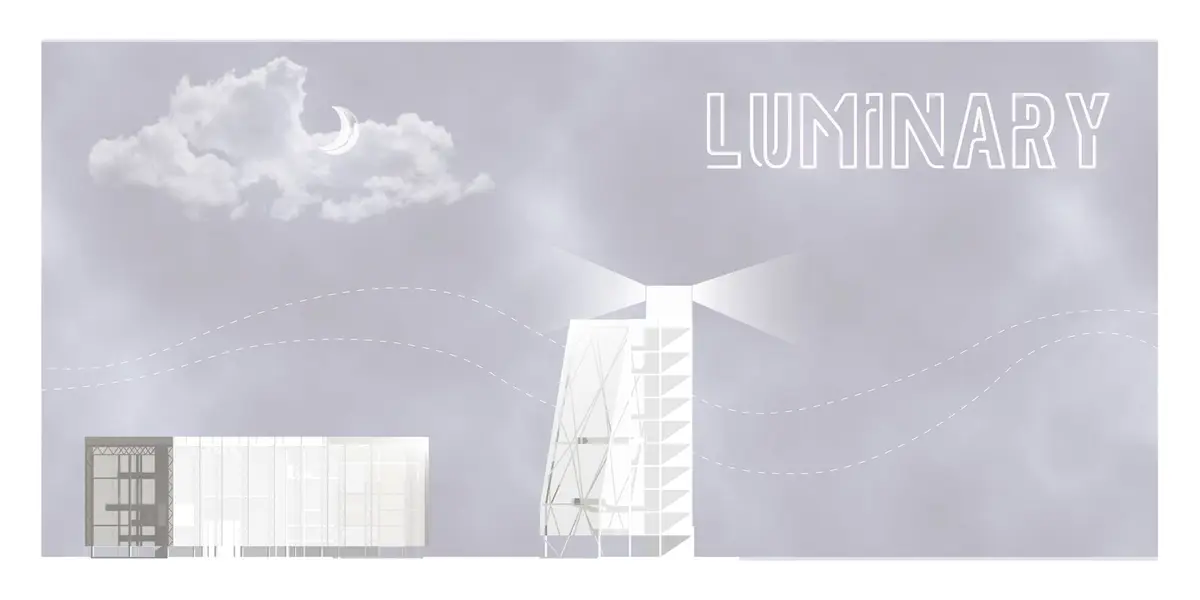
What if a building could behave like a lighthouse: invisible in fog, radiant when occupied, and always oriented toward the people approaching it? Luminary takes that conceit literally, proposing a modular tower at the edge of Milan's CityLife district that fades into the urban haze until its interior lights up with the activity of designers, sound artists, and collaborators working inside. The building's dual nature, quiet shell and glowing core, maps directly onto the creative process it aims to house.
Designed by Александра Дубова and selected as an Editor's Choice entry at Co-design Milan 2020, Luminary sits where pedestrian vectors and pocket parks converge between the CityLife Shopping District and surrounding residential zones. The project draws visitors from the northwest into a plaza anchored by a slender tower and a low-rise pavilion, functioning simultaneously as a design incubator and a public beacon for the neighborhood.
A Beacon on the Plaza Edge


The night rendering reveals Luminary's core theatrical gesture: a white multi-story tower paired with a low-rise pavilion, connected by string lights that drape across a public plaza under a full moon. The composition reads less like a conventional office building and more like a festival ground hardened into permanent infrastructure. The tower's height and orientation are calibrated to punctuate the skyline without overshadowing adjacent structures, establishing a visual anchor that balances statement with subtlety.
The conceptual collage, showing a classical statue in contemplation against a mountain landscape, grounds the project's ambition in something older than modular construction: the idea that creative thought requires withdrawal from noise. Luminary's shell buffers visitors from the city's rush, encouraging what Дубова describes as "hovering in the clouds," abstracting internal creative work from external distraction. The building is meant to be felt before it is understood.
Siting Between Noise and Quiet
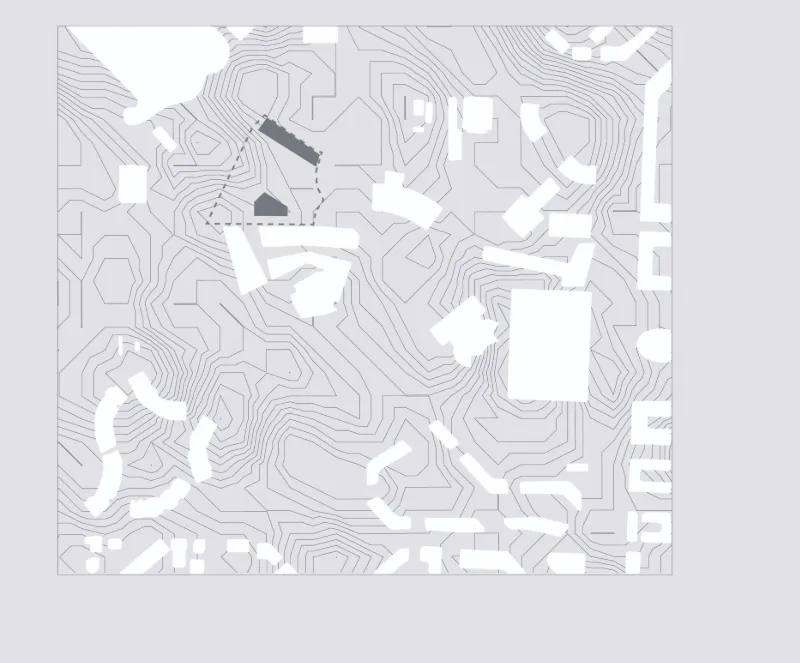
The site plan, drawn with topographic contour lines, locates Luminary at the intersection of commercial energy and residential calm. By respecting this threshold, the project creates a dialogue between the shopping district and the quieter zones around it, maximizing access for residents, workers, and tourists without importing the noise of any single group. The continuous flow of different users transforms Luminary from a private studio complex into a genuinely public piece of urban infrastructure.
Six Spatial Modules, One Ecosystem

The diagram of six spatial configurations is where Luminary's modularity becomes tangible. Cross-shaped volumes, spherical enclosures, and rooms with different material treatments represent the project's programmatic toolkit: regular offices, inspiration zones, sound design studios, exhibition halls, and collaborative workspaces. Each cell can morph based on the user's needs, serving both short-term projects and long-term residencies. The variety isn't decorative; it supports cross-pollination between disciplines, so a sound designer and an exhibition curator might share a wall and, eventually, an idea.
Crucially, these components can be rearranged, downsized, or deconstructed and reused. Luminary treats architectural longevity not as a matter of stasis but of reinvention. In an era where rapid innovation renders static spaces obsolete, this approach proposes that a building's most sustainable quality is its willingness to become something else.
Daylight, Section, and the Double-Height Interior

The section perspective cuts through a double-height interior where figures occupy multiple levels and daylight enters through tall windows. The drawing demonstrates that modularity here does not mean cramped or repetitive; the generous vertical space creates room for both focused work and spontaneous encounter. Light becomes an active participant in the program, shifting through the day to mark time and animate surfaces. The section also reveals how the tower manages its relationship to the ground plane, pulling visitors upward through a sequence of increasingly intimate creative environments.
The Plaza as Shared Ground

The axonometric drawing of the public plaza, populated with figures gathered between tall towers and low buildings, shows Luminary's investment in the space between structures. The plaza is not leftover ground; it is the connective tissue that makes the project legible as a civic proposition rather than a private compound. People linger, cross paths, and improvise gatherings in a zone where the building's modular logic extends outward into landscape and furniture. The result is an environment that adjusts to the task at hand, whether that task is a pop-up exhibition or an afternoon conversation.
Why This Project Matters
Luminary's strength lies in its refusal to separate metaphor from mechanics. The lighthouse concept is not a stylistic veneer applied to a conventional studio building; it organizes the project's siting, orientation, material strategy, and relationship to urban flow. The tower faces northwest to catch arriving pedestrians, its shell dissolves in Milan's characteristic fog, and its interior glows outward only when activated by human presence. Every design decision serves the central idea.
The modular strategy, meanwhile, addresses a real tension in contemporary creative work: the need for both stability and impermanence. By designing components that can be reconfigured or relocated entirely, Дубова offers a model for architecture that ages gracefully not through preservation but through adaptation. In a discipline often fixated on the permanent object, Luminary makes a persuasive case for the building that knows when to change shape.
View the Full Project
About the Designers
Designer: Александра Дубова
Enter a Design Competition on uni.xyz
uni.xyz runs architecture and design competitions year-round that reward proposals with spatial conviction and real site intelligence.
Project credits: Luminary by Александра Дубова Co-design Milan 2020 (uni.xyz).


Popular Articles
Popular articles from the community


David Ortega Stacks a Two-Story Mexico City Penthouse Around a Steel Stair and a Pergola-Shaded Roof Terrace
In Colonia Roma, a 300 m² penthouse uses oak joinery, a planted steel stair and a slatted roof pergola to make a new-build apartment feel like a house.

Architekt Andreas Gruber Scatters 23 Dark Timber Chalets Across a South Tyrolean Forest Edge
In Molini di Tures, Amonti Chalets breaks a resort into a hamlet of gabled timber houses, with parking, storage and services pushed into the slope.

LT2A and OPEN Architectes Thread a Brick and Glass High School Through a Wooded Belgian Campus
In Braine-l'Alleud, a 3,000 m² wing for Collège Cardinal Mercier pairs pale brick with a glazed colonnade, deferring to a small chapel and a dense wood.

David Macias Steps a Doorless Stone and Plaster House Down a Tropical Colombian Hillside
In the humid hills of Colombia, Threshold House replaces the front door with an open void and terraces its 850 m² down the slope instead of fighting it.

Similar Reads
You might also enjoy these articles


Vereda Arquitetos Renovates a 40-Square-Meter Apartment Inside Niemeyer's Copan Building
A compact unit in São Paulo's most iconic residential tower gets a material overhaul that pairs exposed concrete with bold blue Formica.

Shakur's House: Exposed Brick as an Interior Organiser in a 168 m² Mashhad Residence
Brick moves indoors in this Mashhad residence, where masonry walls, glass partitions and teal planes sequence a compact home without closing it off.

Day and Night Park: A Time-Based Urban Newsstand in Beijing
A temporary urban newsstand in Beijing blending travel, light, and reading through poetic colors, compact form, and community-focused design.

Modernist Patio Renovation in El Masnou, Barcelona by Oliver Segura Arquitectura + Cebrià Arquitectura
Modernist patio renovation blending tradition and innovation with a movable pool, leveled floors, and Catalan materials in El Masnou.

Explore Luminaire Competitions
Discover active competitions in this discipline

Challenge to design public laboratory

Challenge to design lighting inspired by nature

Challenge to imagine architecture inspired by fiction

Challenge to reimagine the Iron Throne
Comments (0)
Please login or sign up to add comments
No comments yet. Be the first to comment!