
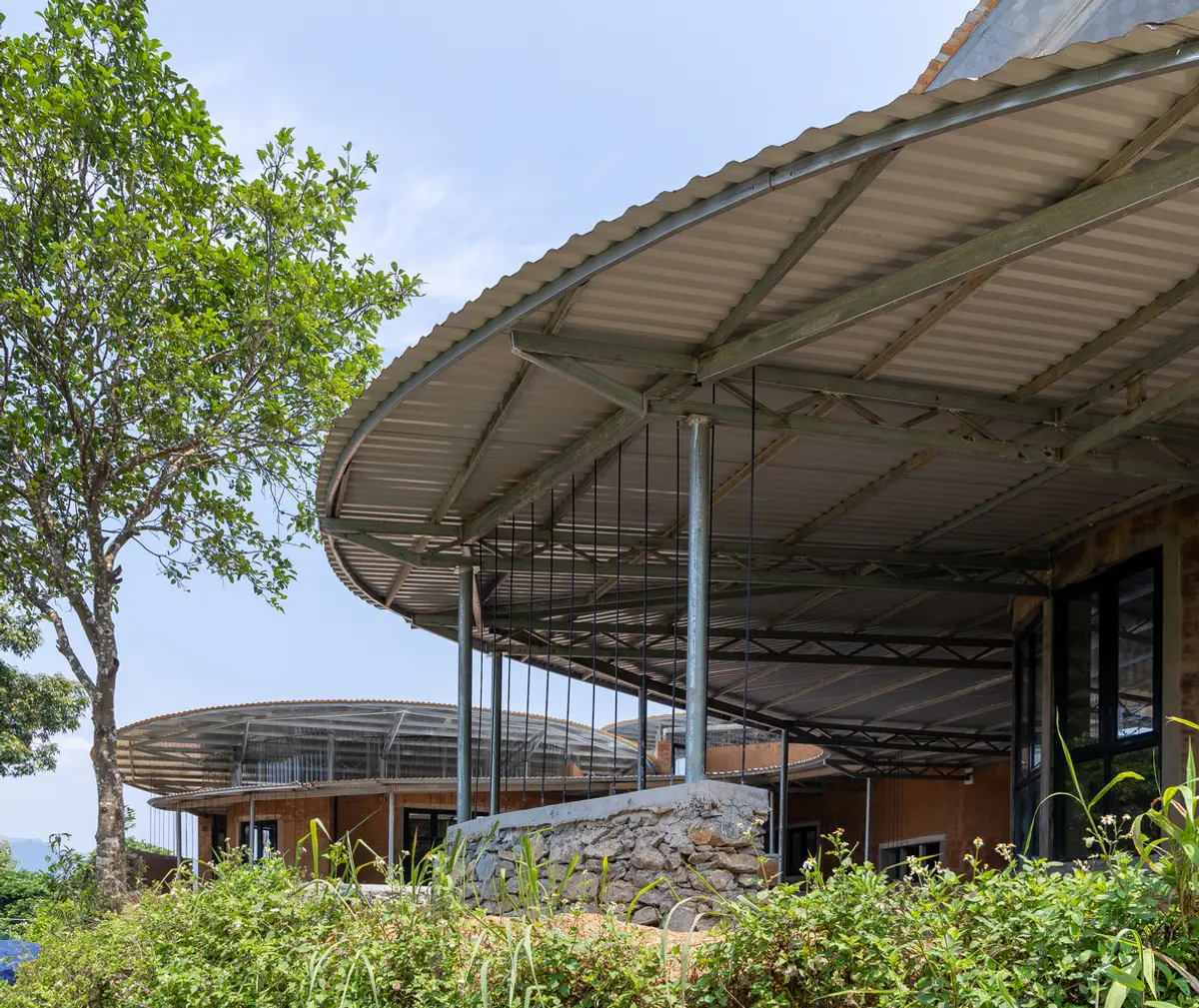
1+1>2 Architects Plants a Rammed Earth School on a Remote Hmong Mountaintop in Ha Giang
Built by hand for 55 households in northern Vietnam, Lung Vai School turns local earth and communal labor into a 250-square-meter learning hub.


Getting construction materials to Lung Vai village requires carving a path through terrain that has no road network to speak of. The village sits on a craggy peak in Ha Giang province, home to 55 Hmong households whose children, until 2020, had no proper school. 1+1>2 Architects responded with a building that cost roughly 80,000 US dollars and took six months to complete, using rammed earth walls mixed from sand and clay found on site. Residents of Lung Vai and neighboring Bac Sum literally paved the way, joining hands to haul materials up the mountain.
What makes the project worth studying is not its budget or even its remoteness, though both are striking. It is the discipline with which the architects matched every design decision to a constraint. Circular roofs shaped like wild mushrooms are not aesthetic whimsy; they shed monsoon rain, shade rammed earth walls from direct sun, and overlap one another to drive cross ventilation through classrooms. Steel framing was chosen where column spans widen because speed and robustness matter when you have no electricity and limited water on site. The school is simultaneously a piece of land art and a piece of infrastructure, and it treats those two roles as the same thing.
Rooted in the Ridge
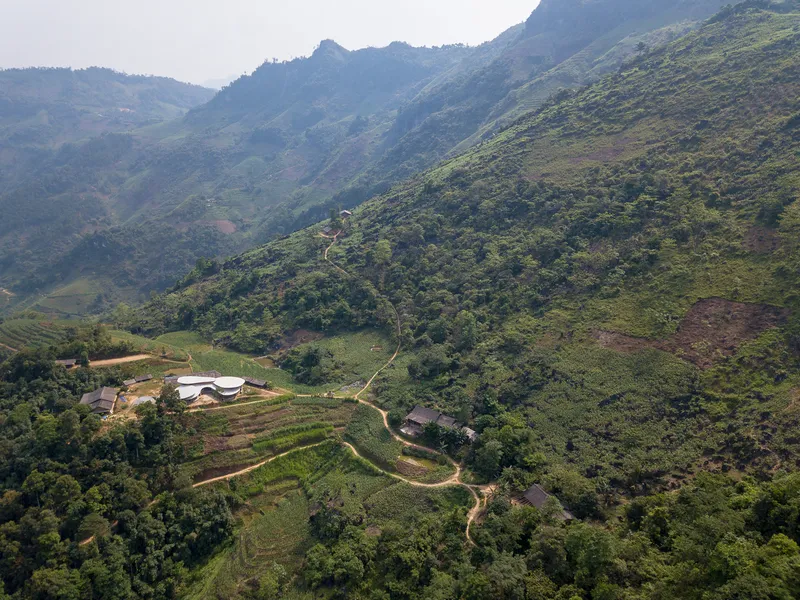
Seen from the air, the three adjoining buildings nestle into the terraced hillside like geological formations. Their curved roof profiles echo the contour lines of the rice paddies below, and their earth-toned walls disappear into the slope. The architects describe the design as a space of continuous high and low movement inspired by winding hills, terraced fields, and blocky village roofs. That language could sound vague, but the aerial view makes the correspondence legible: the school reads as another terrace in the landscape.
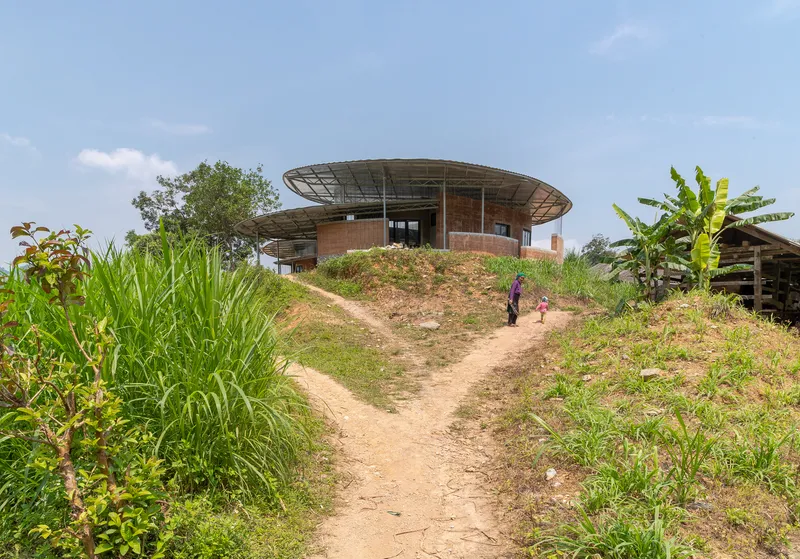
Approaching on foot, a dirt path winds through wild grasses before the circular canopies reveal themselves. The floor is raised slightly above natural grade, a pragmatic move that keeps classrooms dry during rains while creating a threshold between landscape and interior. There is no formal entrance gate, no institutional signage. You arrive at the school the way you arrive at a neighbor's house: by walking up.
Mushroom Canopies and Steel Bones
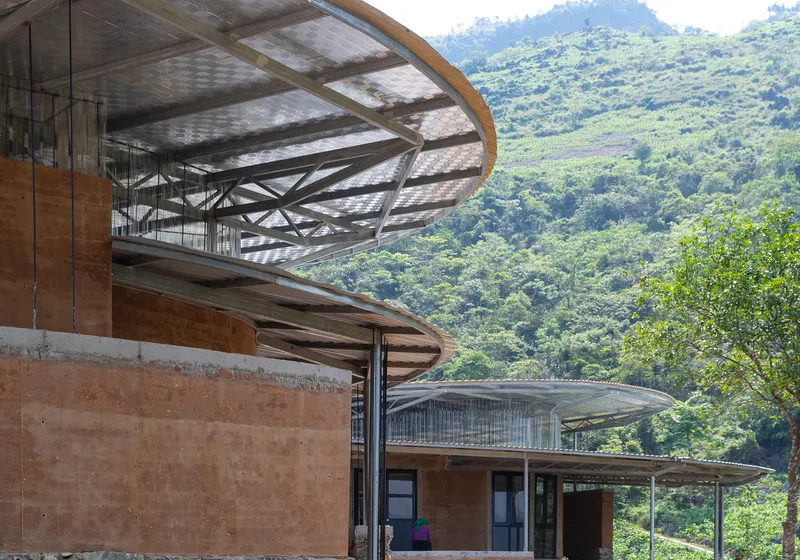
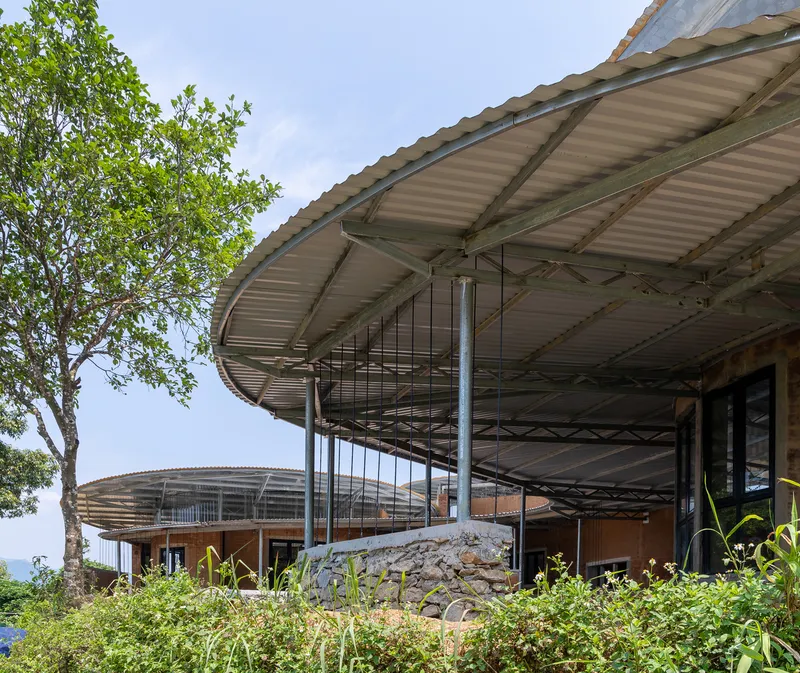
The roof system is the project's most visible invention. Circular canopies cantilever well beyond the rammed earth walls, supported by exposed steel trusses and slender columns. The overhang keeps classrooms cool in summer and dry during the rainy season while allowing the void between wall top and roof to be filled with translucent polycarbonate panels. These panels admit daylight without the thermal penalty of conventional glazing, a simple but effective detail in a building with no mechanical systems.
Steel was a deliberate choice, not a default. Where column spacing increases, particularly across the multifunctional hall and covered terraces, rammed earth alone cannot span the distance. Steel framing solves that problem quickly, and speed mattered on a site where every day of construction depended on hand-carried supplies. The overlap of one building's roof onto the next creates continuous shade and channels breezes between the structures, turning the gaps between buildings into usable circulation space.
Earth Walls as Thermal Mass and Identity

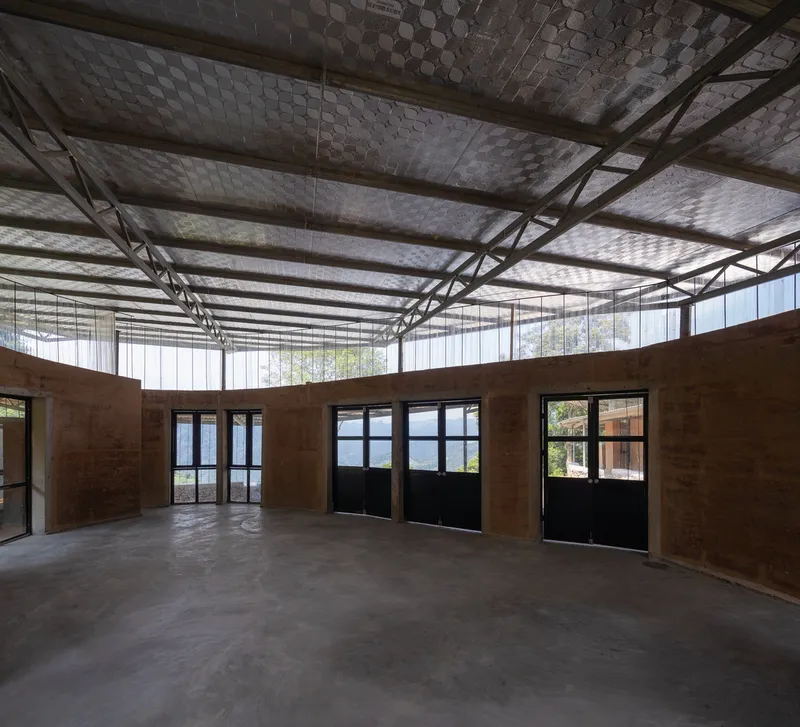
Rammed earth is not a novelty in Ha Giang province; it is a regional building tradition. The architects used a mixture of sand, clay, and locally available aggregates in proportions calibrated to the site's specific soil. The walls perform double duty: they absorb heat during the day and release it slowly at night, moderating temperatures on a mountaintop where cold winds are a constant. Their ochre and brown tones allow the schoolhouses to blend into the surrounding terrain, reinforcing the sense that the building grew out of the ground rather than being placed on it.
Inside, the texture of the rammed earth is left fully exposed, and the layered striations of the compaction process become the primary interior finish. Overhead, hexagonal ceiling tiles and curved timber slats add warmth without competing with the raw honesty of the walls. The effect is a classroom that feels sheltered without being enclosed, a cave with generous openings to the valley below.
Classrooms Open to the Valley
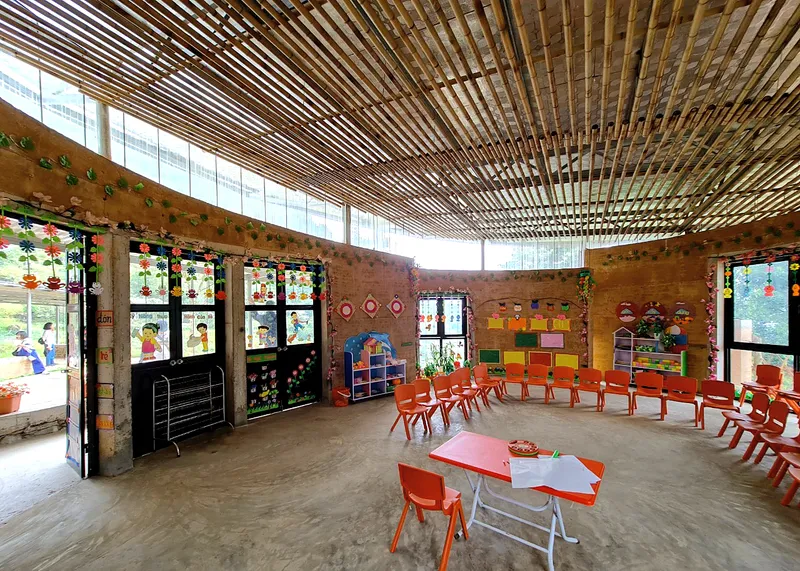

The program splits across the three buildings: one for kindergarten, one for elementary classrooms, and one housing the teacher's office, kitchen, bathrooms, and a multifunctional hall. Hallways are deliberately wider than standard, lined with built-in bench seating that turns circulation into social space. Four entry areas link to stairs and ramps connecting floors, so the building is navigable by the youngest students without bottlenecks.
Large windows and generous wall openings above the rammed earth allow cool mountain breezes to pass through the classrooms continuously. One interior space features a full glass wall oriented toward the forested mountains, dissolving the boundary between lesson and landscape. Orange plastic chairs, the most conventional objects in the building, sit in bright contrast to the earth walls and steel trusses. They are a reminder that this is, above all, a functioning school where children sit, learn, and look out at the world they will inherit.
Thresholds and In-Between Spaces

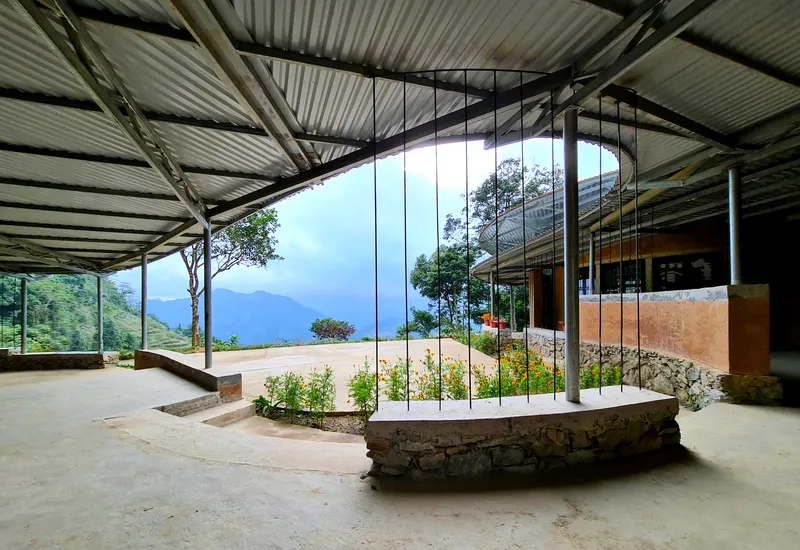
Some of the most compelling moments happen outside the classrooms. A covered terrace with a corrugated metal ceiling and glass perimeter frames the mountain slopes like a panoramic screen. Curved planting beds filled with young trees sit beneath steel tension rods, softening the boundary between built and grown. Rainwater is harvested from the overlapping roofs and carried to an underground storage tank, closing a resource loop on a site where water supply is limited.
These interstitial zones serve the school's dual function as a center of learning and a venue for cultural activities. The Hmong community gathers here for events that extend well beyond the academic calendar. By making circulation and outdoor space generous, the architects ensured the building serves the village, not just its students.
Why This Project Matters
Lung Vai School is a proof of concept for what community-driven, materially honest architecture can achieve at a price point that most institutional budgets would dismiss as impossible. At roughly 80,000 US dollars for 250 square meters, the project delivers thermal comfort, natural light, rainwater harvesting, and cultural resonance without a single mechanical system. It does so not through technological innovation but through intelligent deployment of techniques that already exist in the region: rammed earth walls, extended overhangs, overlapping roof planes, and natural ventilation pathways.
More broadly, the project reframes the relationship between architect and community. 1+1>2 did not parachute a design onto a mountaintop; they worked within the logistical reality of a site with no roads and no electricity, relying on communal labor and locally sourced materials. The result is a school that belongs to Lung Vai in the most literal sense. Its walls are made of the same earth the village stands on. Its form mirrors the terraced landscape the Hmong have cultivated for generations. And its doors are open to 55 households whose children now have a place to learn that feels as permanent and inevitable as the mountain itself.
Lung Vai School by 1+1>2 Architects, Minh Tan commune, Vi Xuyen district, Ha Giang province, Vietnam. 250 square meters. Completed 2020. Photography by Trieu Chien.
About the Studio
Share Your Own Work on uni.xyz
If projects like this are the kind of work you want to make, uni.xyz is a place to publish your own, find collaborators, and enter design competitions.


Popular Articles
Popular articles from the community


GROUP A Strips a 1969 Rotterdam Harbor Headquarters to Its Frame and Wraps It in Timber Louvers
In Rotterdam's M4H harbor district, Ferro Offices reuses a 1969 frame, adds one timber storey and reaches BREEAM-NL Outstanding.

Cube Design Draws an Ecological Corridor Between Two Shenzhen Hills with the Nankai Building
Beside Shenzhen's container docks, the Nankai Building pairs stacked balconies with a climbing green screen to connect two hillsides across its height.

U.GA Architects Wraps an Oval Rooftop Pool in Curved Board-Formed Concrete on Busan's Jeollidan-gil
In Busan's Jeonpo-dong, a 454 m² mixed-use block stacks a neighborhood facility, guest rooms and an oval rooftop pool inside spiraling concrete walls.

longwave studio Reorganizes a 112 m² Tainan Apartment Around the Daily Routines of a Family and Two Cats
In Tainan, Taiwan, birch plywood, rust-red furniture and a freestanding plaster wall link arrival, storage, work and family life in one apartment.

Similar Reads
You might also enjoy these articles


Hodi-Mandai Geram
Project Function: Preservation and revitalization of the Intangible heritage and socio-spatial identity of the Hodi by Housing, Cultural Memory Center, Sacred Grove, landscape, local tourism economy


Olio Towers: A Mid-Rise for Performers That Fuses Housing, Rehearsal, and Stage
Located blocks from Houston's Theater District, this modular tower stacks living units around a central performance atrium.

Oasis: Modular Green Housing Carved into Dhaka's Urban Fabric
A shortlisted Plugin Housing entry reclaims unauthorized settlements in Dhaka with stepped concrete volumes, green roofs, and ventilation-driven design.

Black Hole: A Floating Megastructure for the Post-Physical Era
Emiliano Mazzarotto envisions a spherical, self-scaling arena where e-sports, digital hotels, and holographic stadiums replace traditional public space.

Explore Educational Building Competitions
Discover active competitions in this discipline

Challenge to design public laboratory

Challenge to reimagine the Iron Throne

Photograph architecture without architects

Illustrate the lost glory of Angkor Wat - Render Challenge
Comments (0)
Please login or sign up to add comments
No comments yet. Be the first to comment!