
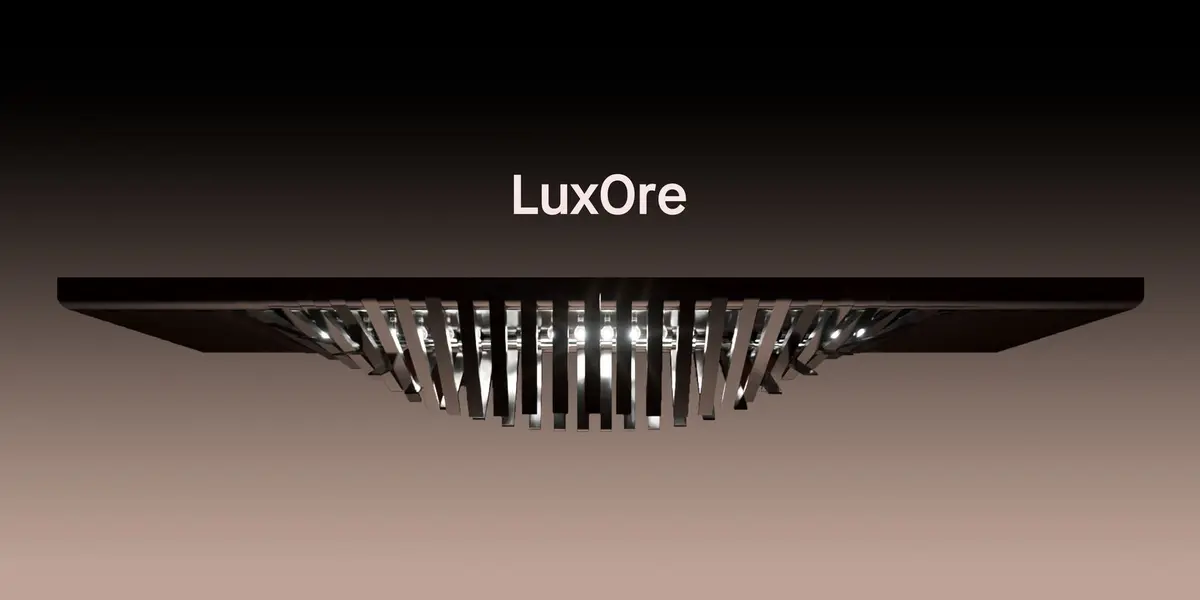
LuxOre: A Kinetic Lighting Fixture That Turns Ceilings into Architectural Canvases
Poly-phalanged parametric geometry meets servo-driven motion in a lighting system that adapts to runways, galleries, and exhibitions.


Most lighting fixtures sit still. They illuminate a surface, cast a predictable shadow, and that is the extent of their spatial contribution. LuxOre refuses that role entirely. Designed as a kinetic, poly-phalanged structure whose interwoven segments physically shift to redirect beams, alter intensities, and reshape ambient patterns in real time, this parametric lighting fixture treats illumination as a live architectural event. When activated, its modules perform a rhythmic opening and closing sequence that transforms a ceiling plane from passive backdrop into a dynamic, shadow-casting canvas.
LuxOre is the work of designers Kseniia Bondarets and Belgi Ozdemir, who earned a Runner-up distinction at the Beegraphy Design Awards. The project positions itself at the intersection of computational geometry, mechanical engineering, and spatial storytelling, proposing that light in architecture should not be fixed but responsive: capable of adapting to context, emotion, and time.
Blueprint Logic: Ribbed Panels and Conical Lattice Geometry
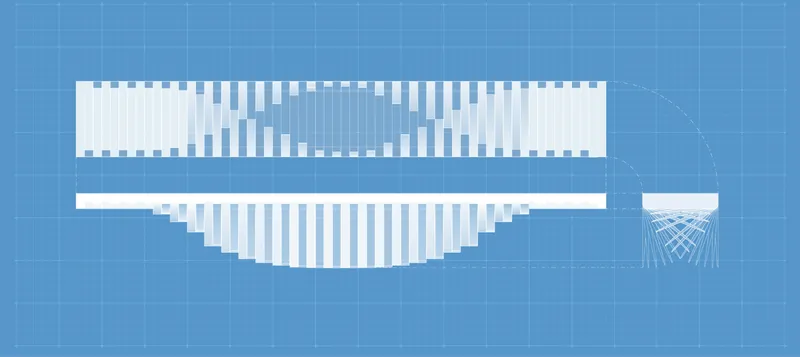
The elevation drawing lays out LuxOre's formal vocabulary with precision: ribbed facade panels sit alongside a conical lattice element, all plotted against a gridded blue background that reads like a technical blueprint rather than a presentation render. This is a deliberate choice. The drawing foregrounds the intelligent layering and structural choreography behind the fixture, showing how each module is parametrically calibrated to balance sculptural presence with functional light distribution.
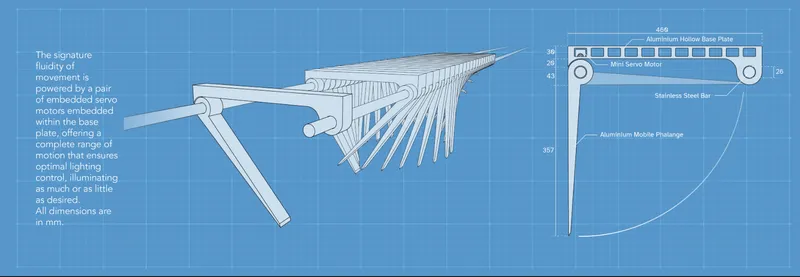
The annotated axonometric view peels back the skin further, revealing a wing-like kinetic structure with embedded servo motors and aluminum components. Mechanical precision meets digital control here. The movement mechanics are optimized for fluid transitions, avoiding abrupt shifts in light output. In its static state, the fixture reads as a suspended sculptural form in equilibrium; in motion, it performs a subtle kinetic choreography that modulates illumination through physical reconfiguration rather than electronic dimming alone.
Runway Drama: Kinetic Light Mirroring the Energy Below
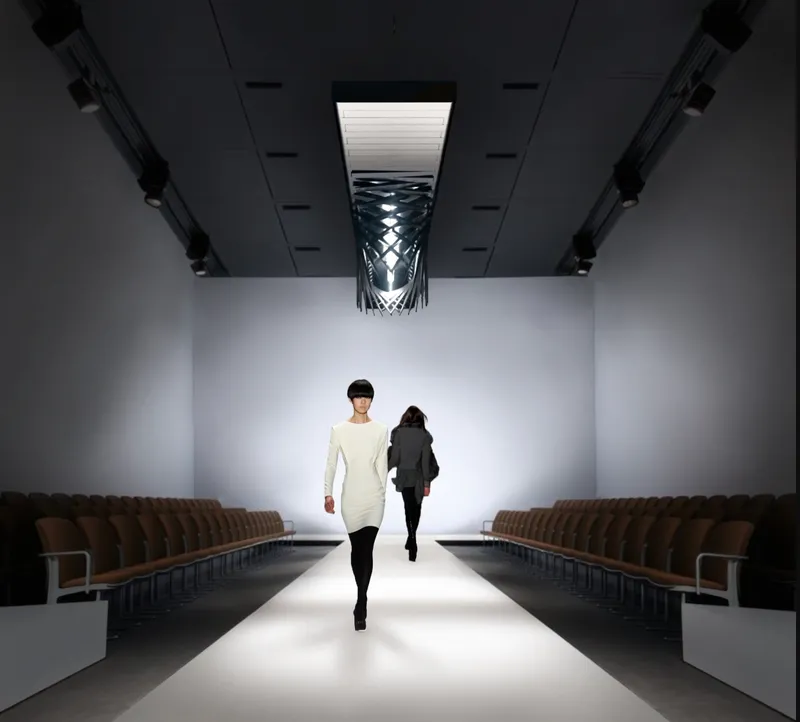
One of LuxOre's most compelling application scenarios places it above a fashion runway, where models walk beneath a suspended lattice fixture that casts complex, shifting patterns across the illuminated path. The fixture's poly-phalanged geometry enhances the drama of movement overhead, its kinetic reconfiguration mirroring the rhythm of the catwalk below. Light here is not simply projected downward; it participates in the event, sculpting atmosphere in tandem with the bodies passing through it.
The gallery setting reinforces the fixture's scale and presence. Hung from a significant height, LuxOre reads as both infrastructure and installation, a condition that makes it equally viable for commercial retail, museum exhibitions, or performance spaces where atmospheric control is paramount.
Industrial Precision Meets Aerodynamic Curves

Positioning a Lamborghini beneath the conical lattice installation is not merely styling; it is an argument about material kinship. The fixture's aluminum components and servo-driven joints share a design ethos with the vehicle below: engineered surfaces, minimal tolerances, and forms shaped by performance as much as aesthetics. LuxOre highlights the aerodynamic curves of the car by distributing light across its body in a way that a conventional overhead array could not achieve, its adaptive beam paths tracing contours rather than flattening them.
The polished floor amplifies the effect, turning the space into a doubled field of reflections where fixture and vehicle become part of a single luminous composition. For automotive exhibitions and showrooms, this level of atmospheric specificity moves lighting from a support role to a design protagonist.
Sacred Light Reinterpreted: From Renaissance Canvas to Parametric Ceiling
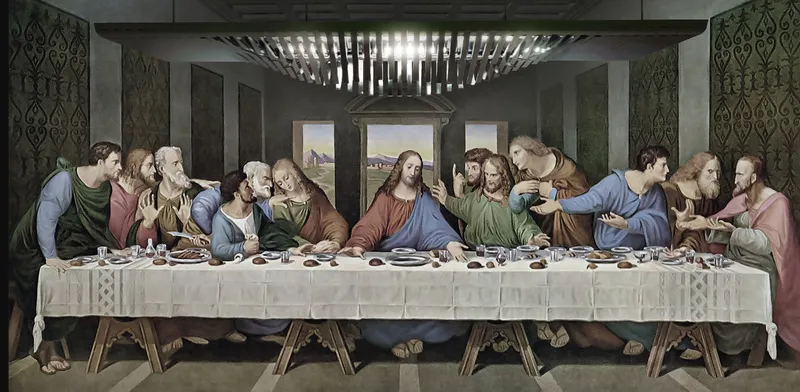
Perhaps the most conceptually ambitious scenario places LuxOre above a long dining table with seated figures, a clear reinterpretation of The Last Supper. Here the fixture becomes a contemporary symbol of illumination, bridging the sacred and the modern. Patterned wall panels frame the scene while the lattice ceiling fixture casts a complex field of light and shadow over the gathering below. The reference is bold but earned: if Renaissance painting used depicted light to signify divine presence, LuxOre proposes that kinetic, responsive light can carry similar symbolic weight in a contemporary spatial context.
What makes this scenario work is restraint. The fixture does not overpower the scene; it orchestrates it. The poly-phalanged structure distributes light efficiently while maintaining a modular, adaptable form that could shift its output to suit different moods or moments within the same gathering.
Why This Project Matters
LuxOre operates on a simple but radical premise: that architectural lighting should move. Not flicker, not dim, but physically reconfigure itself to reshape the spatial experience in real time. By embedding servo motors and parametric logic into an aluminum lattice structure, Bondarets and Ozdemir have proposed a fixture that collapses the distance between infrastructure and installation, between utility and art. The poly-phalanged geometry is not decorative; it is the mechanism through which light becomes spatially intelligent, distributing illumination with minimal energy waste while adapting to wildly different programmatic contexts.
The range of application scenarios, from fashion runways to automotive exhibitions to sacred reinterpretations, demonstrates that kinetic lighting is not a niche proposition. It is a new category of spatial tool. As architecture increasingly embraces responsive, interactive environments attuned to human experience, projects like LuxOre point toward a future where the built environment does not just house activity but actively participates in it. The ceiling is no longer a boundary; it is a performer.
View the Full Project
About the Designers
Designers: Kseniia Bondarets, Belgi Ozdemir
Enter a Design Competition on uni.xyz
uni.xyz runs architecture and design competitions year-round that reward proposals with spatial conviction and real site intelligence.
Project credits: LuxOre by Kseniia Bondarets, Belgi Ozdemir Beegraphy Design Awards (uni.xyz).


Popular Articles
Popular articles from the community


Opera on the Sea: Driftwood Logic Shapes a Timber Opera House on Estonia's Coast
Trevor Orgill's opera house translates the entangled drift of floating timber into a civic building where wood, water, and music converge.


David Ortega Stacks a Two-Story Mexico City Penthouse Around a Steel Stair and a Pergola-Shaded Roof Terrace
In Colonia Roma, a 300 m² penthouse uses oak joinery, a planted steel stair and a slatted roof pergola to make a new-build apartment feel like a house.

graciastudio Turns a Viewless Tijuana Lot Inward Around a Courtyard of Concrete, Timber and Trees
In Tijuana, Jorge Gracia's GA2 House stacks a timber-clad private floor over exposed concrete and replaces a missing view with a planted interior patio.

Cube Design Draws an Ecological Corridor Between Two Shenzhen Hills with the Nankai Building
Beside Shenzhen's container docks, the Nankai Building pairs stacked balconies with a climbing green screen to connect two hillsides across its height.

Similar Reads
You might also enjoy these articles

Aquadapt: An Underwater Habitat That Rewrites Its Rooms by the Hour
Curved modules ring the seabed while one shell shifts from breakfast room to cinema, farm and football pitch as residents' needs change.

Play: Fragments of Their World: Remembered Architecture Rebuilt as a Modular Playground for Refugee Camps
Tom Gardner abstracts domes, arches and towers from the homelands of displaced families into a kit of child-scaled play parts for camp settlements.
REBIRTH: A Circular Settlement Where Afghan Widows and Their Children Rebuild Life Together
A shortlisted Resile entry turns the circle into a protective ring of timber and brick, gathering homes, classrooms and gardens around a shared landscape.
The Main Dream: A Recycled Plastic Kit That Lets Refugee Children Build Their Own Playground
Thirty-centimetre interlocking cubes that connect on three axes turn play into construction, letting children author the spaces they occupy.

Explore Luminaire Competitions
Discover active competitions in this discipline

Challenge to design luxury tourism on rails

Challenge to reimagine the Iron Throne

Photograph architecture without architects

VR headsets Storefront design competition
Comments (0)
Please login or sign up to add comments
No comments yet. Be the first to comment!