

MuseLAB Wraps a Mumbai Bathware Showroom in Mint Green Circles and Berry-Red Steel
The Sorbet showroom in Mahalaxmi turns a former rug atelier into a chromatic bathware discovery lounge built on circular geometry.


A bathware showroom should not, by any reasonable measure, be this interesting. But MuseLAB's Sorbet showroom in Mahalaxmi, South Mumbai, manages to convert 241 square metres of former rug atelier into a space that feels closer to a gallery installation than a retail floor. Designed and executed in just six months to minimize rental bleed, the project replaces the conventional grid of display plinths with a network of overlapping circular enclosures, each one hosting a different product typology and dressed in a relentless palette of mint green and berry red.
What makes the project genuinely worth studying is the collision between a highly specific brand identity and a rigorous spatial idea. The mint green is not arbitrary: it derives from Aquant's corporate color, scaled up from logo to architecture. The circular geometry is not decorative: it generates semi-open rooms that allow the entire store volume to remain visible from any point while still creating distinct moments of enclosure. And the exposed, marsala-painted HVAC and I-section stanchions overhead are not a budget compromise: they provide the counterweight that keeps all that pastel from tipping into sweetness.
Facade and Threshold


From the street, Sorbet signals its chromatic commitment immediately. The facade layers fluted glass, clear glass, and a lime-hued trellis interwoven with planters holding plum-colored foliage, a color pairing that previews the interior without giving everything away. A glass brick enclosure shades the entrance porch, filtering Mumbai's aggressive daylight into something softer. The bilingual signage and modest scale of the storefront sit comfortably in Mahalaxmi's dense commercial fabric, resisting the temptation to shout.
Large bottle-shaped pendant lights, visible through the glazing, act as beacons from the sidewalk. They hang above the mint green partition walls like oversized laboratory vessels, establishing the showroom's playful material vocabulary before you cross the threshold.
The Circular Logic
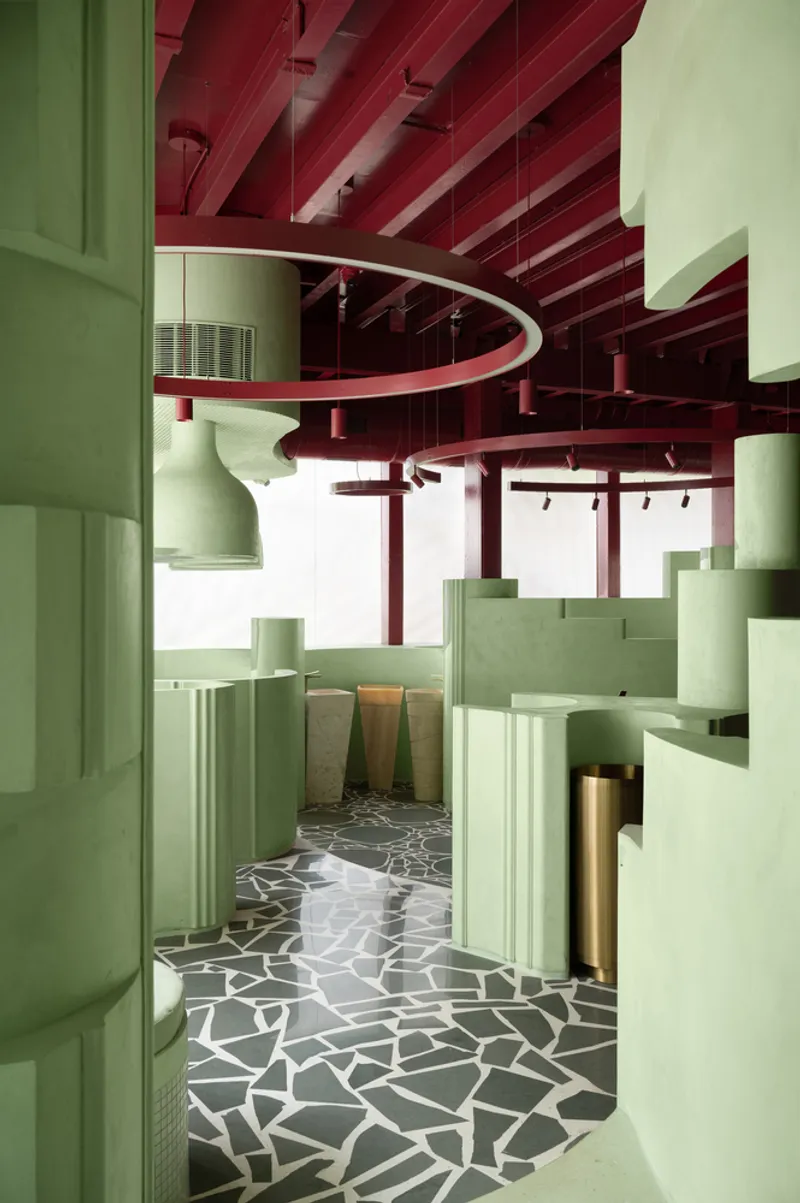
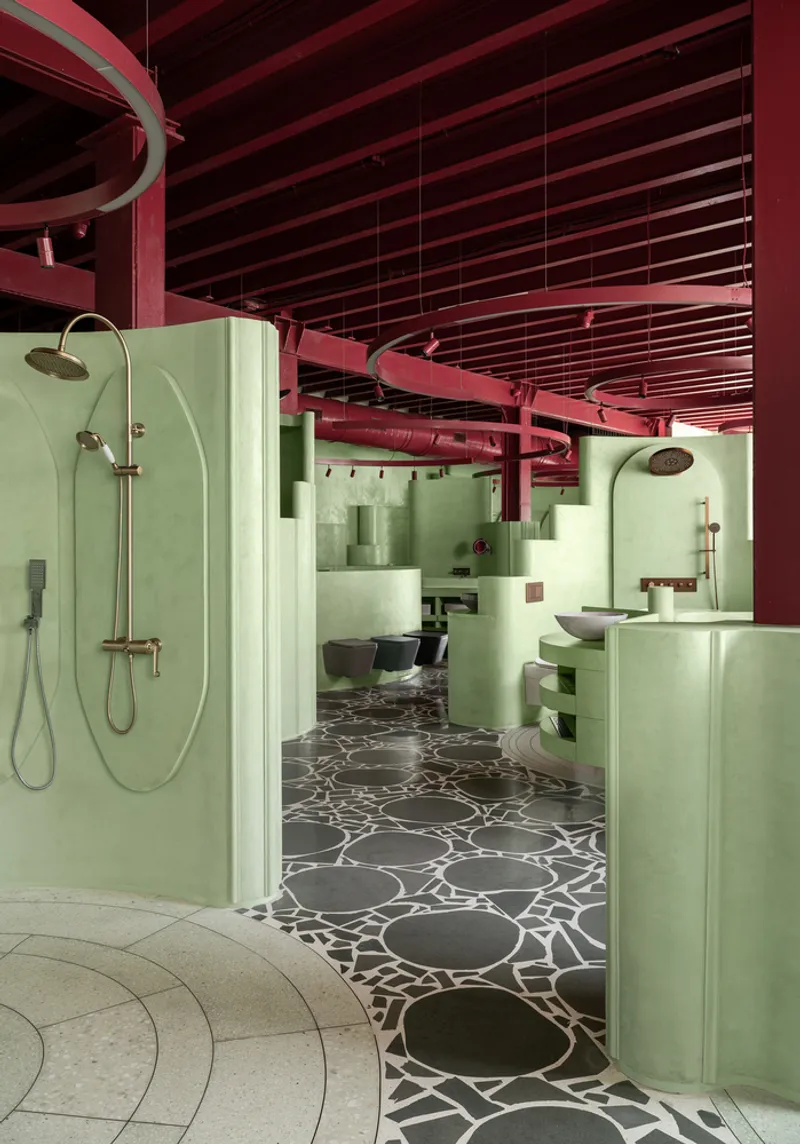
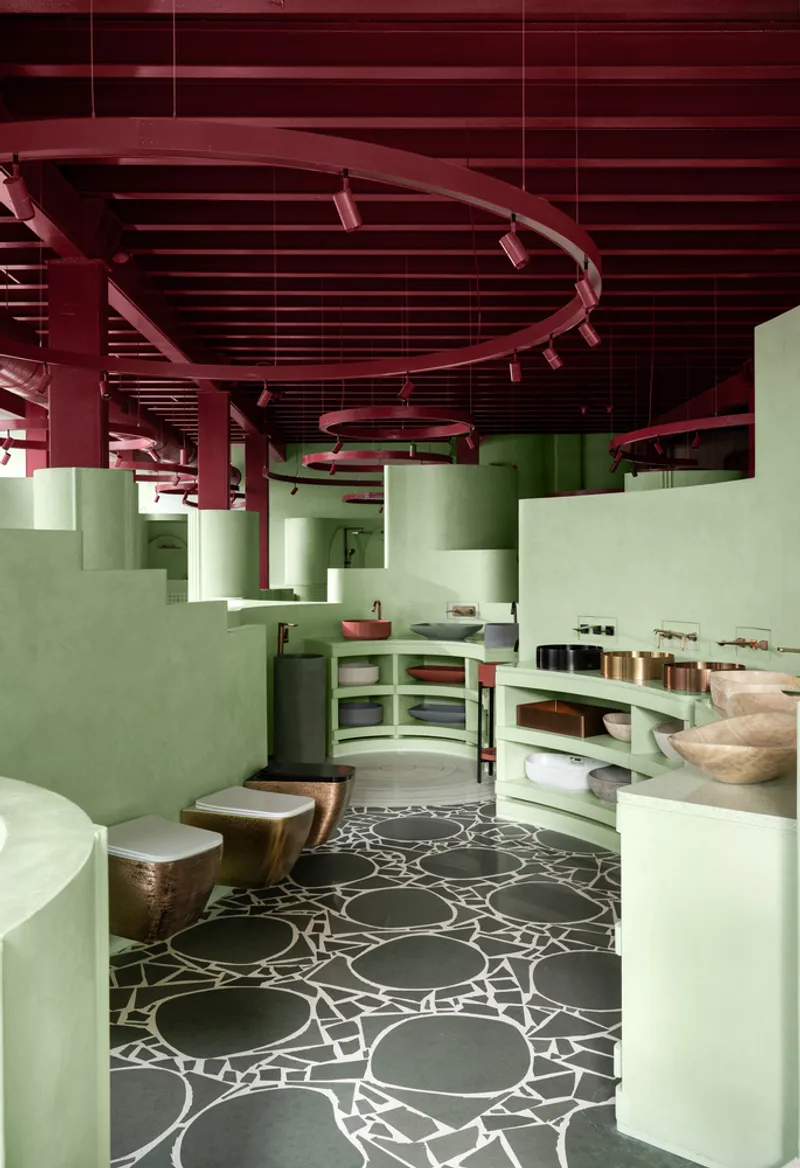
Step inside and the geometry takes over. Curved partition walls of varying heights and radii carve the rectangular volume into a sequence of overlapping rooms without ever sealing one off from the next. Cylindrical column fragments punctuate the terrazzo floor like ruins of some pastel antiquity. The rectilinear axis of the original building remains legible beneath the circles, providing long sightlines that let you orient yourself even as the curves redirect your path.
The effect is a kind of controlled disorientation. You can always see the far wall, but the route to get there winds through shower enclosures, vanity stations, and display niches. MuseLAB describes the circulation as a "rhythmic sequence of movement," which is accurate: the pace changes as enclosures tighten and release. It is retail choreography executed through plan geometry rather than signage.
Material Vocabulary: Kota Stone Meets Terrazzo

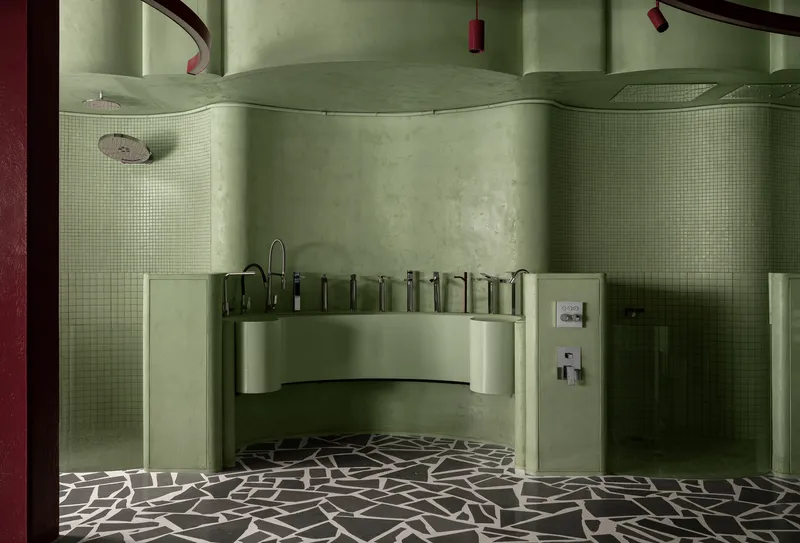
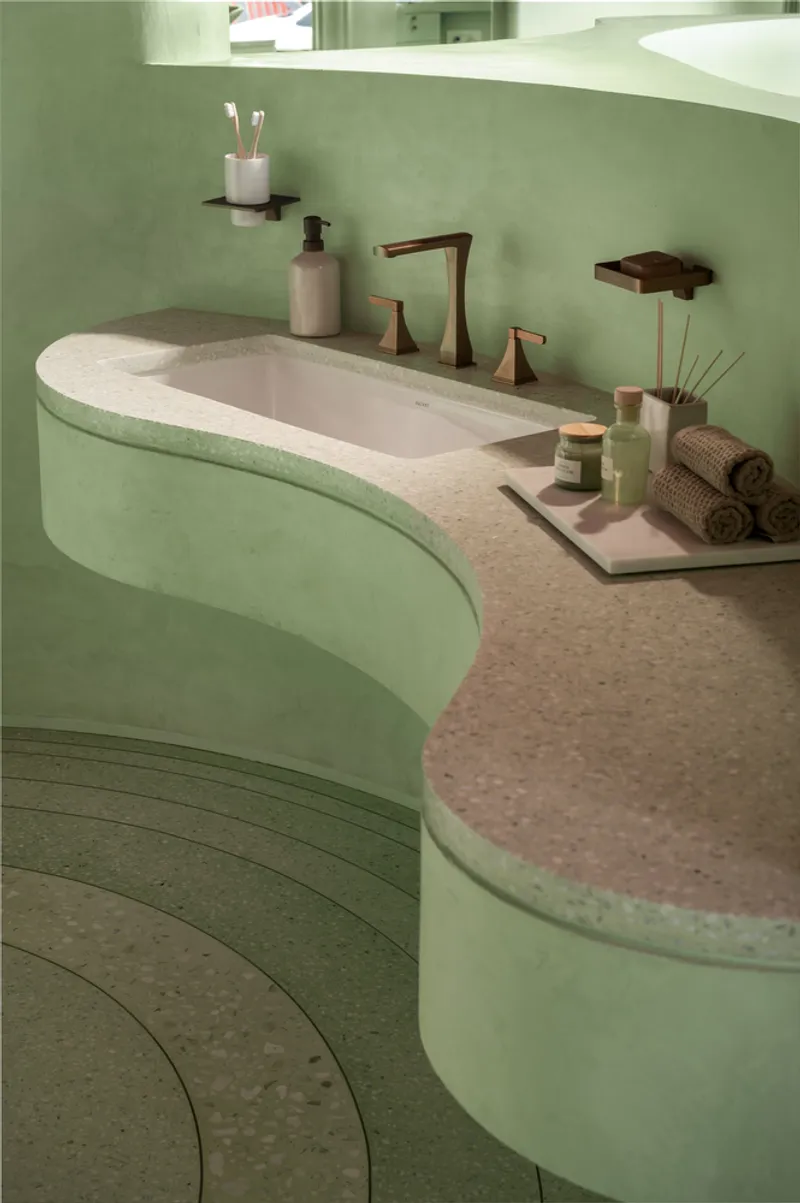
The floor does much of the storytelling. Kota stone appears in two distinct patterns: rubble-style jagged chunks set in ivory grout, and smooth curvilinear pieces that follow the circular plan logic. The shift between the two registers underfoot, marking transitions between zones without requiring a wall or a threshold. Terrazzo surfaces appear on countertops and display units, their aggregate flecks echoing the mint-and-berry palette at a smaller grain.
At the vanity stations, vessel sinks sit on curved counters backed by soft green plaster, open shelving displaying ceramic bowls and fixtures with the precision of a museum vitrine. Piccolo mosaic tiles clad the curved shower enclosures, adding texture that catches raking light and reinforces the handmade quality MuseLAB clearly prizes over seamless minimalism.
The Berry-Red Ceiling
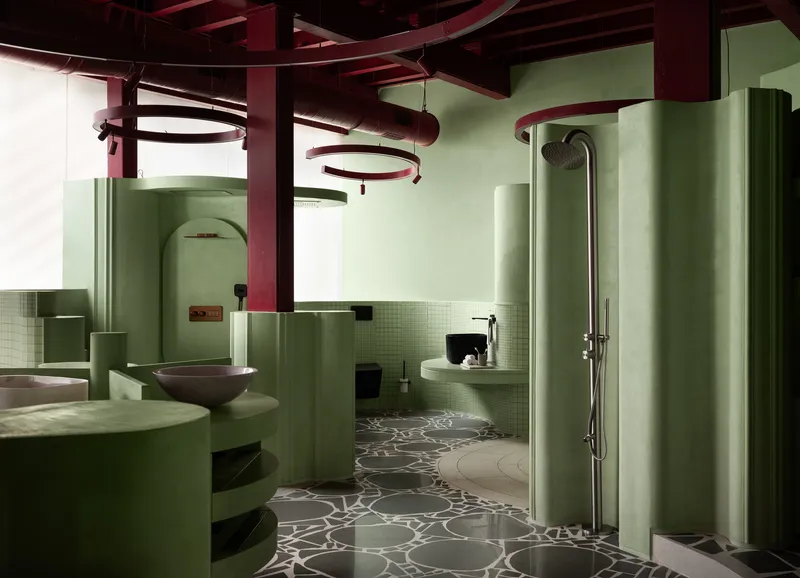


Look up and the atmosphere changes entirely. The 12-foot ceiling is an honest display of structure and services: I-section steel stanchions, spiral HVAC ducts, and slatted framing, all painted in a deep marsala tone that MuseLAB calls berry red. Against the mint green below, it reads almost like a geological section, a warm crust hovering above a cool mineral deposit.
Leaving the mechanical systems exposed was a deliberate move, not an economy. The painted ducts become ornamental in their own right, their cylindrical forms rhyming with the circular plan below. The color choice is critical: a neutral ceiling would have let the green walls float untethered, while the marsala provides gravity and warmth, grounding the space and giving it an industrial backbone that prevents the palette from reading as merely cute.
Bespoke Lighting as Spatial Marker
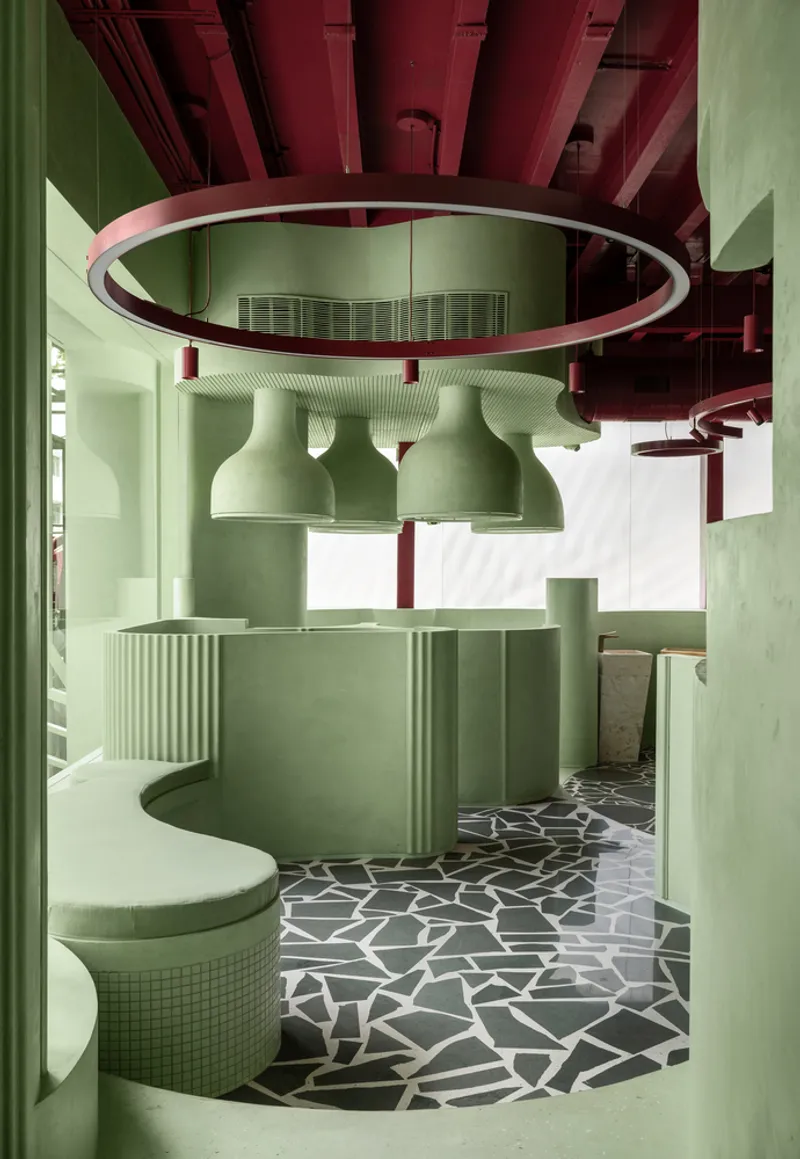
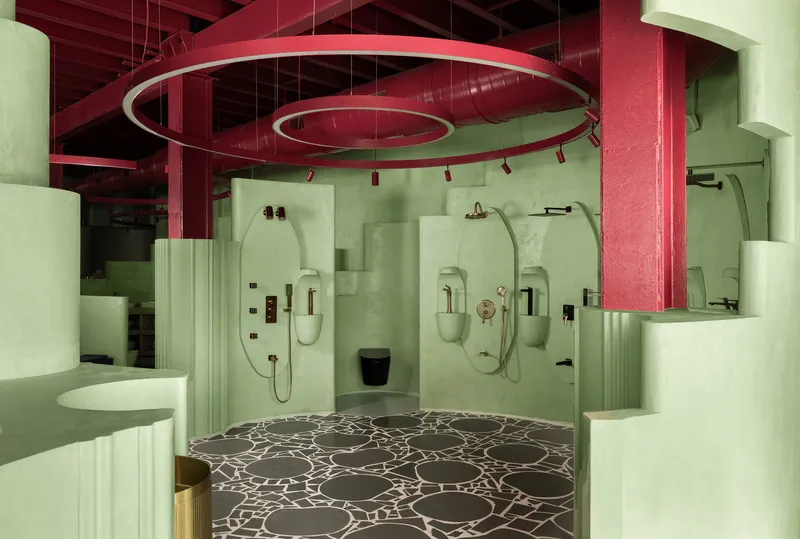
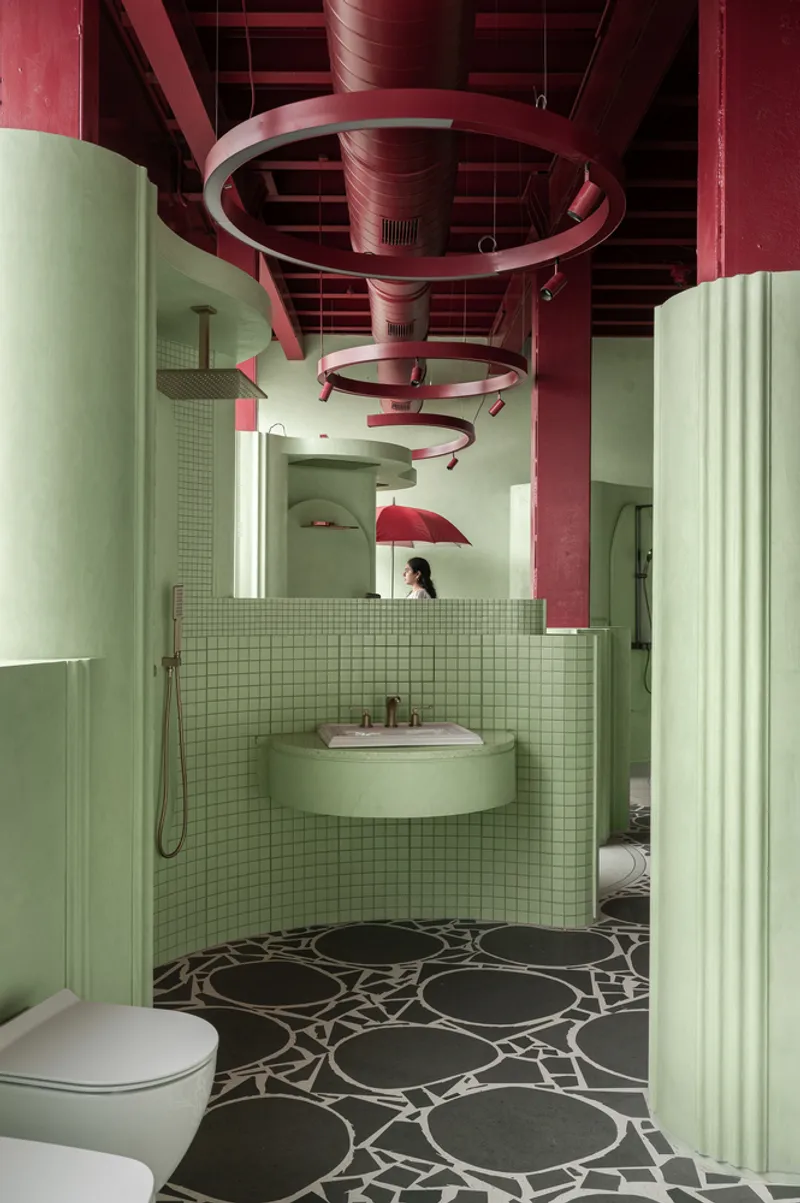
Custom halo light fixtures, suspended on thin cables from the red ceiling, serve double duty as ambient illumination and spatial markers. Each ring corresponds to a display zone below, making the lighting plan a legible diagram of the floor plan when viewed from within. At the reception counter, a single large ring hangs beneath vaulted ceiling forms and fluted detailing, signaling arrival.
In the shower niches, the rings frame arched openings and rainfall heads, turning functional wet areas into composed vignettes. A person glimpsed in a background mirror reminds you that these are not abstract compositions but working demonstrations of plumbing hardware. The lighting never overwhelms; it annotates.
Display Systems and Product Encounters
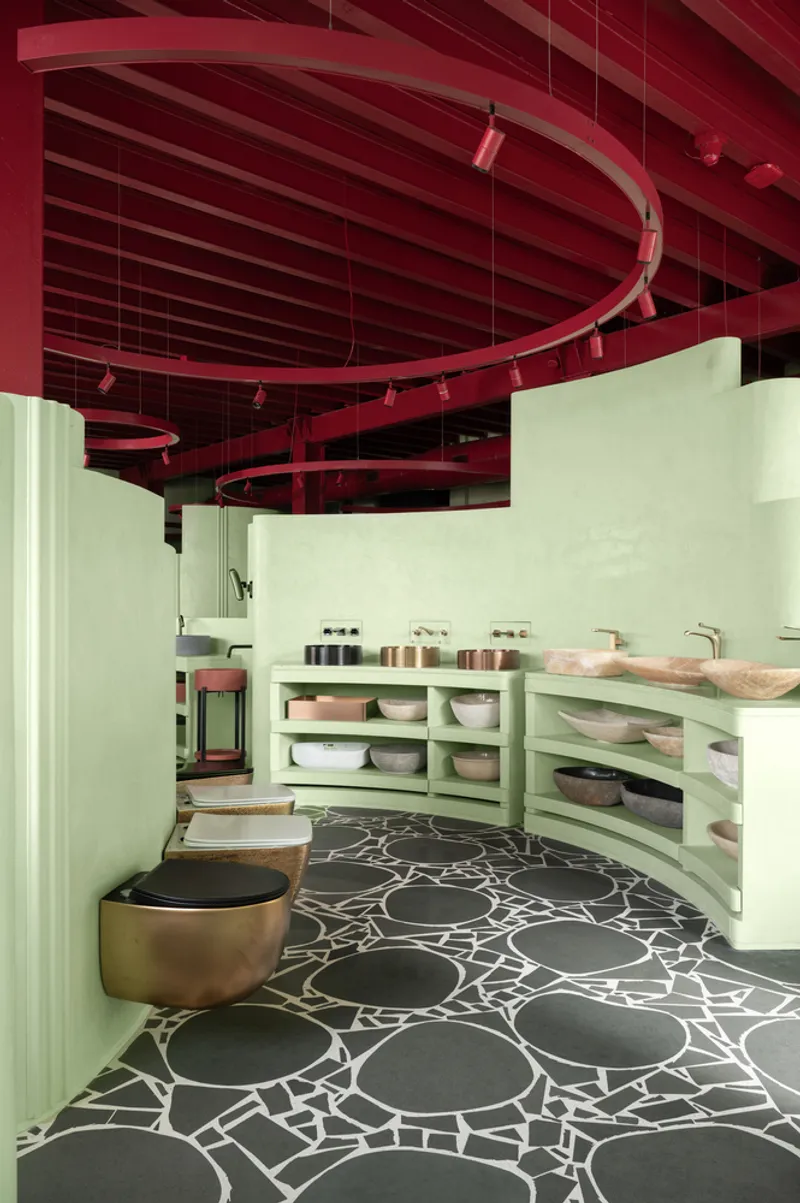
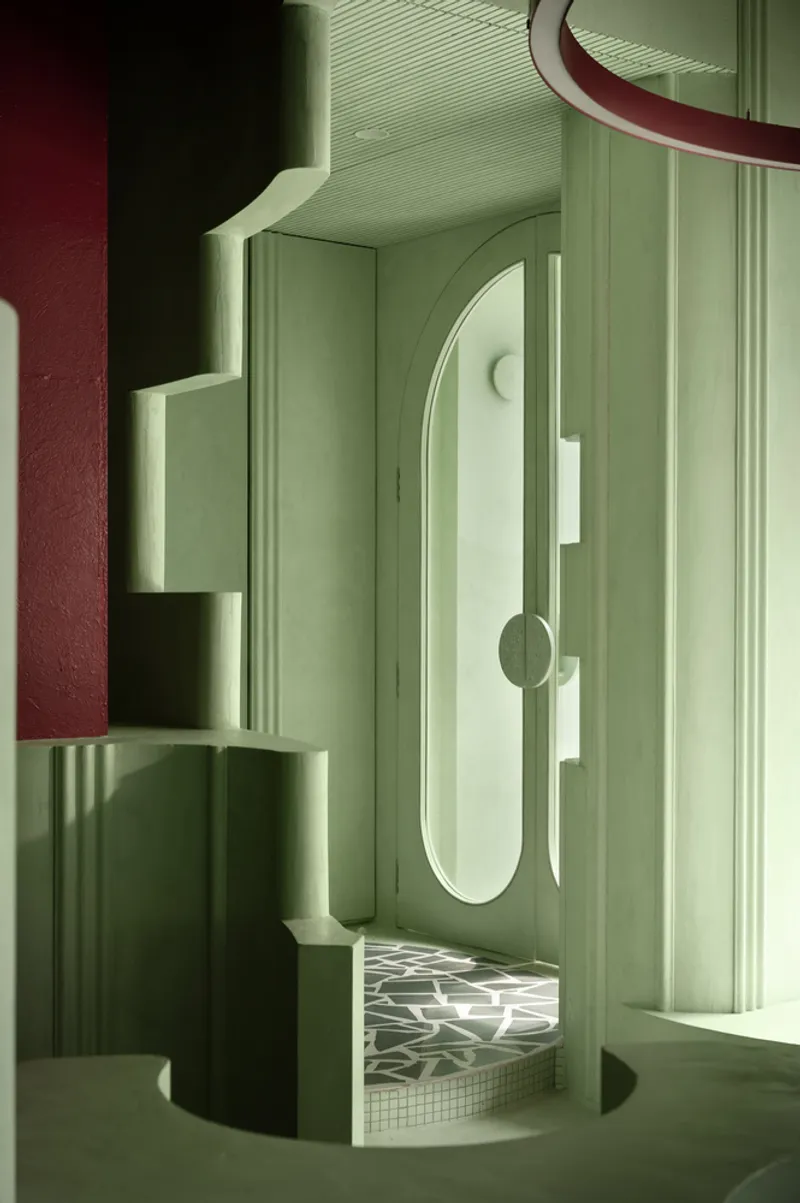
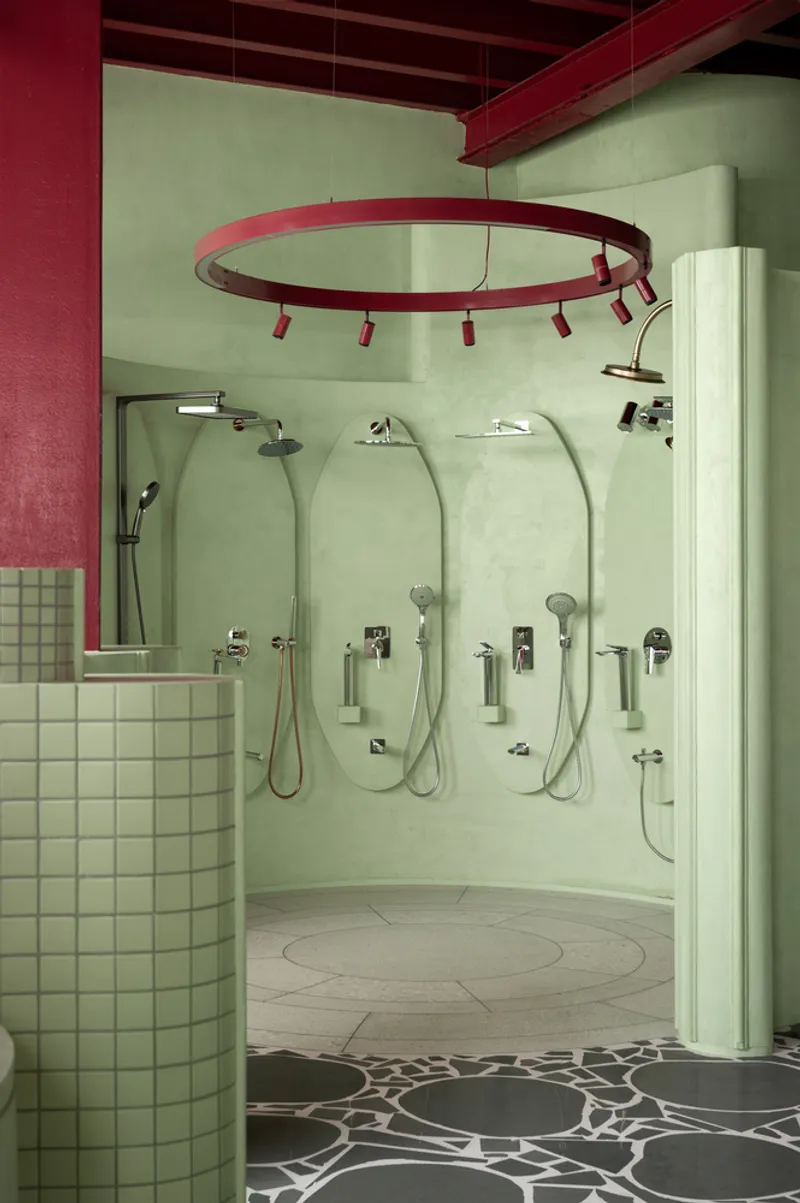
The display furniture is as idiosyncratic as the architecture. Bulbous, funnel-shaped pedestals elevate individual fixtures to eye level. Stepped partition walls create niches for faucets and accessories, layered like geological strata. Arched doorways framed by fluted pilasters lend a civic scale to transitions between wet and dry zones, a gesture that would be absurd in a lesser project but works here because MuseLAB commits fully to the theatrical register.
The curved shower wall stacked with multiple rainfall heads and handheld fixtures is perhaps the most effective product moment in the entire showroom. It transforms a commodity display into an experiential proposition, letting the customer stand within the geometry and understand the hardware spatially rather than from a catalog page.
Plans and Drawings
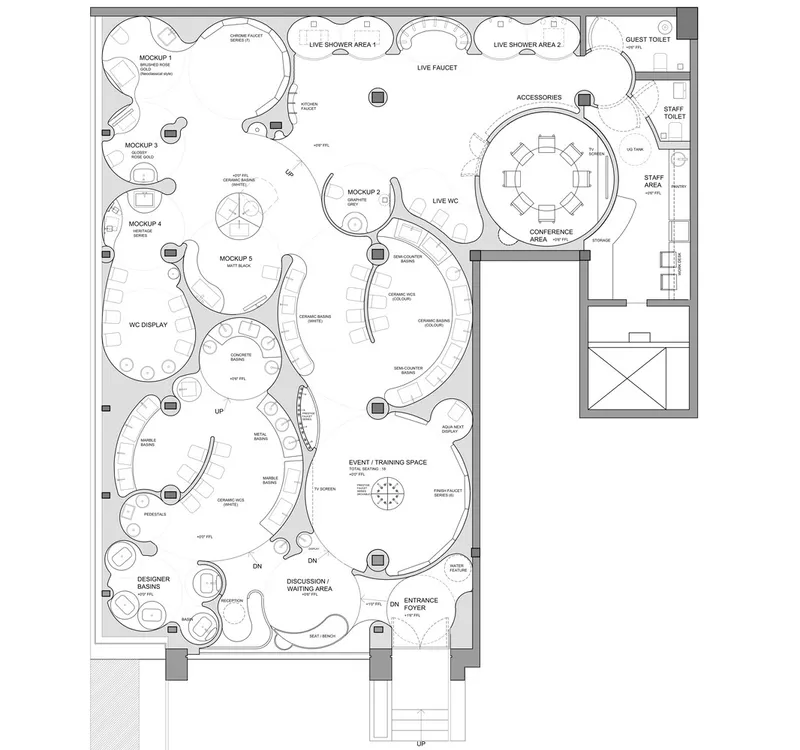
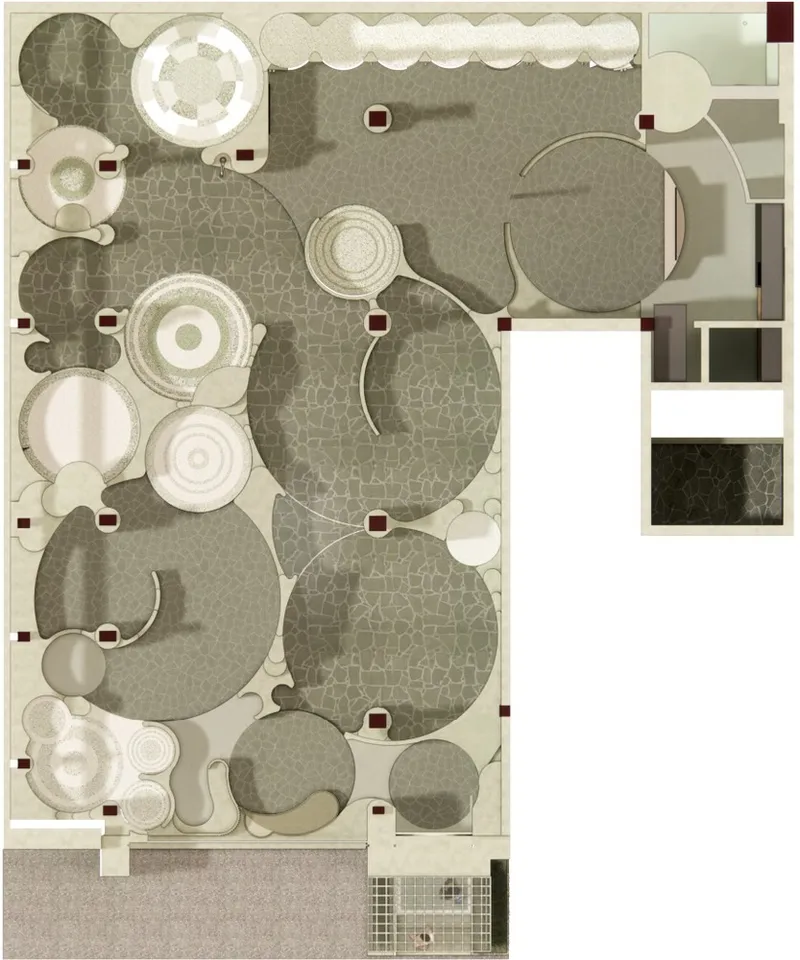


The floor plan makes the circular logic explicit. Overlapping arcs of varying radii partition the rectangle into zones labeled by program: shower, vanity, reception, consultation. No two enclosures share the same radius, which prevents the repetition from becoming monotonous. The rendered plan views reveal how material changes on the floor, from rough Kota stone to smooth terrazzo to mosaic, reinforce the boundaries that the walls only suggest.
Furniture clusters appear at the intersections of circles, turning leftover geometry into social space. The seating arrangements visible in the renderings suggest that MuseLAB conceived the showroom as much as a lounge as a retail environment, a place where the act of choosing a faucet is meant to take time and involve conversation. The six-month design-to-execution timeline makes these drawings all the more impressive in their precision.
Why This Project Matters
Retail design for commodity products tends toward two extremes: the white-box gallery approach that lets the product "speak for itself," or the themed environment that smothers it in lifestyle cues. MuseLAB sidesteps both by building an architectural system, the network of circles, that is strong enough to constitute an experience on its own terms while remaining porous enough to let the bathware register as individual objects. The Sorbet showroom proves that a rigorous plan idea, a committed color strategy, and honest material choices can transform even the most transactional of programs into something worth visiting for its own sake.
For a young Mumbai practice, the project is also a statement about speed and conviction. Delivering this level of spatial complexity in six months, under the pressure of compounding rent, required the kind of decisiveness that larger firms often struggle with. The result is a showroom that does not hedge its bets: every surface, every fixture, every painted duct declares allegiance to a single chromatic and geometric idea. That clarity is what makes it land.
Sorbet Showroom by MuseLAB, Mahalaxmi, Mumbai, India. 241 square metres.
About the Studio
Share Your Own Work on uni.xyz
If projects like this are the kind of work you want to make, uni.xyz is a place to publish your own, find collaborators, and enter design competitions.


Popular Articles
Popular articles from the community

Tsunami Convergenics: Turning Catastrophic Ocean Forces into Underwater Housing Infrastructure
A speculative underwater settlement off the coast of Onagawa, Japan, treats tsunamis and typhoons as energy sources rather than threats.
Extended Shell: Retrofitting Kolkata's Balconies as Living Urban Thresholds
A modular retrofit system recovers the social and environmental intelligence of Kolkata's historic verandas for contemporary Park Street residents.

Opera by the Sea Estonia: Three Shells Dissolving Architecture into Tallinn's Coastline
A winning opera house proposal replaces monumental form with interconnected shells that blur the boundary between building, park and Baltic Sea.
Faces of the Soviet Avant-Garde: Turning Moscow's Street Names into an Open-Air Museum
A network of sculptural installations across a Moscow residential district transforms forgotten architect names into spatial encounters with cultural memor

Similar Reads
You might also enjoy these articles


Hodi-Mandai Geram
Project Function: Preservation and revitalization of the Intangible heritage and socio-spatial identity of the Hodi by Housing, Cultural Memory Center, Sacred Grove, landscape, local tourism economy


Olio Towers: A Mid-Rise for Performers That Fuses Housing, Rehearsal, and Stage
Located blocks from Houston's Theater District, this modular tower stacks living units around a central performance atrium.

Oasis: Modular Green Housing Carved into Dhaka's Urban Fabric
A shortlisted Plugin Housing entry reclaims unauthorized settlements in Dhaka with stepped concrete volumes, green roofs, and ventilation-driven design.

Black Hole: A Floating Megastructure for the Post-Physical Era
Emiliano Mazzarotto envisions a spherical, self-scaling arena where e-sports, digital hotels, and holographic stadiums replace traditional public space.

Explore Samira Rathod Design Atelier Competitions
Discover active competitions in this discipline

Challenge to reimagine the Iron Throne

Photograph architecture without architects

Illustrate the lost glory of Angkor Wat - Render Challenge

Design challenge to reuse E-waste
Comments (0)
Please login or sign up to add comments
No comments yet. Be the first to comment!