
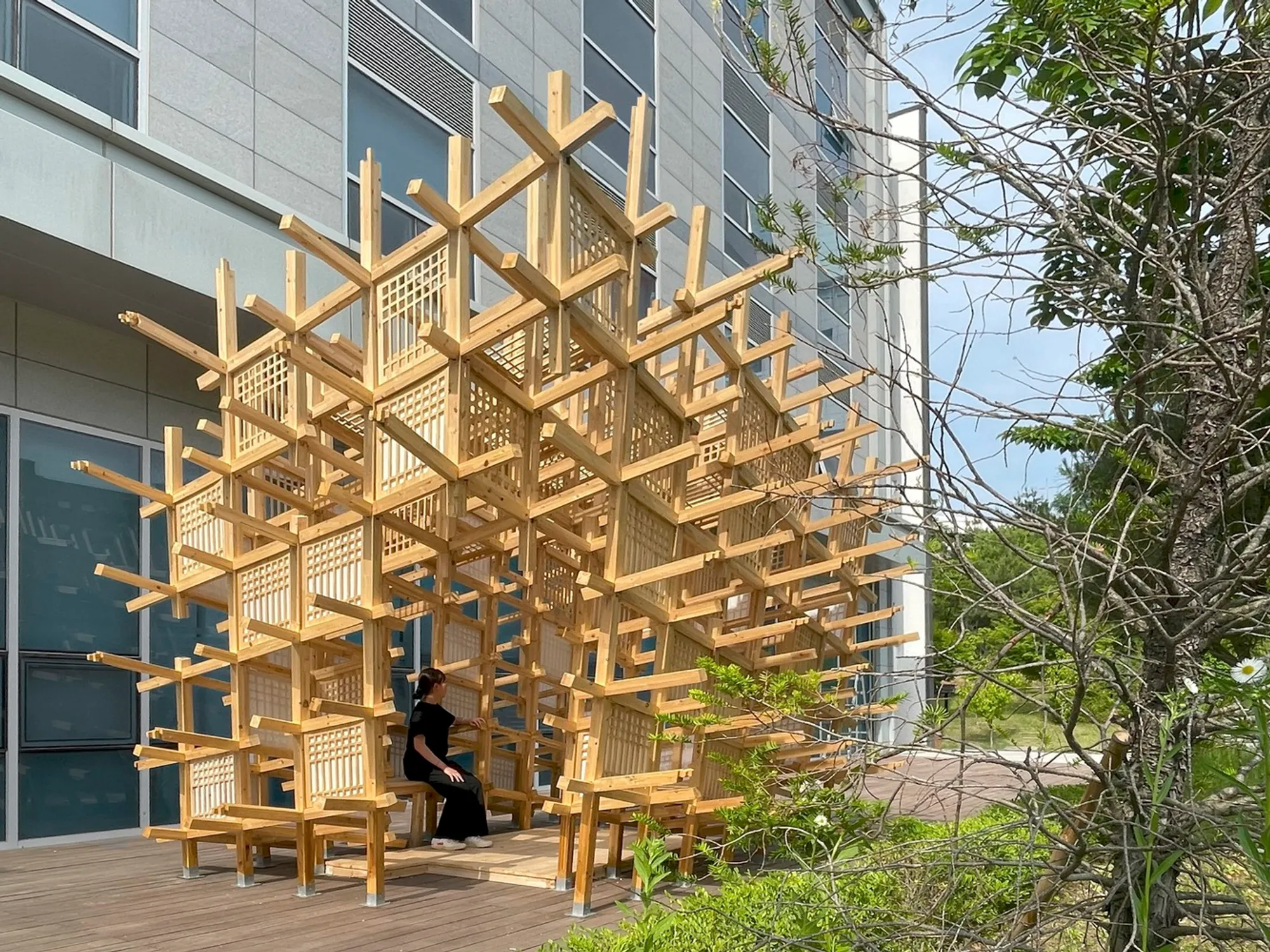
Machum House Pavilion by Yong Ju Lee Architecture: A Fusion of Korean Tradition and Robotic Precision
Machum House Pavilion blends Korean joinery with robotic fabrication, showcasing sustainable timber design and algorithmic precision in modern architecture.


Reimagining Korean Joinery Through Algorithmic Design and Robotic Fabrication
The Machum House Pavilion, designed by Yong Ju Lee Architecture in South Korea, is a compelling architectural experiment that merges traditional Korean joinery with advanced computational design and robotic construction techniques. Completed in 2023, this 20-square-meter temporary installation is a bold reinterpretation of the Sagae-machum—a historic wooden joinery system that connects columns and beams without the use of nails or metal fasteners.
The term Machum refers to "joint" in Korean, highlighting the core of the design concept: the celebration of interlocking wooden craftsmanship. The pavilion uses dimension lumber, carefully carved and assembled into a modular structure using robotic arms (ABB IRB-4600), illustrating how heritage construction techniques can find new relevance in digital fabrication and sustainable timber architecture.
Integrating Tradition and Technology: The Sagae-Machum Joint System
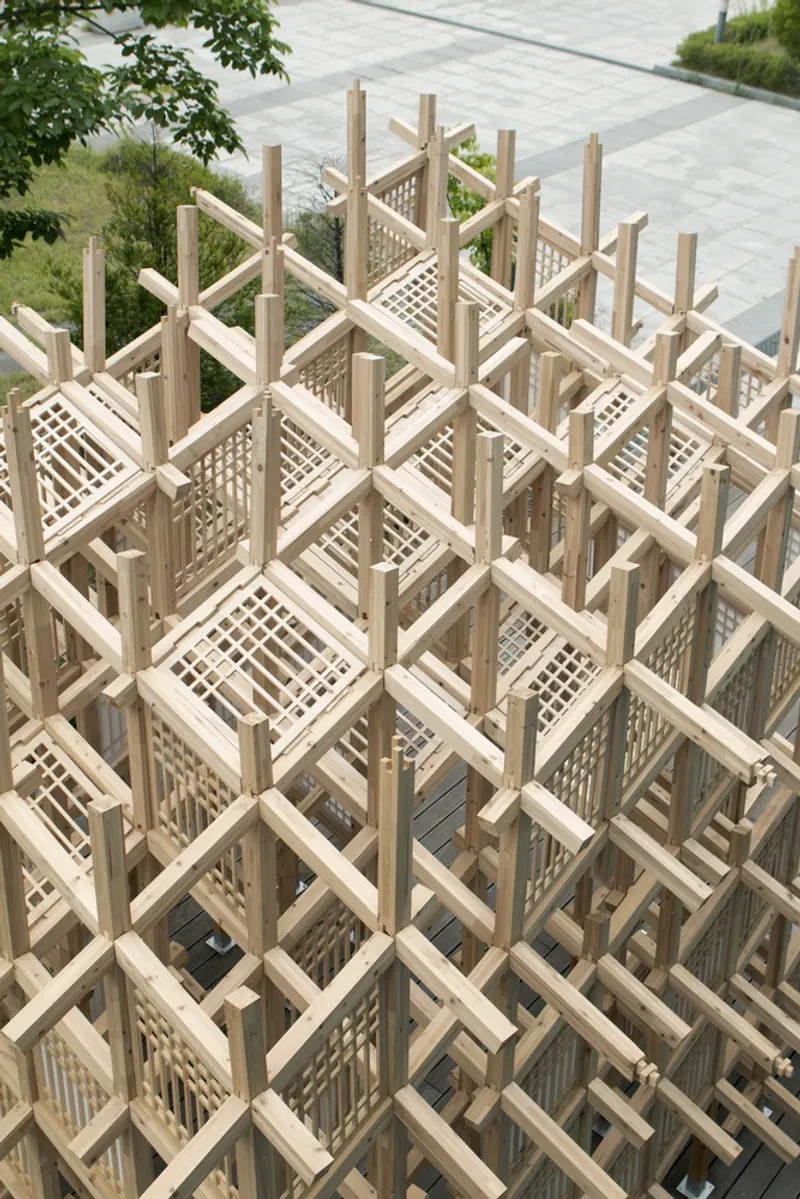
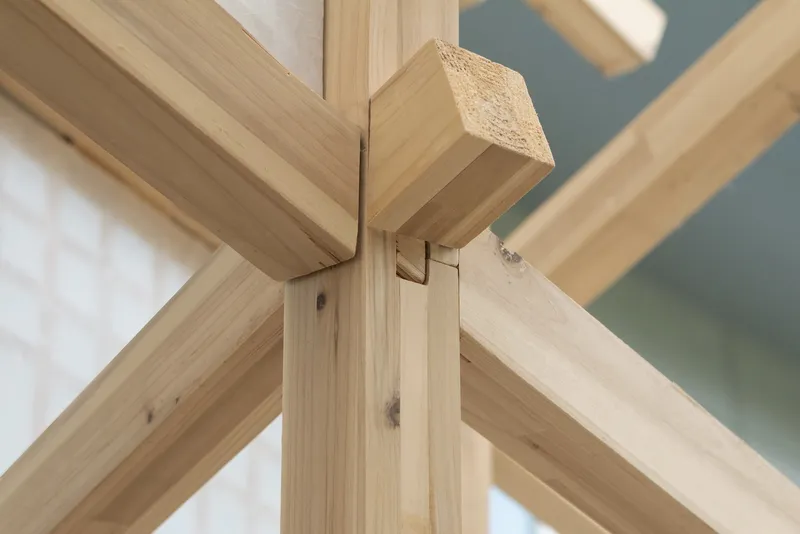
Historically found in Hanok, or traditional Korean houses, the Sagae-machum joint is a spatially complex volumetric node where beams and columns interlock across three axes. In this project, computational algorithms were used to deform the conventional coordinate system, allowing for custom interlocking modules that enhance structural stability and material efficiency.
Each module comprises:
- A lower and upper column (Gi-Dung) on the Z-axis
- A receiving beam (Badeul-Jang) on the Y-axis
- A covering beam (Upeul-Jang) on the X-axis
These elements are tilted at 15 degrees, which maximizes the contact surface and improves structural integrity. The result is a volumetric puzzle that assembles into a rigid frame—each piece milled precisely to support the loads from multiple directions without additional fasteners.
Sustainable Timber Architecture and Robotic Craftsmanship
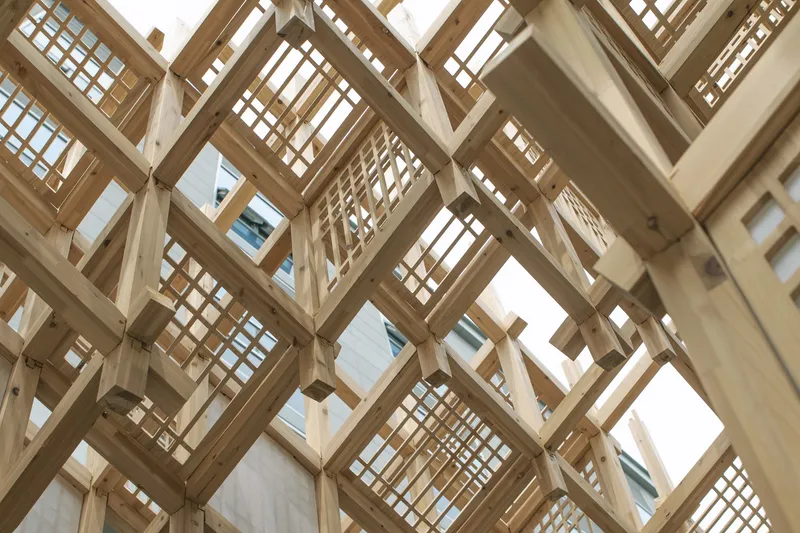
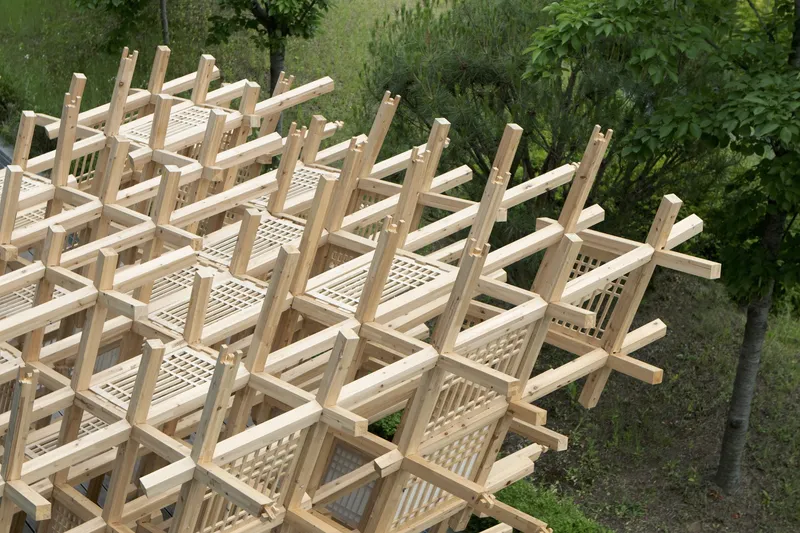
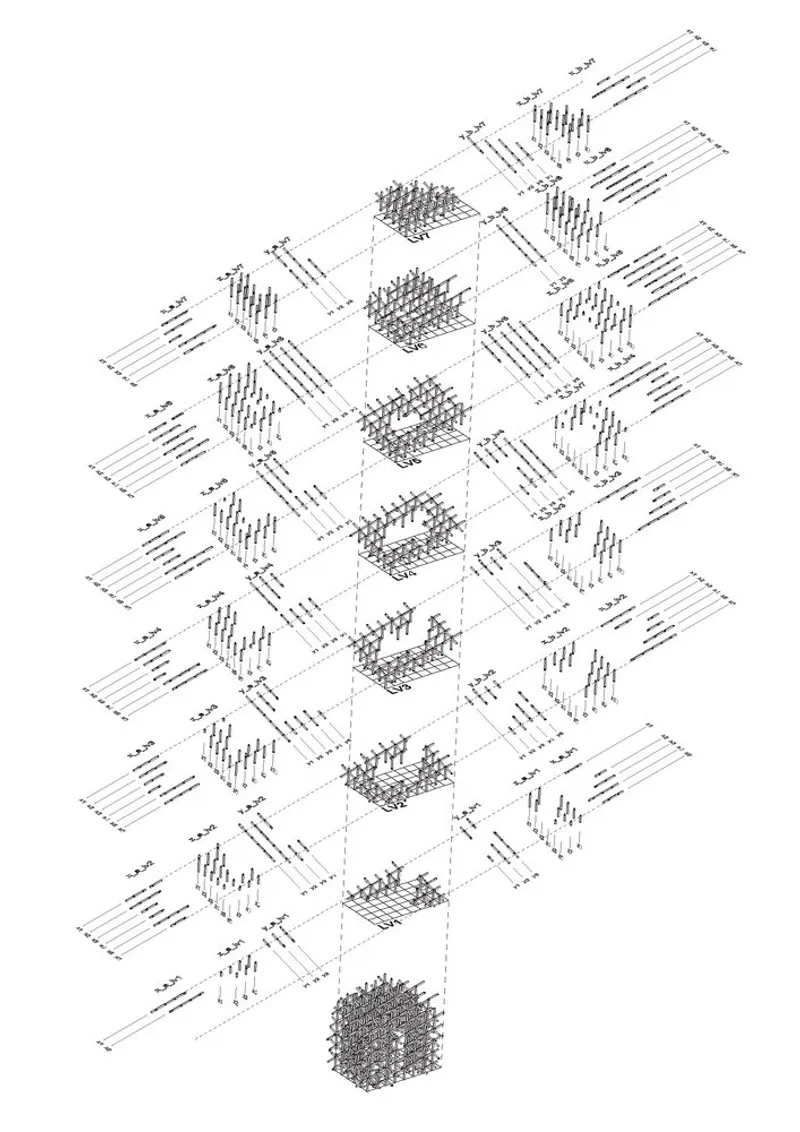
The Machum House Pavilion was constructed with Glued Laminated Timber (GLT), chosen not only for its sustainable attributes but also for its compatibility with robotic carving. The use of 241 vertical and 233 horizontal elements—ranging from 500mm to 1700mm in length—results in a structure that reaches 3.7 meters in height, forming a serene and intimate space of 5 meters by 4.2 meters.
This high level of material precision and digital coordination was only achievable through the use of industrial robotics, emphasizing how automation can expand the boundaries of vernacular architecture. The interlocking geometry behaves like internal bracing, reducing the need for additional support systems and minimizing waste in fabrication.
Sensory Experience and Spatial Interaction
A key element in the pavilion’s experience is its translucent traditional Korean paper windows, which filter daylight and provide a diffused, calm interior atmosphere. Visitors are invited into a contemplative wooden chamber where light, structure, and materiality interact, reinforcing the harmony between craft and code, tradition and innovation.
A Vision for the Future of Korean Architecture
By bridging digital innovation and historic techniques, the Machum House Pavilion sets a precedent for context-sensitive, ecologically responsible, and culturally rooted architecture. It invites reflection on how robotic fabrication can contribute not to the erasure of tradition, but to its reinvention and revitalization in the face of changing technologies and environmental demands.




Popular Articles
Popular articles from the community


The Musturak Paradise: Senior Living Architecture for a Connected Future in Temara, Morocco
The Musturak Paradise reimagines senior living architecture in Temara via private homes, social spaces, culture, community, and shared care.

Co-life: Sustainable Architecture for Age-Friendly Community Living
Co-life reimagines sustainable architecture for seniors through courtyards, rammed earth, shared gardens, and spaces designed for belonging.

The Ocean Hive: Sustainable Architecture for a Self-Sufficient Civilization at Sea
The Ocean Hive imagines sustainable architecture at sea, where modular habitats, algae, wave power and ocean waste sustain a growing colony.
EW PARK: Sustainable Architecture Reimagines the Future of Urban Parking
EW PARK reimagines city parking as a modular wooden tower combining automation, solar energy, electric mobility, and adaptable urban design.


Similar Reads
You might also enjoy these articles


Hodi-Mandai Geram
Project Function: Preservation and revitalization of the Intangible heritage and socio-spatial identity of the Hodi by Housing, Cultural Memory Center, Sacred Grove, landscape, local tourism economy


Olio Towers: A Mid-Rise for Performers That Fuses Housing, Rehearsal, and Stage
Located blocks from Houston's Theater District, this modular tower stacks living units around a central performance atrium.

Oasis: Modular Green Housing Carved into Dhaka's Urban Fabric
A shortlisted Plugin Housing entry reclaims unauthorized settlements in Dhaka with stepped concrete volumes, green roofs, and ventilation-driven design.

Black Hole: A Floating Megastructure for the Post-Physical Era
Emiliano Mazzarotto envisions a spherical, self-scaling arena where e-sports, digital hotels, and holographic stadiums replace traditional public space.


Explore Architecture Competitions
Discover active competitions in this discipline



Challenge to reimagine the Iron Throne


Photograph architecture without architects


Illustrate the lost glory of Angkor Wat - Render Challenge


Design challenge to reuse E-waste
Comments (0)
Please login or sign up to add comments
No comments yet. Be the first to comment!