

Madhura House by Design Kacheri: Modern Bengaluru Residence Inspired by Ancestral Karnataka Architecture
Madhura House blends ancestral Karnataka architecture with modern Bengaluru living, using mud, stone, landscaped courtyards, Vastu principles, and sustainable design.


Madhura House by Design Kacheri is a masterful residential project in Bengaluru that elegantly bridges ancestral architecture and modern urban living. Drawing inspiration from the client’s roots in Kampli, Karnataka, a historic town near Hampi known for its traditional mud and stone dwellings, the architects reimagined the essence of their ancestral home within a dense, contemporary urban context.

Concept and Design Approach
The brief was to design two 3 BHK homes for siblings, incorporating shared common spaces while maintaining independence and privacy. The challenge was to recreate a traditional, warm, and earthy aesthetic while accommodating modern lifestyle needs. Adhering to Vastu principles, both east-facing homes are carefully stacked vertically on a 3000 ft² plot, maximizing spatial efficiency without compromising privacy.
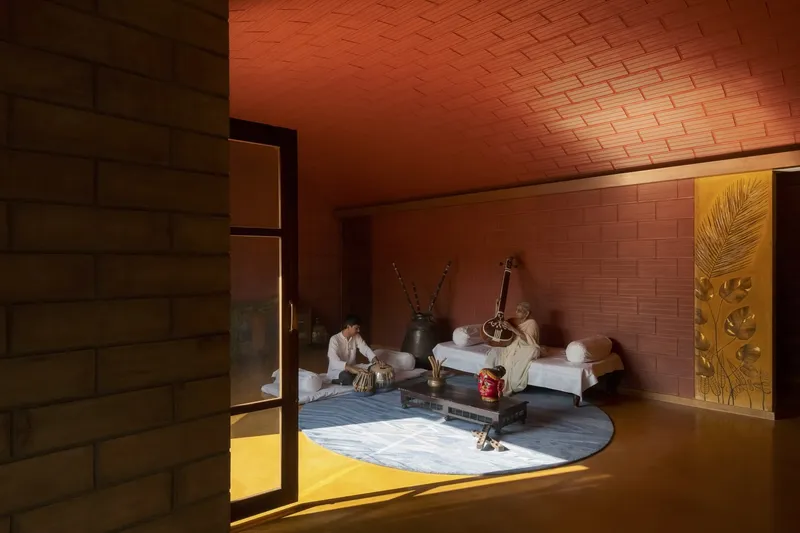
The design focuses on fostering social and cultural interactions, providing spaces for family gatherings, chamber concerts, and religious meets. The architects emphasized landscape integration, ensuring that both homes open seamlessly to gardens and courtyards, connecting indoor and outdoor experiences.


Landscaping and Spatial Planning
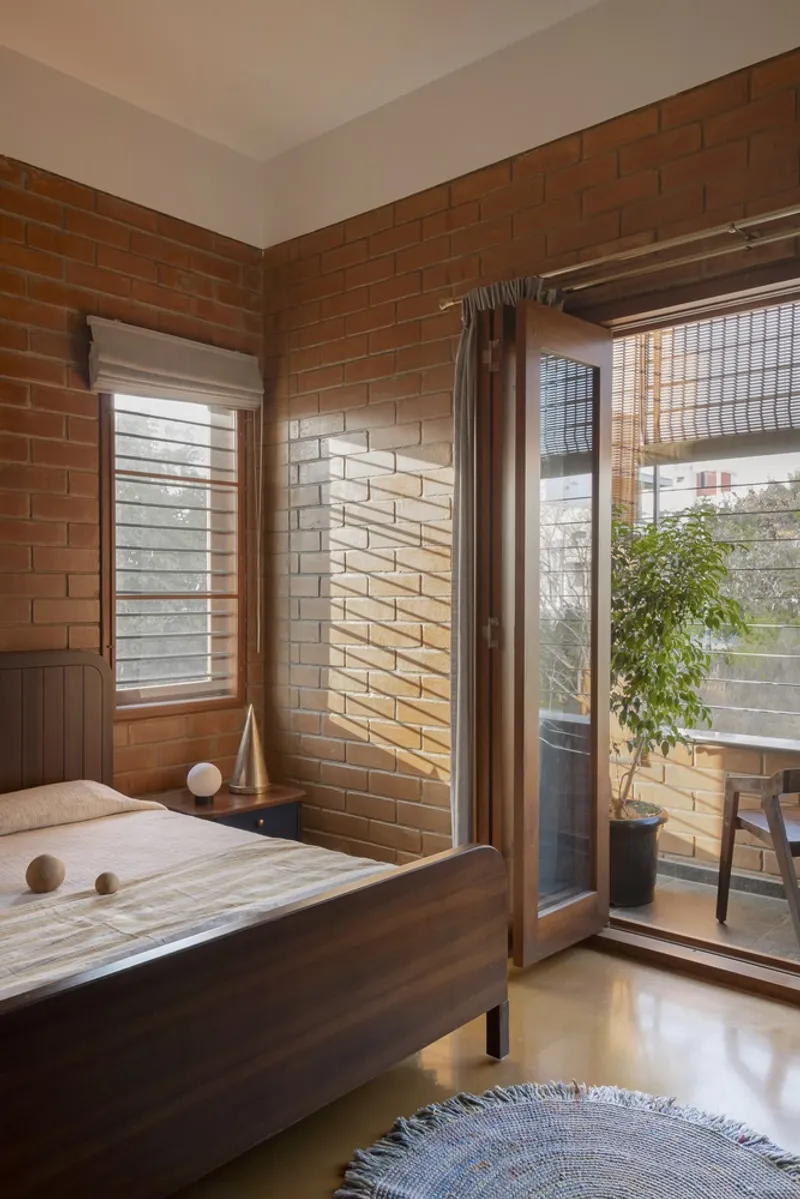
The entrance welcomes visitors with a front yard and parking space paved with Sira stone in random rubble patterns, setting a tactile and visual tone. The ground-floor home features a garden with a Tulasi Brindavan (holy basil plant) as a focal point. The living, dining, kitchen, and puja areas are aligned parallel to the garden, allowing natural eastern light to permeate the interiors. Bedrooms overlook decks and green spaces, creating private retreats.
The first-floor home centers around a covered landscaped courtyard with stepped seating, designed as an informal gathering space. The terracotta jali walls and clay-tiled sloping roof with glass inserts create dynamic light and shadow patterns throughout the day.
The third level is a multifunctional terrace with open and semi-open spaces, accommodating a home theatre, gym, pantry, and seating areas. This level serves as a hub for gardening, yoga, outdoor movies, and social events, connecting the two homes while maintaining individual privacy.

Materials and Sustainability
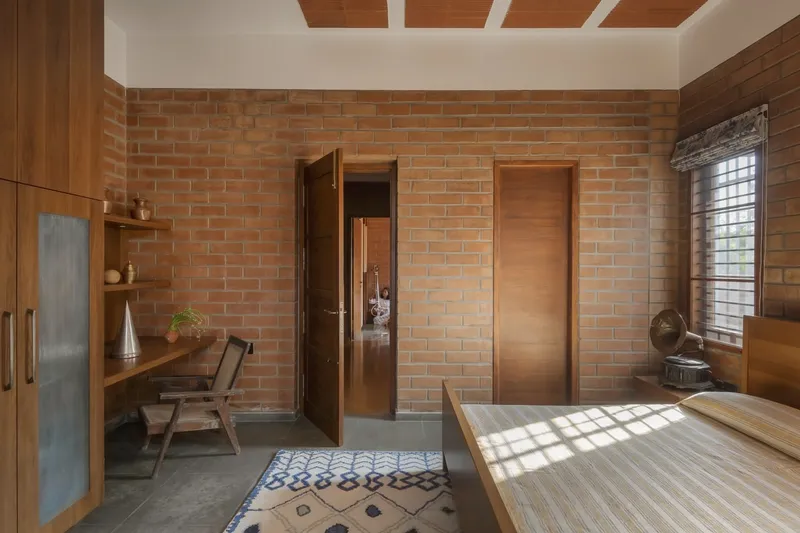
Madhura House celebrates earthy materials, primarily mud and stone, to evoke the warmth of ancestral homes while prioritizing eco-friendly construction. The architects employed compressed stabilized earth blocks (CSEB) and hollow terracotta blocks, reducing the carbon footprint while providing excellent thermal insulation.
Roof designs incorporate filler slab techniques, jack arches, and vaulted brick roofs to reduce concrete usage and improve energy efficiency. The home showcases a rich palette of Indian stones: Sira granite in rough and herringbone patterns, yellow Jaisalmer stone, Kota stone in polished and rough finishes, and leather-finished black granite.


Interior Design and Artistic Elements
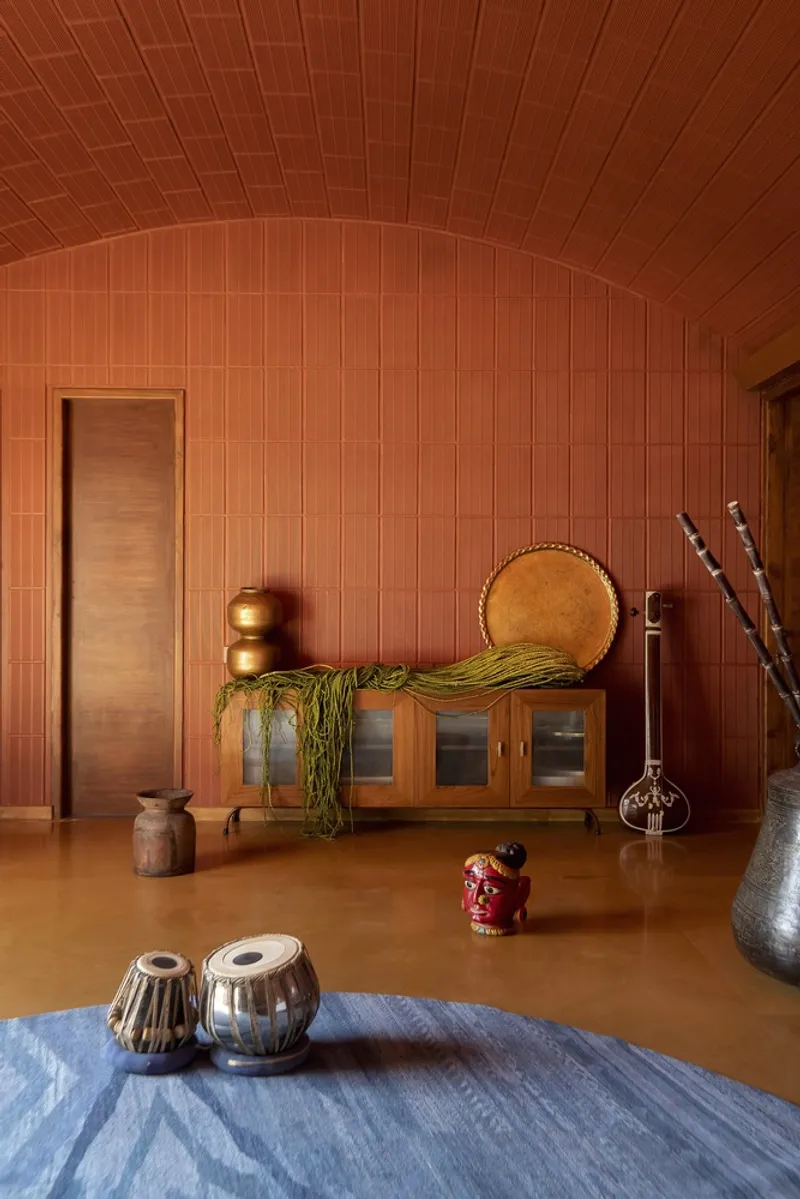
The interiors reflect a harmonious blend of traditional and contemporary elements. Yellow oxide feature walls, inspired by Jaisalmer flooring and imprinted with leaf patterns from surrounding plants, add a vibrant, earthy charm. Antique furniture, artwork, and curated artifacts create a sense of continuity with the past.
The home’s exterior balances linear forms with rhythmic curves of jack arches and steeply sloping clay-tiled roofs, resulting in a dynamic, sculptural elevation. Although designed as two distinct homes, the visual cohesion makes Madhura House feel like a singular architectural expression.

Madhura House, A Modern Tribute to Ancestral Living
Madhura House is a testament to contextual residential architecture, integrating heritage-inspired design, sustainable construction, and modern lifestyle needs. With its careful attention to Vastu, landscape, and materiality, the project creates a home that is both culturally resonant and future-ready.
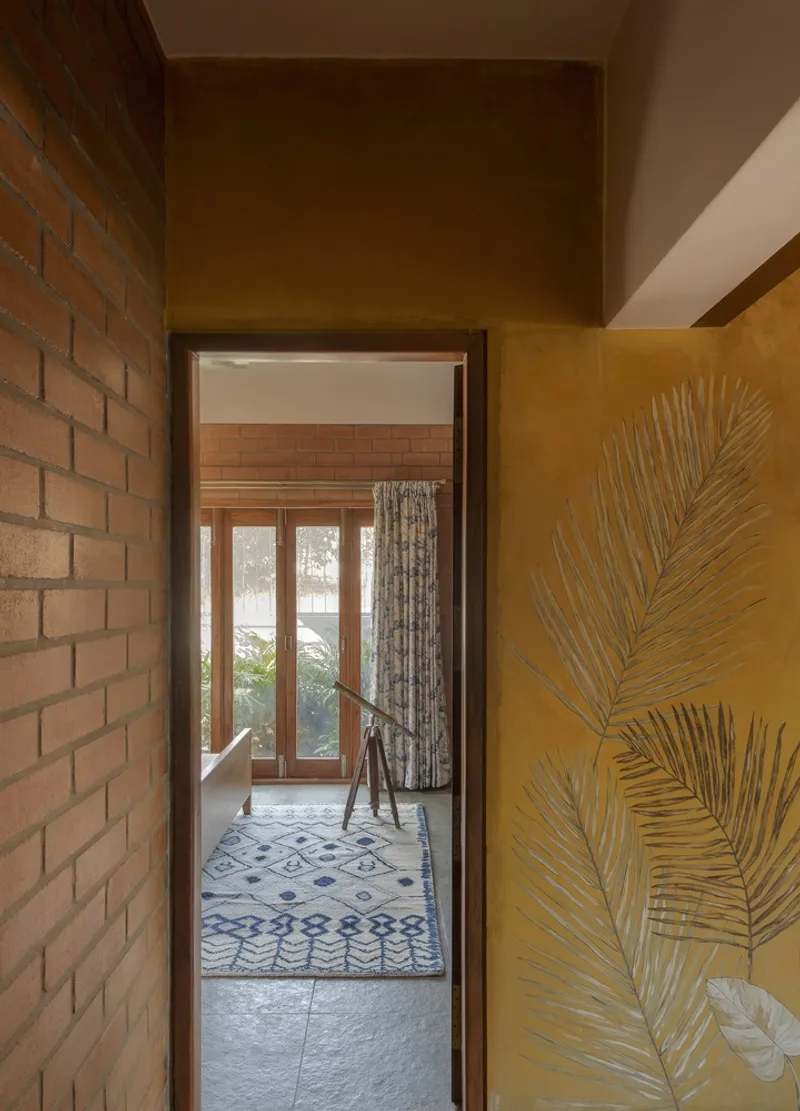
All photographs are works of Arjun Krishna




Popular Articles
Popular articles from the community


Co-life: Sustainable Architecture for Age-Friendly Community Living
Co-life reimagines sustainable architecture for seniors through courtyards, rammed earth, shared gardens, and spaces designed for belonging.

The Musturak Paradise: Senior Living Architecture for a Connected Future in Temara, Morocco
The Musturak Paradise reimagines senior living architecture in Temara via private homes, social spaces, culture, community, and shared care.
EW PARK: Sustainable Architecture Reimagines the Future of Urban Parking
EW PARK reimagines city parking as a modular wooden tower combining automation, solar energy, electric mobility, and adaptable urban design.
AL-JANNAH: Sustainable Architecture and Permaculture for Afghan Widows
AL-JANNAH uses sustainable architecture and permaculture to create resilient oasis of housing, learning, work and renewal for Afghan widows.

Similar Reads
You might also enjoy these articles


Hodi-Mandai Geram
Project Function: Preservation and revitalization of the Intangible heritage and socio-spatial identity of the Hodi by Housing, Cultural Memory Center, Sacred Grove, landscape, local tourism economy


Olio Towers: A Mid-Rise for Performers That Fuses Housing, Rehearsal, and Stage
Located blocks from Houston's Theater District, this modular tower stacks living units around a central performance atrium.

Oasis: Modular Green Housing Carved into Dhaka's Urban Fabric
A shortlisted Plugin Housing entry reclaims unauthorized settlements in Dhaka with stepped concrete volumes, green roofs, and ventilation-driven design.

Black Hole: A Floating Megastructure for the Post-Physical Era
Emiliano Mazzarotto envisions a spherical, self-scaling arena where e-sports, digital hotels, and holographic stadiums replace traditional public space.

Explore Uttarakhand Architecture Competitions
Discover active competitions in this discipline



Challenge to reimagine the Iron Throne


Photograph architecture without architects


Illustrate the lost glory of Angkor Wat - Render Challenge


Design challenge to reuse E-waste
Comments (0)
Please login or sign up to add comments
No comments yet. Be the first to comment!