

Atelier tao+c Turns a Rented Shanghai Flat into a Monk's Cell with Green MDF Cupboards
In a 1936 French Concession apartment, prefabricated shelving systems redefine solitary urban living during lockdown Shanghai.


When Shanghai locked down in the spring of 2022, atelier tao+c was designing an apartment on Wulumuqi Road for a client who rented a small studio on the upper floor of a 1936 residential building in the former French Concession. The timing was not incidental. The enforced isolation turned the project's central question from "how should this person live?" into something sharper: what does a dwelling owe someone who is alone? The answer the studio arrived at borrows from monastic typology and Karel Teige's 1932 treatise Minimum Dwelling, stripping the apartment of every social pretense and rebuilding it around one occupant's daily rituals of reading, working, sleeping, and looking out the window.
The renovation's defining move is a single system of green humidity-resistant MDF cupboards, supported by thin steel holders that hover above the original basketweave teakwood floor without touching it. Prefabricated off-site and assembled in place, the system morphs from bookshelves to desks to bed platform to closet, carving distinct zones out of what is now one continuous room. The original bathroom and kitchen remain untouched; everything else has been opened up and reoccupied by this insertable infrastructure. It is a project about restraint as both architectural method and way of life.
A Green Skeleton That Does Everything
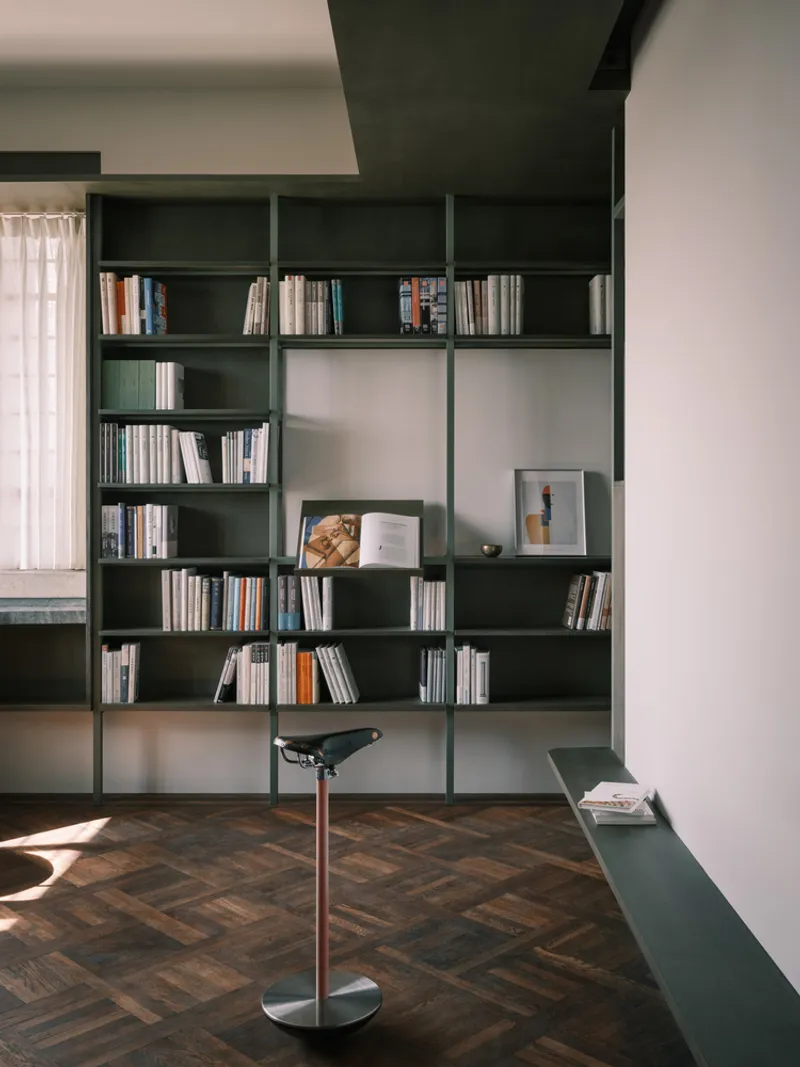
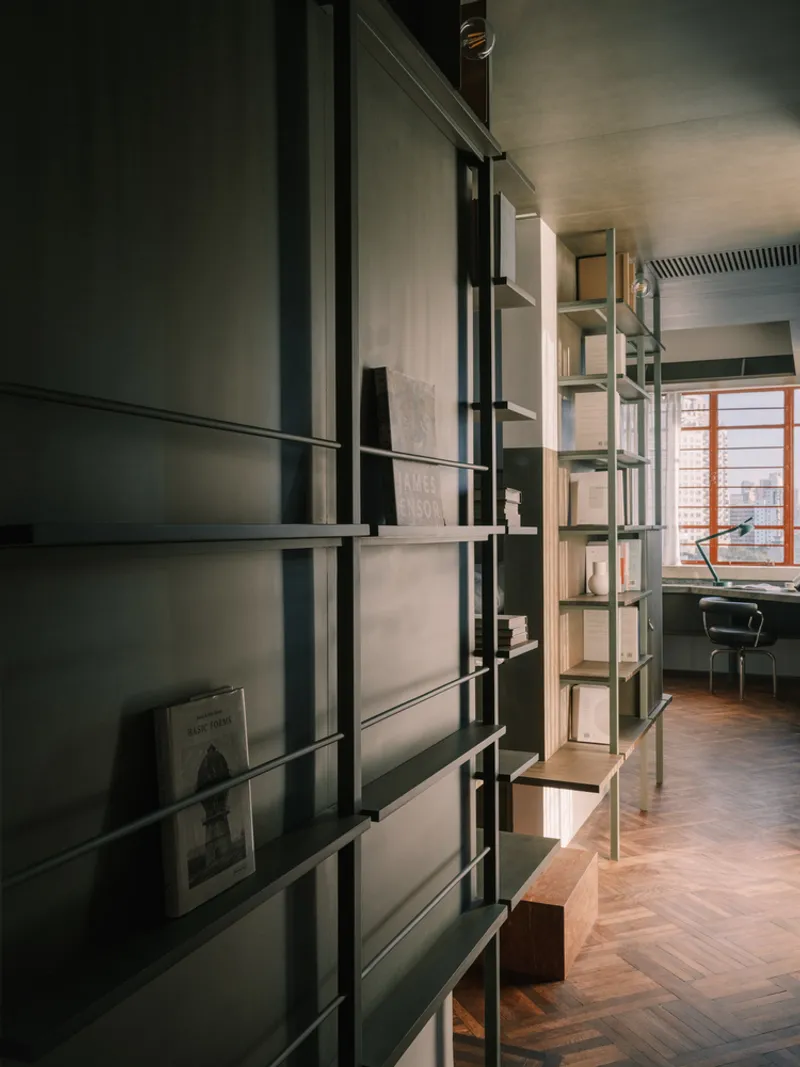
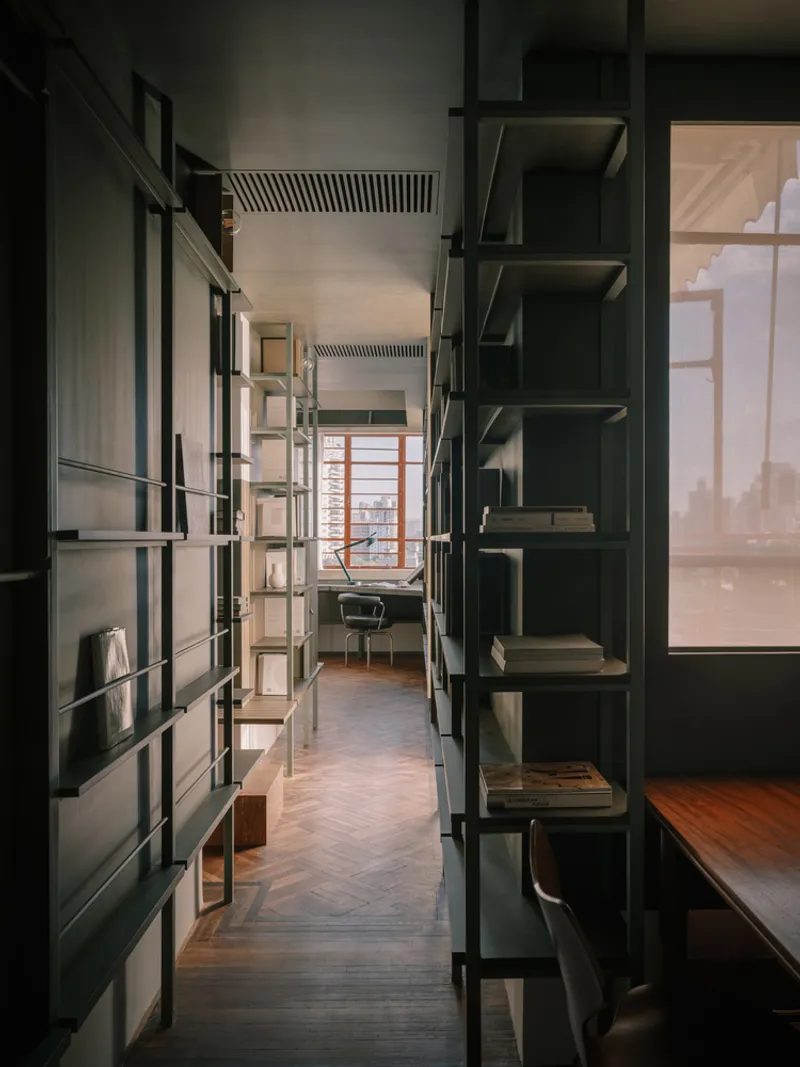
The cupboard system reads as a single material gesture: dark green MDF panels locked into a thin steel framework. Closed compartments alternate with open shelves, and the proportions shift depending on what each section needs to do. Where the system forms a room divider, it stays skeletal and transparent. Where it becomes storage, the panels close up. The consistency of color and module gives the apartment a visual coherence that most renovations of this size struggle to achieve.
What makes the system genuinely clever is its relationship to the floor. The steel holders lift every cupboard element just enough to leave a gap between new and old, so the original teakwood parquet runs uninterrupted beneath the entire apartment. No screwing into historic fabric, no irreversible damage. For a rented space, this is not just considerate; it is strategic. The entire intervention could, in theory, be unbolted and removed, leaving the 1936 room more or less as it was found.
Two Desks, Two Kinds of Attention
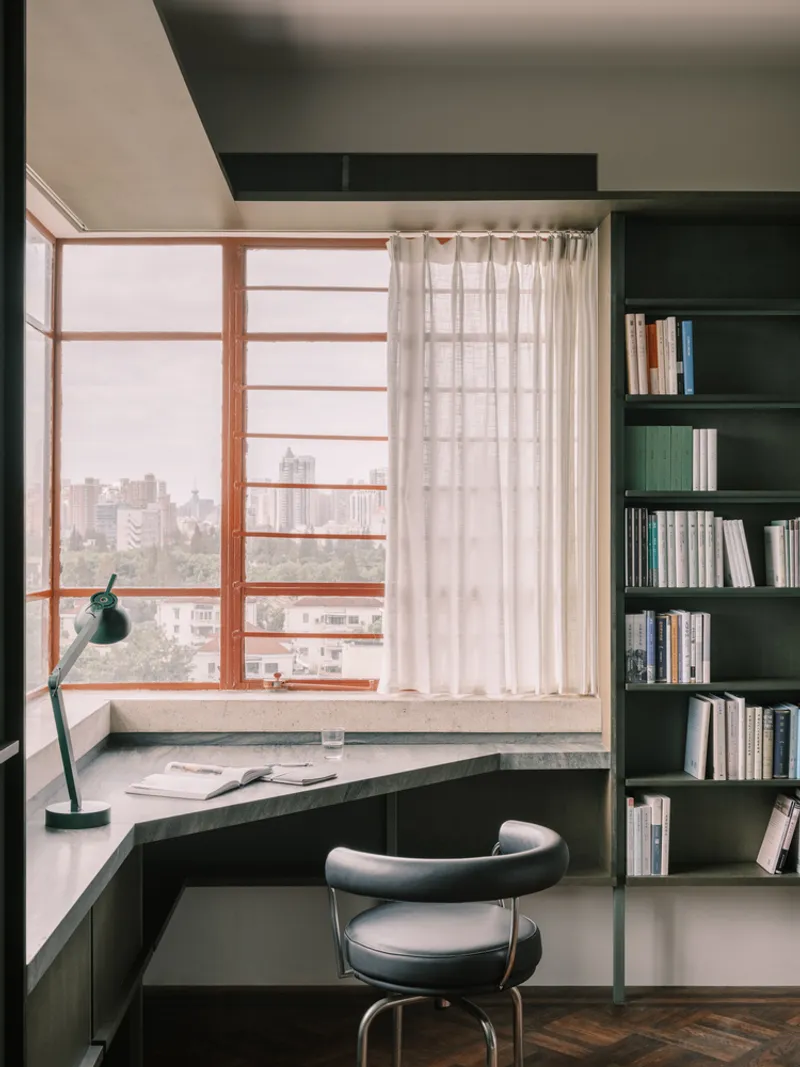
The apartment contains two work areas, and the distinction between them is deliberate. The larger desk sits at a corner window overlooking the Shanghai cityscape, its timber frame and translucent linen curtain filtering the panoramic view into something usable rather than distracting. This is the outward-facing workspace, designed for tasks that benefit from peripheral awareness of the city below.
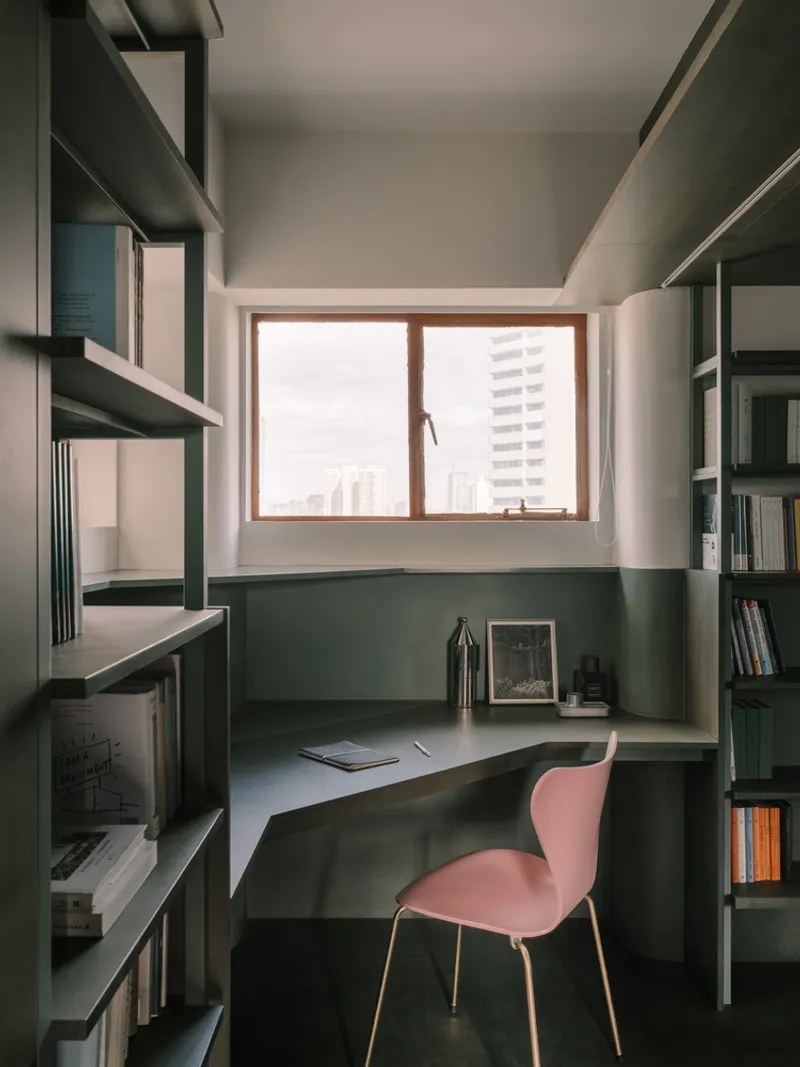
The smaller study nook, by contrast, is wrapped on three sides by the green shelving system. A curved desk tucks under a timber window, and a pink chair provides the only color accent that departs from the project's otherwise disciplined palette. The enclosure here is intentional: books and objects within arm's reach, daylight from a single direction, minimal visual noise. It is a workspace built for sustained concentration, the kind of focus that the monk's cell analogy actually earns.
The Sleeping Platform as Architectural Event
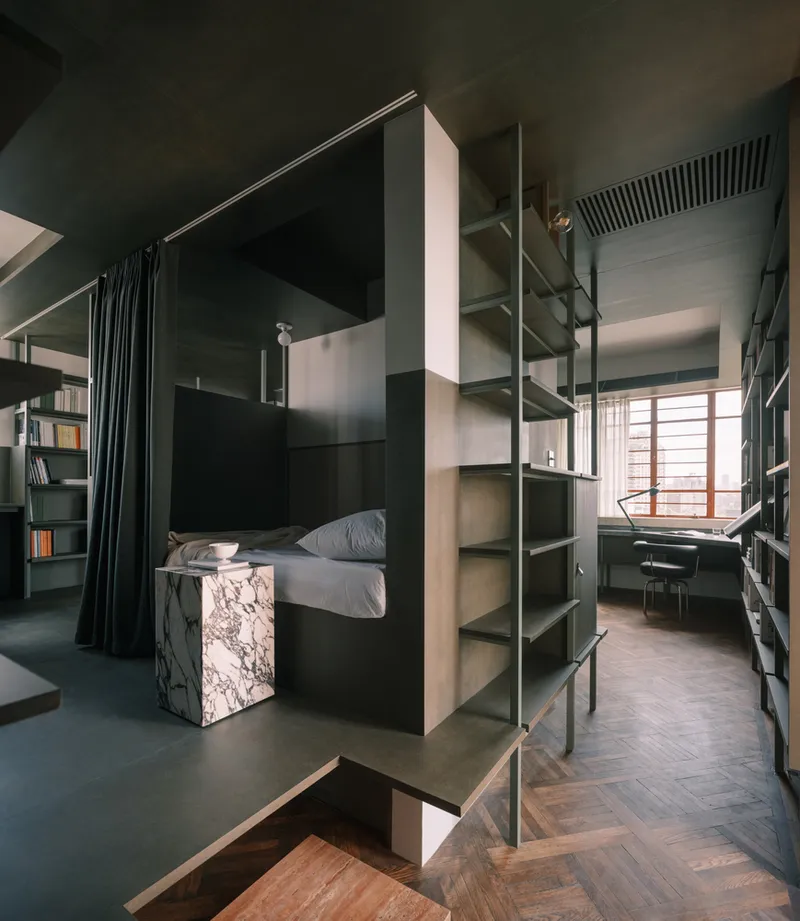
Raising the bed onto a platform is a well-worn small-apartment trick, but atelier tao+c executes it with real care. The sleeping surface is integrated into the steel shelving framework, accessed by a built-in ladder, and flanked by the same MDF cupboard system that organizes the rest of the apartment. Timber shutters at the adjacent window control both light and privacy, turning the elevated platform into a genuinely enclosed retreat within the larger open room.
Below the platform, the space is not wasted on storage bins or awkward crawl spaces. Instead it transitions into a secondary workspace, maintaining the apartment's commitment to productive solitude at every elevation. The vertical stacking of sleep above work compresses the domestic program without making it feel cramped, largely because the steel framework remains open and legible rather than boxed in.
Framing the Room Through Thresholds
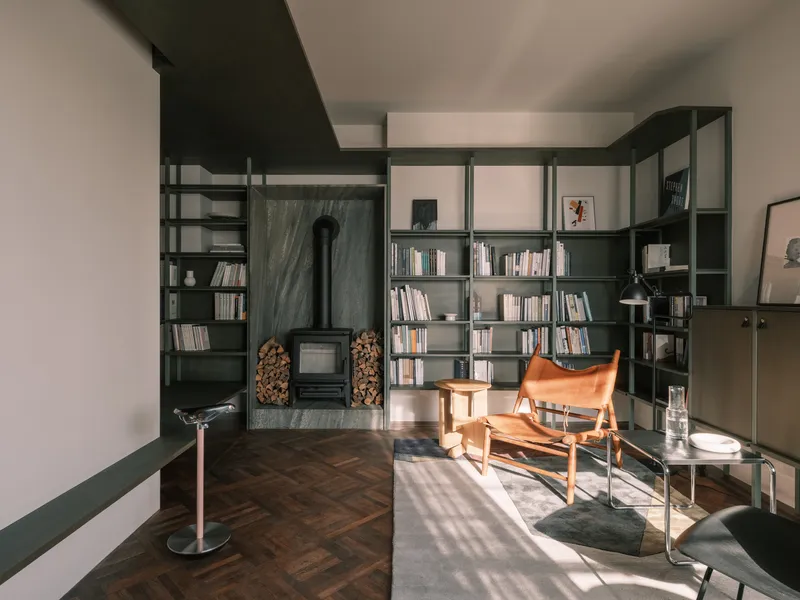
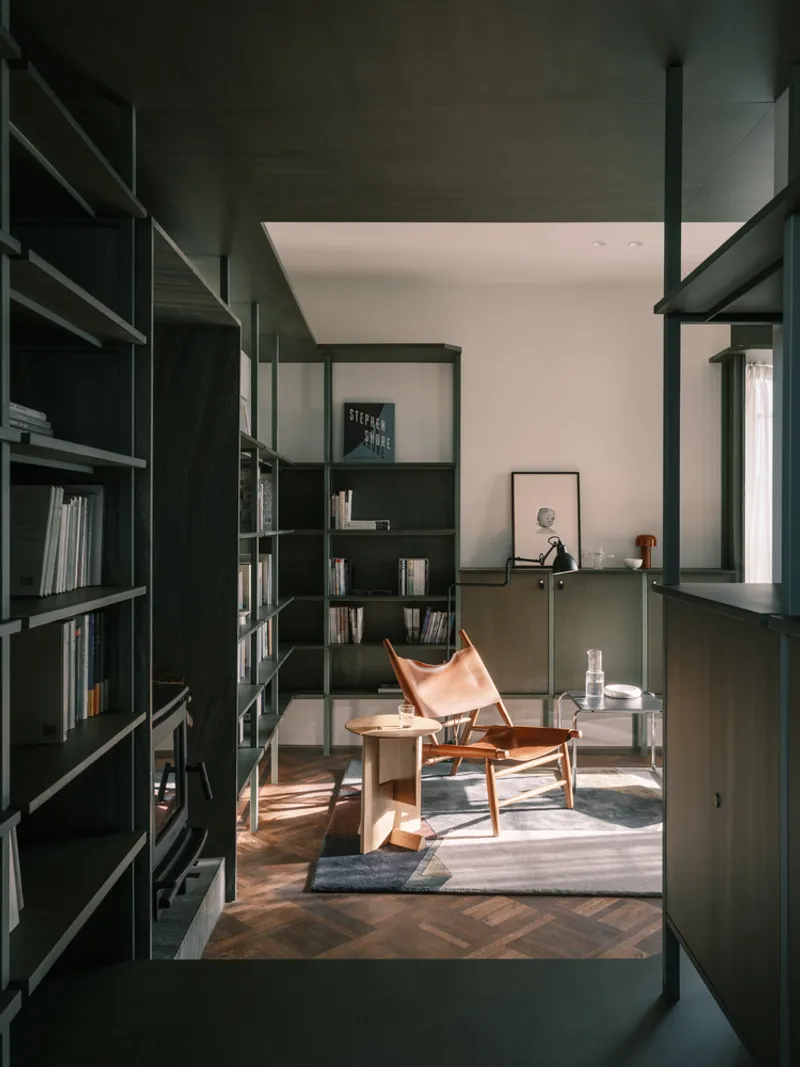
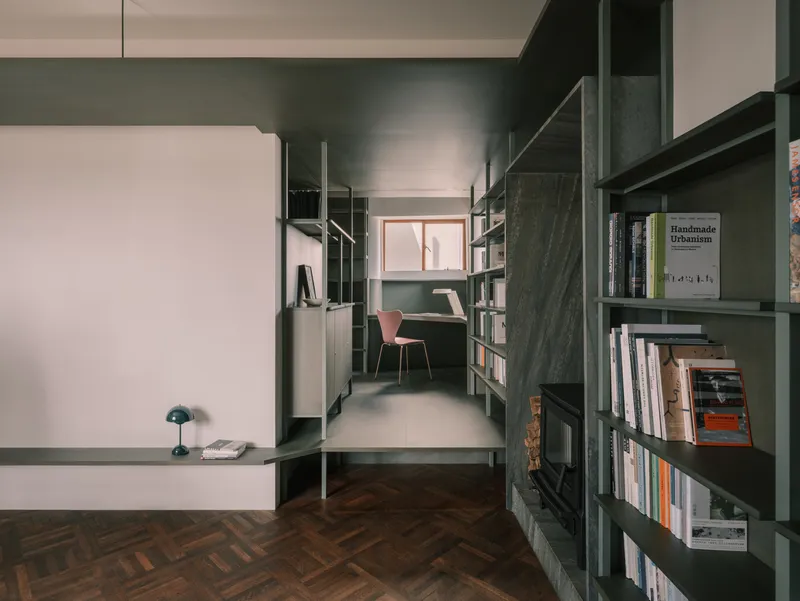
With the original bedroom partition demolished, the apartment relies on the cupboard system itself to create thresholds. Seen from certain angles, the green steel frames act as doorways, compressing the view into a tight rectangle before releasing it into the next zone. Striped afternoon light rakes through these frames, landing on the teakwood parquet and a leather sling chair, giving the space a warmth that the monastic concept might otherwise deny it.
The effect is cinematic in the best sense: each zone is discovered sequentially, framed by the repeating vertical rhythm of the shelving. A firewood-burning stove tucked into the library area reinforces the sense that this is a place of deliberate retreat. The neighborhood outside, alive with collective facilities, restaurants, and street life on Wulumuqi Road, takes care of the social dimension. Inside, the apartment is permitted to be entirely inward.
Why This Project Matters
The Magy Upper Apartment challenges a default assumption in residential design: that a home must accommodate guests, express identity, and perform social life. By treating a rented flat as a monastic cell, atelier tao+c sidesteps the question of ownership entirely and focuses on what a single occupant actually needs hour by hour. The result is not ascetic in any punishing sense. It is generous where it counts, with carefully positioned windows, two distinct workspaces, and a material palette that feels warm rather than severe. The green MDF and teakwood parquet conversation alone justifies the project's restraint.
More practically, the prefabricated, floor-hovering construction method offers a genuine model for renovating historic rental apartments without permanent alteration. In a city like Shanghai, where prewar residential fabric is both valuable and increasingly occupied by renters rather than owners, this approach is less a stylistic choice than a responsible one. The project demonstrates that you can radically rethink a dwelling's spatial logic while leaving its bones untouched, and that sometimes the most ambitious design move is to build something that can be completely taken apart.
Magy Upper Apartment Renovation by atelier tao+c. Located on Wulumuqi Road, Shanghai, China, in a 1936 residential building in the former French Concession. Completed in 2022. Photography by Wen Studio.
About the Studio
Share Your Own Work on uni.xyz
If projects like this are the kind of work you want to make, uni.xyz is a place to publish your own, find collaborators, and enter design competitions.


Popular Articles
Popular articles from the community


Cube Design Draws an Ecological Corridor Between Two Shenzhen Hills with the Nankai Building
Beside Shenzhen's container docks, the Nankai Building pairs stacked balconies with a climbing green screen to connect two hillsides across its height.

David Ortega Stacks a Two-Story Mexico City Penthouse Around a Steel Stair and a Pergola-Shaded Roof Terrace
In Colonia Roma, a 300 m² penthouse uses oak joinery, a planted steel stair and a slatted roof pergola to make a new-build apartment feel like a house.

U.GA Architects Wraps an Oval Rooftop Pool in Curved Board-Formed Concrete on Busan's Jeollidan-gil
In Busan's Jeonpo-dong, a 454 m² mixed-use block stacks a neighborhood facility, guest rooms and an oval rooftop pool inside spiraling concrete walls.

Architekt Andreas Gruber Scatters 23 Dark Timber Chalets Across a South Tyrolean Forest Edge
In Molini di Tures, Amonti Chalets breaks a resort into a hamlet of gabled timber houses, with parking, storage and services pushed into the slope.

Similar Reads
You might also enjoy these articles


Hodi-Mandai Geram
Project Function: Preservation and revitalization of the Intangible heritage and socio-spatial identity of the Hodi by Housing, Cultural Memory Center, Sacred Grove, landscape, local tourism economy


Olio Towers: A Mid-Rise for Performers That Fuses Housing, Rehearsal, and Stage
Located blocks from Houston's Theater District, this modular tower stacks living units around a central performance atrium.

Oasis: Modular Green Housing Carved into Dhaka's Urban Fabric
A shortlisted Plugin Housing entry reclaims unauthorized settlements in Dhaka with stepped concrete volumes, green roofs, and ventilation-driven design.

Black Hole: A Floating Megastructure for the Post-Physical Era
Emiliano Mazzarotto envisions a spherical, self-scaling arena where e-sports, digital hotels, and holographic stadiums replace traditional public space.

Explore Architecture Competitions
Discover active competitions in this discipline

Challenge to reimagine the Iron Throne

Photograph architecture without architects

Illustrate the lost glory of Angkor Wat - Render Challenge

Design challenge to reuse E-waste
Comments (0)
Please login or sign up to add comments
No comments yet. Be the first to comment!