

Making extreme habitats possible
Extreme Habitat Challenge - Arctic


Extreme Habitat Challenge 2019 invited architects, designers, engineers, student fraternity, and visualizers from around the globe to take part in its second edition of Arctic Habitat Challenge. The Extreme Habitat Challenge (EHC) is one of the world’s most coveted competitions for habitat design. It recognizes exceptional ideas that redefine habitat design through the implementation of innovative ideas, techniques, construction, visual, programmatic and futuristic organizations through architecture as a tool.
As our cities grow, there are severe impacts visible to the quality of life due to overpopulation - poverty - traffic - pollution, etc. Weather changes are becoming more rampant. Limitless population growth ultimately contradicts the motive of moving to the city, where people instead of experiencing a better quality of life face the contrary throughout. With a non-stop growth of the human species, we will eventually see more of these circumstances and vulnerabilities unavoidably in the long run.
Cities cannot be overhauled overnight. But our cities changed, with the advent of the industrial revolution and technological development. Technology is the fastest agent of change today has almost displaced the need of living in a city - including repercussions like social isolation between people of today. A new layer of evolution has begun, which brings in technology to resolve man-made disasters. Faster transportation techniques and connectivity + collaboration have made it possible to look beyond the boundaries of cities. We take this opportunity to build a more responsible class of habitats that can be small but can be definitely inspiring for our next change of cities to come.
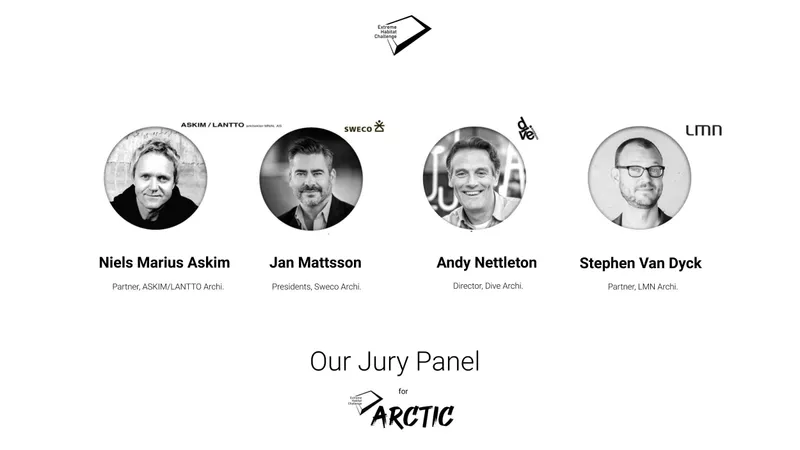
The jury for the competition consisted of esteemed designers, professionals and academicians from around the world. The Lead Jurors for the competitions were as follows:
Jan Mattsson, President, Sweco Architects AB, Sweden
Niels Marius Askim, Architect/Partner, Askim/Lantto architects, Norway
Andy Nettleton, Director/Co-founder, Dive Architects, Sweden
Stephen Van Dyck, Partner, LMN Architects, United States
"Some of the Best of competition projects are:"
Winning Project: Over the Edge. Arctic Habitat
By: Arseniy Bychkov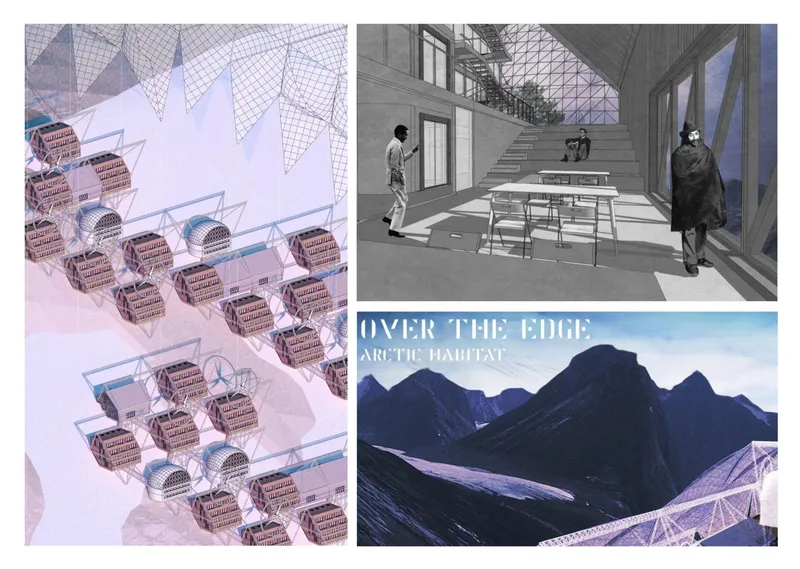
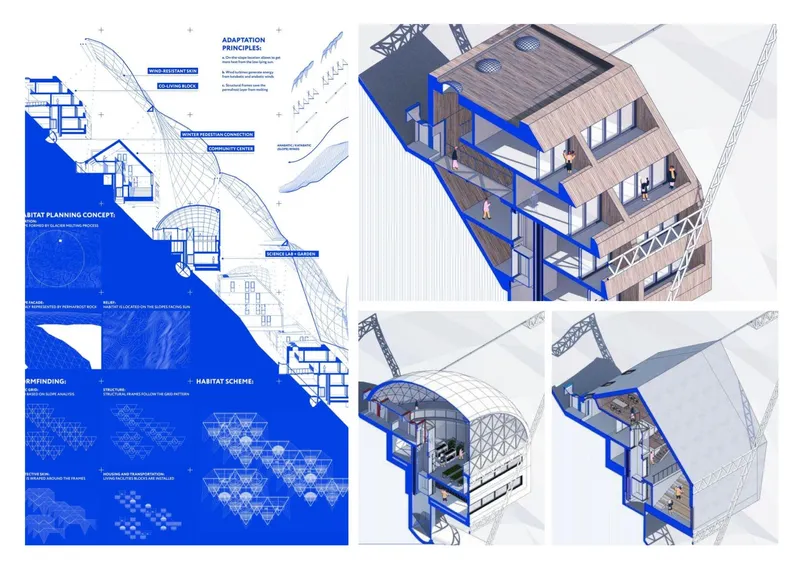
Description: The project of the Arctic settlement "over the edge" is a study on the possibility of adapting traditional architectural systems to extreme environmental conditions while maintaining their functionality. The constructive basis of the project is special frames on which various types of residential and public blocks are installed. The shape of the frames and their location pattern on the slope is dictated by the geometry of the slope.
-----------------
Runner-Up: LIFELINE
By: Филипп Трофимчук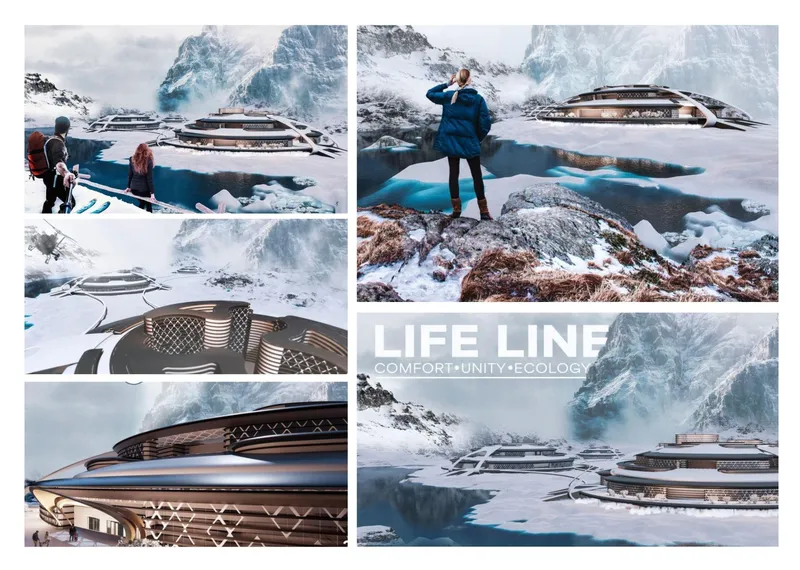

Description: The "LINE OF LIFE" project represents a new environment - comfortable, unified and environmentally friendly. It is a living organism that grows, develops and gives new life! These are new opportunities to make the world a better place and take care of nature. BUT we have to do it together! This is our chance to fix it. Comfort, unity, and ecology are what are necessary for a new life. The birth of a new city should be with care for nature. Residents of the city should solve problems together and open new borders.
---------------------
People’s Choice : HabitatNow
By: Wioletta Dębicka, Kamila Susze, Robert Czajka & Alicja Kowalewska
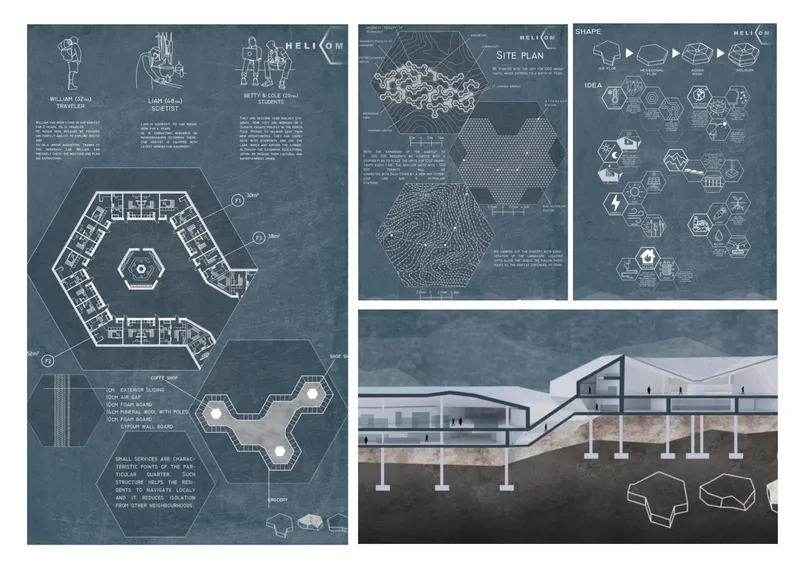
Description: Helicom habitat responds to a number of problems defined by the climate and geographical location of the Arctic. Our habitat is inspired by the behaviour of animals living in the coldest parts of our globe. For example on the south pole, penguins gather close to each other to keep warm. The main aim of our project is to gather people in the helicomic quarters and these can encourage people to make stronger social bonds. Polar nights are a depressing period in the Arctic because of the lack of natural lighting. That’s why we want to regulate the day/night cycle by installing a smart system that enables them to adjust the colour and intensity of light.
-----------------
Editorial Choice: HermetiCity
By: Luciana Teodozio, Eduardo Gutierrez & Jordi Fernández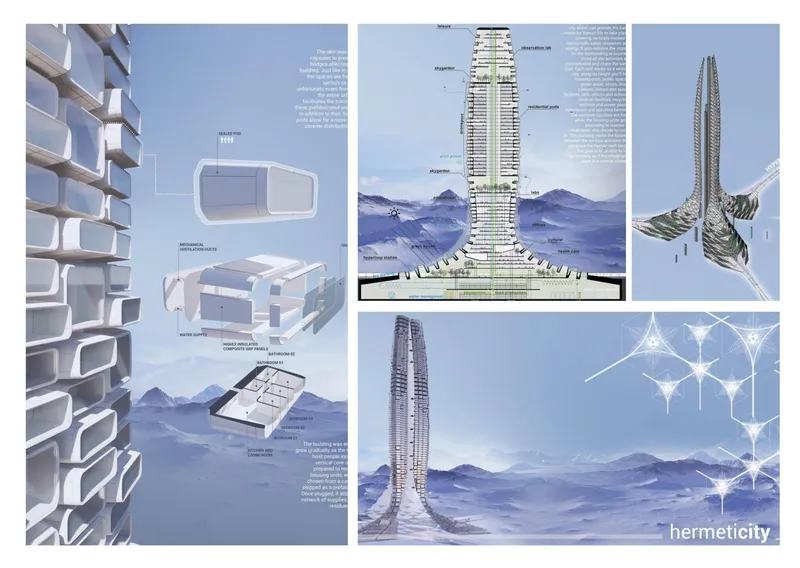
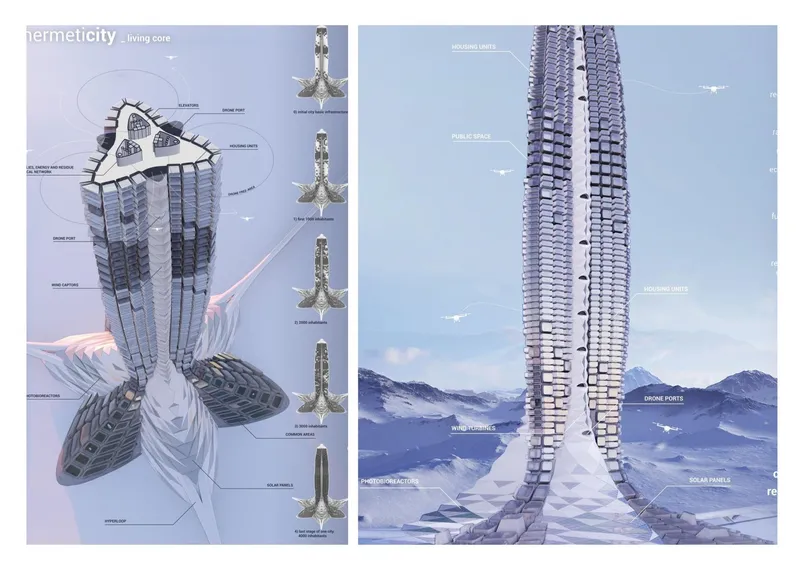
Description: The proposal envisions a hermetic vertical city that can provide the basic needs for human life to take place in the Arctic. Growing vertically instead of horizontally saves resources and energy, it also reduces the impact on the surrounding ecosystem since all the activities are concentrated and share the same core. The proposal envisions a hermetic city that can provide the basic needs for human life to take place. Growing vertically instead of horizontally saves resources and energy, it also reduces the impact on the surrounding ecosystem since all the activities are concentrated and share the same core. Each unit works as a vertical city: along with its height, you’ll find housing units, public spaces, green areas, shops, drone stations, leisure and sports facilities, labs, offices and schools, medical facilities, recycling stations and power plants, hydroponic and spirulina farming.
------------------------
Editorial Choice: ARRIVAL
By: Valery Karpov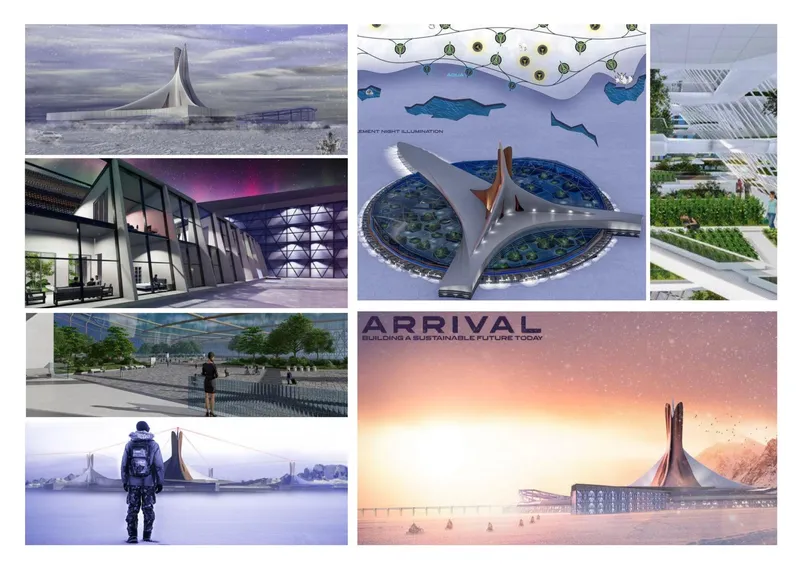

Description: Project Arrival about life without borders. People living in extreme climates should feel the same as usual, should receive the same services and have the same functions, have freedom of choice and the ability to fulfil their desires. The basic concept is the creation of an autonomous habitat capable of living and developing independently.
---------------------
Editorial Choice: SCIENHIVE
By: Александра Выворотнюк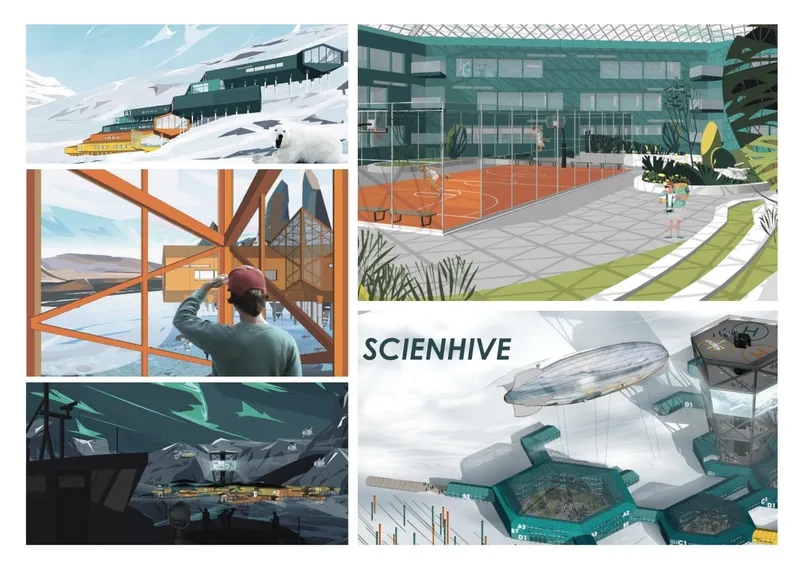

Description: The research complex consists of all the necessary functions for survival in the harsh Arctic climate. Designing this kind of architecture will provide an opportunity for further sustainable development of the Arctic. The modular structure is a series of interconnected repeating elements, each of which is responsible for a specific function and provides the ability to create an autonomous, adaptive structure in the form of mutually and mutually changing components based on a matrix system depending on needs. This principle has many advantages. Here the principle of modularity is justified by huge variability and a simplified construction process.
------------------------
Editorial Choice: THE SEAM
By: Atakan Gunduz & Selcan Şimşek

Description: Habitat is not designed as an object but as part of the context. With the effect of global warming, glaciers also form large crevices. With the movable structure, space settles between these slits and prevents the glaciers from separating from each other and freezes the water used to form insulation material on the wall and cools the glaciers. The concept of habitat that we have established does not ignore the context as a criticism of today's architecture. It offers new building material suggestions using local material and prioritizing sustainability.
--------------
Editorial Choice: Underglass ocean
By: Владислав Омельяненко, Денис Романов & Виолетта Бурмистрова

Description: The traditional housing type can't fulfil people's needs with a diversified lifestyle. As a result, we propose a concept, "Dynamics Social Infrastructure." It means that besides the basic necessary space in every living unit, there will be dynamic share space attached outside the basic living unit. So that we can create a multi-function housing in constraints.
--------------------
Discover the full results here: https://uni.xyz/competitions/ehc-arctic/entries
Discover the design brief here: https://uni.xyz/competitions/ehc-arctic/info/about
Follow us on social media: Facebook | Instagram | LinkedIn | Twitter | Youtube
Discover other design competitions to participate here: https://uni.xyz/competitions


Popular Articles
Popular articles from the community


Studio Andre Lenza Shrinks a Family Home into a Single-Storey Goiânia House Behind Timber Screens
A couple's move to a smaller home in eastern Goiânia becomes a single-storey concrete house wrapped in timber screens, around a plunge pool and garden.

Fiechter Salzmann Extends Werner Künzi's Listed Mösli School in Ostermundigen with Concrete, Spruce and Red Steel
In Ostermundigen near Bern, a kindergarten and day school wing lengthens a heritage-listed complex using precast concrete, regional spruce and red steel.


Becoming Aligned With All: A Rammed Earth Campus in Sri Lanka That Rises From the Ground and Falls Back
Two white concrete shells lift off a riverside site and land again, framing a pooled courtyard, rammed earth walls and rooms that can be reshuffled.

Ayodele: Earth-Built Housing That Pushes Back Against Accra's Concrete and Asphalt
A modular earth-built housing block for central Accra stacks family units around shared courtyards, craft studios and planted roofs.

Similar Reads
You might also enjoy these articles
Ayodele: Earth-Built Housing That Pushes Back Against Accra's Concrete and Asphalt
A modular earth-built housing block for central Accra stacks family units around shared courtyards, craft studios and planted roofs.

SHED: A Folded Canopy That Turns a Roadside Fuel Stop into One Continuous Roof
Winner of Overhaul 2020, this service station drapes a single faceted roof over pumps, shop and café, pinning its sharp corners into the lawn.

The Infinity Park: A Figure-Eight Park That Tries to Breathe for Its Neighbourhood
A sculptural lung and visitor-triggered oxygen bollards make people the park's breath, and show how narrow a carbon-only idea of clean air can be.

The Student Center As A Modular Space: A Timber Grid That Behaves Like a Street in Amsterdam
Shortlisted at Overseas Oasis 2020, a stacked wooden frame holds cafés, shops, studios and terraces in parts that can serve shifting demands.

Explore Extreme Habitat Competitions
Discover active competitions in this discipline

The Global Benchmark for Architecture Dissertation Awards

The Global Benchmark for Graduation Excellence

Challenge to design a shop stop sunk in the city
Comments (0)
Please login or sign up to add comments
No comments yet. Be the first to comment!