
Mangrove Swamp: Modular Flood-Resilient Housing Rooted in Ecological Logic
A pile-dwelling settlement inspired by mangrove root systems adapts, expands, and transforms into emergency shelter during floods.


Mangrove forests do not resist water. They let it pass through, filtering force into flow, absorbing shock through a lattice of roots that holds land and sea in productive tension. Mangrove Swamp takes that principle and translates it into architecture: a modular, column-based settlement designed to rise above floodwaters rather than fight them. The result is not a fortress against climate change but a framework that coexists with it, offering housing, communal infrastructure, and emergency shelter within a single adaptive system.
Designed by Julian Castañeda, the project was shortlisted in HEAL+, a competition focused on architecture's capacity to address global crises. Castañeda's entry confronts the reality that millions of people in low-lying and coastal regions live in structures that simply cannot survive rising water levels. Rather than proposing a singular building, the project outlines an entire settlement strategy: a phased, scalable system of elevated platforms, communal halls, and housing volumes that can grow from a single structural bay into a functioning neighborhood.
Phased Growth on a Structural Grid
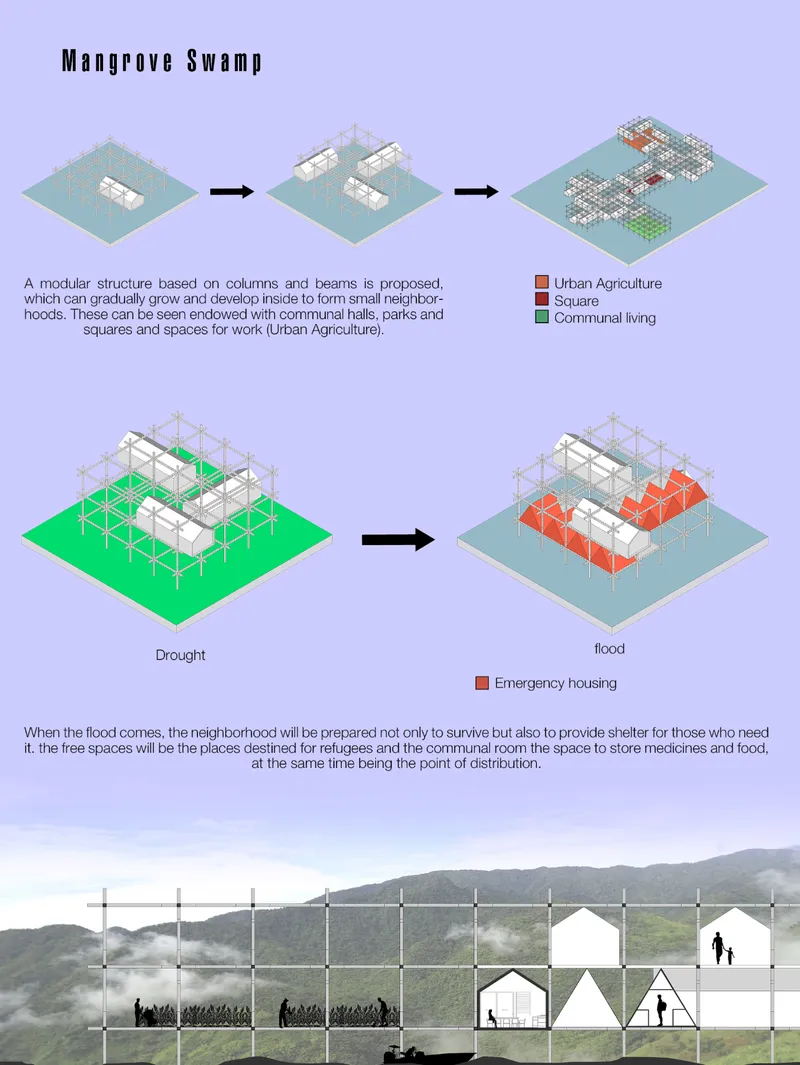
The phased development diagram reveals the project's core ambition: incremental growth that mirrors the organic spread of a mangrove forest. The settlement begins with a basic grid of columns and beams planted into the landscape, forming a structural skeleton that can be populated over time. Early phases establish circulation and primary shelters; later phases introduce urban agriculture plots, parks, and communal gathering spaces. The modularity is not merely aesthetic. It is operational, allowing communities to build what they need, when they need it, without requiring a master plan to be executed all at once.
This incremental logic also gives the settlement a critical second function. During floods or displacement crises, unoccupied bays within the grid can be rapidly converted into emergency shelters. Communal halls double as distribution points for food and medicine. The same framework that organizes daily life reorganizes itself around disaster response, collapsing the distance between permanent settlement and humanitarian infrastructure.
Elevated Volumes Above the Waterline
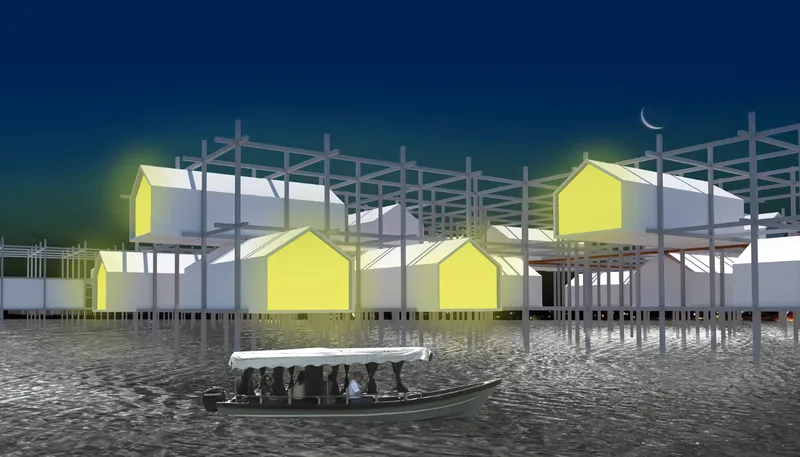
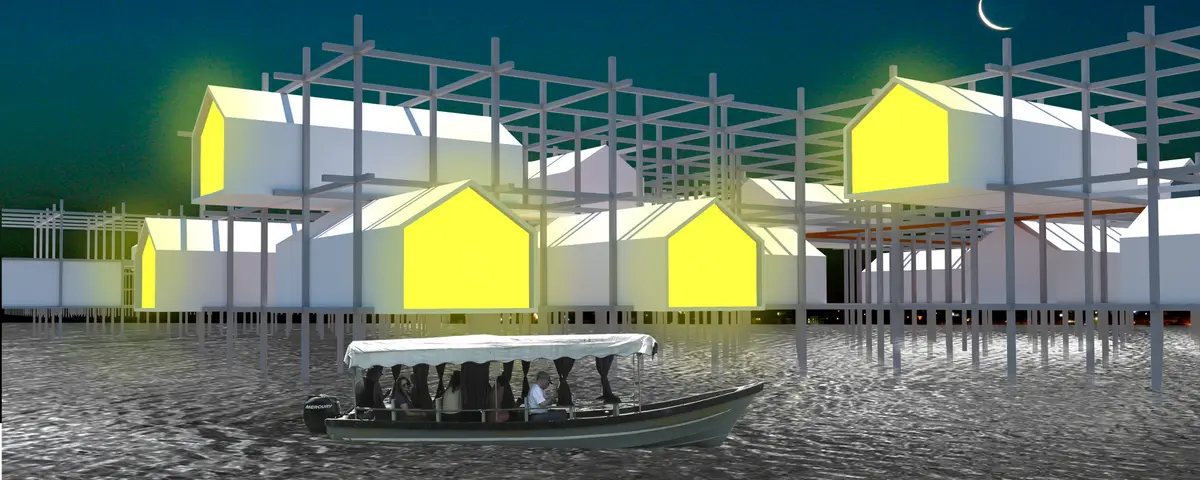
The night rendering makes the spatial logic vivid. Housing volumes sit elevated on the structural grid, their recognizable pitched profiles slotted into the framework like objects on a shelf. Below, water occupies the ground plane freely; a boat passes beneath the settlement as naturally as it would through a mangrove channel. The architecture does not pretend the water is not there. It acknowledges it, designs around it, and keeps inhabitants above it.
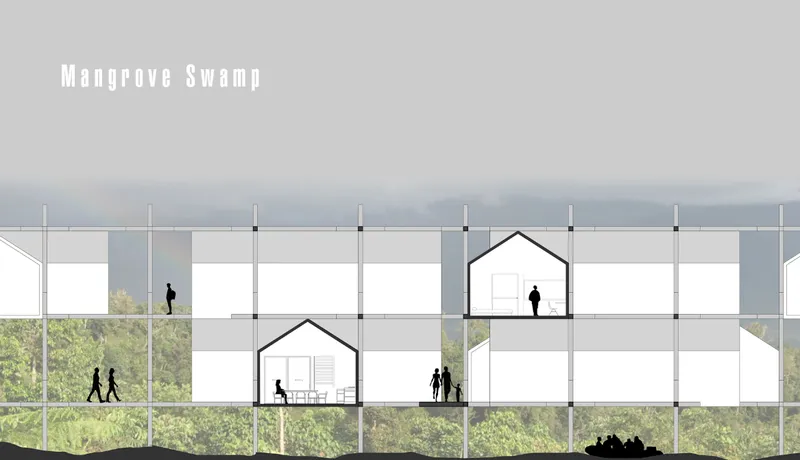
The section drawing clarifies how this works structurally. House-shaped units are inserted within a multi-level framework of columns and horizontal platforms. Figures occupy different levels, suggesting a vertical community where ground-floor contact with floodwater is eliminated entirely. Open frameworks between units allow natural ventilation and daylight to penetrate deep into the settlement, preventing the claustrophobic density that plagues many elevated or stacked housing models. Each unit reads as a discrete home, yet the larger framework binds them into a collective infrastructure.
Living Beneath the Canopy
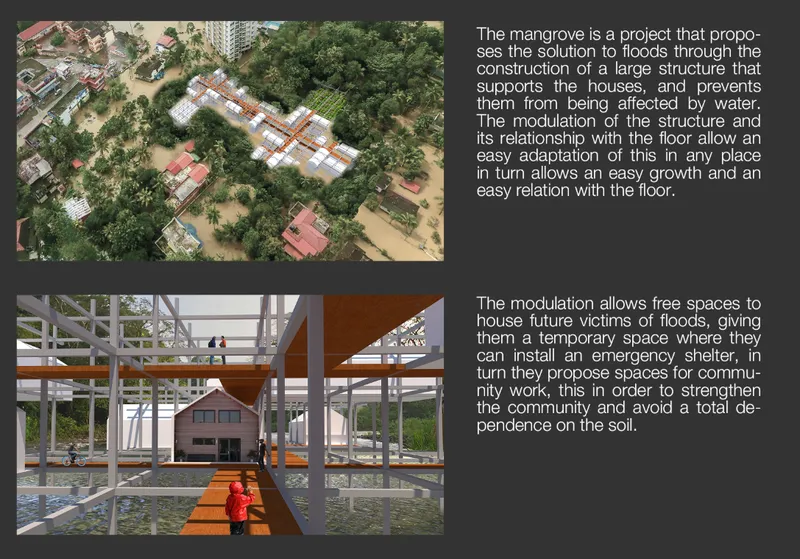
The view from beneath the raised grid is the project's most compelling image. Orange walkway panels span between columns above shallow floodwater, creating a network of circulation paths that function regardless of water levels. The perspective recalls the experience of standing beneath a mangrove canopy: shaded, suspended, surrounded by structure that is simultaneously above and around you. The columns themselves become the roots, and the settlement above becomes the forest. It is a literal and spatial translation of the ecological metaphor that drives the entire project.
What matters here is accessibility. The walkway system ensures that even during flooding events, residents can move through the settlement, reach communal spaces, and access supplies. The ground plane is surrendered to water intentionally, not catastrophically. By designing for submersion rather than against it, Castañeda eliminates the anxiety of the rising waterline and replaces it with a settlement that simply continues to function.
Why This Project Matters
Mangrove Swamp is significant because it refuses the binary that dominates flood-prone architecture: either build barriers or relocate. Castañeda proposes a third path, one where architecture absorbs flooding as a normal condition rather than an emergency. The modular column-and-beam system is replicable across geographies, from Southeast Asian deltas to Caribbean coastlines, and its phased deployment model means communities do not need massive upfront investment to begin building resilience.
The project also carries a social argument that is easy to overlook. By embedding communal halls, urban agriculture, and shared gathering spaces into the structural grid, Castañeda insists that flood resilience is not only a matter of keeping water out of buildings. It is a matter of keeping communities intact: connected, fed, and organized. In a climate era defined by displacement and fragmentation, that insistence on social infrastructure alongside physical infrastructure is where the real design intelligence lies.
View the Full Project
About the Designers
Designer: Julian Castañeda
Enter a Design Competition on uni.xyz
uni.xyz runs architecture and design competitions year-round that reward proposals with spatial conviction and real site intelligence.
Project credits: Mangrove Swamp by Julian Castañeda.


Popular Articles
Popular articles from the community

Temporary Home for Dogs: A Reversed Zoo Rethinks Animal Shelter Architecture
In Bucharest, a sinuous corridor and freed landscape flip the logic of containment, designing a shelter that works to make itself unnecessary.

Opera on the Sea: Driftwood Logic Shapes a Timber Opera House on Estonia's Coast
Trevor Orgill's opera house translates the entangled drift of floating timber into a civic building where wood, water, and music converge.
Cloaked Colonization: A Mobile Underwater Habitat That Moves Like a Fish
Micah Abaya's shortlisted EHC Pacific entry reimagines ocean settlement as a dispersed network of self-sustaining architectural organisms.

Singing Woman: An Opera House That Performs Before the Curtain Rises
Ovidiu Cristian Pavel's conceptual opera house translates Estonia's choral identity into a sculpted waterfront landmark facing the Baltic Sea.

Similar Reads
You might also enjoy these articles

Pixel Gardens: One Repeated Module Stacked Into a Terraced Social Housing Tower for Famagusta
Salem Bader's shortlisted housing tower builds a vertical neighbourhood from one repeated module, offsetting units to carve terraces, light and air.

Bao Huynh Watercolor Atelier: A Serene Art Retreat in Hội An
Bao Huynh Watercolor Atelier in Hội An blends multifunctional art spaces, sustainable design, local materials, and family-friendly living in a serene environment.

Atelier Macri Concept Store Interior Design by CASE-REAL
Atelier Macri store features a "ko" counter, walnut wood details, cork displays, blending retail, gallery, and seamless customer experiences.

Manuel Vargas Izquierdo Stadium and High-Performance Sports Center: Architectural Excellence in Jalpa de Méndez
The Manuel Vargas Izquierdo Stadium blends sustainable design, inclusive sports facilities, and cultural-inspired architecture, revitalizing Jalpa de Méndez’s public spaces.

Explore Urban Resilience Competitions
Discover active competitions in this discipline

Challenge to reimagine the Iron Throne

Photograph architecture without architects

Illustrate the lost glory of Angkor Wat - Render Challenge

Design challenge to reuse E-waste
Comments (0)
Please login or sign up to add comments
No comments yet. Be the first to comment!