
Espacio Colectivo Arquitectos Builds a Nest for Children Above the Rooftops of Cali's Siloé Neighborhood
A child development center in one of Colombia's most resilient informal settlements doubles as civic anchor and protective canopy.


Siloé is a neighborhood that has survived on grit. Founded by coal miners, later swelled by communities displaced by violence and poverty, it clings to the steep hillsides of western Cali with an irregular urban fabric that has overtaken water courses and left almost no public green space. It is also the only neighborhood in Colombia to produce two Olympic medalists. The Cuna de Campeones Child Development Center, designed by Espacio Colectivo Arquitectos under the lead of Aldo Marcelo Hurtado and Carlos Hernan Betancourt, is named after that improbable sporting legacy, and it is the first child development center in the country to embed athletics directly into its pedagogical program.
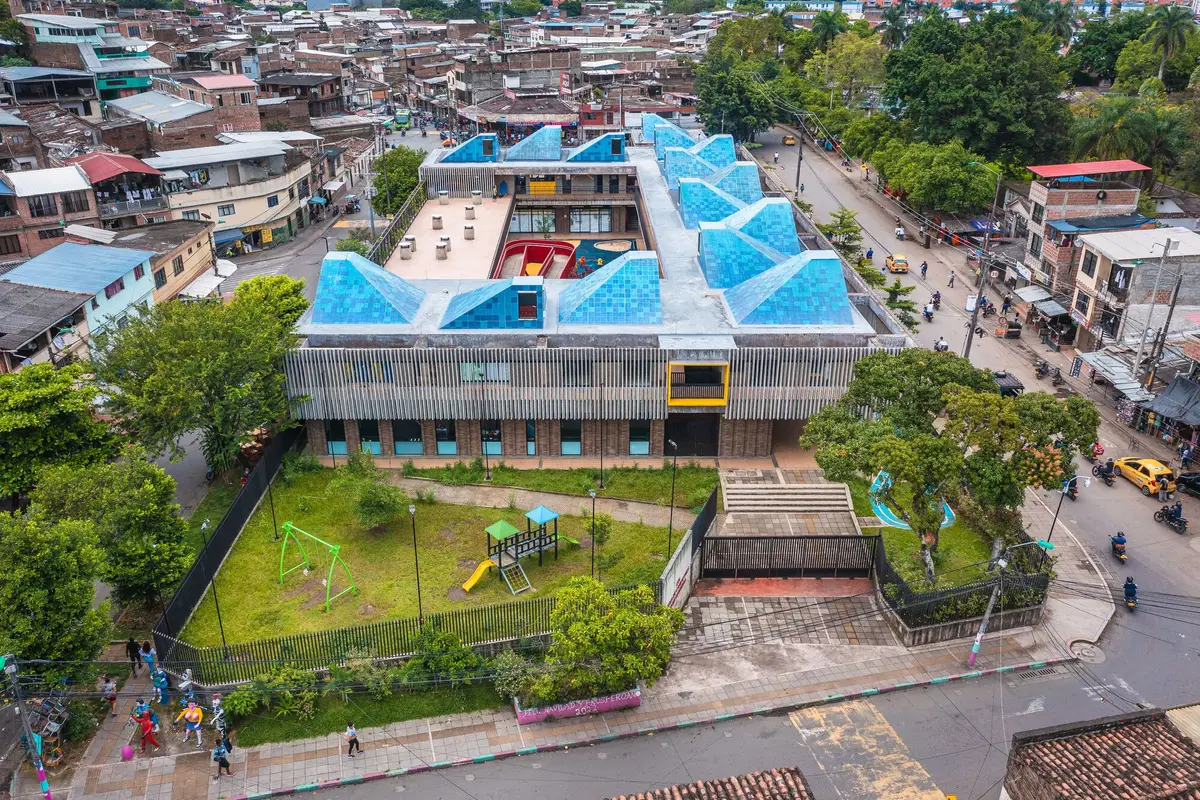
Won through a public competition organized by the Mayor's Office of Cali in 2018 and built just a year later, the 2,800 m² project sits at a charged site facing a cemetery, at the confluence of some of Siloé's densest occupation. What makes it genuinely interesting is the way the architects split the building into two distinct social registers: a porous, column-lifted ground floor that belongs to the community, and an elevated "nest" of classrooms and play spaces that belongs to the children. The metaphor is literal. Classrooms are raised to the height of the surrounding treetops and the rocky cliffs above Siloé, deliberately placing children at an altitude that frames protection and aspiration in the same gesture.
A Ground Floor for the City
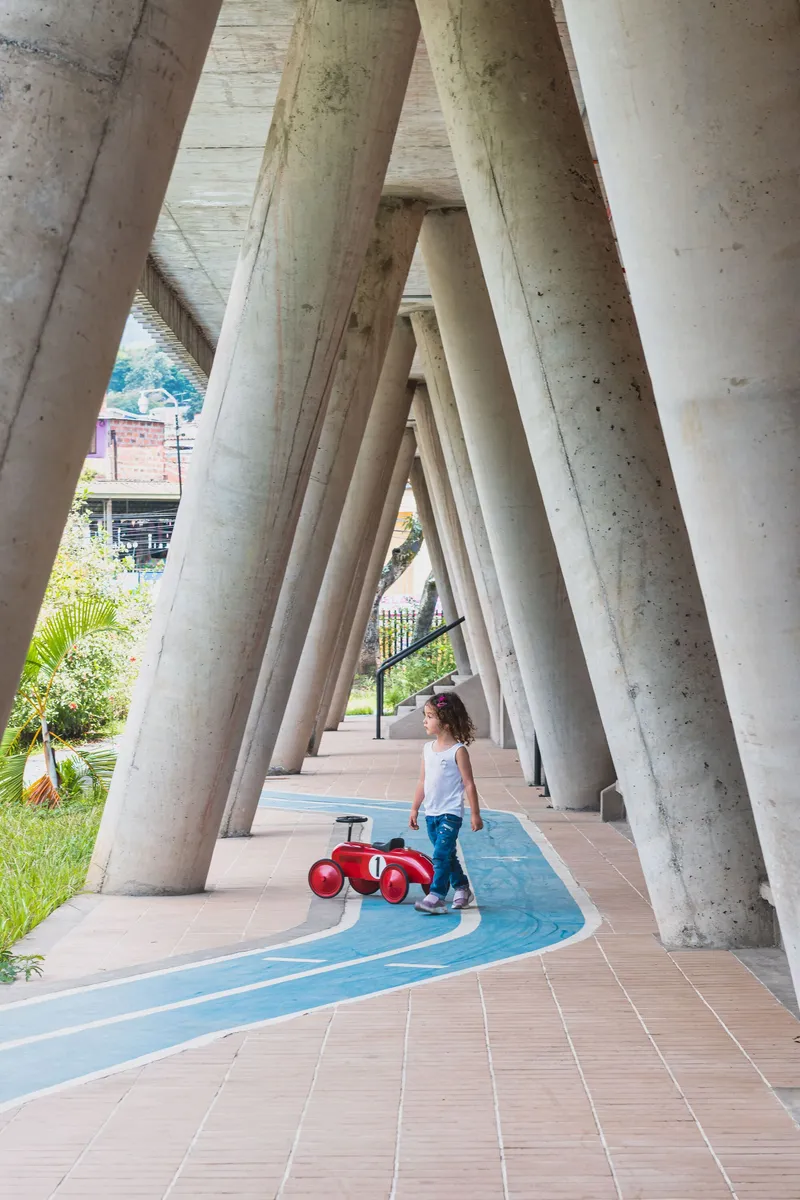


The building's most radical decision is economic rather than formal: the entire ground floor is conceived as a public threshold. A colonnade of angled concrete columns lifts the upper volume and creates a covered, shaded zone that functions as community gathering space, a sheltered pickup area for parents, and a transitional buffer between the street and the interior program. The columns lean at angles that recall buttresses but read more like an open hand propping up the floor above.
Blue painted floor markings and paved pathways guide movement through this level, turning what could have been dead space beneath a raised slab into something closer to a roofed plaza. In a neighborhood where public gathering areas are scarce and shade from the tropical sun is a genuine resource, this covered ground plane may be the building's most socially consequential contribution.
The Courtyard as Engine

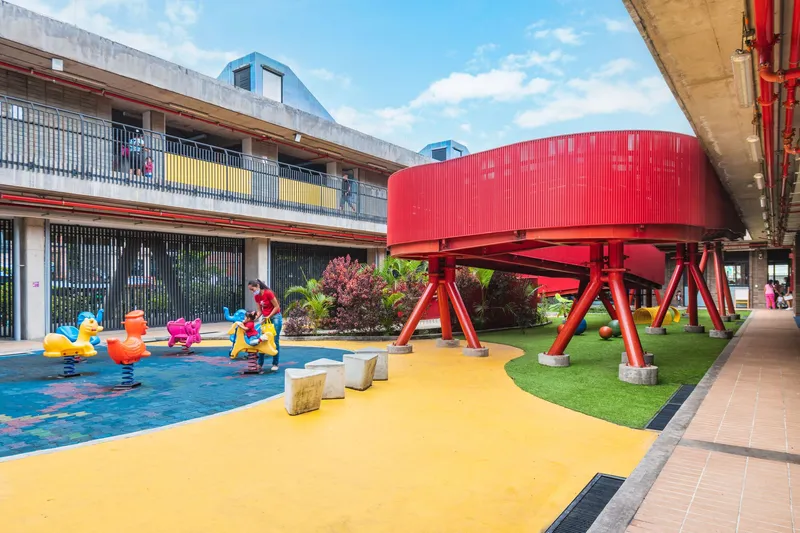
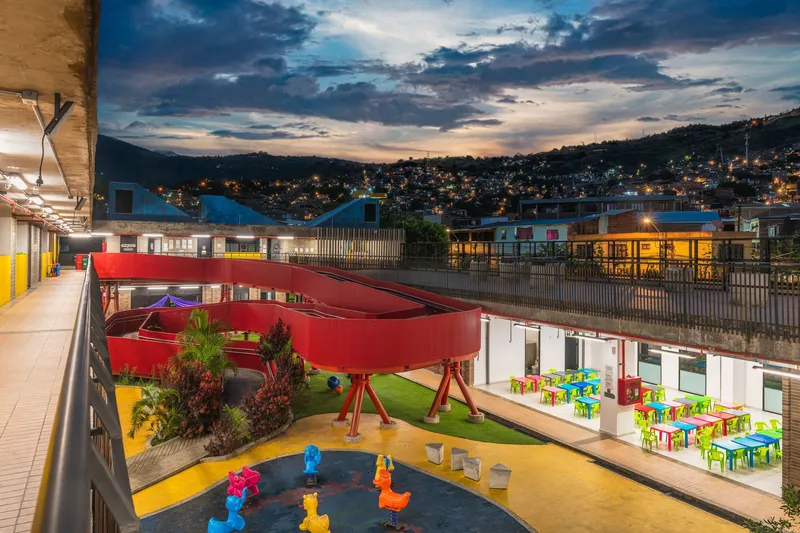
At the heart of the complex, a central courtyard organizes everything. A curved red ramp spirals upward through the space, connecting ground level activities to the upper classrooms while doubling as a play structure. Below it, a blue-tiled wading pool and yellow rubber surfacing create zones for recreation that are visible from nearly every surrounding corridor. The courtyard is not quiet or contemplative. It is designed to be loud, active, and full of children.
The color choices are worth noting: red for circulation, blue for water and sport, yellow for thresholds and apertures. These are not decorative. They function as wayfinding for small children navigating a building that, by any measure, is spatially complex. The saturated palette also softens the visual weight of the concrete structure, a deliberate compensatory strategy by the architects.
Corrugated Armor
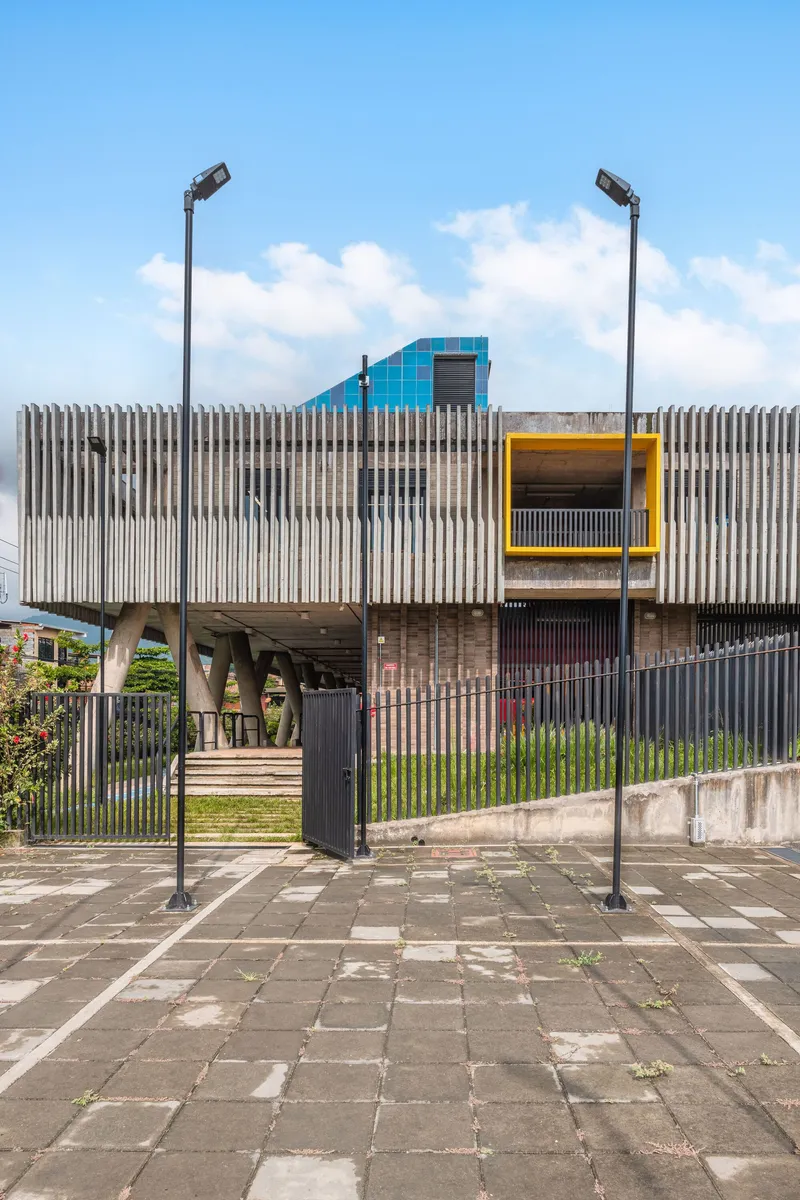
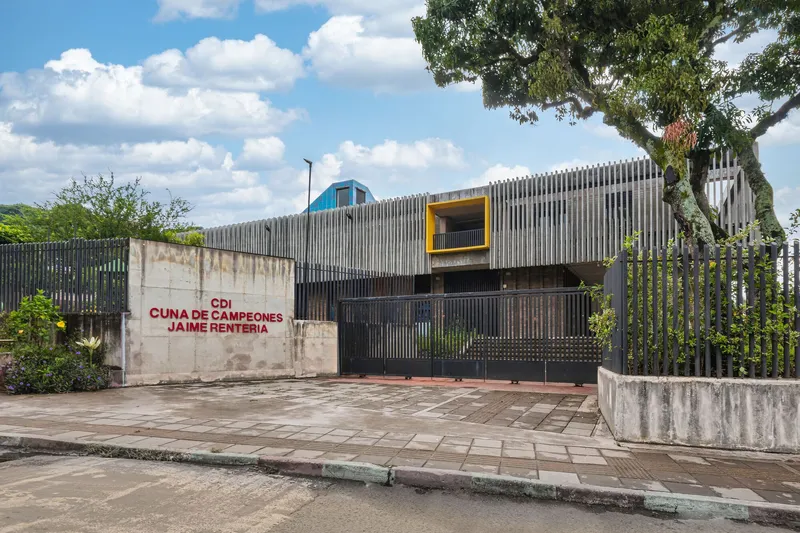
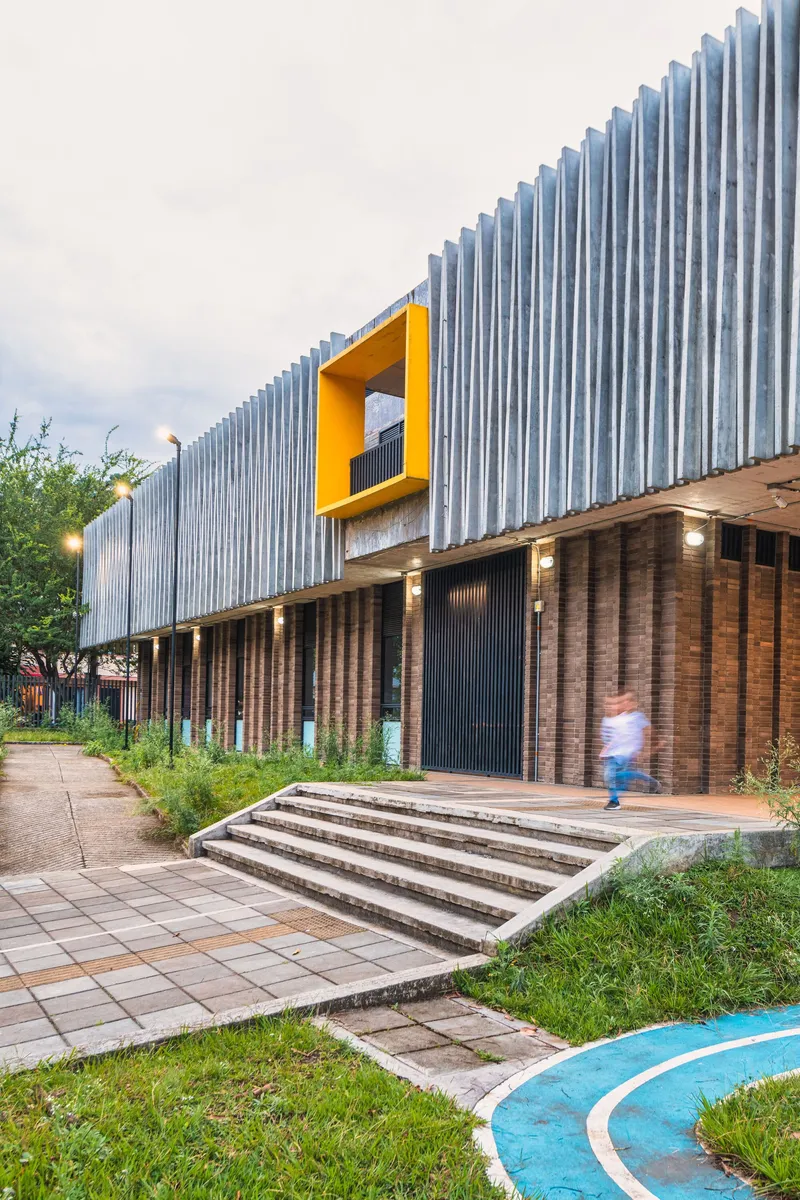
The exterior is wrapped in vertical corrugated metal cladding, a Hunter Douglas Geoclad system that serves triple duty as rain screen, solar control device, and, unflinchingly, ballistic protection. The architects have acknowledged that the perforated and slatted facades are designed to shield children from stray bullets during gang confrontations in the surrounding streets. This is not a detail buried in construction documents. It is central to the architectural logic of the project.
Punctured by yellow-framed window apertures, the corrugated skin creates a rhythm of light and shadow that registers as playful from the interior while presenting a more guarded posture to the street. It is a facade that must do two contradictory things at once: invite the community in and keep danger out. The vertical orientation of the cladding exaggerates the building's height and lends a certain civic seriousness to what is, functionally, a nursery.
Blue Pyramids on the Skyline


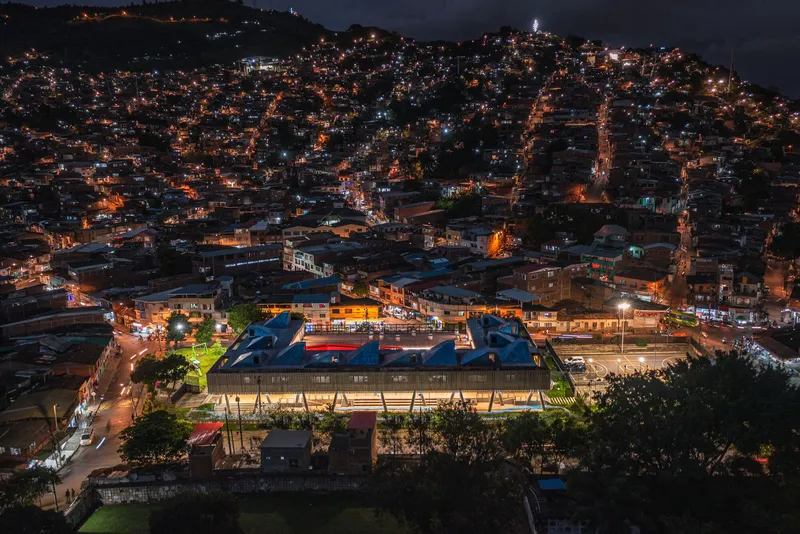
From the air, the building's most distinctive feature is immediately legible: a series of blue pyramidal roof monitors that punctuate the roofscape in a sawtooth rhythm. These are not merely sculptural. They function as light scoops, pulling daylight into the deep plan classrooms below while keeping direct solar gain under control. Against the grey and terracotta tones of Siloé's rooftops, they read as an unmistakable signal that something different is happening here.
The aerial views reveal something else that is harder to grasp at street level: the building's scale relative to its context. At 2,800 m², it is one of the largest single structures in the neighborhood, yet its footprint is carefully contained within the existing block geometry. The red courtyard, visible from above like a glowing core, makes the project instantly identifiable even in the dense urban fabric that surrounds it.
Interior Life

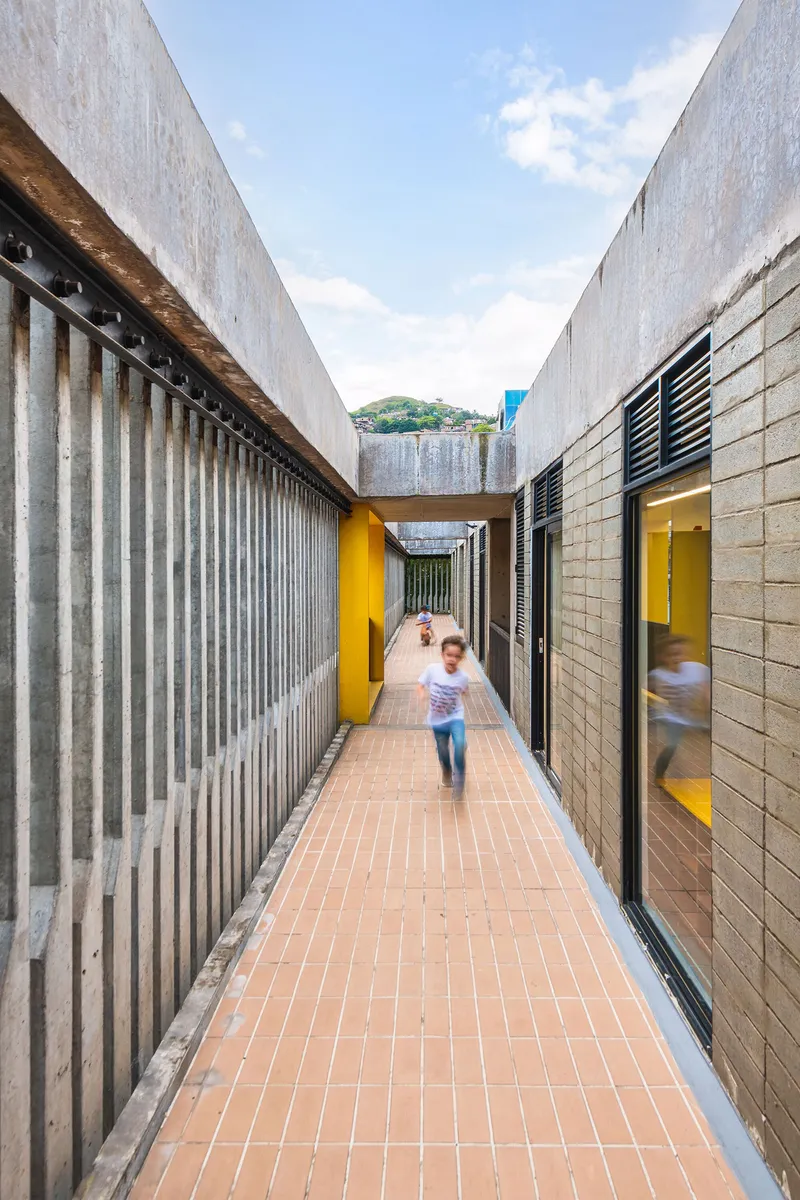

Inside, the building oscillates between raw and warm. Exposed concrete ceilings and structural elements are left unfinished, but walls receive murals and painted surfaces that transform corridors into inhabited canvases. The narrow passageways between corrugated metal walls, lit by yellow-rimmed openings, compress space in ways that feel scaled to children rather than adults. A child running through one of these slots occupies the full width of the corridor, which makes the architecture feel right-sized for its primary users.
Vertical slatted screens filter views between interior program and the courtyard, allowing supervision without surveillance. Teachers can see the pool and play areas from classroom thresholds. Parents arriving at ground level can look up through the colonnade to the courtyard above. The building is designed so that sightlines reinforce trust, a critical quality in a neighborhood where institutions have historically been absent or unreliable.
Ramps and Bridges


Circulation is never hidden. The red curved ramps that link levels are exposed, elevated, and performative. They arc above the courtyard as pedestrian bridges, turning the simple act of walking between classrooms into a moment of visibility and play. Children appear on these bridges framed by tropical foliage, elevated above the neighborhood, momentarily protagonists in a piece of urban theater.
The ramps also solve a practical problem. In a building that serves very young children, stairs are obstacles. The continuous ramped circulation makes the entire building wheelchair accessible and stroller friendly without resorting to a separate elevator core. Structure, play, and accessibility converge in a single red steel ribbon.
Plans and Drawings

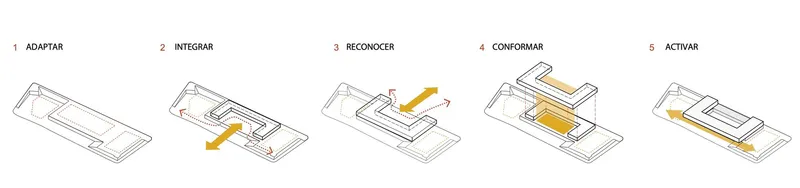
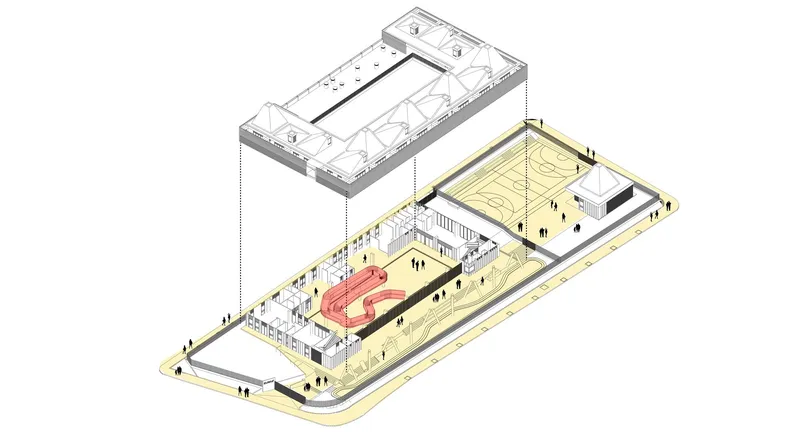


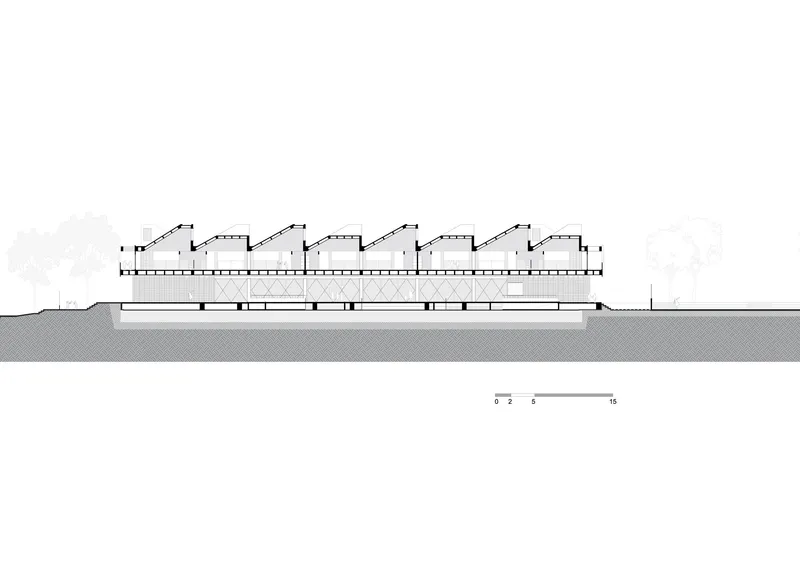
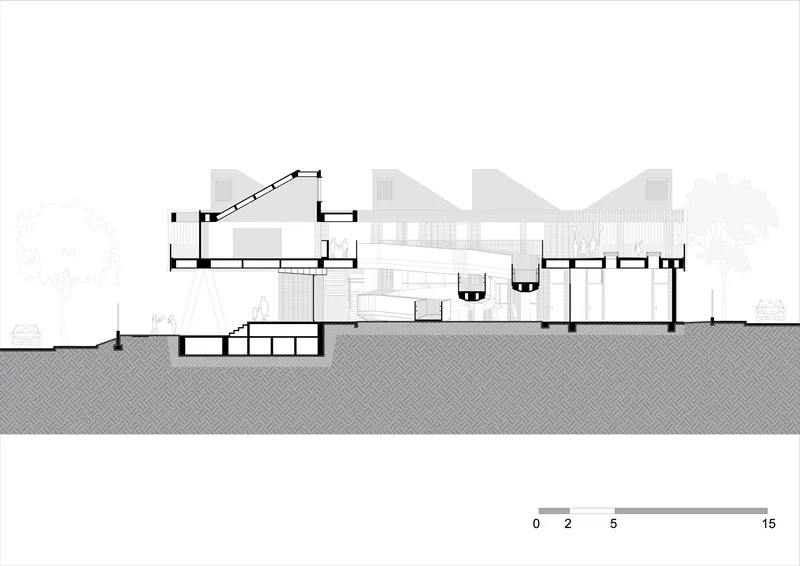
The design diagrams reveal a process that moves from abstract gesture to specific spatial consequence. An isometric sequence shows the project evolving through five phases of intervention, with colored volumes placed onto a rectangular platform like blocks in a child's game. The exploded axonometric makes the curving red circulation element legible as the building's organizational spine, weaving through the plan and binding the upper classrooms to the courtyard below.
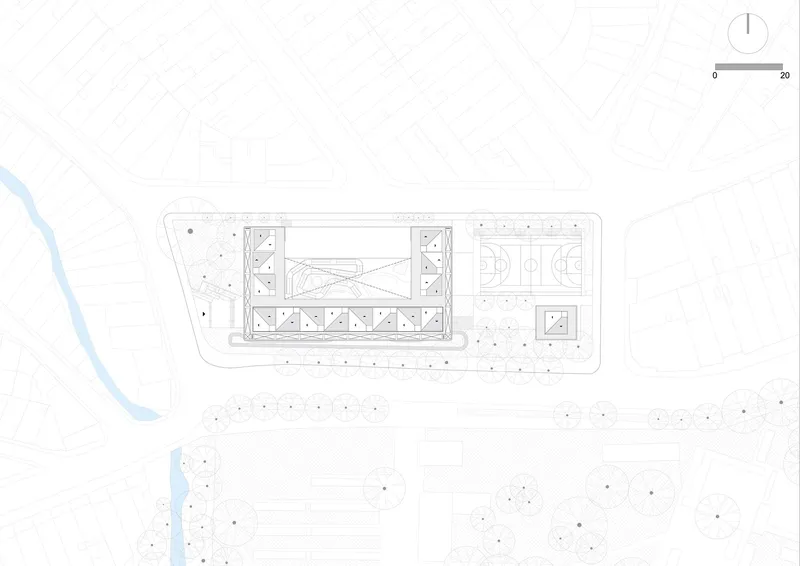
The ground and upper floor plans confirm the U-shaped footprint that wraps around the central courtyard, with sports courts and landscape pushing outward to the site's edges. Sections through the sawtooth roof monitors show how daylight is directed into the deep plan while the overall building profile remains low, barely exceeding two stories. The cascading section reveals how the architects exploit the sloping topography, tucking program into the hillside grade changes rather than fighting them.
Why This Project Matters
Child development centers are among the most common building types commissioned by governments across Latin America, and most of them are forgettable. They tick programmatic boxes, meet seismic codes, and fade into the background. What Espacio Colectivo Arquitectos have done in Siloé is refuse that trajectory entirely. By lifting classrooms into a protective nest, opening the ground floor to the community, and wrapping the whole thing in a facade that must simultaneously welcome and defend, they have produced a building that confronts the actual conditions of its site rather than idealizing them.
The building does not pretend that Siloé is safe. It does not pretend that public space exists where it does not. Instead, it manufactures both safety and public space through architectural means: the colonnade as covered plaza, the elevated classroom as refuge, the corrugated skin as shield. That this was achieved through a public competition, built within a year, and delivered at a modest scale makes it a model worth studying. Architecture cannot fix systemic inequality, but it can create the physical conditions under which a community's children are sheltered, educated, and, in this case, trained to become champions.
Cuna de Campeones Child Development Center by Espacio Colectivo Arquitectos, led by Aldo Marcelo Hurtado and Carlos Hernan Betancourt. Located in Siloé, Cali, Colombia. 2,800 m². Completed 2019. Photography by Santiago Robayo.
About the Studio
Share Your Own Work on uni.xyz
If projects like this are the kind of work you want to make, uni.xyz is a place to publish your own, find collaborators, and enter design competitions.


Popular Articles
Popular articles from the community


Cube Design Draws an Ecological Corridor Between Two Shenzhen Hills with the Nankai Building
Beside Shenzhen's container docks, the Nankai Building pairs stacked balconies with a climbing green screen to connect two hillsides across its height.

David Macias Steps a Doorless Stone and Plaster House Down a Tropical Colombian Hillside
In the humid hills of Colombia, Threshold House replaces the front door with an open void and terraces its 850 m² down the slope instead of fighting it.

longwave studio Reorganizes a 112 m² Tainan Apartment Around the Daily Routines of a Family and Two Cats
In Tainan, Taiwan, birch plywood, rust-red furniture and a freestanding plaster wall link arrival, storage, work and family life in one apartment.

Juan García Correa, John González and Claudia Rueda Sink a Circular Amphitheater into a Manizales Engineering Building
On the La Nubia campus in Manizales, Colombia, the S1 Building folds labs and offices into a hillside of ramped lawns that double as a campus route.

Similar Reads
You might also enjoy these articles


LAVA Architecten Gives Vocational Education a Sawtooth-Roofed Face on a Mechelen School Campus
In Mechelen, Belgium, a 2,053 m² STEM school on a 6×6 m grid turns workshops and classrooms into rooms that can be rearranged as teaching changes.

KEMA Studio Turns a Derelict Marvila Attic into a 60 m² Lighthouse Apartment Above Lisbon
In Lisbon's Marvila district, a rebuilt roof, four skylights and two plywood volumes turn an unlivable attic into a bright home facing the Tagus.

Pixel Gardens: One Repeated Module Stacked Into a Terraced Social Housing Tower for Famagusta
Salem Bader's shortlisted housing tower builds a vertical neighbourhood from one repeated module, offsetting units to carve terraces, light and air.

Bao Huynh Watercolor Atelier: A Serene Art Retreat in Hội An
Bao Huynh Watercolor Atelier in Hội An blends multifunctional art spaces, sustainable design, local materials, and family-friendly living in a serene environment.

Explore Childcare Center Competitions
Discover active competitions in this discipline

Challenge to reimagine the Iron Throne

Photograph architecture without architects

Illustrate the lost glory of Angkor Wat - Render Challenge

Design challenge to reuse E-waste
Comments (0)
Please login or sign up to add comments
No comments yet. Be the first to comment!