

Masakazu Tsujibayashi Architects Weaves a Split-Level Osaka Home Around Light and Plywood
Jonoya House negotiates a tight trapezoidal plot in Osaka with layered interiors, skylights, and a generous material palette.


Osaka's residential fabric is defined by density: narrow streets, power lines strung like clotheslines, and plots that rarely offer the luxury of a generous footprint. Jonoya House, completed in 2025 by Masakazu Tsujibayashi Architects, occupies one of these irregular trapezoidal sites and turns its constraints into a spatial argument for interiority. At 105 square meters the house is not large, but its sectional complexity, split levels, and persistent use of skylights make it feel like a structure far beyond its measurable area.
What makes Jonoya House worth studying is not any single gesture but the coherence of many small ones. Plywood ceilings curve and slope. Walnut millwork wraps corners and frames views through successive rooms. A central staircase acts less as circulation and more as the spine from which every level, nook, and planted ledge unfolds. The house is a careful negotiation between what the city gives and what the architect carves back.
A Quiet Exterior in a Dense Lane

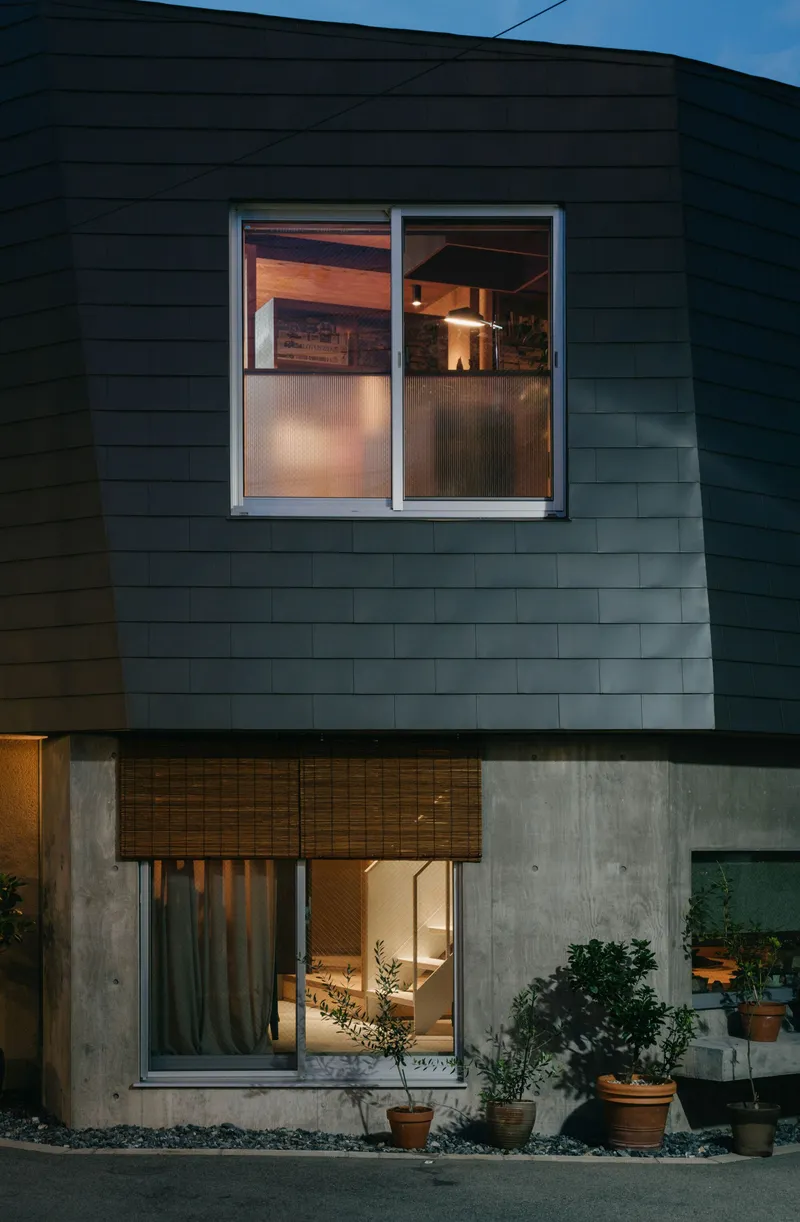

From the street, Jonoya House is deliberately restrained. Dark fiber-cement panels clad the upper volume, which cantilevers over a concrete and plaster base. The proportions are compact, almost boxy, and the material language reads as protective rather than expressive. In the narrow lane at dusk, with overhead power lines threading the sky, the house becomes a charcoal silhouette that sits comfortably among its neighbors without mimicking them.
The entrance, set behind a gravel border with potted plants, introduces a diagonal metal siding and a timber door that hint at the warmer material world inside. It is a threshold designed to compress before the interior opens up, a move that amplifies the spatial release once you step through.
The Central Stair as Spatial Engine


The staircase in Jonoya House is not pushed to a corner or enclosed in a shaft. It runs through the center of the plan, open-tread and timber-framed, connecting split levels while allowing light to pass vertically through the entire section. Textured green wall panels and potted plants flank the treads on one level; a terrazzo wall and cacti appear on another. The stair does not merely connect floors. It organizes the sequence of experiences.
Looking down from upper landings or up through plywood ceiling voids, you perceive the house as a continuous section rather than stacked plans. Skylights positioned above the stairwell pull daylight deep into the core, which on such a tight plot is the only reliable strategy for natural illumination at the center of the building.
Plywood, Walnut, and Terrazzo: A Warm Material Register
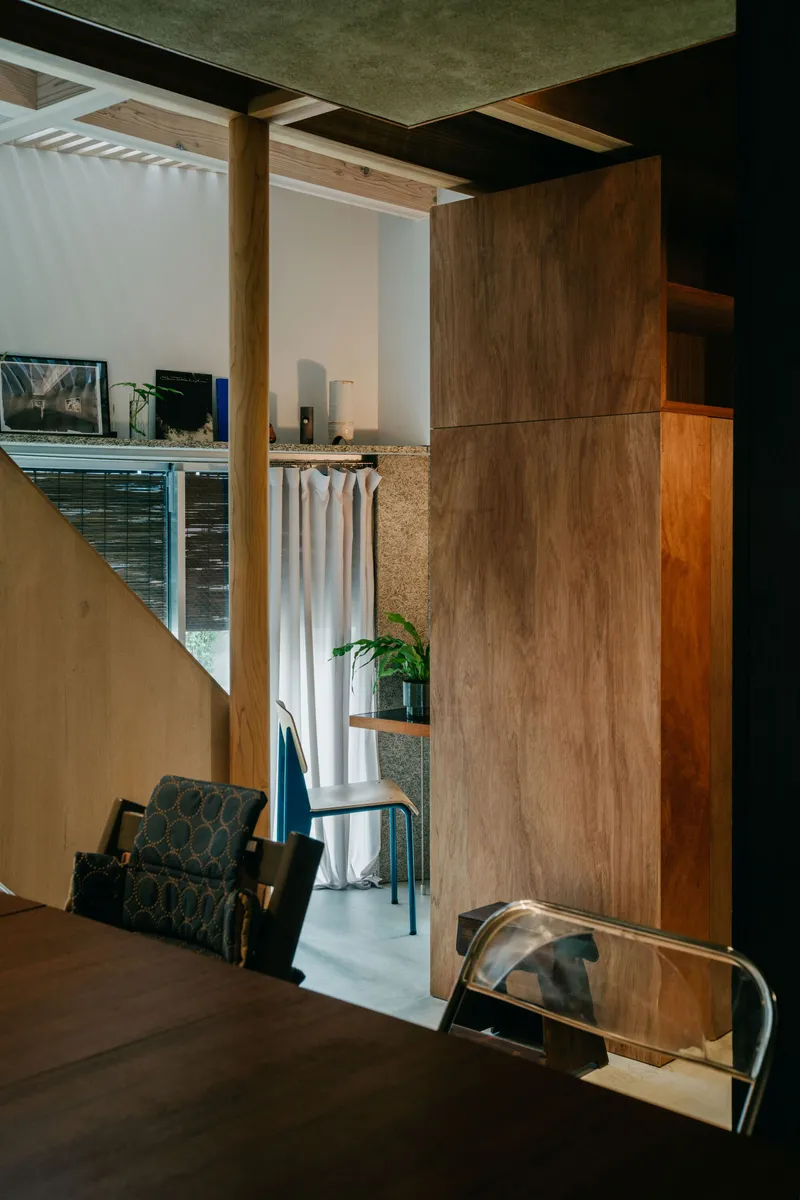
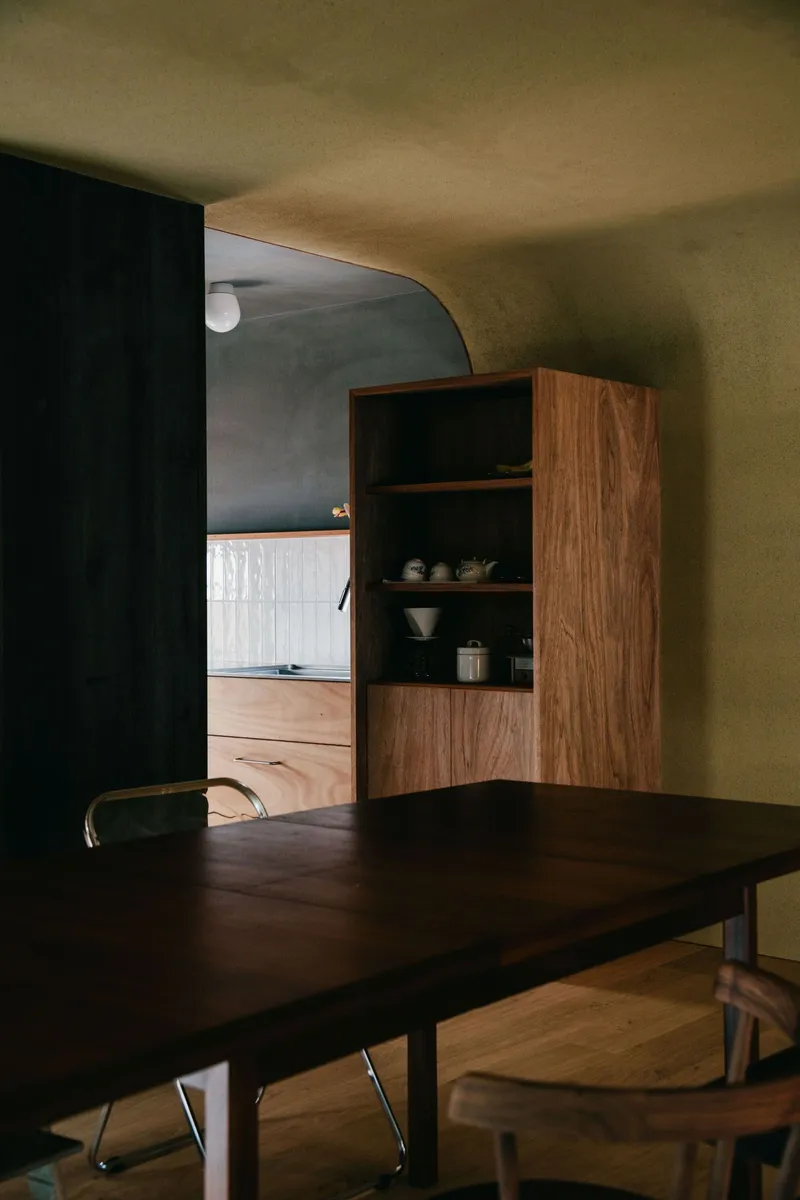

The interior palette moves between plywood, walnut veneer, terrazzo, and white-painted surfaces with a fluency that avoids monotony without becoming restless. Walnut appears as dining table, cabinet face, and arched doorway surround. Plywood handles the ceilings and bookshelves. Terrazzo surfaces the planter ledges. Each material has a clear role, and none is asked to do too much.
The corrugated metal flooring detail at the built-in planter is a notable exception to the timber dominance, a moment where an industrial texture punctuates the domestic warmth. These small friction points keep the house from feeling like a plywood box and signal a designer who treats material junctions as design opportunities.
Living Under Curved Ceilings and Geometric Skylights


Ceiling treatment varies room by room, and this is one of the project's most effective strategies. In the living room, plywood curves gently overhead, creating a sense of compression and intimacy at dusk as a window frames the street. In the study area, a geometric skylight punches precise light onto the desk below. On the upper landing, a square skylight illuminates slatted metal flooring and plywood walls with an almost gallery-like clarity.
By modulating ceiling height, geometry, and the entry point of natural light, Tsujibayashi gives each space a distinct atmospheric character without relying on room-by-room material changes. The house reads as one connected interior, yet no two moments feel identical.
Built-In Storage and Framed Views
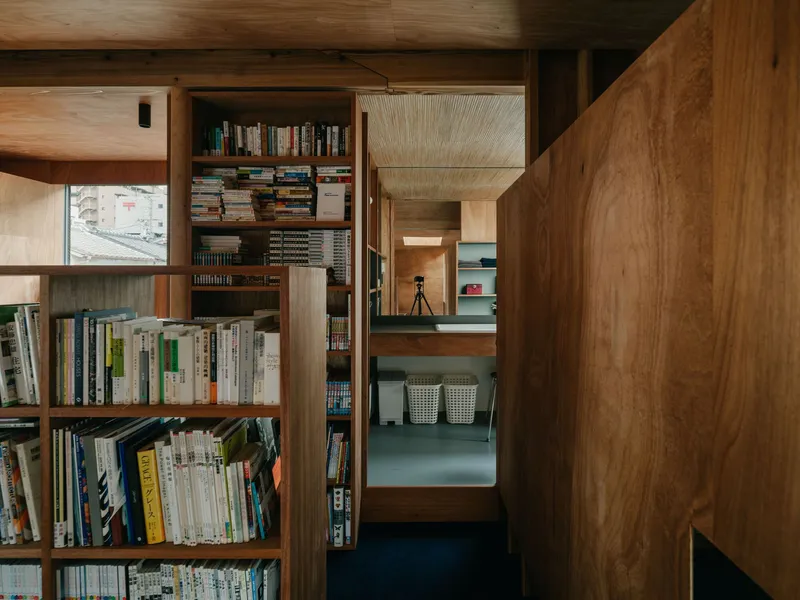
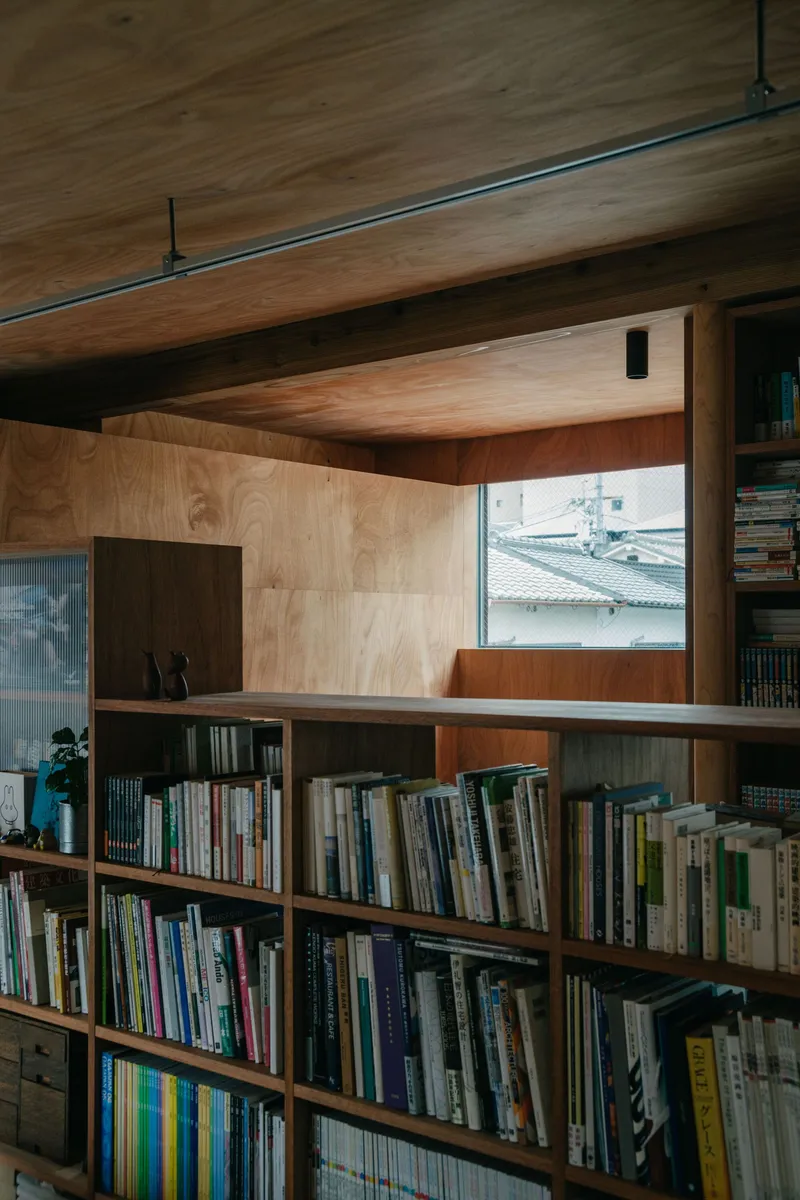

In a house of this scale, freestanding furniture is a luxury the plan cannot afford. Jonoya House responds with an extensive system of built-in plywood bookshelves, walnut cabinetry, and timber-framed storage walls. These elements serve dual purposes: they store the life of the household while simultaneously acting as spatial dividers and viewfinders. A horizontal window above a bookshelf frames a band of neighboring tiled rooftops, turning the mundane urban context into a composed picture.
The sequence through multiple rooms, visible through framed doorways and ceiling voids, suggests that Tsujibayashi conceived the plan as a series of layered transparencies. You are always looking through something: a shelf, a doorway, a void. This layering makes the house feel generous in section even where the plan is tight.
Green Life Inside the Section


Plants are not decoration here. They are programmed into the architecture. A planted interior courtyard sits at the heart of the section, visible from the upper level through a concrete balustrade and lit by skylights. Terrazzo planter ledges host cacti and tropical plants in dappled morning light. Even the staircase landings carry potted greenery, blurring the line between circulation and garden.
This strategy is particularly effective on a site with limited exterior space. By pulling landscape into the section, the house borrows the psychological benefits of a garden without requiring the real estate of one. The result is an interior that breathes, changes with the light, and never feels sealed off from the living world.
Dining and Gathering at the Core

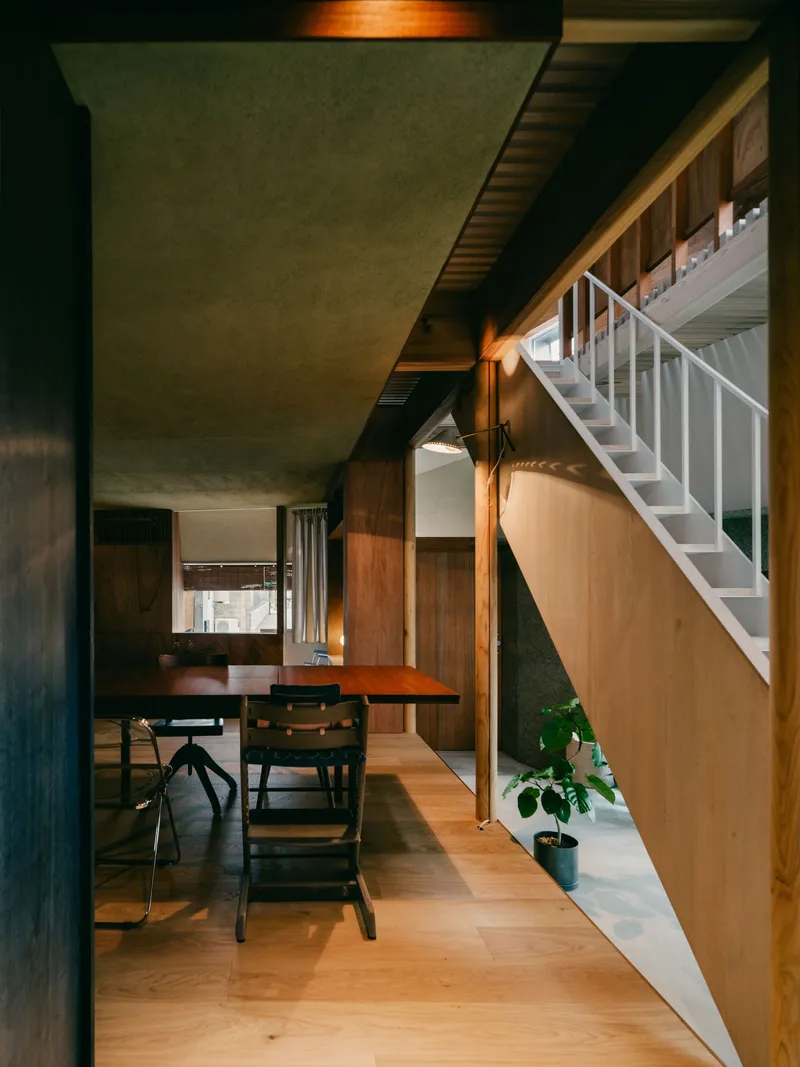

The dining level anchors the social life of the house. A timber table sits beneath the exposed plywood ceiling, adjacent to the staircase and open to the mezzanine above through a ceiling void. The relationship between this level and the bookshelves overhead is one of the most compelling spatial moments in the house: sitting at dinner, you look up through the void to see translucent panels and shelves, a reminder that domestic life and intellectual life are literally stacked on top of one another.
The white-painted staircase beside the dining table keeps this area bright and airy despite its position deep in the plan. It is a simple move, painting the stair white while leaving the ceiling and furniture in warm timber, but it effectively distinguishes circulation from habitation by color alone.
Plans and Drawings

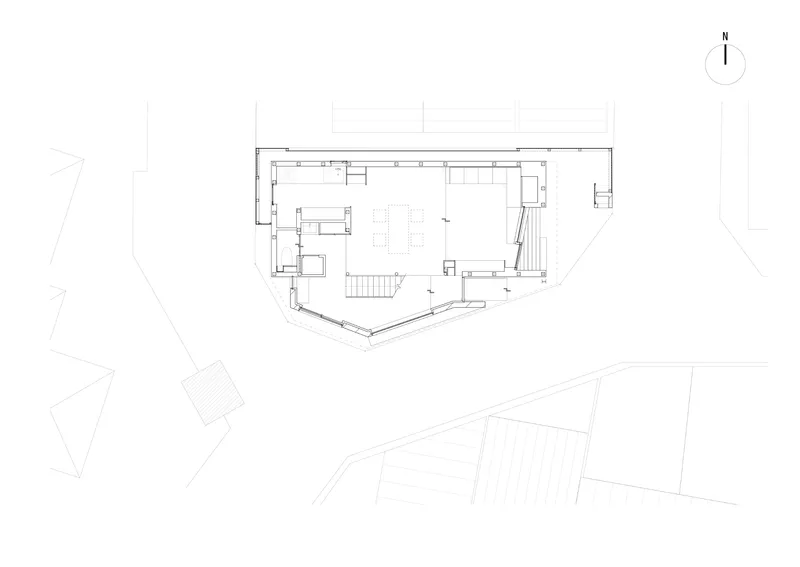
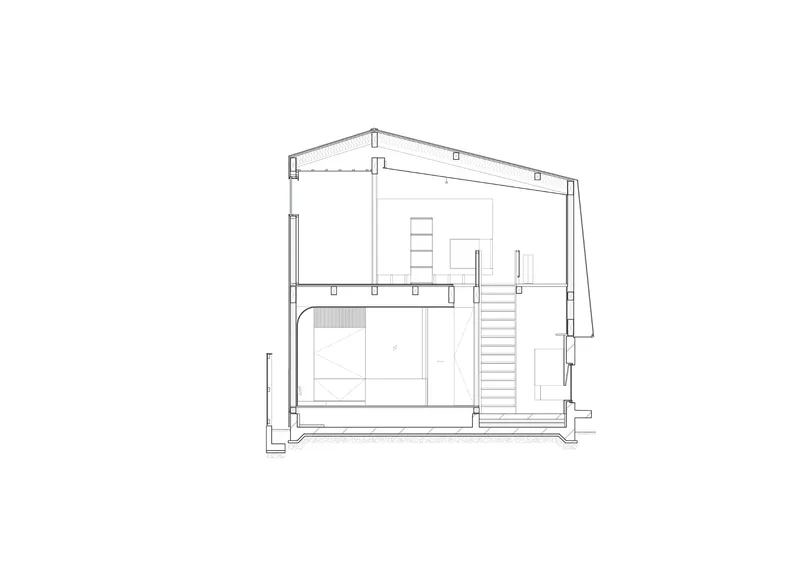
The floor plans reveal the trapezoidal site and the central stair that organizes everything around it. Rooms wrap the perimeter, oriented to catch light from whatever direction the dense neighborhood allows. The section drawing is the most instructive: it shows a two-story interior with a pitched roof, the staircase threading through the middle, and built-in storage filling the walls. The relationship between the upper mezzanine and the lower dining level, separated by a half-story, is legible only in section and explains why the house feels taller and more varied than its modest footprint suggests.
Why This Project Matters
Jonoya House is not a showpiece. It does not gesture toward formal novelty or compete for attention on its street. Its ambition is internal, sectional, material. On a constrained urban site, Masakazu Tsujibayashi has built a house that generates spatial variety through ceiling modulation, split levels, and strategically placed skylights rather than through size or spectacle. Every surface, from the curved plywood overhead to the terrazzo planter edge, carries intention without demanding admiration.
For architects working at a residential scale in dense Japanese cities, the lessons are transferable. A central stair can be the primary light well. Built-in furniture can define spatial boundaries. Plants can substitute for gardens. And a restrained street presence, far from being a concession, can be a deliberate posture of quiet confidence. Jonoya House demonstrates that 105 square meters, handled with care, can hold more architecture than many buildings three times its size.
Jonoya House by Masakazu Tsujibayashi Architects. Osaka, Japan. 105 m². Completed 2025. Photography by Yosuke Ohtake.
About the Studio
Share Your Own Work on uni.xyz
If projects like this are the kind of work you want to make, uni.xyz is a place to publish your own, find collaborators, and enter design competitions.


Popular Articles
Popular articles from the community


GROUP A Strips a 1969 Rotterdam Harbor Headquarters to Its Frame and Wraps It in Timber Louvers
In Rotterdam's M4H harbor district, Ferro Offices reuses a 1969 frame, adds one timber storey and reaches BREEAM-NL Outstanding.

Cube Design Draws an Ecological Corridor Between Two Shenzhen Hills with the Nankai Building
Beside Shenzhen's container docks, the Nankai Building pairs stacked balconies with a climbing green screen to connect two hillsides across its height.

Juan García Correa, John González and Claudia Rueda Sink a Circular Amphitheater into a Manizales Engineering Building
On the La Nubia campus in Manizales, Colombia, the S1 Building folds labs and offices into a hillside of ramped lawns that double as a campus route.

longwave studio Reorganizes a 112 m² Tainan Apartment Around the Daily Routines of a Family and Two Cats
In Tainan, Taiwan, birch plywood, rust-red furniture and a freestanding plaster wall link arrival, storage, work and family life in one apartment.

Similar Reads
You might also enjoy these articles


LAVA Architecten Gives Vocational Education a Sawtooth-Roofed Face on a Mechelen School Campus
In Mechelen, Belgium, a 2,053 m² STEM school on a 6×6 m grid turns workshops and classrooms into rooms that can be rearranged as teaching changes.

KEMA Studio Turns a Derelict Marvila Attic into a 60 m² Lighthouse Apartment Above Lisbon
In Lisbon's Marvila district, a rebuilt roof, four skylights and two plywood volumes turn an unlivable attic into a bright home facing the Tagus.

Pixel Gardens: One Repeated Module Stacked Into a Terraced Social Housing Tower for Famagusta
Salem Bader's shortlisted housing tower builds a vertical neighbourhood from one repeated module, offsetting units to carve terraces, light and air.

Bao Huynh Watercolor Atelier: A Serene Art Retreat in Hội An
Bao Huynh Watercolor Atelier in Hội An blends multifunctional art spaces, sustainable design, local materials, and family-friendly living in a serene environment.

Explore Residential Building Competitions
Discover active competitions in this discipline

Challenge to design mud housing for contemporary communities

Challenge to reimagine the Iron Throne

Photograph architecture without architects

Illustrate the lost glory of Angkor Wat - Render Challenge
Comments (0)
Please login or sign up to add comments
No comments yet. Be the first to comment!