
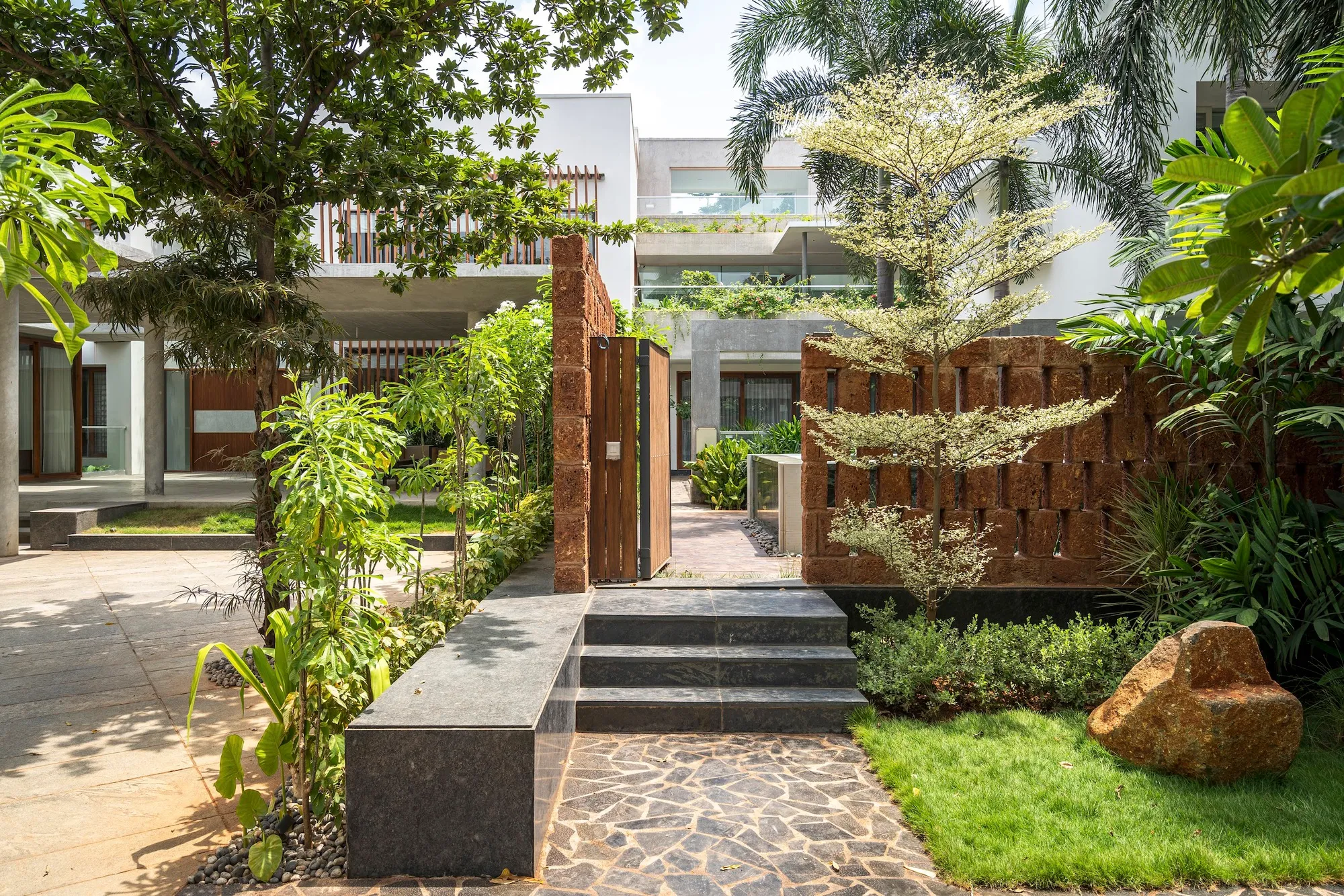
Mawi Design Peels Back an Existing Shell to Reveal a Layered Courtyard House in Chennai
On a triangular plot in T. Nagar, laterite stone, reclaimed wood, and garden courts compose a residence of calibrated depth and porosity.


Renovation projects rarely announce themselves with such spatial ambition. Mawi Design's Through the Layers House in T. Nagar, Chennai, took the structural grid of an existing building, stripped every non-structural element down to its bones, and reassembled the 20,500-square-foot residence as three distinct wings separated by open and semi-open courts. The result is a house that does not present a single facade so much as a succession of thresholds, each calibrated in material, light, and enclosure.
What makes this project genuinely interesting is the way it treats transparency not as a binary condition (glass or wall) but as a gradient. Laterite stone screens, planted buffers, cold-cut cement surfaces, and reclaimed timber frames each register a different degree of openness. The architects describe three kinds of layering at work: spatial, conceptual, and perceptual. In practice, these translate to a house where your reading of depth changes with every step, every shift in light, every season of growth in the garden pockets that moderate both the view and the microclimate.
Arrival and the Art of Controlled Glimpses


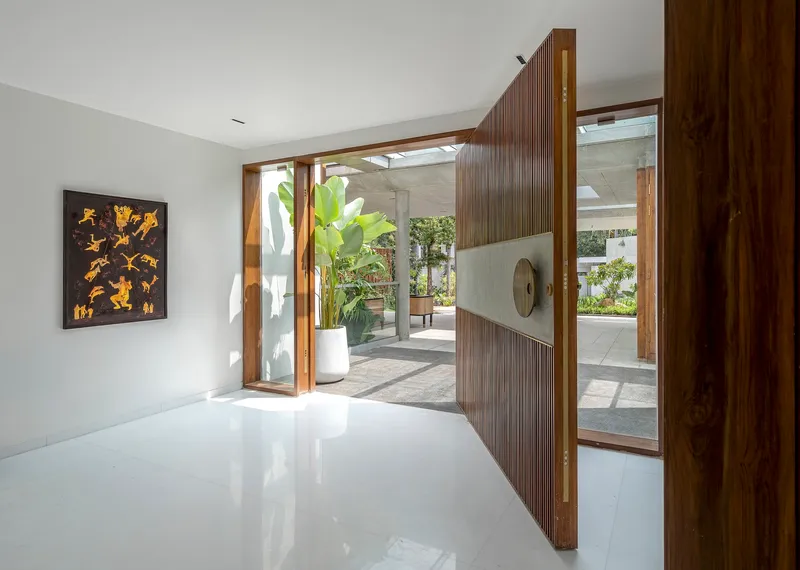
The approach sequence is deliberately restrained. From the driveway, thick shrubs allow only partial views of the white concrete canopy and a circular planted island that anchors the composition. A cylindrical column frames the entrance, and a massive pivoting timber door swings open to reveal concrete columns and a corridor of greenery. Nothing about the arrival is monumental in a heavy-handed way; instead, the house introduces itself through gaps, filtering your sightline through foliage and structure before you even step inside.
The foreground programs, including an office, entry porch, and a kid's pool, are new additions that Mawi Design grafted onto the retained structural grid. They act as a buffer between the street and the more private zones deeper in the plan. It is a common strategy in dense urban neighborhoods, but the execution here avoids feeling fortress-like because the screens and planting ensure the boundary remains porous.
Laterite Walls as Filter and Character
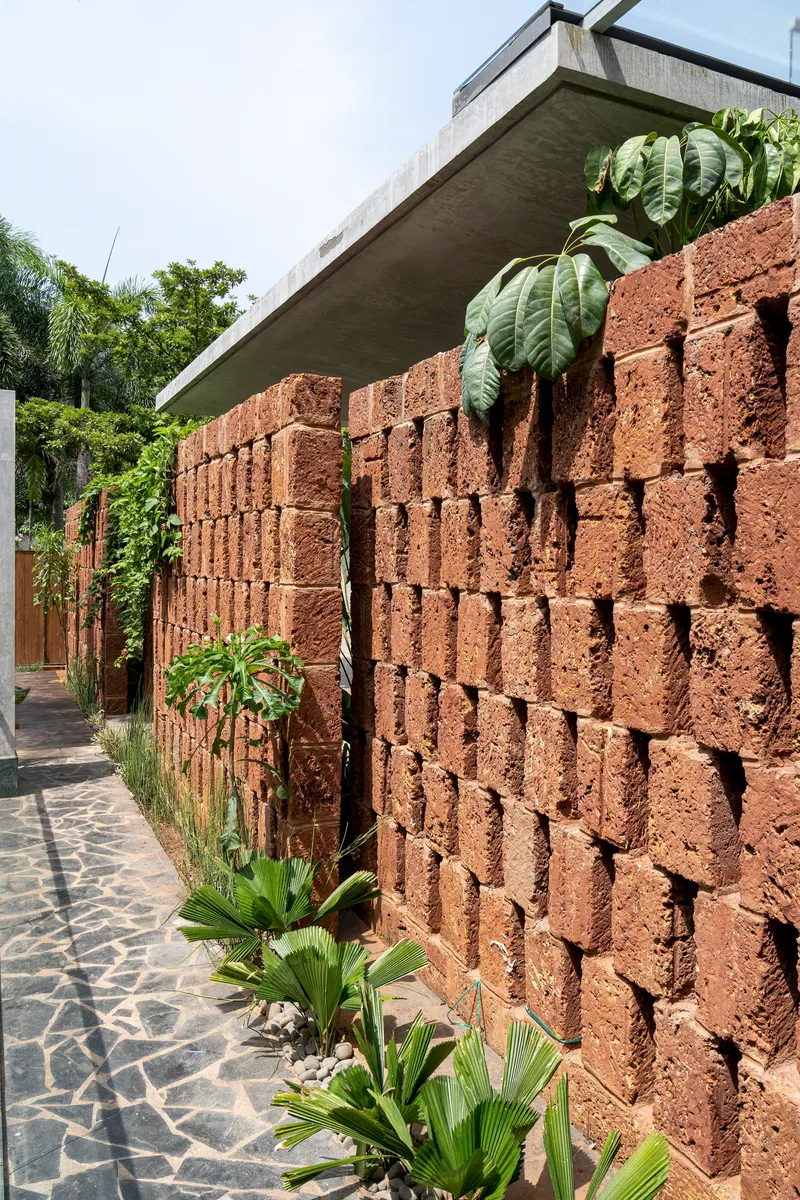

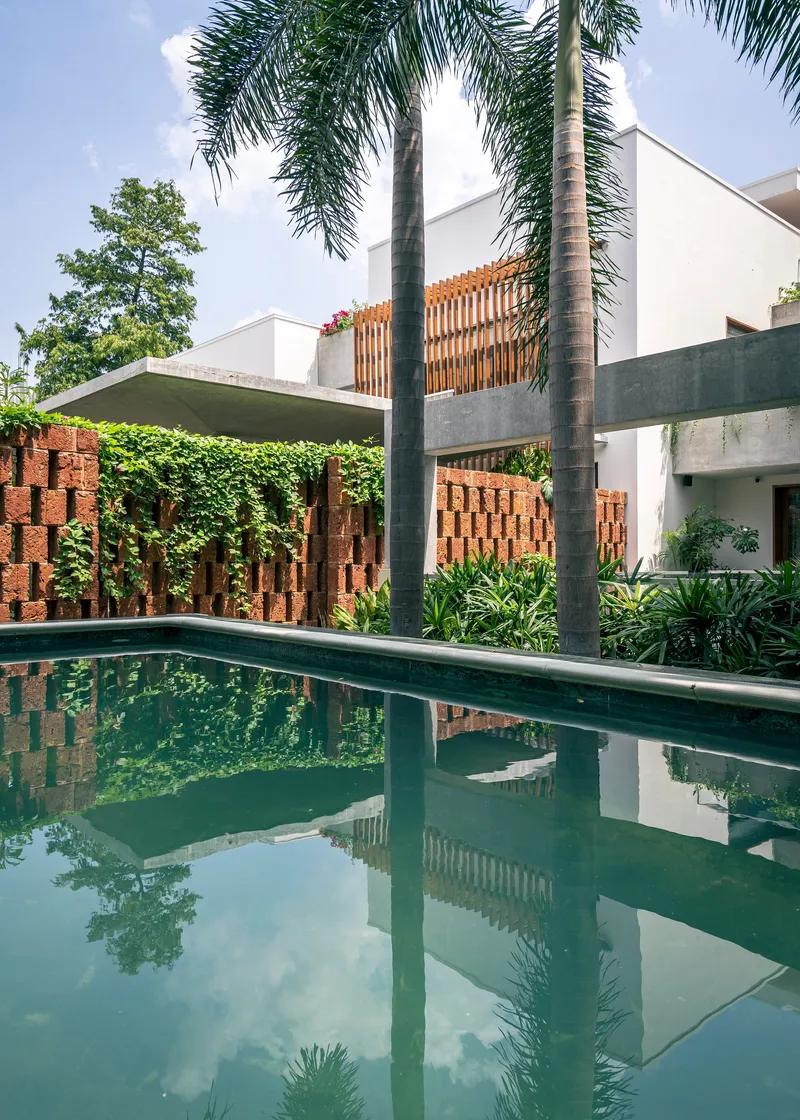
The most distinctive material move is the perforated laterite stone wall. This warm, volcanic-red block appears at key moments: screening the pool area from the entrance, defining the edge of covered terraces, and framing garden courts. Laterite is a regional material with deep roots in tropical South Asian construction, and its rough, pocked surface offers both visual texture and functional benefits. The perforations allow air to pass through, turning what could be a heavy masonry boundary into a breathing, cooling element.
Paired with cane furniture and dense tropical planting, the laterite screens create outdoor rooms that feel both sheltered and connected to the garden. It is a detail that earns its presence through performance: privacy for pool users, natural ventilation for the terrace, and a visual warmth that counterbalances the alabaster-toned concrete of the main volumes.
Courts and Interior Gardens
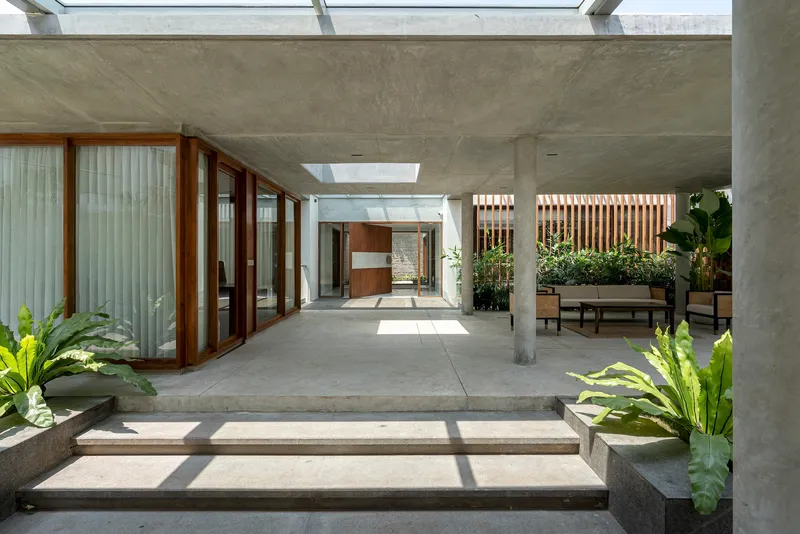

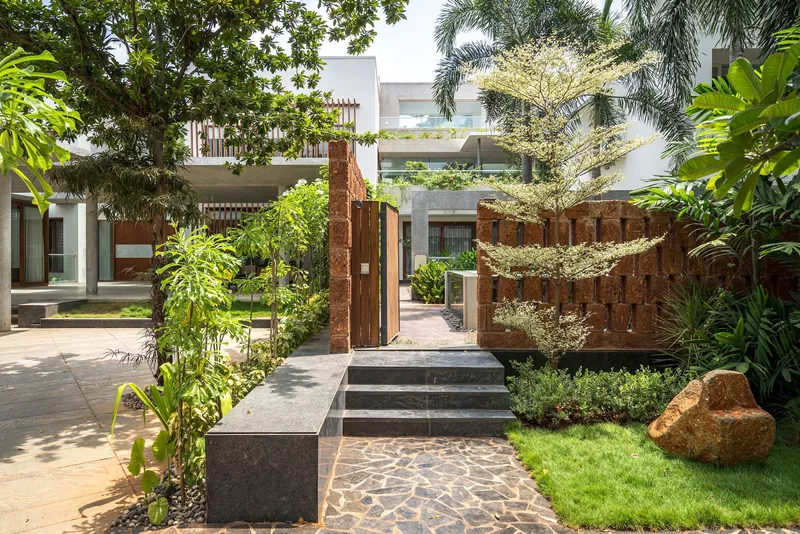
The three-wing plan is stitched together by a series of courts that function as both spatial joiners and climatic moderators. One court features concrete steps descending into planted beds beneath skylights, where timber-framed glazing frames views of textured stone walls and palms. Another presents a Zen-inspired arrangement of dry branches, rocks, and pebbles. These are not leftover spaces between buildings; they are the organizing logic of the house, carved out of the original structural mass.
Light and plants are treated as construction materials here. The skylit courts pull daylight deep into the plan, while the planted beds moderate temperature and humidity. In Chennai's climate, these garden pockets create a measurable difference in comfort, allowing the house to rely less on mechanical cooling and more on the physics of shade, airflow, and evapotranspiration.
Living Spaces and Material Contrasts

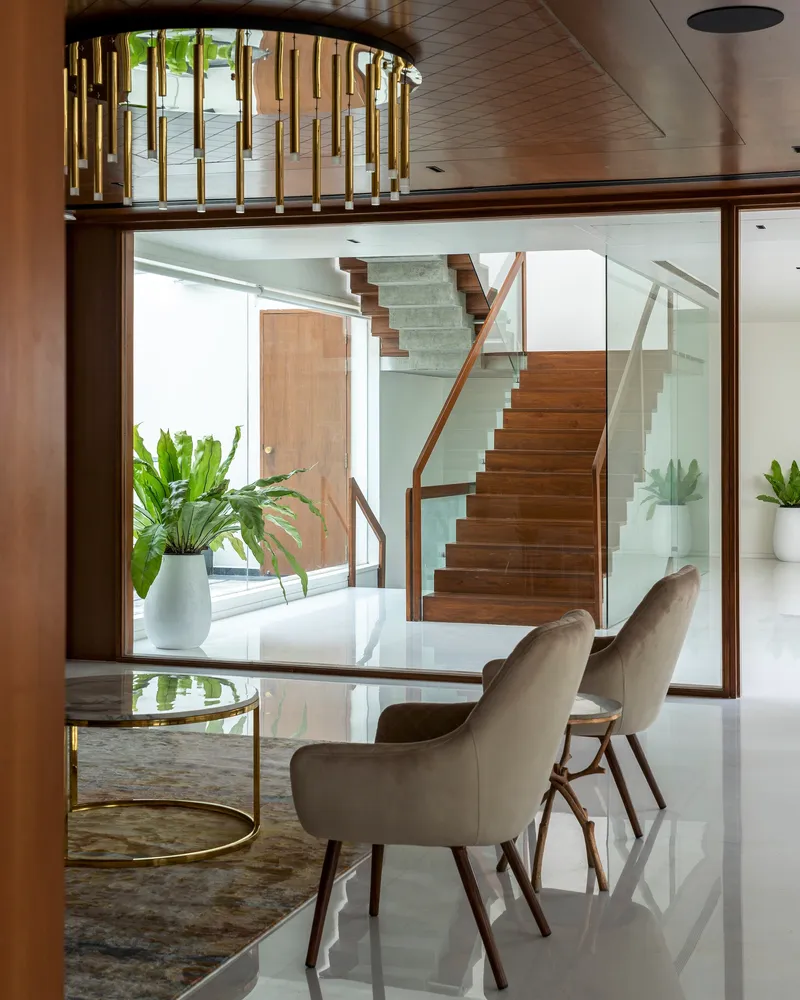

Inside, the palette stays disciplined. The living room pairs horizontal stone wall cladding with clerestory windows that wash the upper wall in even light, while a wide opening connects directly to a planted courtyard. The dining area is anchored by a brass chandelier, its warm metallic glow complementing the reclaimed wood framing of a staircase visible through a timber-edged window. These interiors do not chase minimalism for its own sake; they are warm, layered, and tactile.
Even the bathroom demonstrates the project's commitment to material specificity. A black vessel sink sits against a glass-enclosed shower floored with river stones, with a palm frond visible through the partition. The tropical theme is carried through consistently, but it never tips into resort pastiche because the detailing remains architecturally rigorous: precise reveals, honest material joints, careful alignment of openings.
Pool, Terraces, and the Rear Landscape

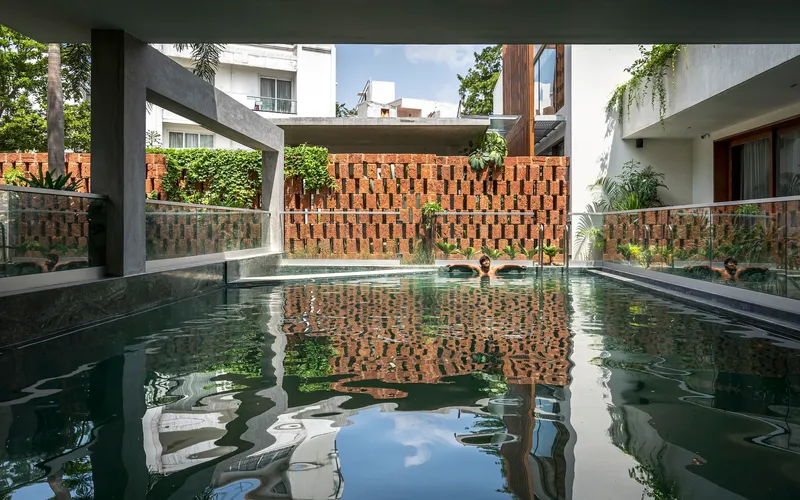

At the rear of the house, cascading terraces step down to merge with a garden centered on an elevated lap pool. The pool's textured stone base and underwater lighting give it a sculptural presence at twilight, when the timber deck and surrounding palms are uplift into silhouette. A curvaceous koi pond, fringed by smooth boulders and enclosed by a forest-like landscape, occupies the far edge of the site, lending a naturalistic counterpoint to the geometric rigor of the architecture.
The reflecting pool near the laterite screen walls operates on a different register: still, reflective, and framed tightly between concrete beams. These two water features, one animated and organic, the other flat and architectural, capture the project's larger strategy of working in oppositions. Open and closed, solid and porous, earthy and refined.
Plans and Drawings


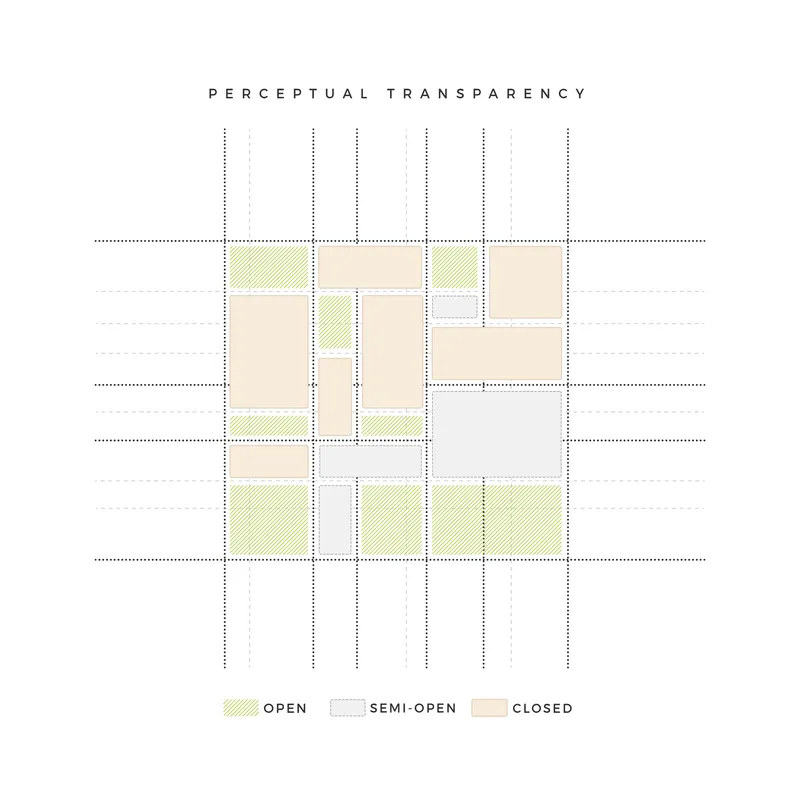
The isometric diagram series reveals the design process in six clear stages: a single mass is progressively subdivided, scooped, and planted until the courtyard house with its garden courts emerges. The axonometric drawing annotates spatial relationships between clustered volumes and green roofs, while the transparency diagram color-codes zones by their degree of openness. Together, these graphics explain the intellectual framework behind the layering concept with welcome clarity.



Further axonometric studies isolate specific moments: a vertical timber screen dividing open from enclosed courtyard space, a sectional sequence showing how semi-open and enclosed volumes alternate around a single tree. The title page for the "Perceptual Transparency" study signals how deliberately the architects theorized these gradations before building them.

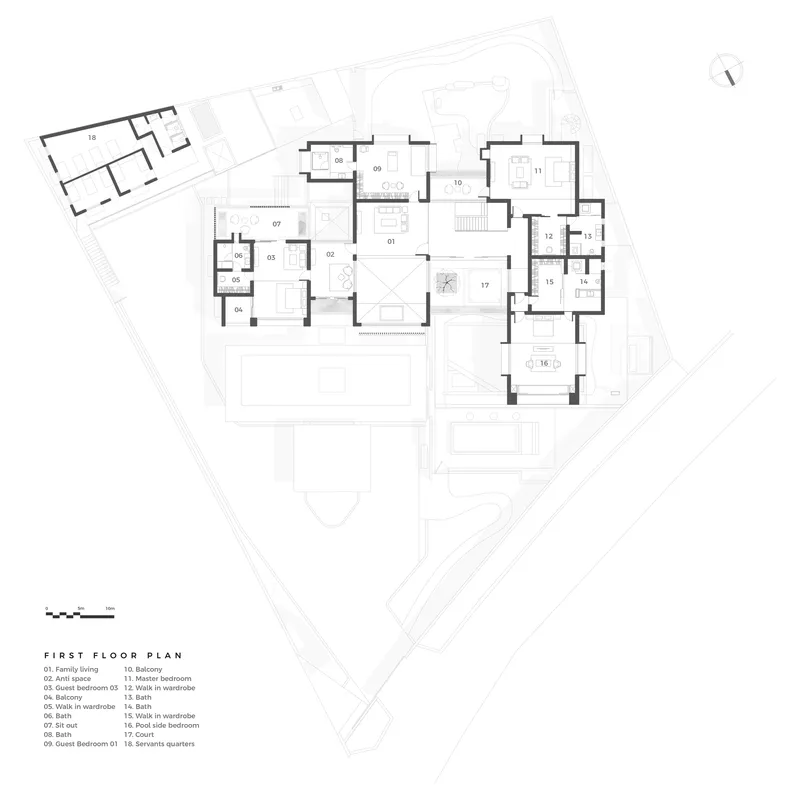

The floor plans confirm the angular site geometry. The ground floor distributes living spaces, service quarters, pool, and garage across the triangular footprint, with garden courts puncturing the mass at strategic intervals. The first floor clusters bedroom suites and voids around a central courtyard atrium. The second floor is compact: a banquet room and bath occupy a single wing above the lower levels, keeping the upper profile low and disaggregated.


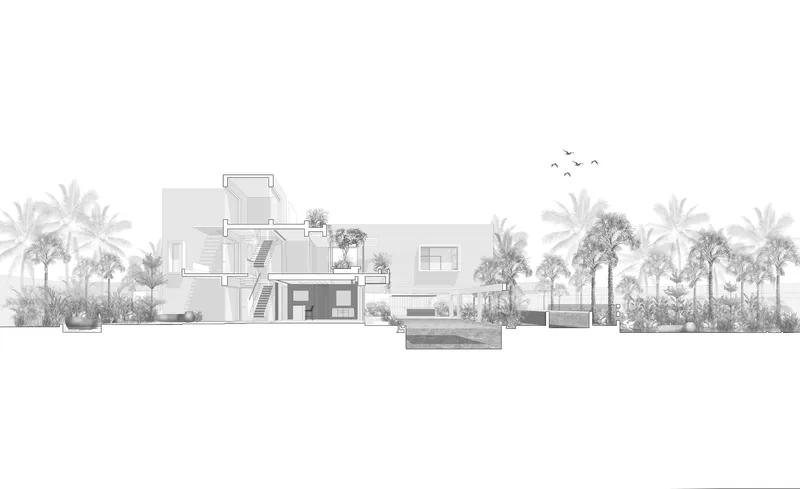
Elevations and sections complete the picture. The multi-level volumes read as a cluster rather than a monolith, with terraces and palm trees flanking both sides. The section drawing is particularly revealing, showing how stacked interior spaces, staircases, and double-height voids interact with the landscape to produce the depth that defines the experience of moving through the house.
Why This Project Matters
Through the Layers House succeeds because its conceptual ambition is matched by material intelligence. The idea of layering is easy to articulate in a diagram, but making it work in a built house requires precise control over screening, planting, opening sizes, material textures, and section. Mawi Design delivered on all of these fronts, producing a residence that feels spacious and connected to its landscape despite sitting in one of Chennai's most densely built neighborhoods. Retaining the existing structural grid while completely reimagining the spatial experience is a move that other practices could learn from: it is both economically sensible and architecturally productive.
The project also makes a quiet argument for regional material culture. Laterite stone, reclaimed wood, and cold-cut cement are not exotic or expensive; they are locally sourced, climatically appropriate, and rich in texture. In an era when tropical residential architecture too often defaults to glass boxes with mechanical cooling, this house demonstrates that porosity, shade, and garden microclimates can do much of the work. It is a house that breathes, and in Chennai's heat, that is not a metaphor but a necessity.
Through the Layers House by Mawi Design. Located in Chennai, India. 20,500 sq ft. Completed in 2022. Photography by Yash Jain.
About the Studio
Share Your Own Work on uni.xyz
If projects like this are the kind of work you want to make, uni.xyz is a place to publish your own, find collaborators, and enter design competitions.




Popular Articles
Popular articles from the community


Conexión: Biophilic Design Reimagines High-Rise Living in Hong Kong
Conexión reimagines high-rise living in Hong Kong through biophilic design, green facades, shared spaces, daylight, water and nature within.

The Musturak Paradise: Senior Living Architecture for a Connected Future in Temara, Morocco
The Musturak Paradise reimagines senior living architecture in Temara via private homes, social spaces, culture, community, and shared care.

Hill & Cross Opera: Sculptural Opera House Architecture Shaped by Tallinn’s Landscape and Identity
Hill & Cross Opera reimagines opera house architecture in Tallinn through its sculptural hill, civic plaza, glass wave and a luminous cross.

AL-JANNAH: Sustainable Architecture and Permaculture for Afghan Widows
AL-JANNAH uses sustainable architecture and permaculture to create resilient oasis of housing, learning, work and renewal for Afghan widows.

Similar Reads
You might also enjoy these articles

Bao Huynh Watercolor Atelier: A Serene Art Retreat in Hội An
Bao Huynh Watercolor Atelier in Hội An blends multifunctional art spaces, sustainable design, local materials, and family-friendly living in a serene environment.

Atelier Macri Concept Store Interior Design by CASE-REAL
Atelier Macri store features a "ko" counter, walnut wood details, cork displays, blending retail, gallery, and seamless customer experiences.

Manuel Vargas Izquierdo Stadium and High-Performance Sports Center: Architectural Excellence in Jalpa de Méndez
The Manuel Vargas Izquierdo Stadium blends sustainable design, inclusive sports facilities, and cultural-inspired architecture, revitalizing Jalpa de Méndez’s public spaces.

KAKR Buluh Awar Hall: Revitalizing Community and Ecology Through Bamboo Architecture
Community built bamboo hall revitalizes Buluh Awar village, empowering youth, restoring ecology, celebrating vernacular craftsmanship through sustainable architecture and culture.




Comments (0)
Please login or sign up to add comments
No comments yet. Be the first to comment!