
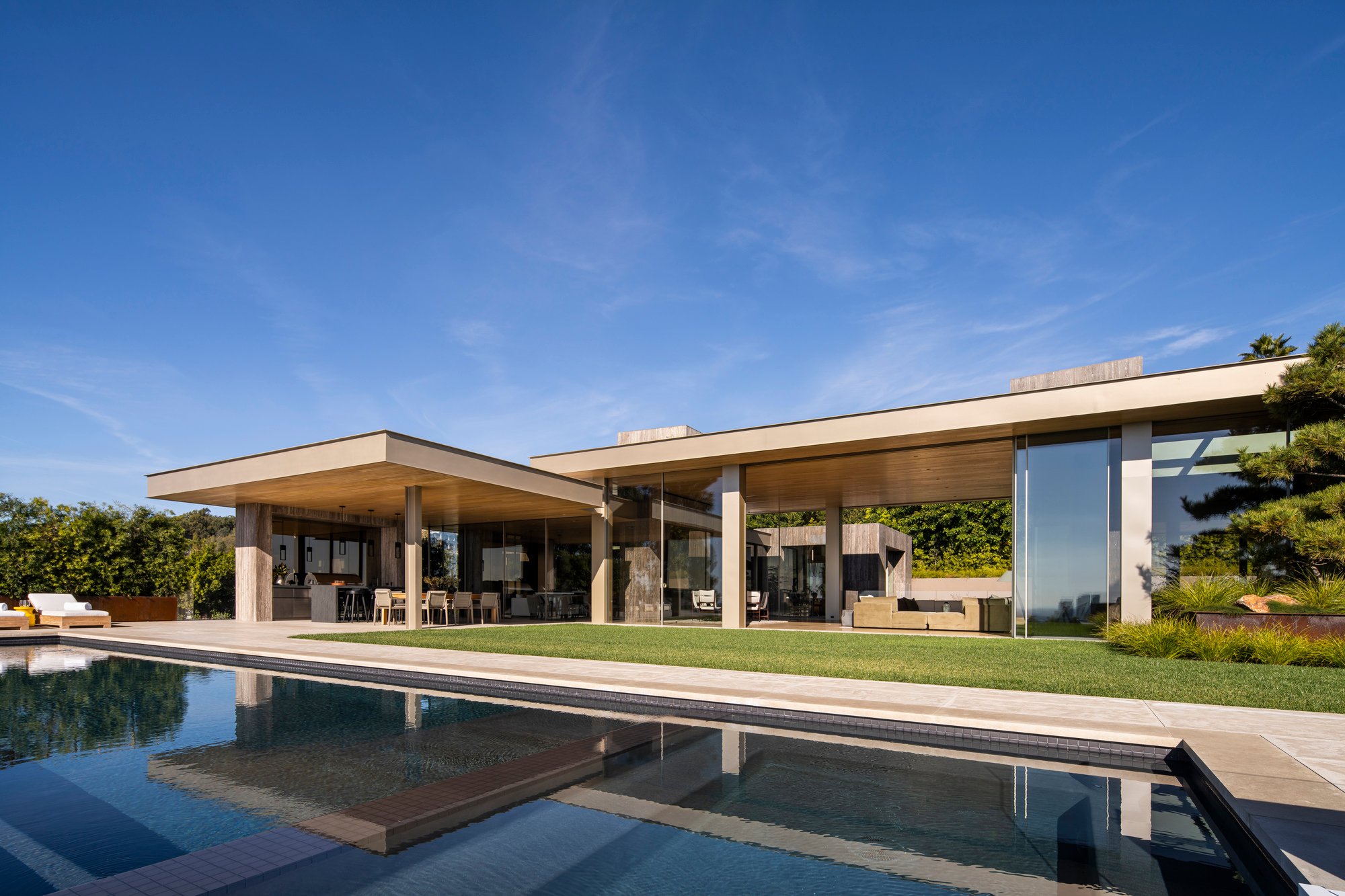
McClean Design Carves a Two-Level Beverly Hills Residence Around Light, Stone, and Courtyard
Laurel II House negotiates a steep hillside lot with open-air rooms, deep material richness, and panoramic views across Los Angeles.

There is a particular kind of residential project that Beverly Hills keeps producing: the house that wants to be seen from the street, the house as billboard. Laurel II, completed in 2022 by McClean Design, is not that house. Sited on a steep, multilevel lot overlooking the city basin, its entry sequence is deliberately compressed. A steep driveway leads to a drive court, then a limestone stair, then a pivot door flanked by board-formed concrete walls. You earn the view. By the time the house opens up, the effect is not just scenic but spatial: you are standing inside a building that seems to dissolve into the hillside on every side.
What makes Laurel II worth studying is not the view, which any developer could exploit, but the way the plan organizes two full levels of program around courtyards, light wells, and a sinuous staircase clad in walnut and limestone. The upper level wraps the pool, garden, and main living spaces into a single open-air circuit. The lower level, constrained by Beverly Hills grading restrictions, turns inward around a basement courtyard designed to pull daylight deep into entertainment rooms, a library, a wine cellar, and three additional bedrooms. It is a house that takes the California modernist tradition seriously: not as a style to quote, but as a set of spatial strategies to test against a genuinely difficult site.
Arrival and Threshold
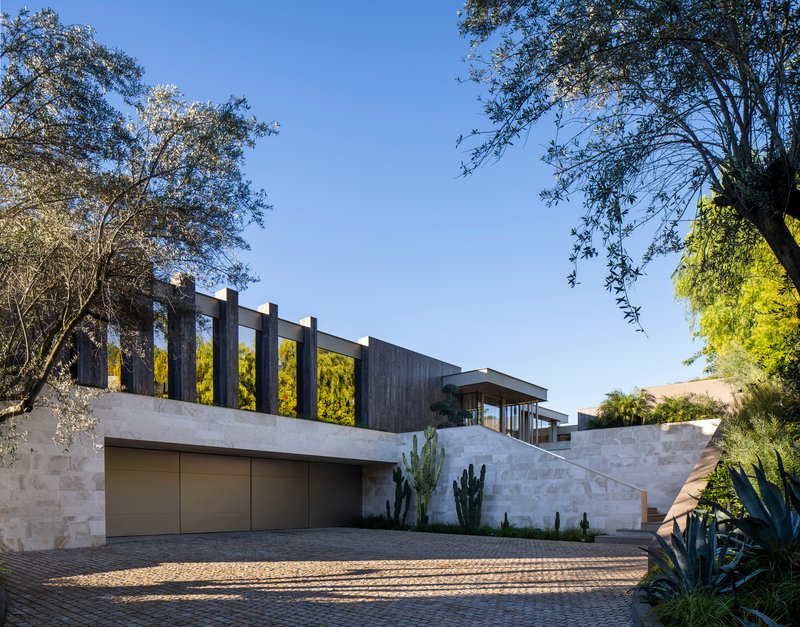
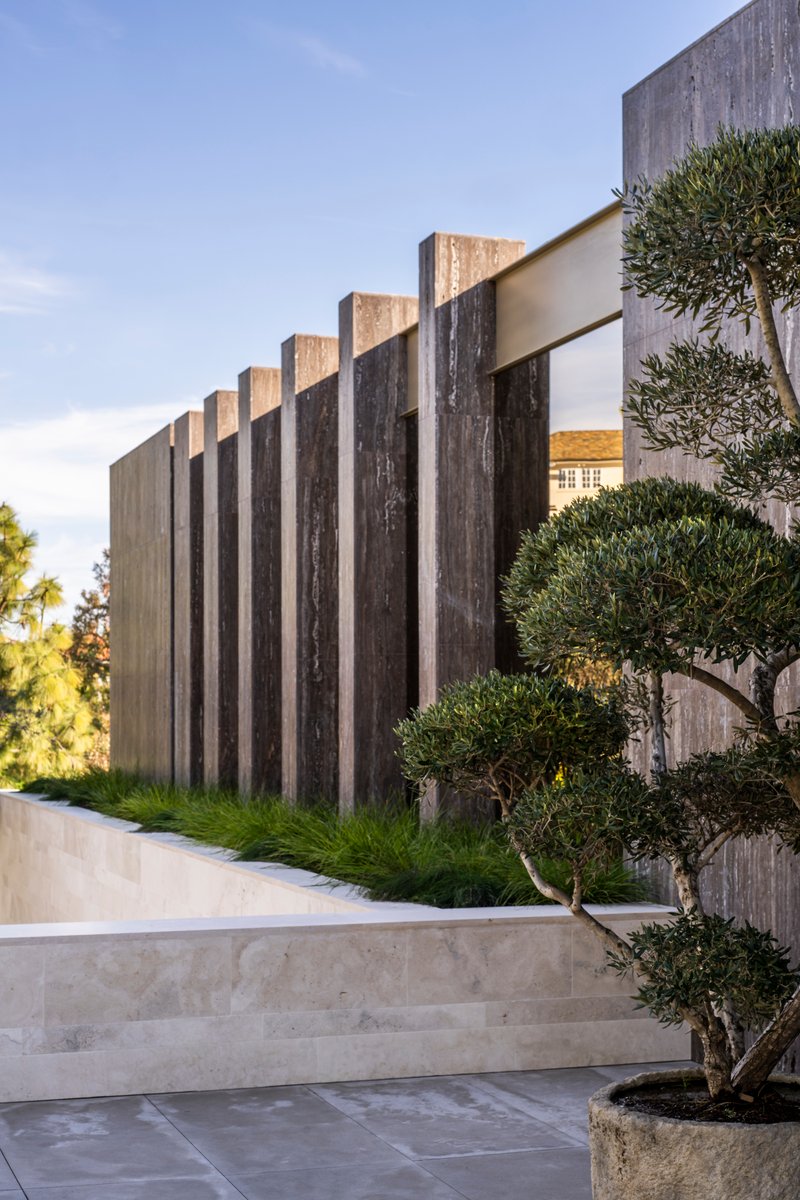
The entry facade is restrained almost to the point of severity. Stone walls, a timber colonnade, garage doors, and a few well-placed cacti form a composition that reveals nothing of the panorama behind. Vertical concrete fin screens beside the entry steps and a board-formed concrete pivot wall reinforce the sense of compression. This is architecture working as choreography: controlling what you see, and when.
The deliberate narrowing of the approach makes the subsequent release into the skylit stairwell and glass foyer all the more effective. Paul McClean understands that in residential work, drama is not about size. It is about the ratio between the tightest moment and the most open one.
The Foyer and Stairwell as Spine
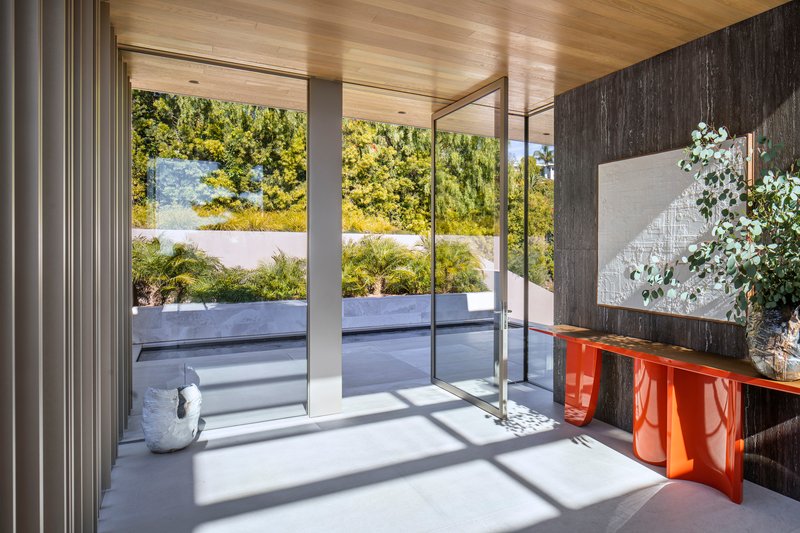
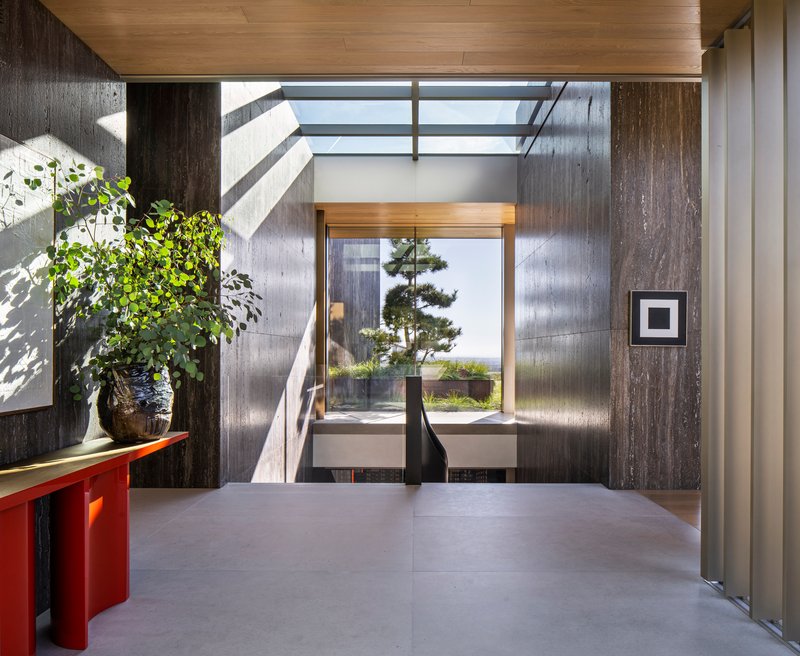
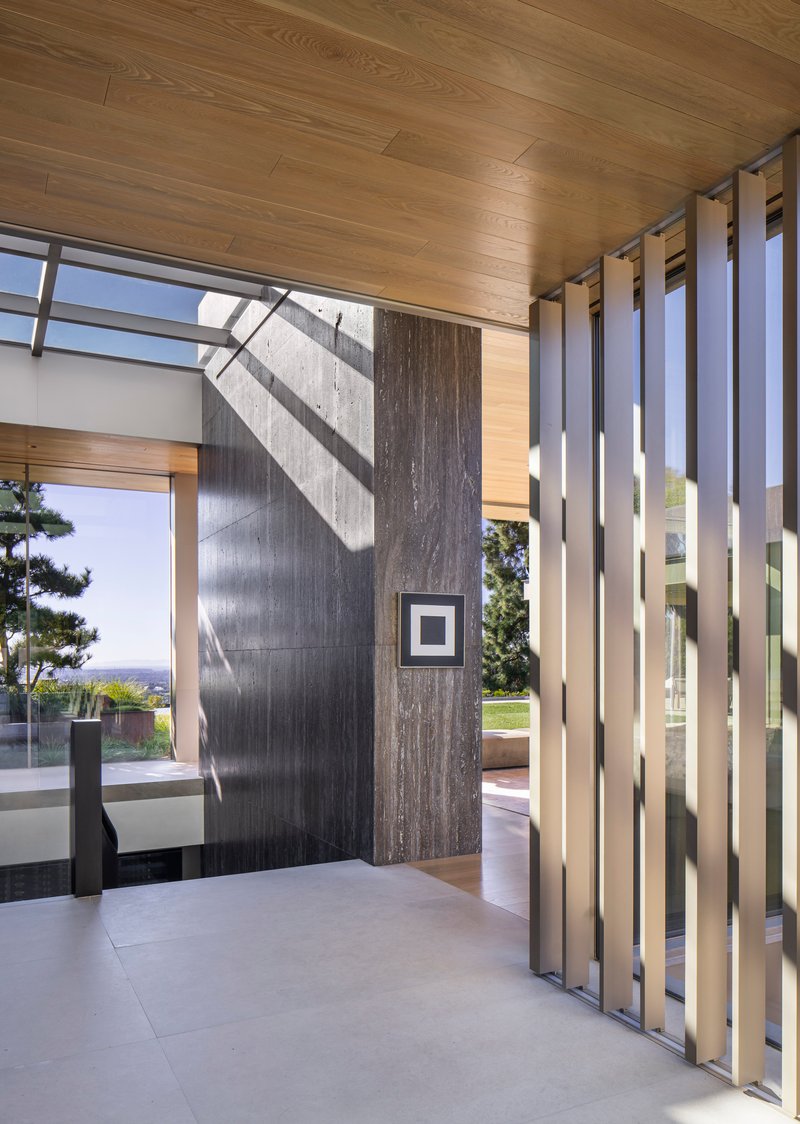
Past the glass pivot door, the entry foyer serves as the project's organizational fulcrum. An orange lacquered console punches against the travertine and concrete, a rare moment of pure color in a palette that otherwise leans into material warmth. A clerestory opening throws diagonal shadows across the floor, calibrating the light as precisely as any museum gallery.
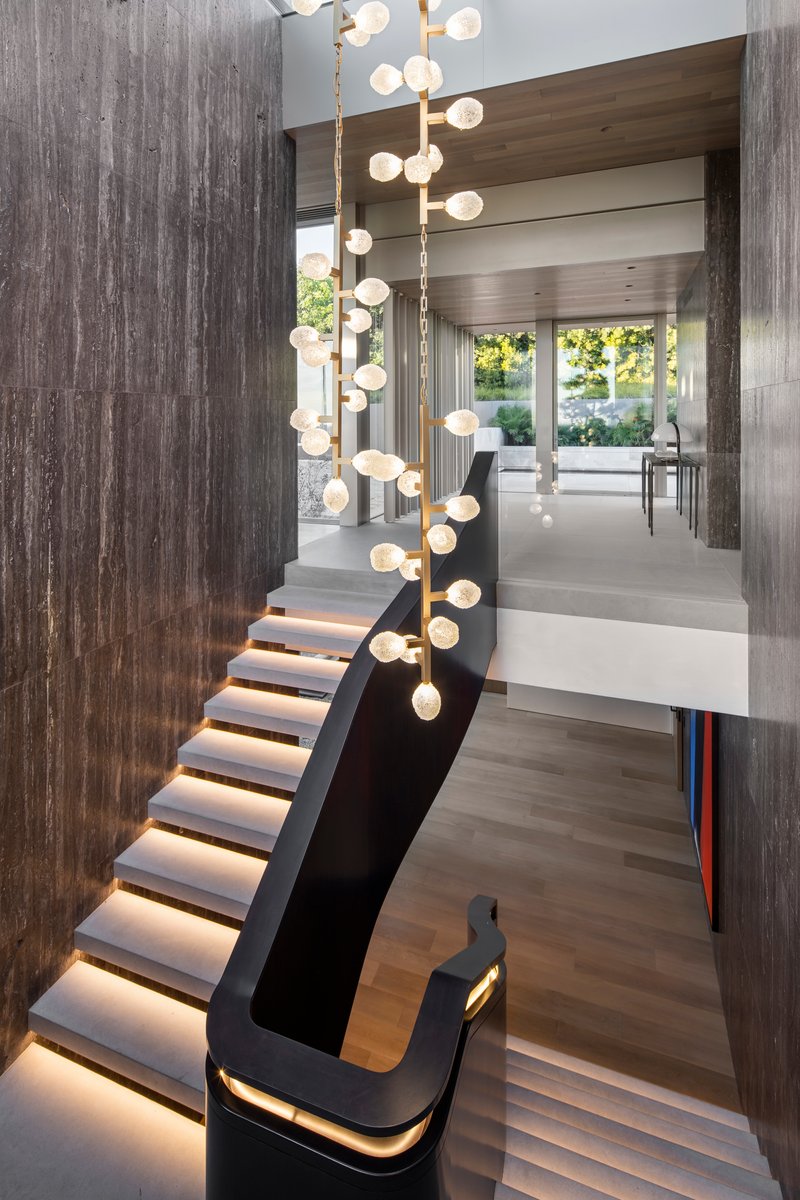
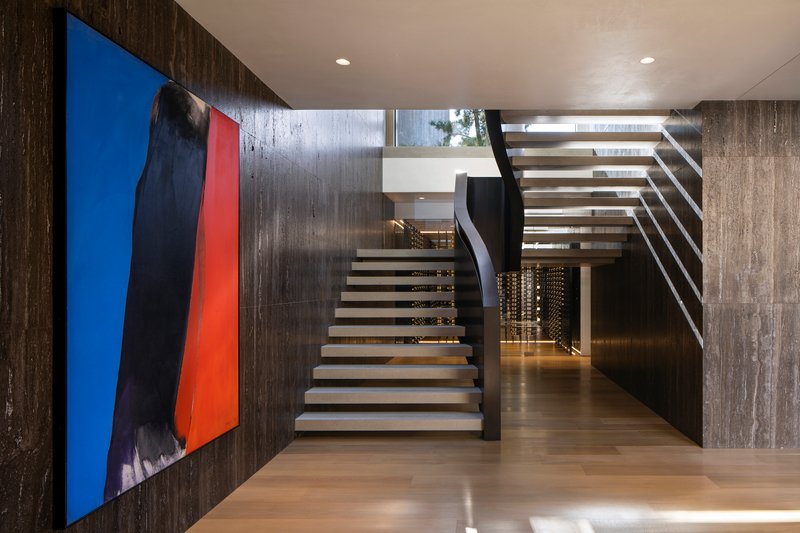
The staircase connecting the two levels is the most sculptural element in the house. Clad in walnut and limestone, its curved black metal balustrade traces a line that the cascading globe pendant above seems to echo. Integrated LED strips beneath each tread turn it into something close to an installation after dark. The stairwell is top-lit by a skylight, so it functions not just as circulation but as a light shaft, feeding daylight down into the lower floor.
Living Rooms That Erase Their Walls
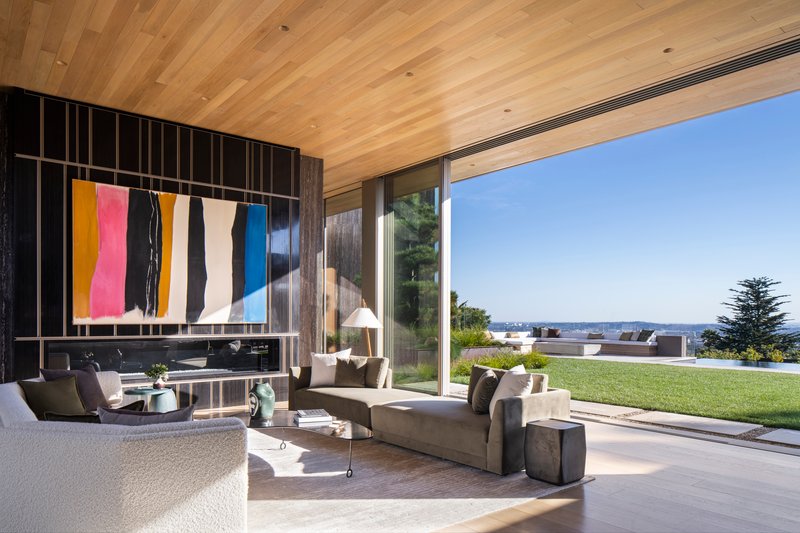
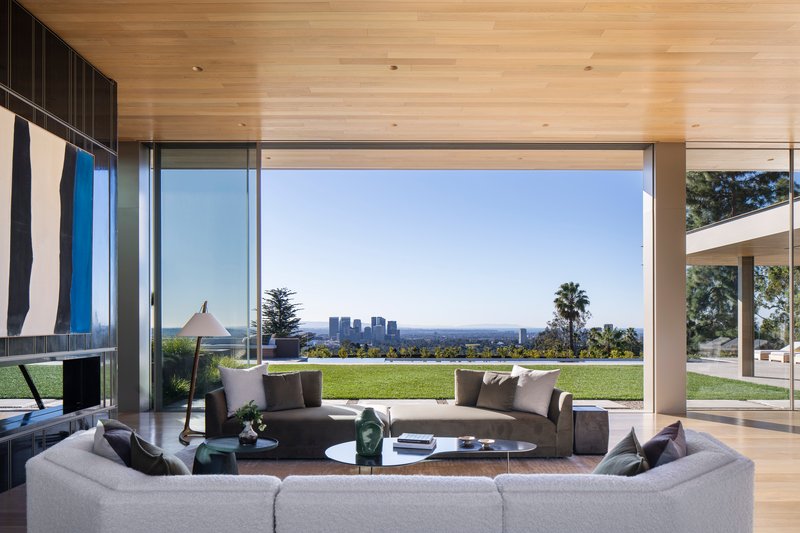
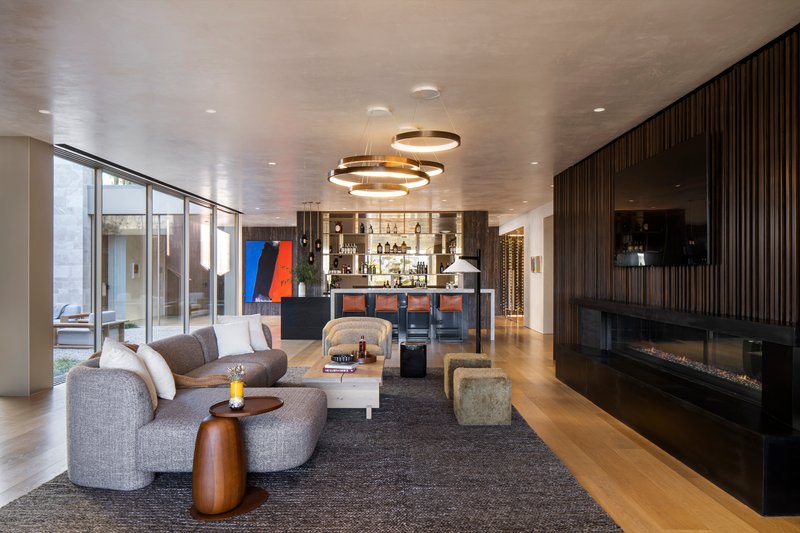
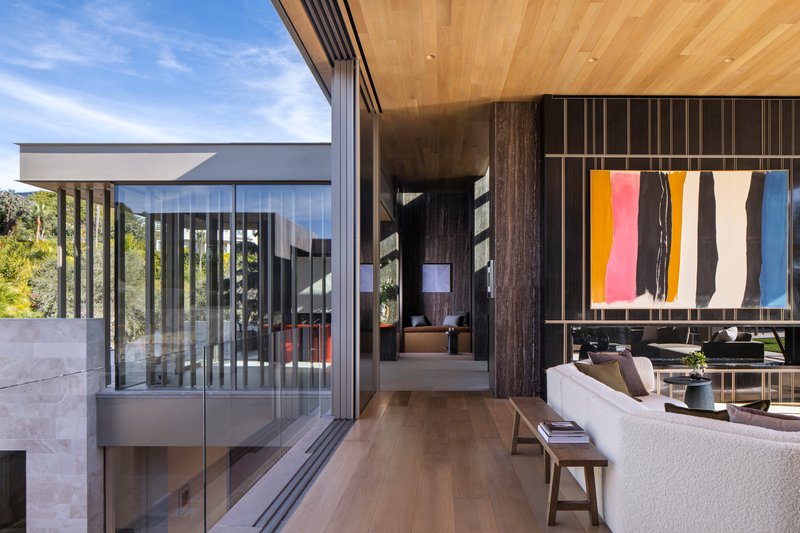
The main living and dining level is configured so that it can open completely on two sides. Full-height glazing retracts to let the pool terrace and the garden merge with the interior. The diagonal wood ceiling in the primary living room introduces a secondary geometry that keeps the space from reading as a simple glass box. A dark metal wall screen acts as a room divider without blocking sightlines, and a linear fireplace set into dark millwork anchors the lounge zone.
Corner glazing in the sitting area frames the lawn in the foreground and the distant Los Angeles skyline beyond. The furniture groupings are generous but not sprawling; ring pendant lights and recessed ceiling slots define zones within the open plan. This is cross-ventilation as spatial luxury: air moves through the house because the walls simply are not there.
Courtyards and the Problem of the Lower Level
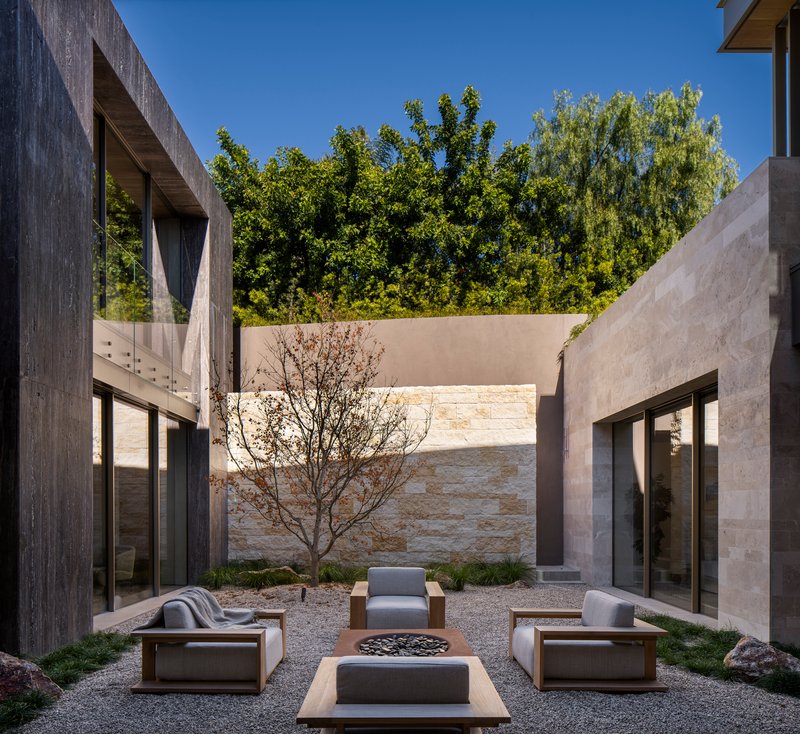
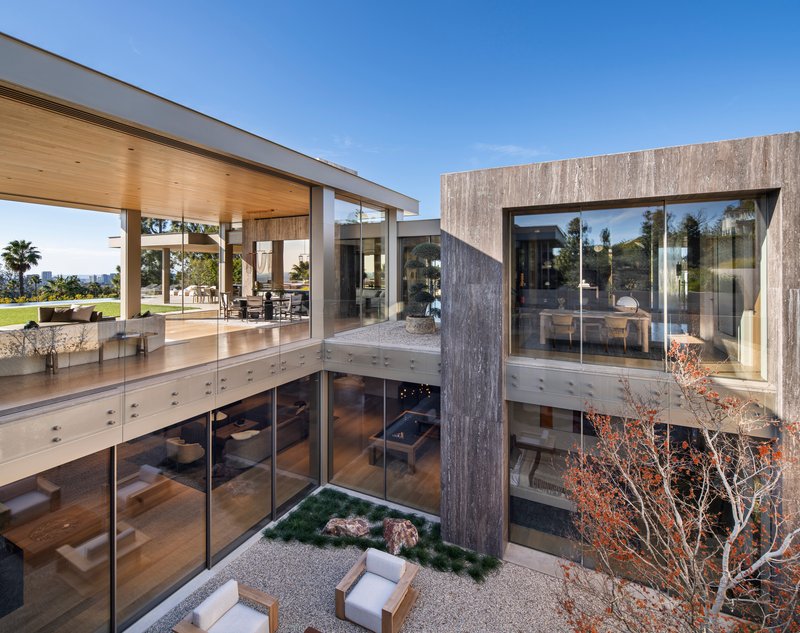
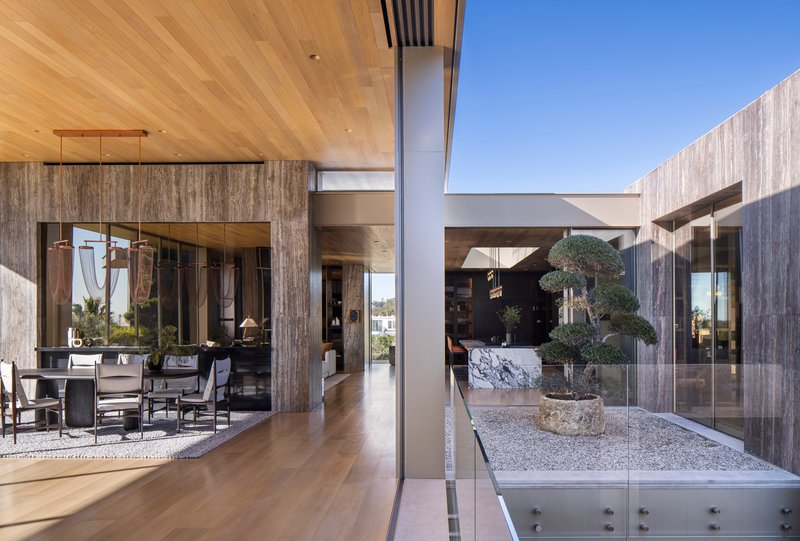
Beverly Hills imposes strict limits on grading, and on a lot this steep, that constraint directly shapes what the lower level can become. McClean's response was to wrap the basement program around a sunken courtyard: a gravel ground plane, a central fire pit, a single specimen tree in a stone planter, and weathered concrete columns supporting the glazed upper terrace above. The courtyard draws light and air into spaces that would otherwise feel entombed.
This is the move that separates Laurel II from more generic hillside mansions. The lower level houses a large entertainment room with bar, fireplace seating, and pool table, a library with western views, a media room, a backlit wine cellar, a gym, three bedrooms, a service kitchen, and staff rooms. That is an enormous program to bury below grade without sacrificing quality. The courtyard strategy turns what could be a basement into something closer to a garden-level apartment, dignified and naturally lit.
Pool, Terrace, and the Outdoor Circuit
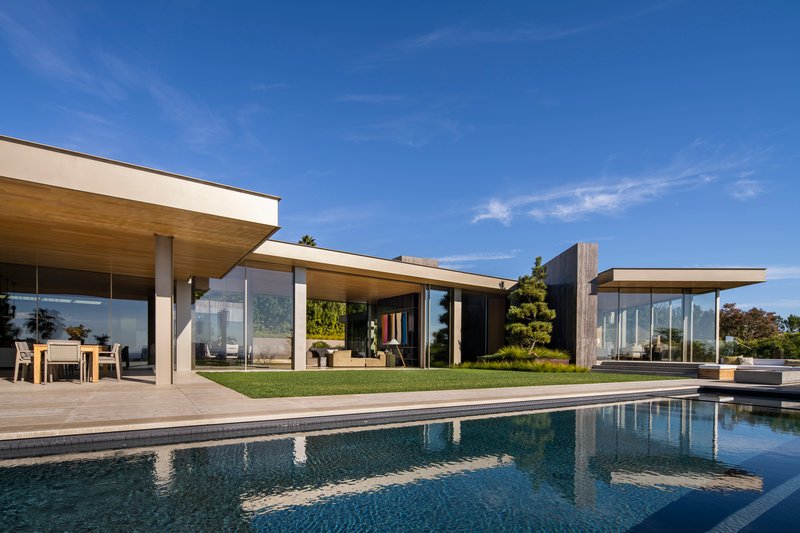
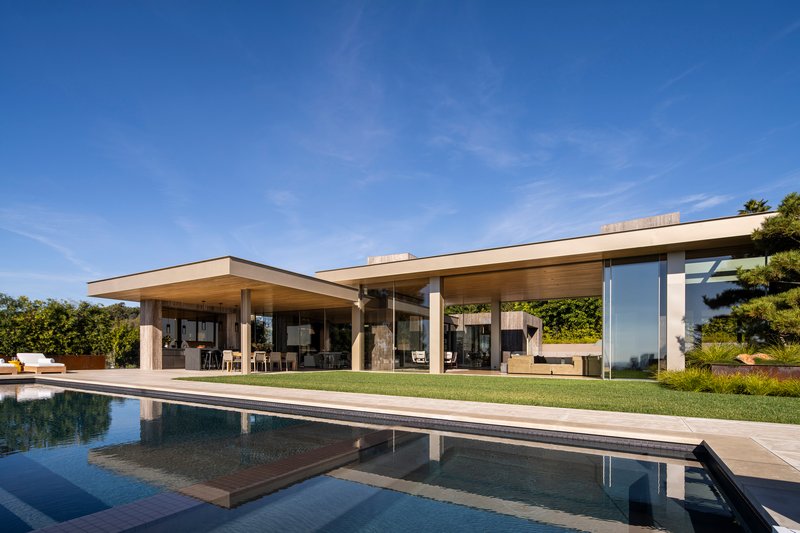
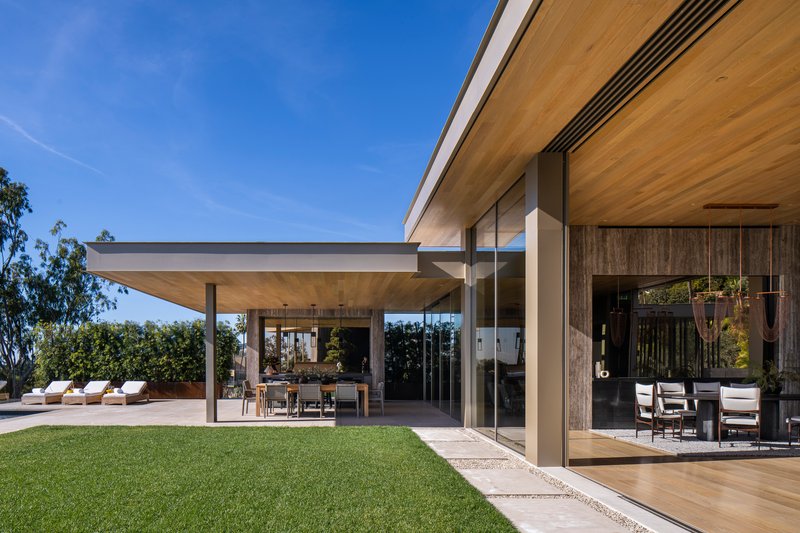
The upper level reads as a continuous loop of indoor and outdoor rooms. Extended roof overhangs with timber soffits shelter the covered terrace, the outdoor kitchen, and the dining loggia. Stone columns ground the cantilevered roofs, and the pool acts as the reflective center of the composition. On a still afternoon, the water mirrors the geometry above it, doubling the roof lines.
Landscape is fully integrated here. Specimen trees and bushes connect the pool deck, the lawn, the gravel courtyard, and the main bedroom terrace with its outdoor fire pit. The boundary between architecture and garden is not blurred, exactly. It is negotiated, room by room, surface by surface.
Material Warmth Against Hard Geometry
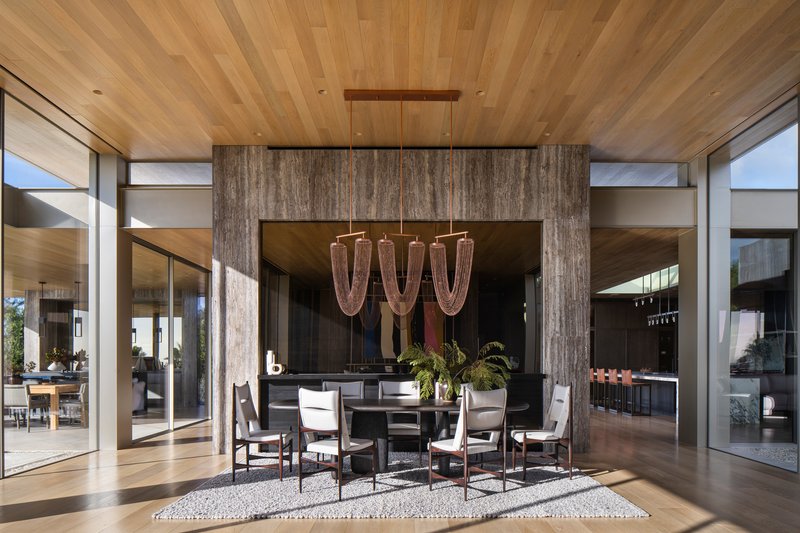
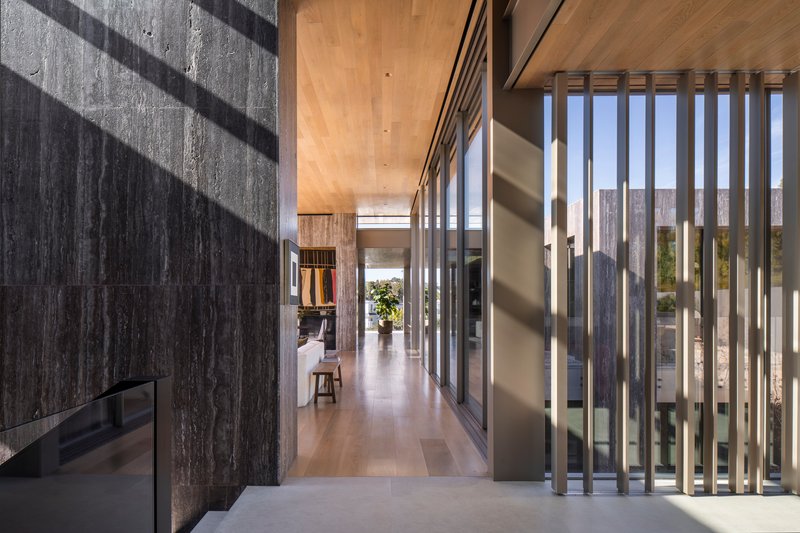
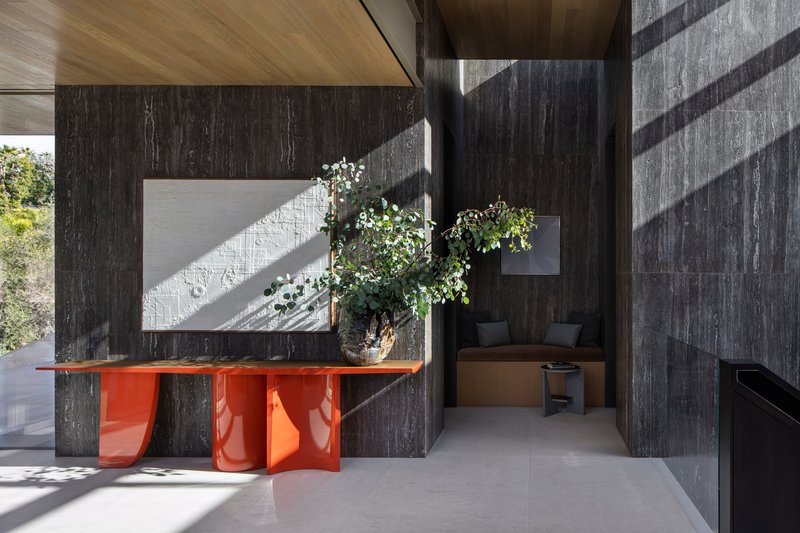
The material palette is where McClean's debt to California modernism becomes most legible. Travertine and limestone provide the base tone: warm, matte, and slightly textured. Board-formed concrete walls add grain and shadow. Oak and walnut surfaces bring warmth to ceilings and corridors. Dark woods and metal trim appear as accent elements, preventing the warmth from tipping into softness.
The covered dining area is a good example. Weathered wood-clad columns and a timber ceiling frame a chandelier and a round table. The materials are rich but never ornamental; every surface is doing structural or environmental work. In the corridor leading from the entry, a board-formed concrete wall sits beside a timber ceiling and vertical metal screen. There is no surface that exists only for decoration.
Private Quarters and Vertical Layering
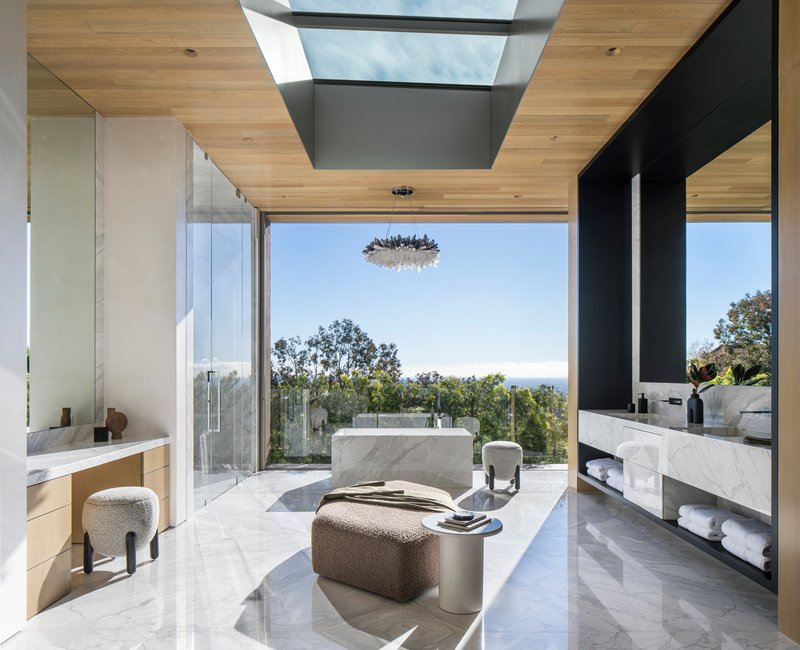
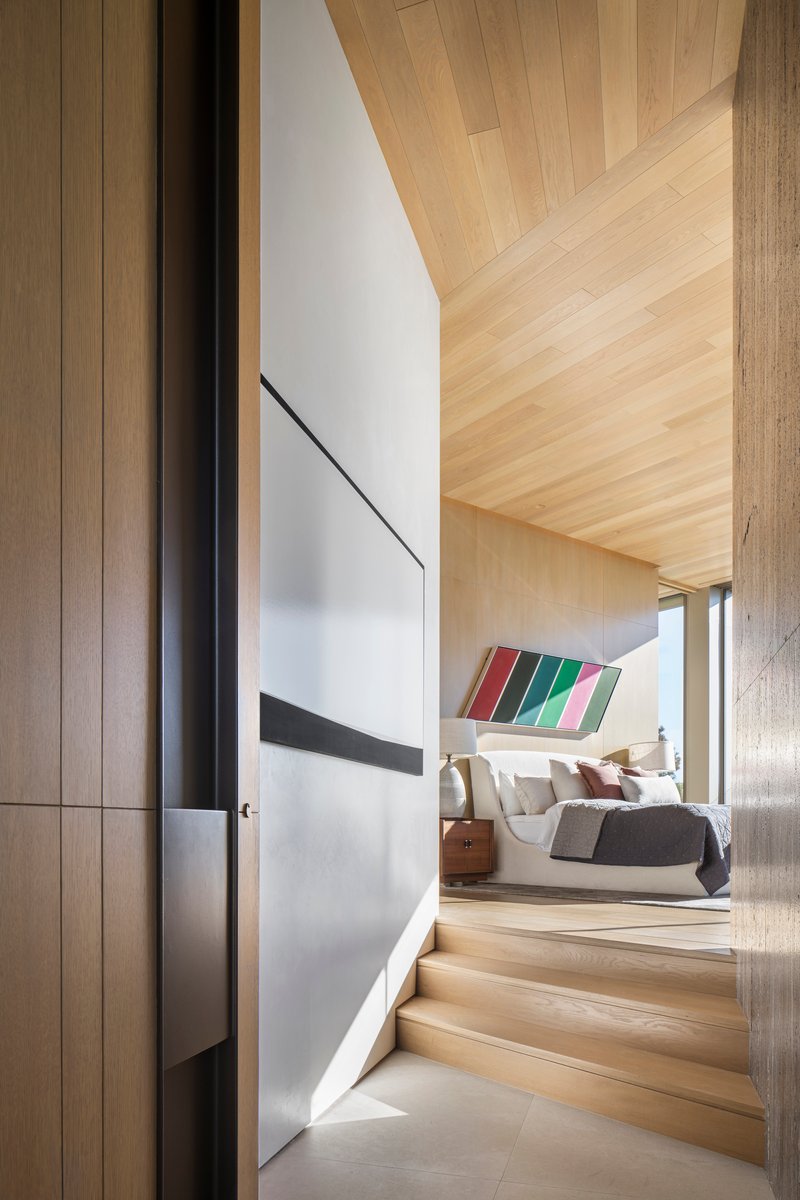
The main bedroom is elevated for privacy and connected to its own garden terrace and outdoor fire pit. Its bathroom features a central marble tub positioned beneath a skylight, with a glazed wall opening to hillside vegetation. This room is less about spectacle than about immersion: the planting feels close enough to touch, and the skylight washes the stone in shifting light through the day.
A blonde wood staircase and corridor connect the upper bedrooms with diagonal timber ceiling panels that introduce movement and warmth. Retractable glass walls on two sides of the main bedroom allow the room to open entirely. His and her closets and a home office adjacent to the kitchen round out a private program that is extensive without feeling sprawling.
Entertainment and the Lower Level Program
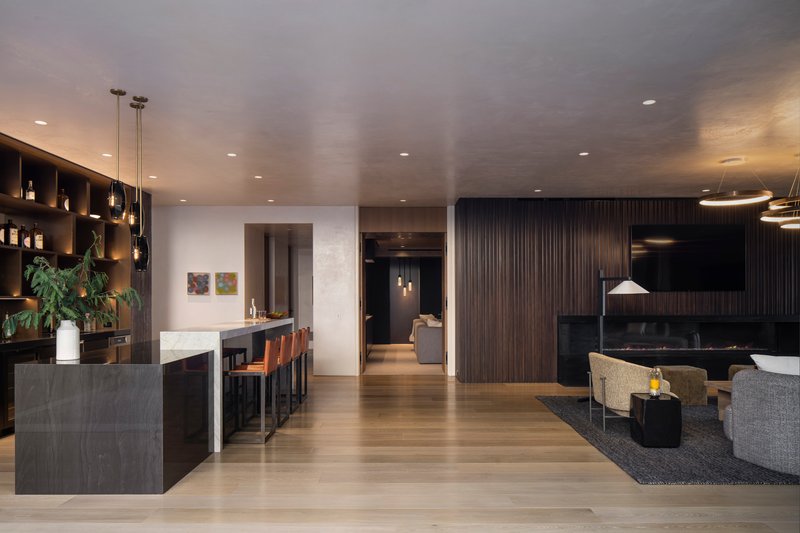
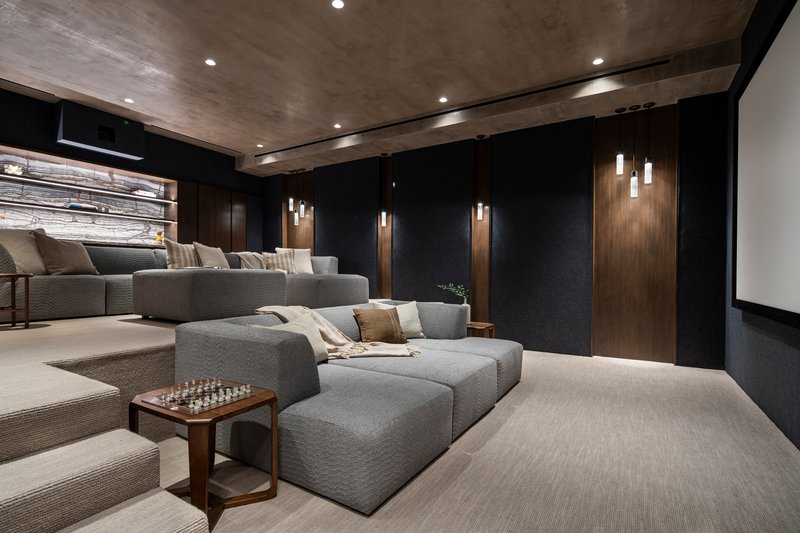
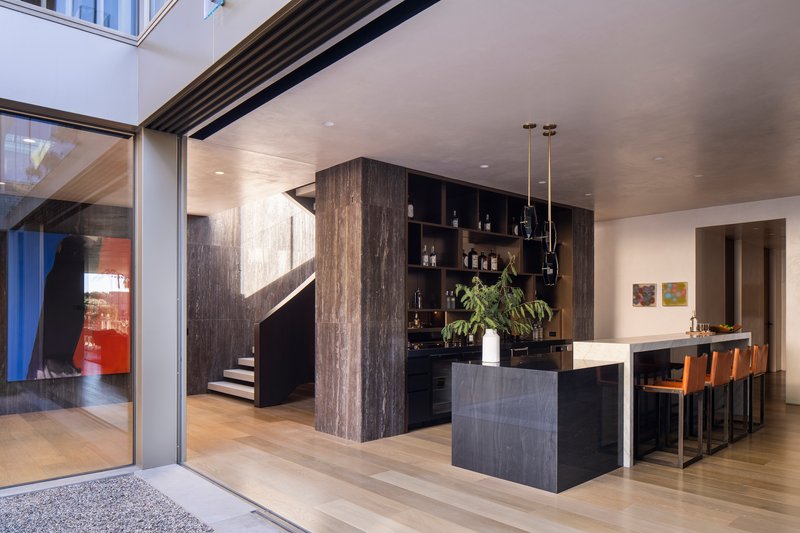
The lower level's entertainment room anchors the social program below grade. Dark wood wall panels, a stone bar island, and recessed ceiling lighting create a space that reads as deliberate and moody rather than simply underground. The screening room, with its tiered seating and textured concrete ceiling, sits adjacent and opens to the larger entertainment area.
From the exterior threshold, you can see through the kitchen bar past the sculptural staircase to the full-height glazed sliding doors beyond. These sightlines are not accidental. They pull the courtyard's daylight deep into the plan and give the lower level a sense of orientation that most basements lack entirely.
Exterior Detailing and Pavilion Logic
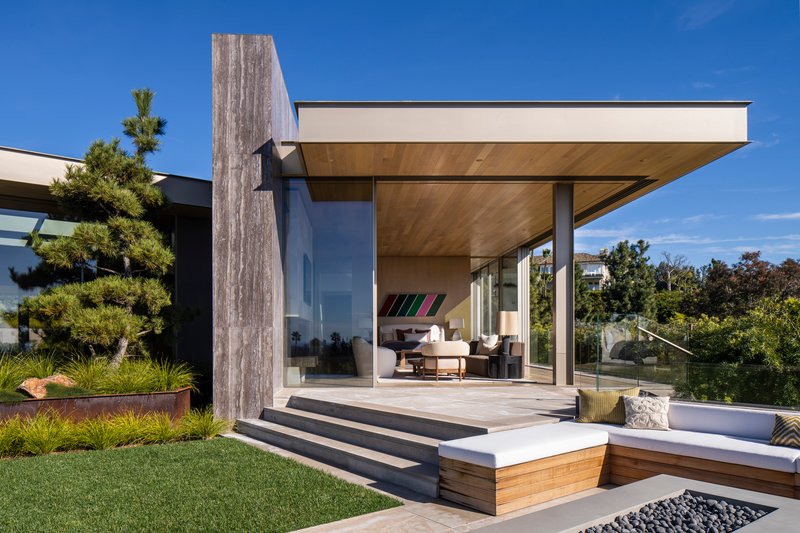
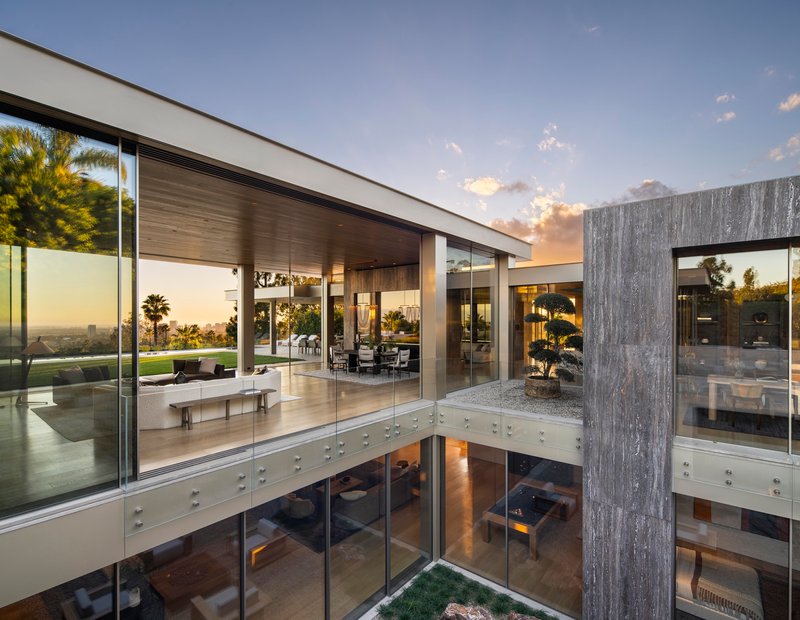
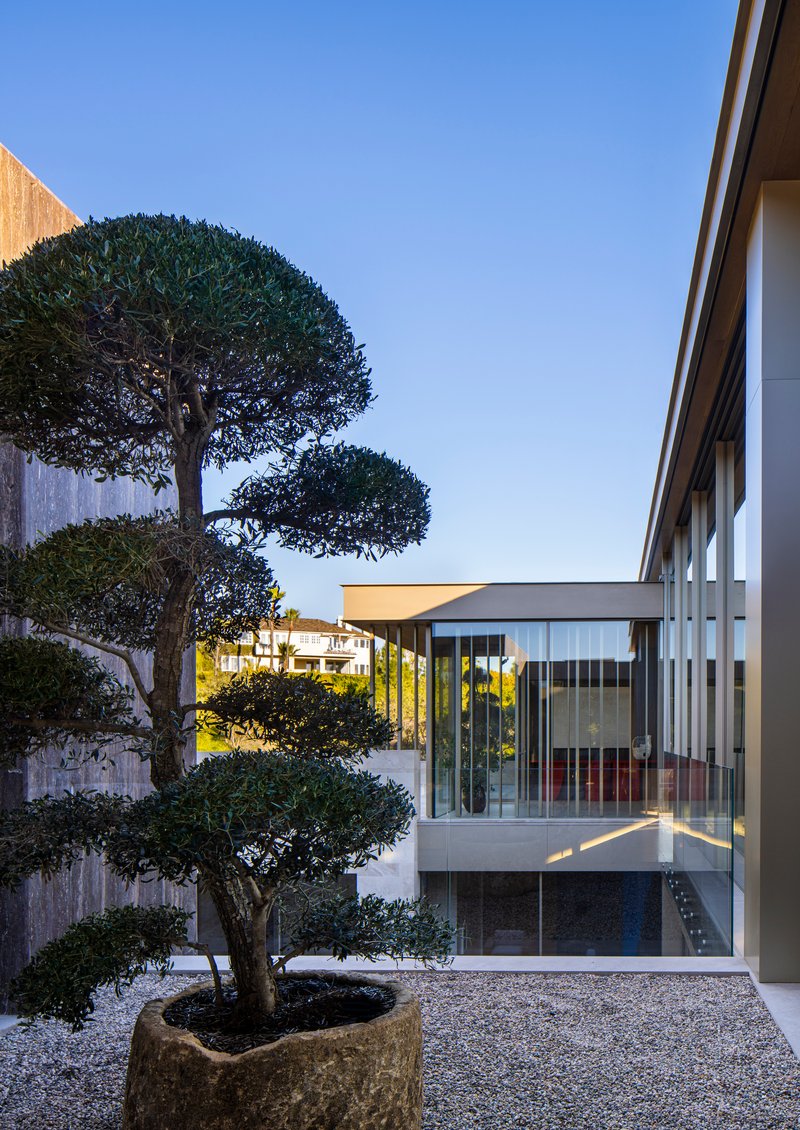
Several moments around the house reveal a pavilion logic at work. A glazed volume with a cantilevered roof meets a stepped timber deck beside a sunken garden bed. A double-height courtyard features a glass-wrapped volume and a weathered concrete tower that reads almost as a ruin at dusk. A gravel courtyard with a potted tree sits beneath a glazed bridge connecting two volumes.
These elements suggest that Laurel II is not one building but a cluster of pavilions linked by covered passages, courtyards, and bridges. The effect is closer to a compound than a house, which is appropriate for a program this large. Breaking the mass into discrete volumes also helps the building sit more lightly on a hillside that could easily be overwhelmed.
Screens, Louvers, and Filtered Light
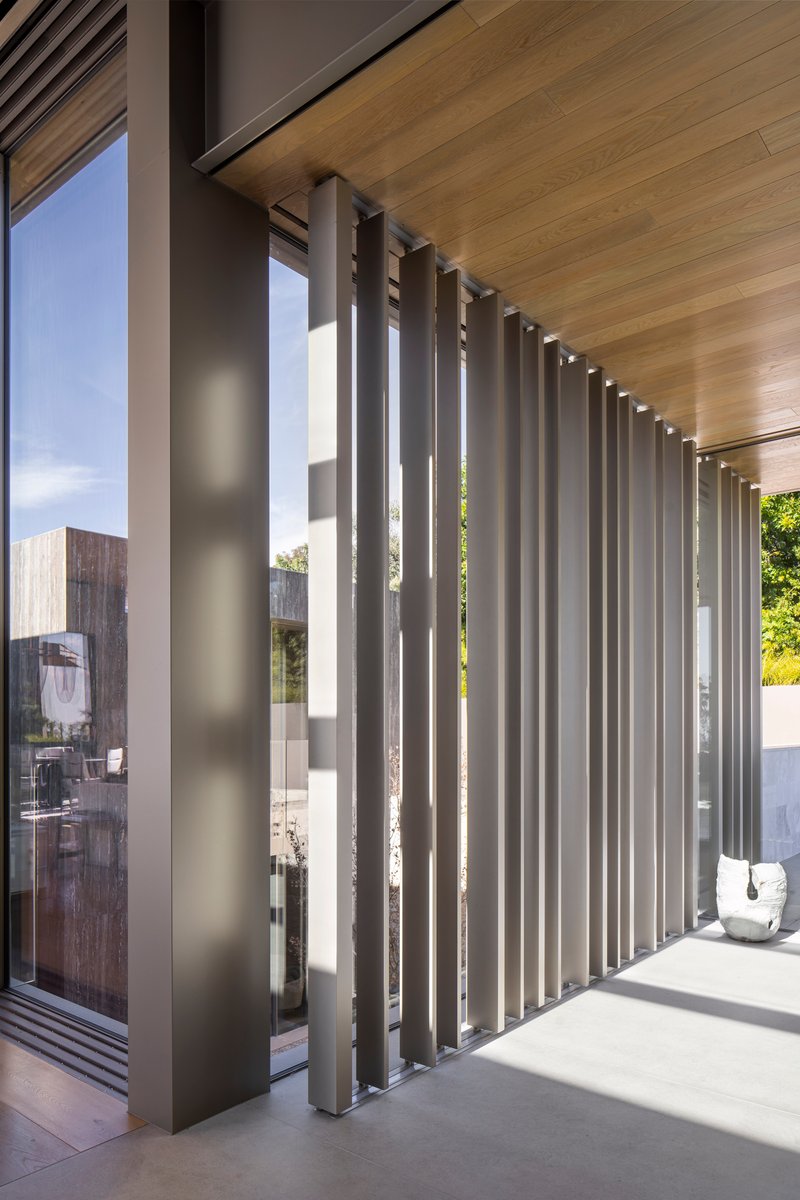
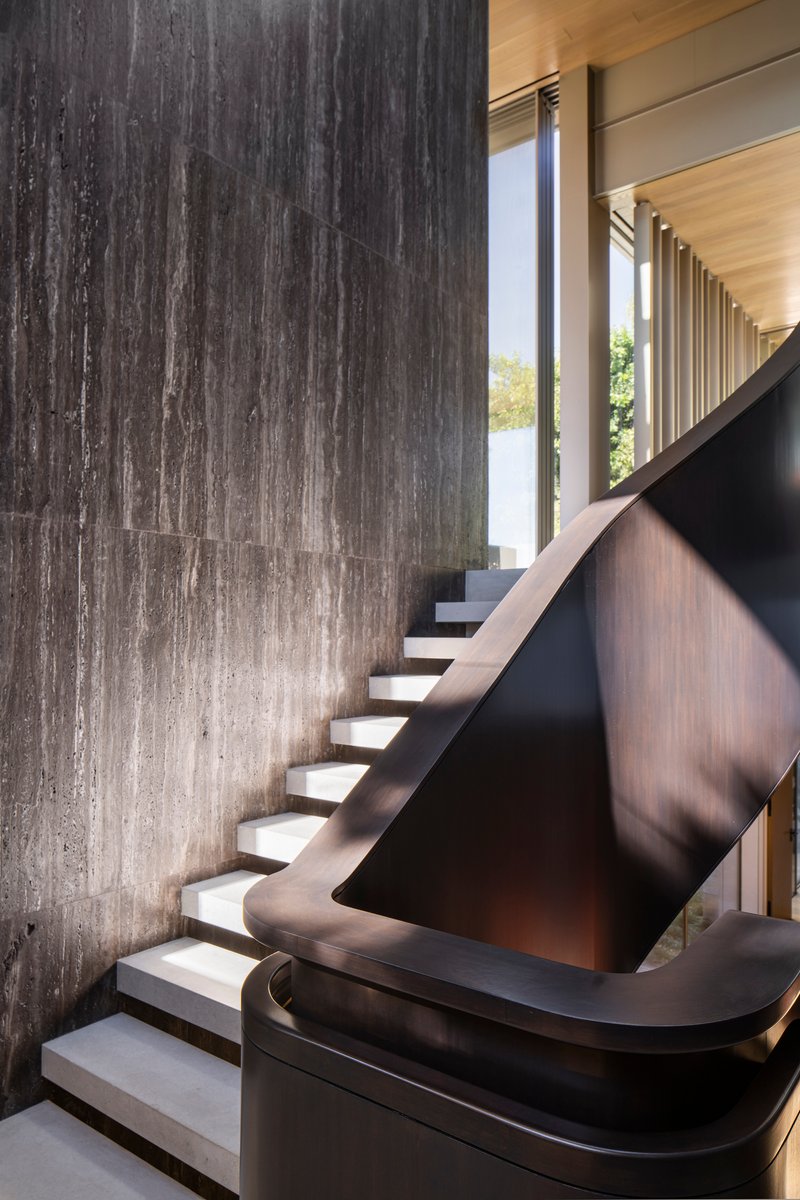
Vertical metal louvers recur throughout the project, sometimes as sun screens, sometimes as spatial dividers, sometimes as both. On the exterior terrace, they frame views of the garden while casting parallel shadow lines across the timber ceiling. Inside, vertical metal screens beside the staircase filter light from the skylit stairwell. The effect is calibrated: the louvers never darken a space, only pattern it.
An open-tread staircase with steel stringers ascending beside a board-formed concrete wall, flanked by a colorful canvas, demonstrates McClean's willingness to let art interrupt the material discipline. The house is austere in its bones but not in its personality.
Plans and Drawings
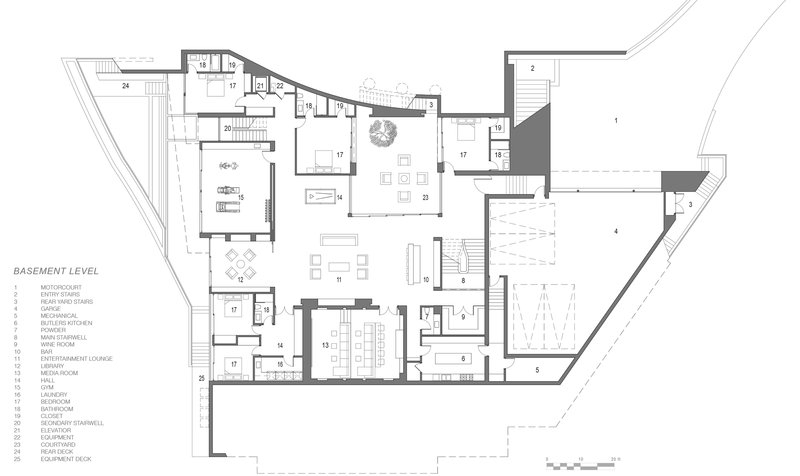
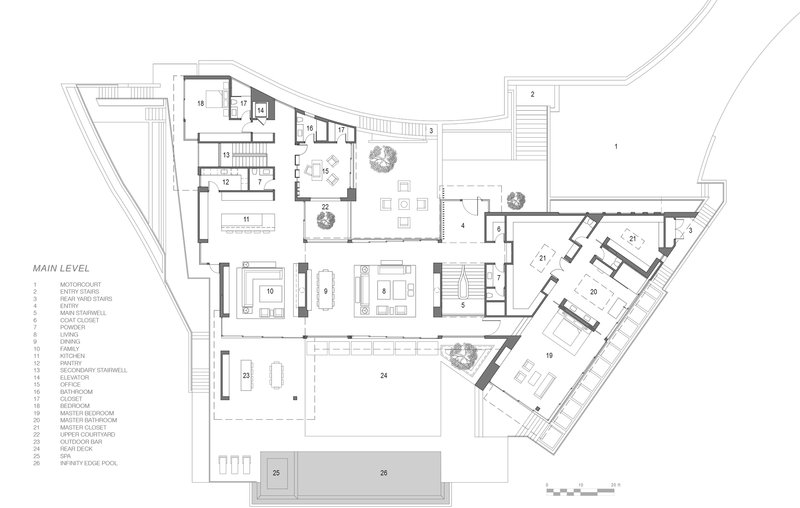
The two floor plans reveal the full extent of the site's complexity. The basement level shows an irregular perimeter that follows the lot's contours, with living spaces, service areas, and the pool arranged around the central courtyard. The main level plan shows open living areas and bedrooms organized along an angled wing that extends to capture western views. The offset between the two levels is the project's key organizational idea: the upper floor floats over the lower, connected by the stairwell and courtyard voids that stitch daylight and air through the section.
Why This Project Matters
Laurel II matters because it demonstrates that a large luxury residence on a constrained hillside lot does not have to default to spectacle. McClean Design has produced a house that earns its views through spatial compression and release, that addresses strict grading codes through courtyard strategy rather than brute engineering, and that uses a California modernist material palette not as nostalgia but as a working method. The sinuous staircase, the basement courtyard, and the pavilion-cluster massing are all genuinely inventive responses to site and program.
For architects working on steep residential sites with heavy programs, this project offers a useful case study in section. The decision to wrap the lower level around a light-giving courtyard, rather than pushing it into the hillside as a sealed box, transforms the entire character of the basement. That single move elevates Laurel II from a very good house to a house worth learning from.
Laurel II House by McClean Design, Beverly Hills, United States. Completed 2022. Photography by Manolo Langis.
About the Studio
Share Your Own Work on uni.xyz
If projects like this are the kind of work you want to make, uni.xyz is a place to publish your own, find collaborators, and enter design competitions.




Popular Articles
Popular articles from the community

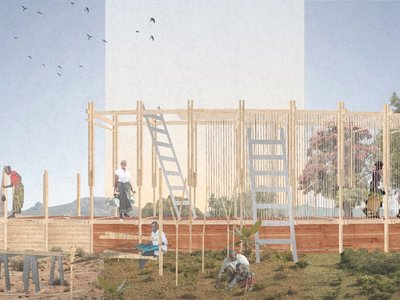
Healing Façade: Sustainable Architecture for Reforestation, Community, and Sacred Ecology in Ethiopia
Healing Façade reimagines sustainable architecture as a living wall that restores soil, catches water and renews Ethiopia's forest churches.
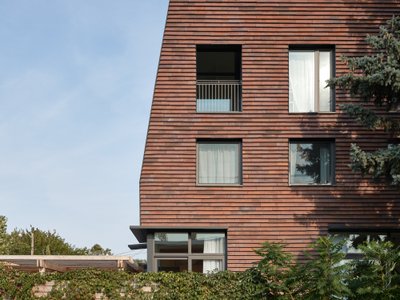
LGA Architectural Partners Build Toronto's First Multiplex Condo on a Single-Family Lot
Ulster House packs five zero-carbon units into a Harbord Village lot, proving gentle density can be market-ready and livable.
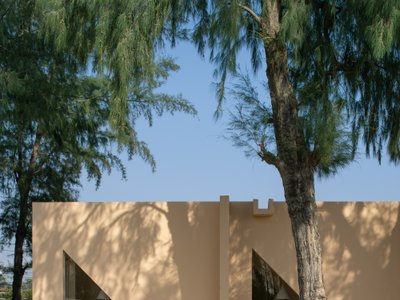
Pinto Builds a Faceless Pavilion Beneath Casuarina Trees on Thailand's Rayong Coast
SON Restaurant refuses a front door or a back wall, treating all four facades equally in a 260-square-meter brick and stucco grid.
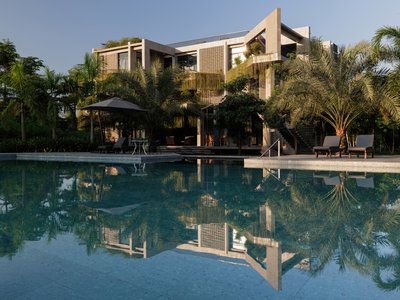
Reincarnation Weaves a Three-Story Retreat into the Green Landscape of Rural Bangladesh
Ara Manor in Narsingdi dissolves the line between domestic architecture and its lush surroundings through screens, courtyards, and planted rooftops.


Similar Reads
You might also enjoy these articles

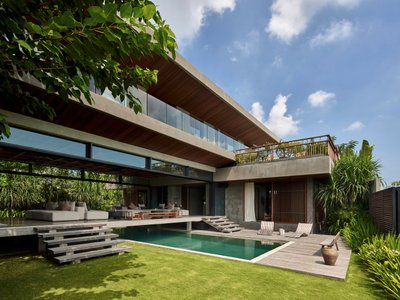
Freebird Residence by Alexis Dornier: A Tropical Modernist Sanctuary in Bali
Floating living pavilion above pool anchors H-shaped tropical villa, blending Japanese minimalism, sustainable strategies, lush landscape, and sculptural interiors.
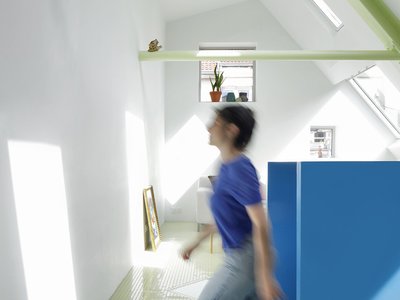
127af Flips a Tiny Bagnolet Rowhouse Upside Down with a Handcrafted Roof Extension
A 55-square-meter terraced house on the edge of Paris gains a luminous upper living floor through lightweight timber and steel.
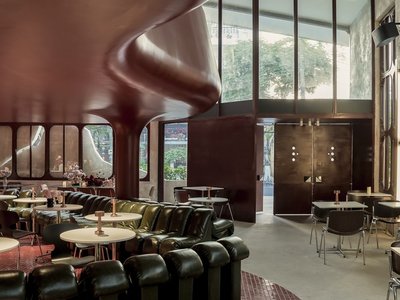
1.61 Design Workshop Wraps a 600-Square-Meter Café in Vietnam in Sculptural Burgundy Drama
Reden Café & Bistro pairs a helical staircase, mosaic floors, and deep red interiors to rethink Vietnamese hospitality space.

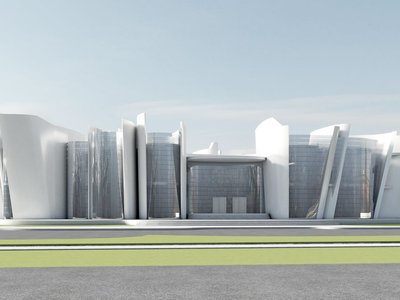
The Unbound Brain: A School Shaped by Cognitive Architecture
Cylindrical learning pods radiate like neurons from a central cortex, turning the floor plan into a spatial model of human thought.

Explore Residential Building Competitions
Discover active competitions in this discipline




The Global Benchmark for Architecture Dissertation Awards


The Global Benchmark for Graduation Excellence


Challenge to design a barrier free sports center


Challenge to design an outdoor ice-rink and park
Comments (0)
Please login or sign up to add comments
No comments yet. Be the first to comment!