
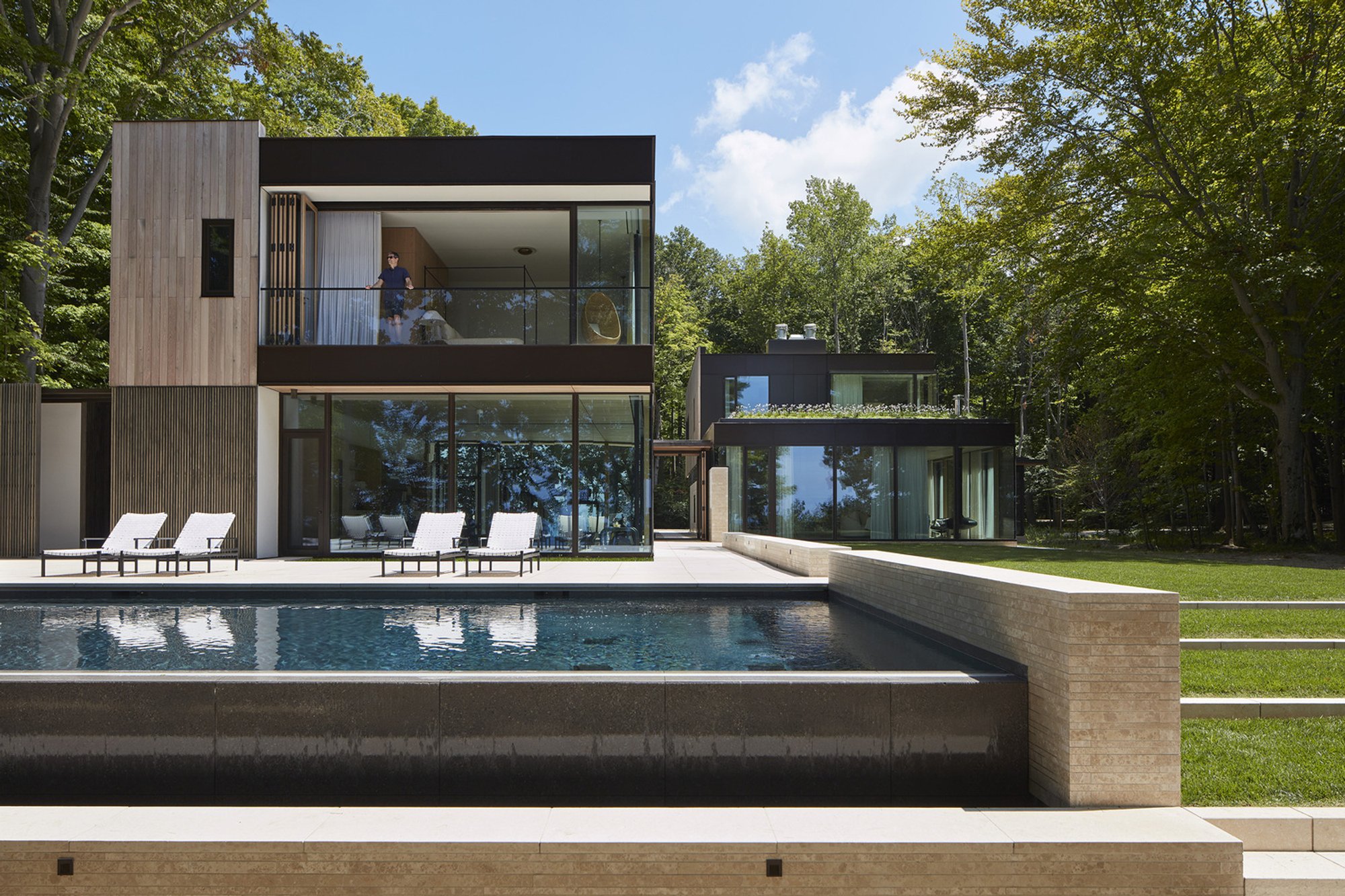
Wheeler Kearns Architects Tucks a Limestone-and-Timber Retreat into a Lake Michigan Bluff
Three staggered volumes in black locust, white oak, and Croatian limestone frame lake and forest views from a wooded Michigan site.

Weekend houses for empty nesters tend to fall into one of two traps: either they scream for attention on the shoreline, or they retreat so far into modesty that they feel like afterthoughts. Meadow Lane Retreat, designed by Wheeler Kearns Architects on a 2.5-acre wooded bluff above Lake Michigan near Lakeside, Michigan, does something more considered. The house is organized as three separate structures, two living bars and a detached garage, staggered perpendicular to the shore so that the building's full scale is never legible from any single vantage point. You arrive through trees, catch a sliver of limestone, pass through a compressed courtyard, and only then does the lake reveal itself. It is architecture as controlled sequence, and it works.
The project's real ambition is material. A wall of Croatian Giallo D'Istria limestone acts as the organizing spine: it wraps the ground floor, breaks at a glazed entry corner, turns ninety degrees through the interior, and continues outside as a low seating wall along the pool terrace before cladding the infinity-edge pool itself. Around and above it, the wood structure reads as though it was built later, a deliberate conceit that gives the house an archaeological layering unusual in residential work. The upper volumes are clad in domestic black locust boards designed to gray over time, while the ground level wears dark-stained Accoya siding milled into narrow vertical slats that echo the surrounding tree trunks. Principal Jon Heinert and project architect Emily Ray, with landscape architect Hoerr Schaudt, have produced a house that is simultaneously rooted and light.
Arrival and the Art of Concealment
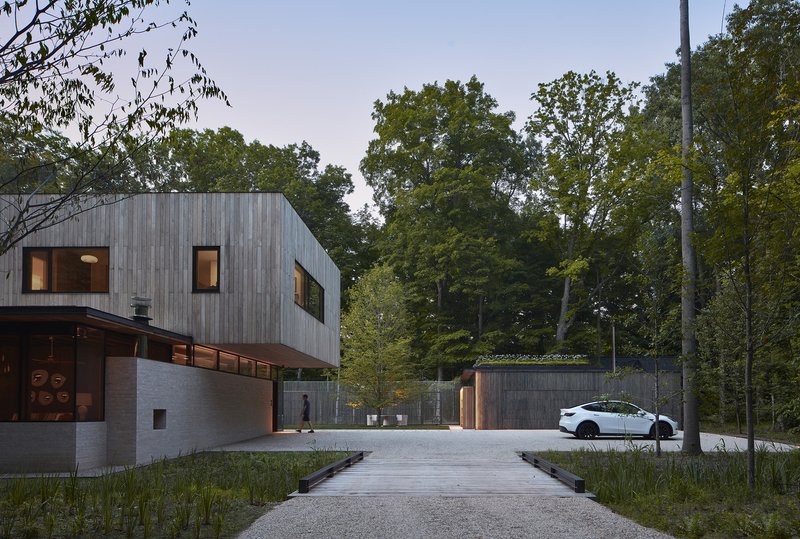
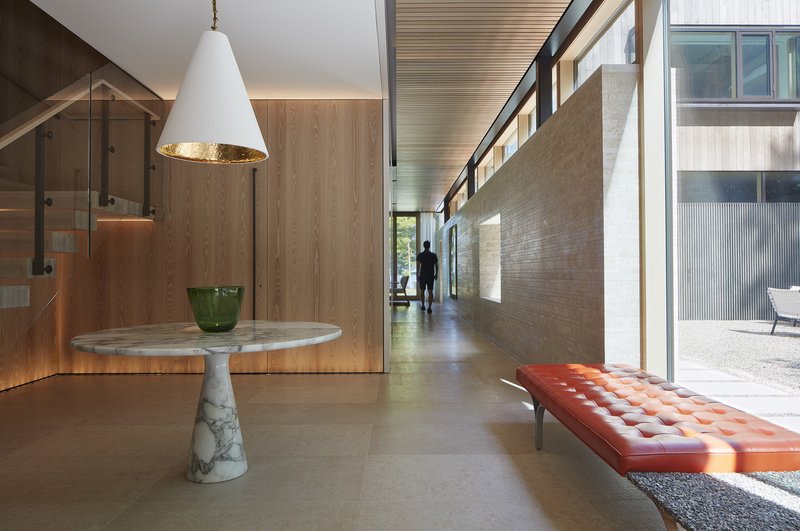
The approach from the gravel drive is deliberately understated. The south bar, closest to the driveway, screens the north bar from view, so the house presents a modest timber-and-limestone face among deciduous trees. The detached garage walls complete a protected garden courtyard, an inward-looking space that gives no hint of the lake beyond. It is only when you pass through the entry hall, with its marble pedestal table and pendant light, that the courtyard yields to the panorama. The decision to hide the payoff is a confident one, and it makes the eventual reveal of azure water through floor-to-ceiling glass genuinely surprising.
At the entry, a cantilevered black locust upper level provides an overhang beneath which a slatted white oak ceiling flows continuously from exterior to interior, erasing the threshold. You step inside without quite knowing when inside began.
Limestone as Protagonist
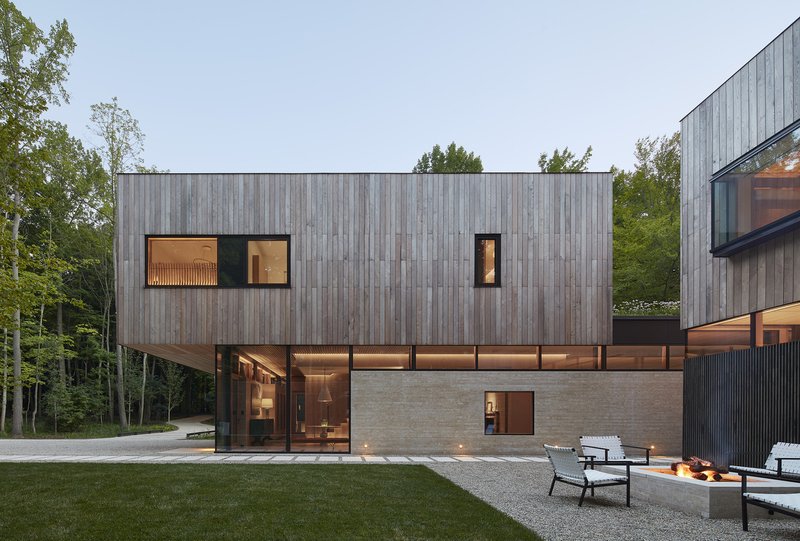
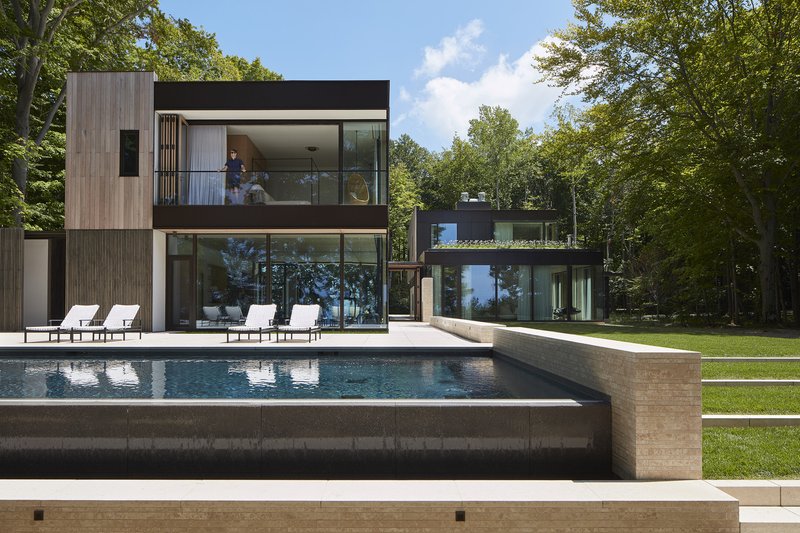
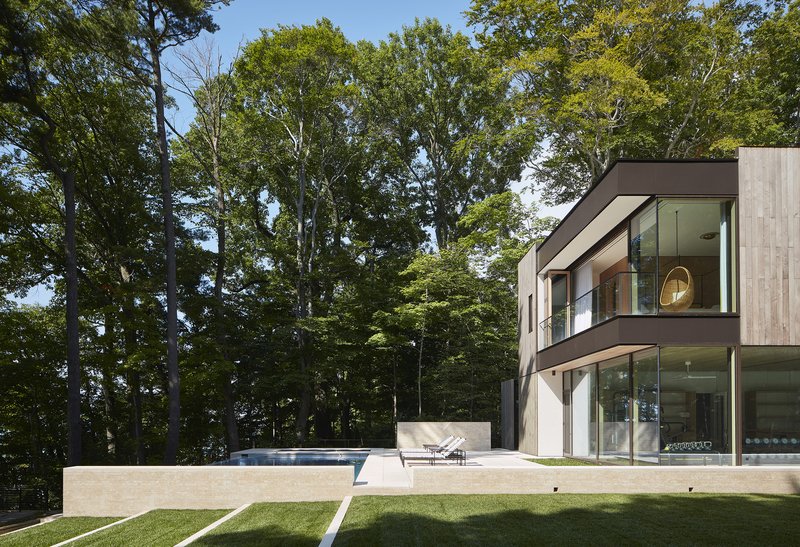
The limestone wall is the conceptual anchor of the entire project. Wheeler Kearns conceived it as a preexisting element, something geological that the timber structure merely wraps and defers to. That reading is reinforced by the way the stone passes through glass walls without interruption: it is underfoot inside, behind the kitchen counter, and then resurfaces on the pool deck outside. The continuity is not decorative; it collapses the distinction between landscape surface and building surface.
The pool terrace is where this idea pays its biggest dividend. Limestone steps descend to a cast concrete deck, the infinity-edge pool sits flush with the stone, and the two-story glass facade rises behind. From this vantage, the house feels less like a structure placed on a bluff and more like a bluff that has been selectively hollowed out and glazed.
Living Spaces Open to Forest and Lake
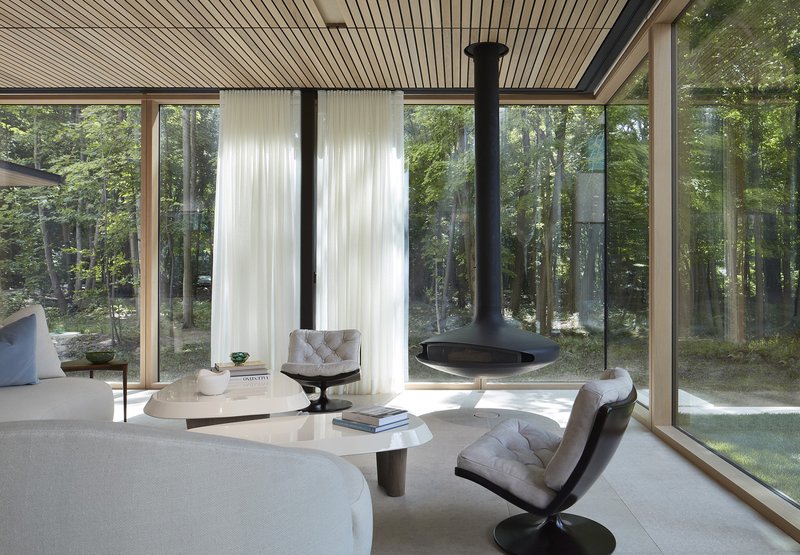
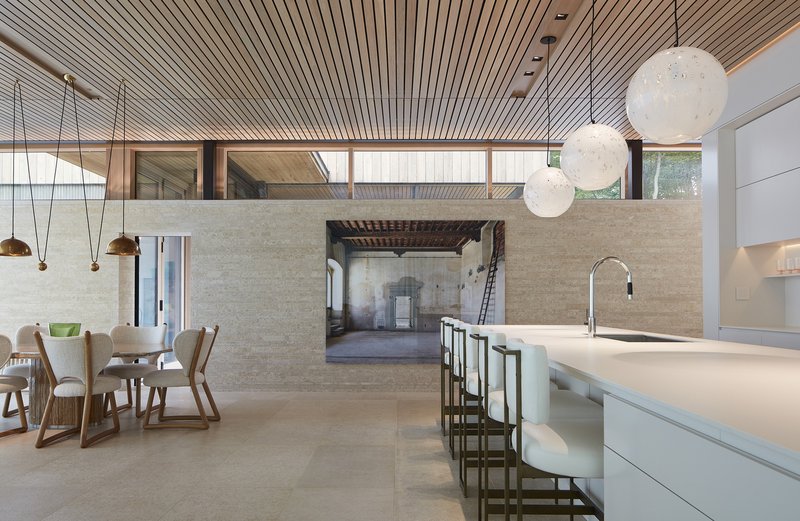
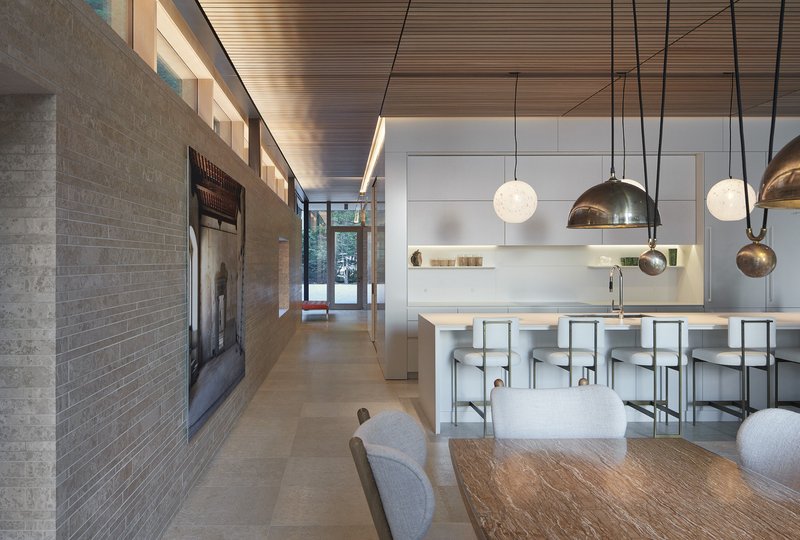
The ground floor of the main house holds kitchen, dining room, and two distinct lounge areas. A suspended fireplace anchors the living room, which is wrapped on two sides by floor-to-ceiling glass overlooking the wooded landscape. Mitered glass corners eliminate mullions at the building's edges, producing peripheral views that pull the forest canopy into the room. The effect is not panoramic so much as immersive: you are surrounded by trees, not looking at them from a distance.
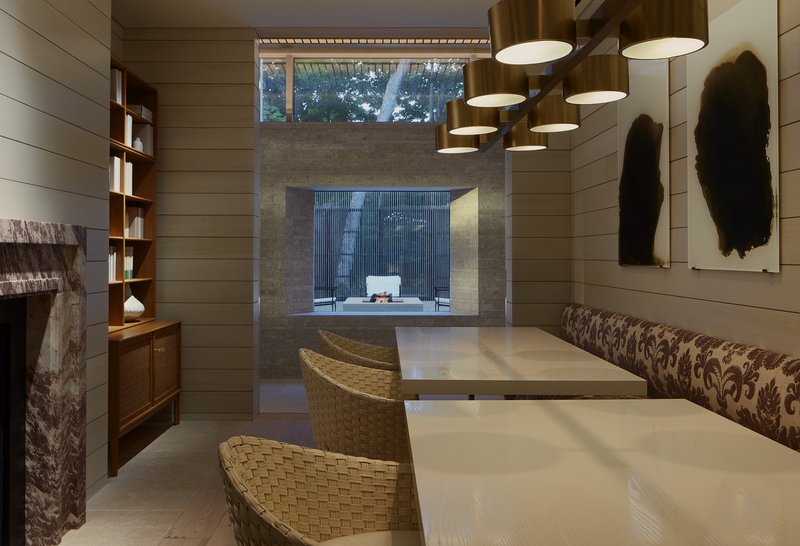
In the kitchen and dining zone, a slatted white oak ceiling runs overhead while a clerestory window above the limestone partition wall brings light deep into the plan. The nickel-gap cedar paneling in the dining room provides a warmer, tighter grain that contrasts with the broader oak slats elsewhere. These material shifts are subtle but they successfully differentiate rooms without hard walls, which is essential in an open plan of nearly 9,000 square feet that could easily feel cavernous.
The Timber-Clad Upper Level
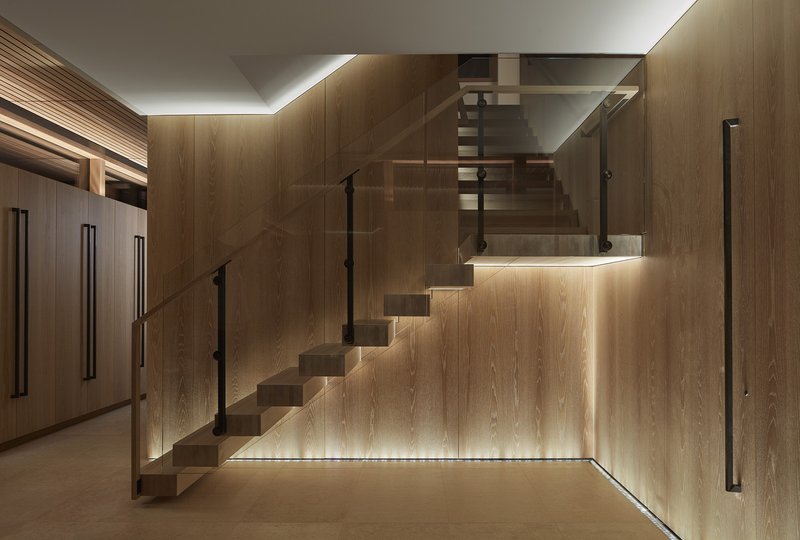
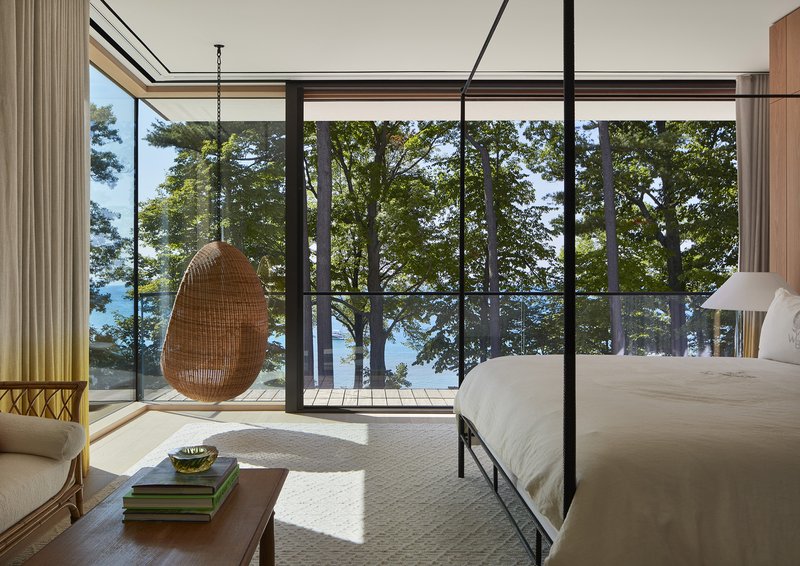
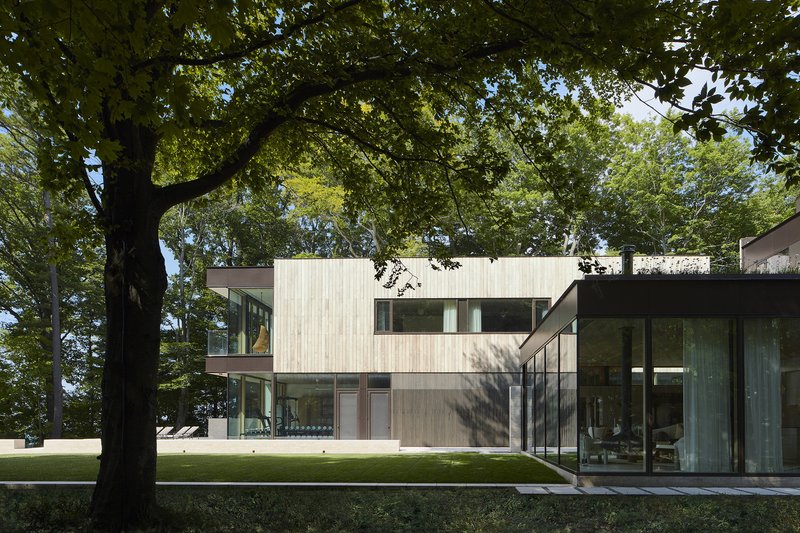
Upstairs, the primary suite occupies a black locust box that hovers above the ground floor, separated by a band of clerestory glazing that reads as a continuous gap of light. The wood-paneled staircase with integrated lighting and black metal handrails ascends through a double-height volume, creating a vertical moment in a house that is otherwise deliberately horizontal. The bedroom itself opens through floor-to-ceiling glass doors to a rooftop meadow planted with bee-friendly species that provides a soft green foreground to the lake beyond.
The choice of black locust for the upper cladding is worth noting. It is a domestic hardwood, extremely rot-resistant, and it weathers to a silver gray that will eventually match the bark of the surrounding oaks. Wheeler Kearns specified short, interlocking boards rather than long runs, giving the facades a scaled texture that avoids the monotony of standard rainscreen panels. Over decades, the upper volumes will progressively disappear into the canopy.
Seasonal Character and Landscape Integration
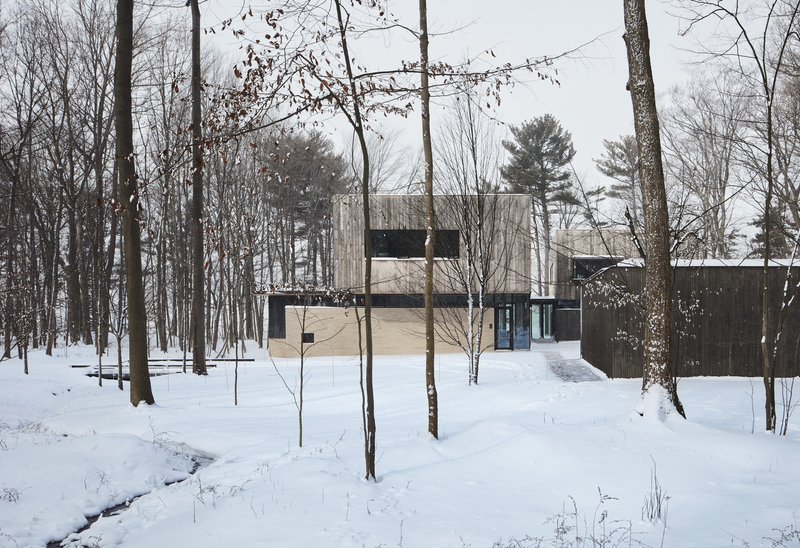
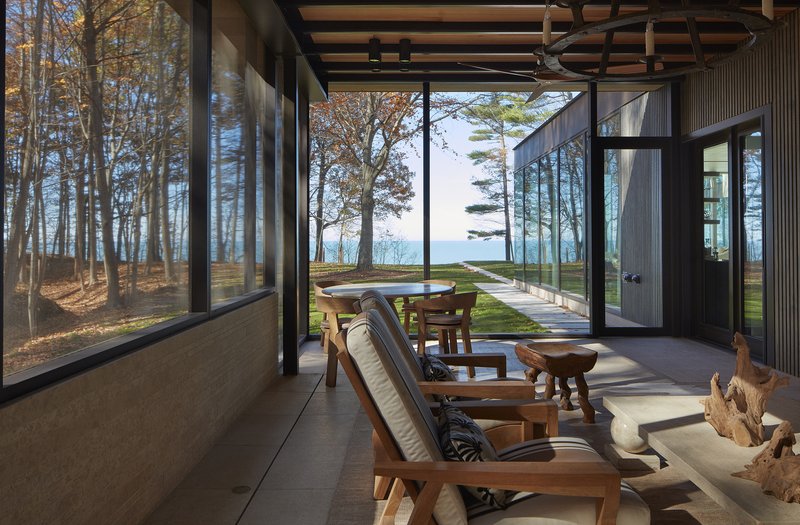
A house designed to weather needs to look convincing in every season. The winter view, with bare trees and deep snow, proves the point: the dark timber volumes read as solid masses against white ground, and the limestone base anchors them with warmth. In summer, the screened porch with its exposed timber beams frames views through the canopy to the lawn and waterfront, functioning as a transitional room that is neither inside nor outside. A neighboring parcel preserved as woodland ensures that the southern edge of the site will never be developed, giving the architects confidence to orient their glass walls toward it.
At dusk, the dining area with its horizontal wood paneling and pendant lights glows above a water feature, collapsing the boundary between architecture and reflection. Hoerr Schaudt's landscape strategy reinforces the perpendicular orientation: the cleared understory guides sight lines simultaneously west to the lake and south into the forest, giving the relatively compact site a sense of boundless depth.
Interior Corridors and Connecting Spaces
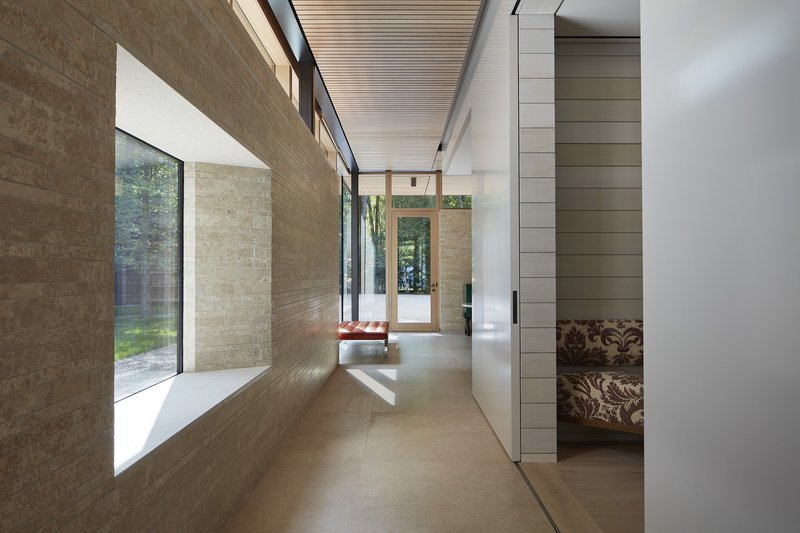
The glass link between the two living structures features fold-away doors that can open entirely, merging the courtyard with the lake view in a single gesture. On either side, interior corridors use rammed-earth-toned walls and slatted wood ceilings to compress the spatial experience before it expands again into the principal rooms. These moments of compression and release are among the most effective moves in the house, turning what could be simple circulation into experiential transitions.
Plans and Drawings
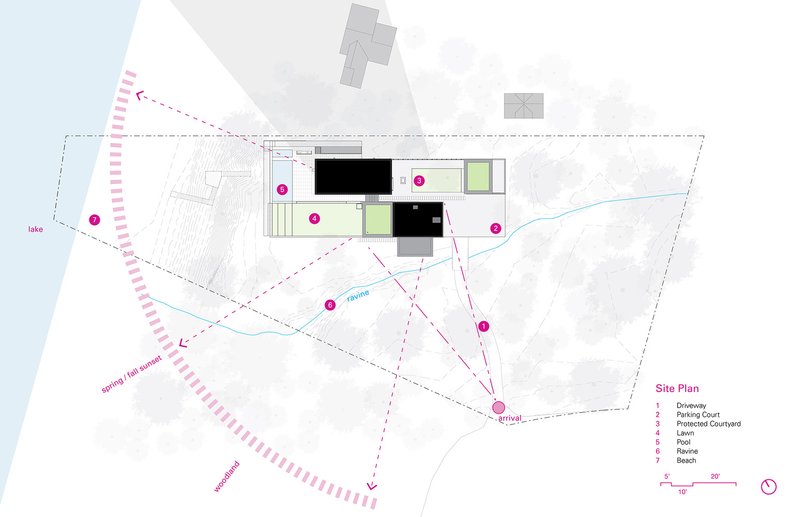
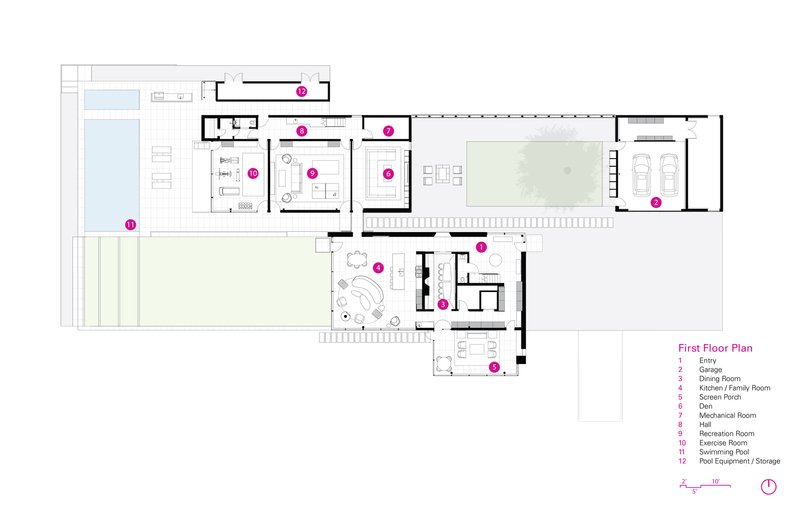
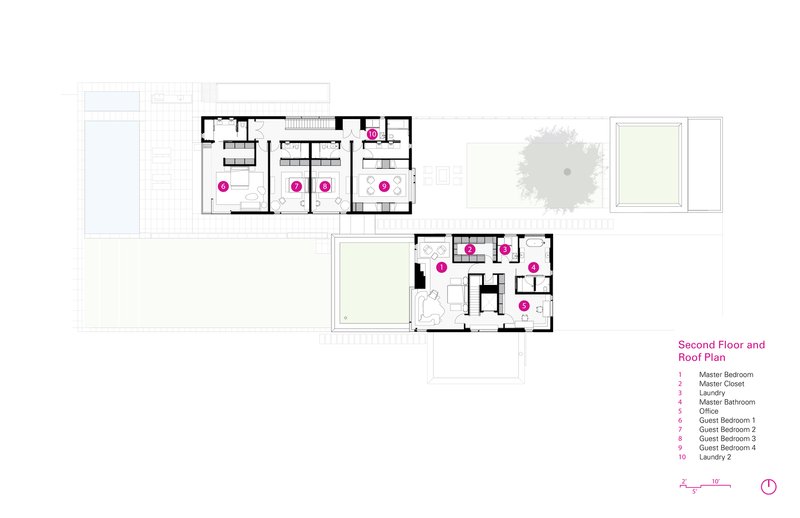
The site plan confirms the staggered, perpendicular logic: two bars slide past each other on a sloped parcel with a ravine to one side, their offset increasing the glass frontage exposed to both lake and forest. The first floor plan reveals the linear configuration of living spaces, garage, and pool, with the limestone wall legible as a continuous line that stitches interior and exterior together. Upstairs, the bedroom layout is compact, perched within the black locust boxes, with upper-level terraces oriented to capture the longest possible horizon.
What the drawings make clear is just how much of the site is left untouched. The building footprint is tight relative to the 2.5-acre lot, and the detached garage's position doubles as a landscape element, defining the entry courtyard without consuming additional ground. The pool sits along the limestone spine rather than floating independently in the yard, which keeps the hardscape consolidated and the meadow intact.
Why This Project Matters
Meadow Lane Retreat is a compelling argument for material honesty as a design strategy rather than a stylistic preference. The decision to treat the limestone wall as a preexisting geological fact, and to build a timber structure around it, gives the house a narrative depth that most weekend retreats lack. It ages into its site rather than resisting it. The black locust will gray, the oak will darken, and the stone will remain, each material on its own timeline. That kind of temporal awareness is rare in residential architecture, and it elevates the project beyond its program.
Wheeler Kearns also demonstrates that concealment can be more generous than display. By hiding the lake at arrival and revealing it gradually, by staggering volumes so the house never reads as a single mass, and by using narrow vertical slats to echo tree trunks rather than compete with them, the architects have made a house that rewards attention without demanding it. On a Great Lakes shoreline increasingly lined with assertive second homes, that restraint is its own kind of statement.
Meadow Lane Retreat by Wheeler Kearns Architects. Lakeside, Michigan, United States. 8,927 sq ft main house, 1,480 sq ft garage. Completed 2022. Photography by Steve Hall, Hall + Merrick Photographers.
About the Studio
Share Your Own Work on uni.xyz
If projects like this are the kind of work you want to make, uni.xyz is a place to publish your own, find collaborators, and enter design competitions.



Popular Articles
Popular articles from the community

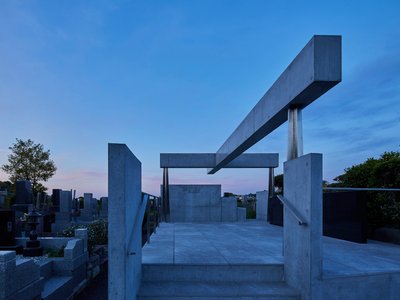
Takeshi Hosaka Architects Suspends a Concrete Cross Above a Yokohama Cemetery
A 28-square-meter burial renovation in Yokohama lifts the symbol of resurrection into the sky so mourners see it against heaven.
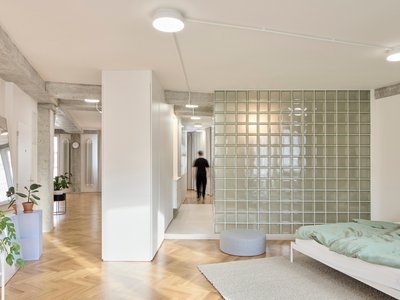
RDTH architekti Rips Out Nearly Every Wall in a Prague Apartment and Replaces Them with Furniture
A 101-square-meter post-war flat in Prague trades rigid partitions for a single rotated furniture block, curtains, and glass concrete.

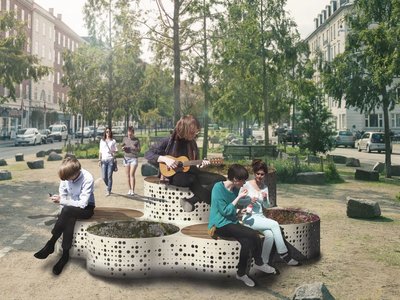
20 Most Popular Furniture Design Projects of 2025
Modular street systems, parametric benches, and insect hotels: the furniture design projects that captivated architects on uni.xyz in 2025.
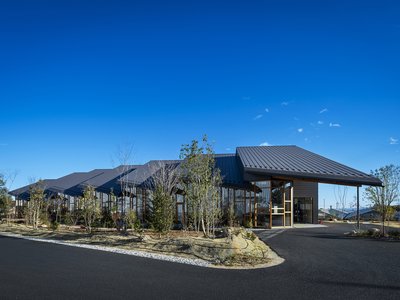
20 Most Popular Office Building Projects of 2025
From biophilic workspaces in India to net-positive energy offices in New Delhi, 20 office building projects that defined architecture in 2025.


Similar Reads
You might also enjoy these articles
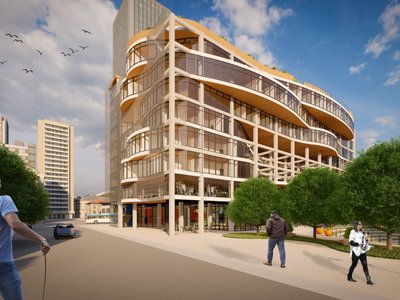
Olio Towers: A Mid-Rise for Performers That Fuses Housing, Rehearsal, and Stage
Located blocks from Houston's Theater District, this modular tower stacks living units around a central performance atrium.

Oasis: Modular Green Housing Carved into Dhaka's Urban Fabric
A shortlisted Plugin Housing entry reclaims unauthorized settlements in Dhaka with stepped concrete volumes, green roofs, and ventilation-driven design.

Black Hole: A Floating Megastructure for the Post-Physical Era
Emiliano Mazzarotto envisions a spherical, self-scaling arena where e-sports, digital hotels, and holographic stadiums replace traditional public space.
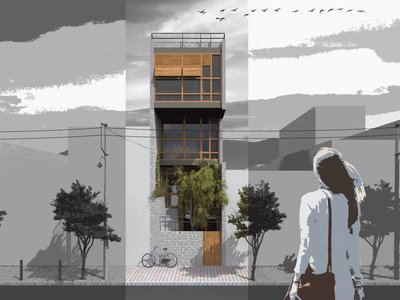
Compact & Sustainable Living in Piraeus: A Four-Level Family Home Built Around Light and Air
A narrow townhouse in one of Greece's densest port cities uses a central atrium and passive strategies to house three generations under one roof.


Explore Architecture Competitions
Discover active competitions in this discipline




The International Standard for Design Portfolios


The Global Benchmark for Architecture Dissertation Awards


The Global Benchmark for Graduation Excellence


Challenge to reimagine the Iron Throne
Comments (0)
Please login or sign up to add comments
No comments yet. Be the first to comment!