
DNSJ.arq Anchors a Concrete House Among Pine Trees and Golden Grassland in Meco
Three board-formed concrete volumes orbit a courtyard where a pine tree punctures the roof, grounding domesticity in the Portuguese littoral landscape.


On the sandy littoral plain south of Lisbon, where maritime pines lean into the Atlantic wind and dry grasses turn gold by midsummer, DNSJ.arq has placed a house that refuses to compete with its setting. Meco's House is organized as three low, board-formed concrete volumes arranged around a central courtyard, each one calibrated to frame a specific relationship with the ground, the sky, and the trees already on site. The result is a project that reads as landscape infrastructure as much as dwelling: heavy enough to anchor itself against the wind, porous enough to let the terrain flow through it.
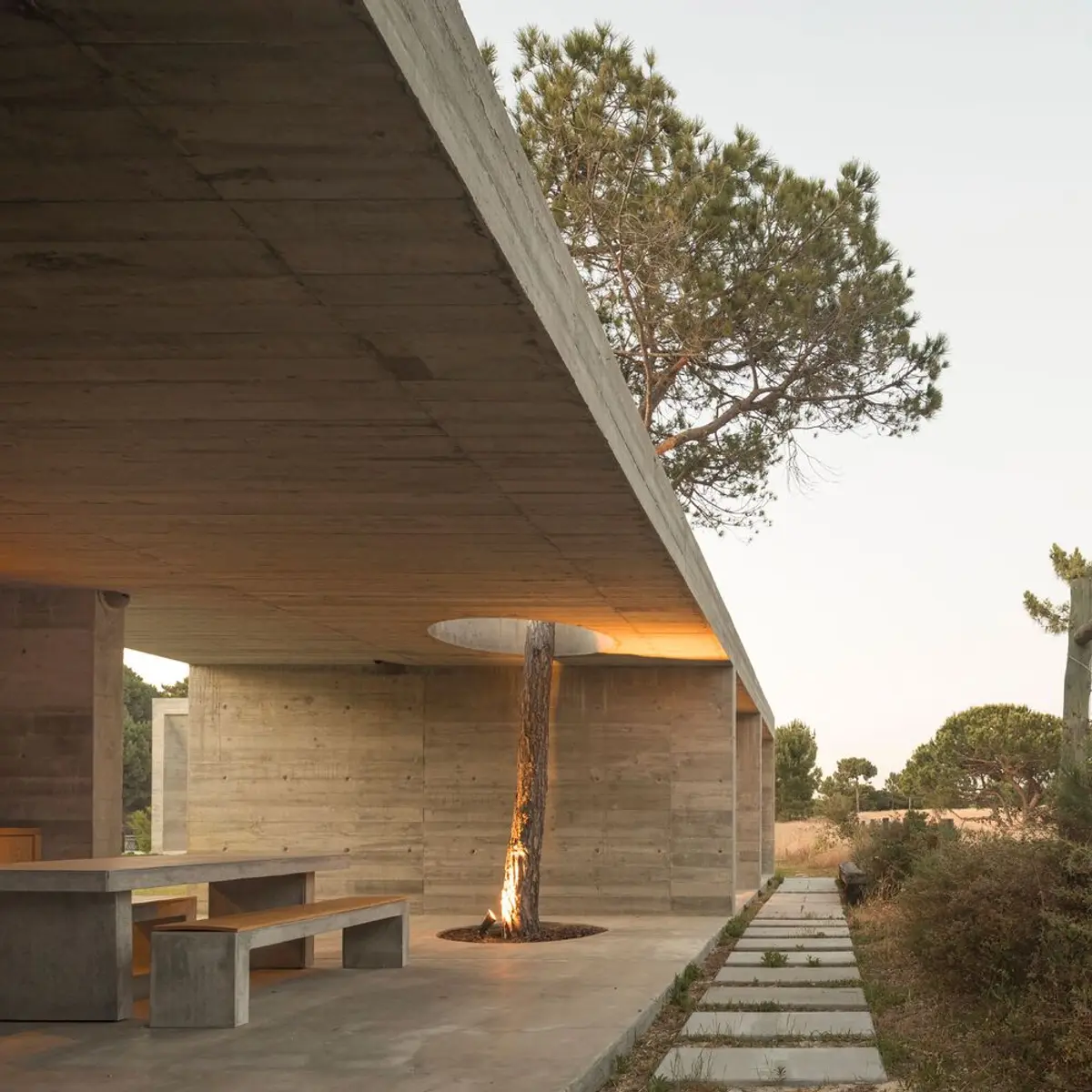
What makes the project genuinely interesting is the level of commitment to a single material thesis. Board-formed concrete does all the heavy lifting here, from perimeter walls to cantilevered soffits, yet its texture shifts register after register depending on sunlight, moisture, and proximity to vegetation. A circular opening in the terrace canopy, cut to accommodate an existing pine, turns a structural concession into the house's defining image. That willingness to yield to what is already there, rather than clear the site and start fresh, gives the architecture a conviction that mere formalism cannot.
Concrete as Context
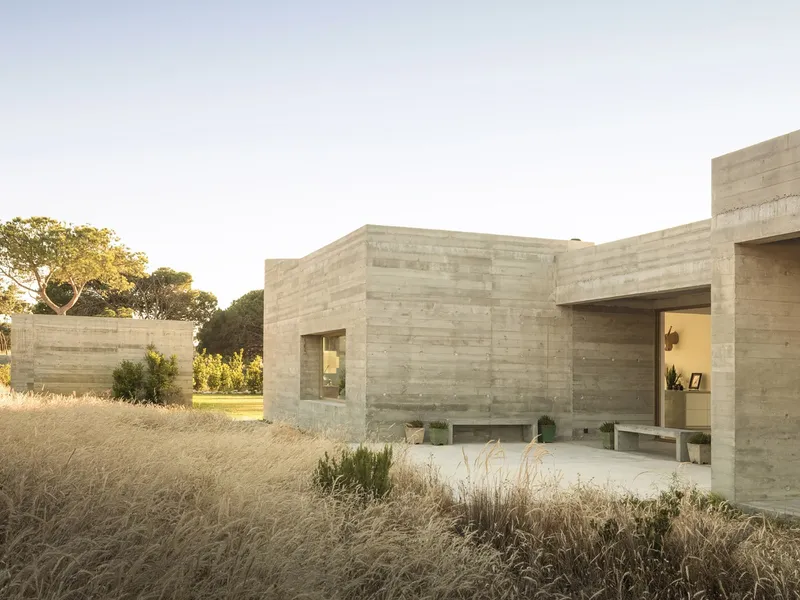
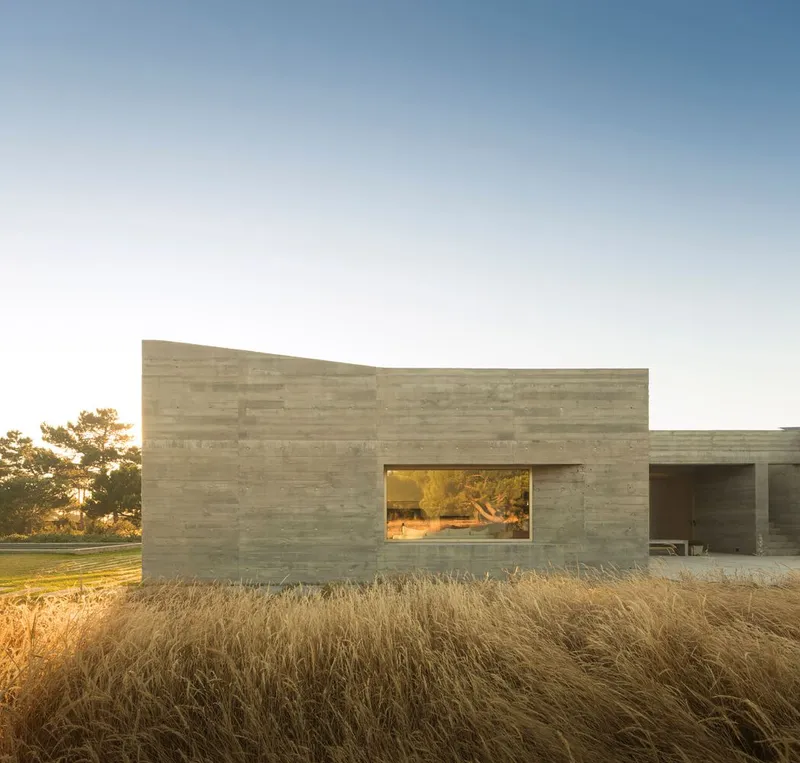
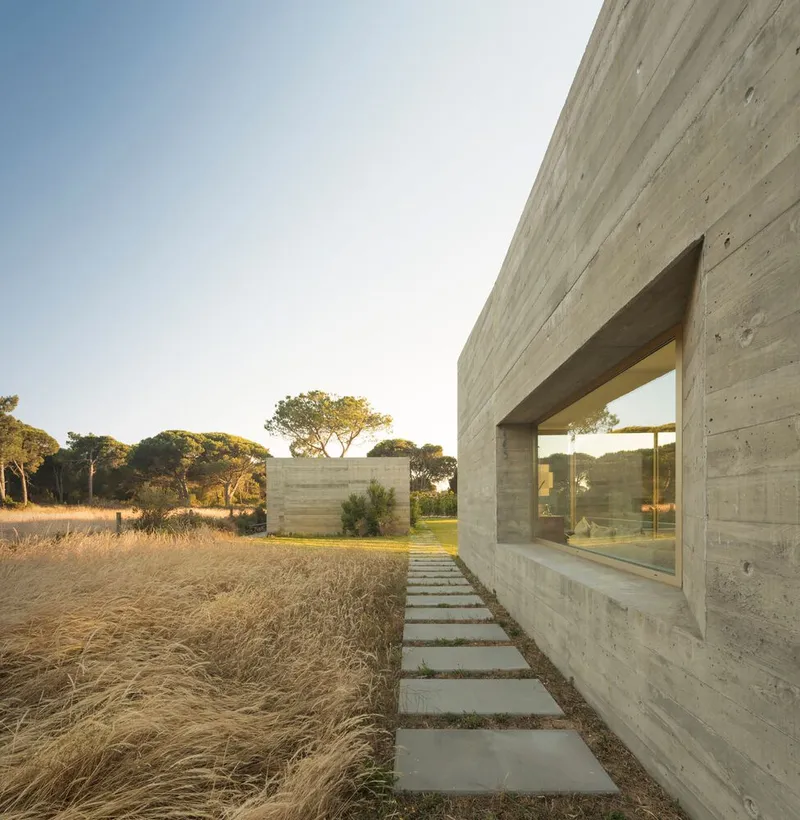
Board-formed concrete is the project's singular material move, and DNSJ.arq deploys it without hedging. The timber grain imprinted in every surface picks up the horizontal register of the surrounding grassland, while the warm grey tone recedes against dry vegetation rather than asserting itself. Seen at sunset, the volumes dissolve into silhouette, their horizontal window slots glowing like embers set into the landscape.
Narrow pathway setbacks between walls and grasses create a threshold condition that is neither garden nor building. You walk alongside these walls as you would alongside a retaining wall cut into terrain, reinforcing the sense that the house has been excavated rather than erected.
The Courtyard and the Pine
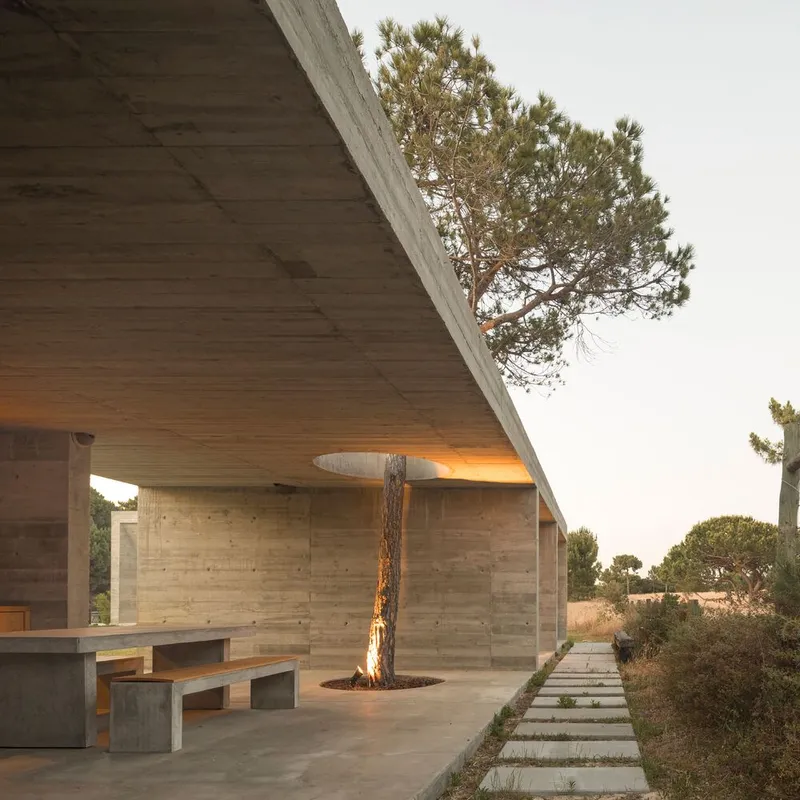
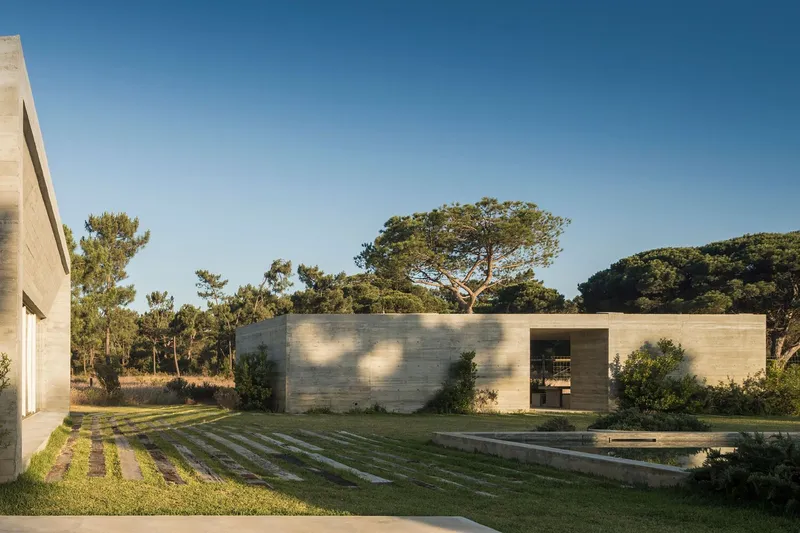
The courtyard is the organizational heart of the plan, and DNSJ.arq treats it as a room without a ceiling, or almost without one. A cantilevered concrete canopy extends over the main terrace, but where a pine trunk would have demanded removal, a circular void has been cut instead. The tree rises through the roof plane and into open air, turning an existing condition into the most memorable moment in the project.
At dusk, the underside of the canopy catches ambient light and glows softly, framing the pine in a halo of warm concrete. The effect is theatrical without being forced. Parallel concrete steps cascade down to a lawn that connects the three volumes, and scattered pines provide a loose canopy overhead, layering shade upon shade.
Water, Reflection, and the Horizontal Line
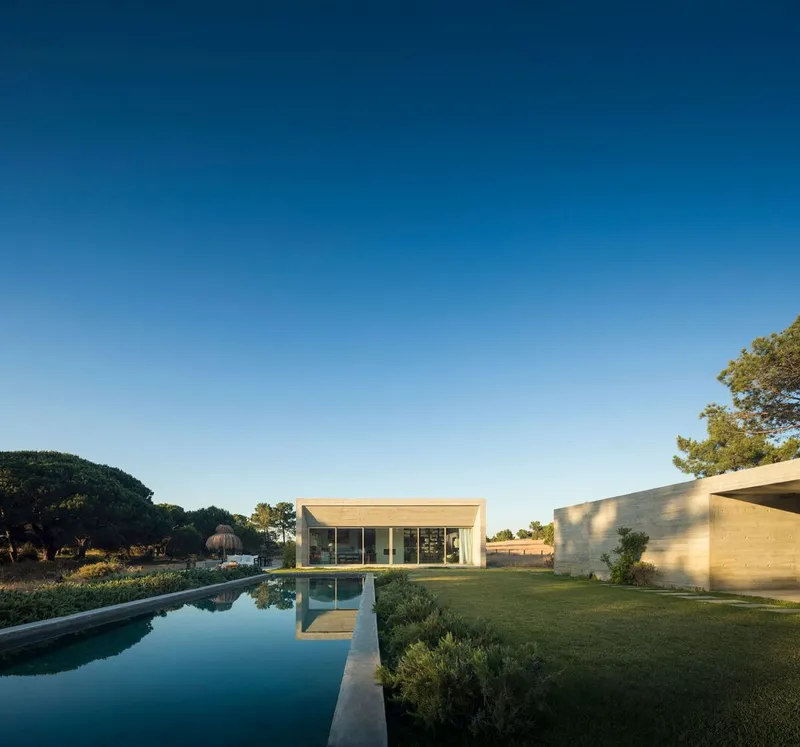
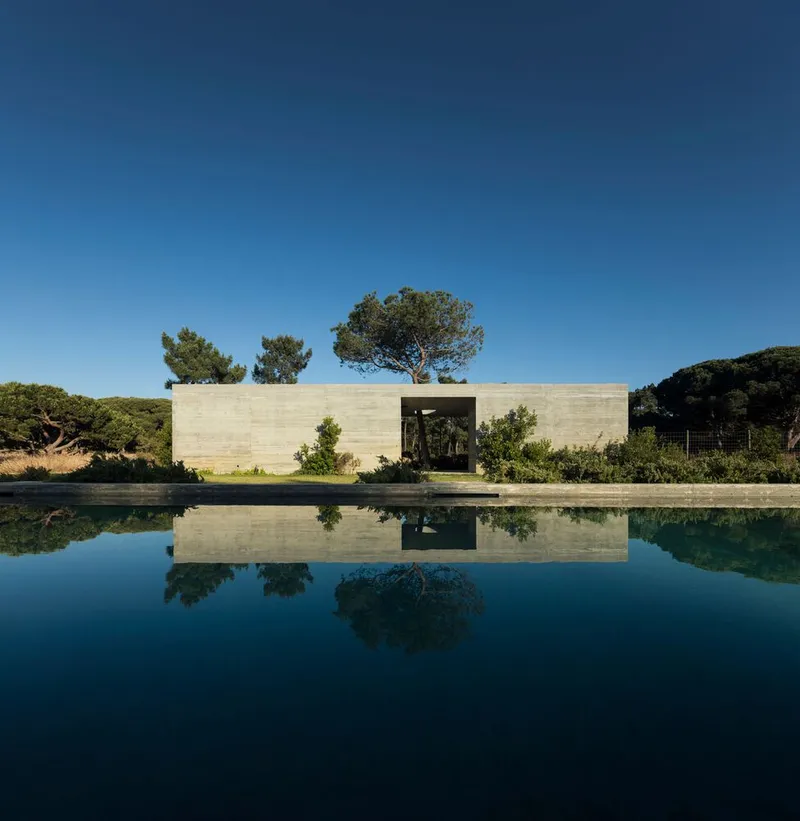
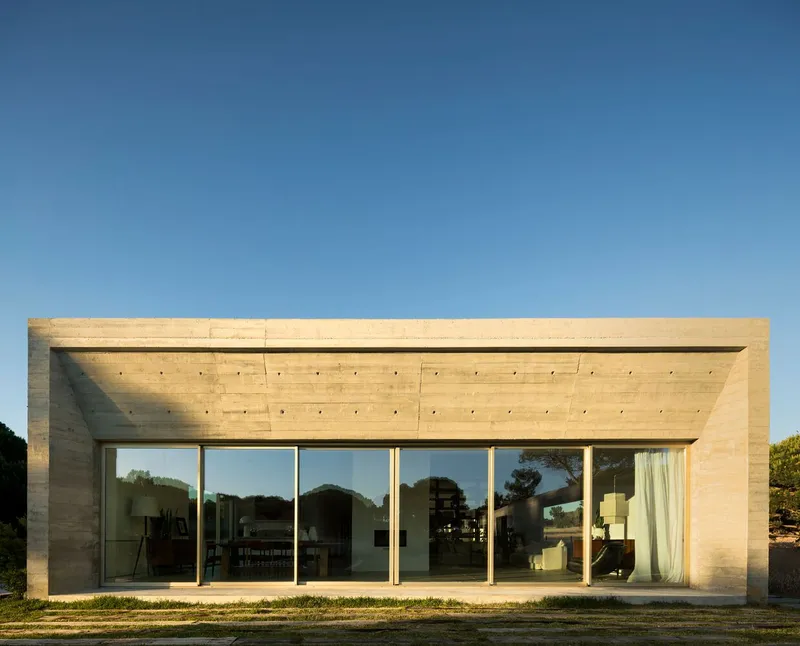
A lap pool runs parallel to one of the volumes, its still surface doubling the concrete facade and the pine canopy beyond. The horizontal emphasis is relentless: low walls, long overhangs, the water plane, the horizon of dry grass. DNSJ.arq understands that in a flat coastal landscape, verticality is the exception, not the rule, and the architecture defers to that fact.
At twilight the glass pavilion beside the pool becomes a lantern, its full-height glazing dissolving the boundary between living space and terrace. The interplay of lit interior, dark concrete, and reflected sky creates a layered depth that photographs well but likely feels even better in person, where the sound of water and wind through pine needles completes the picture.
Thresholds and Interior Light
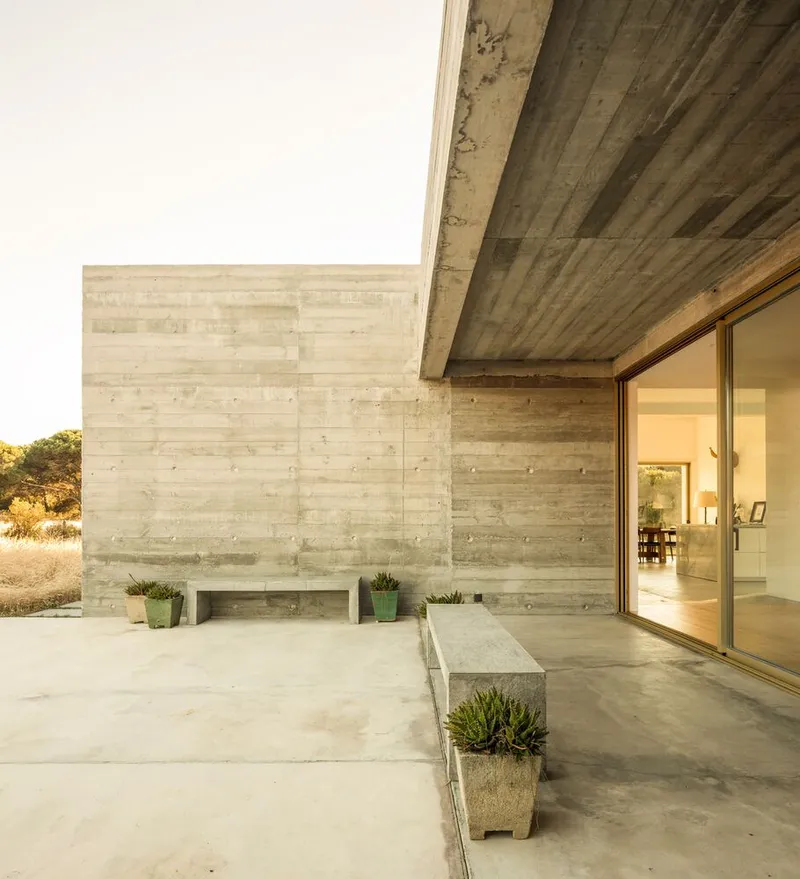
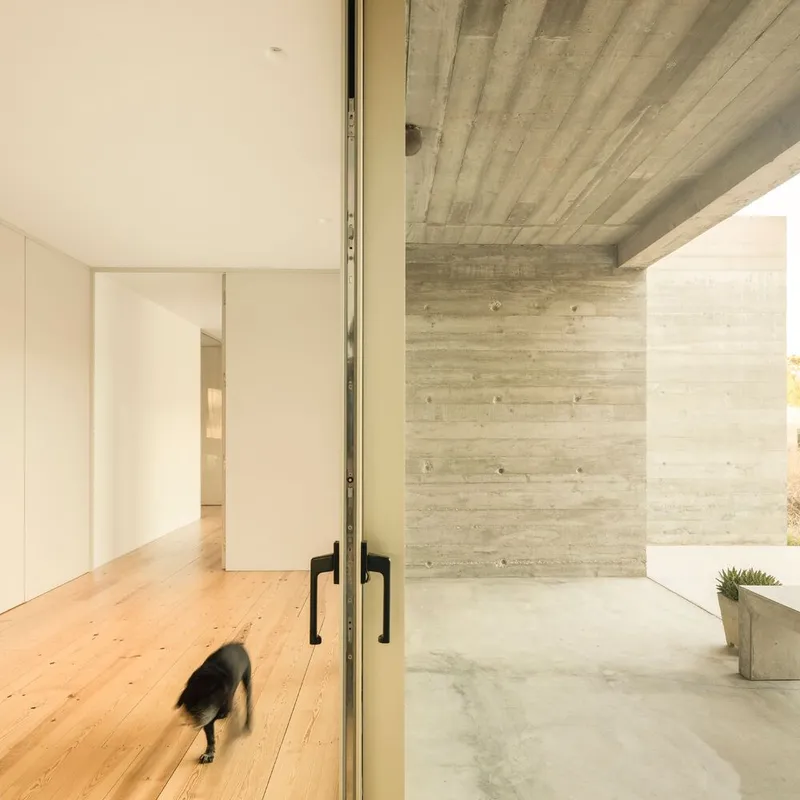
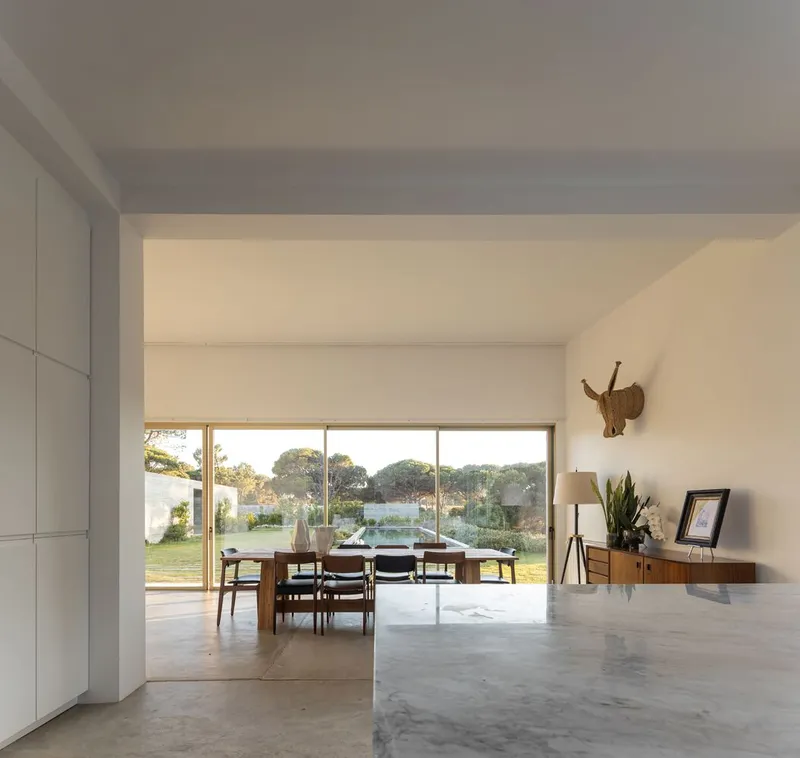
The transitions between inside and outside are deliberately calibrated. Sliding glass doors retract fully, allowing the covered terrace to function as an extension of the living and dining areas. Concrete pavers outside align with the polished concrete floor inside, erasing the sill as a visual barrier. A dog trotting through an open doorway, as captured in one image, is the best evidence of a threshold designed to be crossed without thinking.
Potted plants on the terrace and a cantilevered soffit overhead create an intermediate zone that is sheltered but not enclosed. It is the kind of space that makes a coastal house livable: shaded from direct sun, open to the breeze, close enough to the garden to feel part of it.
Interior Warmth Against Concrete Weight
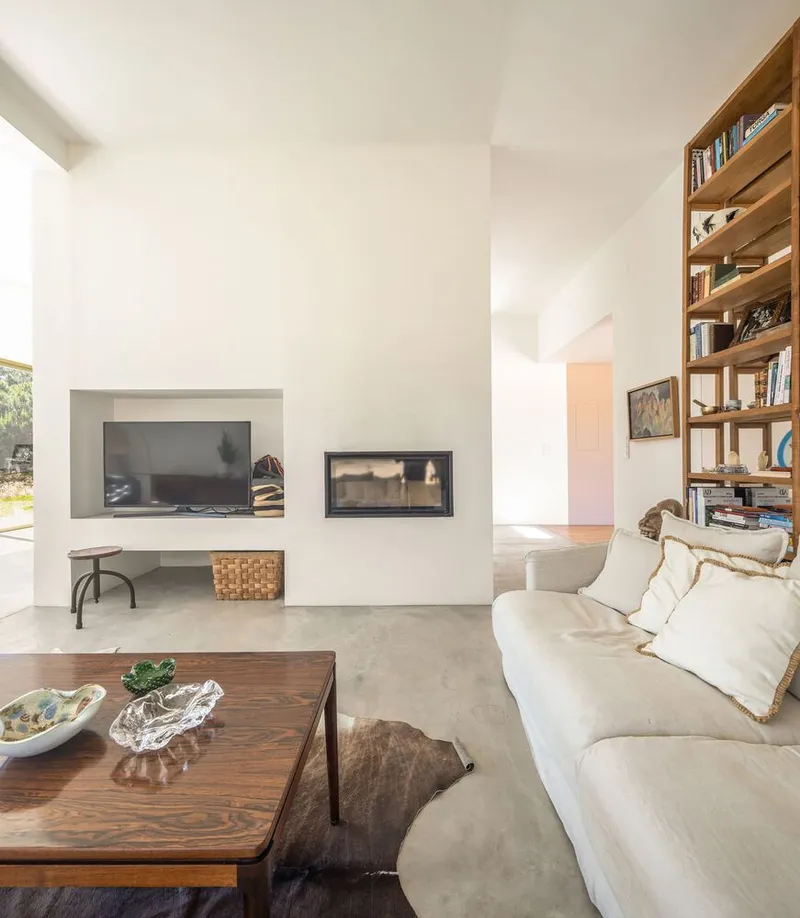
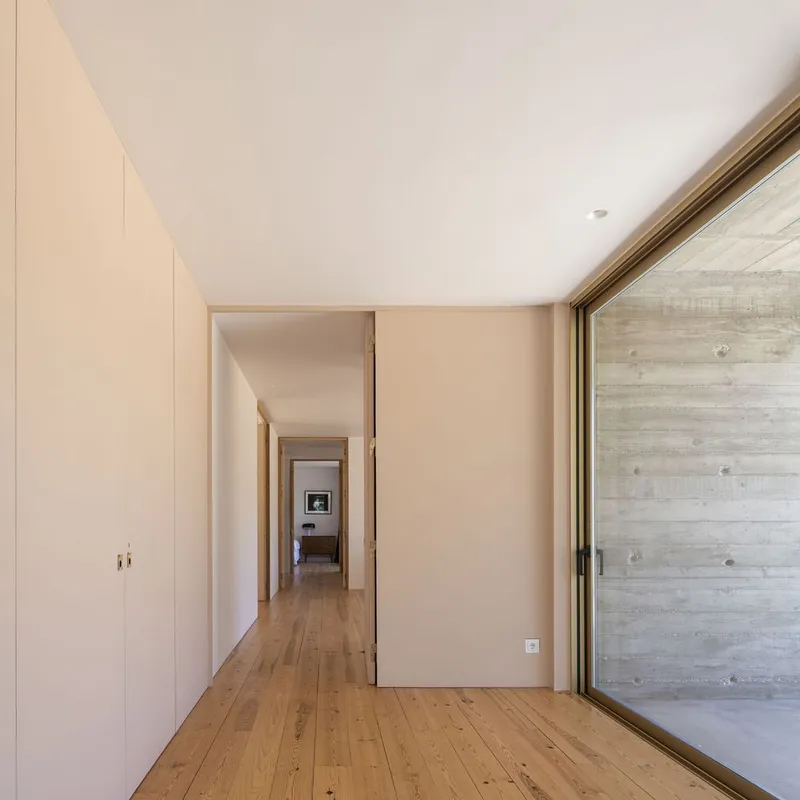
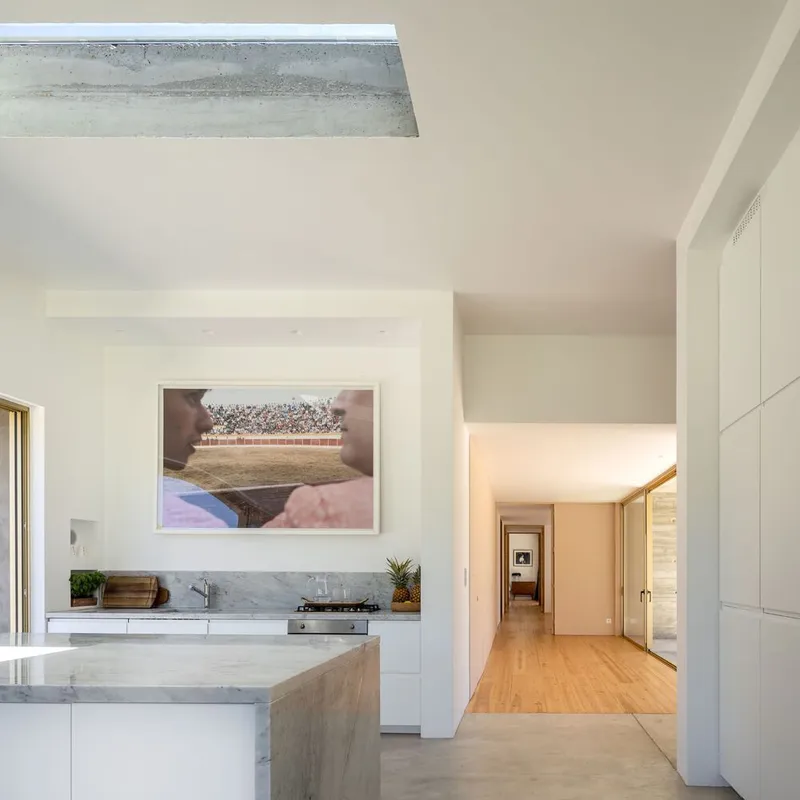
Inside, DNSJ.arq shifts register. Polished concrete floors and white plaster walls replace the rough board-formed exterior, and pale timber shelving and flooring introduce warmth. The living room's fireplace wall is handled simply: a monolithic plaster surface with a recessed hearth, flanked by timber shelves that bring domestic scale to a room that could otherwise feel austere.
A corridor lined with built-in cabinetry in light wood connects the private quarters, its proportions narrow enough to compress the experience before releasing it into a room at the far end. The kitchen, centered on a marble island beneath a skylight, demonstrates how a single overhead opening can transform an otherwise introverted space. Daylight washes down the walls in a soft gradient that changes character throughout the day.
Earth and Light at the Edge
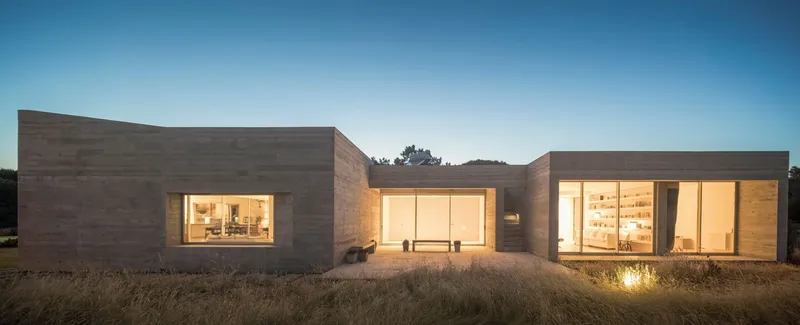
One facade appears to use rammed earth rather than board-formed concrete, its stratified layers reading like a geological section exposed by erosion. At dusk, illuminated glazed openings punctuate the surface and glow against the dry grassland, lending the house an almost archaeological presence. Whether this is a material shift or a variation in formwork technique, the effect is of a building that belongs to the ground it sits on.
Plans and Drawings
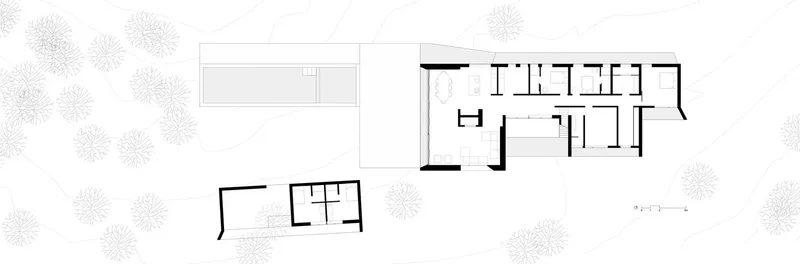
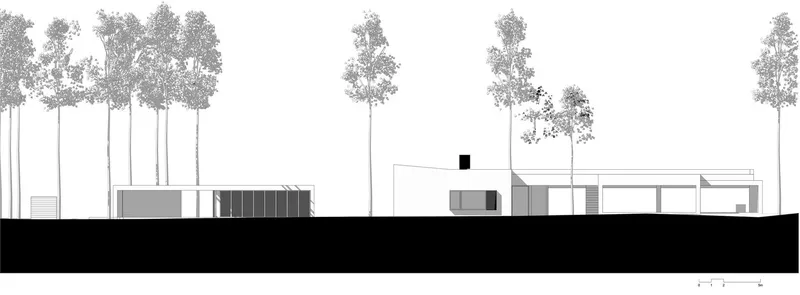
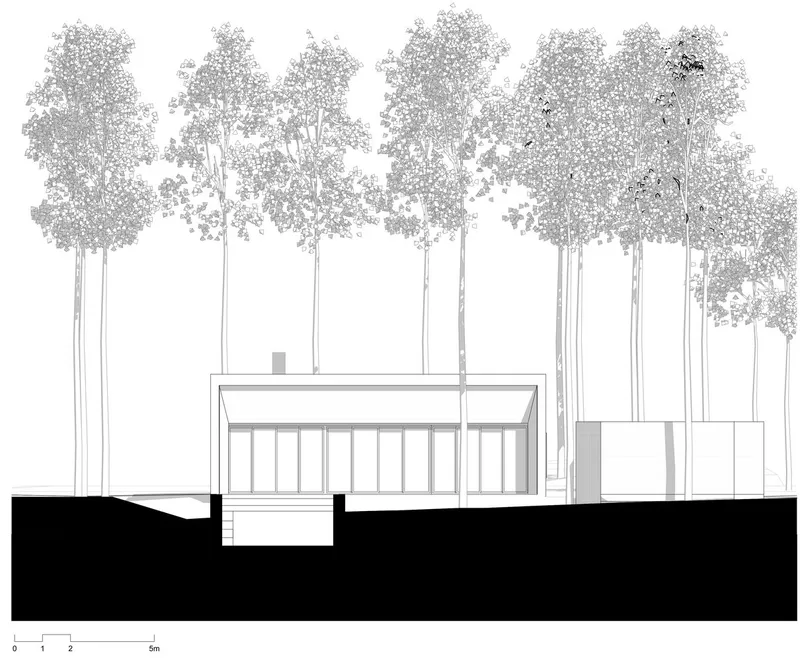
The floor plan confirms what the photographs suggest: three rectangular volumes, offset and rotated to define a courtyard with existing trees preserved in place. The arrangement avoids symmetry but achieves balance, each wing oriented to capture different views and light conditions. Sections reveal just how low the volumes sit relative to the mature pines. The trees dwarf the architecture, and the colonnade section shows the roof plane nestled beneath the canopy like a shelf inserted into a forest.
These drawings make clear that the apparent simplicity of the built result is the product of careful calibration. Setbacks, overhangs, and floor-level changes are all tuned to specific site conditions. Nothing is generic.
Why This Project Matters
Meco's House matters because it demonstrates that a rigorous material commitment and genuine site sensitivity are not competing ambitions. DNSJ.arq did not soften their concrete vocabulary to accommodate the landscape; they sharpened it, using the weight and texture of board-formed concrete to create a counterpoint to the lightness of pine and grass. The result is a house that feels inevitable in its setting, as if the architecture and the terrain arrived at the same conclusion from different directions.
In a residential market that too often treats landscape as backdrop and materiality as finish selection, projects like this one offer a corrective. The decision to cut a hole in the roof for a tree is a small gesture with outsized consequence: it declares that the site is not a blank canvas, that what exists before the architect arrives has value worth preserving and worth designing around. That principle, applied with the discipline and craft visible here, produces architecture that is genuinely rooted.
Meco's House by DNSJ.arq, Meco, Portugal.
About the Studio
Share Your Own Work on uni.xyz
If projects like this are the kind of work you want to make, uni.xyz is a place to publish your own, find collaborators, and enter design competitions.


Popular Articles
Popular articles from the community


The Ocean Hive: Sustainable Architecture for a Self-Sufficient Civilization at Sea
The Ocean Hive imagines sustainable architecture at sea, where modular habitats, algae, wave power and ocean waste sustain a growing colony.

Conexión: Biophilic Design Reimagines High-Rise Living in Hong Kong
Conexión reimagines high-rise living in Hong Kong through biophilic design, green facades, shared spaces, daylight, water and nature within.

Play: Fragments of Their World
Familiar architecture becomes modular playground design, creating safe spaces where displaced children can learn, connect, imagine and play.

Co-life: Sustainable Architecture for Age-Friendly Community Living
Co-life reimagines sustainable architecture for seniors through courtyards, rammed earth, shared gardens, and spaces designed for belonging.

Similar Reads
You might also enjoy these articles


Hodi-Mandai Geram
Project Function: Preservation and revitalization of the Intangible heritage and socio-spatial identity of the Hodi by Housing, Cultural Memory Center, Sacred Grove, landscape, local tourism economy


Olio Towers: A Mid-Rise for Performers That Fuses Housing, Rehearsal, and Stage
Located blocks from Houston's Theater District, this modular tower stacks living units around a central performance atrium.

Oasis: Modular Green Housing Carved into Dhaka's Urban Fabric
A shortlisted Plugin Housing entry reclaims unauthorized settlements in Dhaka with stepped concrete volumes, green roofs, and ventilation-driven design.

Black Hole: A Floating Megastructure for the Post-Physical Era
Emiliano Mazzarotto envisions a spherical, self-scaling arena where e-sports, digital hotels, and holographic stadiums replace traditional public space.

Explore Architecture Competitions
Discover active competitions in this discipline

Challenge to reimagine the Iron Throne

Photograph architecture without architects

Illustrate the lost glory of Angkor Wat - Render Challenge

Design challenge to reuse E-waste
Comments (0)
Please login or sign up to add comments
No comments yet. Be the first to comment!