
De Zwarte Hond and Loer Architecten Replace a Groningen Warehouse with a Green-Glazed Urban Catalyst
Mercado stitches 41 gas-free apartments, a public market hall, and 3,800 plants into the north side of Groningen's Grote Markt.


For decades, Rode Weeshuisstraat was the back side of Groningen's Grote Markt: a service alley anchored by a V&D department store warehouse, dominated by cars, and largely ignored by pedestrians. Mercado, designed by De Zwarte Hond and Loer Architecten, replaces that warehouse with 8,400 square meters of mixed-use program and, more critically, turns the street itself into a destination. The building's compact footprint carves out a new public square, Stalplein, and its transparent six-meter plinth puts a market hall on display to the surrounding lanes at night. Five years of transformation have flipped the orientation of an entire city block.
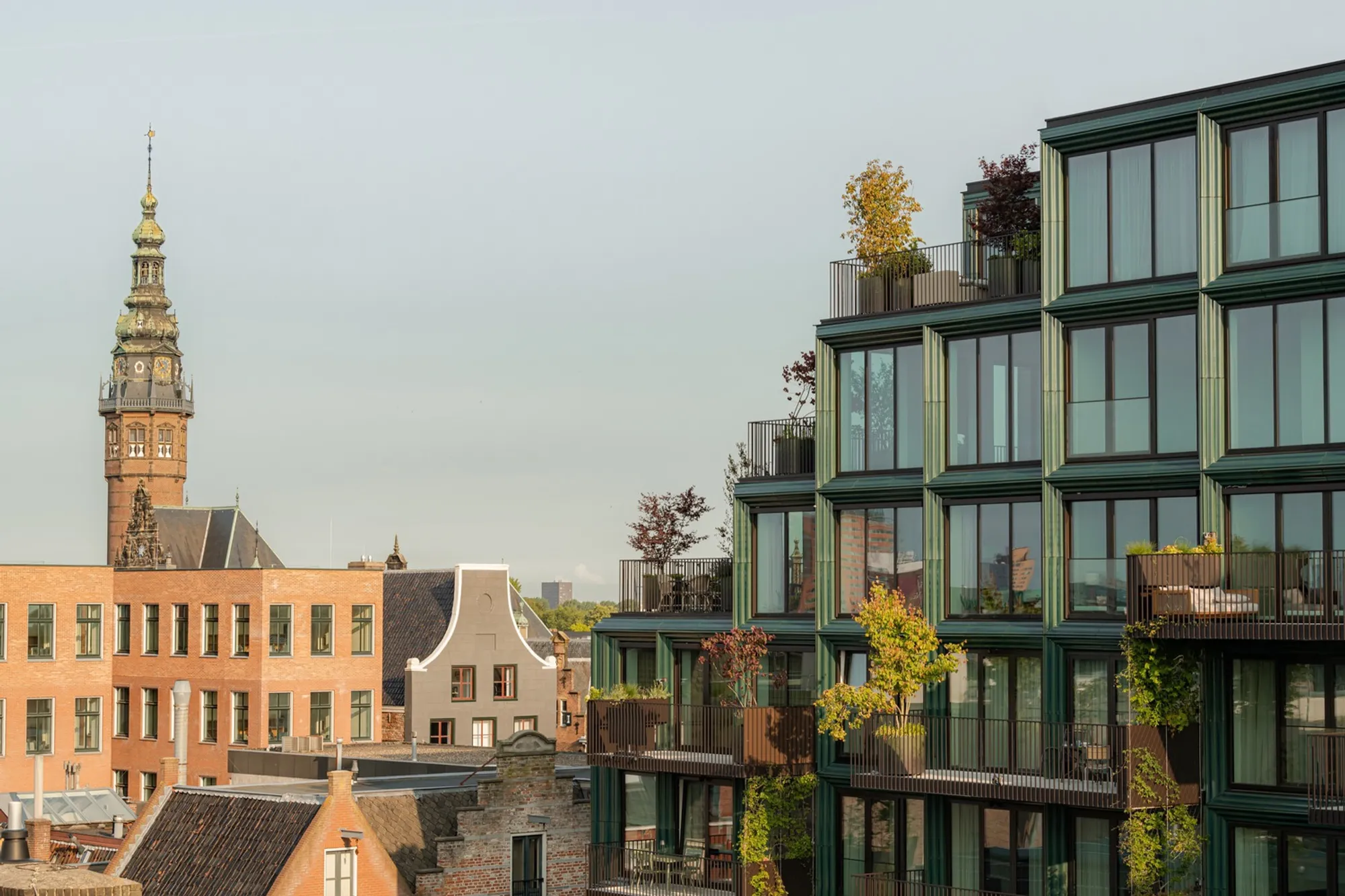
What makes Mercado worth studying is not simply that it is green, both literally and in its energy strategy, but how precisely it negotiates scale. The Grote Markt side of the site calls for height; the orphanage and smaller buildings to the north demand restraint. The architects answered with a stepped volume, higher where the context allows and lower where it must defer, wrapping the whole thing in roughly 1,400 square meters of double-fired terracotta finished in a blue-green glaze that shifts color with the weather. It is a building that borrows from both the pastel plaster of the historic Weeshuis and the blunt materiality of Groningen's post-war reconstruction, without imitating either.
A Stepped Volume That Mediates Two Scales
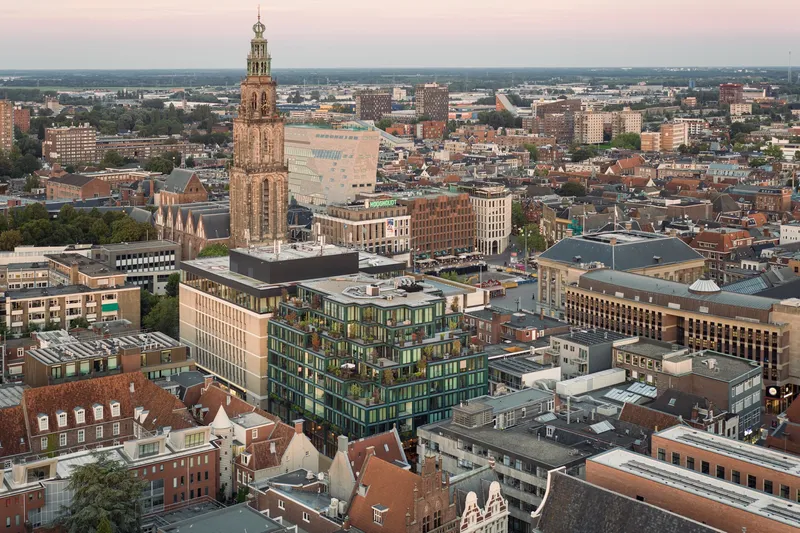

Seen from the air at dusk, Mercado reads as a series of terraces stepping down toward the north, each setback creating a planted roof deck. The aerial view makes the strategy legible: the tallest portion aligns with the larger commercial blocks along the Grote Markt, while the lower masses defer to the residential grain of the streets behind. It is a textbook contextual move, but one executed with enough conviction that the building reads as a single composition rather than a stack of compromises.
At street level, the stacked balconies with their planted trees create a layered foreground against the historic bell tower. The stepped massing is not just a planning concession; it generates outdoor space at every level, turning what could have been a flat slab into a series of inhabited terraces. Special planters with a custom color scheme reinforce the idea that the greenery is part of the architecture, not an afterthought bolted on.
Terracotta That Changes Its Mind
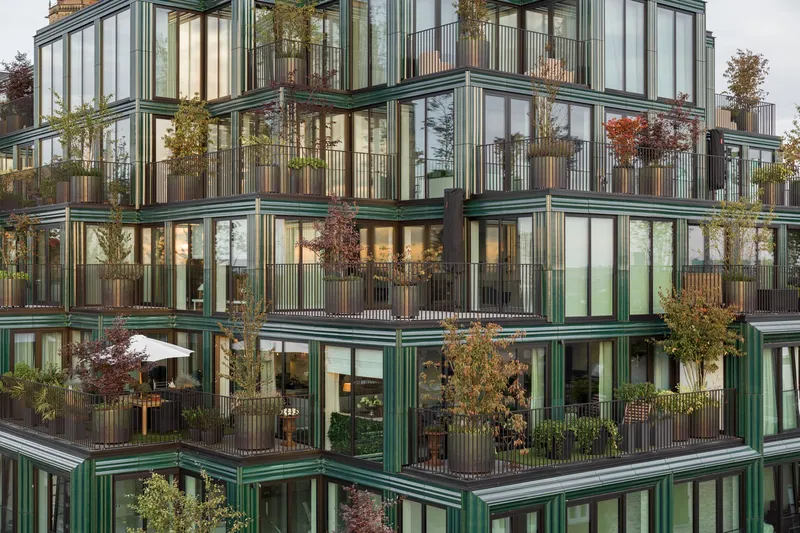
The facade's defining material is a beige clay tile finished with a semi-transparent, green-blue glaze, developed through an extended collaboration with ceramic manufacturer NBK and facade builder Bijlbouw. Samples and mock-ups were used to dial in the exact finish, and the result is a surface that appears teal under overcast skies and shifts toward warmer tones in direct sun. Each window corner is composed of six to eight individual terracotta panels with precisely cut angles and glazed edges, eliminating the need for sealant adhesives and maintaining a clean open-joint pattern.
The corner detail photograph captures this system at close range: panels mounted both horizontally and vertically, green metal window frames, and climbing plants already beginning to colonize the balcony railings. The panels were pre-assembled in the factory, complete with drill holes and back-fixing hardware, then mounted on site in a process the architects compare to assembling flat-pack furniture. It is industrial precision deployed in the service of something handcrafted in appearance, a strategy that keeps costs manageable while delivering visual richness that references Groningen's ornamental building traditions.
A Ground Floor Built for Flexibility

The interior photograph reveals the raw bones of the building: exposed concrete beams, diagonal bracing, and a structural clarity that prioritizes adaptability over finish. Stairs and lifts are pushed to the side of the floor plate, freeing the ground level to function as an open, monumental market hall that can be reconfigured for public events, retail, or food and beverage uses without hitting a column in the wrong place. The 2,105 square meters of commercial space across the plinth are designed to be as close to column-free as the structural logic allows.
The transparency of the base is more than an aesthetic choice. At night, market activity illuminates the surrounding streets, turning the building into a lantern that activates public space after hours. For a street that used to be a dark service corridor, this inversion of light and program is the single most consequential design decision in the project.
Gas-Free Energy and 3,800 Plants
Mercado operates without natural gas. Wells beneath the building feed a thermal energy storage system coupled with heat pumps, handling both heating and cooling for the 41 apartments and penthouses above. On the south facade, climbing plants double as green privacy screens for balconies, while the vertical garden contributes roughly 3,800 individual plants to the city's biodiversity. A computerized irrigation system handles watering, supplemented by regular gardener maintenance, a necessary concession given that living facades die without consistent care.
The sustainability narrative here is not performative. The thermal wells, the gas-free systems, and the planted facades are all working systems, not demonstration panels. What gives the approach credibility is that the green infrastructure also solves spatial problems: climbing plants provide privacy, rooftop planting softens the stepped massing, and the compact footprint that enabled the new Stalplein also reduced the building's ground-floor heat island contribution. Energy strategy and urban design reinforce each other.
Plans and Drawings
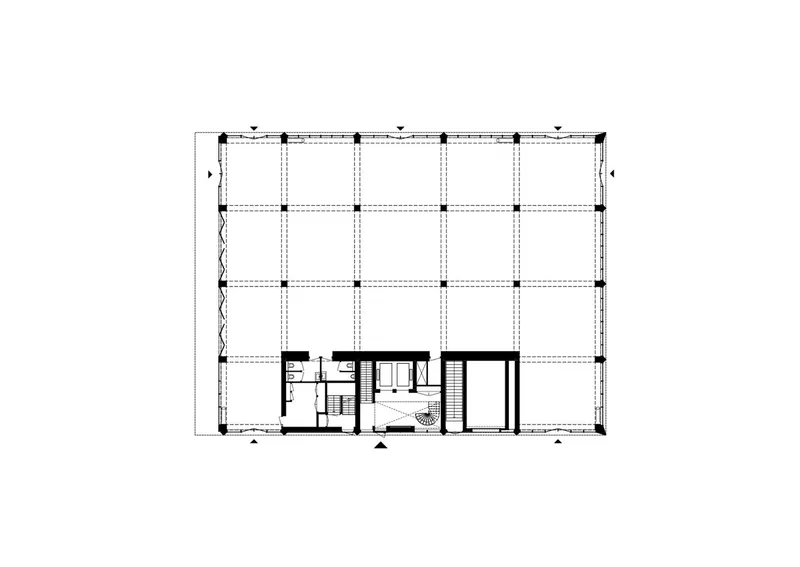
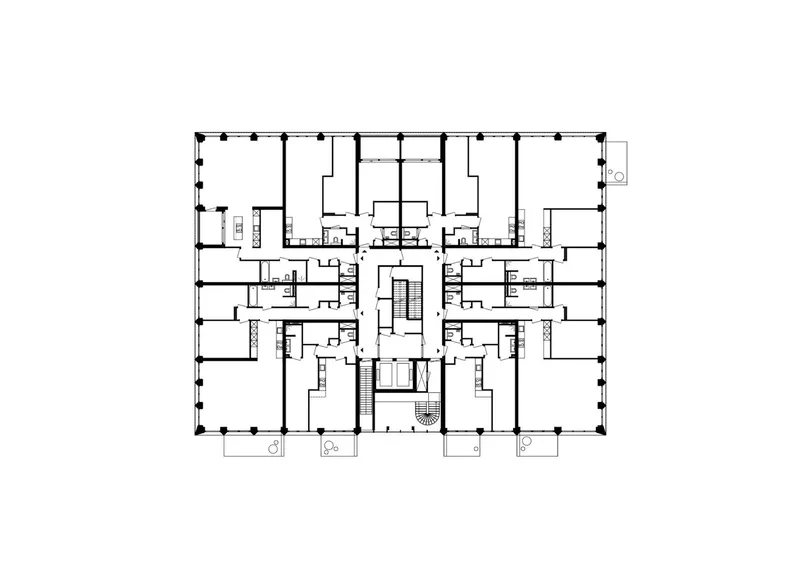

The floor plans confirm the organizational logic: a corner core groups vertical circulation and services to one side, leaving an open floor plate on the commercial levels and efficient residential units arranged around a central corridor above. The structural grid is regular enough to accept the terracotta panel system without excessive custom cutting, yet flexible enough to allow varied apartment layouts across 6,332 square meters of residential space.
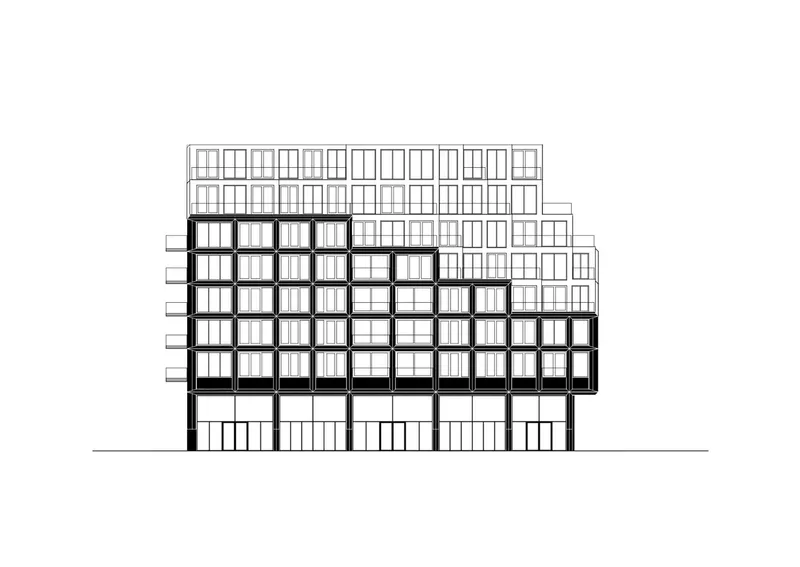
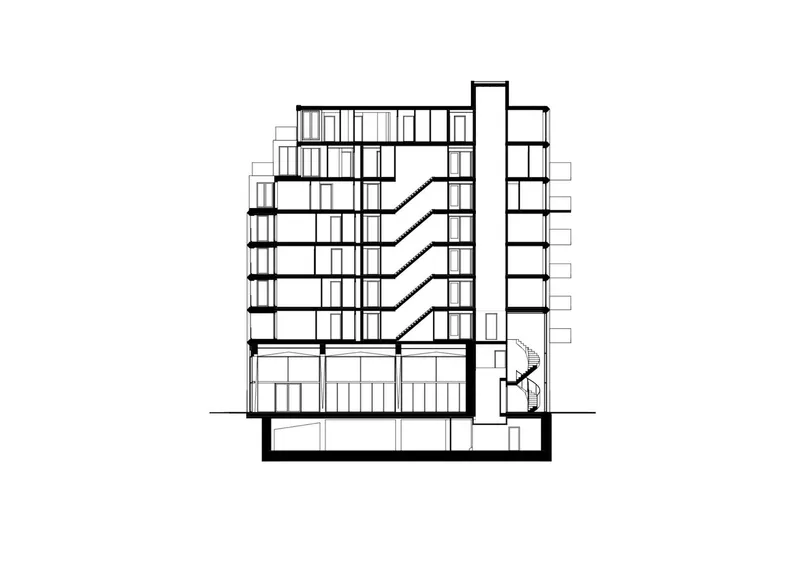
The elevation and section drawings are where the stepped massing becomes legible as a deliberate strategy rather than an arbitrary sculptural gesture. One elevation shows the regular grid of window openings marching across the full-height facade, while the other reveals the terraced setbacks on the opposite side. The section drawing cuts through the zigzag stairs and the vertical core, exposing the double-height market hall at the base and the stacking logic that transitions from public program to private apartments. The diagonal setbacks create the rooftop terraces visible in the photographs, and the section makes clear that each step back aligns with a floor change, not an arbitrary line.
Why This Project Matters
Mercado is a case study in how a single building can restructure the hierarchy of a city center. By replacing a closed warehouse with a transparent market hall, shifting cars off the street, and creating a new public square, De Zwarte Hond and Loer Architecten have turned a secondary service street into the front door of Groningen's northern quarter. That is a spatial inversion that goes well beyond what any individual building is typically asked to do, and it was achieved through compact footprinting and program placement rather than heroic formal gymnastics.
The project also demonstrates that serious sustainability credentials and contextual richness are not competing goals. The gas-free thermal system, the 3,800-plant vertical garden, and the pre-assembled terracotta facade all coexist within a building that references both the ornamental traditions of Groningen's historic center and the pragmatic language of its post-war architecture. Mercado does not look like a sustainability project, and that may be its most important quality. It looks like a building that belongs where it stands, which is exactly the kind of building that cities need more of.
Mercado, Groningen, The Netherlands. Designed by De Zwarte Hond and Loer Architecten. 8,400 sqm. Photography by Sebastian van Damme and Marcel IJzerman.
About the Studio
Share Your Own Work on uni.xyz
If projects like this are the kind of work you want to make, uni.xyz is a place to publish your own, find collaborators, and enter design competitions.



Popular Articles
Popular articles from the community


The Ocean Hive: Sustainable Architecture for a Self-Sufficient Civilization at Sea
The Ocean Hive imagines sustainable architecture at sea, where modular habitats, algae, wave power and ocean waste sustain a growing colony.

Co-Life: Senior Housing Design That Reconnects Older Adults With the City
Co-Life reimagines senior housing design through healing gardens, shared streets, workshops, and a sustainable community across generations.
EW PARK: Sustainable Architecture Reimagines the Future of Urban Parking
EW PARK reimagines city parking as a modular wooden tower combining automation, solar energy, electric mobility, and adaptable urban design.
AL-JANNAH: Sustainable Architecture and Permaculture for Afghan Widows
AL-JANNAH uses sustainable architecture and permaculture to create resilient oasis of housing, learning, work and renewal for Afghan widows.


Similar Reads
You might also enjoy these articles


Hodi-Mandai Geram
Project Function: Preservation and revitalization of the Intangible heritage and socio-spatial identity of the Hodi by Housing, Cultural Memory Center, Sacred Grove, landscape, local tourism economy


Olio Towers: A Mid-Rise for Performers That Fuses Housing, Rehearsal, and Stage
Located blocks from Houston's Theater District, this modular tower stacks living units around a central performance atrium.

Oasis: Modular Green Housing Carved into Dhaka's Urban Fabric
A shortlisted Plugin Housing entry reclaims unauthorized settlements in Dhaka with stepped concrete volumes, green roofs, and ventilation-driven design.

Black Hole: A Floating Megastructure for the Post-Physical Era
Emiliano Mazzarotto envisions a spherical, self-scaling arena where e-sports, digital hotels, and holographic stadiums replace traditional public space.

Explore Urban Design Competitions
Discover active competitions in this discipline



Challenge to reimagine the Iron Throne


Photograph architecture without architects


Illustrate the lost glory of Angkor Wat - Render Challenge


Design challenge to reuse E-waste
Comments (0)
Please login or sign up to add comments
No comments yet. Be the first to comment!