

Milieu: A Biomimetic Entertainment Nucleus Floating Above Los Angeles
Jellyfish-inspired membranes, aquathermal cooling, and floating transport pods reimagine LA as a self-sustaining cultural ecosystem.


What if the future of Los Angeles looked less like a skyline and more like a reef? Milieu proposes a radical inversion of the city's growth pattern: instead of pushing towers higher into polluted air, it sinks its foundation and stretches a living membrane overhead, a translucent enclosure made of Scyphozoan Hydrogel that protects, purifies, and heals the environment beneath it. The project imagines a 23rd-century LA where biomimicry replaces brute engineering, and where the city's two most defining cultural forces, cinema and sports, converge inside a single self-sustaining organism.
Milieu is the winning entry in the Di - Generic Cities: Los Angeles competition, designed by Antonio Carbajal, Michael Horan, and Joey Ali. The competition challenged designers to resist the homogenization of global cities by amplifying what makes a place irreplaceable. For LA, the team identified the answer immediately: the entertainment industry and professional sports. Rather than treating those programs as separate civic investments, they fused them into what they call a Global Entertainment Nucleus, suspended above a sunken island and serviced by floating membrane transport pods.
Holographic Studios and Coliseums Under the Membrane
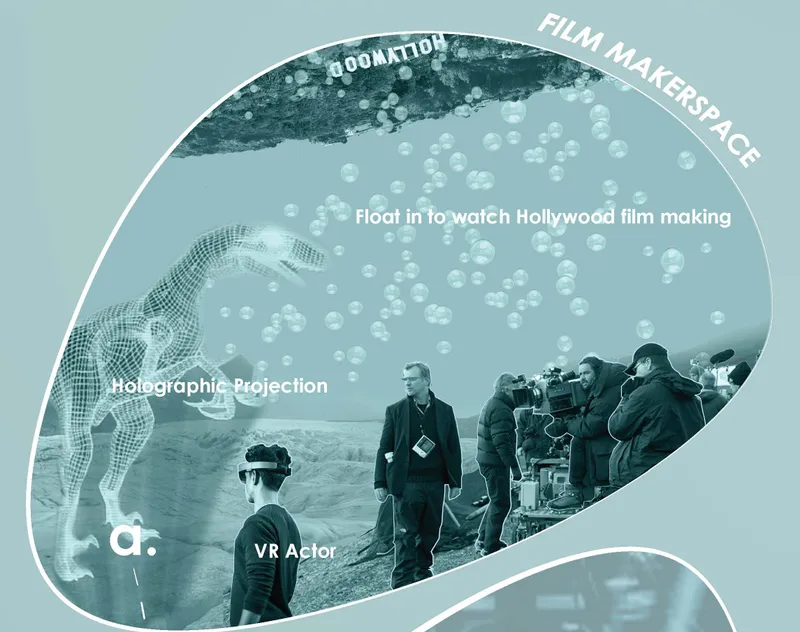
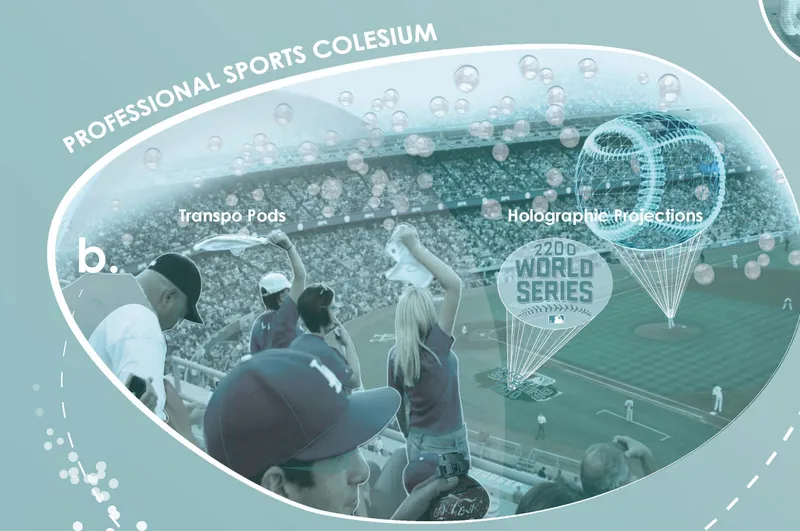
The program inside Milieu reads like a speculative cultural manifesto. A Film Makerspace integrates holographic projection and VR actors directly into production workflows, letting crews shoot inside immersive environments without leaving the structure. Adjacent to it, a Professional Sports Coliseum stacks spectators around a playing field served from above by transport pods, while holographic overlays augment the live action below. These are not decorative visions of the future; they are spatial diagrams that show how program, technology, and circulation overlap. The designers treat entertainment not as something that happens in a building but as something a building is made of.
Self-Healing Membranes and Propulsion Pods
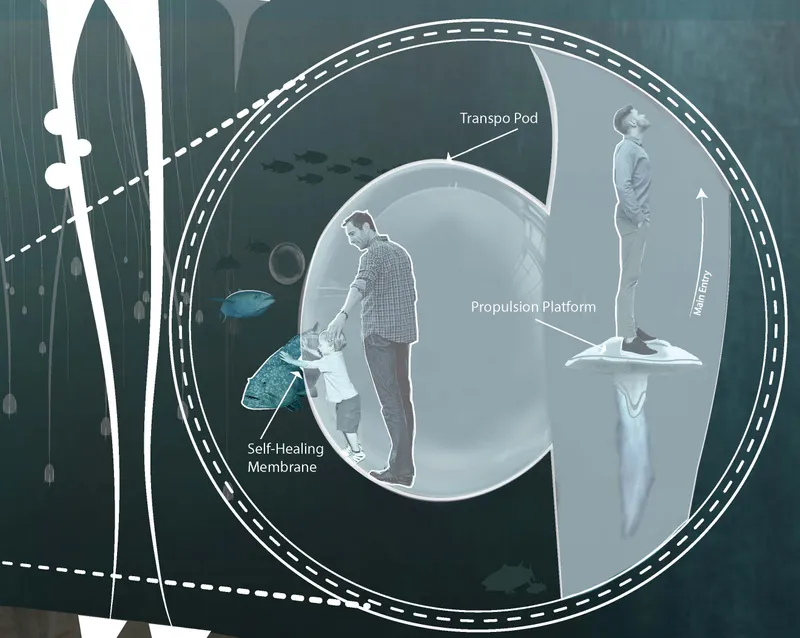
Movement through Milieu happens via floating transportation pods constructed from the same membrane technology that forms the enclosure. A sectional diagram reveals the pod's propulsion platform suspended beneath a self-healing membrane canopy, suggesting a transit system that repairs itself as it operates. The structural logic borrows from jellyfish anatomy: the "Hood" acts as a protective shell, "Tendrils" facilitate airflow and circulation, and "Tentacles" serve as defense mechanisms against environmental threats. Each component is named for its biological analog, and the designers commit to the metaphor at every scale.
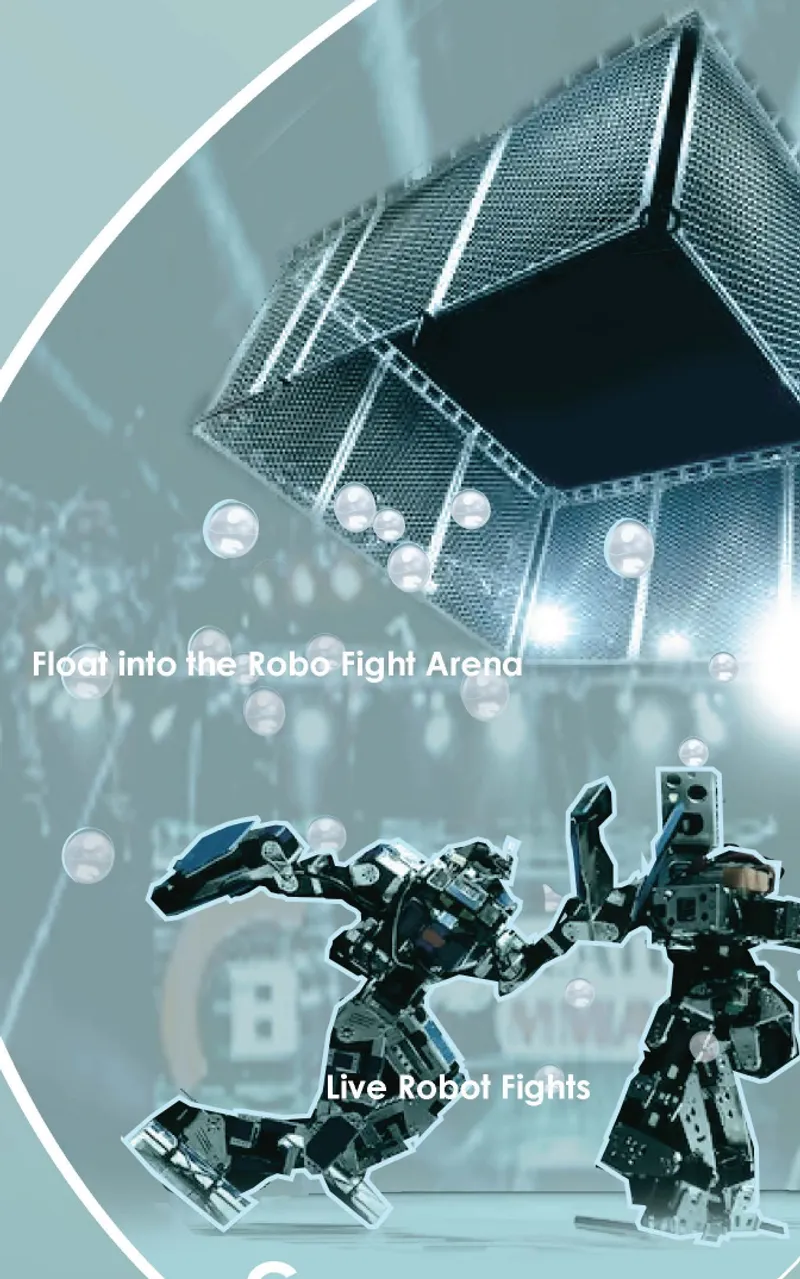
Below the transit layer, a Robot Fight Arena occupies an open wireframe mesh structure, its cage-like enclosure suspended above a floor where robotic figures face off. The wireframe reads as a stripped-back version of the organic membranes elsewhere, exposing the skeleton beneath the skin. It is a deliberate contrast: raw structure against soft biology, spectacle against ecosystem.
Organic Forms Hovering Above a Restored Landscape
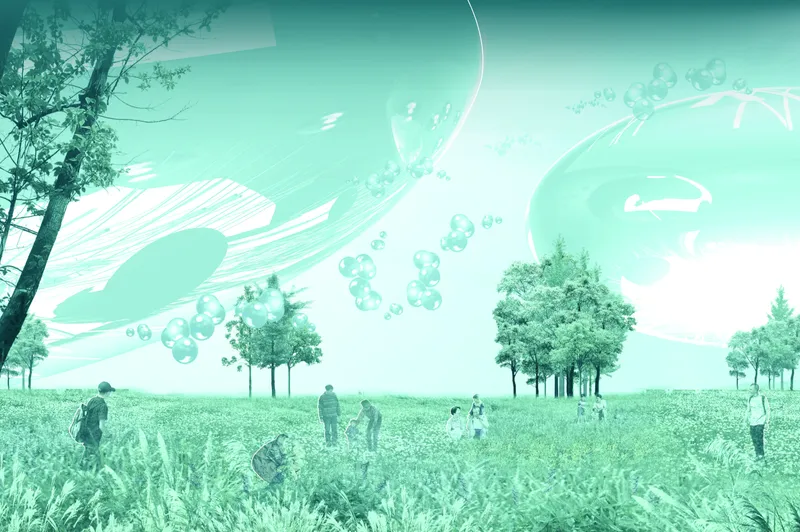
From ground level, Milieu appears as a cluster of translucent organic forms drifting above parkland. Scattered trees and walking figures establish a human scale that makes the floating volumes feel enormous, almost geological. The rendering communicates the project's most ambitious claim: that a structure this large can coexist with a restored landscape rather than consuming it. By lifting the program off the ground, the designers return the surface to pedestrians and vegetation, treating the earth as something to heal rather than to build on.
Aquathermal Cooling and Desalination at the Waterline
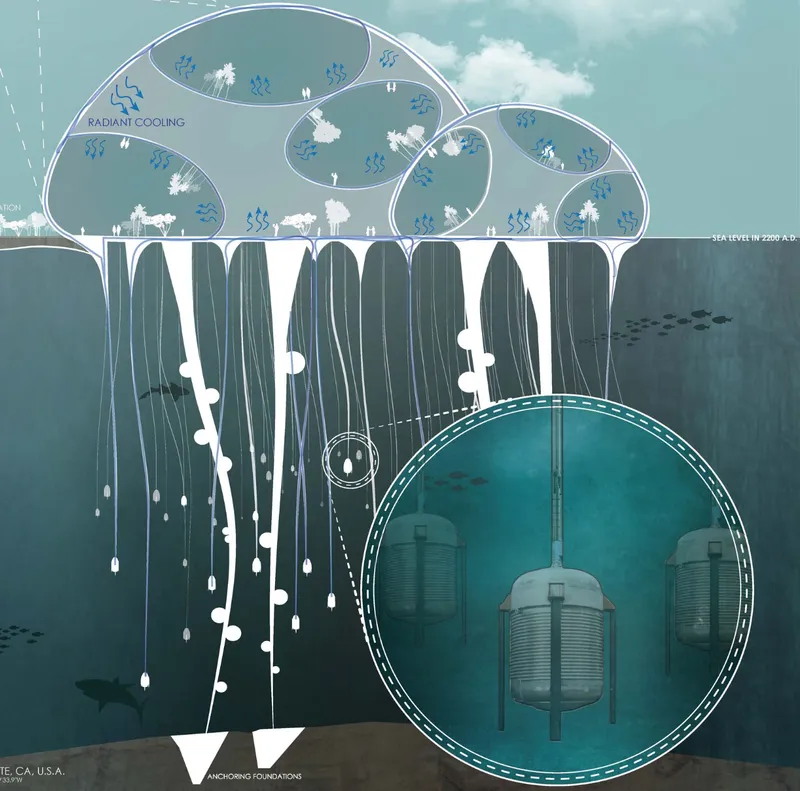
The final section drawing anchors the entire vision. Floating platforms hover above the ocean surface, connected to an underwater anchoring system that registers against a sea level datum line. Here the aquathermal system becomes legible: tentacle-like appendages transfer solar-heated fluid between architectural segments while a desalination filter converts ocean water into potable drinking water. Radiant cooling regulates internal temperatures without conventional HVAC. The structure does not merely sit in the water; it metabolizes it, turning the Pacific Ocean into both a coolant and a resource.
Why This Project Matters
Milieu operates at the frontier where speculative fiction meets architectural proposition. Its biomimetic vocabulary, from Scyphozoan Hydrogel membranes to tentacle-based thermal systems, is unapologetically futuristic, yet every component maps to a real performance requirement: cooling, filtration, structural resilience, transit. The project refuses to treat sustainability and spectacle as opposing values. Instead, it argues that a self-healing, water-purifying entertainment complex is exactly the kind of infrastructure a climate-stressed coastal city should be imagining.
For the Generic Cities brief, Carbajal, Horan, and Ali found the sharpest possible answer: Los Angeles becomes generic when it loses its cultural engines. Their response is to supercharge those engines, wrapping cinema and sports in a living membrane that makes the city's identity inseparable from its ecology. Whether or not a jellyfish-inspired hydrogel megastructure is buildable in the 23rd century is beside the point. What matters is the conviction that architecture can be both a protective organism and a stage, and that the most sustainable building might also be the most entertaining one.
View the Full Project
About the Designers
Designers: Antonio Carbajal, Michael Horan, Joey Ali
Enter a Design Competition on uni.xyz
uni.xyz runs architecture and design competitions year-round that reward proposals with spatial conviction and real site intelligence.
Project credits: Milieu by Antonio Carbajal, Michael Horan, Joey Ali Di - Generic Cities: Los Angeles (uni.xyz).


Popular Articles
Popular articles from the community


Riyadh For All: Intergenerational Urban Design for Active Aging in Rabat
Riyadh For All reimagines urban design in Rabat with intergenerational co-living, adaptive courtyards, and Moroccan cultural exchange today.

EW PARK: Sustainable Architecture Reimagines the Future of Urban Parking
EW PARK reimagines city parking as a modular wooden tower combining automation, solar energy, electric mobility, and adaptable urban design.

Co-Life: Senior Housing Design That Reconnects Older Adults With the City
Co-Life reimagines senior housing design through healing gardens, shared streets, workshops, and a sustainable community across generations.

Conexión: Biophilic Design Reimagines High-Rise Living in Hong Kong
Conexión reimagines high-rise living in Hong Kong through biophilic design, green facades, shared spaces, daylight, water and nature within.

Similar Reads
You might also enjoy these articles

Day and Night Park: A Time-Based Urban Newsstand in Beijing
A temporary urban newsstand in Beijing blending travel, light, and reading through poetic colors, compact form, and community-focused design.

Modernist Patio Renovation in El Masnou, Barcelona by Oliver Segura Arquitectura + Cebrià Arquitectura
Modernist patio renovation blending tradition and innovation with a movable pool, leveled floors, and Catalan materials in El Masnou.

Alto Residencial Coop: Cooperative Housing Development in Santiago de Compostela by Carbajo Barrios Arquitectos
A linear cooperative housing complex blending white volumes and perforated metal façades, enhancing community living, natural light, privacy, and urban integration.

Vil Genis School by BPA ARCHITECTURE – Massy, France
Vil Genis School in Massy, France, features sustainable design, south-facing classrooms, community integration, accessible spaces, and modern educational architecture.

Explore Biomimicry Frontiers Competitions
Discover active competitions in this discipline


Challenge to design a barrier free sports center

Challenge to design an outdoor ice-rink and park
Comments (0)
Please login or sign up to add comments
No comments yet. Be the first to comment!