

Red Brick Studio Embeds a Staggered Concrete Home into a Hillside Above a Reservoir
The Oblique House in India steps down a slope in raw concrete and steel, framing lake and mountain views at every turn.


There is a particular kind of residential project that earns its logic entirely from the land it sits on. The Oblique House by Red Brick Studio is one of those: a home that could not exist anywhere other than its specific hillside, perched above a reservoir and oriented to pull distant mountains into its daily domestic life. Its staggered volumes step down the terrain in board-formed concrete and steel, each level slightly offset from the one above, producing a sectional cascade that reads as both architecture and topography.
What makes the project genuinely interesting is the refusal to flatten the site. Rather than carving a platform and placing a conventional plan on top, the architects let the slope dictate the section. Living spaces, bedrooms, and courtyards occupy different elevations, connected by stairs that double as spatial events. The material palette, raw concrete, exposed black steel, brick, and corrugated metal, stays deliberately industrial. There is no plaster, no concealment. Every structural decision is visible, and the house is better for it.
Siting and Massing on the Slope


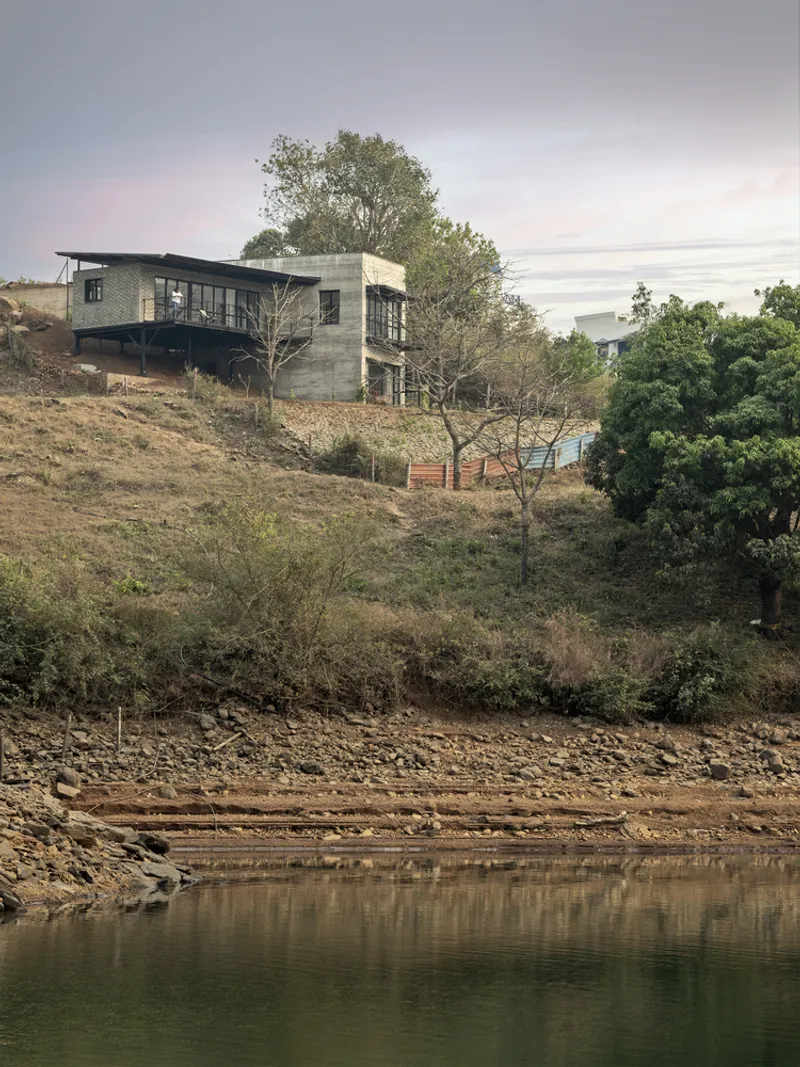
The house reads differently depending on your vantage point. From the road above, it appears as a cluster of corrugated metal roofs barely emerging from the tree canopy. From the reservoir below, the full sectional drama comes into view: stacked volumes of concrete and brick descending the red earth hillside like geological strata. The massing fragments what could be a single bulky form into smaller, legible pieces, each one housing a distinct part of the program.
Aerially, the relationship between building and site becomes clearest. The house occupies a narrow strip between the road and the water, its corrugated roofs angled to shed rain while their white upper surfaces reduce heat gain. Mature trees are retained within and around the footprint, and the excavated earth left by construction becomes part of the landscape rather than something to be hauled away.
Board-Formed Concrete and the Exposed Frame
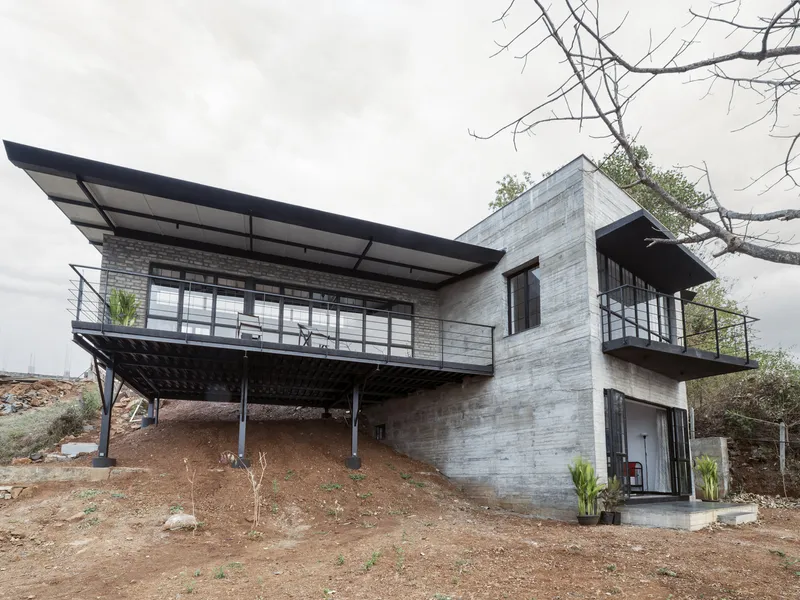
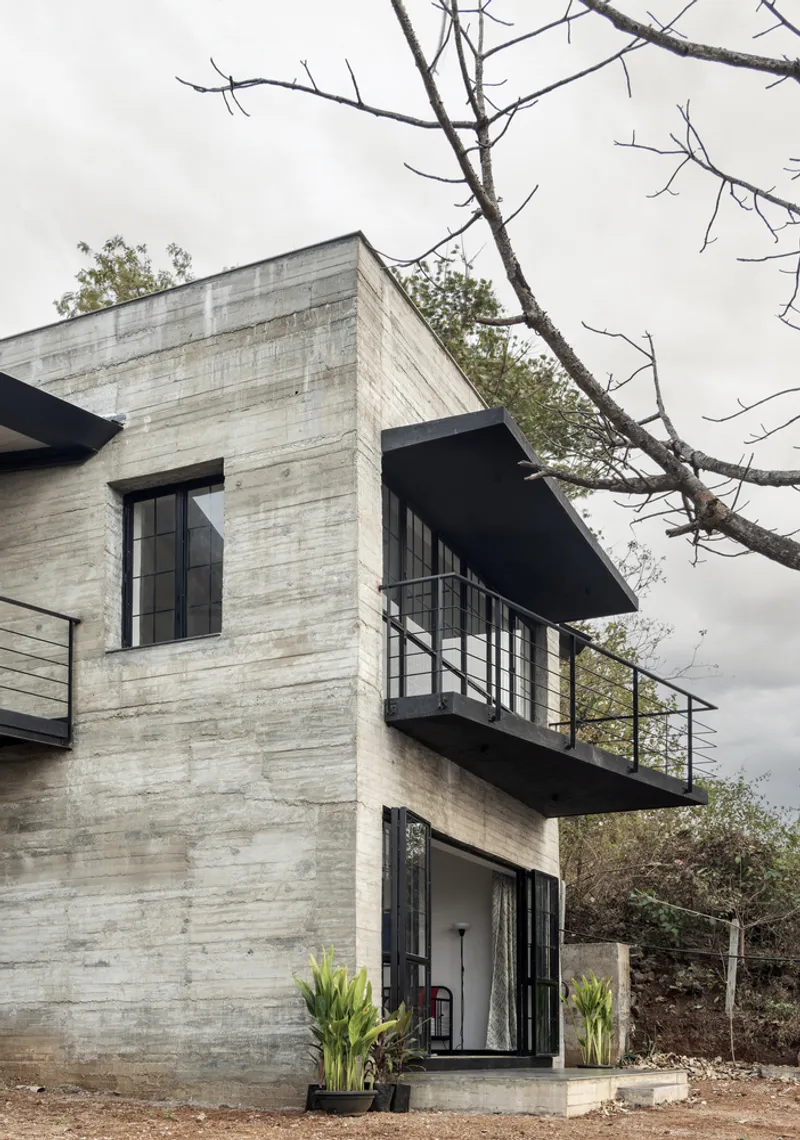

The board-formed concrete walls carry a roughness that most residential projects would sand down and paint over. Here, the wood grain impressions are left as found: a record of the formwork process, honest about how the building was made. The cantilevered steel canopy at the entry extends the interior outward without adding mass, its thin profile contrasting with the heaviness of the concrete below.
Steel balconies project from the tower-like volumes with minimal depth, just enough for a person to stand and survey the valley. A metal mesh screen beside one concrete wall provides a planting backdrop, softening the industrial material language without disguising it. The architects clearly trust their materials to age well, which in this climate of monsoons and intense sun is a bold and correct bet.
Courtyards and Circulation as Social Space


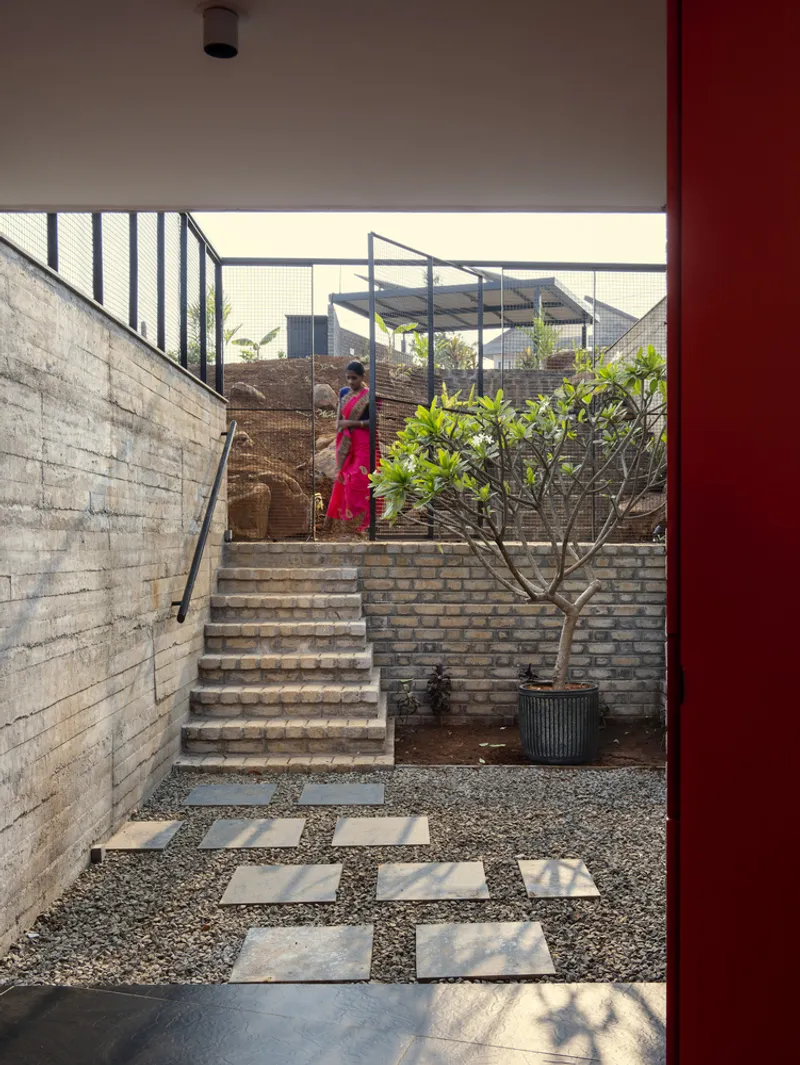
The most spatially generous moments in the Oblique House happen not in its rooms but in the spaces between them. Courtyards carved into the section bring light deep into the plan and create pockets of landscape at every level. One courtyard frames a mature tree rising above a retaining wall, its canopy visible from multiple floors. An orange-painted passage beneath a concrete staircase introduces a flash of color that feels deliberate rather than decorative.
Red steel doorways and columns punctuate the otherwise monochrome palette, marking thresholds between inside and outside. A planted courtyard with gravel, brick walls, and a potted tree works as a compression chamber: you pass through a tight, shaded threshold before emerging into a bright living area. It is a simple move, but it makes the transition between exterior and interior a conscious experience rather than an afterthought.
Interior Spaces Framed by Steel and Glass
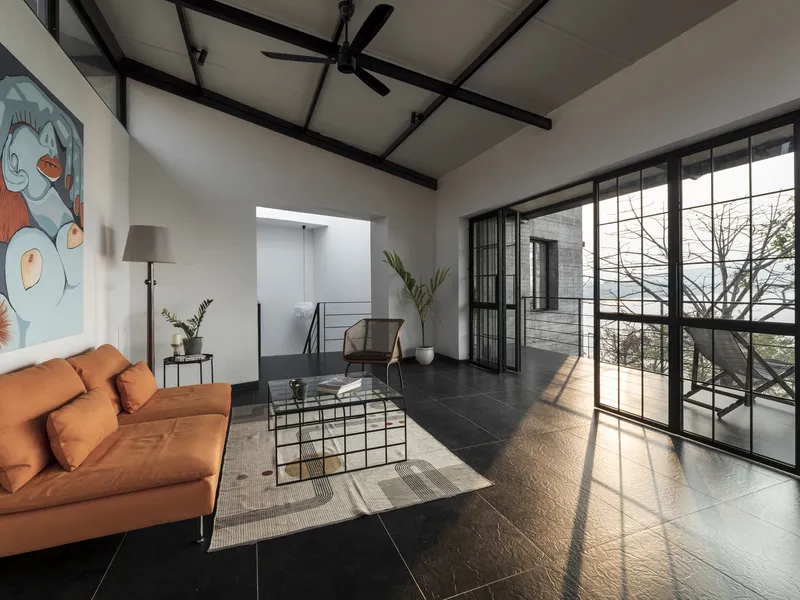


Inside, the exposed black steel beams that carry the roof become the dominant visual element. In the living room, floor-to-ceiling gridded glazing transforms the hillside view into a framed composition, bare winter branches layered against the sky. The grid of the steel mullions echoes the structural grid above, creating a visual continuity between ceiling and wall that makes the room feel resolved rather than decorated.
Bedrooms receive the same treatment: gridded glass doors open to distant lake views, and the furniture, a black metal bed frame, a simple daybed, stays within the material vocabulary of the architecture. Nothing competes. The interiors succeed because the architects resist the temptation to soften the palette for domestic comfort, trusting that the views, the light, and the spatial generosity of the section provide all the warmth the house needs.
Terraces, Corridors, and the View

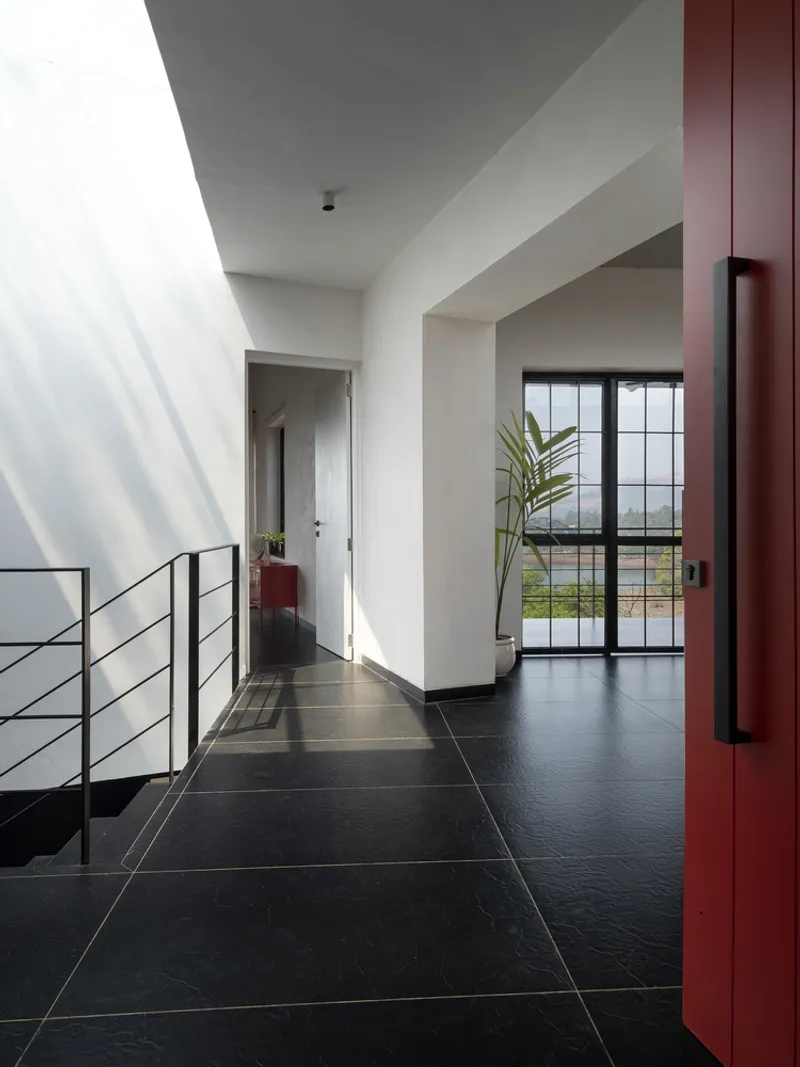
The covered terrace on the upper level is the house's most extroverted space. Exposed steel beams span above dark tile flooring, and a cable railing keeps the view completely unobstructed. From here, the hills roll away in successive ridgelines, and the reservoir sits in the middle distance like a mirror. It is the kind of prospect that most houses would reserve for a single room; here it is given to a semi-outdoor space where you can stand in the rain and still feel sheltered.
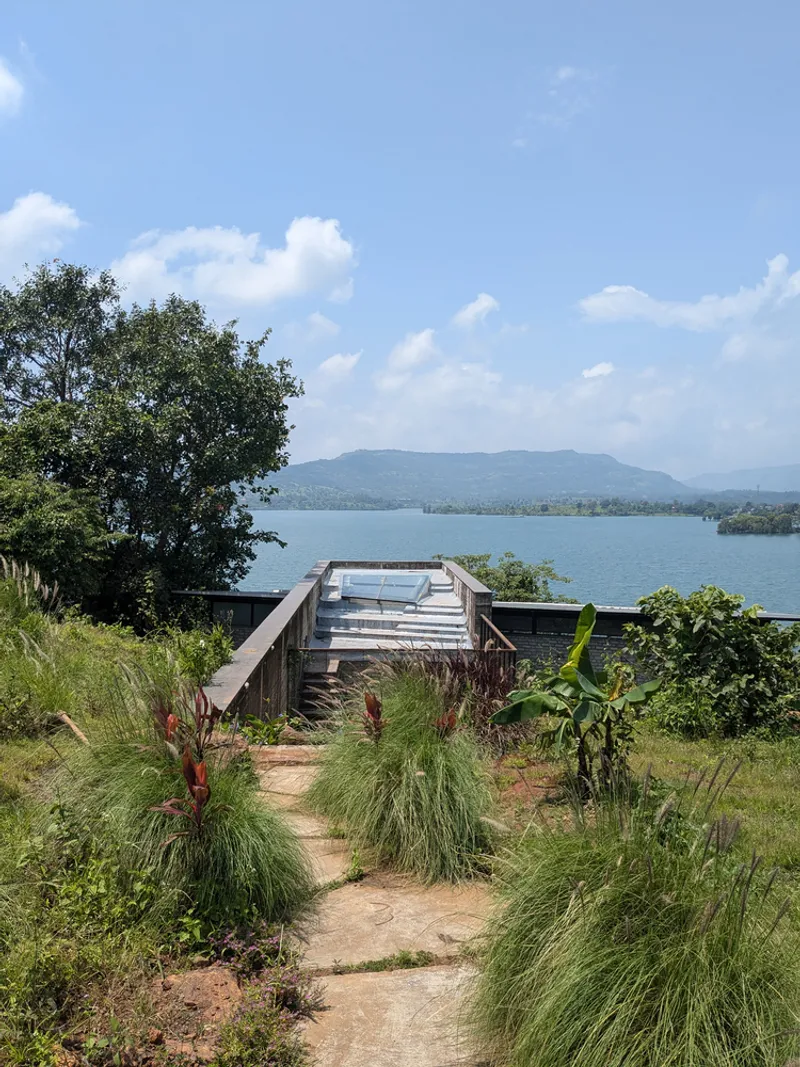
Upper corridors continue this logic of maximizing exposure to landscape. Black tile floors absorb the strong daylight pouring in from open sides, and red steel columns mark the structural rhythm. A path through planted grasses and banana palms on the roof terrace connects the house back to its terrain, blurring the boundary between architecture and ground plane.
Roof and Landscape from Above


Drone views reveal the fifth elevation, always the most revealing test of any hillside house. The corrugated metal roofs and white terrace surfaces read as clean planes against the red excavated earth. Skylights punctuate the metal cladding, bringing natural light to deeper interior zones that the section would otherwise leave in shadow. The roofscape is not pretty in a conventional sense, but it is legible and purposeful.
At dawn, mist rising from the lake wraps the lower volumes, and the house appears to float above the water. It is an atmospheric effect that no rendering could convincingly produce and one that rewards the architects' decision to embed the building into the slope rather than hovering it above on stilts. The house belongs to the hill.
Plans and Drawings
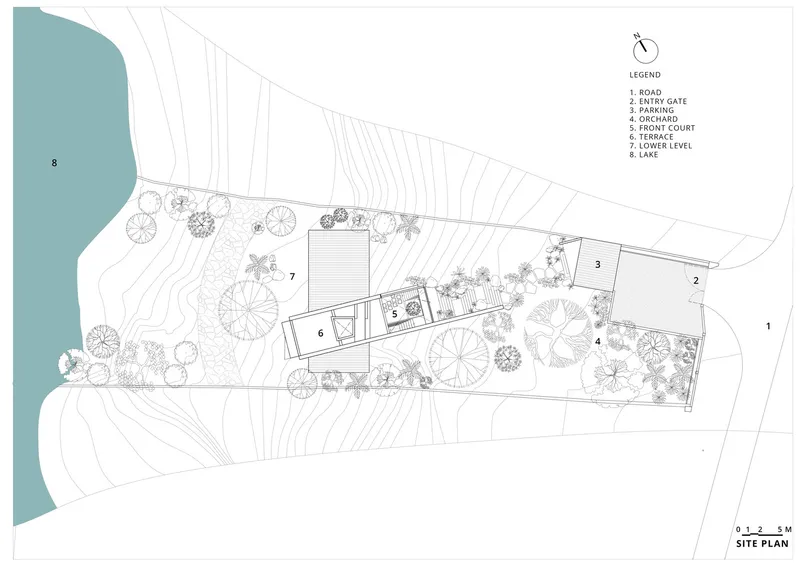


The site plan confirms the building's orientation along the contour of the slope, with volumes arranged to maximize lake frontage while keeping the road-side profile low. The lower level plan shows an entertainment room and deck opening directly onto a landscaped courtyard, while the upper level places living, dining, and bedrooms around a central entry porch. The two section drawings are where the project's real intelligence becomes clear: staggered interior levels step down the hillside in half-storey increments, creating vertical spatial variety that a conventional two-storey plan could never achieve.
Reading the sections alongside the photographs, you understand that the house is fundamentally a sectional project. The plan is relatively straightforward; the section is where the decisions that matter were made. Each room sits at a slightly different elevation, which means each room has a slightly different relationship to the ground, the view, and the sky. That specificity, room by room, level by level, is what separates the Oblique House from the generic hillside villa.
Why This Project Matters
The Oblique House demonstrates that sustainability in residential design does not require performative technology or a visible catalog of green systems. It is embedded in the terrain to minimize cut and fill. It uses thermal mass from concrete walls to temper interior temperatures. It retains existing trees. It orients openings to capture prevailing breezes. None of these strategies demand explanation; they are legible in the built form. That is a more convincing argument for sustainable design than any energy label.
More broadly, the project makes a case for sectional thinking in residential architecture. On a flat site, the plan is king. On a slope, the section takes over, and architects who understand that difference produce houses that feel inevitable rather than imposed. Red Brick Studio understood the assignment: let the land generate the architecture, express the structure, and get out of the way. The result is a house that will only improve as the concrete weathers, the trees grow, and the landscape reclaims the excavated earth.
The Oblique House by Red Brick Studio. Photography by Hemant Patil and Sohaib Ilyas.
About the Studio
Share Your Own Work on uni.xyz
If projects like this are the kind of work you want to make, uni.xyz is a place to publish your own, find collaborators, and enter design competitions.




Popular Articles
Popular articles from the community


The Ocean Hive: Sustainable Architecture for a Self-Sufficient Civilization at Sea
The Ocean Hive imagines sustainable architecture at sea, where modular habitats, algae, wave power and ocean waste sustain a growing colony.

Hill & Cross Opera: Sculptural Opera House Architecture Shaped by Tallinn’s Landscape and Identity
Hill & Cross Opera reimagines opera house architecture in Tallinn through its sculptural hill, civic plaza, glass wave and a luminous cross.

Co-Life: Senior Housing Design That Reconnects Older Adults With the City
Co-Life reimagines senior housing design through healing gardens, shared streets, workshops, and a sustainable community across generations.

Riyadh For All: Intergenerational Urban Design for Active Aging in Rabat
Riyadh For All reimagines urban design in Rabat with intergenerational co-living, adaptive courtyards, and Moroccan cultural exchange today.

Similar Reads
You might also enjoy these articles


Hodi-Mandai Geram
Project Function: Preservation and revitalization of the Intangible heritage and socio-spatial identity of the Hodi by Housing, Cultural Memory Center, Sacred Grove, landscape, local tourism economy


Olio Towers: A Mid-Rise for Performers That Fuses Housing, Rehearsal, and Stage
Located blocks from Houston's Theater District, this modular tower stacks living units around a central performance atrium.

Oasis: Modular Green Housing Carved into Dhaka's Urban Fabric
A shortlisted Plugin Housing entry reclaims unauthorized settlements in Dhaka with stepped concrete volumes, green roofs, and ventilation-driven design.

Black Hole: A Floating Megastructure for the Post-Physical Era
Emiliano Mazzarotto envisions a spherical, self-scaling arena where e-sports, digital hotels, and holographic stadiums replace traditional public space.


Explore Minimalism Competitions
Discover active competitions in this discipline



Challenge to reimagine the Iron Throne


Photograph architecture without architects


Illustrate the lost glory of Angkor Wat - Render Challenge


Design challenge to reuse E-waste
Comments (0)
Please login or sign up to add comments
No comments yet. Be the first to comment!