

Mitti Raag: 3D-Printed Housing That Reconnects Displaced Families to Land
A 150-home neighborhood in Assam uses low-carbon concrete printing and communal planning to restore dignity after displacement.


What does it take to print a sense of belonging? Mitti Raag proposes that a 3D printer, low-carbon concrete, and a deeply considered site plan can do exactly that. Set on agricultural land in Tezpur, Assam, the project deploys 150 L-shaped homes around shared green courtyards, creating a self-sustaining neighborhood where displaced families can farm, trade, and rebuild their lives. The architecture refuses to treat affordability and dignity as opposing forces; instead, it fuses them through material precision, communal spatial logic, and a commitment to vernacular warmth.
Designed by El S, Mitti Raag was shortlisted in the Strata competition. The project's name, loosely translating to "song of the earth," signals its core ambition: to use digital fabrication not as a spectacle of technology but as a humanitarian tool, one that can heal social displacement by reconnecting people to the ground beneath them.
Ribbed Walls and Timber Frames Along a Quiet Street
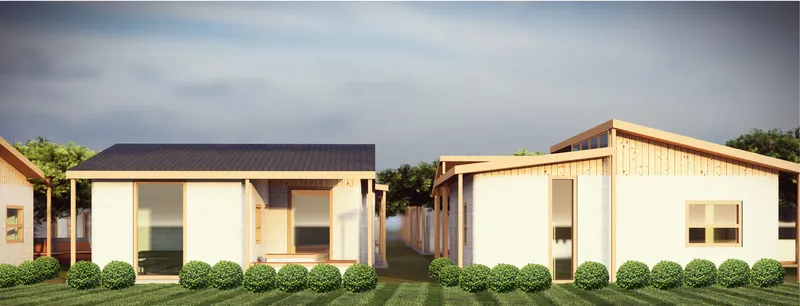
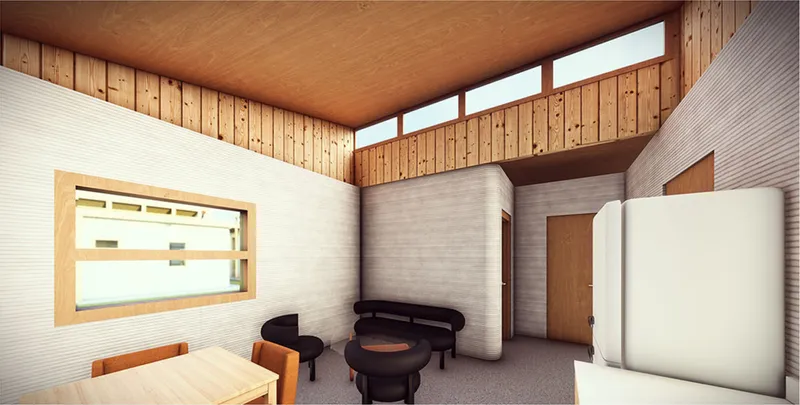
The street-level perspective reveals the project's material identity: white ribbed wall panels produced by the ICON Vulcan printer sit within timber structural frames, capped by gabled roofs that echo rural Assamese building forms. The zigzag wall profile is not decorative; it enhances thermal insulation, a critical performance feature in Assam's humid climate. Carbon X, the low-carbon concrete blend used throughout, is printed to a height of 280 cm with wooden inserts for doors and windows integrated during the layering process.
Inside, the ribbed texture continues as an honest expression of construction method. Clerestory windows pull daylight across timber ceilings, while built-in seating and storage modules are printed directly into the wall structure. This eliminates the need for additional furniture in many cases, reducing cost and clutter in units that measure just 46.5 square meters each.
A Kitchen Window Opens Onto Communal Life

One of the project's most telling moments is the kitchen view: a timber-framed window opens directly onto a courtyard where children play on grass. Each unit is organized into two zones. Two bedrooms and a bathroom form the essential rooms, while a spacious living and kitchen area extends into a veranda that faces the communal green. Fixed glass panels frame these views deliberately, ensuring that light and social visibility define the interior experience. The design insists that even in low-cost housing, the act of cooking dinner should come with a view of your neighbors' children running safely outside.
Clusters, Not Rows: The Courtyard as Micro-Neighborhood
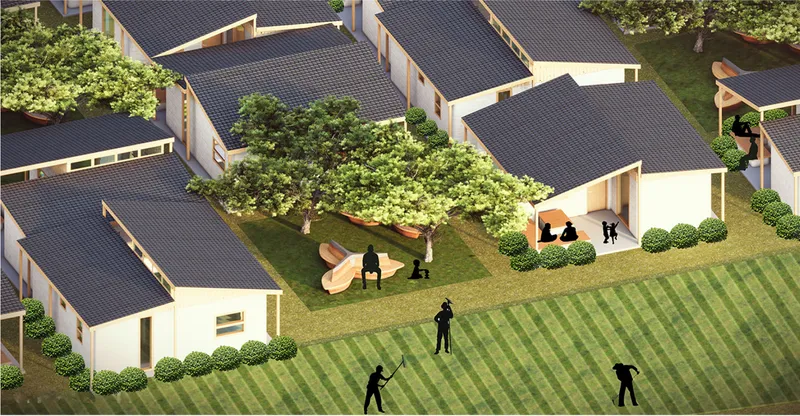
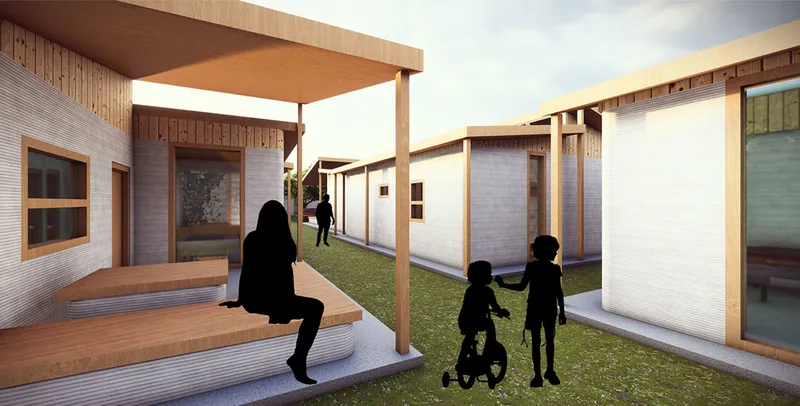
The aerial view makes the planning logic clear. Rather than lining homes along roads in repetitive rows, Mitti Raag clusters its L-shaped units around shared lawns and trees, forming micro-neighborhoods where interaction is unavoidable in the best sense. Covered timber walkways link units to one another, providing shaded circulation that encourages movement through the courtyards rather than around them. Children and residents occupy these in-between spaces naturally, as the renderings suggest.
The vertical printing axis allows rows of homes to emerge with systematic precision, but the resulting spatial experience is anything but mechanical. Every pathway leads somewhere communal. No home is isolated. Key public facilities, including a local market, medical center, administrative block, and worship area, are positioned at the neighborhood's edge along the main road, connecting the internal community to the wider urban fabric of Tezpur.
Planted Buffers and a Self-Sustaining Economic Loop
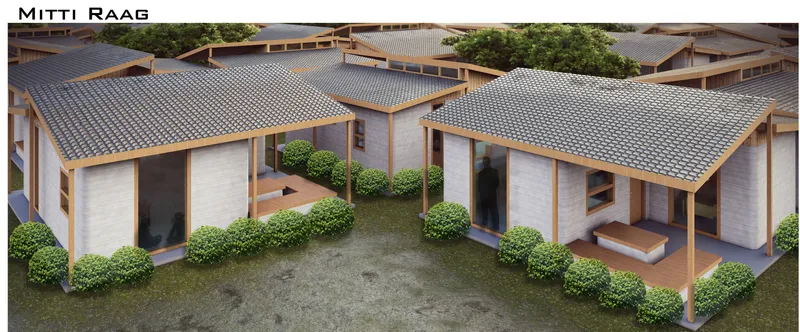
The overhead rendering reveals planted buffer zones surrounding the courtyard arrangements, softening the boundary between the neighborhood and the adjacent agricultural land. This is not incidental landscaping. Families can cultivate crops on the surrounding farmland and sell their produce at the on-site local market, creating a self-reliant economic ecosystem that reduces dependence on external supply chains. The neighborhood is not just a place to sleep; it is designed to be a productive landscape where shelter and livelihood are spatially intertwined.
Why This Project Matters
Mitti Raag operates in a space where most affordable housing projects fall short: the emotional register. It is easy enough to print walls quickly and cheaply. It is far harder to ensure that the resulting spaces feel like homes rather than emergency provisions. By embedding verandas, courtyard views, built-in furnishings, and communal greens into the printed fabric of each unit, this project insists that displaced families deserve more than efficiency. They deserve spatial generosity.
The project also demonstrates that 3D-printed construction need not produce alien aesthetics. The gabled roofs, timber framing, and ribbed concrete walls create a material language that sits comfortably within Assam's rural building traditions while performing at a level those traditions cannot easily achieve alone. As climate pressures intensify and displacement accelerates across South Asia, Mitti Raag offers a credible prototype: not a finished solution, but a clear argument that technology, community planning, and cultural sensitivity can occupy the same structure.
View the Full Project
About the Designers
Designer: El S
Enter a Design Competition on uni.xyz
uni.xyz runs architecture and design competitions year-round that reward proposals with spatial conviction and real site intelligence.
Project credits: Mitti Raag by El S Strata (uni.xyz).


Popular Articles
Popular articles from the community


Aquadapt: An Underwater Habitat That Rewrites Its Rooms by the Hour
Curved modules ring the seabed while one shell shifts from breakfast room to cinema, farm and football pitch as residents' needs change.

The Amber Palace Opera: A Geological Fiction Surfaces on Tallinn's Baltic Waterfront
Pierre Brillard reimagines a Baltic legend as a public landscape, opera house, and waterfront promenade rooted in Tallinn's coastal identity.
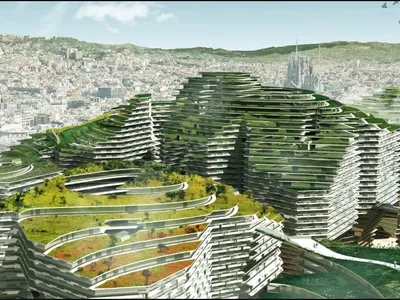
Manzana Morphosis: Stretching Barcelona's Grid into a Living Landscape for 2050
A radical reworking of the Eixample manzana turns density into a tool for generous public space, vertical ecology, and environmental performance.


FCC Arquitectura Expands a Portuguese Granite House with a Board-Marked Concrete Wing
In Portugal, JV House pairs a cleaned-up whitewashed and granite dwelling with a timber-shuttered concrete extension, courtyards and a garden pool.

Similar Reads
You might also enjoy these articles
Aquadapt: An Underwater Habitat That Rewrites Its Rooms by the Hour
Curved modules ring the seabed while one shell shifts from breakfast room to cinema, farm and football pitch as residents' needs change.

Play: Fragments of Their World: Remembered Architecture Rebuilt as a Modular Playground for Refugee Camps
Tom Gardner abstracts domes, arches and towers from the homelands of displaced families into a kit of child-scaled play parts for camp settlements.
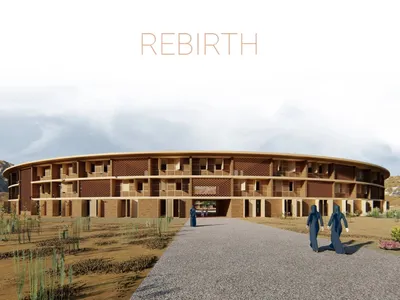
REBIRTH: A Circular Settlement Where Afghan Widows and Their Children Rebuild Life Together
A shortlisted Resile entry turns the circle into a protective ring of timber and brick, gathering homes, classrooms and gardens around a shared landscape.
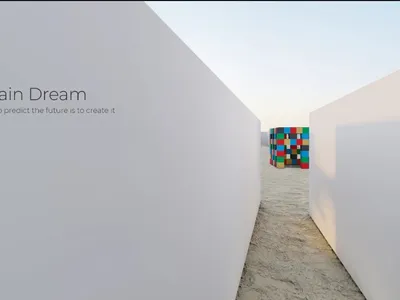
The Main Dream: A Recycled Plastic Kit That Lets Refugee Children Build Their Own Playground
Thirty-centimetre interlocking cubes that connect on three axes turn play into construction, letting children author the spaces they occupy.

Explore Affordable Housing Competitions
Discover active competitions in this discipline

Challenge to reimagine the Iron Throne

Photograph architecture without architects

Illustrate the lost glory of Angkor Wat - Render Challenge

Design challenge to reuse E-waste
Comments (0)
Please login or sign up to add comments
No comments yet. Be the first to comment!