
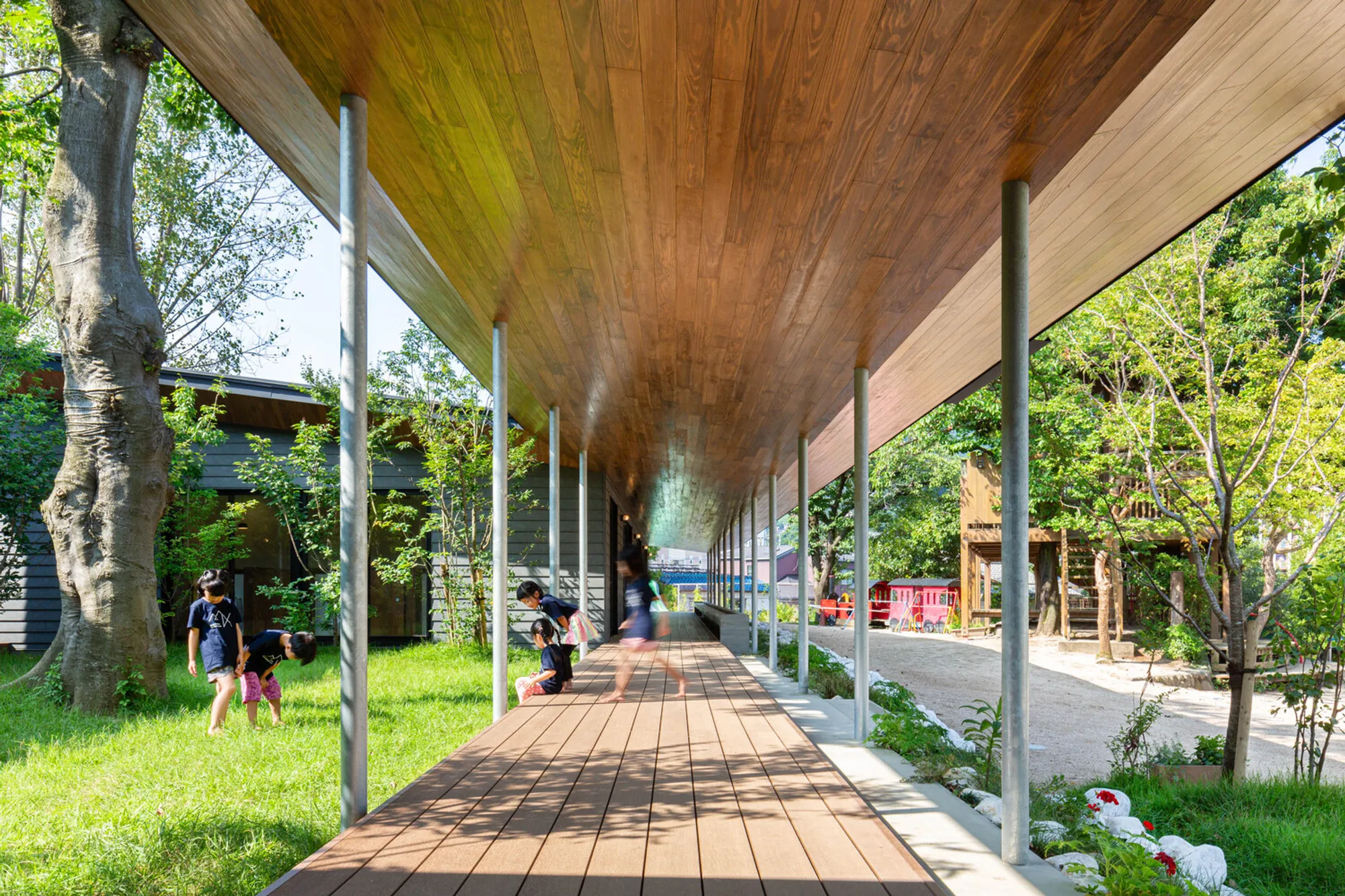
HIBINOSEKKEI and Kids Design Labo Build a Kindergarten Where the Courtyard Is the Curriculum
A low-slung timber campus in Japan dissolves the wall between classroom and landscape, letting children learn through terrain.


There is a persistent problem in kindergarten design: the building tries too hard to be a building. Walls go up, rooms get labeled, and the landscape becomes a leftover, something glimpsed through a window on the way to lunch. MJK Kindergarten, designed by HIBINOSEKKEI and Kids Design Labo (working under their collaborative umbrella with Youji no Shiro), refuses that logic entirely. Here the courtyard is not outside the school. It is the school. Everything else, the classrooms, the corridors, the wading pool, the sand pit, orbits around a central lawn anchored by a mature tree.
What makes the project genuinely interesting is the degree to which its architecture operates as infrastructure for discovery rather than enclosure for supervision. The pavilions are low, the rooflines are horizontal, and nearly every interior space opens onto ground that is deliberately unfinished: sand, water, grass, dirt. The building does not decorate nature or frame it as a backdrop. It gets out of nature's way while remaining precise about how children circulate, gather, and retreat. That precision is what elevates the project beyond the now-familiar trope of the "nature kindergarten."
A Courtyard That Holds the Whole School Together
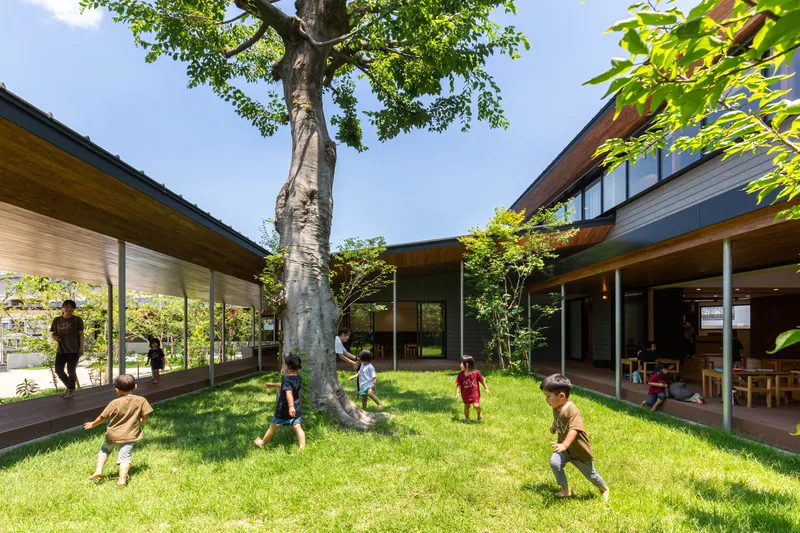
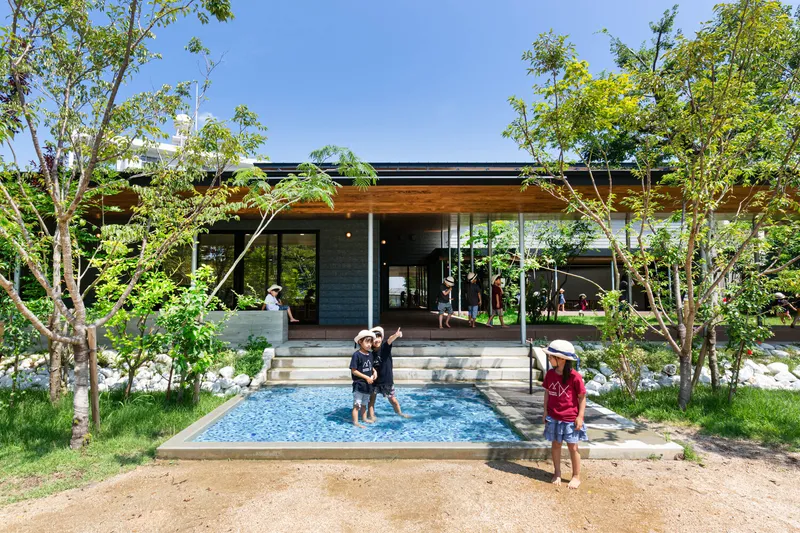
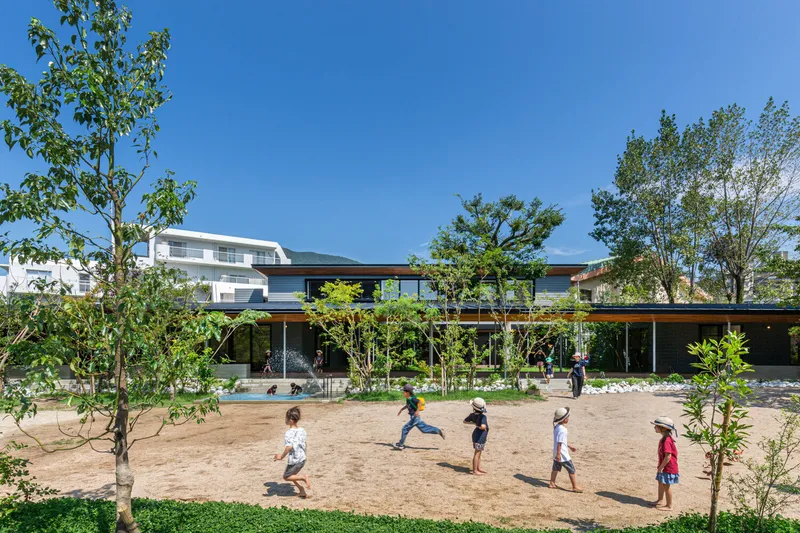
The central courtyard is not decorative green space. It is a working landscape, the largest single room in the school, defined by the pavilions that wrap loosely around its perimeter. A mature tree presides at its center, and children move freely between grass, wading pool, and sand play zones without ever crossing a threshold that feels like leaving one place and entering another. The shallow pool with its concrete steps doubles as a social amphitheater. The sandy play area beyond is framed by young trees that will, in time, create a canopy of their own.
The genius is in the grade changes. Steps, slopes, and level shifts make the courtyard topographically rich without requiring any equipment. Children navigate terrain rather than apparatus, which is a fundamentally different motor and cognitive experience.
Corridors as Rooms, Not Hallways


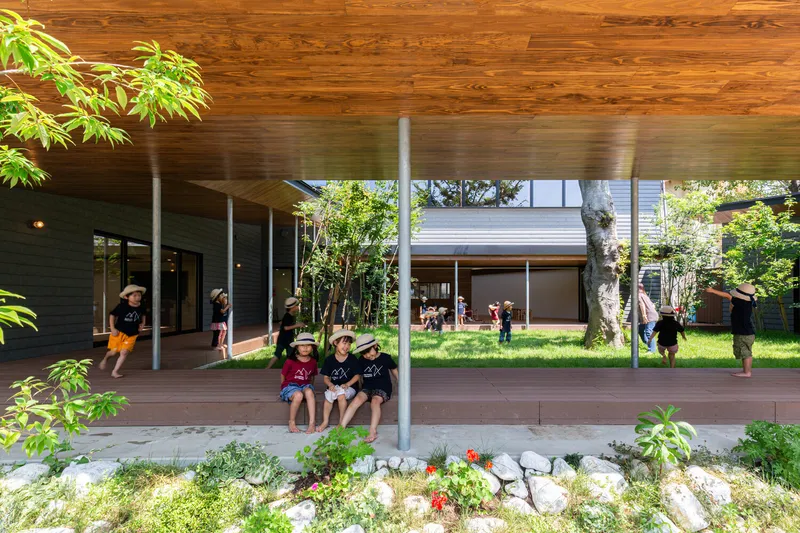
In many schools, corridors are dead space: the price you pay for having rooms. Here, the covered walkways are among the most inhabited parts of the campus. Timber ceilings run continuously above timber decking, and slender steel columns keep the structure visually light. Dappled sunlight moves across the floor as the day progresses. Children sit on concrete benches near planted beds, or cluster in small groups along the deck. These are not transitional spaces. They are gathering rooms without walls.
The decision to make circulation generous and habitable has a downstream effect on the classrooms themselves: because socializing and informal play already have a home in the corridors, the classrooms can be calmer, more focused, less burdened by the need to do everything at once.
Timber Interiors Scaled for Small Bodies


Inside, the material palette is disciplined: timber flooring, exposed timber beams, plywood partitions, and occasional black accent walls that give depth without heaviness. Furniture is uniformly low, and storage walls are designed so that children can reach what they need without adult intervention. One classroom features a mezzanine library, a simple platform that gives young readers a sense of elevation and privacy within a shared room.
The open-plan living area with its pendant lights and glazed partitions overlooking potted plants reads less like a school and more like a well-considered house. That is deliberate. The domesticity of the interiors puts children at ease in a way that institutional finishes never can. Exposed beams and warm lighting create a sense of shelter that complements the openness of the courtyard just beyond the glass.
Even the Bathrooms Deserve Design

The plywood toilet partitions are worth noting because they reveal the architects' attitude toward every square meter of the building. Rather than a tiled room with standard stalls, the bathroom is a maze of child-height partitions beneath exposed timber beams and pendant lights. Children move through the space playfully. Privacy is provided without rigidity. It is a small detail, but it signals a project where nothing has been left to default.
Elsewhere, the covered terrace with its planted border becomes a semi-outdoor classroom where children sit together on the timber deck. White columns keep the roof hovering above without enclosing the space, reinforcing the campus-wide strategy of maximizing the zone between inside and outside.
The Canopy as Architectural Identity

From the exterior, the building reads as a continuous timber-clad canopy floating above a landscape. Concrete stepped seating spills out toward the sandy courtyard, and the roofline stays relentlessly horizontal, deferring to the trees rather than competing with them. The architectural identity of MJK is not a facade or a form. It is a roof, and everything it shelters beneath it.
That restraint is what makes the project so legible at the scale of a child. There is no monumental entrance, no heroic gesture. Just a long, low line that says: come underneath, the ground is yours.
Plans and Drawings
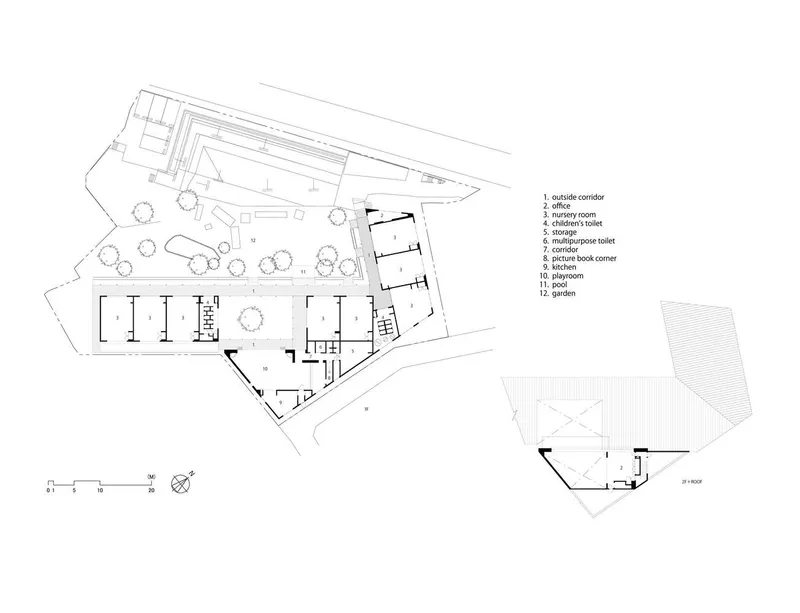
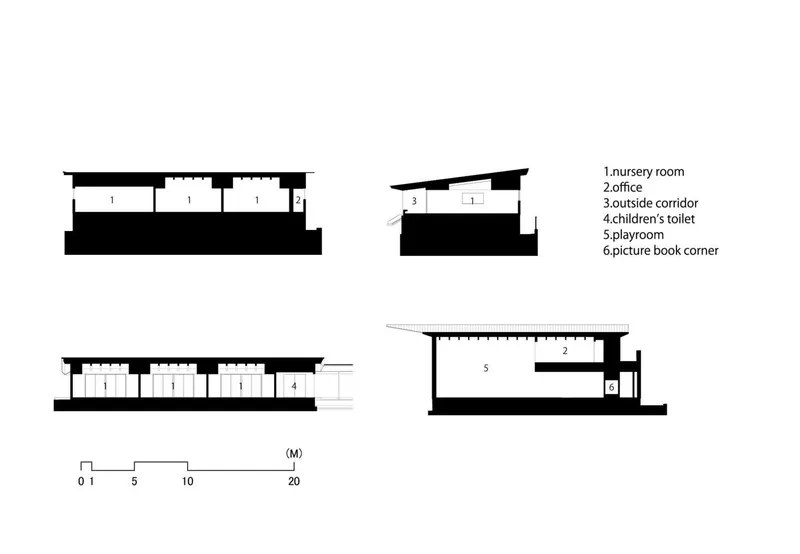
The floor plan reveals the angled footprint that generates the courtyard's irregular geometry. Rooms are arranged along the building's inner edge, each opening directly onto covered walkways and the central landscape beyond. A detached structure sits to one side, creating a secondary outdoor zone and preventing the courtyard from feeling fully enclosed. The section drawings confirm what the photographs suggest: roof slopes are gentle, interior ceiling heights vary to create distinct spatial experiences within a compact profile, and the relationship between floor level and ground plane shifts constantly.
Why This Project Matters
Kindergarten design has become a crowded genre, full of projects that feature bright colors, quirky forms, and obligatory green roofs. MJK Kindergarten sidesteps all of that. Its ambition is structural rather than decorative: rethink what a room is, make circulation habitable, and treat the ground itself as the primary teaching material. HIBINOSEKKEI and Kids Design Labo have been refining this approach across dozens of projects, and the fluency shows. Nothing here feels experimental. It feels resolved.
The project matters because it proves that child-centered design does not require spectacle. A low roof, a mature tree, sand underfoot, and the freedom to move between inside and outside without asking permission: these are not radical propositions, but executing them with this level of consistency and material discipline is genuinely rare. MJK is less a building than a landscape with shelter, and that distinction makes all the difference.
MJK Kindergarten by HIBINOSEKKEI and Kids Design Labo (Youji no Shiro), Japan.
About the Studio
Share Your Own Work on uni.xyz
If projects like this are the kind of work you want to make, uni.xyz is a place to publish your own, find collaborators, and enter design competitions.




Popular Articles
Popular articles from the community


The Ocean Hive: Sustainable Architecture for a Self-Sufficient Civilization at Sea
The Ocean Hive imagines sustainable architecture at sea, where modular habitats, algae, wave power and ocean waste sustain a growing colony.

Co-life: Sustainable Architecture for Age-Friendly Community Living
Co-life reimagines sustainable architecture for seniors through courtyards, rammed earth, shared gardens, and spaces designed for belonging.

Co-Life: Senior Housing Design That Reconnects Older Adults With the City
Co-Life reimagines senior housing design through healing gardens, shared streets, workshops, and a sustainable community across generations.

Riyadh For All: Intergenerational Urban Design for Active Aging in Rabat
Riyadh For All reimagines urban design in Rabat with intergenerational co-living, adaptive courtyards, and Moroccan cultural exchange today.


Similar Reads
You might also enjoy these articles


Hodi-Mandai Geram
Project Function: Preservation and revitalization of the Intangible heritage and socio-spatial identity of the Hodi by Housing, Cultural Memory Center, Sacred Grove, landscape, local tourism economy


Olio Towers: A Mid-Rise for Performers That Fuses Housing, Rehearsal, and Stage
Located blocks from Houston's Theater District, this modular tower stacks living units around a central performance atrium.

Oasis: Modular Green Housing Carved into Dhaka's Urban Fabric
A shortlisted Plugin Housing entry reclaims unauthorized settlements in Dhaka with stepped concrete volumes, green roofs, and ventilation-driven design.

Black Hole: A Floating Megastructure for the Post-Physical Era
Emiliano Mazzarotto envisions a spherical, self-scaling arena where e-sports, digital hotels, and holographic stadiums replace traditional public space.


Explore Educational Building Competitions
Discover active competitions in this discipline



Challenge to design public laboratory


Challenge to reimagine the Iron Throne


Photograph architecture without architects


Illustrate the lost glory of Angkor Wat - Render Challenge
Comments (0)
Please login or sign up to add comments
No comments yet. Be the first to comment!