
mmkplus Resurrects a Forgotten Artificial Island on Seoul's Han River as a Modular Cultural Park
Nodeul Island Park reclaims a 30-acre abandoned landmass with terraced plazas, a performance hall, and a village-like grid of public life.


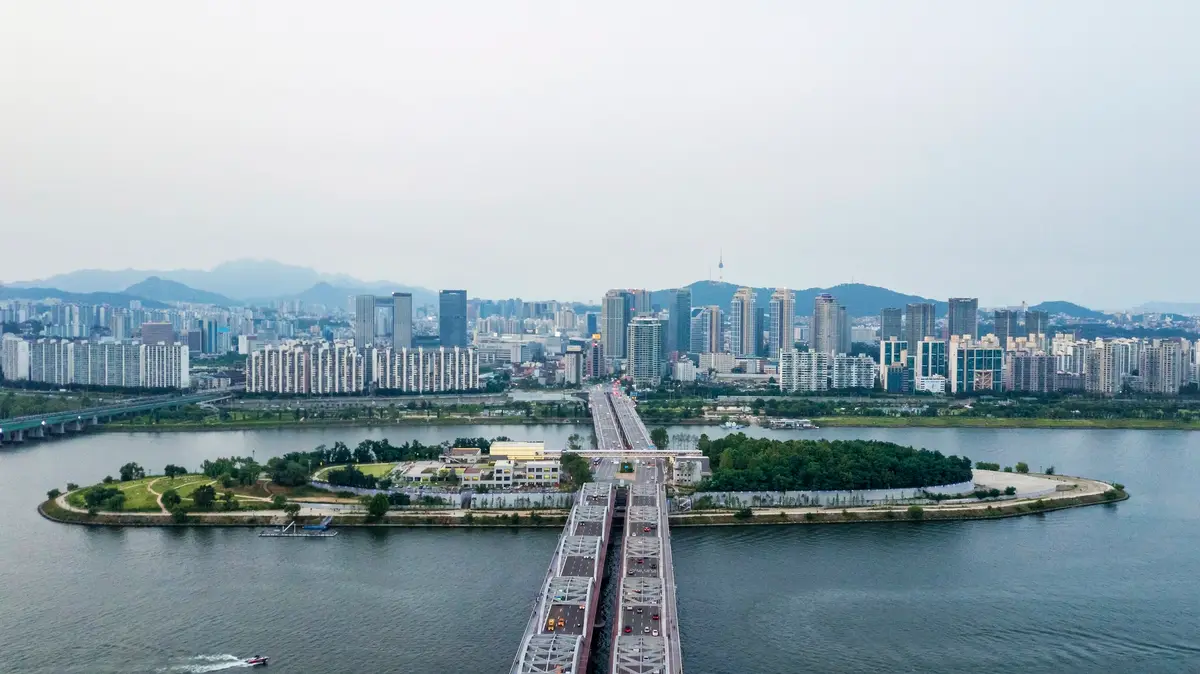
Seoul's Han River carries a strange piece of infrastructure: a 30-acre artificial island originally built in 1917 to anchor a pedestrian bridge, later engineered into a beloved public beach during the 1960s, and finally abandoned in the 1970s when shifting currents and protective dikes submerged parts of the land. For decades, Nodeul Island sat in plain view of millions of commuters crossing the river yet remained entirely inaccessible, a blank in the city's mental map. mmkplus was tasked not just with building on this site but with giving it a reason to exist again.
What makes Nodeul Island Park genuinely interesting is how it treats the ground itself as the primary design problem. A multilane bridge bisects the island at a level well above the existing landscape, creating a hostile disconnect between car traffic and the terrain below. Rather than building a standard building at bridge level and ignoring the lower ground, mmkplus reconfigures the island's topography into multiple ground planes, using a 10m x 10m modular precast concrete grid as both structure and urban scaffold. The result is closer to a Korean maeul, a traditional village settlement, than to a conventional park building: a cluster of programs at different elevations, linked by two circulation loops, where the architecture provides a framework and the community fills it in.
Manufactured Topography

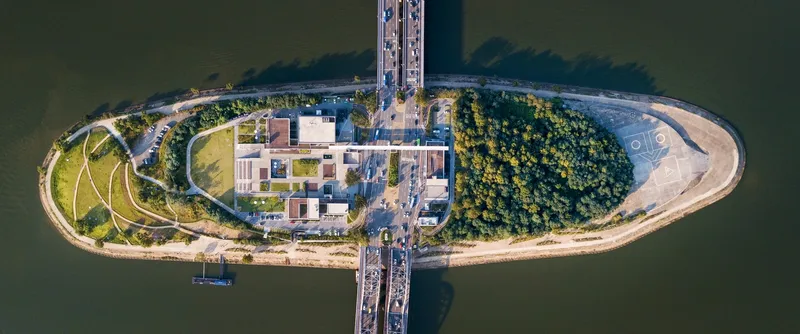

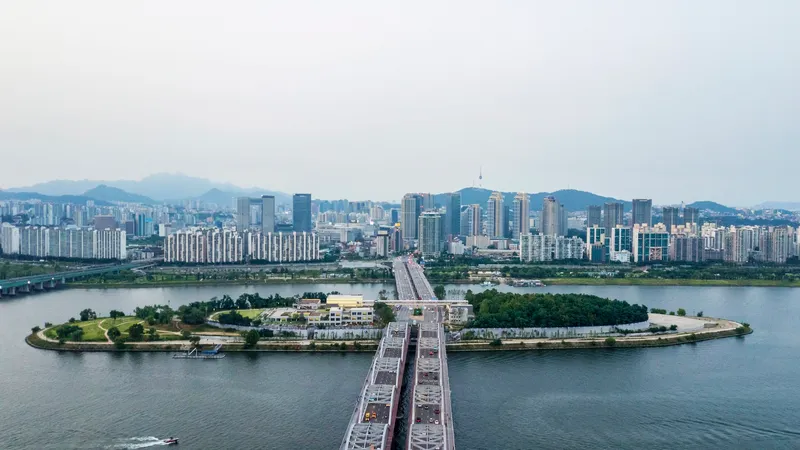
Seen from above, the island reads as a series of green terraces and low-slung volumes arranged around courtyards rather than a single monolithic structure. The curved planted rooflines merge the architecture into the surrounding landscape so convincingly that the 9,620 square meters of built area nearly disappear. Concrete block terraces step down toward the river shore, blurring the edge between building and landform.
The aerial views reveal the dual bridge connections that stitch the island back into the city's pedestrian network, a critical move for a site that had been functionally severed from Seoul for half a century. Without those links, even the most compelling architecture would remain a curiosity viewed from a car window.
Two Loops and a Split Section
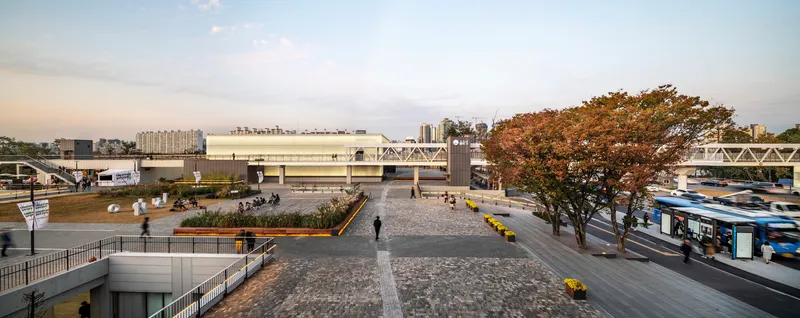


The project's spatial logic hinges on two circulation loops. The Upper Loop, tighter in radius, connects the Eco-learning center, Han River observatory, and Nodeul Forest at the elevated bridge level. The Lower Loop wraps the entire island perimeter with a promenade, urban beach, bike center, and observation deck. These are not redundant paths; they serve fundamentally different speeds and moods, one civic and compact, the other leisurely and expansive.
The sunken passageways and stepped plazas manage the level change with surprising grace. Pedestrians move beneath elevated walkways through concrete corridors that feel intentionally compressed before opening onto cobblestone plazas and planted courtyards. The sequencing owes more to traditional Korean village planning, where narrow alleys open onto communal gathering spaces, than to any Western park precedent.
The Interior as Infrastructure


Inside, the modular grid reveals itself honestly. The 500-person performance hall exposes a dense ceiling grid of mechanical and electrical systems beneath theatrical rigging, treating the MEP infrastructure as part of the visual character rather than something to be hidden. The multipurpose hall does the same, with exposed ductwork hovering above timber stepped seating. These are not polished cultural institutions; they are robust, flexible shells designed to absorb whatever program the city throws at them.
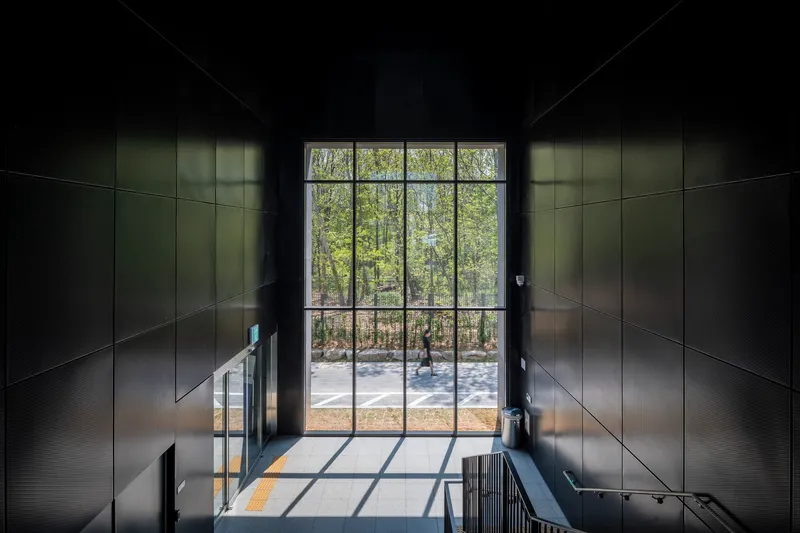
The double-height entrance lobby frames a view of bare trees through a gridded steel window wall, collapsing the boundary between the cultivated interiors and the wild forest that mmkplus was careful to preserve on the island's edges. A four-phase planting strategy systematically removed decaying vegetation, seeded new growth, and curated edge-defining plantings, but the architecture consistently defers to the existing ecology rather than competing with it.
Threshold Spaces at Dusk

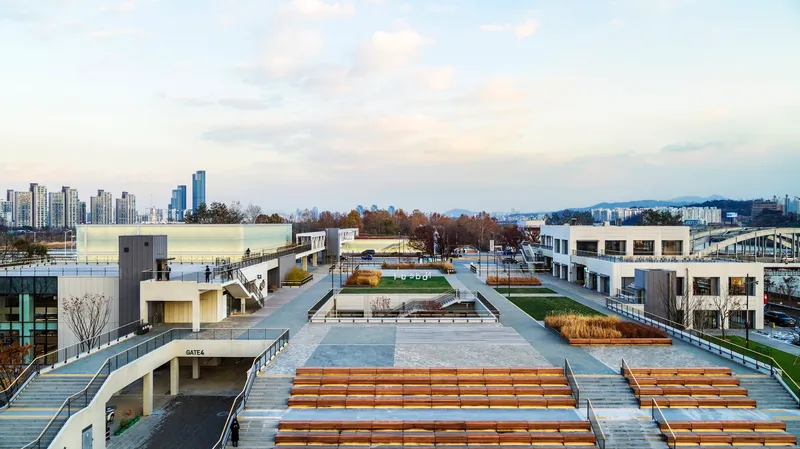
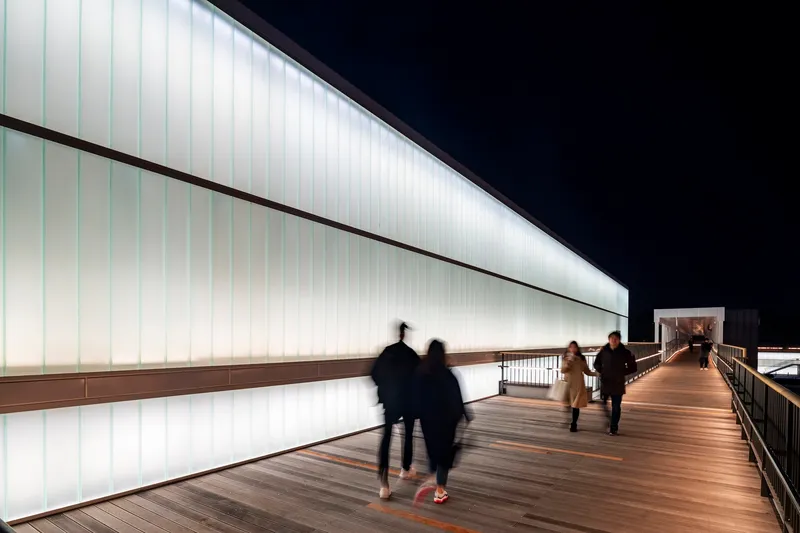
The most atmospheric moments happen in the in-between zones. Sunken courtyards with timber benches and planted beds glow beneath the elevated walkways at dusk, creating intimate pockets that feel protected without being enclosed. On the rooftop, stepped timber seating faces the Seoul skyline, turning the building's upper surface into a grandstand for the city itself.
At night, an elevated timber walkway runs alongside a backlit translucent panel wall, its warm glow pulling visitors along the path like a lantern on the river. These threshold conditions, neither fully inside nor fully outside, are where the project is most convincing as a piece of public space rather than a building that happens to be public.
Bridges and Connections

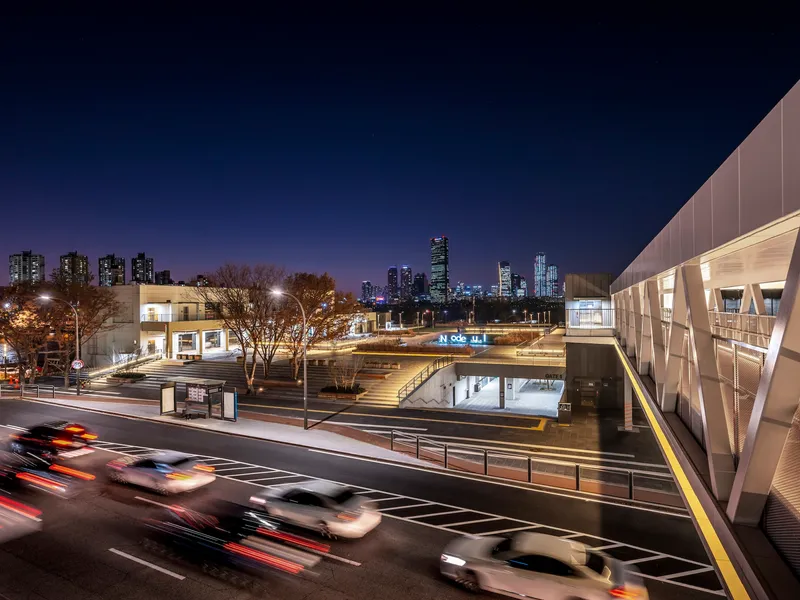

The white truss bridge crossing above the corrugated metal volumes is more than a circulation connector. It is the project's most legible gesture from the city scale, a signal that the island is once again inhabited. From the waterfront, the park reads as a low green mass punctuated by this single structural exclamation mark, giving the island an identity visible from both riverbanks.
The dusk views from across the river show how the project negotiates its peculiar urban condition. Flanked by lawns and a sunken plaza, the architecture settles into the water's edge with the quiet confidence of something that has always been there. The distant skyline reflection in the Han River completes the composition, reminding you that this island exists in the geographic center of a megacity of 10 million people.
Material and Modular Logic
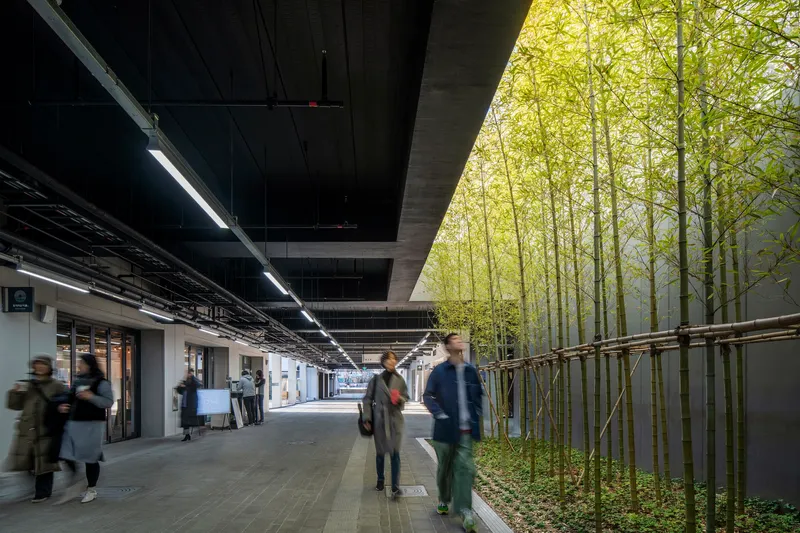
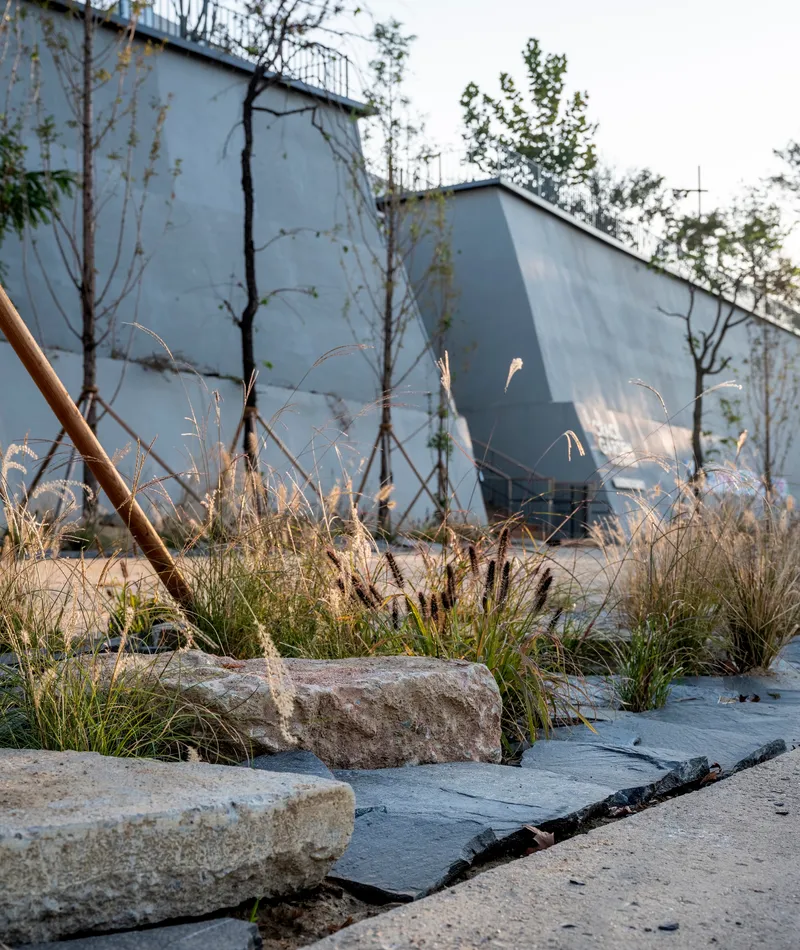
The material palette is deliberately limited: precast concrete, corrugated metal cladding, timber decking, and steel framing. Bamboo planting lines covered platform corridors under exposed concrete beams, softening the structural frankness without disguising it. Stone boulders and ornamental grasses populate the gaps between paving slabs, introducing texture at a scale you can touch.
The 10m x 10m modular grid was designed with expandability in mind, a framework for participatory design where future users define the character of individual spaces. The pre-installed flexible MEP system embedded within the grid anticipates change without requiring demolition, a quietly radical decision that acknowledges the unpredictability of public life on a site that has already been a bridge pier, a beach, and a wasteland.
Transit Interface

The transit platform level, with its exposed black ceiling and planted tree beds, acts as the project's most pragmatic layer. Waiting passengers sit among trees, a small gesture that reframes commuting as an encounter with the island rather than a pause between destinations. The covered corridor with bamboo planting along one edge extends this logic, treating even utilitarian circulation as landscape.
Plans and Drawings


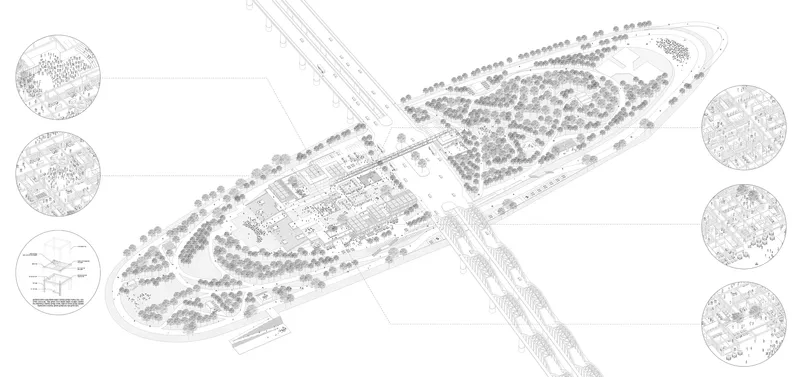

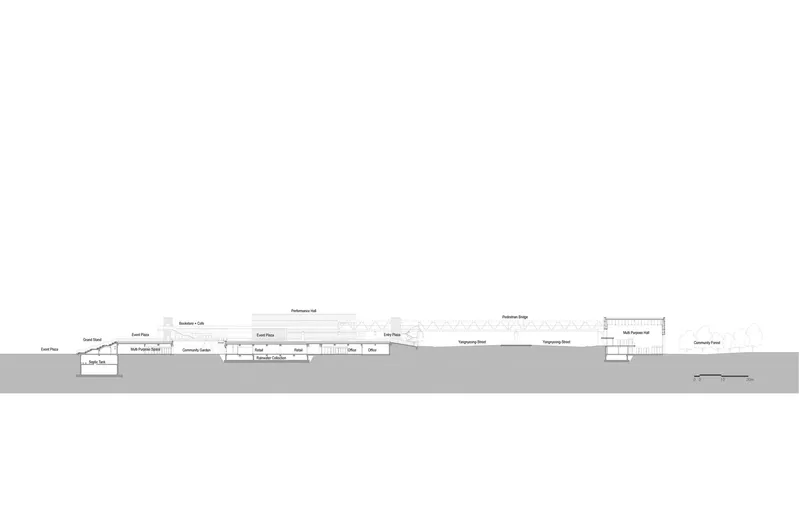
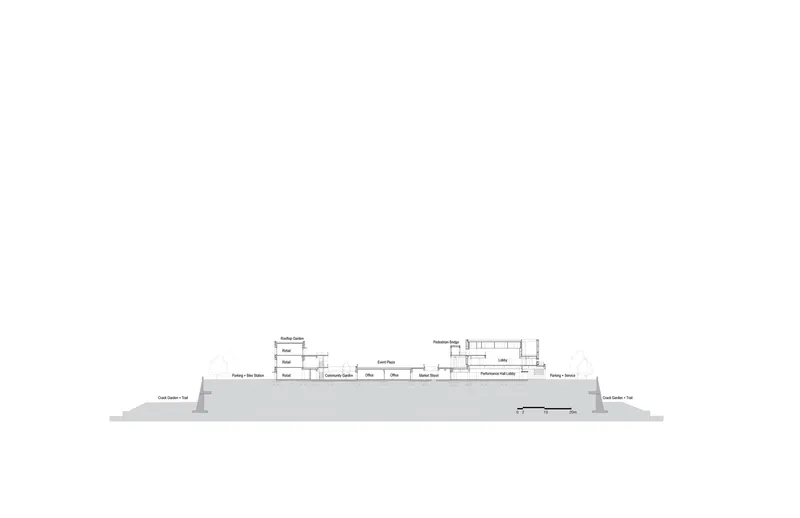

The site plans reveal what the photographs cannot fully communicate: the degree to which the central roadway infrastructure dominates the island's geometry. The building clusters are organized as a series of courtyards that mediate between the road's hard geometry and the organic edge of the island's planted perimeter. The axonometric drawing makes the village analogy explicit, showing figures populating courtyards, roof planes, and connecting bridges in a pattern that reads more like a neighborhood than a single complex.
The longitudinal sections are the most telling drawings. They show how the varied roof heights create a stepped profile that echoes the island's sloping context, and how the interior spaces alternate between compressed service zones and generous double-height halls. The sections also clarify the relationship between the upper bridge level and the lower landscape, confirming that the project's primary ambition is to reconcile these two planes into a continuous public experience.
Why This Project Matters
Nodeul Island Park matters because it takes on a problem that most architecture avoids: what to do with urban infrastructure that has outlived its original purpose but occupies irreplaceable real estate. The island is not a brownfield or a vacant lot; it is a geological anomaly created by engineering decisions made a century ago. mmkplus responded not by erasing that history but by adding another layer to it, treating the modular grid as the latest chapter in a site that has been continuously reshaped by human intervention since 1917.
The project also offers a compelling alternative to the signature cultural building. Instead of a single iconic form, mmkplus delivered a framework: an expandable village of programs, circulation loops, and landscape strategies that can absorb future change. In a city that builds fast and demolishes faster, that kind of patience is itself a radical act. Nodeul Island spent fifty years waiting. The architecture suggests it can afford to keep evolving for another fifty.
Nodeul Island Park by mmkplus, Seoul, South Korea. 9,620 m². Completed 2019. Photography by Hyun Jun Lee and Cheong-O Yu.
About the Studio
Share Your Own Work on uni.xyz
If projects like this are the kind of work you want to make, uni.xyz is a place to publish your own, find collaborators, and enter design competitions.


Popular Articles
Popular articles from the community


Faces of the Soviet Avant-Garde: Turning Moscow's Street Names into an Open-Air Museum
A network of sculptural installations across a Moscow residential district transforms forgotten architect names into spatial encounters with cultural memor

The Amber Palace Opera: A Geological Fiction Surfaces on Tallinn's Baltic Waterfront
Pierre Brillard reimagines a Baltic legend as a public landscape, opera house, and waterfront promenade rooted in Tallinn's coastal identity.

Singing Woman: Contemporary Architecture Inspired by Estonia’s Voice and the Sea
Singing Woman turns Estonia’s song culture into flowing opera house architecture, blending public life, landscape, sea, and national memory.

Manzana Morphosis: Stretching Barcelona's Grid into a Living Landscape for 2050
A radical reworking of the Eixample manzana turns density into a tool for generous public space, vertical ecology, and environmental performance.

Similar Reads
You might also enjoy these articles

Bao Huynh Watercolor Atelier: A Serene Art Retreat in Hội An
Bao Huynh Watercolor Atelier in Hội An blends multifunctional art spaces, sustainable design, local materials, and family-friendly living in a serene environment.

Atelier Macri Concept Store Interior Design by CASE-REAL
Atelier Macri store features a "ko" counter, walnut wood details, cork displays, blending retail, gallery, and seamless customer experiences.

Manuel Vargas Izquierdo Stadium and High-Performance Sports Center: Architectural Excellence in Jalpa de Méndez
The Manuel Vargas Izquierdo Stadium blends sustainable design, inclusive sports facilities, and cultural-inspired architecture, revitalizing Jalpa de Méndez’s public spaces.

KAKR Buluh Awar Hall: Revitalizing Community and Ecology Through Bamboo Architecture
Community built bamboo hall revitalizes Buluh Awar village, empowering youth, restoring ecology, celebrating vernacular craftsmanship through sustainable architecture and culture.

Comments (0)
Please login or sign up to add comments
No comments yet. Be the first to comment!