
Atelier Garcia Carves a Triangular Concrete Belvedere into a Colombian Hilltop
A 120-square-meter house in Guatapé, Colombia treats poured concrete as liquid rock, echoing the monolith it overlooks.


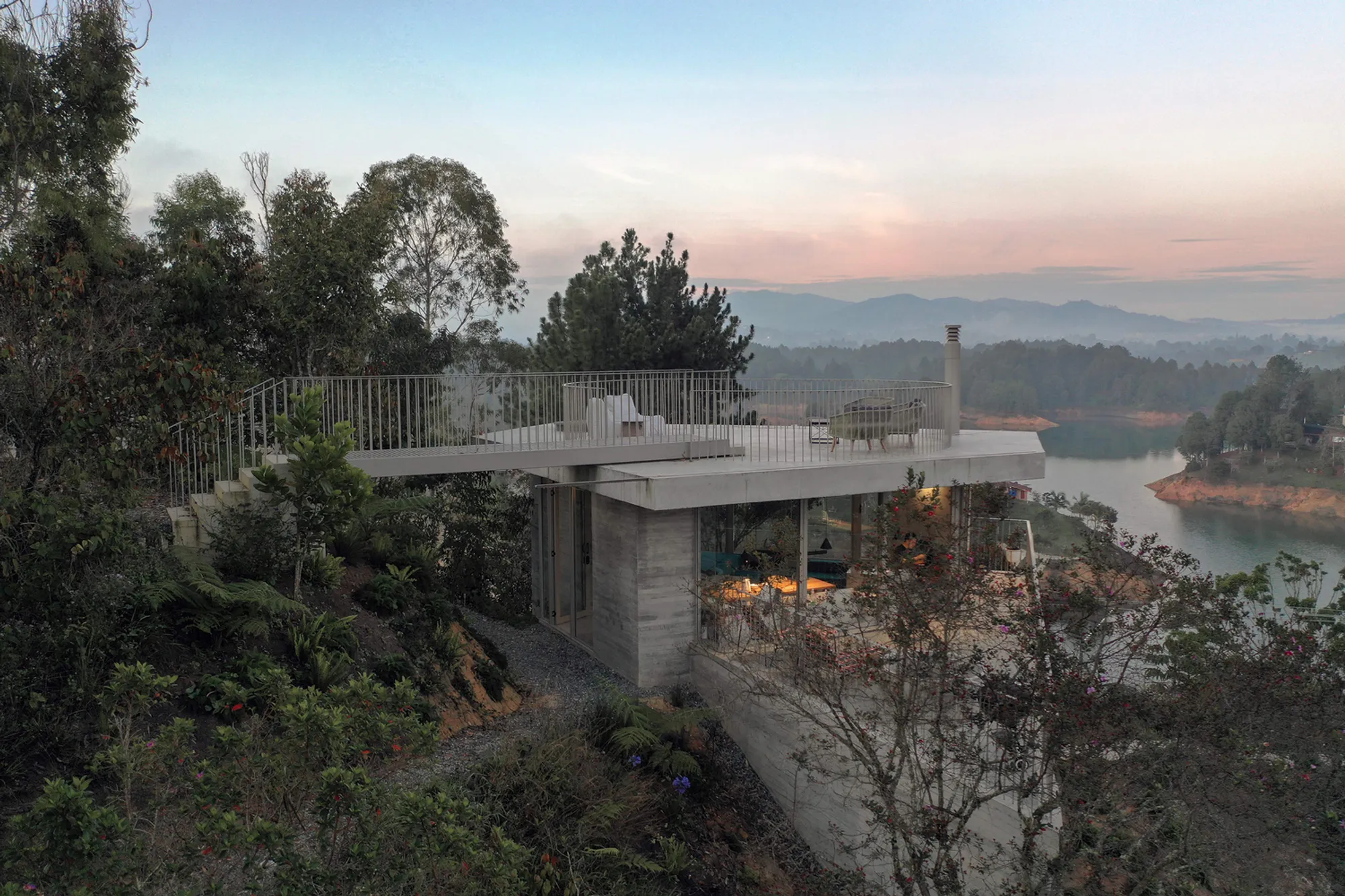
At the highest point of a 3.5-acre hillside site near Guatapé, Colombia, a house shaped like a wedge of stone emerges from the forest canopy. Designed by Atelier Garcia, led by Clara Arango and Orlando García, the Concrete House takes its triangular footprint directly from the angular topography beneath it. Rather than bulldozing a flat pad for a conventional rectangular plan, the architects let the land dictate the geometry. The result is 120 square meters of poured-in-place concrete that reads simultaneously as a lookout perched above the horizon and a shelter excavated from the mountain itself.
What makes the project genuinely compelling is how it compresses an enormous range of spatial experiences into a tiny area. Three structural columns, each with a different cross-section, do triple duty as structure, furniture, and circulation. A triangular fireplace anchors one corner. A rectangular hollow column hides a refrigerator and pantry. A cylindrical stair tower, lit from above by a skylight, spirals visitors up to a rooftop terrace with full 360-degree views of the Rock of El Peñol, the Guatapé reservoir, and layered mountain ridges beyond. The concrete itself, board-formed and left exposed inside and out, is treated as "liquid rock," a deliberate echo of the 950-foot monolith visible from nearly every room.
A Triangular Plan Born from the Terrain


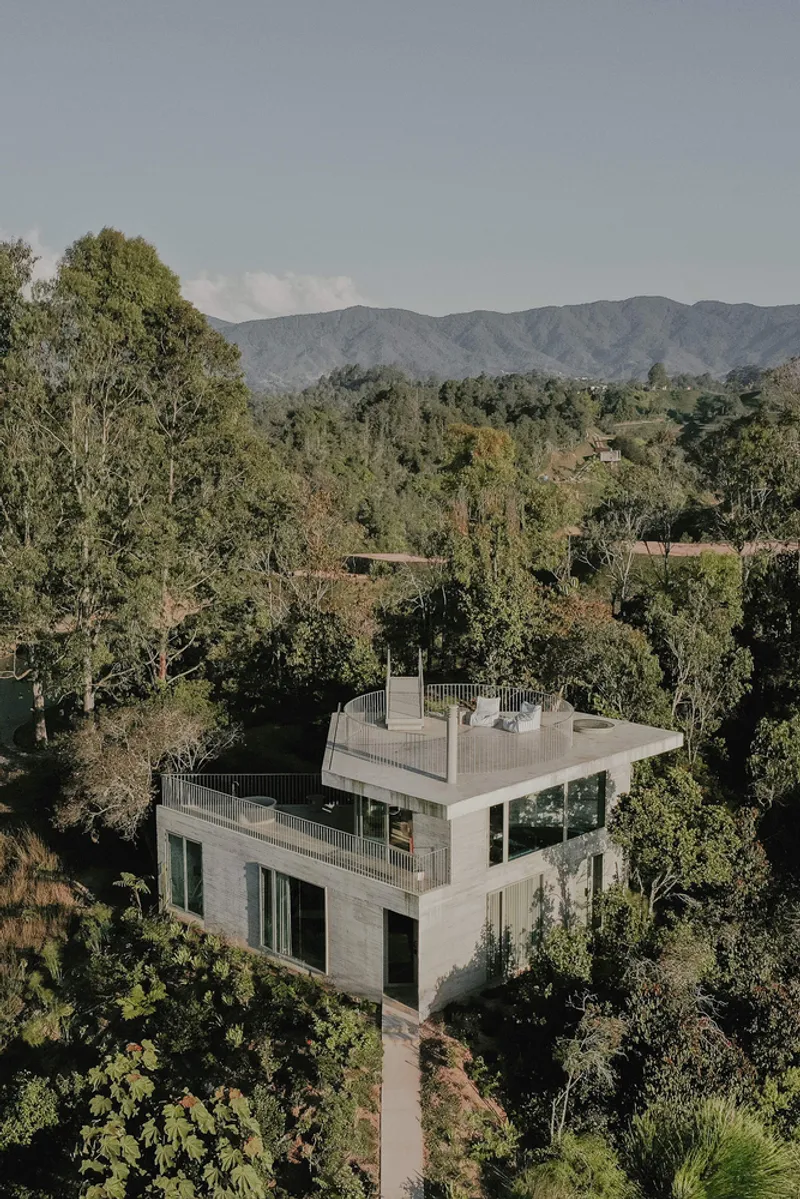
Seen from above, the logic is immediate. The building's three sides follow the natural contour lines as the ridge narrows toward its apex. Three axes organize movement through the house, converging at different programmatic moments: the fireplace, the stair, and the kitchen column. The aerial views reveal just how tightly the form hugs the ridge without disturbing the surrounding canopy, a deliberate decision to preserve both the terrain's structural integrity and its long-distance views.
Positioning the house at the tip of the hill also means every facade faces outward toward landscape rather than toward neighboring structures. It is a fundamentally centrifugal plan, pushing the eye and the body toward the horizon at every turn.
Concrete as Structure, Furniture, and Finish
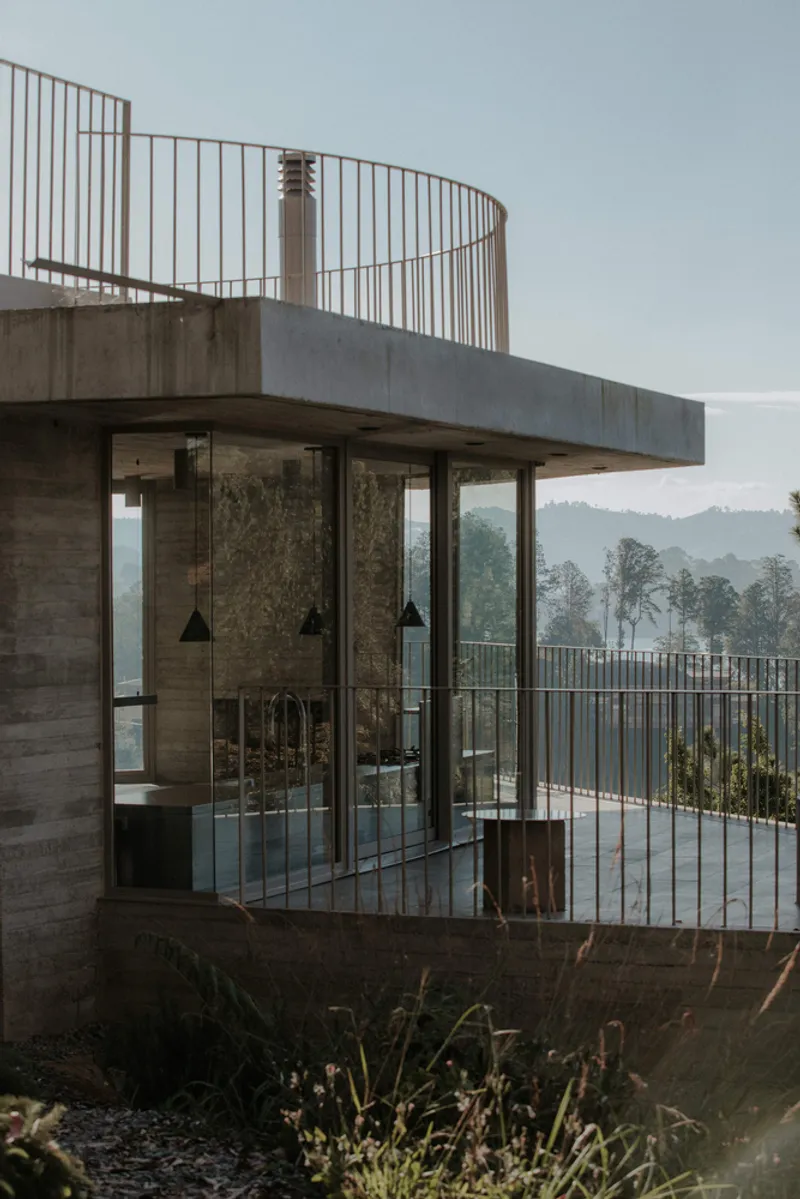
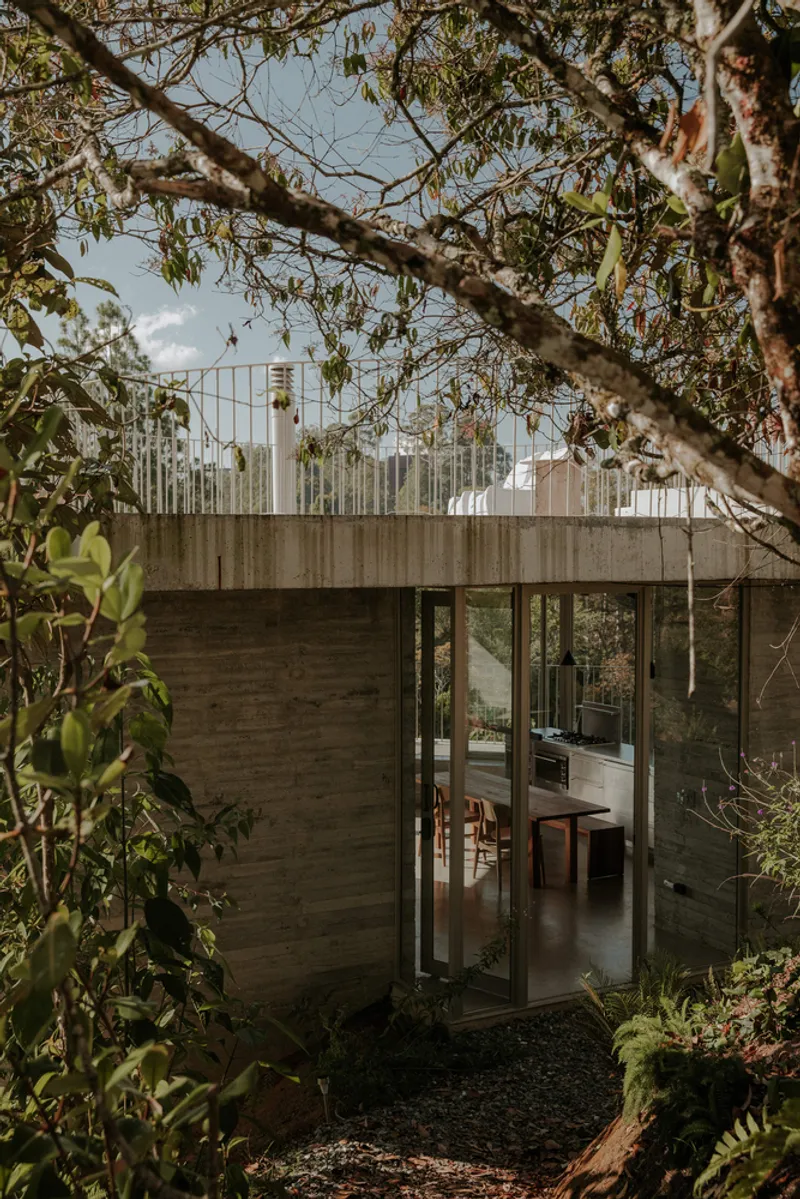
Board-formed concrete is the only significant material here, and Atelier Garcia treats it with a monomaniacal consistency that pays off. Horizontal formwork lines wrap the exterior walls, curve around the stair enclosure, and continue inside as headboards, counters, and ceiling planes. The material discipline means the house registers as a single carved object rather than an assembly of parts. Lightweight metal railings and floor-to-ceiling glazing provide contrast without competing.
In a climate like Guatapé's, where temperatures are mild but fluctuate between day and night, concrete's thermal mass is an asset. The thick walls absorb heat during the day and release it slowly after dark, reducing the need for mechanical conditioning. Southwest-facing overhangs limit solar gain through the extensive glass, ensuring that transparency does not come at the cost of comfort.
Two Worlds Stacked: Private Base, Open Pavilion


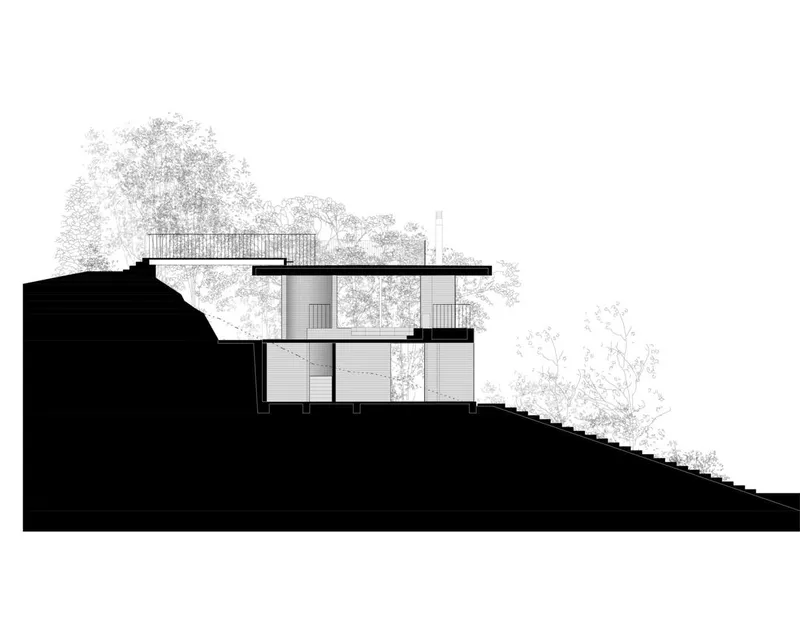
The sectional strategy is cleanly legible. A lower level sits partially embedded in the hillside, opening onto sloped gardens and forest. This is the private domain: bedrooms with walnut headboards set against raw concrete walls, a bathroom where dappled sunlight filters through foliage onto marble surfaces. The compression of these rooms, low ceilings, earth on three sides, creates genuine intimacy without claustrophobia.
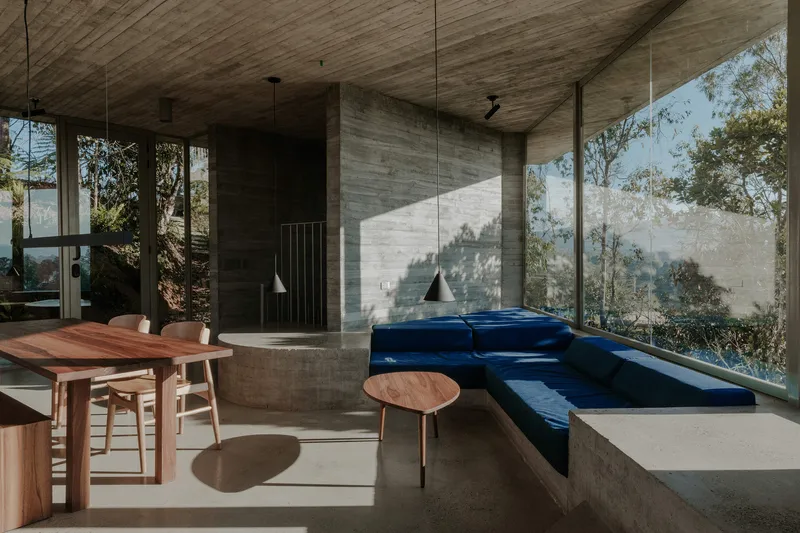
Step upstairs and the mood flips entirely. The upper floor is a transparent pavilion where glazed walls dissolve the enclosure on nearly every side. The living space, with its blue upholstered built-in seating and timber ceiling plane, catches afternoon sun while framing misty hillside views through the glass. This inversion of heavy below and light above gives the house its distinctive silhouette: a solid plinth crowned by an almost weightless room.
Three Columns, Three Geometries
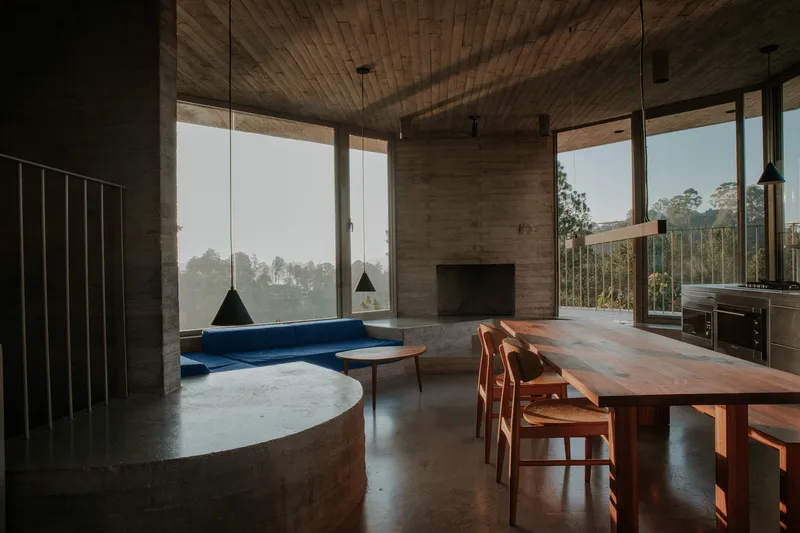
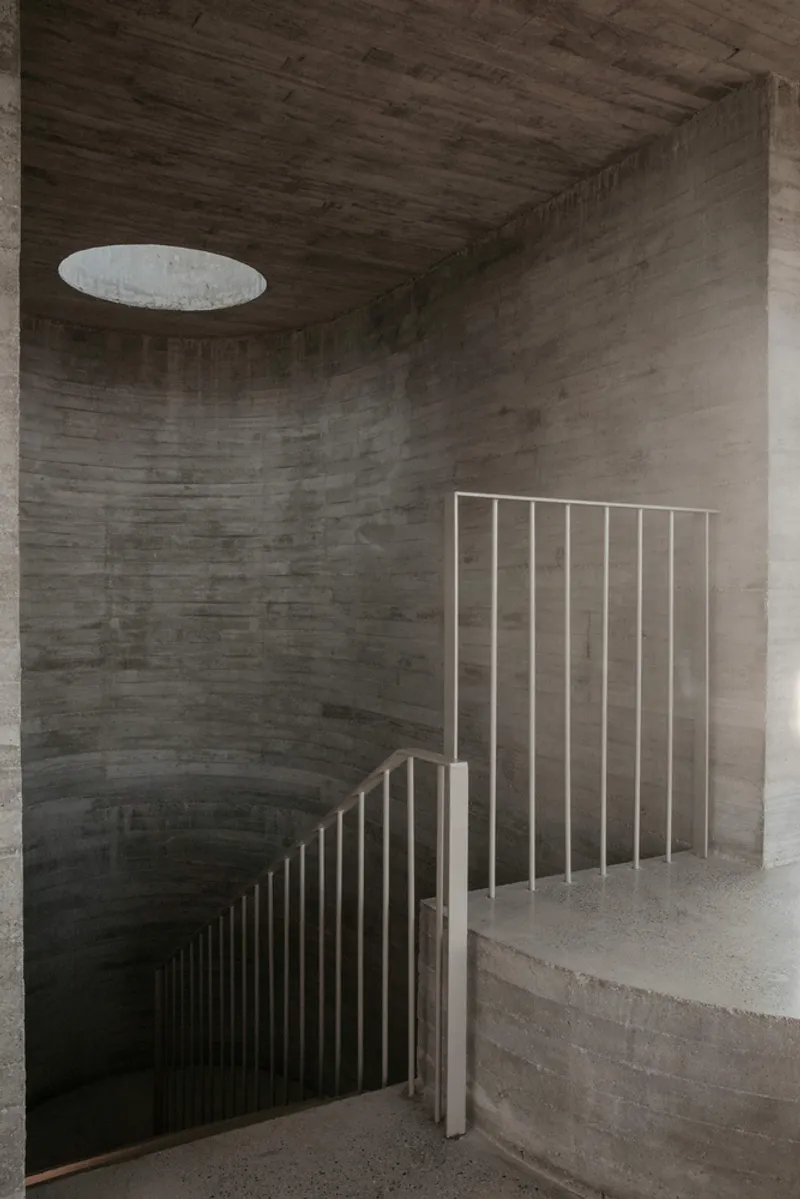
The three structural columns are the most inventive element here. Instead of relegating structure to the background, Atelier Garcia foregrounds it as the primary spatial organizer. The triangular fireplace column anchors the living area and directs circulation around it. The rectangular hollow column solves the perennial small-house problem of where to put the kitchen storage without adding cabinetry that would clutter the open plan. And the circular stair column, shaped with horizontal wooden formwork into a smooth curve, becomes the building's vertical spine, pulling daylight down through a skylight and distributing it along the spiral.
Each column has a different geometric cross-section, a move that could feel arbitrary but here reads as a direct response to program. Form follows function in the most literal sense: the column's shape is the shape of the thing it contains.
The Rooftop Terrace as Destination
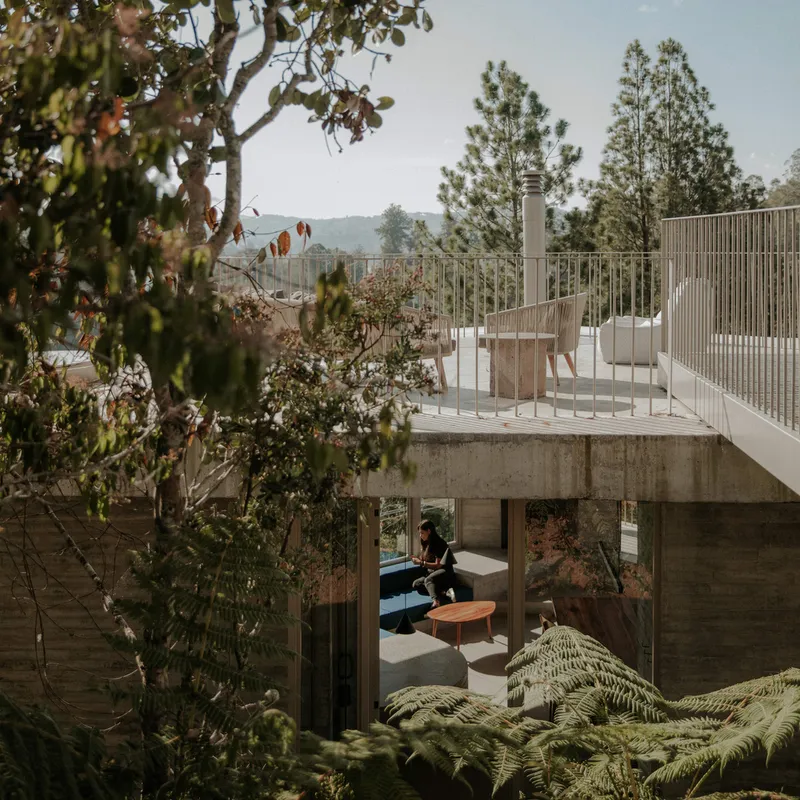

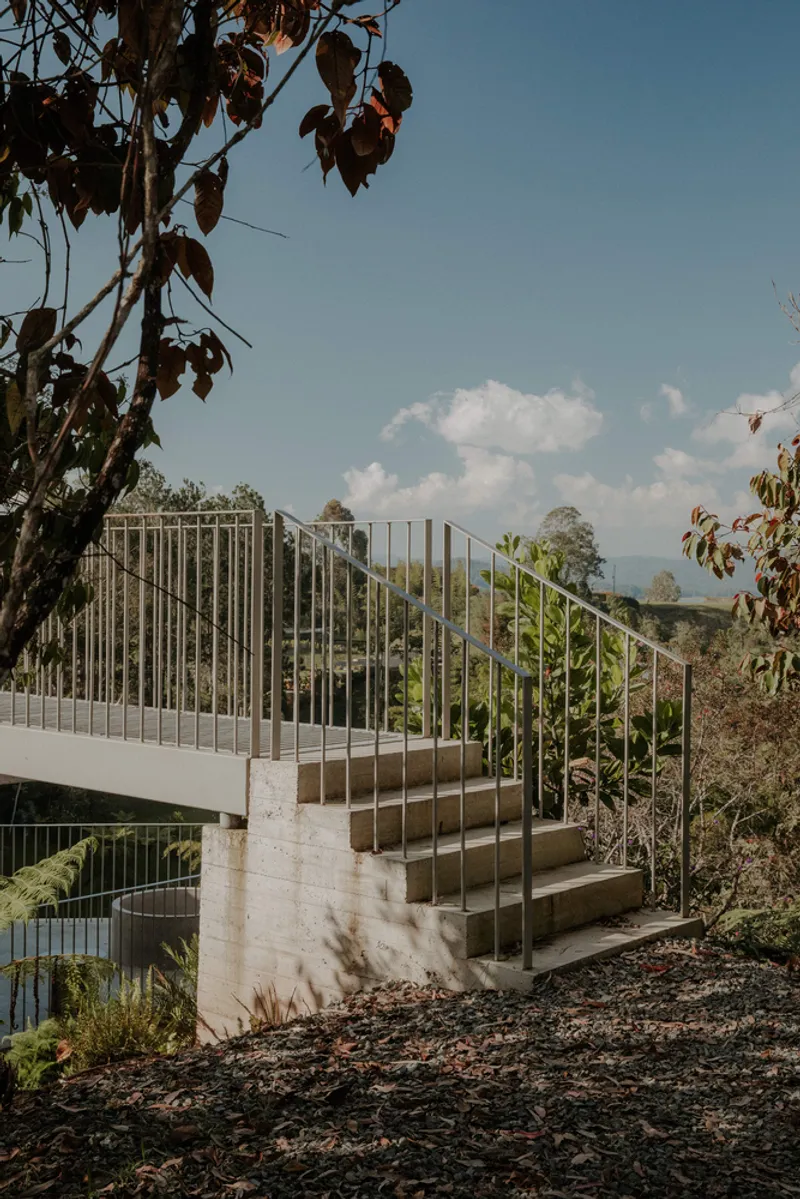
An organic pathway through the garden leads to a bridge that connects to the rooftop, transforming the roof into something more than a fifth facade. It becomes a room without walls. The circular terrace, ringed by vertical steel rod railings, offers the promised 360-degree panorama: reservoir to one side, mountains to the other, the Rock of El Peñol anchoring the middle distance. White seating and a cylindrical chimney punctuate the concrete deck.
The exterior staircase ascending through planted terraces reinforces the idea that the house is not just a building to enter but a landscape to ascend. You move from forest floor to embedded rooms to open pavilion to sky terrace, each level more exposed than the last. The sequence is cinematic, calibrated to build anticipation before delivering the view.
Landscape Thresholds
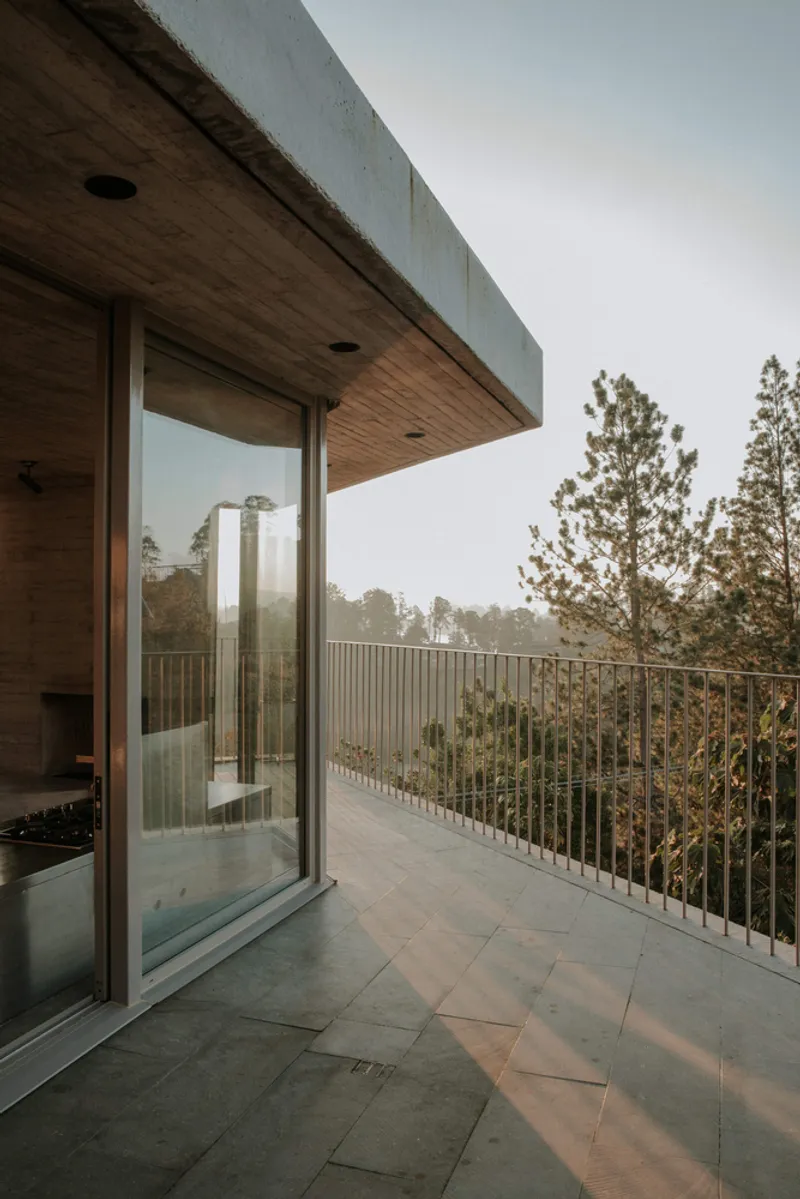

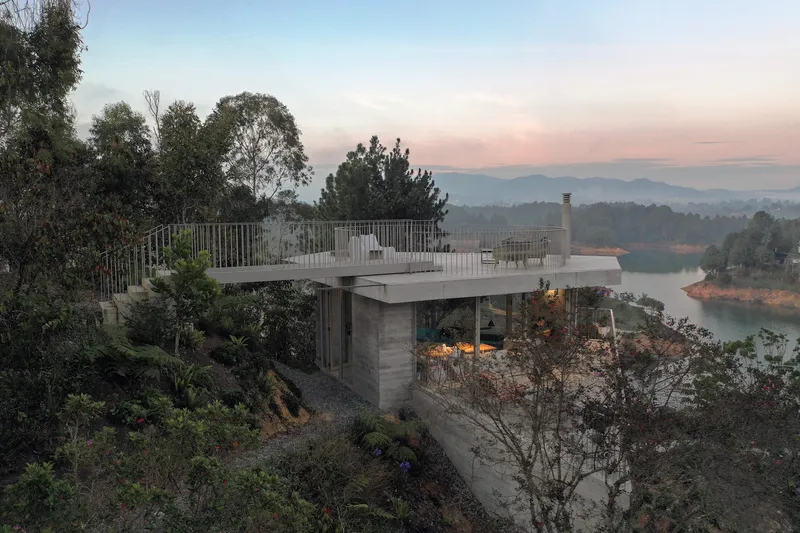
The covered terrace on the upper level, with its timber soffit and sliding glass doors, serves as the main threshold between inside and out. When the glass is open, the living room and the landscape become one continuous surface. When closed, the vertical rod railing still permits unobstructed views while signaling the edge of the habitable zone. At dusk, with the reservoir reflecting the last light and mountain ridges layering into blue silhouettes, the terrace becomes the most compelling room in the house.
From the hillside, the cantilevered roof deck reads as a sharp horizontal line cutting through the vegetation, giving the house a presence far larger than its modest footprint suggests. The two-story volume rising from the slope is confident without being aggressive, a piece of infrastructure that the mountain appears to have accepted.
Plans and Drawings

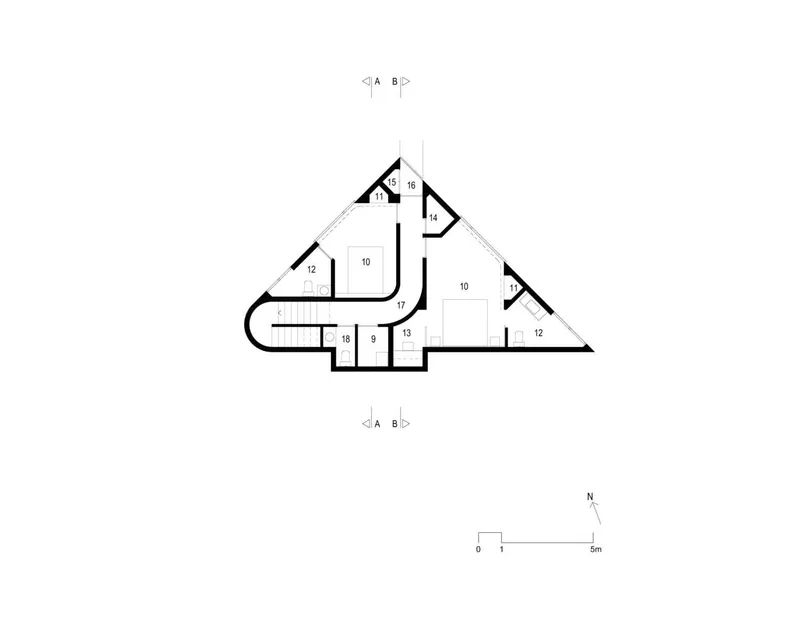
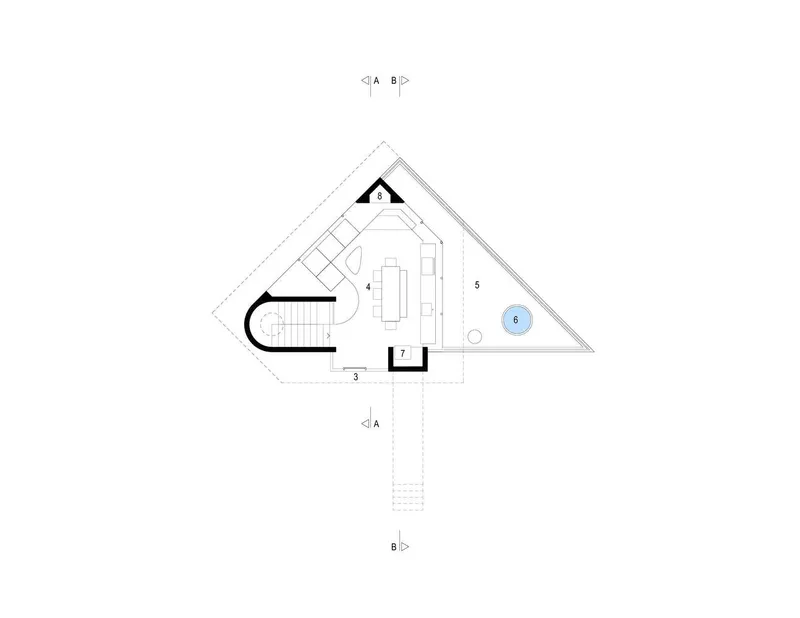

The drawings make the triangular logic explicit. The site plan shows how the building footprint tapers to follow the ridge's narrowing crest, with contour lines confirming the steep drop on all three sides. Two floor plans reveal the arrangement: a curved entry wall funnels visitors inward on the lower level, while the upper plan opens outward toward the landscape on every axis. The roof plan shows the circular element, likely a plunge pool or terrace feature, connected by the bridge path.
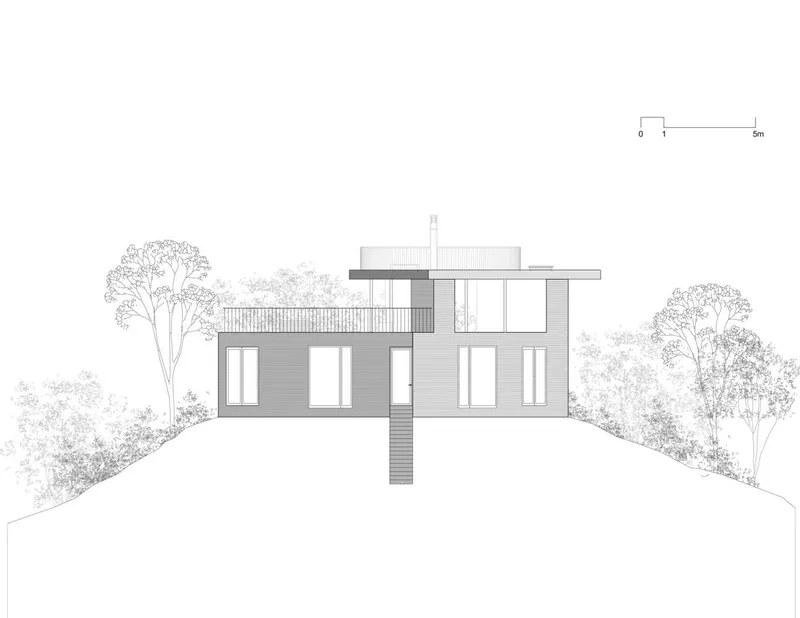
The section is perhaps the most revealing drawing. It confirms that the lower level is genuinely embedded in the slope, with the terrain rising to meet the walls on one side while falling away dramatically on the other. Trees are drawn at the same scale as the house, a reminder that the structure is a minor intervention within a much larger natural system. The elevation shows horizontal volumes stacked with the central entry stair bridging the grade change, the whole composition reading as a geological stratum rather than an imposed object.
Why This Project Matters
Small houses on dramatic sites risk two common failures: either they try to be invisible, disappearing into the landscape through excessive deference, or they try to dominate it with oversized gestures. Atelier Garcia avoids both traps. The Concrete House is unambiguously present, a geometric object made of a single heavy material, yet its geometry is the geometry of the land itself. The triangular plan is not an imposed diagram; it is the shape that the ridge already suggested. The concrete is not an alien import; it echoes the monolithic rock that defines the region's identity.
At 120 square meters, the house also proves that spatial richness does not require spatial excess. By assigning multiple roles to every element, from columns that store kitchens to roofs that become terraces, the architects extract a remarkable density of experience from a compact footprint. For anyone designing on steep terrain with limited area, this project offers a clear lesson: let the site draw the plan, let the structure do the work, and trust a single material to carry the whole argument.
Concrete House by Atelier Garcia (Clara Arango and Orlando García), Guatapé, Antioquia, Colombia. 120 square meters. Completed 2023. Photography by Mateo Soto.
About the Studio
Share Your Own Work on uni.xyz
If projects like this are the kind of work you want to make, uni.xyz is a place to publish your own, find collaborators, and enter design competitions.




Popular Articles
Popular articles from the community


Play: Fragments of Their World
Familiar architecture becomes modular playground design, creating safe spaces where displaced children can learn, connect, imagine and play.

Conexión: Biophilic Design Reimagines High-Rise Living in Hong Kong
Conexión reimagines high-rise living in Hong Kong through biophilic design, green facades, shared spaces, daylight, water and nature within.

The Musturak Paradise: Senior Living Architecture for a Connected Future in Temara, Morocco
The Musturak Paradise reimagines senior living architecture in Temara via private homes, social spaces, culture, community, and shared care.

Co-life: Sustainable Architecture for Age-Friendly Community Living
Co-life reimagines sustainable architecture for seniors through courtyards, rammed earth, shared gardens, and spaces designed for belonging.


Similar Reads
You might also enjoy these articles


Hodi-Mandai Geram
Project Function: Preservation and revitalization of the Intangible heritage and socio-spatial identity of the Hodi by Housing, Cultural Memory Center, Sacred Grove, landscape, local tourism economy


Olio Towers: A Mid-Rise for Performers That Fuses Housing, Rehearsal, and Stage
Located blocks from Houston's Theater District, this modular tower stacks living units around a central performance atrium.

Oasis: Modular Green Housing Carved into Dhaka's Urban Fabric
A shortlisted Plugin Housing entry reclaims unauthorized settlements in Dhaka with stepped concrete volumes, green roofs, and ventilation-driven design.

Black Hole: A Floating Megastructure for the Post-Physical Era
Emiliano Mazzarotto envisions a spherical, self-scaling arena where e-sports, digital hotels, and holographic stadiums replace traditional public space.

Explore Eco-concrete Competitions
Discover active competitions in this discipline



Challenge to reimagine the Iron Throne


Photograph architecture without architects


Illustrate the lost glory of Angkor Wat - Render Challenge


Design challenge to reuse E-waste
Comments (0)
Please login or sign up to add comments
No comments yet. Be the first to comment!