
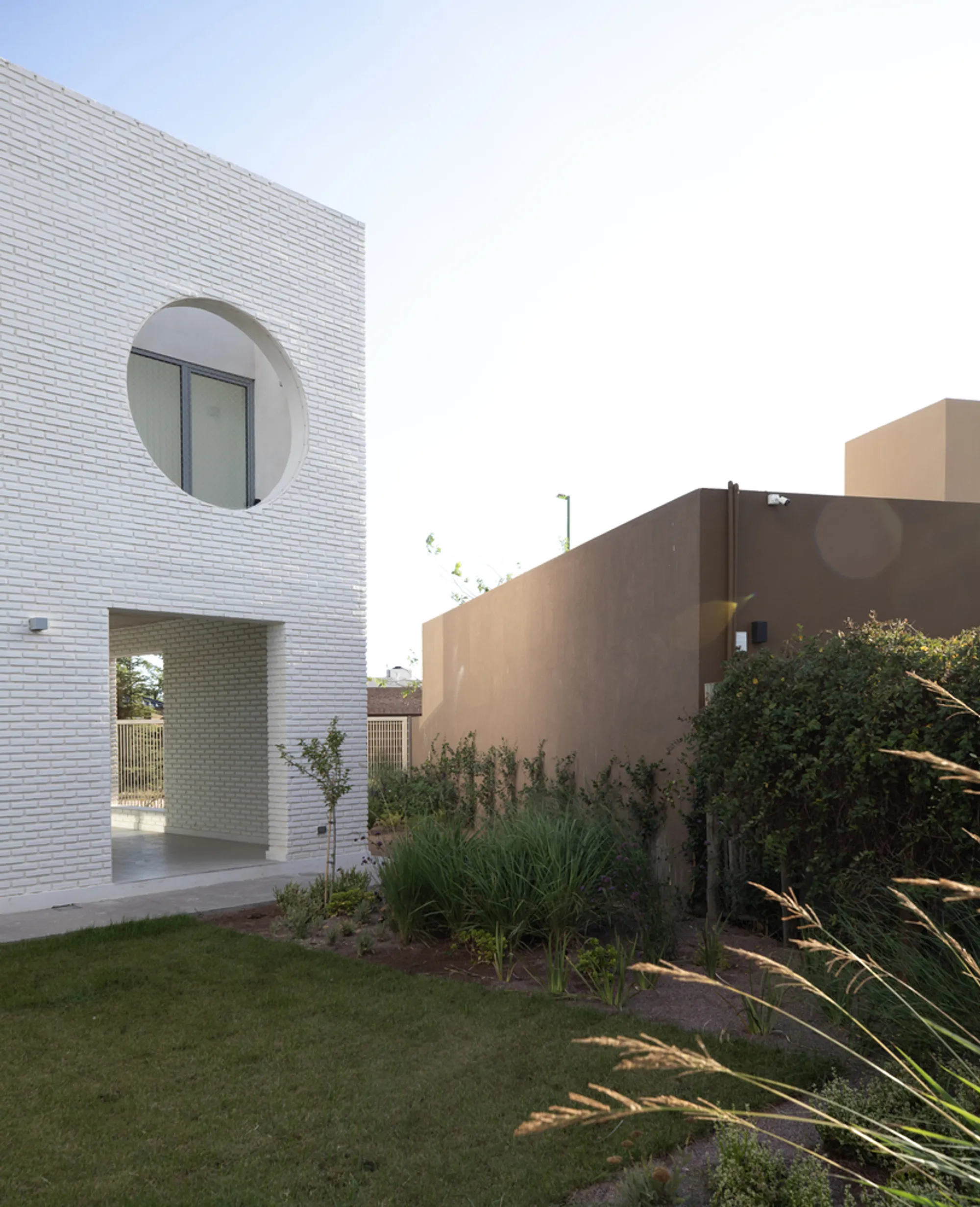
FLORA Carves Circular Openings into a White Brick House in Brazil
House 104 pairs robust masonry with playful geometries, turning a modest residential plot into a sequence of framed courtyards and light wells.


There is a particular kind of restraint that makes a house feel generous rather than austere. House 104, designed by studio FLORA, operates in that narrow register: white brick walls, exposed concrete ceilings, circular and arched apertures, and not much else. The result is a home that reads as both monolithic and porous, a solid volume perforated just enough to let light, air, and vegetation filter through.
What makes House 104 worth studying is the economy of its architectural language. FLORA relies on a single material palette, white brick and raw concrete, then generates variety almost exclusively through the shape, size, and placement of openings. A coral-red door. A circular window punched into a blank facade. An arched passageway that frames a garden. Each move is simple in isolation but accumulative in effect, producing a house that feels spatially rich without ever resorting to formal gymnastics.
The Street Face: A Quiet Provocation
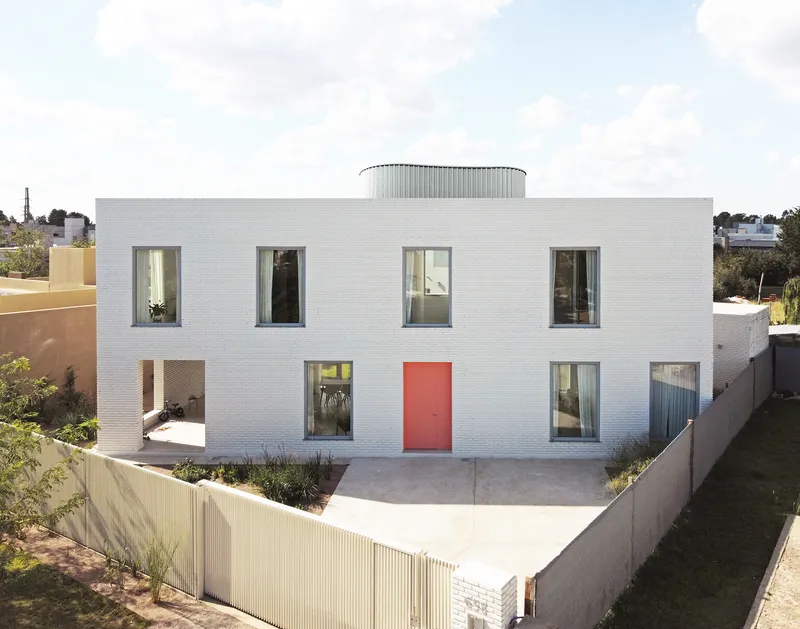
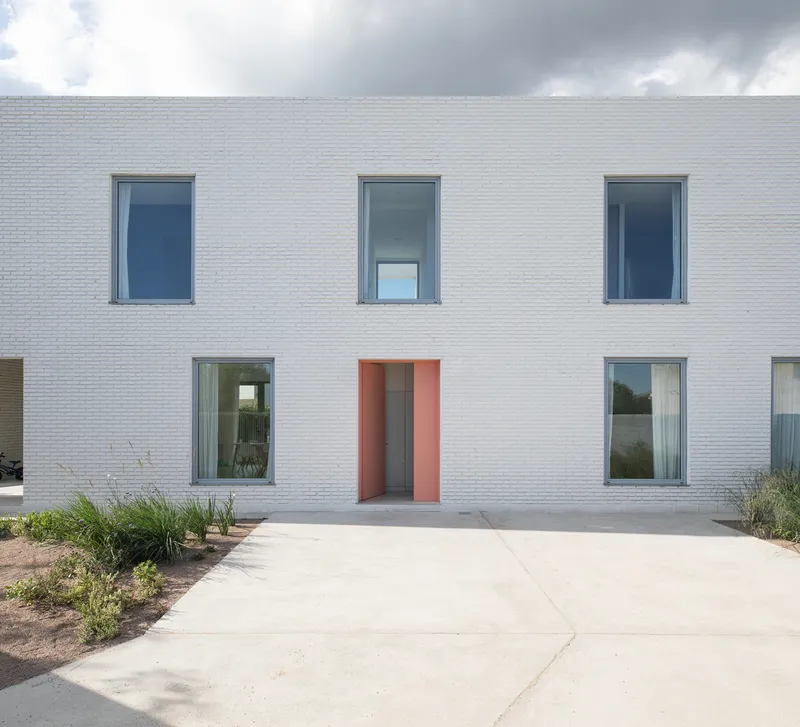
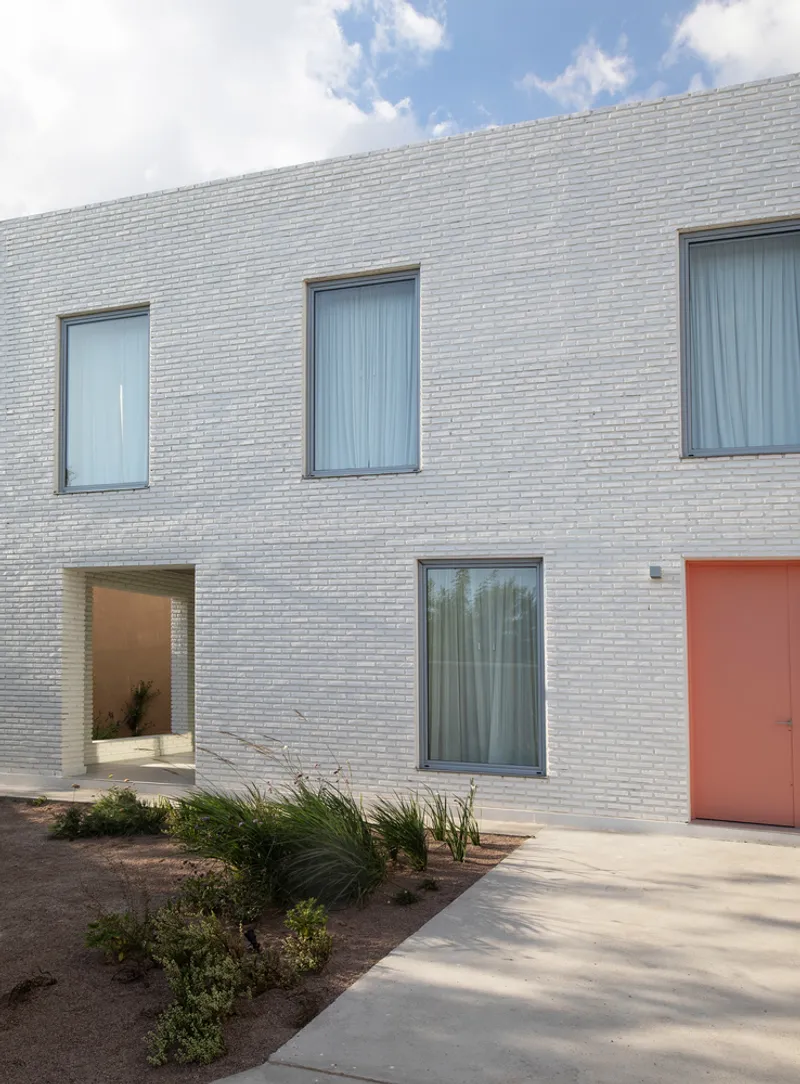
From the street, House 104 presents a deliberately reticent face. The white brick wall rises with almost no fenestration, broken only by a deeply recessed coral-red entry door. That door is the only chromatic event on the facade, and its saturated warmth against the pale masonry does more compositional work than an elaborate entrance canopy ever could. The recessed threshold creates a compressed, shadowed zone before you cross inside, a spatial beat that slows the transition from public sidewalk to private interior.
Above, a cylindrical element pushes through the roofline like a periscope. It hints at the circular geometry that recurs throughout the house but gives nothing else away. FLORA understands that a street facade in a residential neighborhood does not need to perform. It needs to protect, suggest, and occasionally surprise.
Circular Openings and Arched Passageways
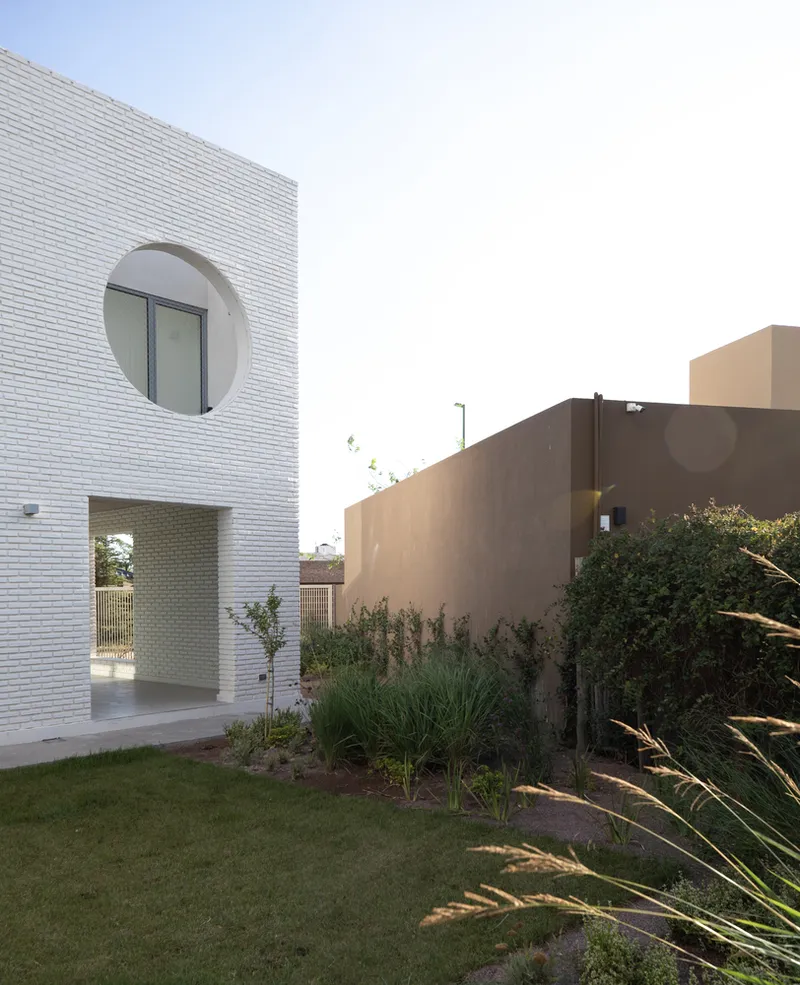
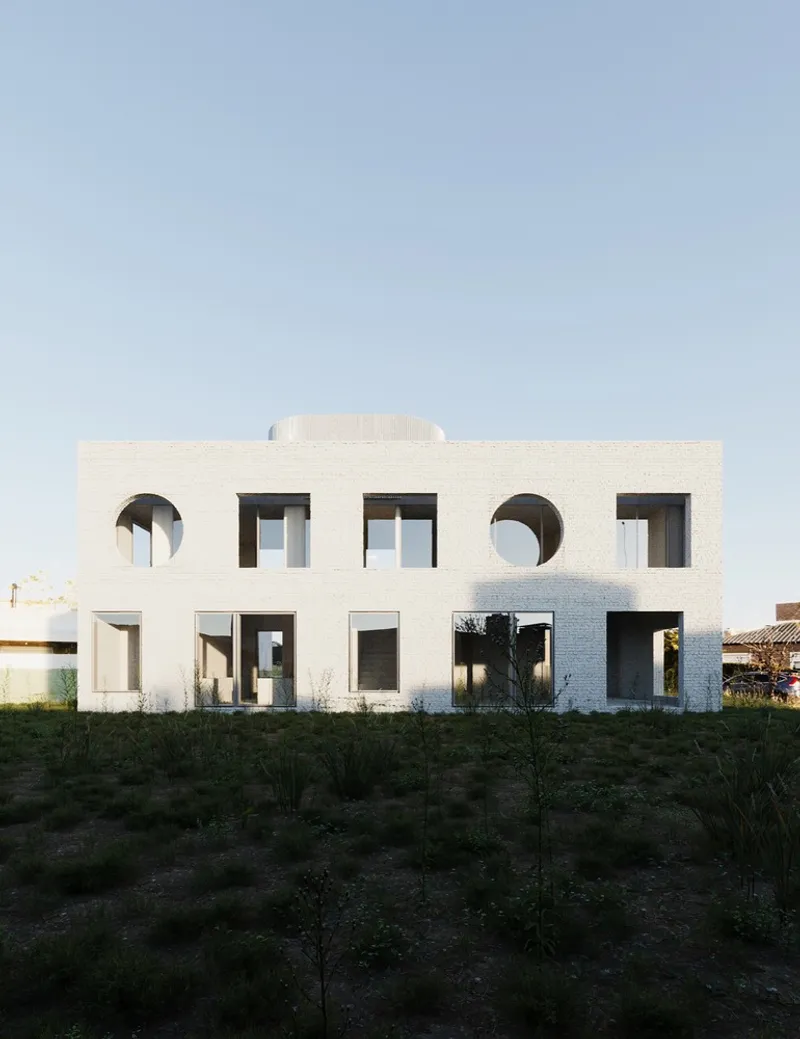
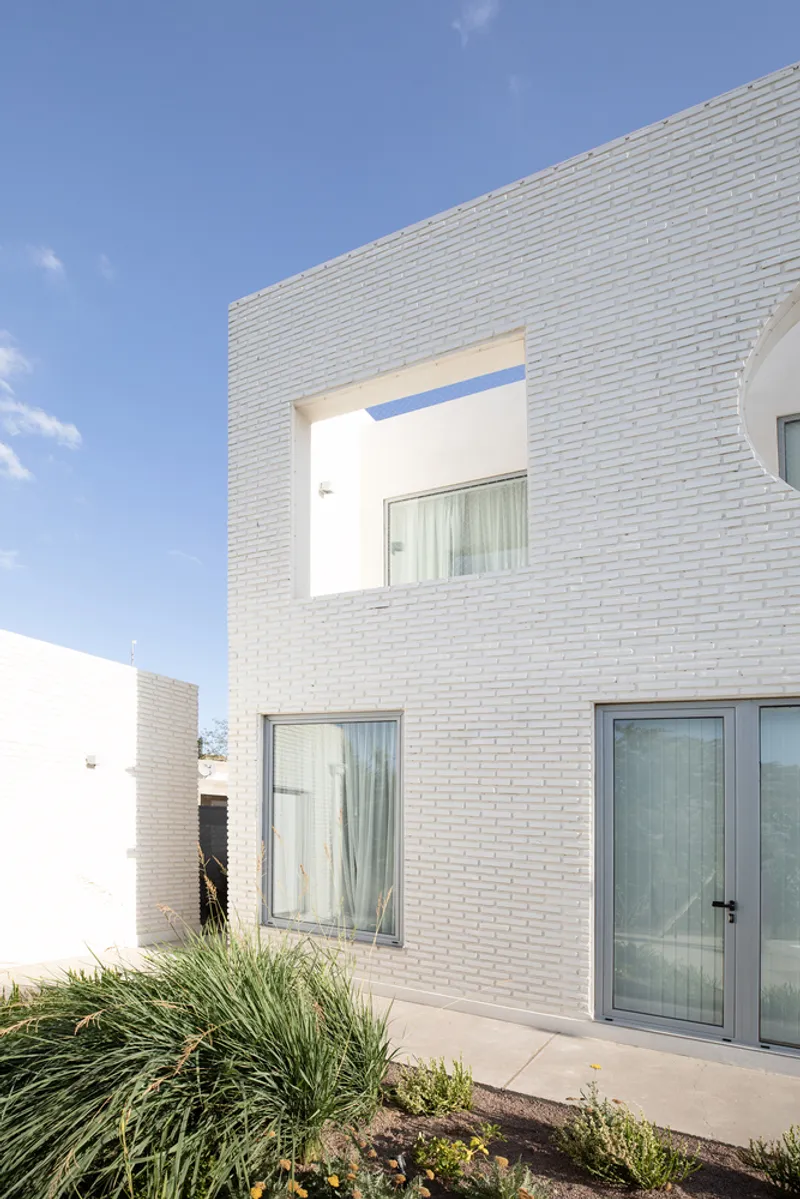
The circular window is the signature motif of House 104. It appears on multiple facades and at different scales, always punched cleanly through the white brick skin. These openings avoid the banality of standard rectangular windows by introducing a geometry that the eye has to work slightly harder to read. They cast round pools of light onto interior surfaces and frame views of sky and vegetation as deliberate compositions rather than casual glimpses.
An arched passageway at ground level opens directly onto a planted garden, collapsing the boundary between built form and landscape. The arch is generous enough to feel like a threshold between two outdoor rooms rather than a simple doorway. FLORA treats each opening as a designed event: the shape, the depth of the reveal, the material edge are all calibrated to control how much of the outside world is admitted.
Courtyards and the In-Between
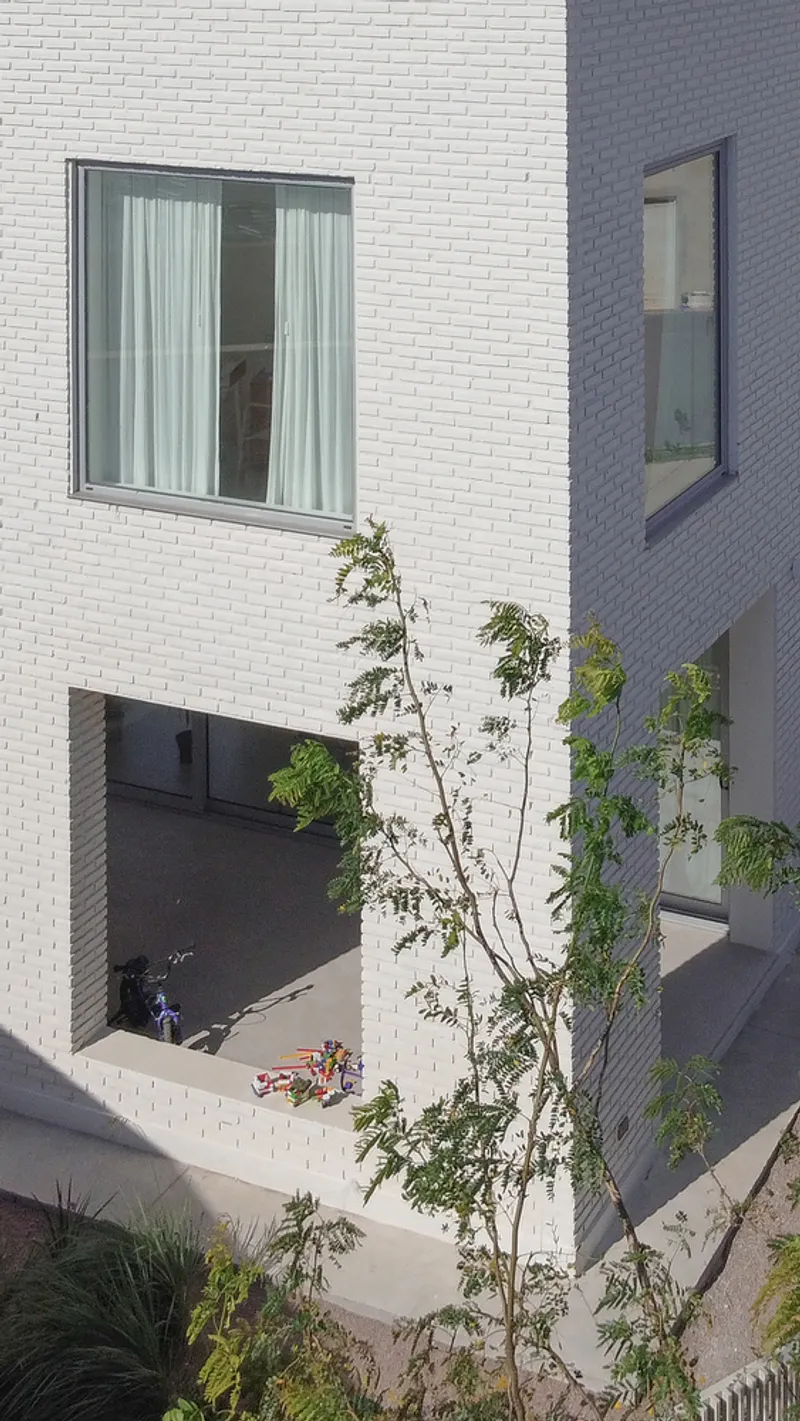
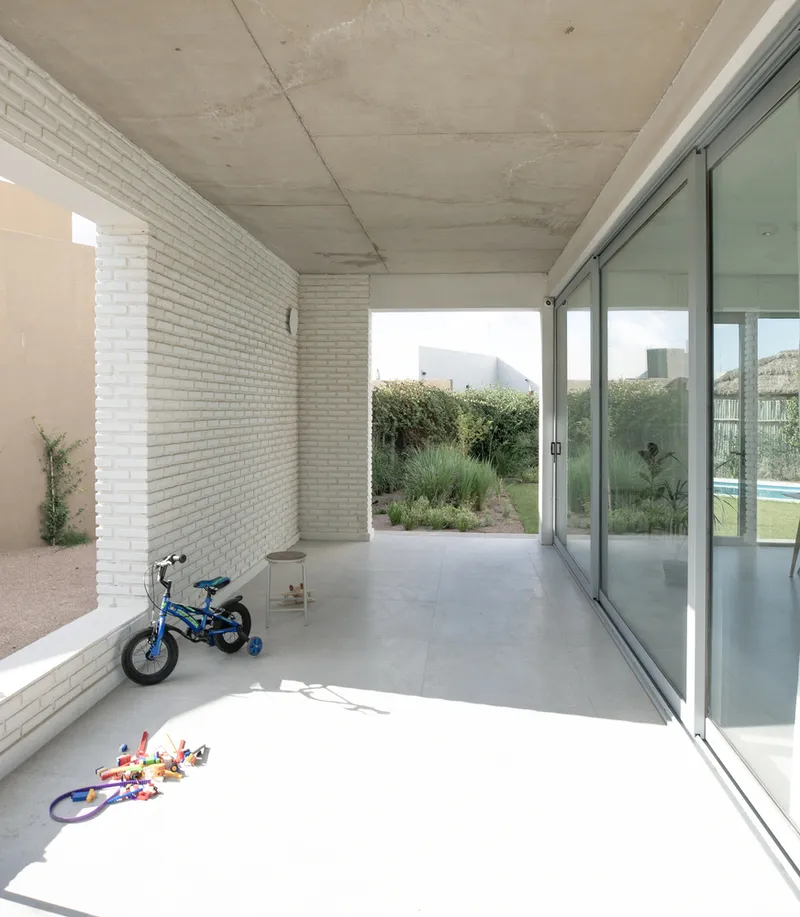
Seen from above, the plan reveals itself as two white brick volumes separated by an open courtyard. A young tree anchors the space, and concrete paving runs between the masses, creating a ground plane that belongs to neither inside nor outside. The courtyard is tight enough to feel intimate but tall enough, bounded by two-storey walls, to channel light downward in a controlled, almost theatrical way.
Covered patios at the edges of the courtyard extend the living area into the open air. Exposed concrete soffits overhead reinforce the structural honesty of the house while providing shade. Planted beds with ornamental grasses soften the mineral palette and introduce a layer of seasonal change to an otherwise permanent material scheme.
Interior Light and Material Contrast
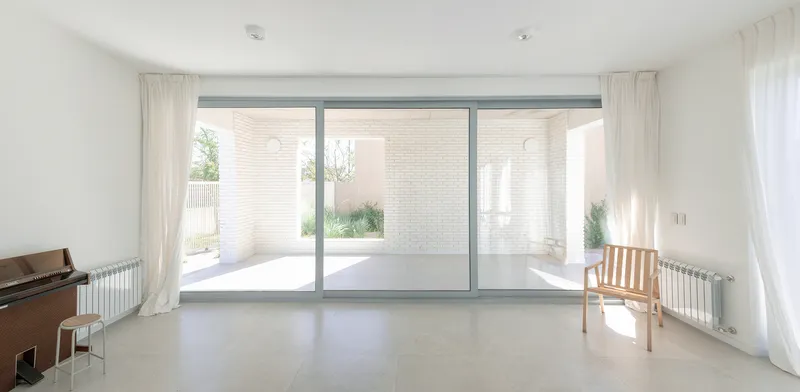
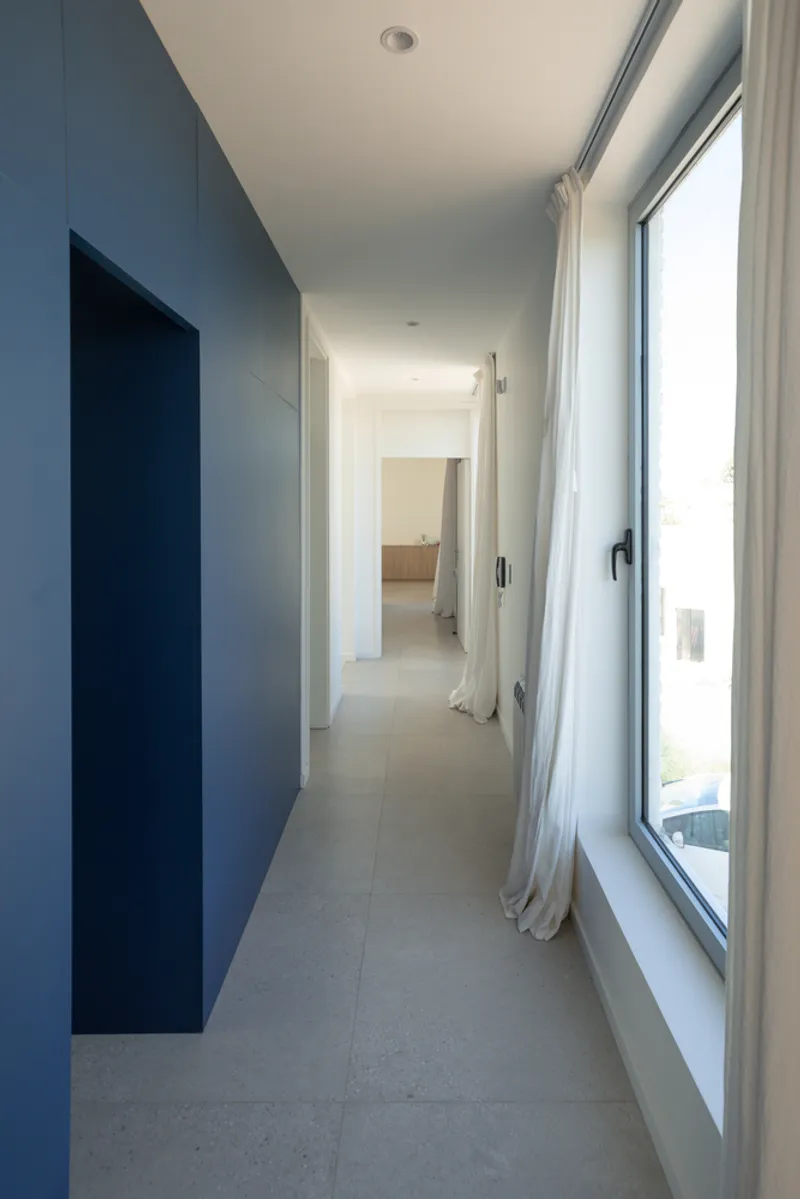
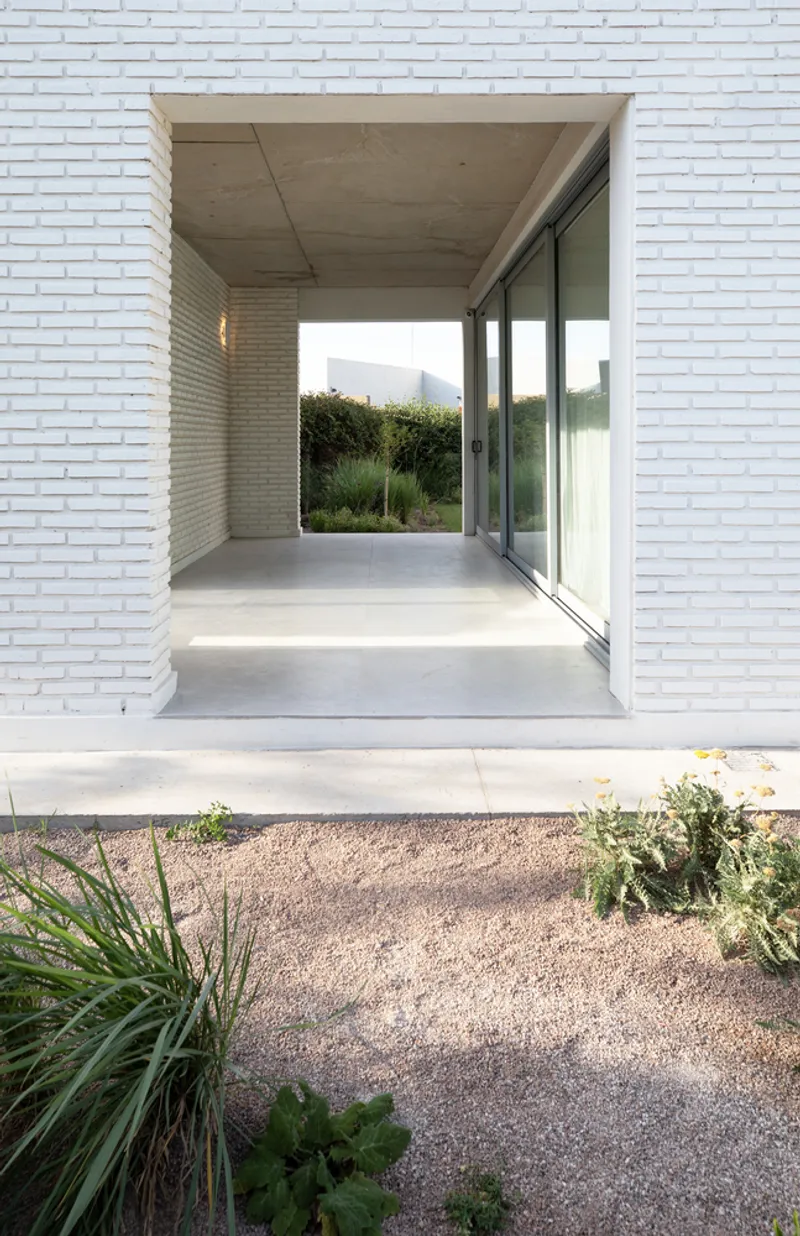
Inside, the restrained palette opens up just enough to register variation. A corridor wall painted in deep blue introduces a moody counterpoint to the pervasive whiteness, while full-height windows with sheer curtains diffuse daylight into soft, even washes. FLORA avoids the common trap of letting natural light flood every room indiscriminately. Instead, windows are placed to create specific lighting conditions: a glazed wall looking onto the courtyard garden, a recessed porch that frames distant vegetation through a single glass plane.
The interplay between the dark blue accent wall and the white brick courtyard visible through the glass establishes a clear interior-exterior dialogue. You always know where you are relative to the garden, but the house never feels transparent. Privacy and openness coexist through careful sectional layering.
After Dark: A Different Building
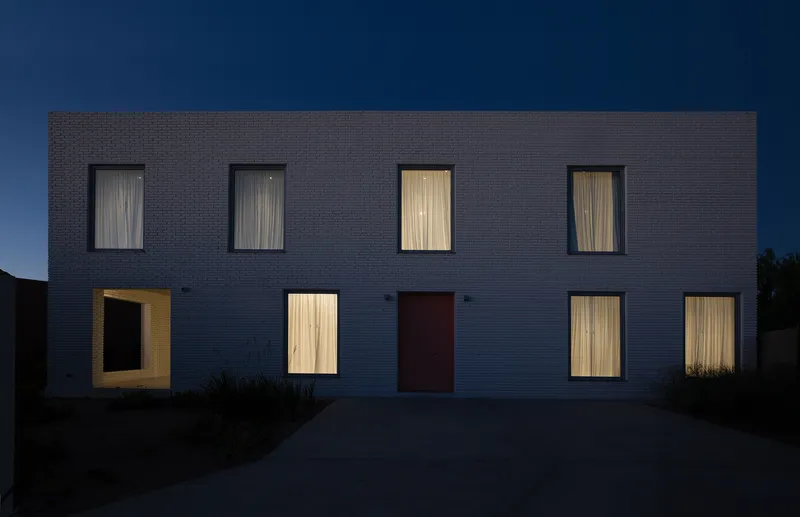
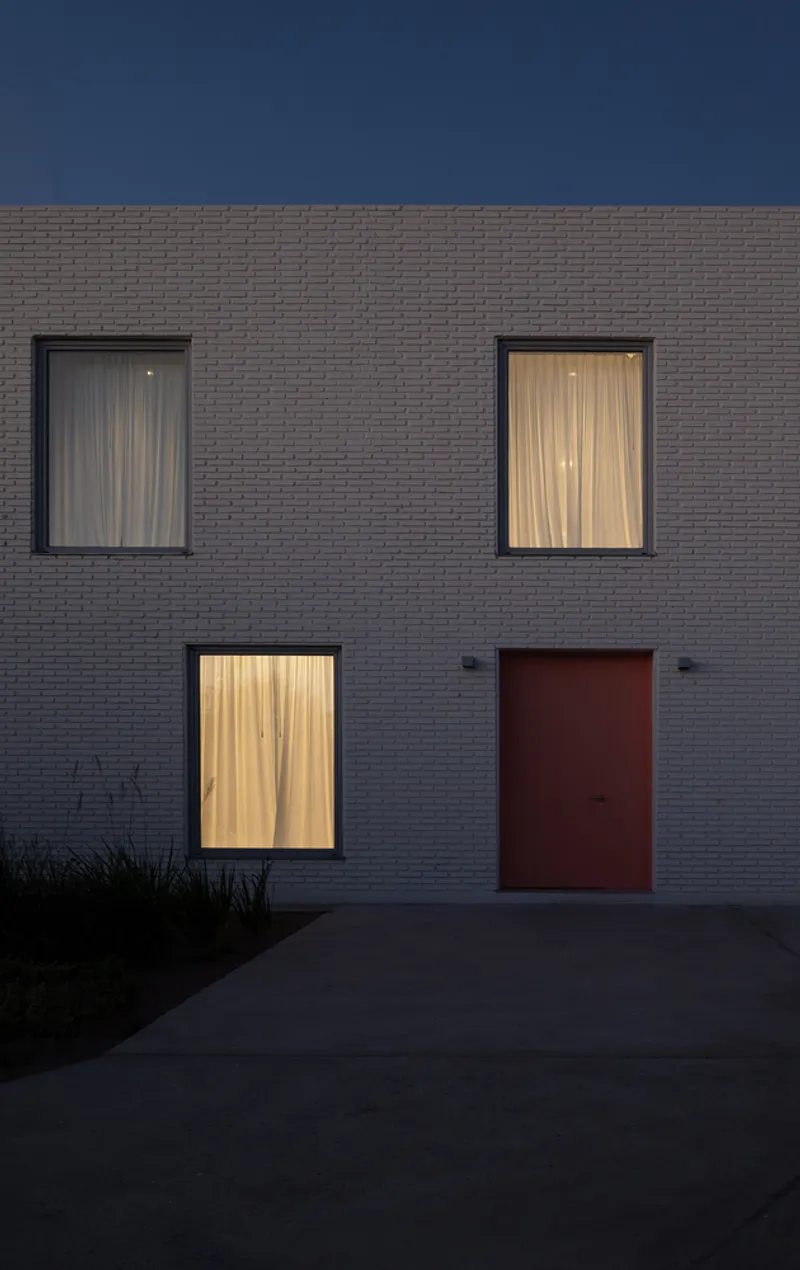
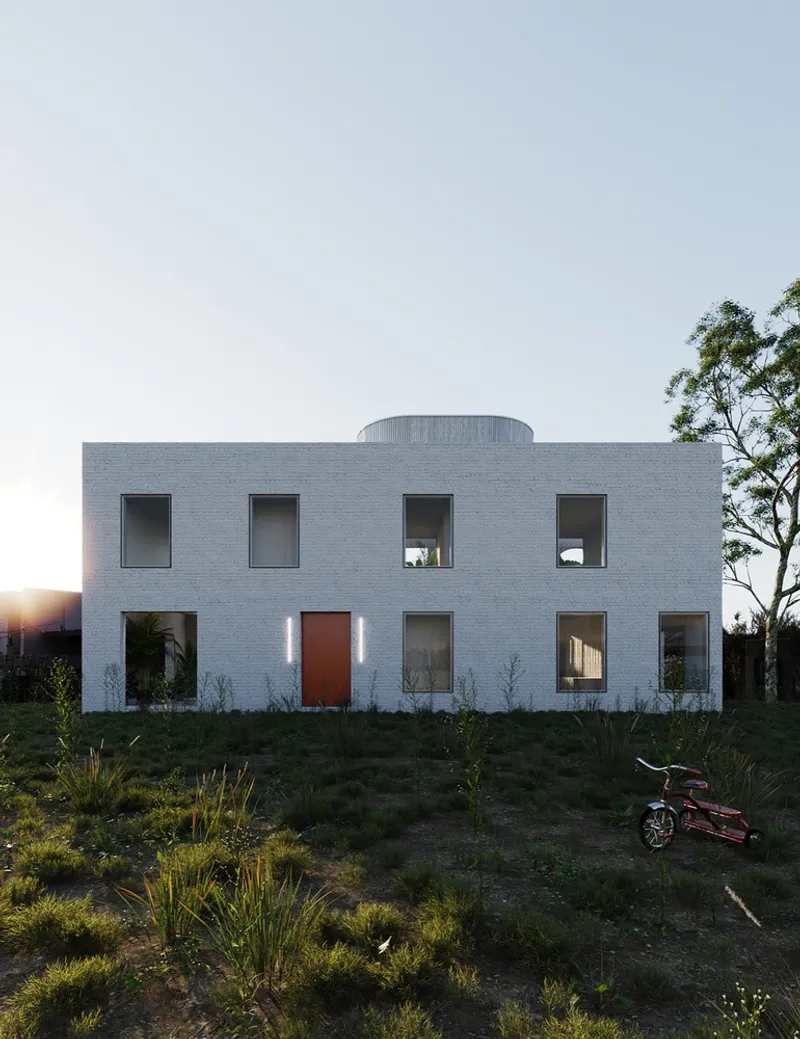
House 104 transforms at dusk. The white brick walls darken, and the windows, minimal during the day, become luminous rectangles that reveal the life inside. The coral-red door, almost invisible in shadow during daylight hours, reasserts itself against the darkened masonry. FLORA's decision to keep the facade openings small and precisely placed pays off here: each lit window becomes an individual composition, not a continuous glass curtain.
There is a lesson in these nighttime views about the value of solid-to-void ratio. Houses with expansive glazing often look spectacular in daylight photography but dissolve into featureless glow at night. House 104 retains its sculptural identity around the clock because the brick mass always dominates.
Neighborhood and Aerial Context
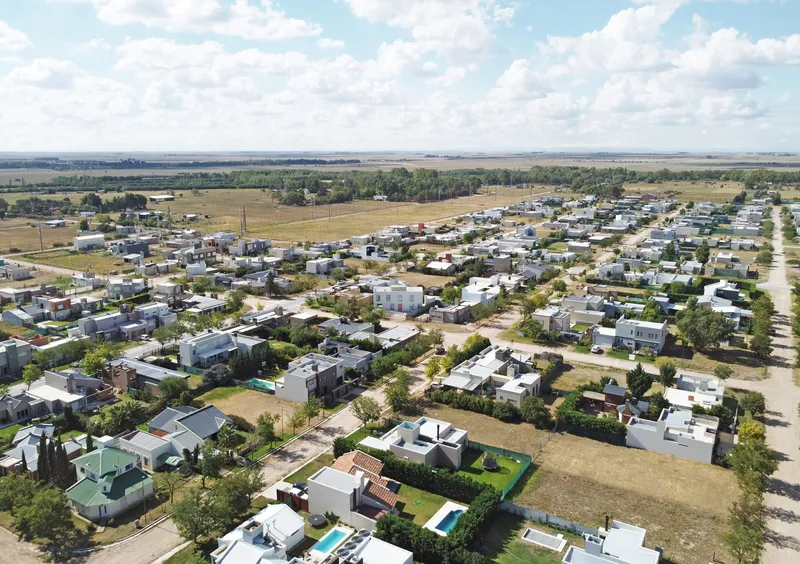
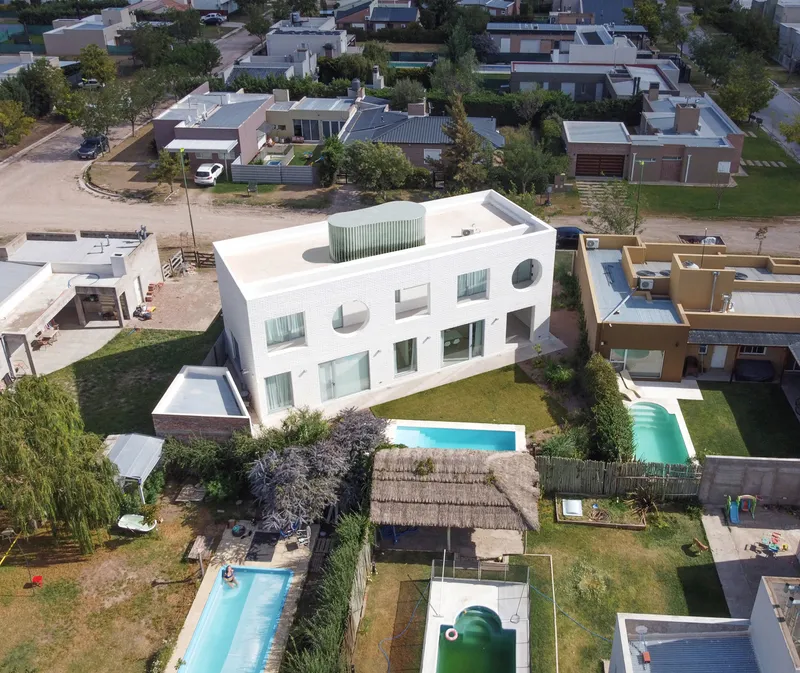
Aerial photography places House 104 within a low-rise residential neighborhood of scattered houses and tree-lined streets. The white volume is immediately legible from above, its circular roof openings and rear swimming pool reading as a compact diagram of the plan strategy. The house occupies its plot fully but without aggression, maintaining setbacks and garden edges that keep it in conversation with its neighbors.
The pool, tucked behind the main volume, confirms that the house organizes its program along a front-to-back gradient: public facade, semi-public courtyard, private garden, and finally the pool terrace at the far edge of the site. It is a straightforward sequence, but FLORA executes it with enough spatial compression and release to keep the journey through the house engaging.
Plans and Drawings
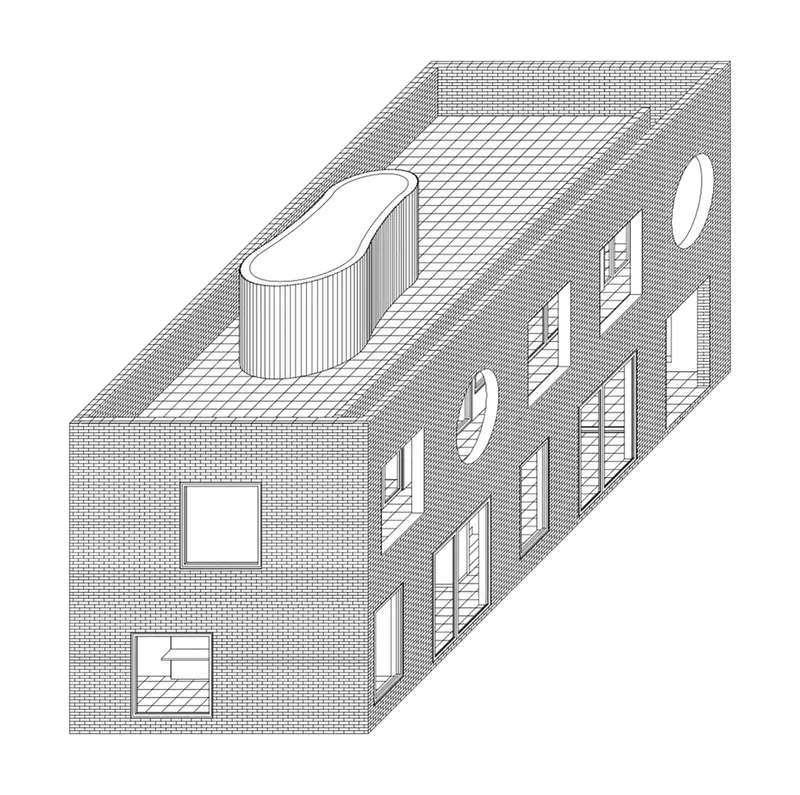
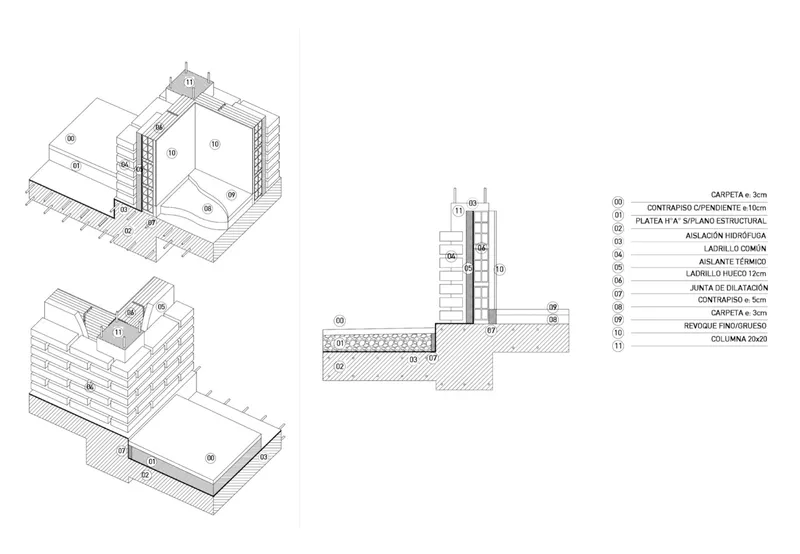
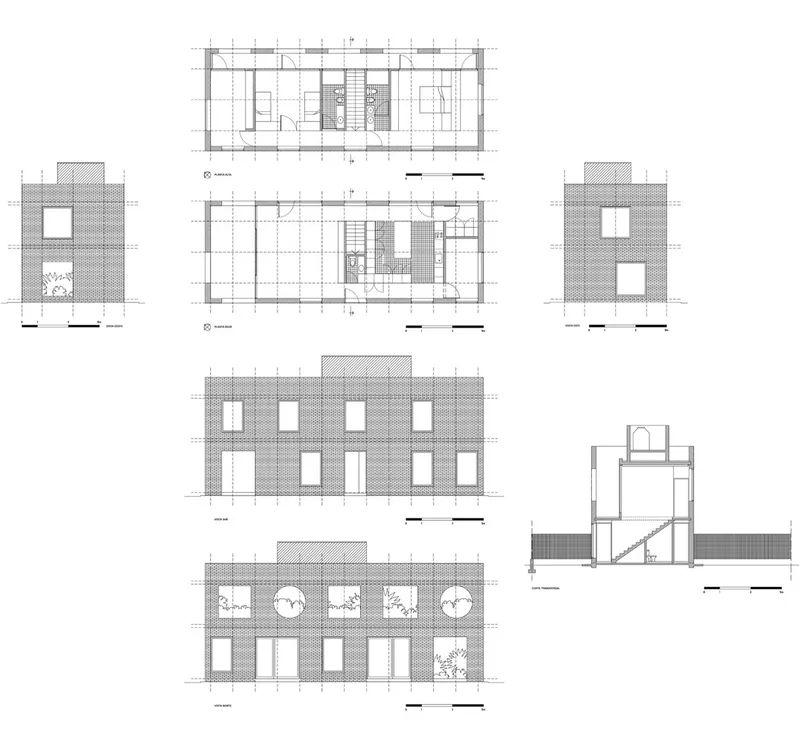
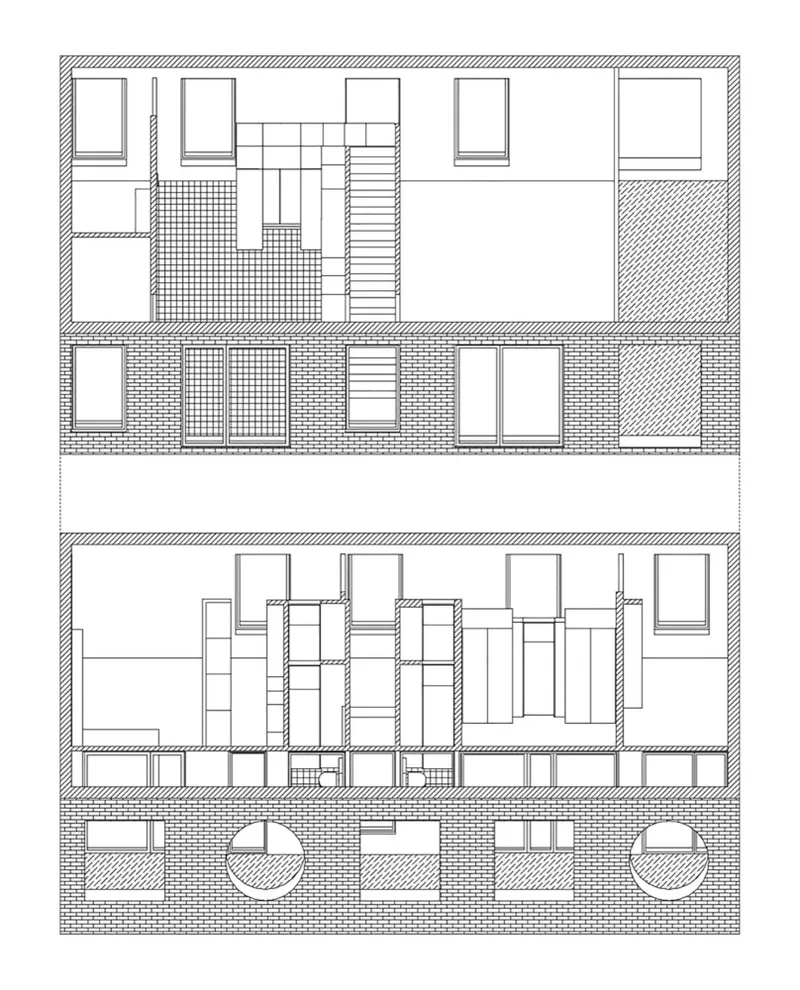
The axonometric drawing makes the cylindrical rooftop element legible as a light well or staircase enclosure that punctures the roof plane. Construction details show the wall-to-foundation connections and the layering of the brick cladding system, confirming that the white brick is a veneer over a structural frame rather than a load-bearing mass. Floor plans, elevations, and sections reveal the varied window configurations: circles, arches, and conventional rectangles are distributed according to the interior program rather than a rigid pattern. The central staircase anchors the plan and connects the two levels while preserving sight lines through to the courtyard.
Why This Project Matters
House 104 demonstrates that material discipline and geometric play are not mutually exclusive. By committing to a white brick and concrete palette and then varying only the geometry of openings, FLORA achieves a richness of spatial experience that more elaborate material strategies often fail to deliver. The circular windows and arched passageways are not decorative gestures; they are the primary instruments through which light, views, and cross-ventilation are managed.
In a residential market that frequently equates ambition with complexity, House 104 argues for a different calculus: invest in fewer moves, but make each one precise. The coral door, the circular aperture, the arched garden threshold. These are the moments that give the house its identity, and they succeed precisely because everything around them is calm.
House 104 by studio FLORA.
About the Studio
Share Your Own Work on uni.xyz
If projects like this are the kind of work you want to make, uni.xyz is a place to publish your own, find collaborators, and enter design competitions.




Popular Articles
Popular articles from the community


The Ocean Hive: Sustainable Architecture for a Self-Sufficient Civilization at Sea
The Ocean Hive imagines sustainable architecture at sea, where modular habitats, algae, wave power and ocean waste sustain a growing colony.

The Earth Pod: 3D Printed Homes for Resilient Refugee Communities
The Earth Pod reimagines refugee housing through 3D printed homes made from clay, combining resilience, self-sufficiency, and rapid shelter.

Co-life: Sustainable Architecture for Age-Friendly Community Living
Co-life reimagines sustainable architecture for seniors through courtyards, rammed earth, shared gardens, and spaces designed for belonging.

The Musturak Paradise: Senior Living Architecture for a Connected Future in Temara, Morocco
The Musturak Paradise reimagines senior living architecture in Temara via private homes, social spaces, culture, community, and shared care.

Similar Reads
You might also enjoy these articles


Hodi-Mandai Geram
Project Function: Preservation and revitalization of the Intangible heritage and socio-spatial identity of the Hodi by Housing, Cultural Memory Center, Sacred Grove, landscape, local tourism economy


Olio Towers: A Mid-Rise for Performers That Fuses Housing, Rehearsal, and Stage
Located blocks from Houston's Theater District, this modular tower stacks living units around a central performance atrium.

Oasis: Modular Green Housing Carved into Dhaka's Urban Fabric
A shortlisted Plugin Housing entry reclaims unauthorized settlements in Dhaka with stepped concrete volumes, green roofs, and ventilation-driven design.

Black Hole: A Floating Megastructure for the Post-Physical Era
Emiliano Mazzarotto envisions a spherical, self-scaling arena where e-sports, digital hotels, and holographic stadiums replace traditional public space.


Explore Eco-concrete Competitions
Discover active competitions in this discipline



Challenge to reimagine the Iron Throne


Photograph architecture without architects


Illustrate the lost glory of Angkor Wat - Render Challenge


Design challenge to reuse E-waste
Comments (0)
Please login or sign up to add comments
No comments yet. Be the first to comment!