

I/O Architects Wrap a Four-Storey Sofia Home Around Three Courtyards and a Hydraulic Meadow
A 685-square-meter house in a 1920s Sofia neighborhood uses brick, concrete, and a rising lawn to reconcile density with domesticity.


Most courtyard houses treat the garden as a single room. I/O Architects treat it as a system. Their House of the Rising Meadow, set inside a low-density 1920s neighborhood in Sofia that was originally planned as a transition zone between urban fabric and a city park, wraps a compact four-storey volume with three distinct courtyards: a formal entrance court, a narrow grassy side passage, and a secluded back garden. Each court plays a different role in terms of light, privacy, and circulation, and the result is a house that feels much larger and more open than its 685 square meters would suggest.
The real provocation here is underground. One section of the front lawn lifts hydraulically to expose a parking ramp and basement garage, complete with a circular turntable for maneuvering cars. It is a piece of infrastructure dressed as landscape, and it sets the tone for a project that takes mechanical ingenuity just as seriously as material refinement. The house reads as a straightforward brick volume from the street, but every surface conceals a decision about how technology can serve domesticity without announcing itself.
Street Presence and the Brick Envelope

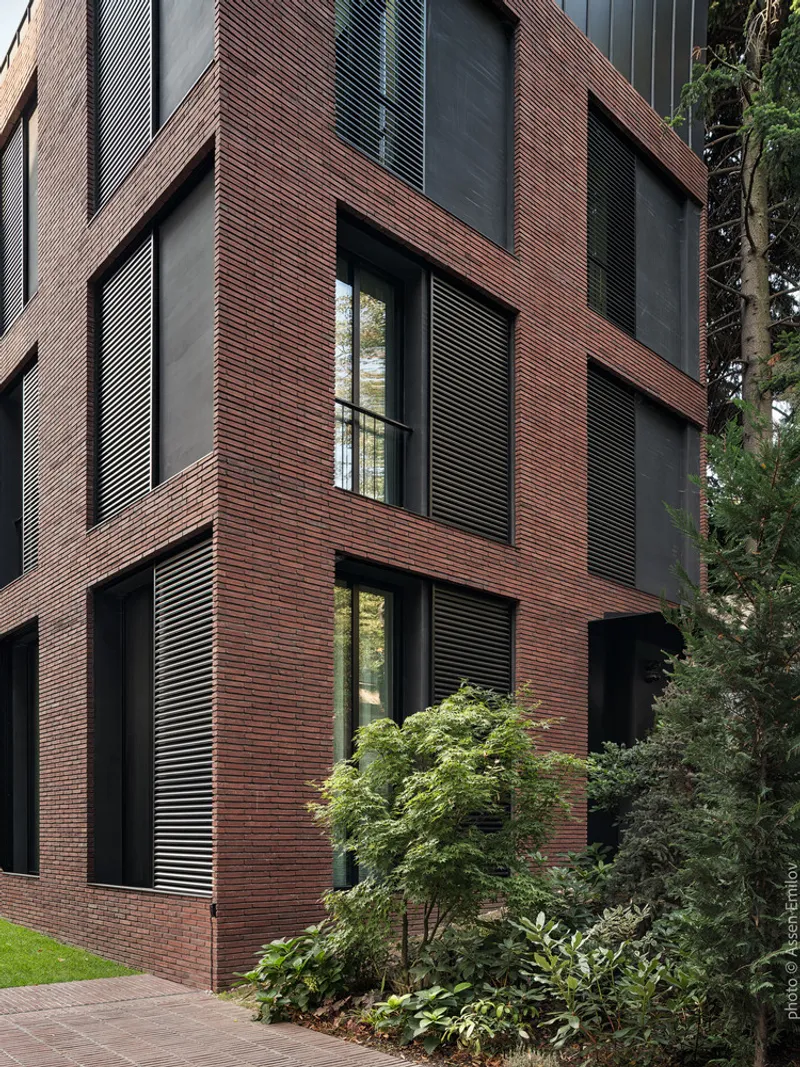

From the sidewalk, the house presents a restrained red brick facade with horizontal louvered screens. The material choice is contextual without being nostalgic: Sofia's early twentieth-century residential fabric relied heavily on masonry, and I/O Architects use brick here not as a quotation but as a texture that grounds the building in its block. Mature evergreen plantings soften the base, and a black metal gate and fence draw a clean line between public and private ground.
The louvered panels do real work. They filter light into interior rooms while screening domestic life from the street, and they break the facade into a rhythm of solid and void that keeps the four-storey mass from feeling monolithic. At twilight the house glows from within, the louvers casting striped shadows outward, and the scale seems to compress. This is important in a neighborhood where the surrounding buildings rarely exceed two storeys.
Three Courtyards, One Circuit
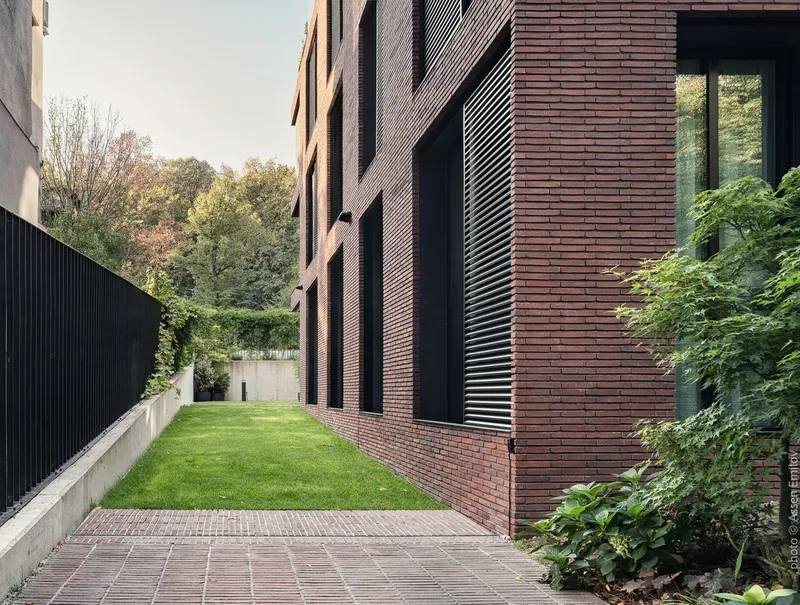
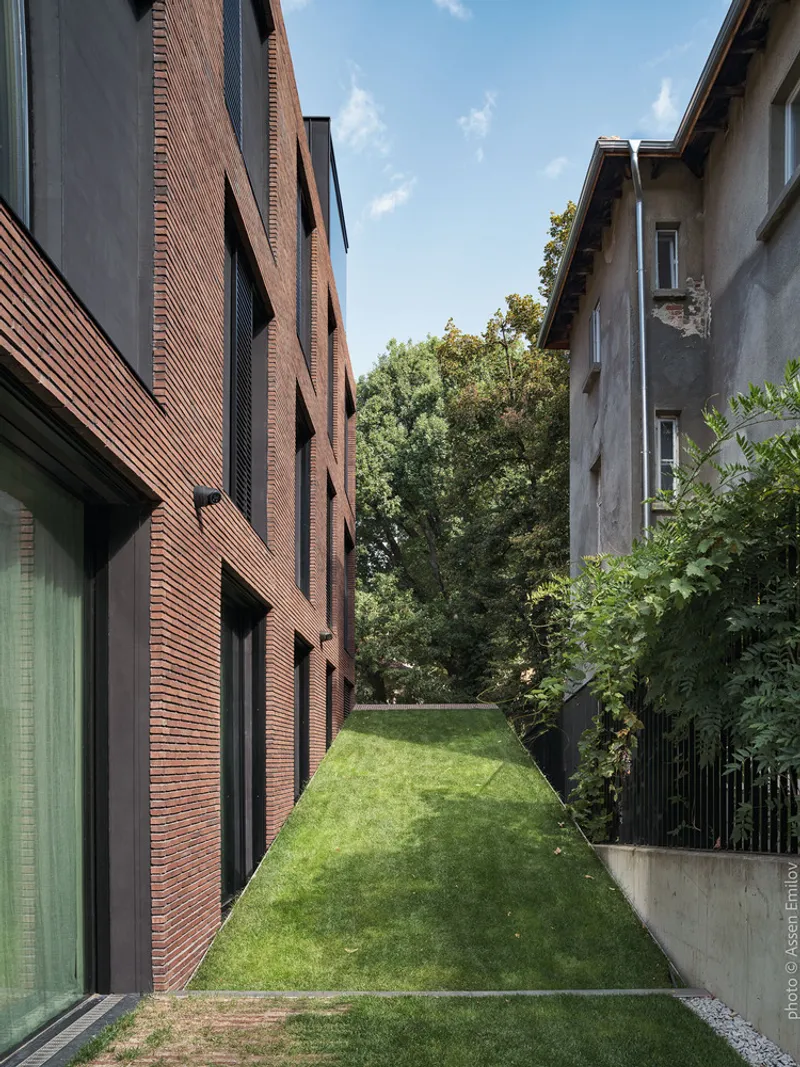
The narrow grassy passage between the new brick volume and the corrugated metal boundary fence is the connective tissue of the plan. It links the entrance court to the rear garden without requiring passage through the house, a move that gives children, guests, or service traffic an independent route. The corridor is barely wider than a person's outstretched arms, yet it is bright, planted, and framed by the contrasting textures of brick and metal.
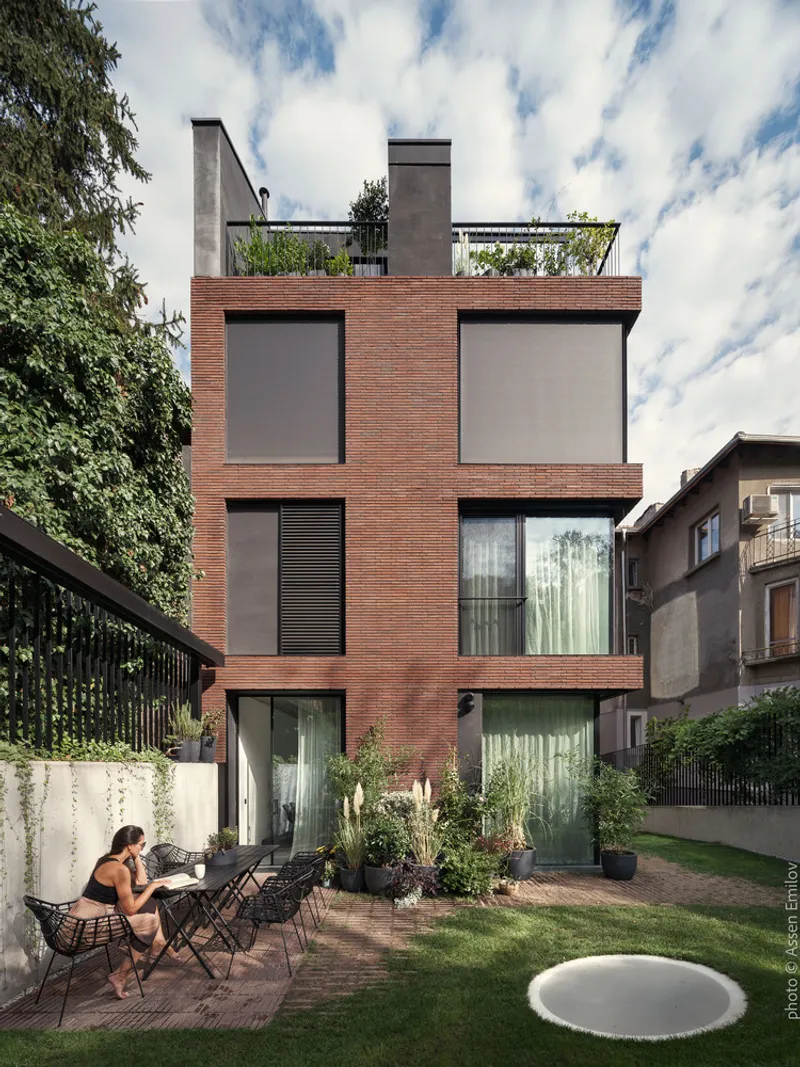
At the back, the garden opens generously. A woman seated on the timber deck in one photograph captures the intended atmosphere: calm, private, surrounded by lawn and planting but still connected to the living spaces behind floor-to-ceiling glass. The courtyard sequence enacts a clear gradient from public to intimate, and the architecture reinforces that gradient by increasing the size of facade openings as you move from street side to garden side.
The Hydraulic Meadow and the Underground Garage
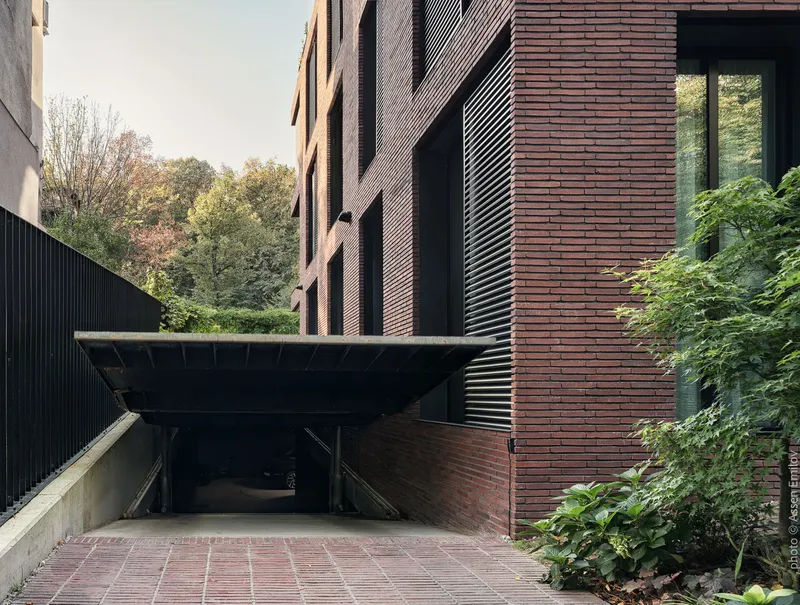
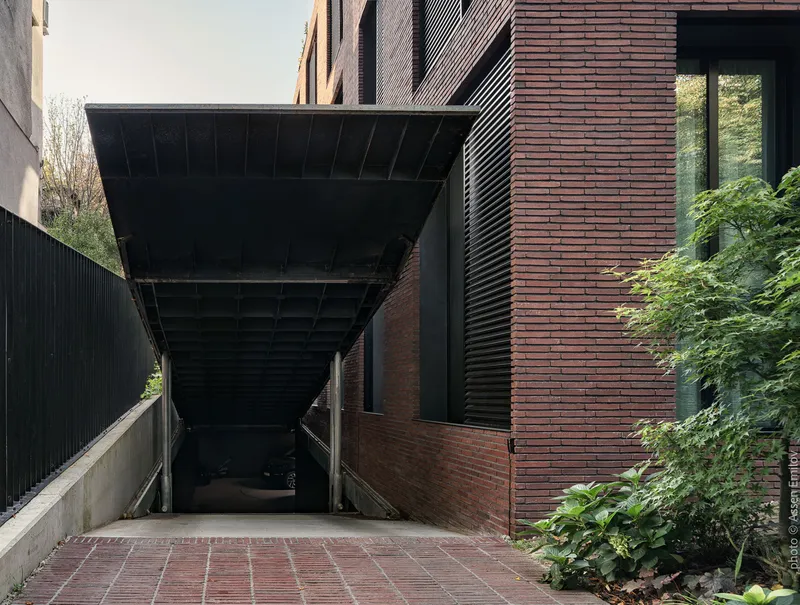
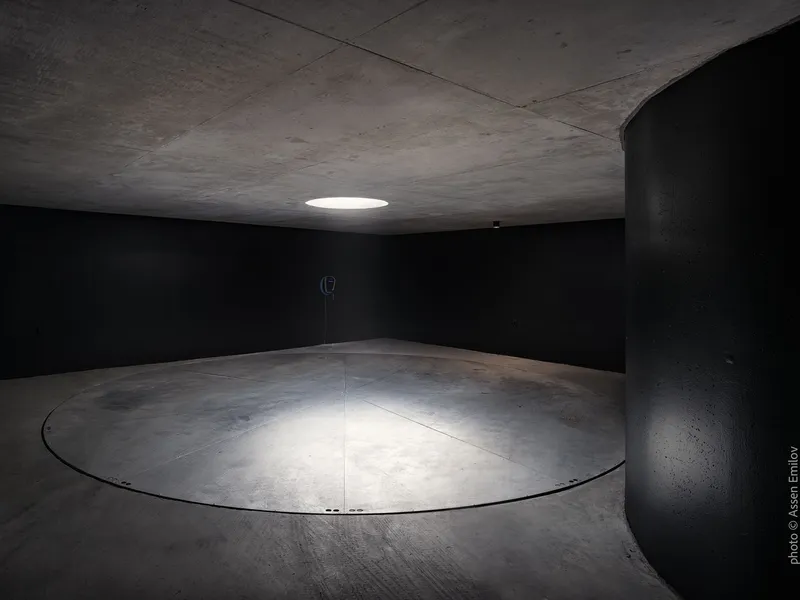
The cantilevered metal canopy over the parking ramp is the most visible clue that something unusual is happening below grade. The ramp descends between brick retaining walls into a basement garage fitted with a circular turntable, a piece of mechanical choreography that lets a car rotate in place and drive out facing forward. The turntable sits beneath a generous skylight, so the garage never feels like a bunker.
The hydraulic meadow itself, a planted surface that lifts to expose the ramp, is the kind of detail that could easily tip into gimmickry. Here it works because it solves a real problem: accommodating car storage in a neighborhood where plot widths are modest and driveways consume precious garden space. By burying the parking and covering it with grass, I/O Architects recover the front courtyard as usable landscape for most of the day.
Concrete, Walnut, and the Open Living Floor

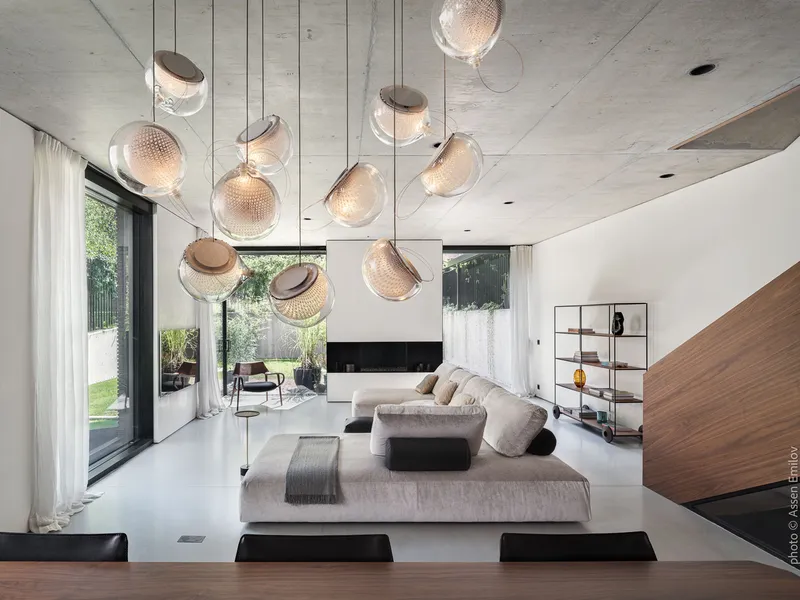
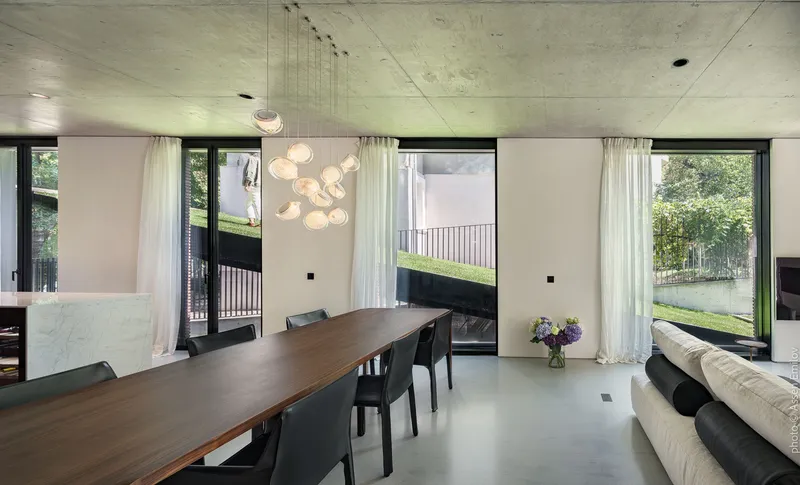
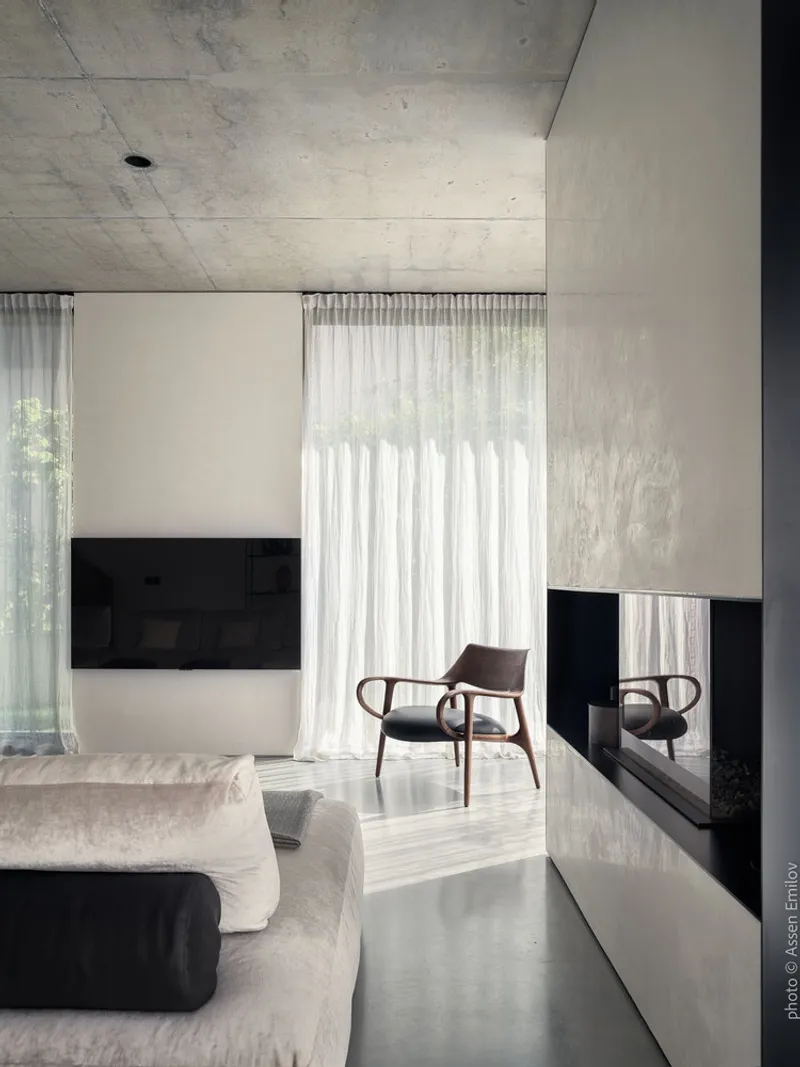
The ground-level living space occupies the entire footprint of the plan, opening on multiple sides to the courtyards. Exposed concrete ceilings run uninterrupted overhead, establishing a material baseline that the architects then soften with walnut cladding on the staircase volume, polished concrete floors, and clusters of glass sphere pendant lights. The palette is tight: grey, brown, and the warm glow of natural light through full-height glazing.
What keeps the interior from reading as a generic luxury loft is the stair. Clad in timber planks and set against dark-toned walls, it rises through the house as a sculptural spine, its underside visible from the dining table. It is the only element that spans all four floors, and it anchors the plan in a way that the open rooms around it cannot. The living room flows into the kitchen, the kitchen into the terrace, and the terrace into the garden, but the stair is always there in your peripheral vision, marking the vertical center of the house.
Vertical Living: Bedrooms, Voids, and the Study
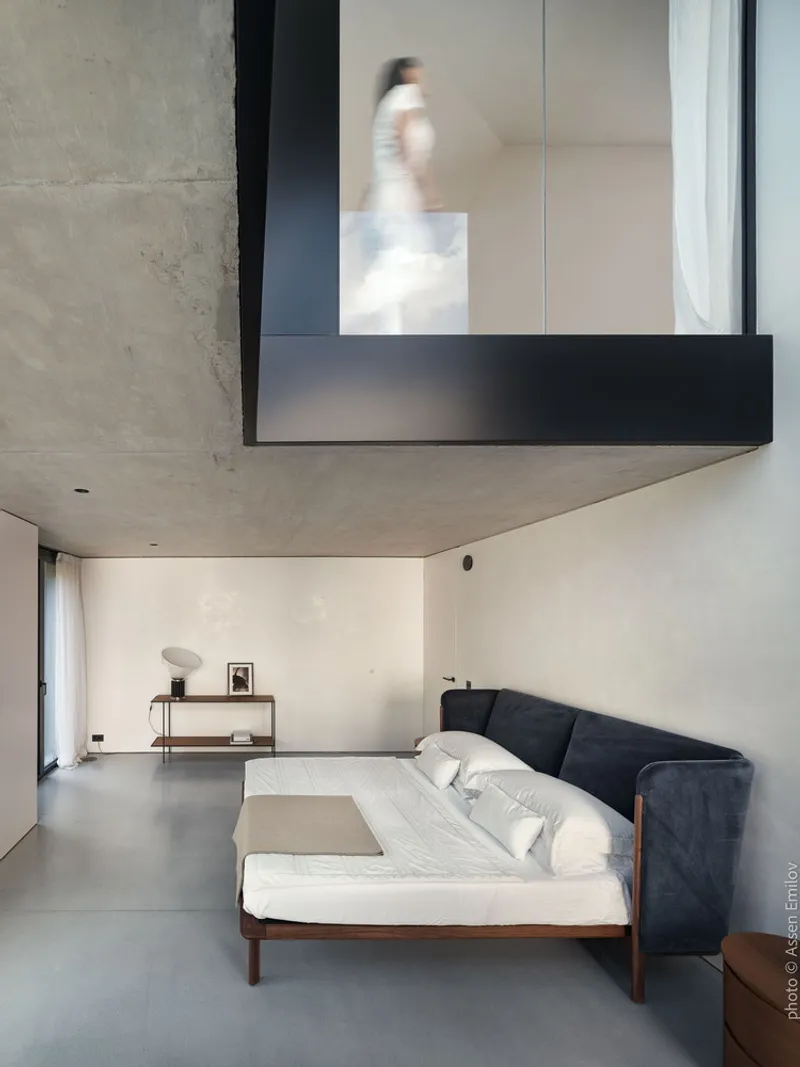

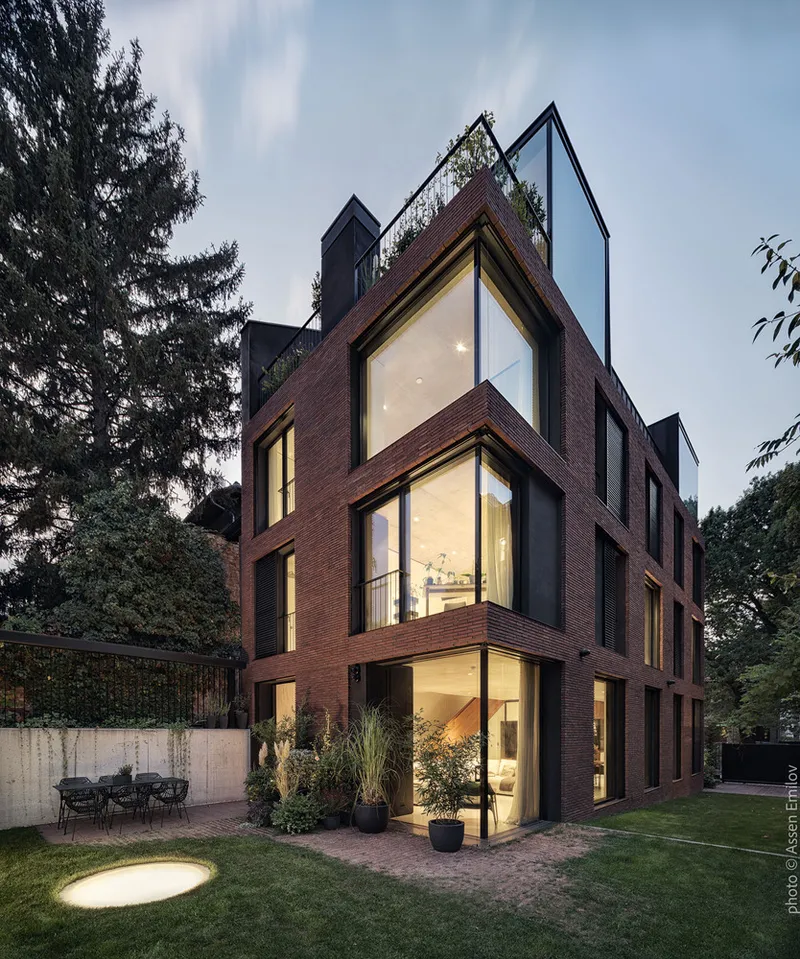
The upper floors compress the plan into bedrooms, bathrooms, and a rooftop study. On the third level, the master bedroom opens into a double-height void with a cantilevered black-framed window box that pushes outward, borrowing volume from the exterior. A figure moving on the upper level is visible through this void, a deliberate visual connection that keeps the private floors from feeling isolated.
The fourth-floor study and terrace are the payoff for stacking four storeys on a modest plot. At dusk, the corner volume glows through floor-to-ceiling glass, and the terrace with its potted grasses becomes a rooftop garden in miniature. Mirrored glass panels on this level reduce the apparent bulk of the top floor by reflecting sky and trees, a smart optical trick that keeps the house from looming over its neighbors.
Material Details: Stair, Bath, and Corridor
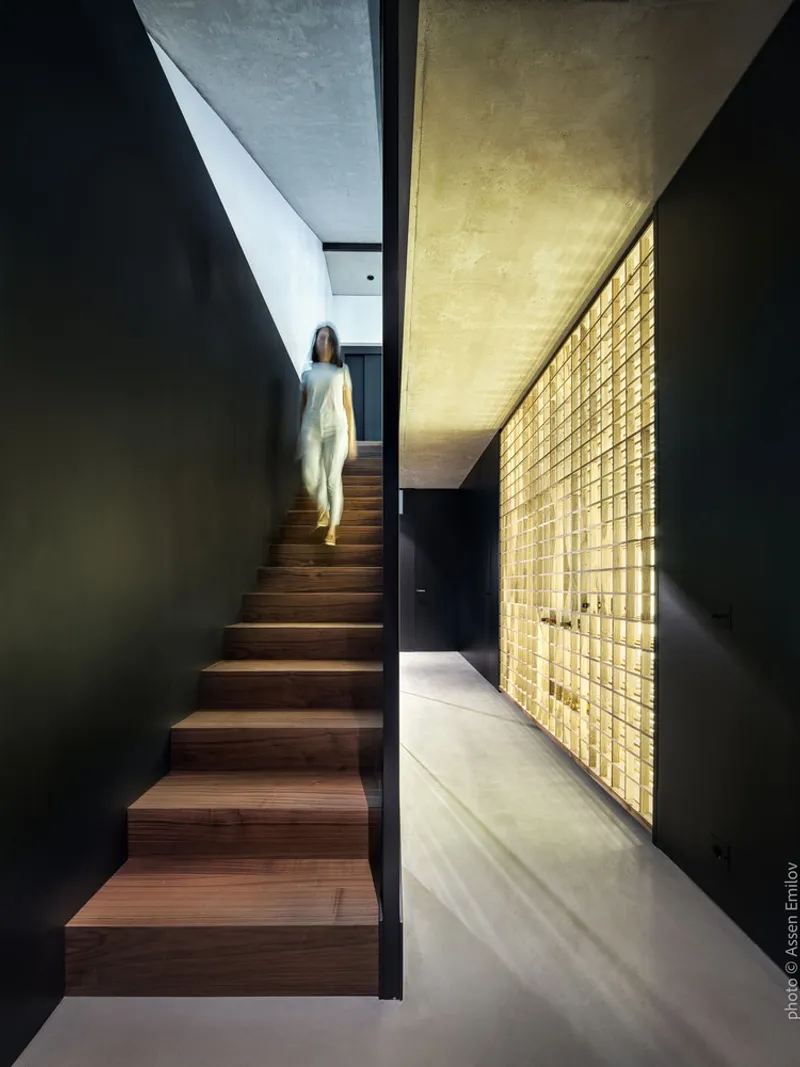
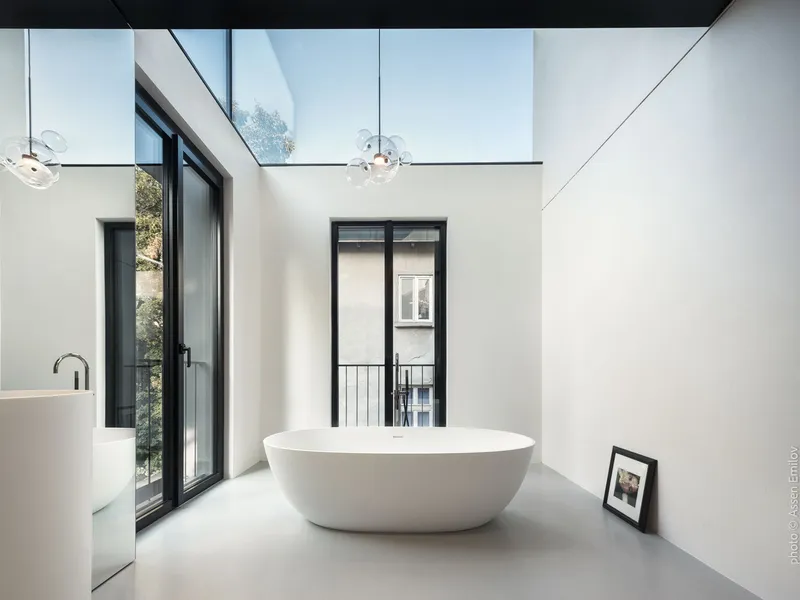

The staircase passage is theatrical. A backlit glass block wall lines one side, casting a diffuse amber glow that makes the ascent feel like a transition between moods rather than floors. In the bathroom, a freestanding white tub sits beneath a skylight flanked by glass pendants, and black-framed doors frame the room as a deliberate composition rather than a utility space. Down the corridor, a golden mosaic tile wall catches light behind a round illuminated mirror, a small flourish that signals the architects' comfort with ornament when it earns its place.
These moments matter because they give the house personality beyond its structural and spatial innovations. Concrete and walnut can be austere; the glass block, the mosaic, and the pendant fixtures introduce warmth and specificity. The house never feels generic, even in its most utilitarian corners.
Garden Rooms and the Timber Deck
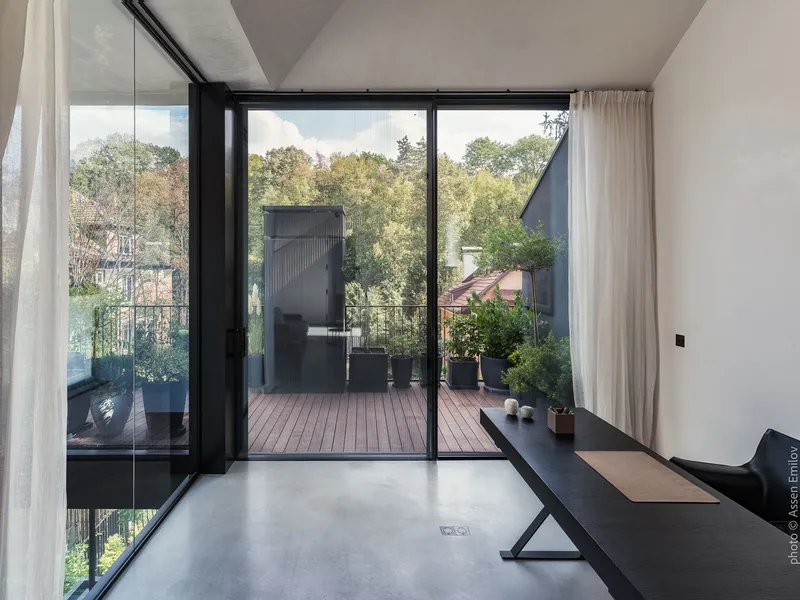

The timber deck terrace operates as an outdoor extension of the living room. Potted plants and autumn trees frame views outward, and the threshold between inside and outside is reduced to a single step across the glazing line. The dining space and kitchen island, with its marble countertop and walnut cabinetry, are positioned to face the garden directly, making the courtyard the focal point of daily domestic life.
A black fireplace surround and sheer curtains in the living room give the interior an evening register that differs from its daytime openness. When the curtains are drawn and the fire lit, the house contracts into something more enclosed and protected. This duality, open by day and sheltered by night, is the real advantage of the courtyard typology, and I/O Architects exploit it fully.
Plans and Drawings
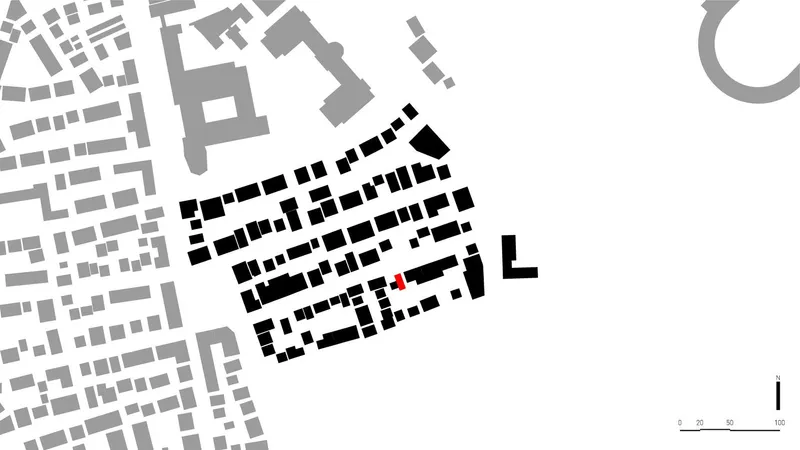
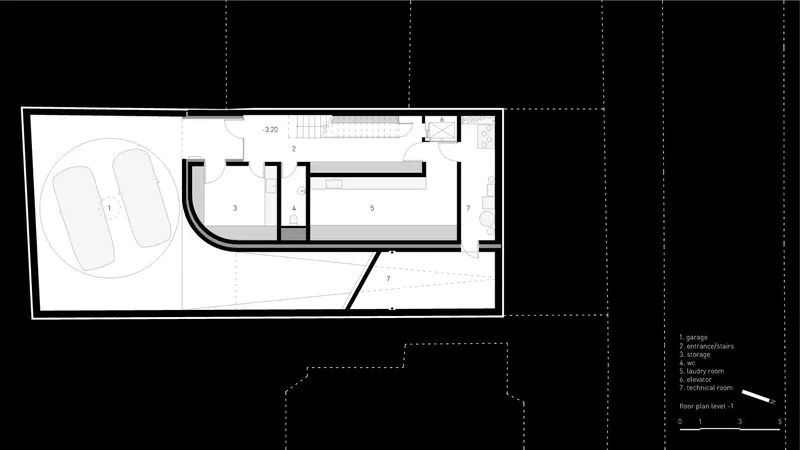
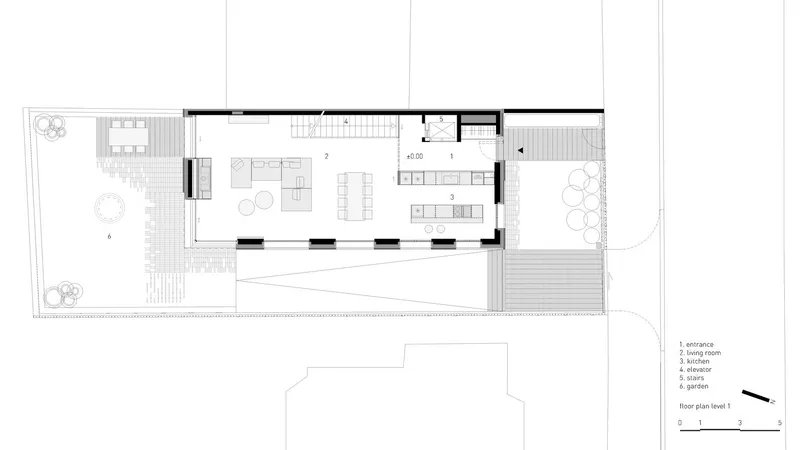
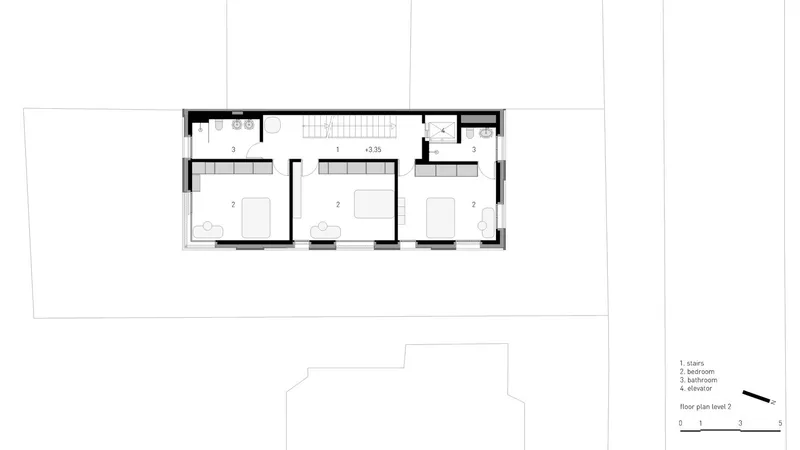

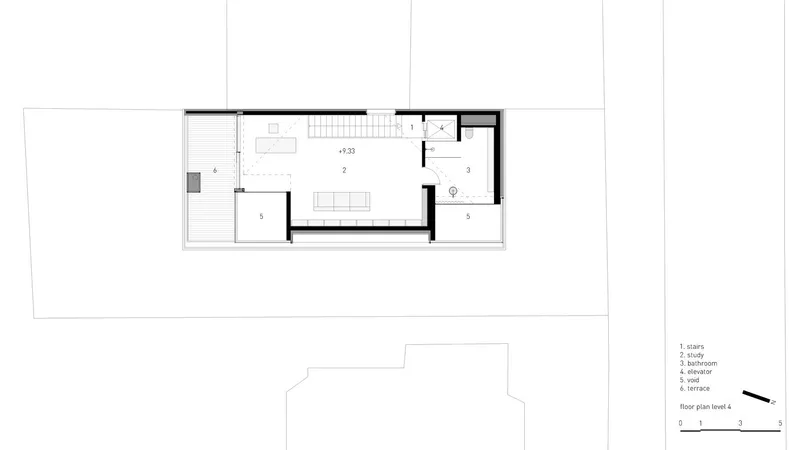

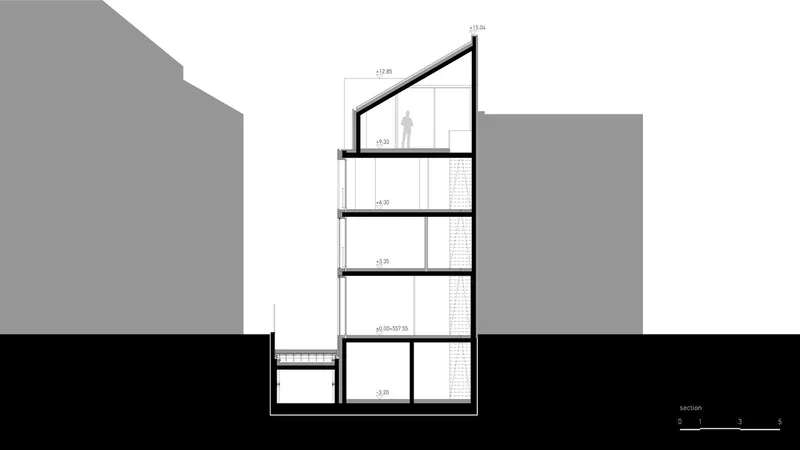
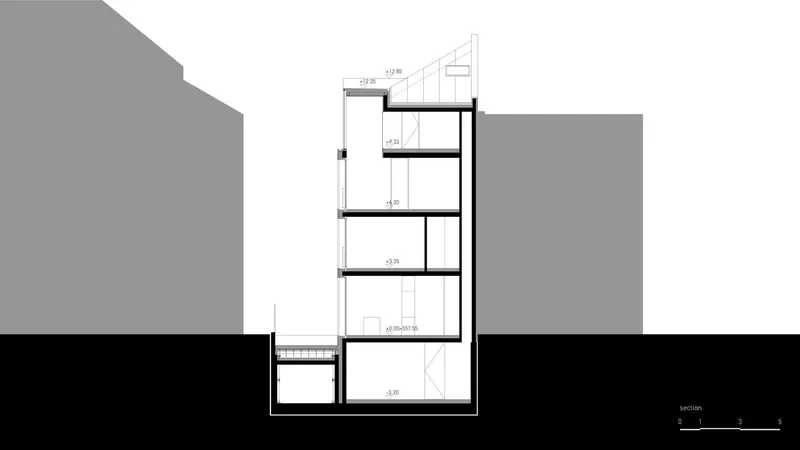
The site plan reveals how tightly the house is embedded in its urban block, occupying a slender plot between neighbors. The floor plans show a clear vertical strategy: parking and services below grade, open social space at ground level, three bedrooms and bathrooms on the second floor, a master suite with dressing room on the third, and a study with terrace on the fourth. The sections are the most revealing drawings. They expose the arched roof profile, the sloped parking ramp descending to the turntable, and the way the building wedges itself between adjacent structures while maintaining light wells and voids on every level.
What the drawings make plain is that vertical circulation is the organizational backbone. The staircase and its surrounding voids connect every floor visually and spatially, ensuring that a narrow plan never feels confined. Double-height openings punch through floor plates at strategic points, pulling daylight down through skylights and circular openings into the deepest parts of the section.
Why This Project Matters
The House of the Rising Meadow is a useful corrective to the assumption that courtyard houses require generous horizontal plots. I/O Architects demonstrate that the courtyard typology can work vertically, distributing outdoor space across three separate courts and a rooftop terrace while stacking four floors of program on a tight urban site. The hydraulic meadow is the headline, but the quieter moves, the graduated facade openings, the backlit stair, the double-height bedroom void, are what make the house livable rather than merely clever.
In a Sofia neighborhood originally designed for low-density living at the edge of a park, this house proves that density and domesticity are not opponents. By burying its car infrastructure, wrapping its volume in contextual brick, and organizing every room around views of green space, the project delivers a four-storey urban home that feels like a garden house. That is a trick worth studying.
House of the Rising Meadow by I/O Architects, Sofia, Bulgaria. 685 square meters. Photography by Assen Emilov.
About the Studio
Share Your Own Work on uni.xyz
If projects like this are the kind of work you want to make, uni.xyz is a place to publish your own, find collaborators, and enter design competitions.




Popular Articles
Popular articles from the community


The Musturak Paradise: Senior Living Architecture for a Connected Future in Temara, Morocco
The Musturak Paradise reimagines senior living architecture in Temara via private homes, social spaces, culture, community, and shared care.

AL-JANNAH: Sustainable Architecture and Permaculture for Afghan Widows
AL-JANNAH uses sustainable architecture and permaculture to create resilient oasis of housing, learning, work and renewal for Afghan widows.

Hill & Cross Opera: Sculptural Opera House Architecture Shaped by Tallinn’s Landscape and Identity
Hill & Cross Opera reimagines opera house architecture in Tallinn through its sculptural hill, civic plaza, glass wave and a luminous cross.

The Ocean Hive: Sustainable Architecture for a Self-Sufficient Civilization at Sea
The Ocean Hive imagines sustainable architecture at sea, where modular habitats, algae, wave power and ocean waste sustain a growing colony.


Similar Reads
You might also enjoy these articles


Hodi-Mandai Geram
Project Function: Preservation and revitalization of the Intangible heritage and socio-spatial identity of the Hodi by Housing, Cultural Memory Center, Sacred Grove, landscape, local tourism economy


Olio Towers: A Mid-Rise for Performers That Fuses Housing, Rehearsal, and Stage
Located blocks from Houston's Theater District, this modular tower stacks living units around a central performance atrium.

Oasis: Modular Green Housing Carved into Dhaka's Urban Fabric
A shortlisted Plugin Housing entry reclaims unauthorized settlements in Dhaka with stepped concrete volumes, green roofs, and ventilation-driven design.

Black Hole: A Floating Megastructure for the Post-Physical Era
Emiliano Mazzarotto envisions a spherical, self-scaling arena where e-sports, digital hotels, and holographic stadiums replace traditional public space.


Explore Courtyard Competitions
Discover active competitions in this discipline



Challenge to reimagine the Iron Throne


Photograph architecture without architects


Illustrate the lost glory of Angkor Wat - Render Challenge


Design challenge to reuse E-waste
Comments (0)
Please login or sign up to add comments
No comments yet. Be the first to comment!