

SPAN Architects Builds a Sandstone Fortress for Modern Living in Indore
Fort House reinterprets the fortified walls of Rajasthani tradition as a 11,500 sq ft residence wrapped in yellow sandstone and cascading greenery.


There is a particular kind of building that announces itself before you even reach the threshold. Fort House, designed by SPAN Architects in a gated township in Indore, India, is one of them. Its rammed earth and yellow sandstone walls rise with the geological certainty of a cliff face, punctuated by trapezoidal windows and spilling over with trailing greenery. The 11,500 square foot residence completed in 2024 does not merely reference the fortified architecture of Rajasthan and Malwa: it metabolizes it, stripping the defensive logic of the fort down to its tectonic essence and reassembling it as a private home.
What makes the project genuinely compelling is the tension between mass and porosity. The exterior reads as a monolith, all stratified stone and planted parapets. But cut through the threshold and the house opens into a courtyard-driven plan where circular skylights, chevron paving, and stacked timber pendants dissolve the fortress posture entirely. SPAN Architects have understood something important here: a fort is not just a wall. It is a negotiation between exposure and enclosure, and that negotiation, transposed to the domestic scale, produces spaces of remarkable atmospheric richness.
Fortified Facades, Living Walls
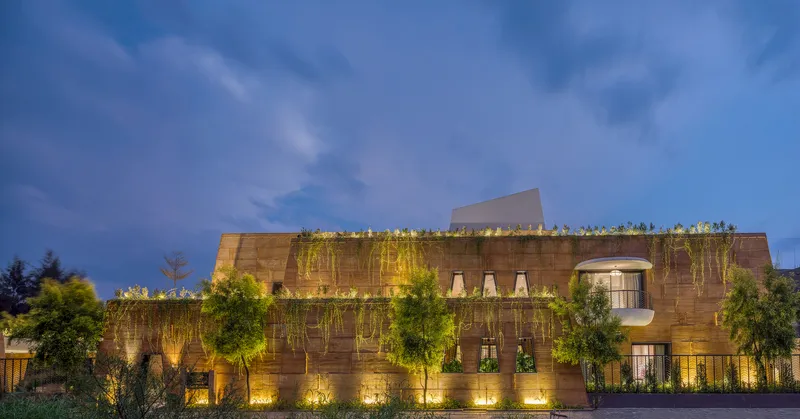
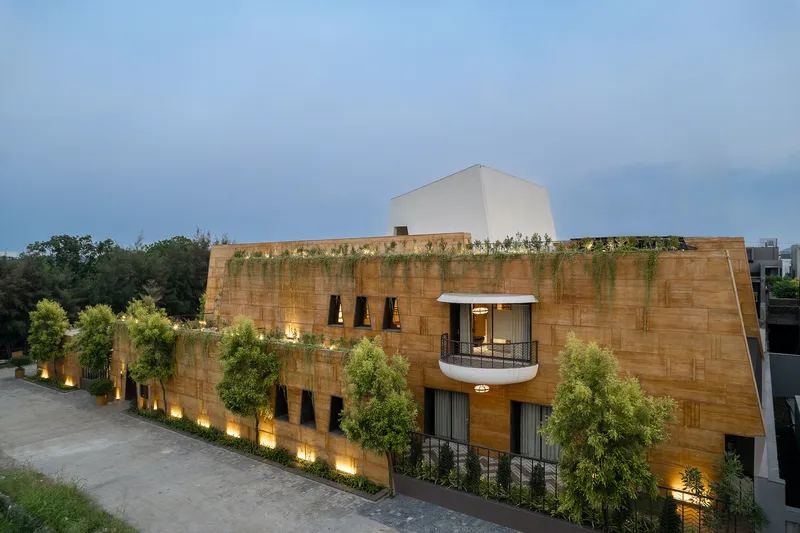
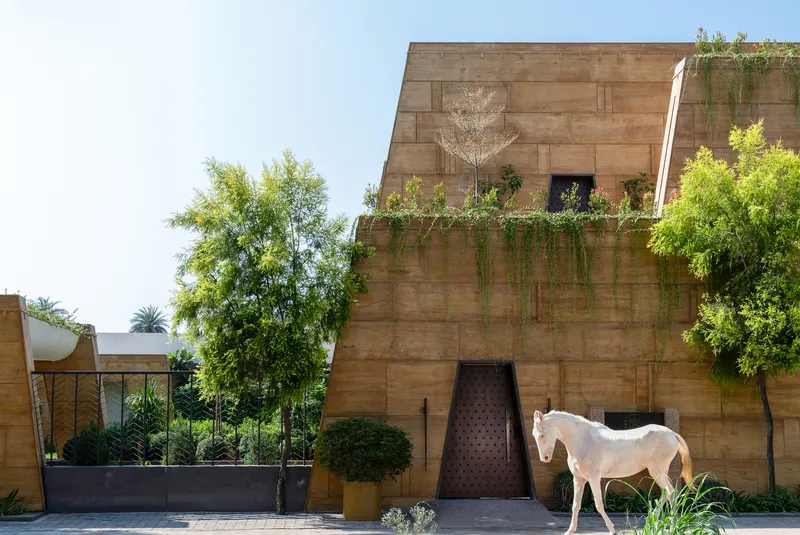
The street-facing elevation is the project's most confrontational gesture. Layered rammed earth walls step forward and back, creating deep shadow lines that change character throughout the day. At dusk, uplighting dramatizes the texture of the stone, making the facade glow like a sandstone canyon. The cascading greenery softens the mass without undermining it, a strategy that owes something to the hanging gardens of traditional havelis but executed with a contemporary restraint.
A white horse appears in one photograph, standing in the entry courtyard as though the scene were a still from a period film. It is a whimsical touch, but it also reveals how the scale of the architecture accommodates ceremony. The proportions are generous enough to absorb movement, livestock, and the kind of procession that defines life in this part of India.
The Entry Sequence as Ritual
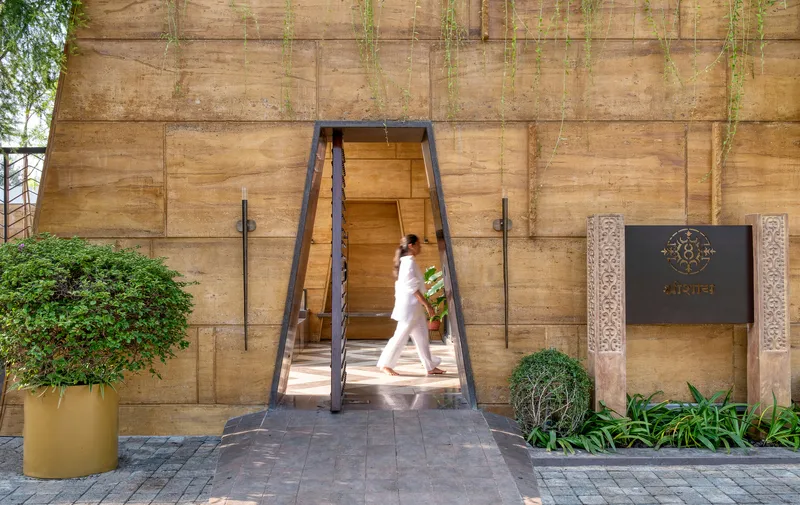
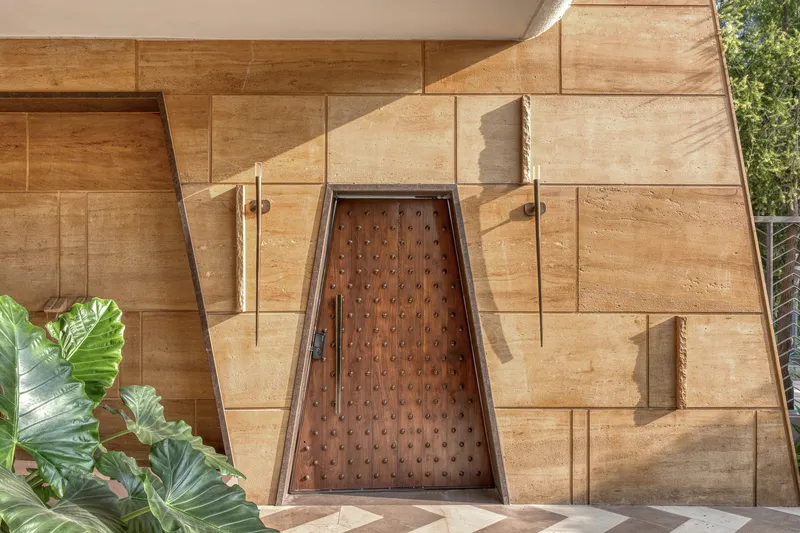
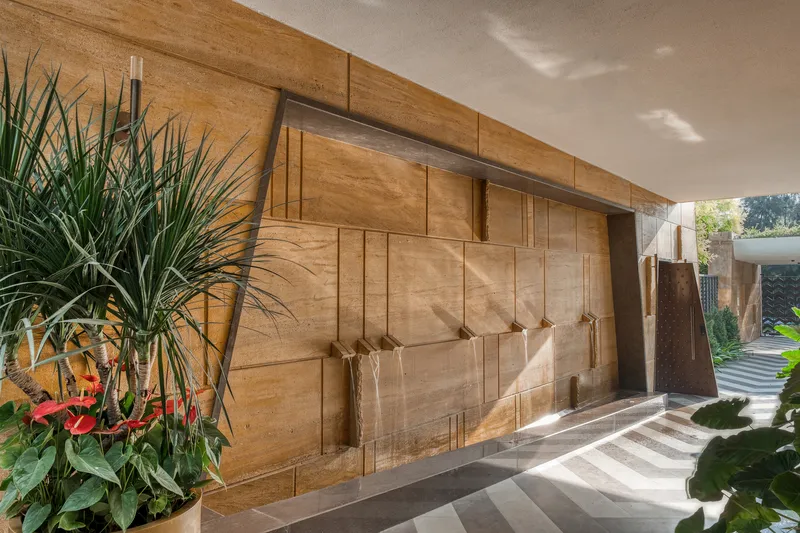
The tapered entry portal narrows toward a studded timber door, compressing the visitor's field of vision before releasing it into the courtyard beyond. It is a move borrowed directly from fort architecture, where gateways were designed to slow an invader and announce the power of what lay within. Here, the effect is domesticated but no less potent. Stratified stone paving underfoot reinforces the sense of passage, while geometric sandstone panels with recessed lighting line the interior wall, creating a transitional space that belongs neither fully to outside nor inside.
This compression-release sequence is one of the oldest spatial tricks in Indian architecture, and SPAN deploys it with discipline. The threshold is not merely a door; it is an event.
The Courtyard as the Heart
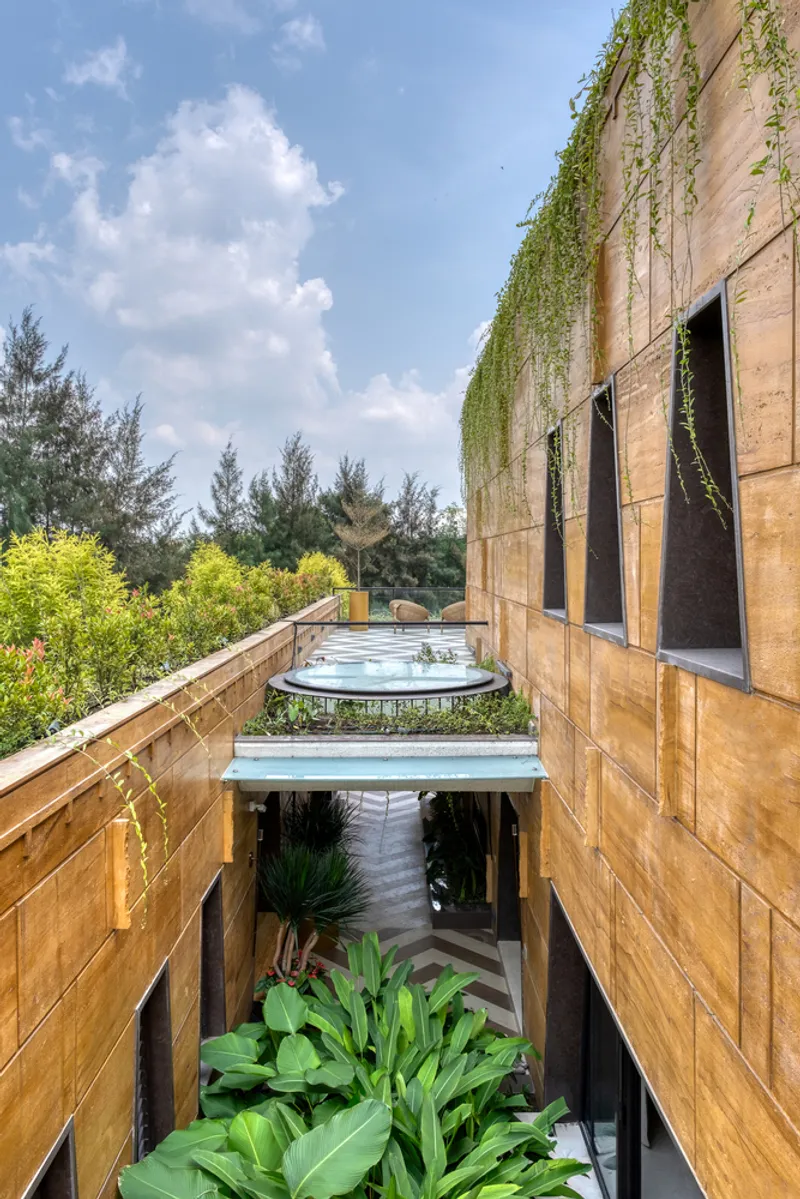
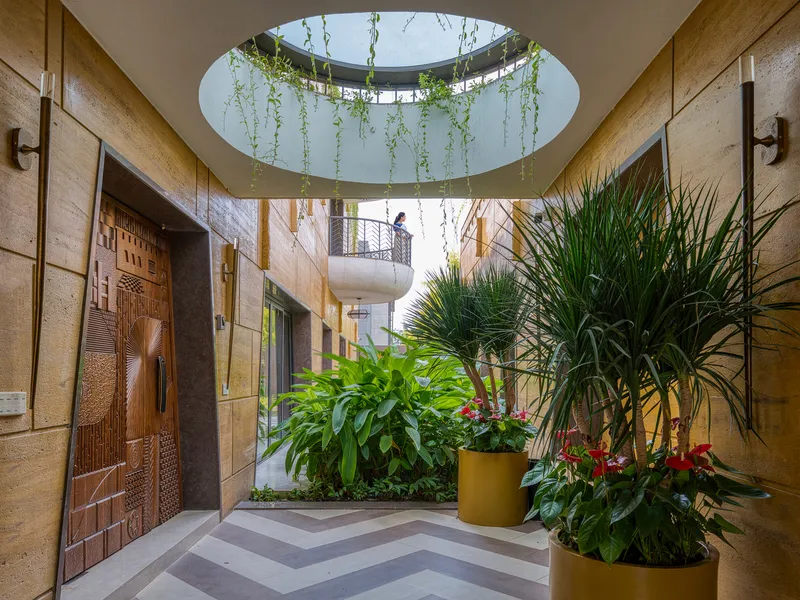
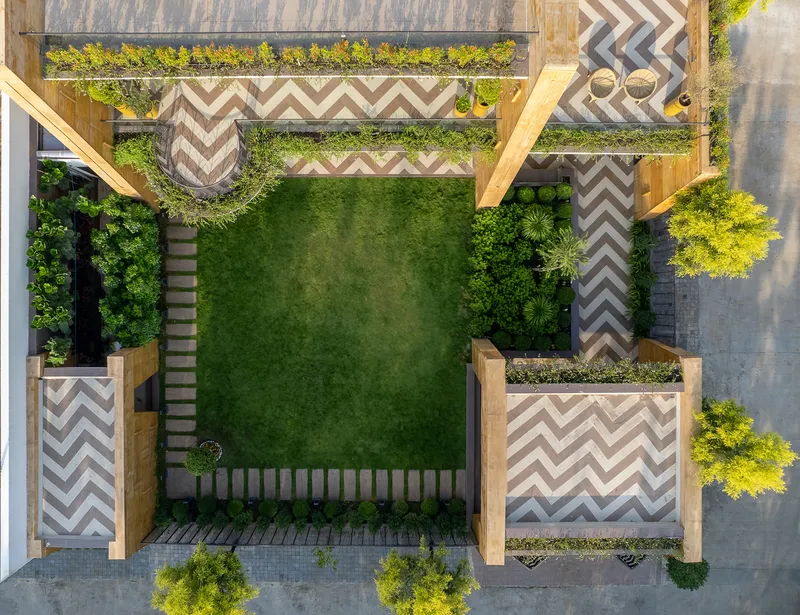
The central courtyard organizes everything. Rooms radiate outward from it; light descends through a circular skylight ringed by trailing vines. The chevron paving below establishes a geometric order that ripples outward through the plan, connecting planted beds, a timber pergola, and the pool in a single spatial system. This is the genius loci of the house, the place where the building breathes.
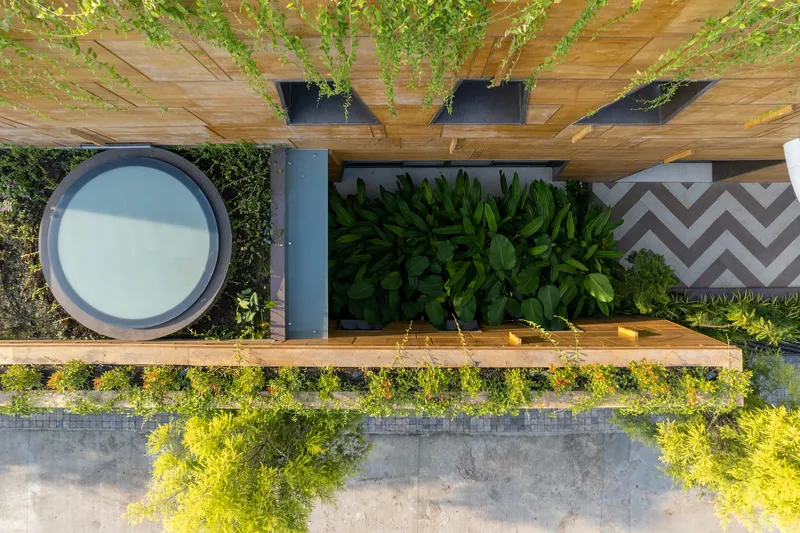
Viewed from above, the courtyard reads almost like a botanical installation: planted openings, a circular oculus, and timber slats creating dappled shadows on the ground plane. The aerial perspective reveals how tightly choreographed the landscape strategy is. Every plant, every gap in the pergola, is positioned to filter light at specific times of day. For a house oriented to the north and east, this courtyard becomes the primary mechanism for pulling controlled daylight deep into the plan.
Vertical Drama: The Staircase and Double Heights
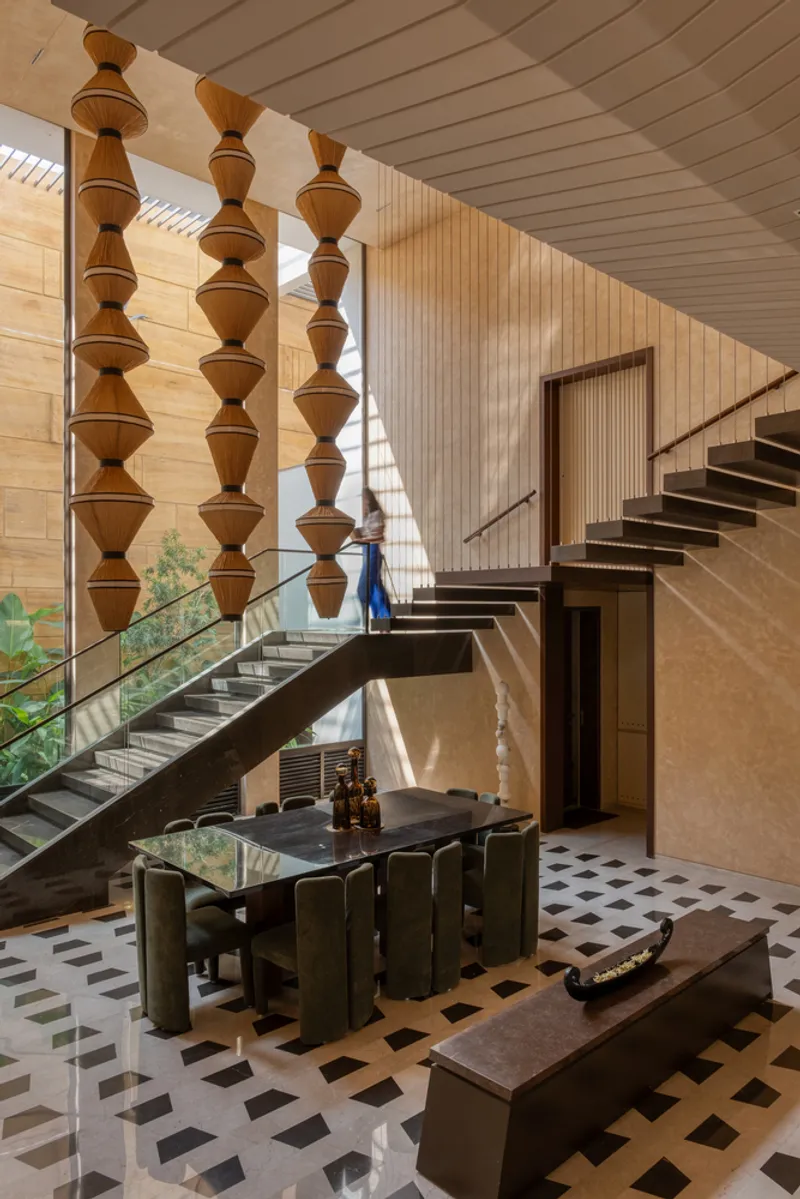
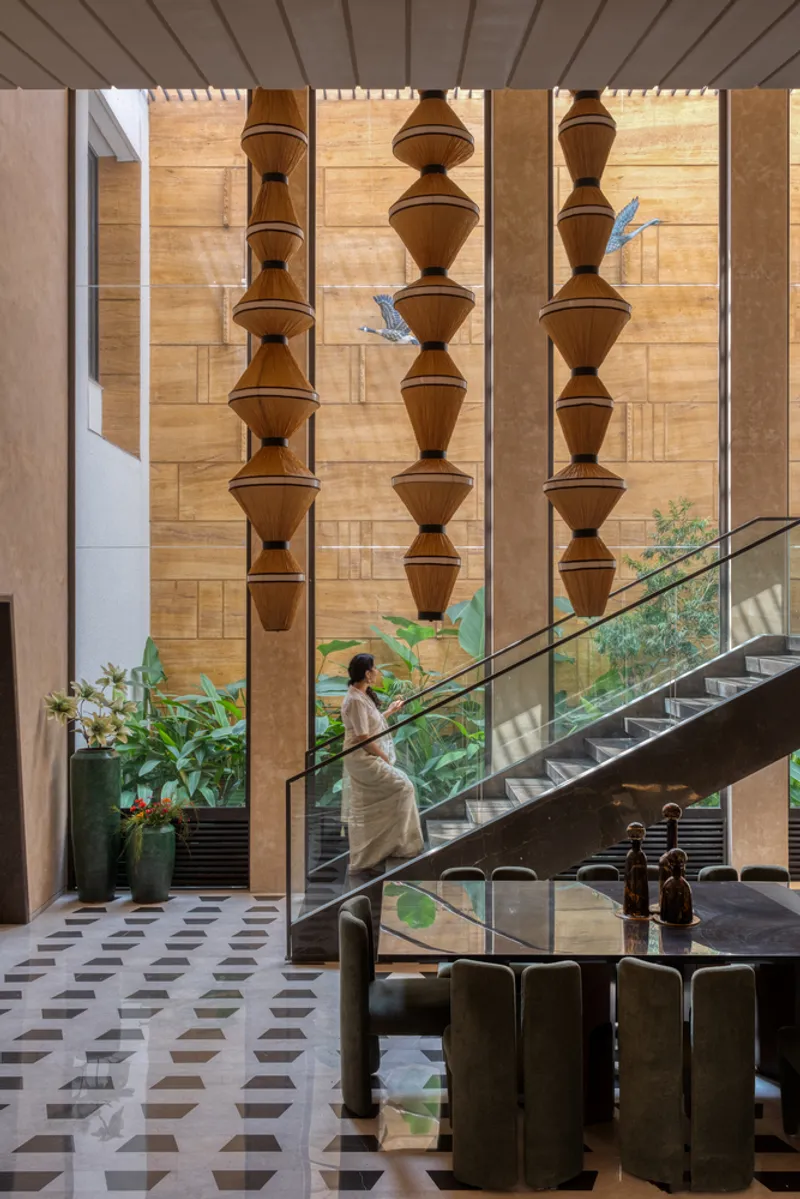
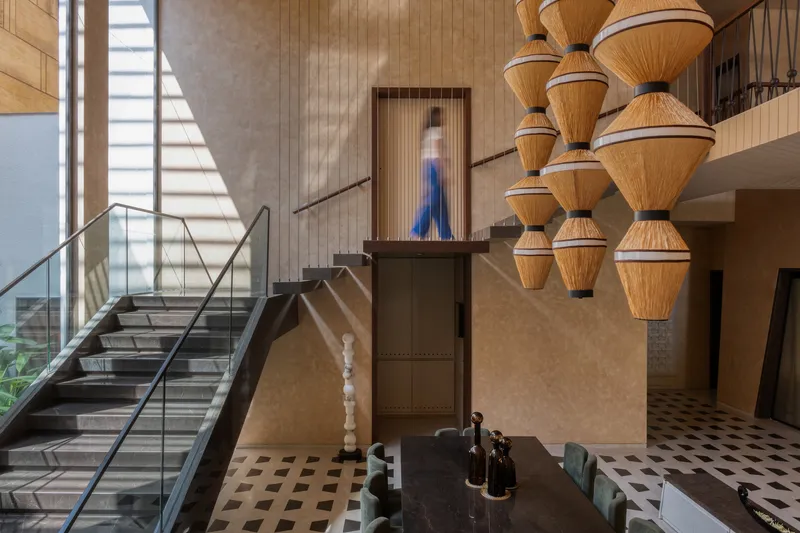
The steel and glass staircase is the project's spine, connecting the courtyard level to the upper bedrooms and the rooftop terrace. Stacked timber pendants, assembled from turned wooden elements, hang in clusters along the stair void, catching dappled light and casting their own intricate shadows on the stone walls. They are simultaneously decorative objects and instruments of atmosphere, breaking up the vertical space into zones of warmth and texture.
The double-height volume at the stair landing is where the house's two identities collide most dramatically. The geometric tiled floor recalls the courtyard's formality, while the timber wall cladding introduces a domestic warmth that softens the fort-like scale. A figure ascending the stairs in one photograph gives a sense of the proportions: this is a house built for bodies in motion, not for posing in catalogue photographs.
Interior Rooms: Texture Over Ornament
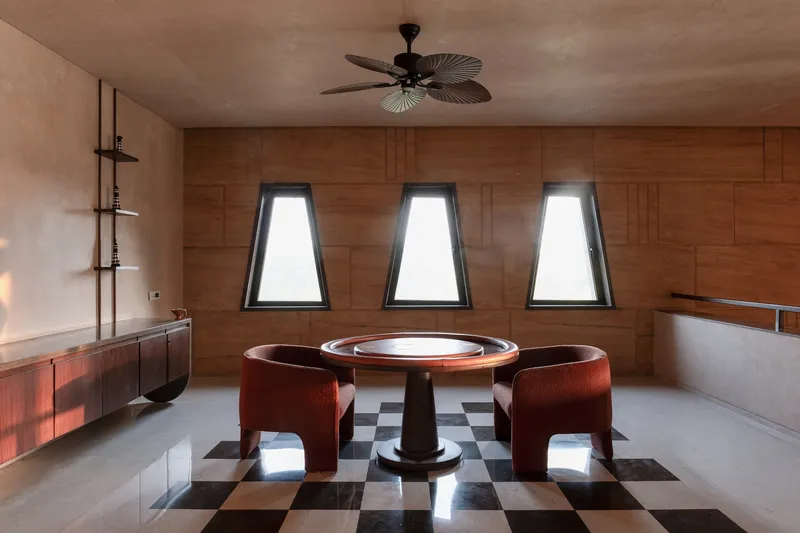
The dining room is a standout. Three trapezoidal windows punch through the wall at irregular intervals, framing views of greenery while echoing the fort's slit-like apertures. A patterned wood wall and black-and-white chequered floor anchor the room in a graphic intensity that feels deliberate rather than decorative. The fenestration here is doing double duty: controlling glare in the harsh Indore climate while creating a rhythm of light and shadow across the room that shifts with the hours.
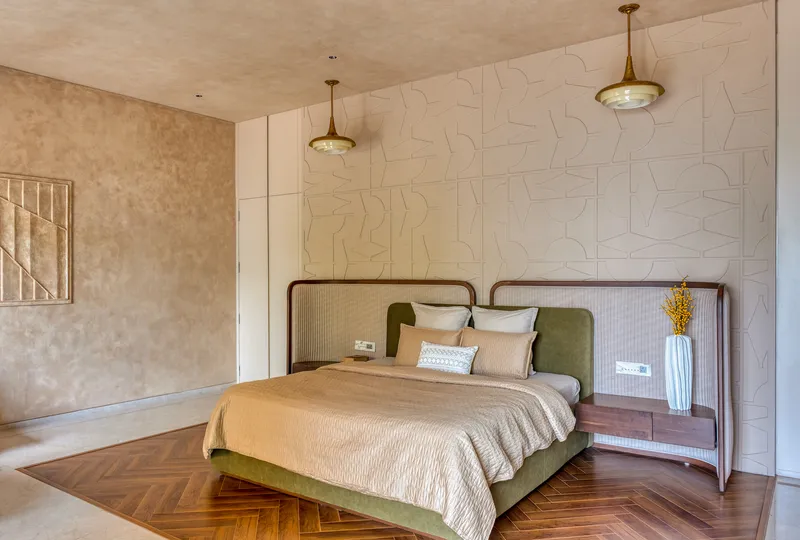
Bedrooms adopt a quieter register. Herringbone timber floors, textured wall panels, and brass pendant lights establish a warm, enclosed atmosphere that contrasts with the courtyard's openness. In one bedroom, an angled window frames a wall of tropical plants, turning the exterior planting into a kind of living artwork. The material palette throughout, marble, timber, sandstone, texture paint, is limited but deployed with enough variety in pattern and scale to keep every room distinct.
Private Retreats and Curated Details
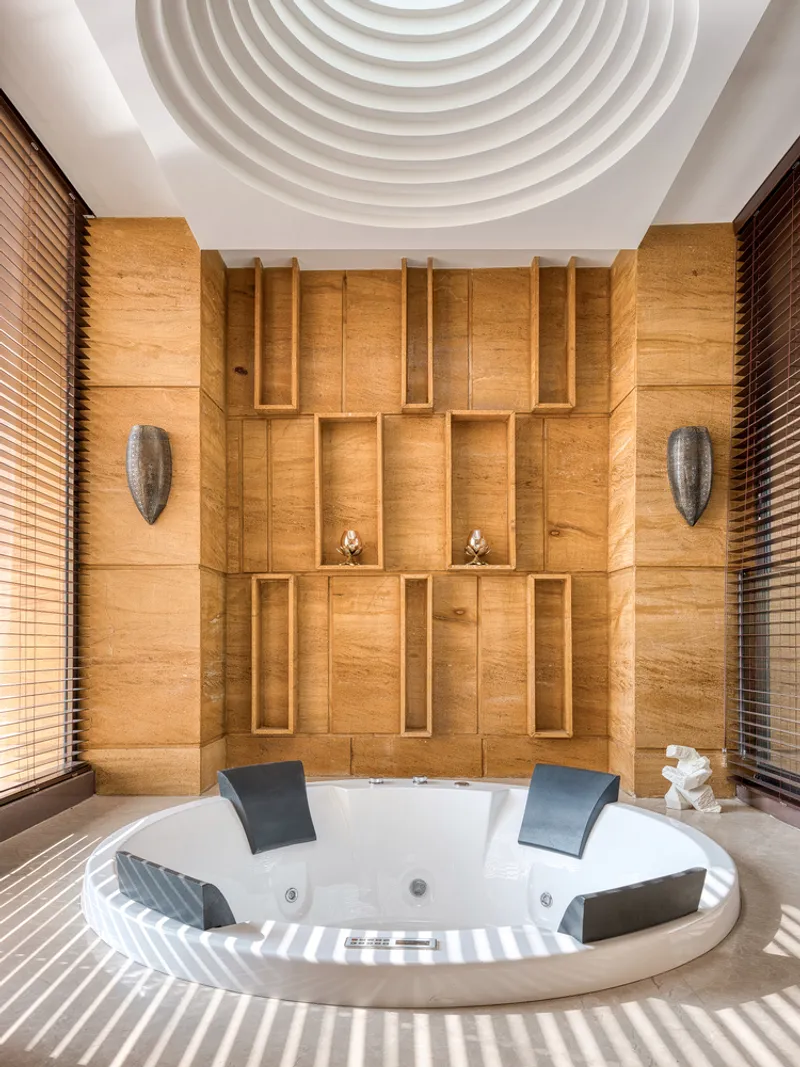
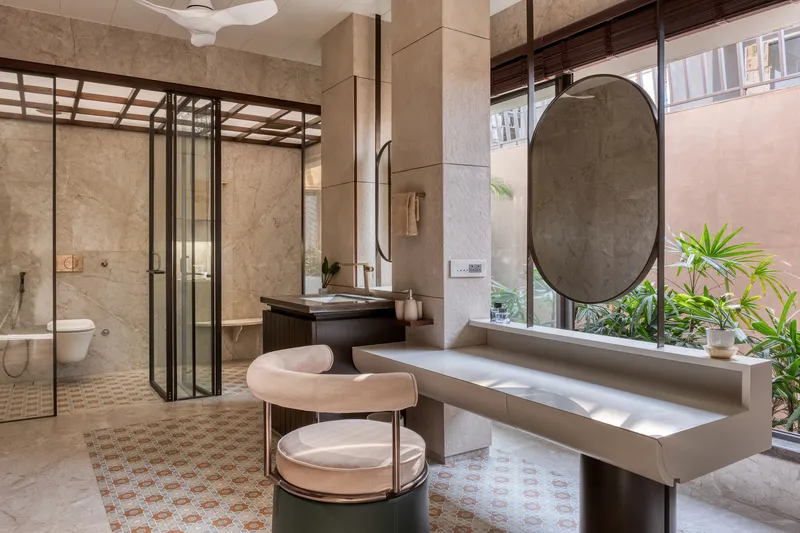
The bathrooms deserve particular attention. A bathtub alcove features concentric plaster ceiling rings that radiate outward like ripples in water, a detail that could tip into excess but is held in check by the surrounding teak paneling. Elsewhere, a vanity with a circular mirror opens directly onto a glazed courtyard view, bringing potted palms into the bathing ritual. These are not luxury-catalogue moments; they are carefully considered spatial experiences where material, light, and sightline converge.
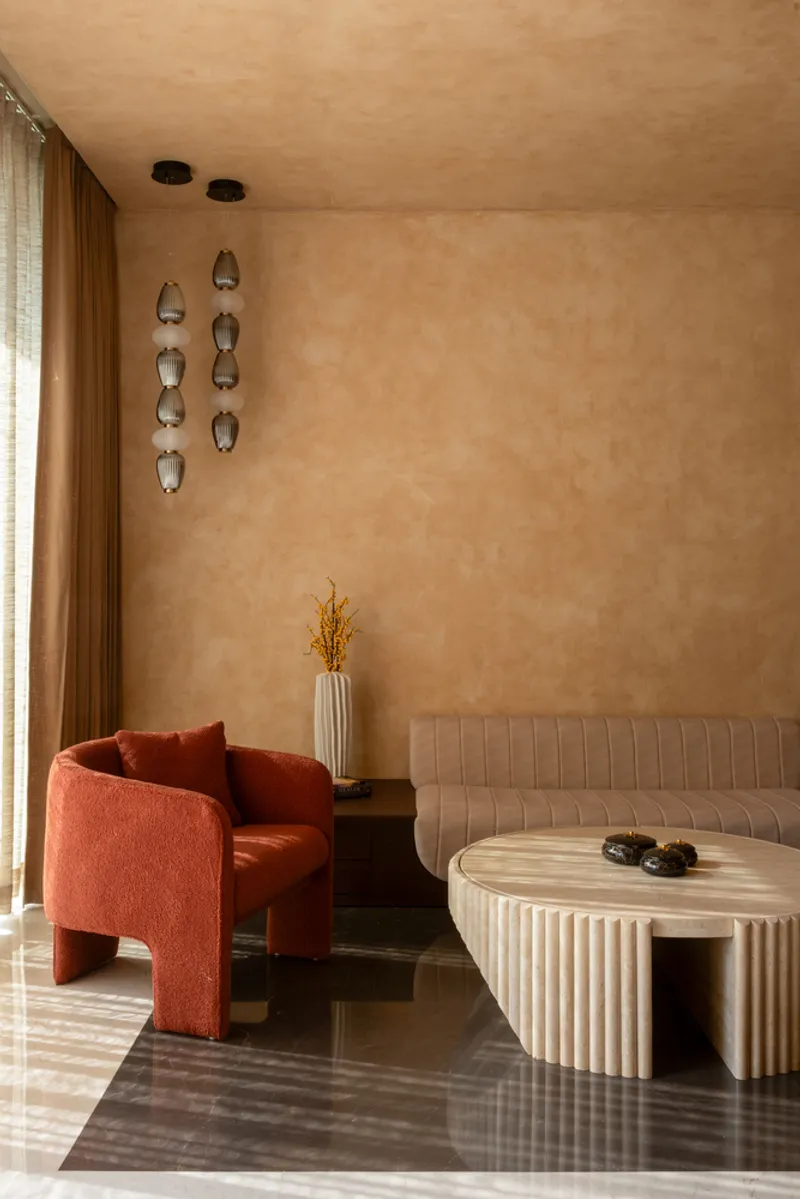
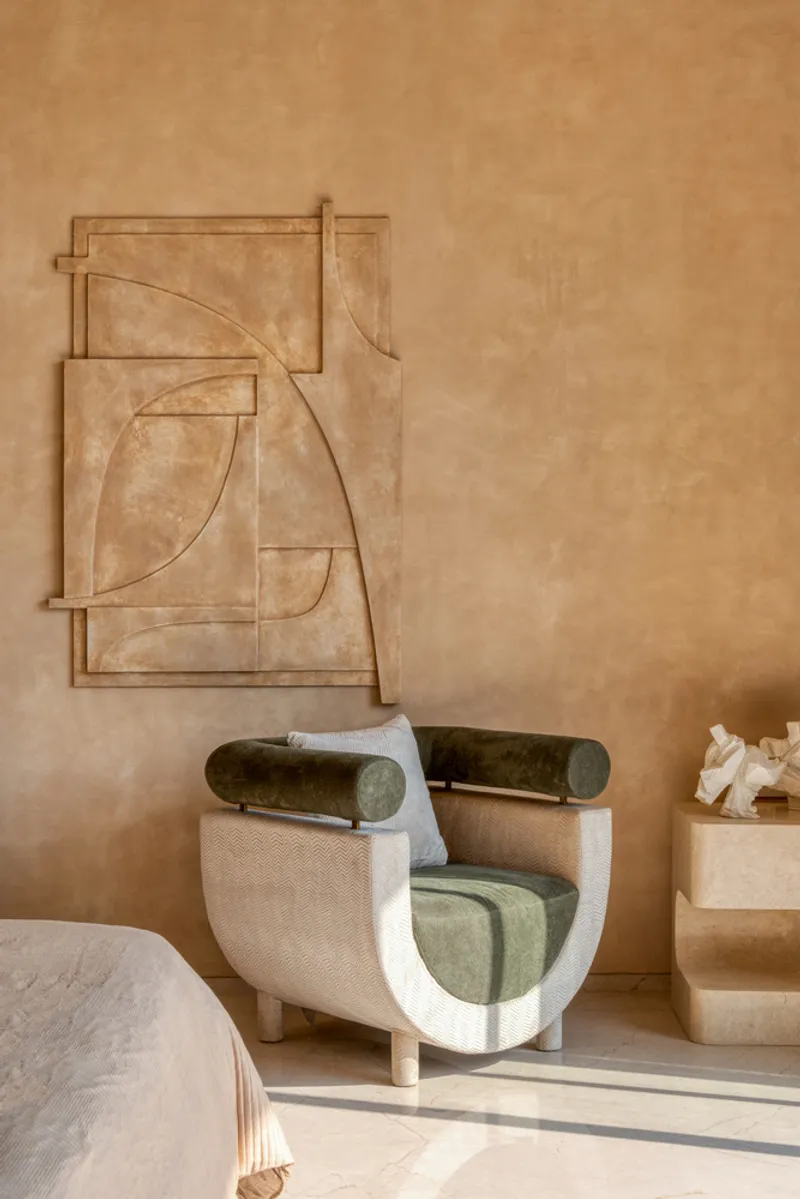
A carved stone relief panel mounted above a curved armchair demonstrates SPAN's commitment to craft. The geometric curves of the carving echo the building's larger formal language, collapsing the distance between architecture and furniture. It is a small gesture, but it speaks to the coherence of the design vision: nothing in this house is accidental.
The Rooftop and Garden Terraces
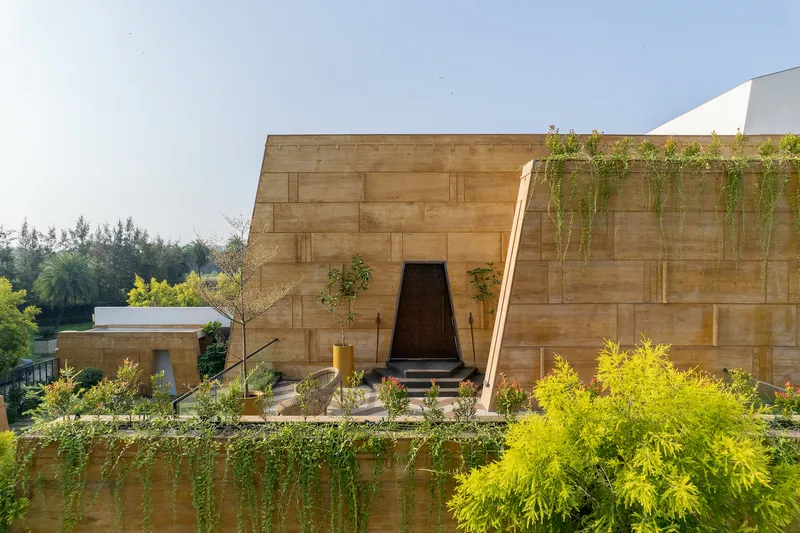
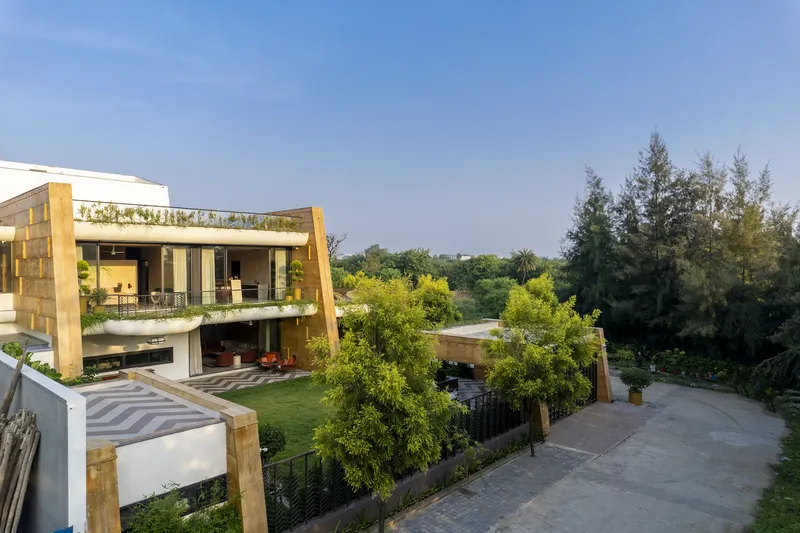
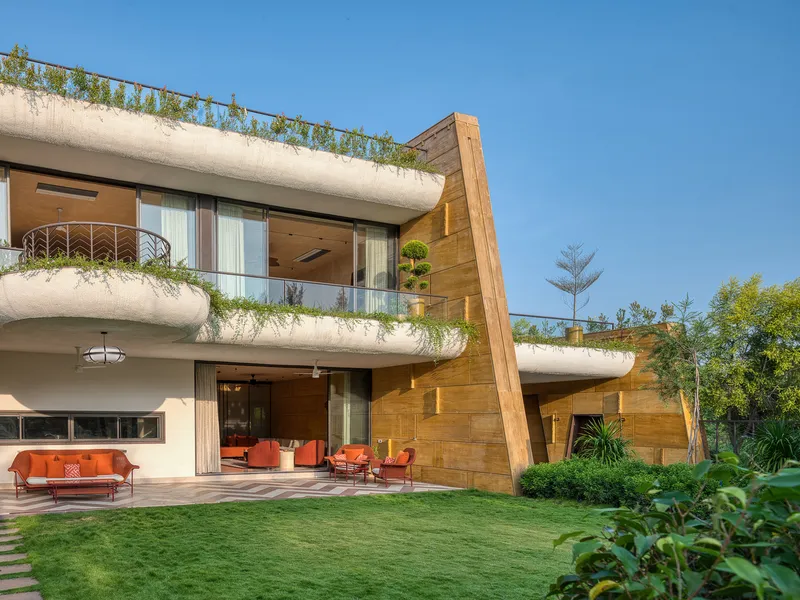
Fort House does not end at its roof line. Planted terraces, hanging vines, and stone-clad volumes extend the architecture vertically, blurring the boundary between built mass and landscape. The rooftop terrace reads as a continuation of the courtyard below, with sandstone facades and planted beds creating a sequence of outdoor rooms stacked above the main living spaces.
From the garden side, curved planted balconies and angled stone piers frame glass openings that bring the interior spaces into dialogue with the surrounding trees and lawn. The massing from this angle is softer, more fragmented, revealing a house that presents different faces depending on where you stand. The fort metaphor holds on the street; here, it dissolves into something more porous and garden-like.
Plans and Drawings

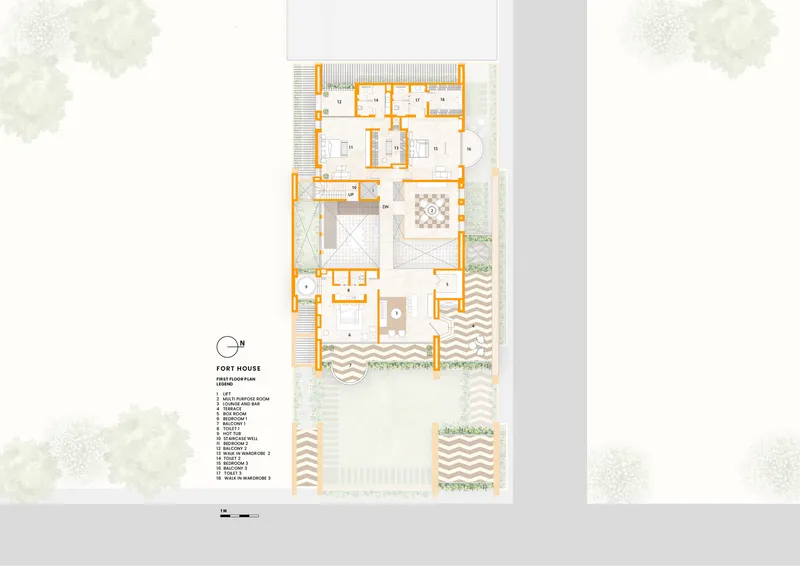

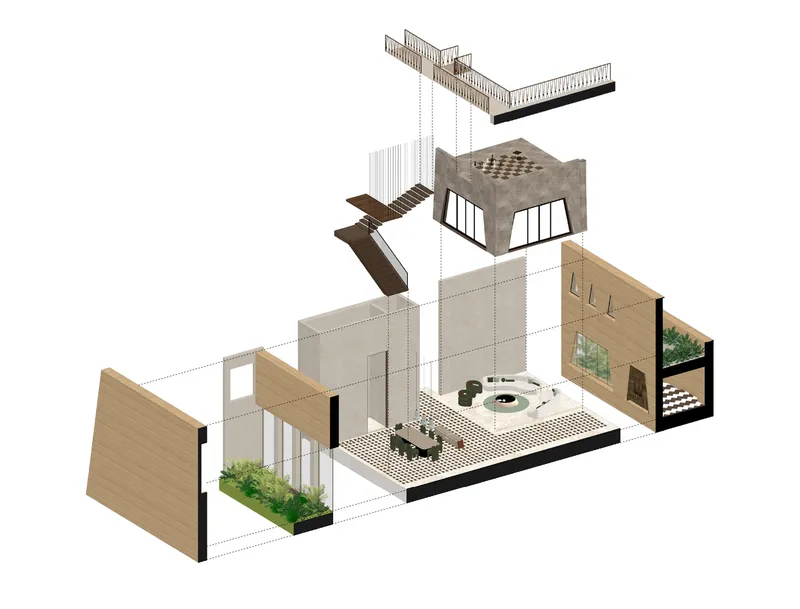
The ground floor plan confirms what the photographs suggest: the courtyard is the organizational fulcrum, with living, dining, and drawing rooms unfolding in sequence along one axis and private zones branching off along the other. A swimming pool occupies the rear of the plot, positioned to receive northern light without competing with the courtyard. The first floor stacks bedrooms above the public spaces, each with access to a terrace or planted balcony. The terrace floor plan shows service spaces and planted areas arranged to maximize usable outdoor space on the roof.
The exploded axonometric is the most revealing drawing. It separates the layered volumes, timber walls, concrete roof slabs, and planted courtyards, into legible components, making visible the structural logic that the photography conceals behind texture and atmosphere. The 72 by 150 foot plot is used with remarkable efficiency, achieving a built area of 11,500 square feet on a site of 10,900 square feet through careful vertical stacking.
Why This Project Matters
The temptation in contemporary Indian residential architecture is to reach for global minimalism on one hand or historicist pastiche on the other. Fort House refuses both. It takes a regional typology, the fortified compound, and subjects it to a rigorous contemporary logic without stripping it of its cultural resonance. The sandstone walls are not decorative veneers; they are structural arguments about weight, permanence, and belonging. The courtyards are not lifestyle amenities; they are climate devices that make the house habitable in Indore's punishing heat. Every decision serves both a formal and a functional purpose.
For architects working in similar contexts, Fort House offers a useful lesson: regionalism does not require nostalgia. You can build with local stone, organize around courtyards, and reference historical fortifications while producing something that is unmistakably of this moment. SPAN Architects have threaded that needle with conviction, delivering a house that feels ancient in its bones and entirely modern in its execution.
Fort House by SPAN Architects, located in Indore, India. 11,500 sq ft built area on a 10,900 sq ft site. Completed in 2024. Photography by Umang Shah.
About the Studio
Share Your Own Work on uni.xyz
If projects like this are the kind of work you want to make, uni.xyz is a place to publish your own, find collaborators, and enter design competitions.



Popular Articles
Popular articles from the community


The Earth Pod: 3D Printed Homes for Resilient Refugee Communities
The Earth Pod reimagines refugee housing through 3D printed homes made from clay, combining resilience, self-sufficiency, and rapid shelter.

AL-JANNAH: Sustainable Architecture and Permaculture for Afghan Widows
AL-JANNAH uses sustainable architecture and permaculture to create resilient oasis of housing, learning, work and renewal for Afghan widows.

Hill & Cross Opera: Sculptural Opera House Architecture Shaped by Tallinn’s Landscape and Identity
Hill & Cross Opera reimagines opera house architecture in Tallinn through its sculptural hill, civic plaza, glass wave and a luminous cross.

The Musturak Paradise: Senior Living Architecture for a Connected Future in Temara, Morocco
The Musturak Paradise reimagines senior living architecture in Temara via private homes, social spaces, culture, community, and shared care.


Similar Reads
You might also enjoy these articles


Hodi-Mandai Geram
Project Function: Preservation and revitalization of the Intangible heritage and socio-spatial identity of the Hodi by Housing, Cultural Memory Center, Sacred Grove, landscape, local tourism economy


Olio Towers: A Mid-Rise for Performers That Fuses Housing, Rehearsal, and Stage
Located blocks from Houston's Theater District, this modular tower stacks living units around a central performance atrium.

Oasis: Modular Green Housing Carved into Dhaka's Urban Fabric
A shortlisted Plugin Housing entry reclaims unauthorized settlements in Dhaka with stepped concrete volumes, green roofs, and ventilation-driven design.

Black Hole: A Floating Megastructure for the Post-Physical Era
Emiliano Mazzarotto envisions a spherical, self-scaling arena where e-sports, digital hotels, and holographic stadiums replace traditional public space.


Explore Architecture Competitions
Discover active competitions in this discipline



Challenge to reimagine the Iron Throne


Photograph architecture without architects


Illustrate the lost glory of Angkor Wat - Render Challenge


Design challenge to reuse E-waste
Comments (0)
Please login or sign up to add comments
No comments yet. Be the first to comment!