
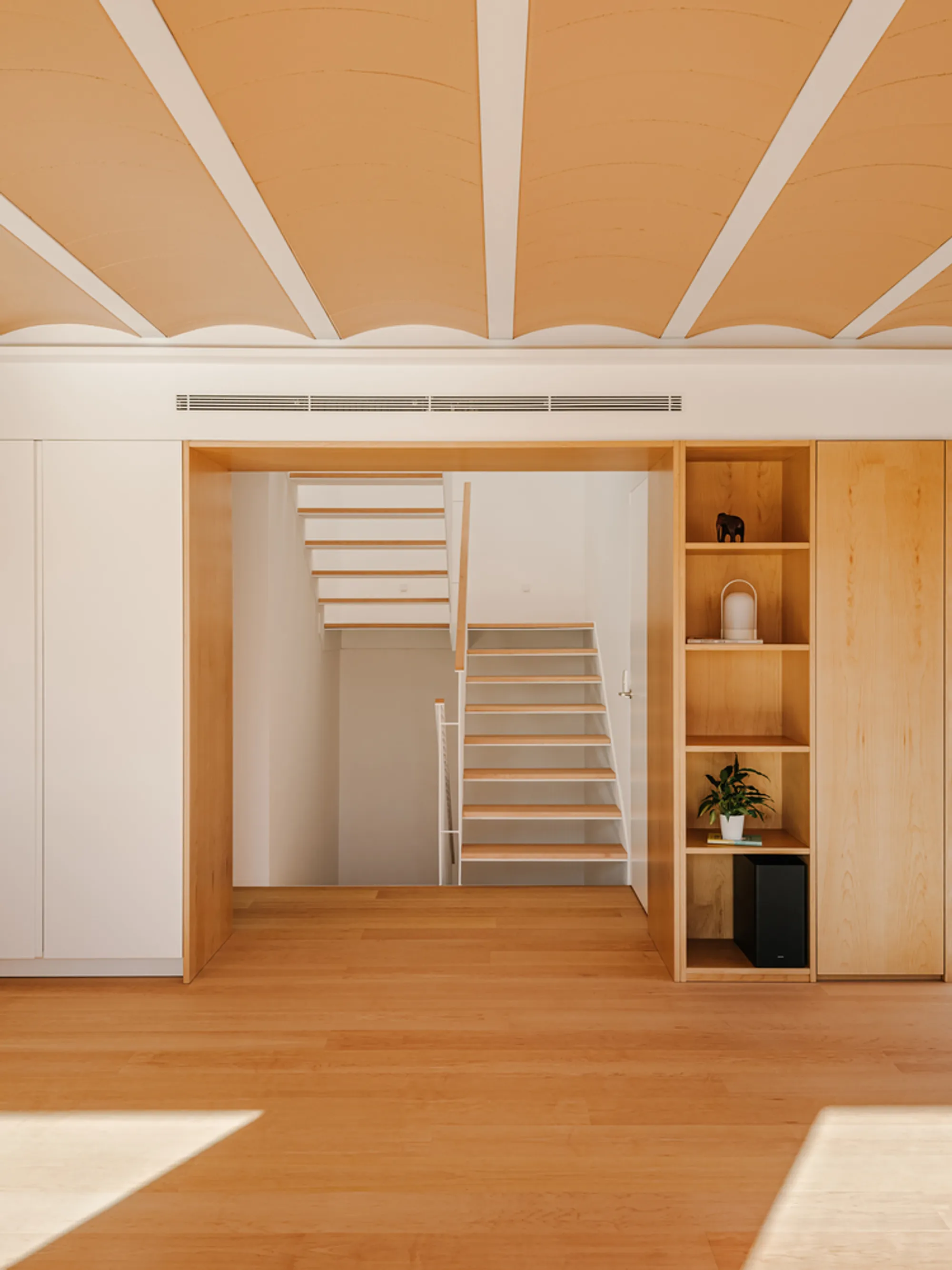
VVAA Studio Rebuilds a Tarragona Garage Into a 290 m² Plywood-and-Ceramic Home
Casa Barcelona strips a pre-existing ground-floor garage back to its structural grid, then stacks four levels of warm, daylit living above it.


Starting from a garage is not glamorous. But for VVAA Studio, the existing structural grid beneath a Tarragona residence became the organizing logic for everything that followed. Casa Barcelona takes that grid, retains it as the skeleton for a new ground floor, and builds three additional levels on top, each one split into an open half and a serviced half by a central staircase core and wet rooms. The result is a 290 m² home completed in 2024 that feels considerably larger than its footprint suggests.
What makes the project worth examining is not its sustainability credentials, though those are real. It is the way a limited palette of plywood ceilings, white-painted structure, and timber flooring produces spatial variety across four floors without ever becoming visually loud. Every room reads as part of one continuous material idea, yet each level has its own proportion of light, enclosure, and ceiling height. That consistency is harder to achieve in a renovation than in new construction, and VVAA Studio pulls it off cleanly.
A Plywood Ceiling That Ties Everything Together
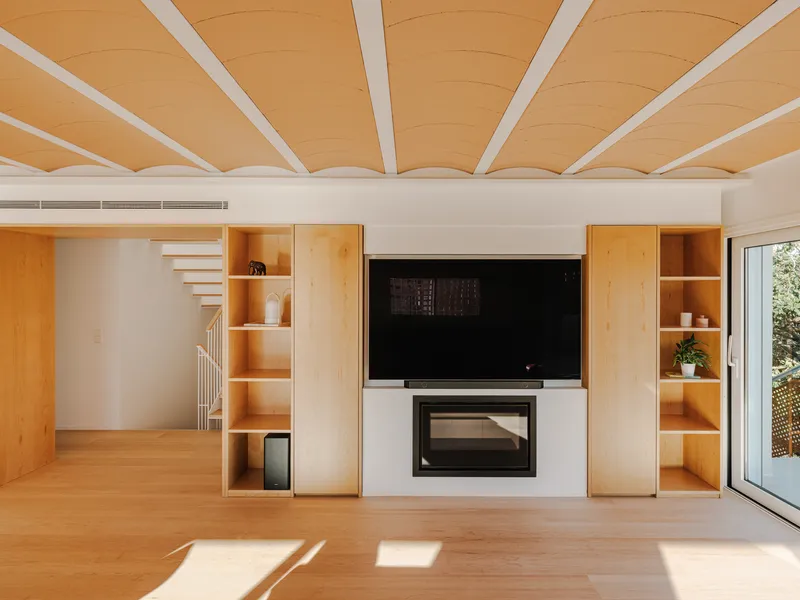
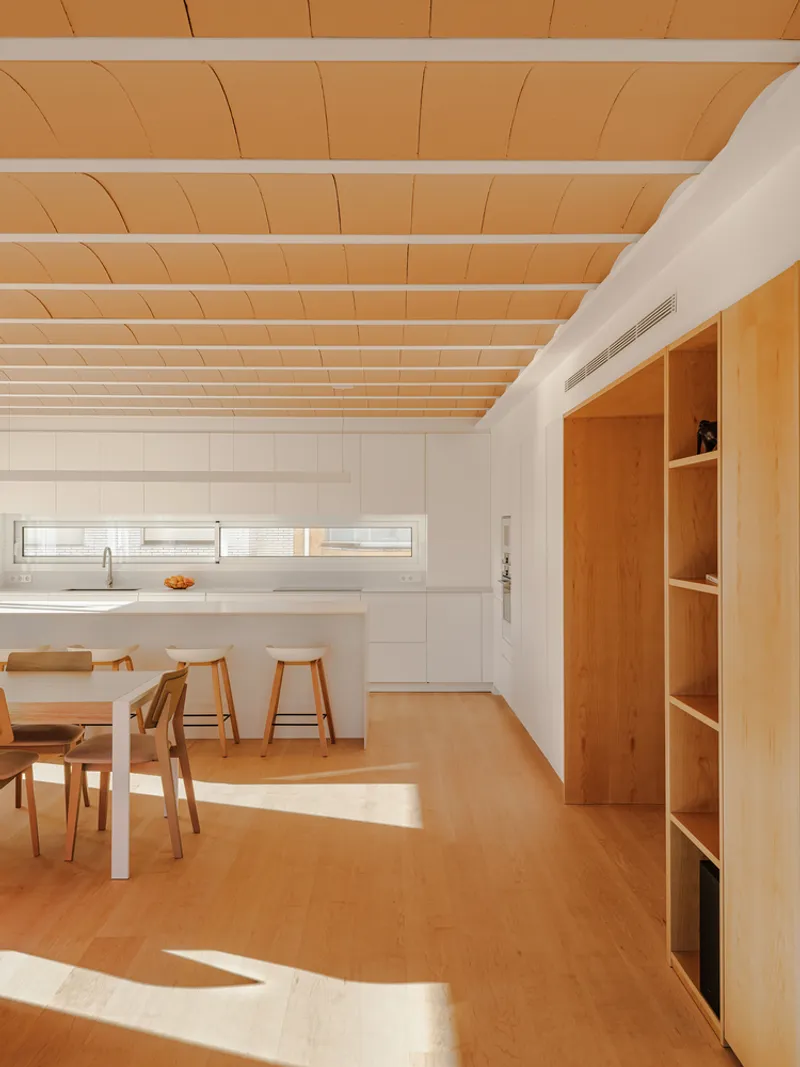
The most immediately recognizable move in Casa Barcelona is the plywood ceiling plane that runs across the main living level, punctuated by white-painted exposed beams. This ceiling does a lot of work. It lowers the perceived scale of the open-plan kitchen, dining, and living zone to something domestic rather than loft-like, and it introduces a warm amber tone overhead that bounces afternoon light downward. The beams remain visible, which keeps the structure honest; you always know where the loads go.
In the living room, white built-in cabinetry flanks a fireplace, creating a symmetrical focal wall that contrasts with the directional grain of the plywood above. The effect is restrained but precise: warm overhead, cool at the perimeter, and a single hearth anchoring the composition.
The Kitchen as Spatial Hinge
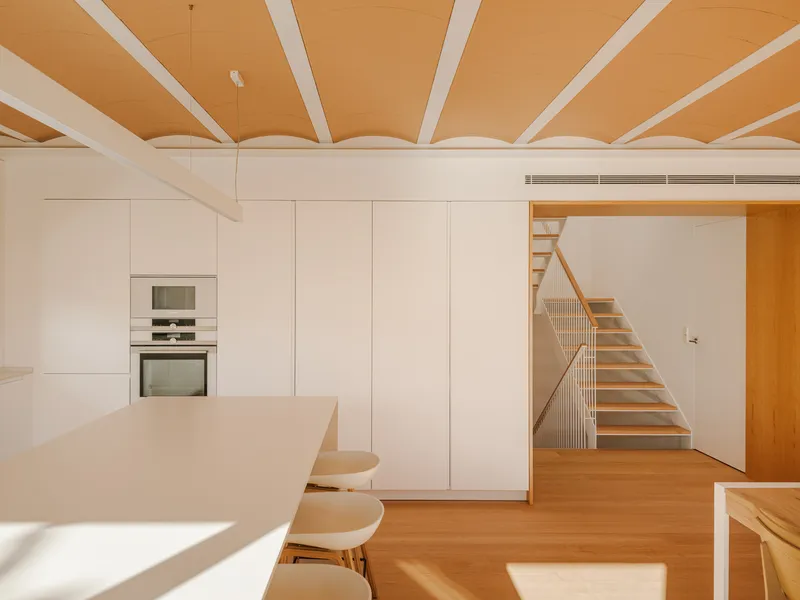
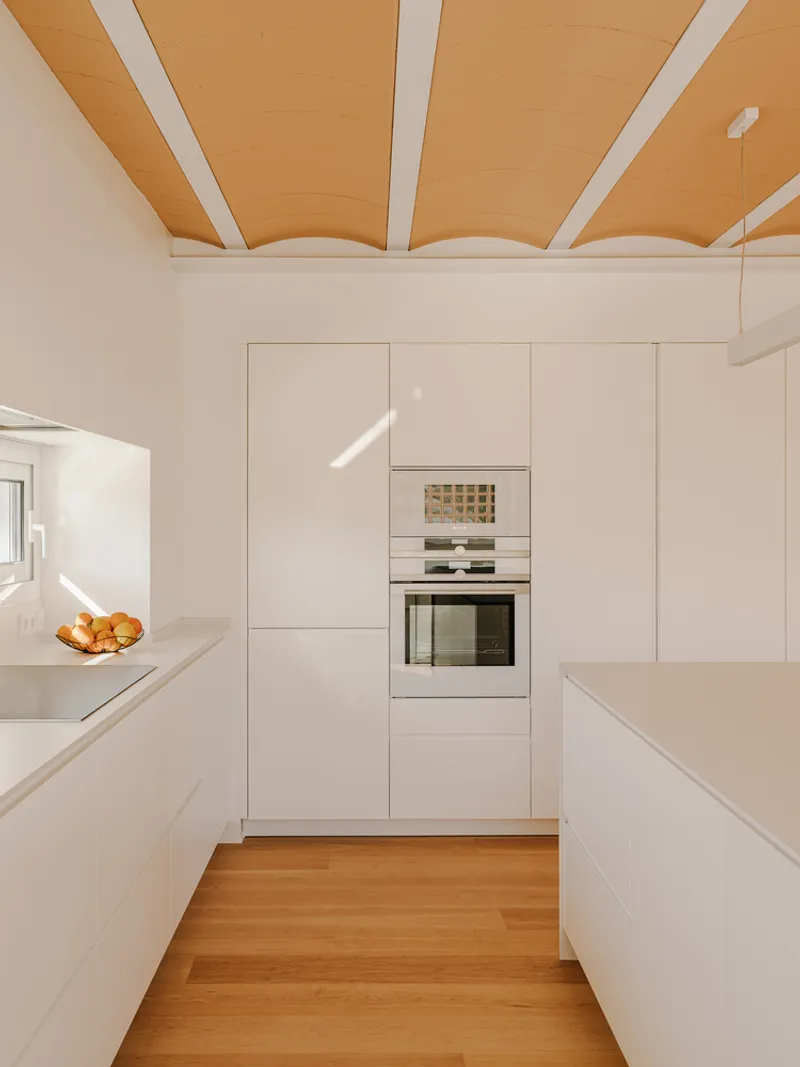
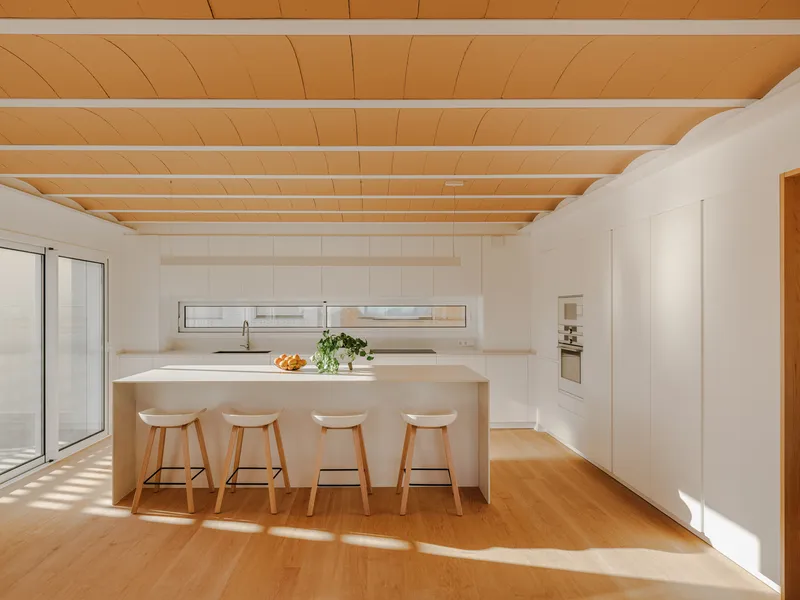
The galley kitchen occupies the narrow, serviced side of the plan, tucked against the staircase core. White cabinetry and built-in appliances line both walls, keeping the countertops free and the sightlines long. Through the doorway, the timber staircase is always visible, which means the kitchen never feels like a dead end. You are always oriented toward vertical circulation and, by extension, toward the upper levels and their light.
A white island with timber bar stools bridges the kitchen and the dining area, acting as a social threshold rather than a hard partition. It is a simple device, but its placement is deliberate: the island sits directly below one of the exposed beam bays, reinforcing the structural rhythm and giving the casual eating zone a sense of enclosure without walls.
Staircase as Sculpture and Spine
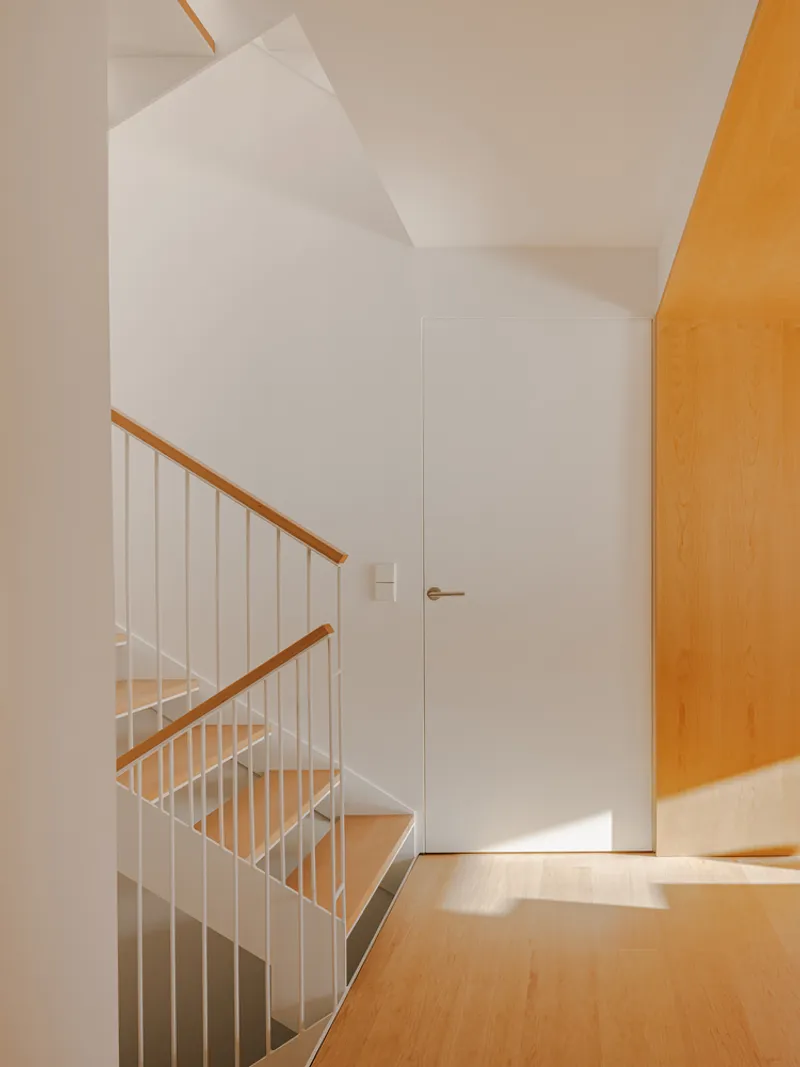
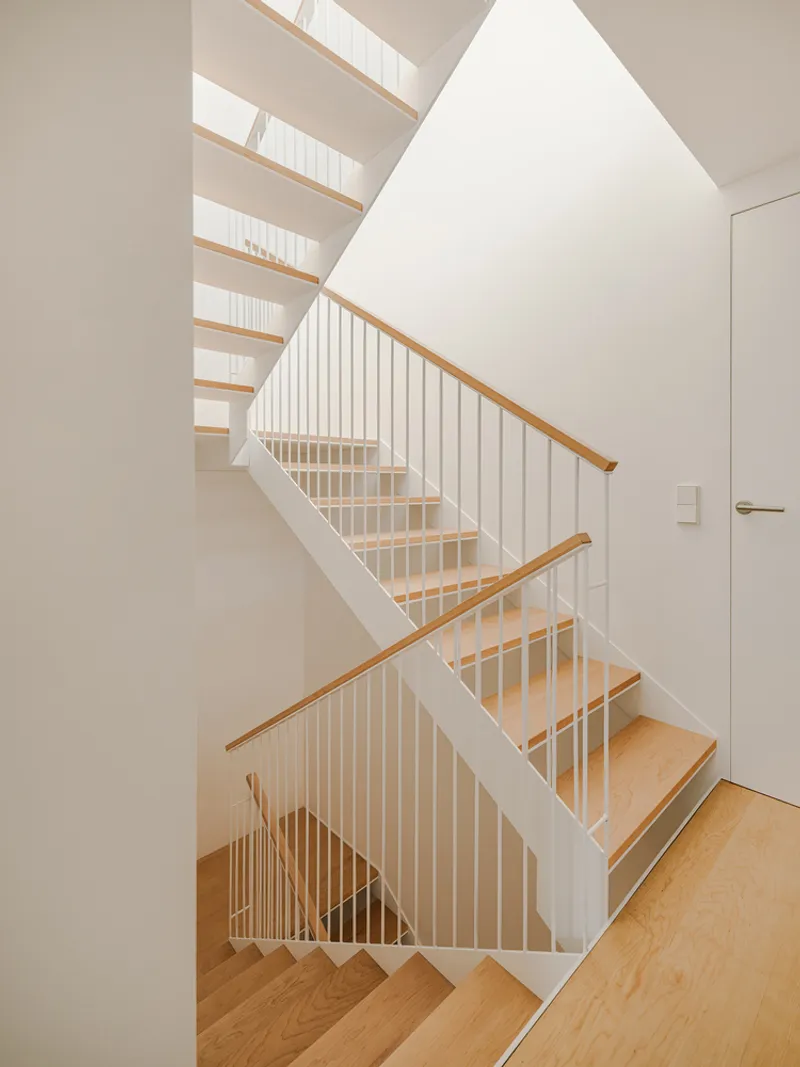
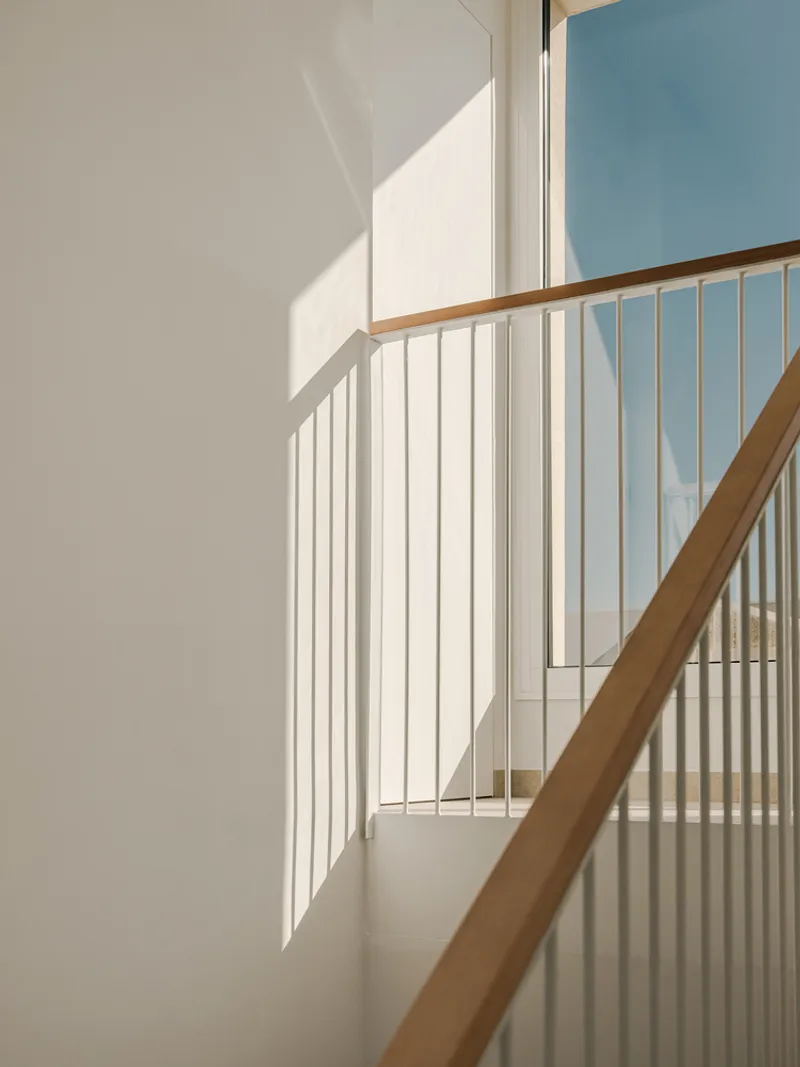
The staircase is the project's organizational backbone, and VVAA Studio treats it accordingly. Vertical white balusters, timber handrails, and open risers recur across every flight, creating a family of details that you encounter again and again as you move through the house. The switchback configuration at the upper levels sits beneath a skylight that pulls daylight deep into the section, washing the white-painted walls and casting sharp shadows through the baluster rods.
What matters here is the consistency. The same timber treads, the same white verticals, the same handrail profile appear whether you are climbing from the former garage level or descending from the roof terrace. That repetition turns a utilitarian element into a spatial event: the stair is never merely a connector, it is the room you pass through most often, and its quality of light changes with each landing.
Open-Riser Stair and Built-In Storage
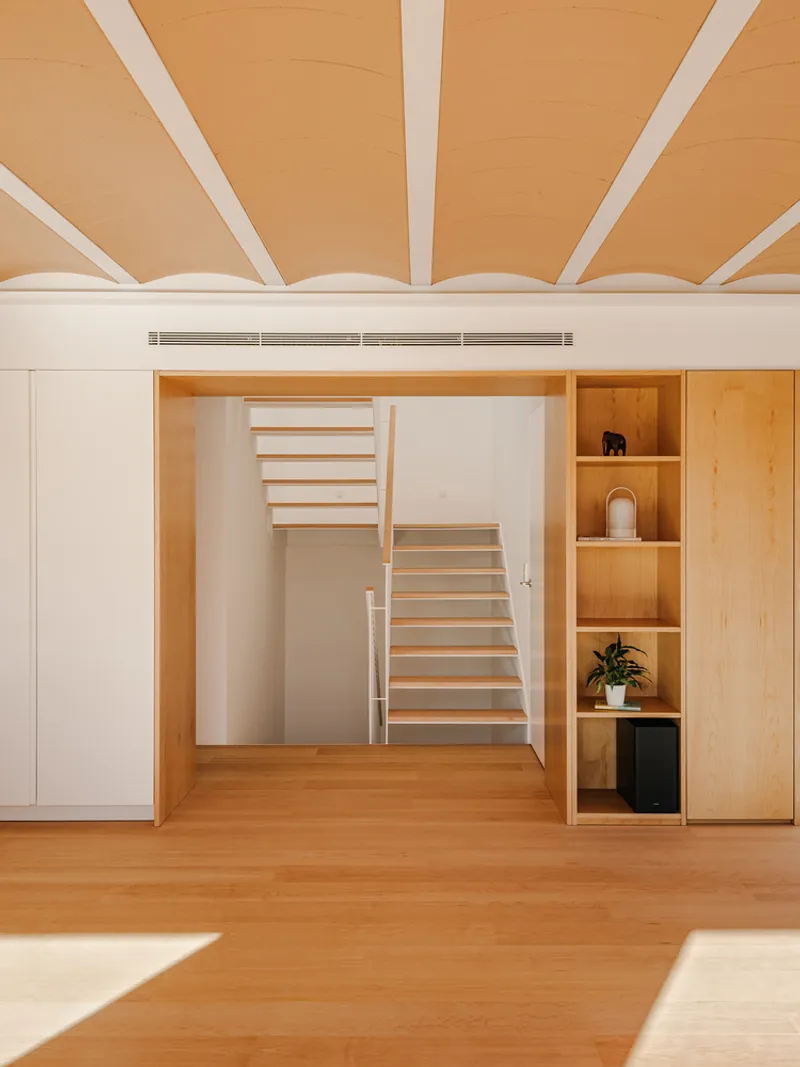
At the transition between levels, an open-riser timber staircase is framed by white cabinetry and built-in shelving beneath the exposed ceiling beams. The shelving wraps around the stair opening, turning dead space into library storage and display. It is a compact detail that speaks to the renovation's broader strategy: every square meter earns its keep.
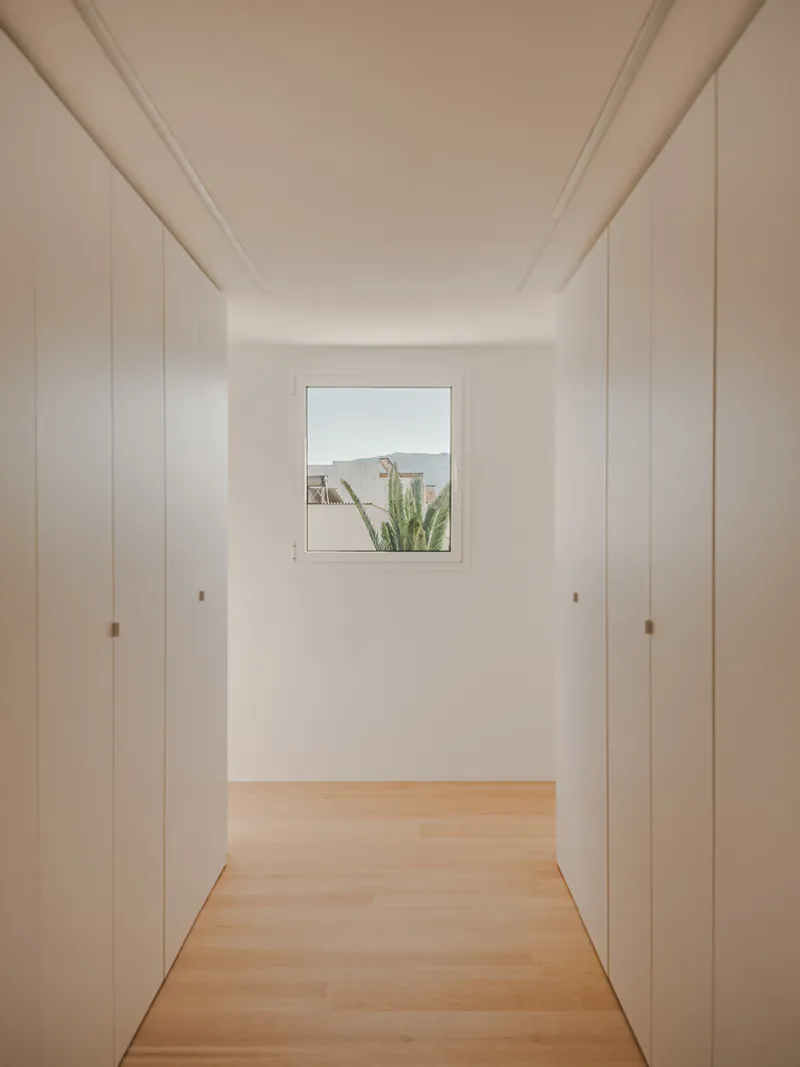
Down the hallway, floor-to-ceiling closet doors in white conceal storage on both sides, and a single square window at the corridor's end frames a cluster of palm fronds. The window is small, deliberately so. It functions less as a source of light and more as a picture frame, grounding you in the Mediterranean context without relying on panoramic glazing.
Wet Rooms: Timber Meets White
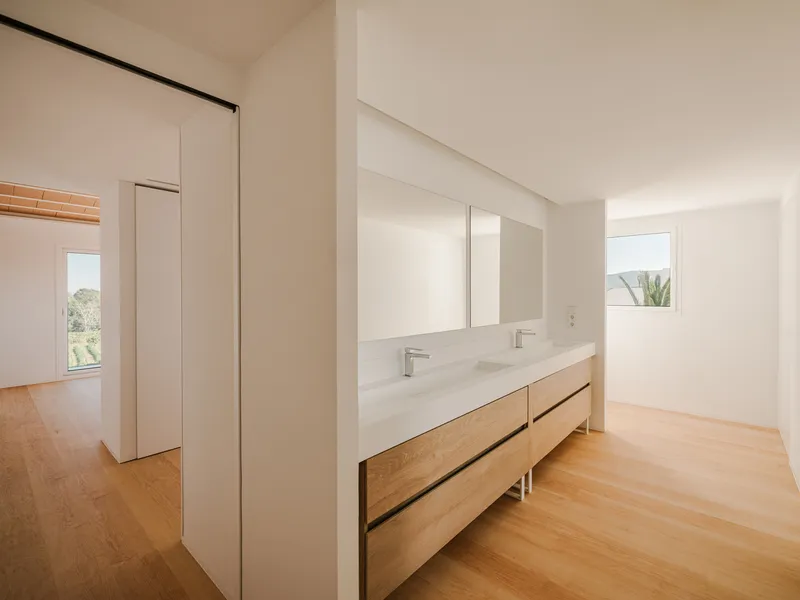
The bathroom continues the project's material logic without deviation. A floating timber vanity with a white countertop and twin sinks sits beneath a frameless wall mirror that extends the room visually. There is no tile pattern, no accent wall, no decorative gesture. The discipline here is the same as everywhere else in the house: timber and white, structure and surface, warmth and neutrality.
Grouping wet rooms alongside the staircase core on the serviced half of each floor plan means plumbing runs stack vertically, simplifying construction and keeping the open halves of each level completely free of service infrastructure. It is a practical decision that yields spatial generosity on the other side of the plan.
Plans and Drawings
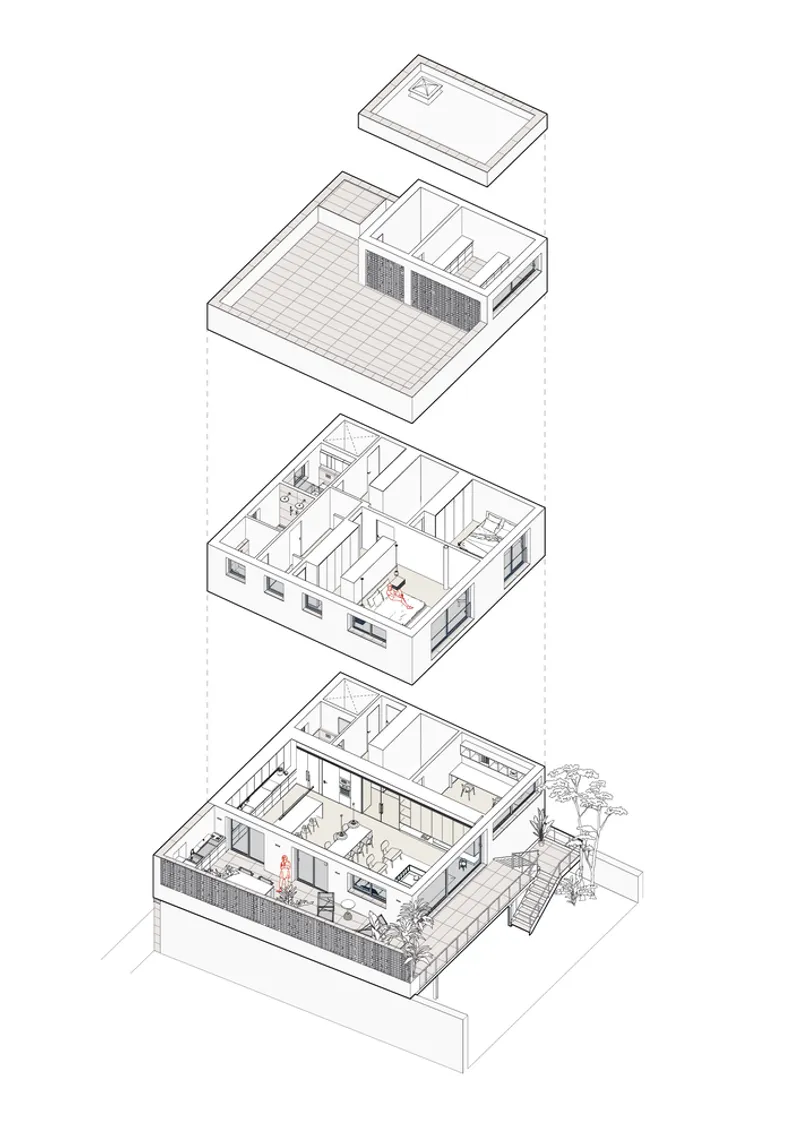
The exploded axonometric drawing reveals the full sectional ambition of the project. Four levels, including the roof terrace, stack above the retained garage structure. Each floor is bisected by the staircase core: open living space on one side, bedrooms and wet rooms on the other. Exterior stairs connect the upper terrace to the garden level, creating a secondary circulation loop that keeps the house from feeling vertically linear. The drawing also clarifies how the structural grid of the garage, with its regular column spacing, dictates the bay rhythm that the plywood ceiling and exposed beams express on the interior.
Why This Project Matters
Casa Barcelona is not trying to reinvent residential renovation. Its external insulation system, photovoltaic panels, and aerothermal climate control are responsible choices, but they are increasingly standard in Southern European retrofits. What distinguishes this project is VVAA Studio's ability to derive spatial richness from structural constraint. The garage grid was a given; the staircase core was a necessity. From those two fixed conditions, the architects generated a section that breathes, a material palette that never overreaches, and a sequence of rooms that feel both specific and flexible.
For anyone considering a renovation over new construction, this is the lesson worth absorbing. You do not need a heroic gesture to make an old structure feel new. You need a clear organizational idea, one material language applied with discipline, and enough restraint to let daylight and proportion do the heavy lifting. VVAA Studio understood that, and the result is a house that will age well precisely because it never tried too hard.
Casa Barcelona by VVAA Studio. Tarragona, Spain. 290 m². Completed 2024. Photography by Marta Vidal.
About the Studio
Share Your Own Work on uni.xyz
If projects like this are the kind of work you want to make, uni.xyz is a place to publish your own, find collaborators, and enter design competitions.




Popular Articles
Popular articles from the community


Co-Life: Senior Housing Design That Reconnects Older Adults With the City
Co-Life reimagines senior housing design through healing gardens, shared streets, workshops, and a sustainable community across generations.

Riyadh For All: Intergenerational Urban Design for Active Aging in Rabat
Riyadh For All reimagines urban design in Rabat with intergenerational co-living, adaptive courtyards, and Moroccan cultural exchange today.

Hill & Cross Opera: Sculptural Opera House Architecture Shaped by Tallinn’s Landscape and Identity
Hill & Cross Opera reimagines opera house architecture in Tallinn through its sculptural hill, civic plaza, glass wave and a luminous cross.

Co-life: Sustainable Architecture for Age-Friendly Community Living
Co-life reimagines sustainable architecture for seniors through courtyards, rammed earth, shared gardens, and spaces designed for belonging.


Similar Reads
You might also enjoy these articles


Hodi-Mandai Geram
Project Function: Preservation and revitalization of the Intangible heritage and socio-spatial identity of the Hodi by Housing, Cultural Memory Center, Sacred Grove, landscape, local tourism economy


Olio Towers: A Mid-Rise for Performers That Fuses Housing, Rehearsal, and Stage
Located blocks from Houston's Theater District, this modular tower stacks living units around a central performance atrium.

Oasis: Modular Green Housing Carved into Dhaka's Urban Fabric
A shortlisted Plugin Housing entry reclaims unauthorized settlements in Dhaka with stepped concrete volumes, green roofs, and ventilation-driven design.

Black Hole: A Floating Megastructure for the Post-Physical Era
Emiliano Mazzarotto envisions a spherical, self-scaling arena where e-sports, digital hotels, and holographic stadiums replace traditional public space.

Explore Architecture Competitions
Discover active competitions in this discipline



Challenge to reimagine the Iron Throne


Photograph architecture without architects


Illustrate the lost glory of Angkor Wat - Render Challenge


Design challenge to reuse E-waste
Comments (0)
Please login or sign up to add comments
No comments yet. Be the first to comment!