
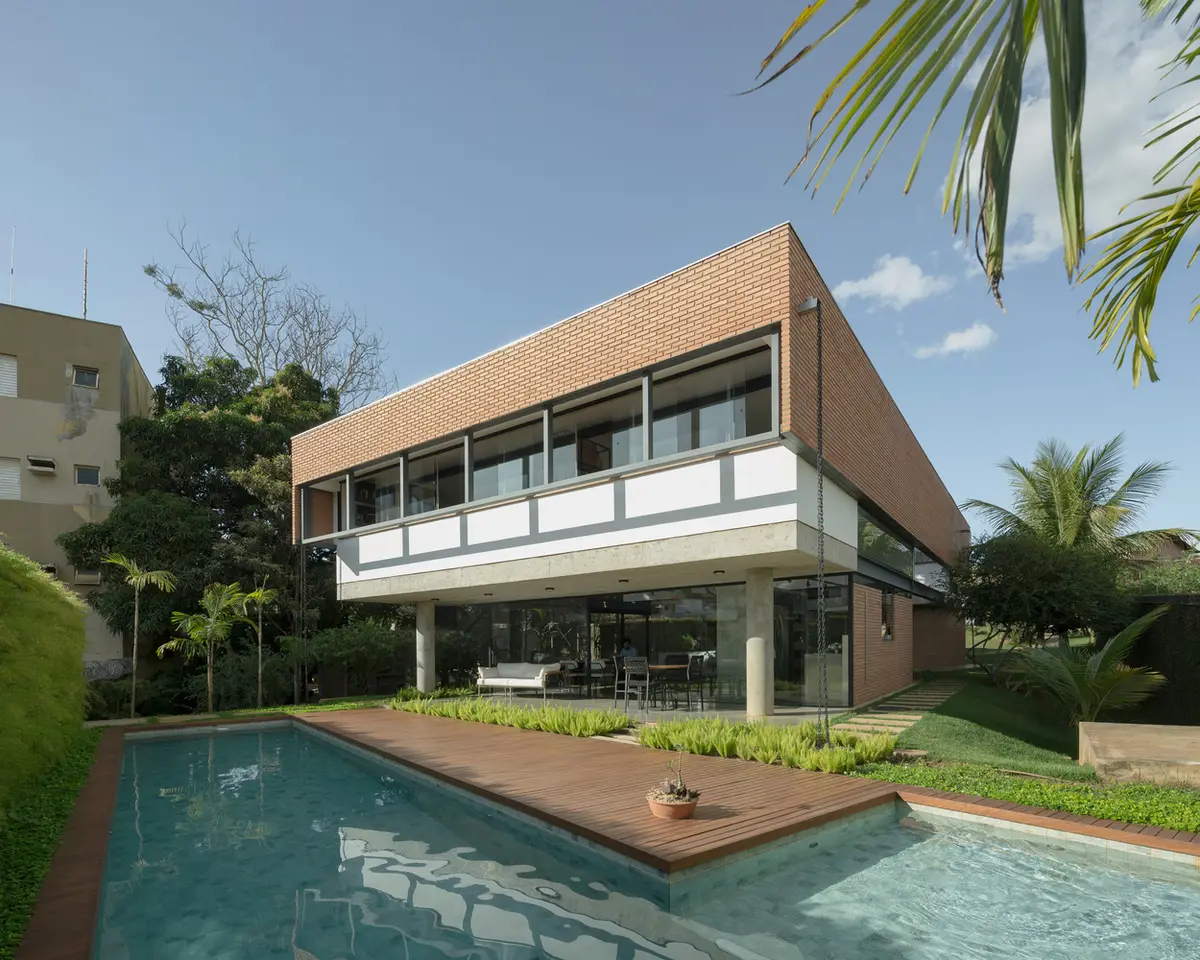
Venta Arquitetos Lifts a Brick Volume Over the Trees in Montes Claros
In northern Minas Gerais, a house suspends its private quarters above a ground floor woven into an existing landscape of mature palms.


The instinct to clear a site before building on it is so deeply ingrained in residential construction that we rarely question it. Venta Arquitetos took the opposite approach in Montes Claros, a city in the semi-arid north of Minas Gerais, Brazil. Rather than flatten the lot and replant later, they designed a house whose structural logic is dictated by what was already growing there: palm trees, large-canopy hardwoods, and established garden beds that now occupy the ground floor as though they had never been disturbed.
The result is a two-story residence that reads as two distinct buildings stacked on top of each other. Below, an open, sheltered landscape of concrete columns, planted beds, and preserved trunks functions as a semi-public living layer. Above, a cantilevered brick and timber volume holds the bedrooms and private quarters, hovering over the treetops with the confidence of a structure that knows exactly where its loads are going. It is a house that refuses the premise that architecture and landscape are separate disciplines.
Living Among the Trunks
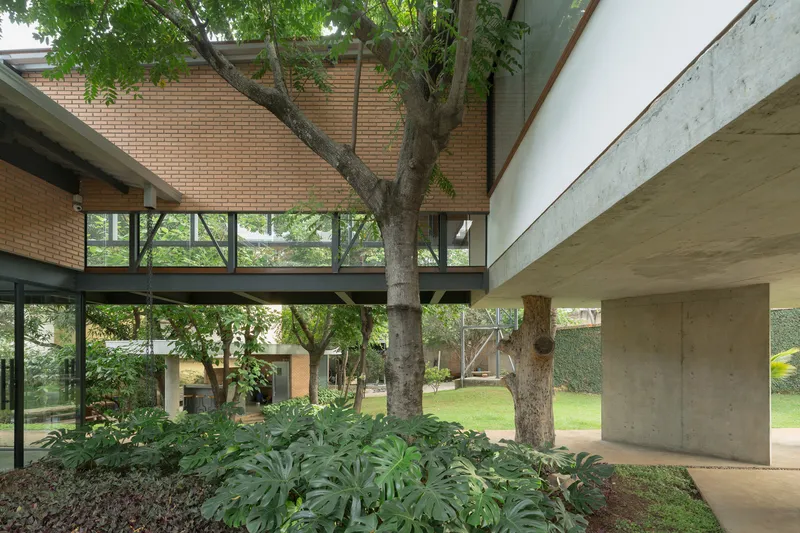
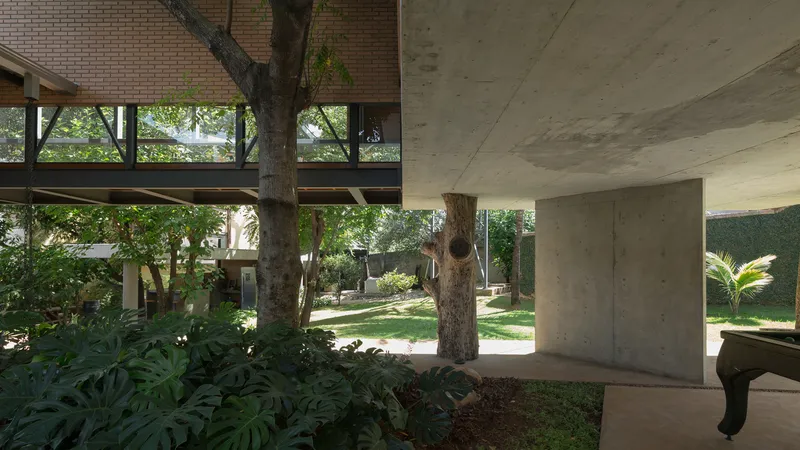
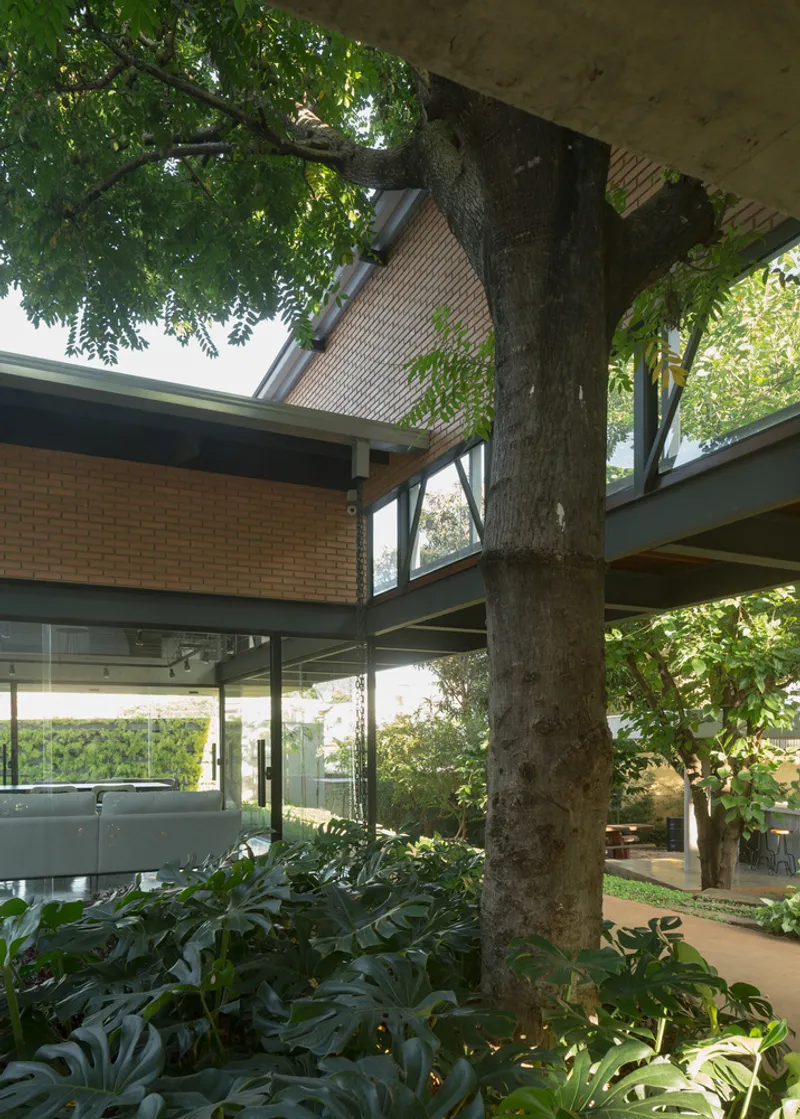
The ground floor is less a conventional interior than a covered garden. Concrete columns and exposed steel beams define a sheltered zone that weaves between existing trees, some of which puncture the floor slab and grow through openings in the soffit above. The effect is not decorative; it is structural choreography. Every column placement and every beam span was calibrated to avoid root zones and canopy lines, meaning the engineering followed the botany rather than the other way around.
Planted beds at ground level blur the line between terrace and garden. You walk beneath a deep concrete soffit, past tree trunks wrapped in ferns and bromeliads, and the transition from outside to inside happens almost without your noticing. The sheltered terrace areas serve as extensions of the social spaces, shaded by both the upper volume and the existing canopy, keeping temperatures down in a region where summer heat is relentless.
The Cantilevered Brick Box
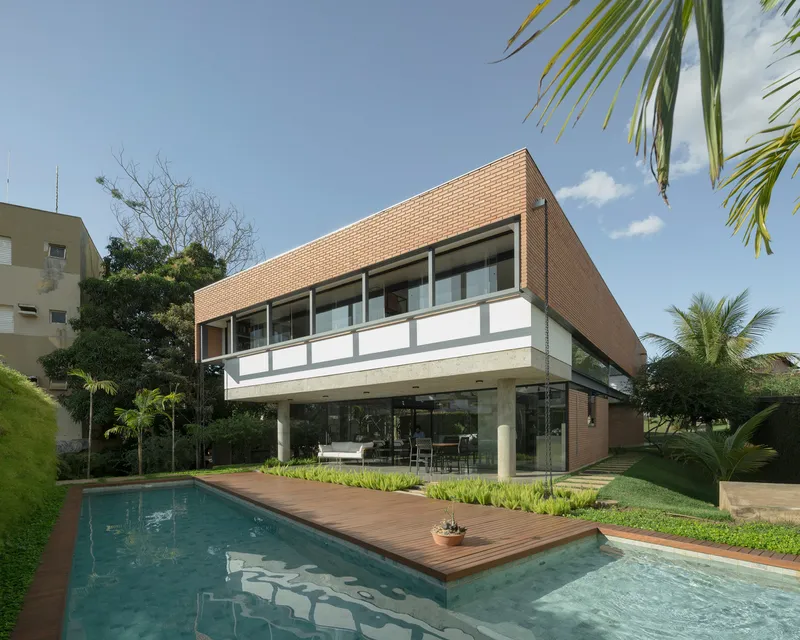
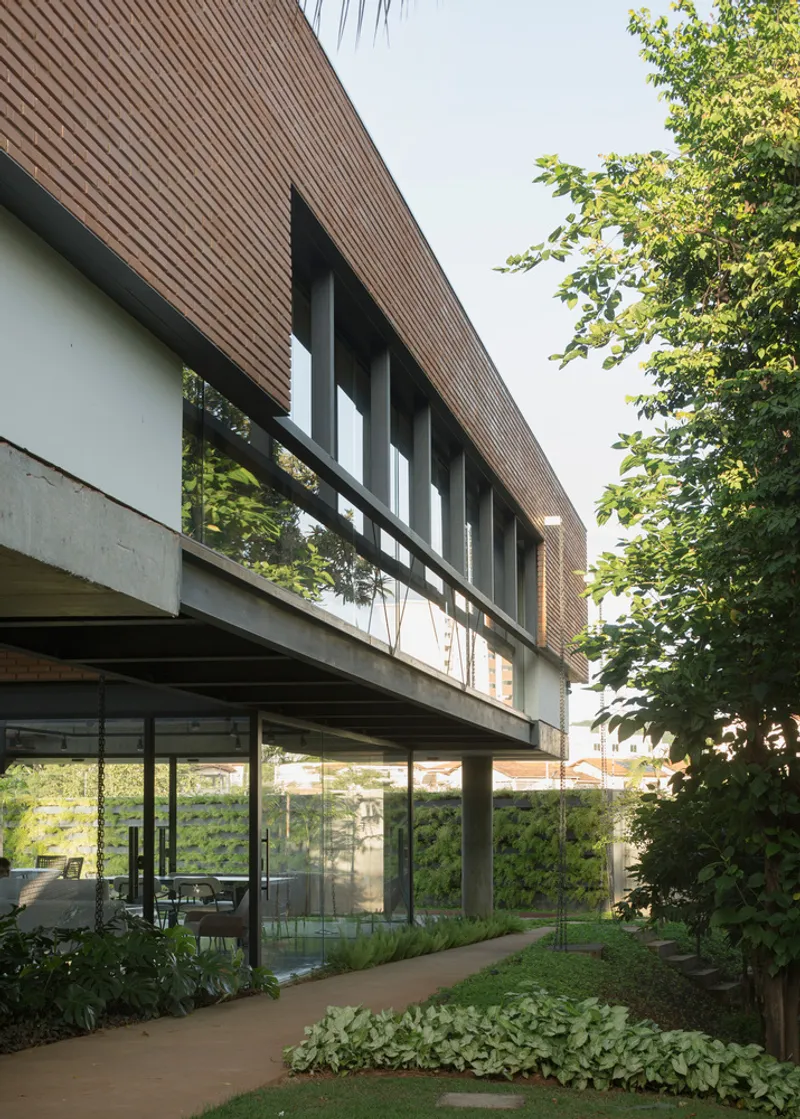
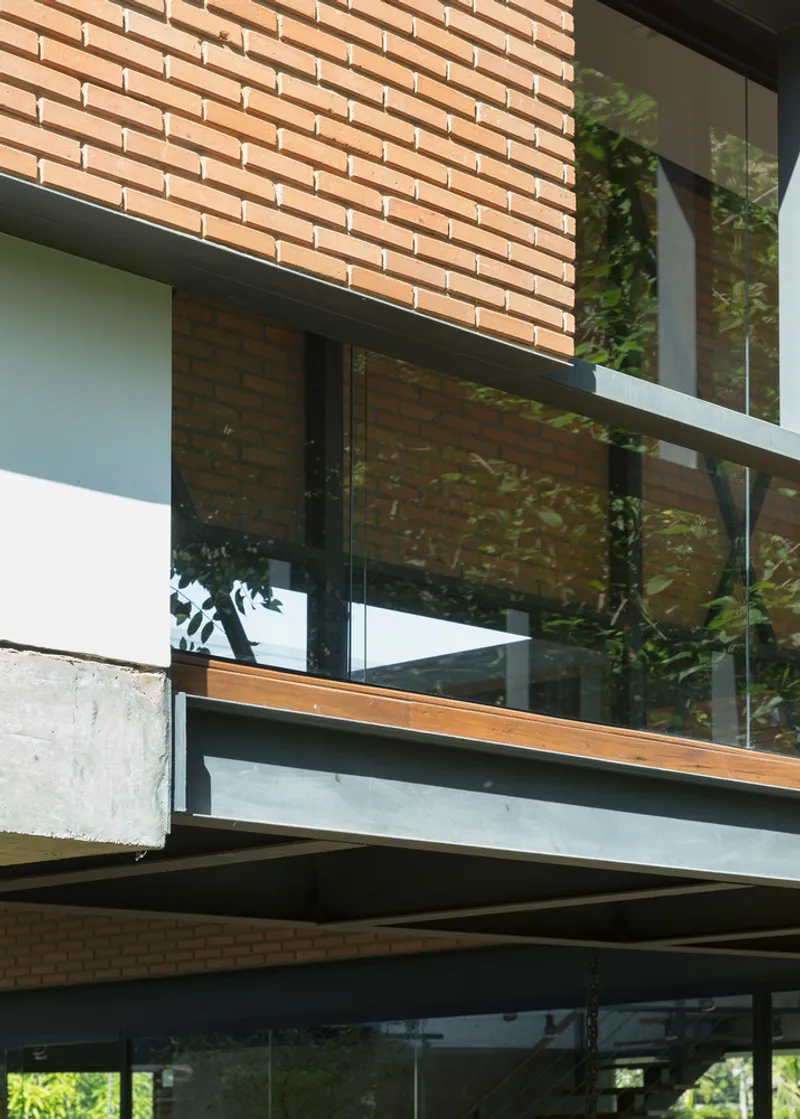
The upper volume is the formal counterpoint to the permeable ground floor. Clad in brick laid in a running bond, it cantilevers decisively over the pool deck and the planted areas below, supported by concrete piers that read as vertical extensions of the landscape rather than alien intrusions. The cantilever is not merely theatrical; it creates the covered outdoor space that makes the ground floor habitable year-round, shading the pool, the deck, and the planted terraces from direct sun.
A closer look at the facade reveals a carefully layered sandwich: a steel frame carries the brick cladding outside a glass balustrade and cantilevered slab. The detailing keeps the upper volume looking lighter than its mass suggests, with shadow gaps and expressed connections that let you read the structural logic from the street. From the sidewalk, what you see is a brick bar floating above a garden, held aloft on slender concrete legs, the house presenting itself as a tectonic proposition rather than a decorative one.
Transparency at the Core
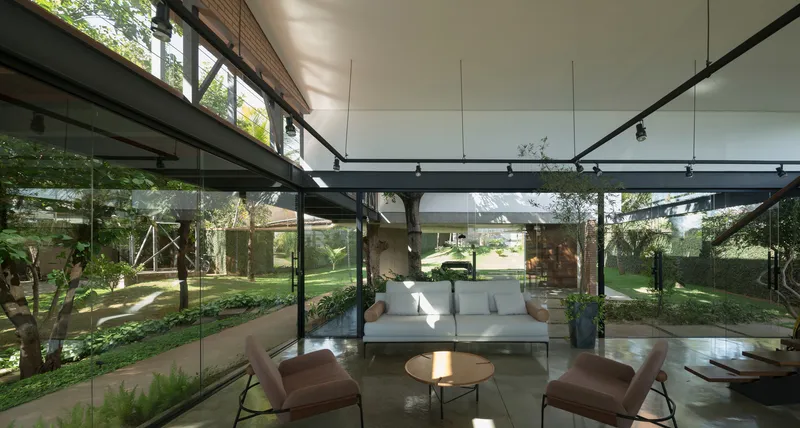
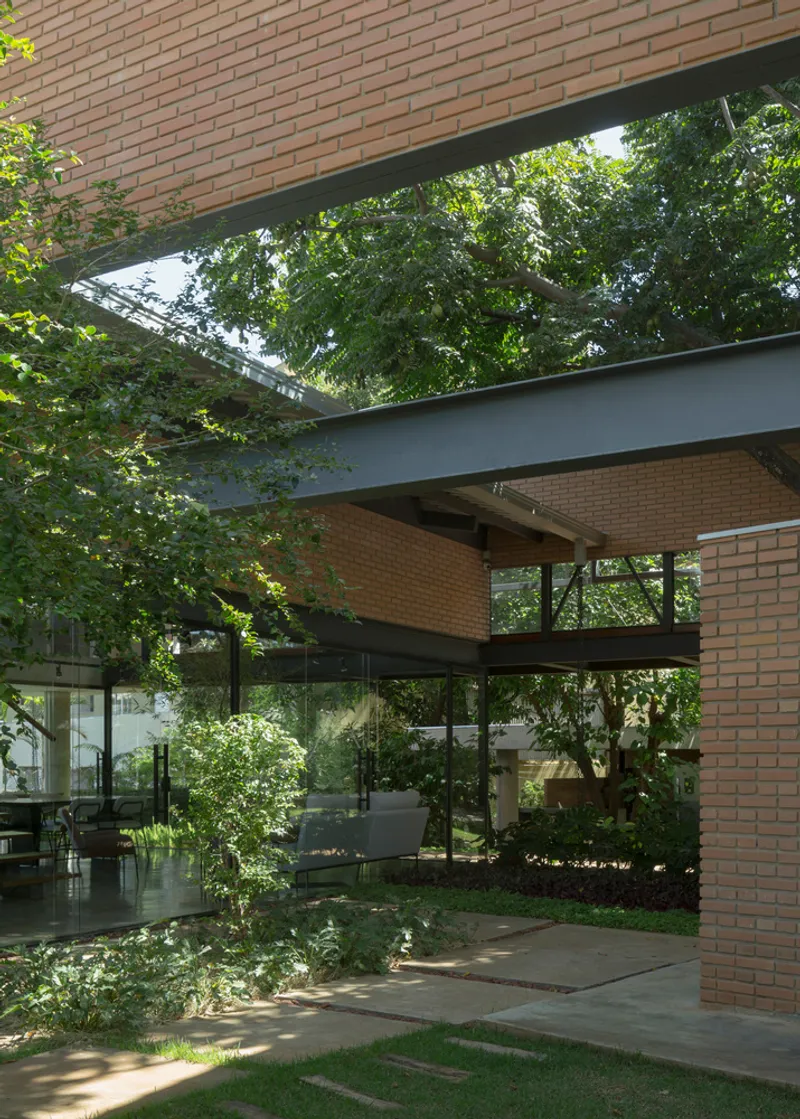
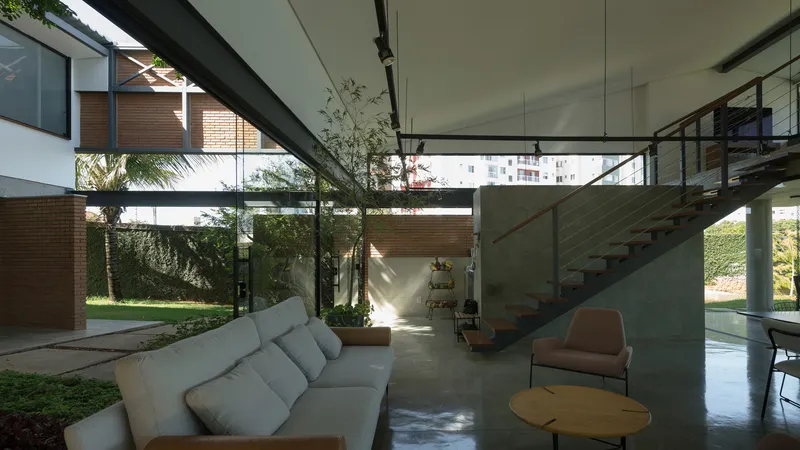
Between the open ground plane and the solid upper volume, Venta inserted the social heart of the house: an open-plan living space wrapped almost entirely in floor-to-ceiling glass. The steel structure is left exposed here, its members painted dark to read as a graphic frame against the garden beyond. Sitting in the living room, you look through glass on both sides, into courtyard gardens populated by the trees that were there before the house existed. It is a rare case where the borrowed landscape is not distant scenery but immediate, tactile proximity.
A double-height void near the stair connects the social floor to the mezzanine above, pulling natural light deep into the plan and giving the interior a vertical dimension that belies its compact footprint. The concrete stair itself is treated as a sculptural element, its mass balanced by the lightness of the steel frame overhead and the greenery pressing against the glass on every side.
Timber, Concrete, and the In-Between
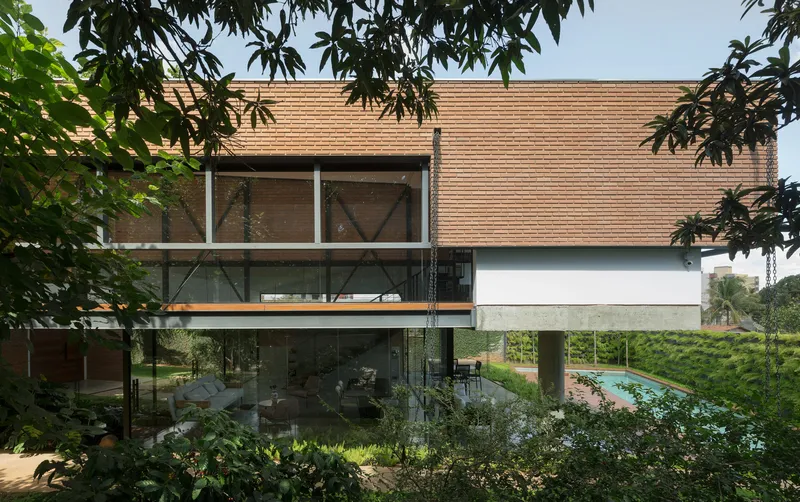
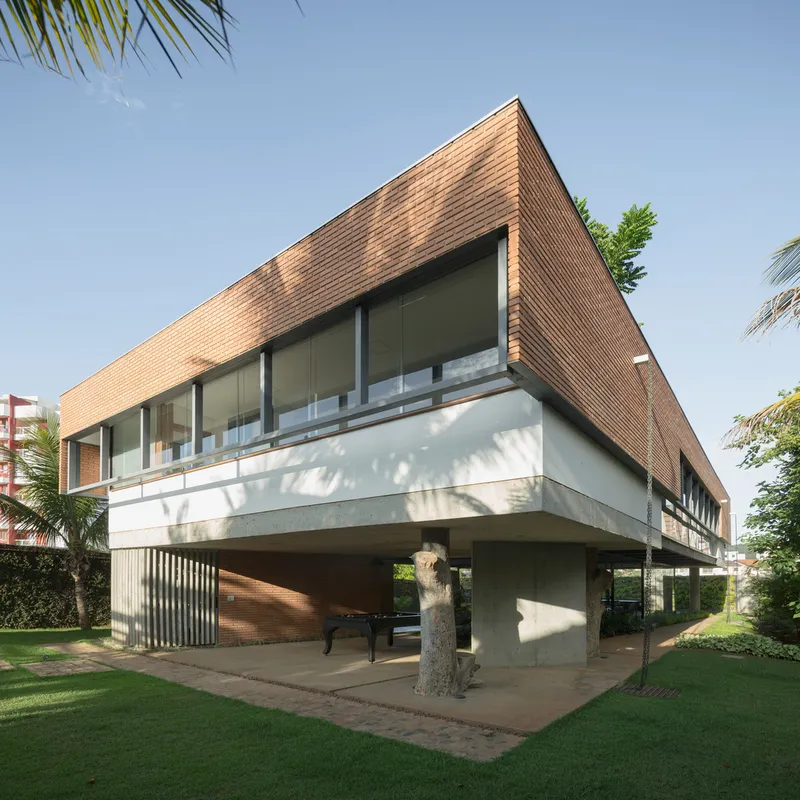
On the garden elevation, the upper volume trades its brick skin for horizontal wood slats, angled to admit light while screening the private rooms from view. The switch in cladding is not arbitrary: the timber face corresponds to the bedrooms, signaling a shift from the public solidity of the brick street facade to the private warmth of the garden side. Below, the glazed lower level remains transparent, maintaining the continuity of the garden through the house.
The material palette across the project is restrained. Concrete for the horizontal planes and vertical supports, steel for the exposed frame, brick and timber for the enclosing skin, and glass where openness is needed. Nothing is gratuitous. Each material does precisely one job, and the junctions between them are clean enough to read at a glance. The honesty of the assembly is what gives the house its character, not ornamentation or formal gymnastics.
Kitchen and Interior Materiality
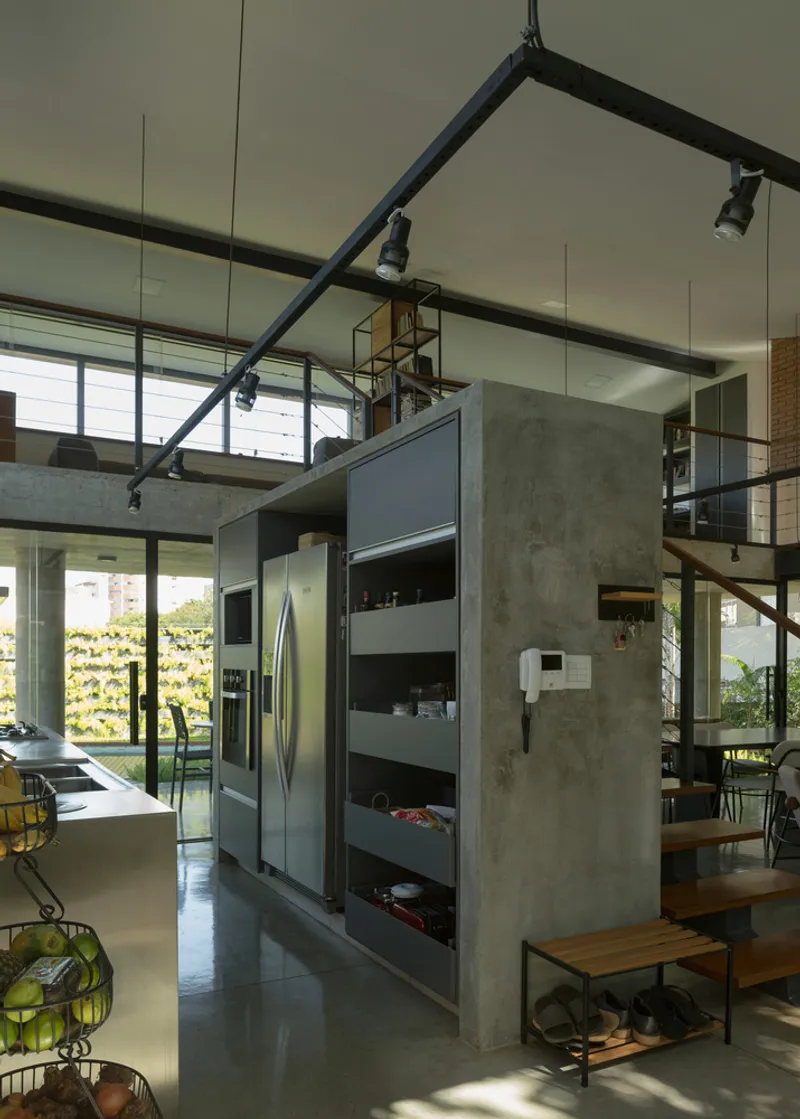
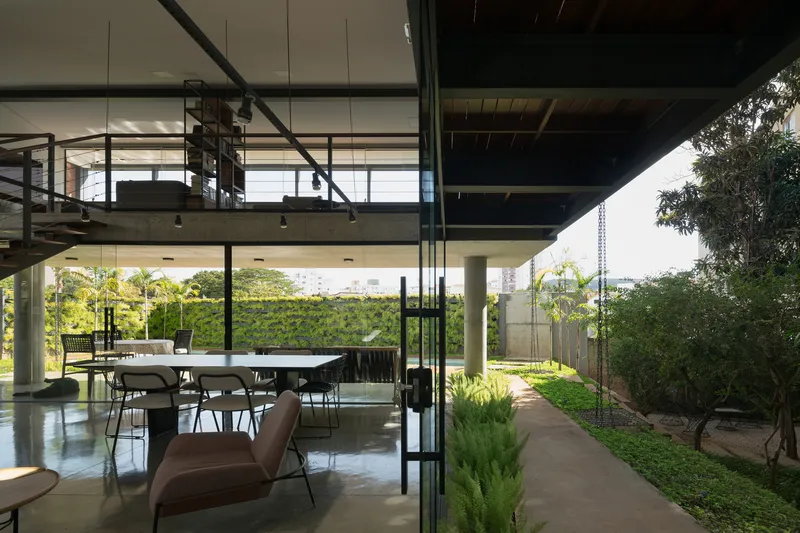
The kitchen is set against a concrete wall with exposed steel beams overhead and clerestory windows that wash the work surfaces in natural light. A vertical garden wall visible through the glazing softens the raw materiality of the interior and reinforces the house's central argument: that vegetation is not decoration but infrastructure. The dining area occupies a position beside the glass facade, with a mezzanine above and a landscaped pathway just outside, so that meals happen at the threshold between architecture and garden.
Neighborhood Context
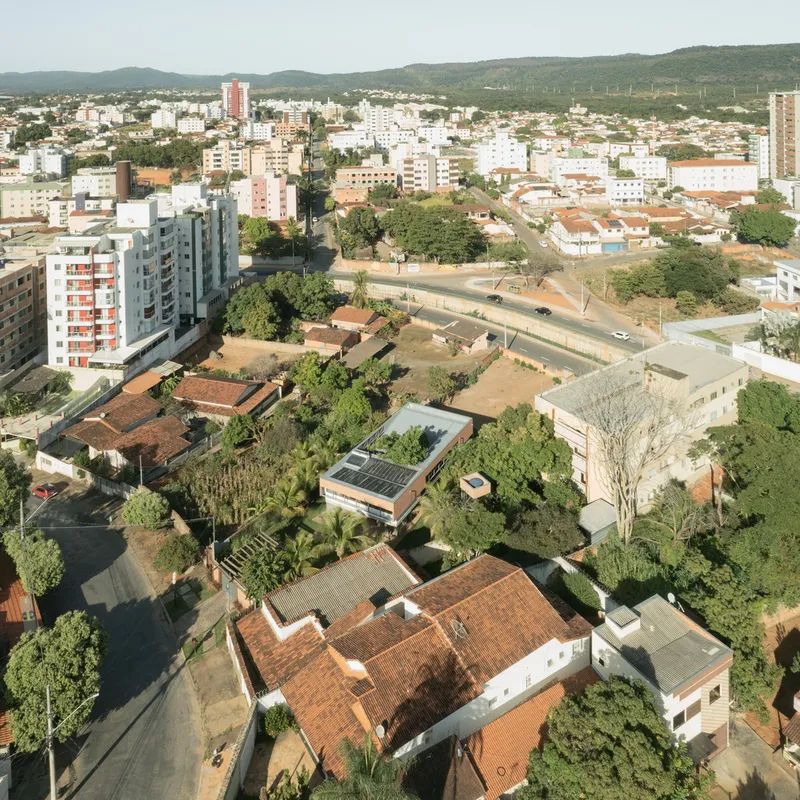
An aerial view places the house within a typical Montes Claros residential fabric: clay-tile roofs, modest apartment blocks, and scattered trees filling the gaps between lots. In this context, the Venta project stands out not because of its scale but because of its posture. Where neighboring houses consume their lots wall to wall, this one lifts itself up and lets the landscape flow beneath it. The elevated brick volume reads as a deliberate statement about density and porosity, arguing that even on a tight urban lot, a house can give back ground to the trees it shares the site with.
Why This Project Matters
Montes Claros House is compelling because it treats existing vegetation not as a constraint to be managed but as a co-author of the design. Every structural decision, from the placement of concrete piers to the span of the cantilever, was shaped by root systems and canopy spreads that predated the building. That commitment elevates the project beyond a well-detailed house into a working demonstration of how architecture can defer to ecology without sacrificing spatial ambition.
Venta Arquitetos have built a house that is genuinely porous. Air, light, and plant life move through it vertically and horizontally, and the boundary between inside and outside dissolves at nearly every turn. In a hot, semi-arid city where shade is a form of comfort and trees are a finite resource, that porosity is not an aesthetic choice but an ethical one. The project offers a replicable model: lift, cantilever, preserve what is already there, and let the landscape do the cooling that mechanical systems would otherwise have to provide.
Montes Claros House by Venta Arquitetos, Montes Claros, Minas Gerais, Brazil. Photography by Federico Cairoli.
About the Studio
Share Your Own Work on uni.xyz
If projects like this are the kind of work you want to make, uni.xyz is a place to publish your own, find collaborators, and enter design competitions.


Popular Articles
Popular articles from the community


U.GA Architects Wraps an Oval Rooftop Pool in Curved Board-Formed Concrete on Busan's Jeollidan-gil
In Busan's Jeonpo-dong, a 454 m² mixed-use block stacks a neighborhood facility, guest rooms and an oval rooftop pool inside spiraling concrete walls.

Juan García Correa, John González and Claudia Rueda Sink a Circular Amphitheater into a Manizales Engineering Building
On the La Nubia campus in Manizales, Colombia, the S1 Building folds labs and offices into a hillside of ramped lawns that double as a campus route.

David Macias Steps a Doorless Stone and Plaster House Down a Tropical Colombian Hillside
In the humid hills of Colombia, Threshold House replaces the front door with an open void and terraces its 850 m² down the slope instead of fighting it.

Jaramillo Van Sluys Arquitectura and Urbanismo Turn a Demolished Registry Lot in Quito into an Orchard Plaza
In Quito's Centro Histórico, a 2,800 m² plaza exposes the San Agustín convent wall and redraws its lost Augustinian orchard in volcanic stone.

Similar Reads
You might also enjoy these articles


Hodi-Mandai Geram
Project Function: Preservation and revitalization of the Intangible heritage and socio-spatial identity of the Hodi by Housing, Cultural Memory Center, Sacred Grove, landscape, local tourism economy


Olio Towers: A Mid-Rise for Performers That Fuses Housing, Rehearsal, and Stage
Located blocks from Houston's Theater District, this modular tower stacks living units around a central performance atrium.

Oasis: Modular Green Housing Carved into Dhaka's Urban Fabric
A shortlisted Plugin Housing entry reclaims unauthorized settlements in Dhaka with stepped concrete volumes, green roofs, and ventilation-driven design.

Black Hole: A Floating Megastructure for the Post-Physical Era
Emiliano Mazzarotto envisions a spherical, self-scaling arena where e-sports, digital hotels, and holographic stadiums replace traditional public space.

Explore Architecture Competitions
Discover active competitions in this discipline

Challenge to reimagine the Iron Throne

Photograph architecture without architects

Illustrate the lost glory of Angkor Wat - Render Challenge

Design challenge to reuse E-waste
Comments (0)
Please login or sign up to add comments
No comments yet. Be the first to comment!