

Montévrain Stadium by Olgga Architects – A Sustainable Landmark for a Growing Eco-District
A sustainable stadium blending concrete and timber, integrating landscape, community spaces, and sports facilities within Montévrain’s growing eco-district.


Montévrain Stadium, designed by Olgga Architects, stands at the center of Montévrain’s rapidly developing eco-district in France. As part of a broader territorial strategy that includes the new middle school, the Montévrain Sport Académie complex, and a future high school, this inter-communal sports facility serves as a dynamic anchor for the region. With a 1,252 m² program that integrates an inter-regional athletics track, an approved soccer pitch, a 500-seat grandstand, and a dedicated changing-room building, the project emphasizes sustainability, landscape integration, and functional clarity.


The site’s position—between Mont Evrin Park to the west and future urban expansions to the east—inspired an east-west organizational layout that aligns the facility with the natural lines of the landscape. From the main entrance along Avenue de la Société des Nations, a thoughtful sequence of filters and pathways welcomes visitors. Permeable parking areas, pedestrian routes, and a generous entrance canopy work together to create an inviting, intuitive arrival experience supported by continuous planting and soft landscape transitions.
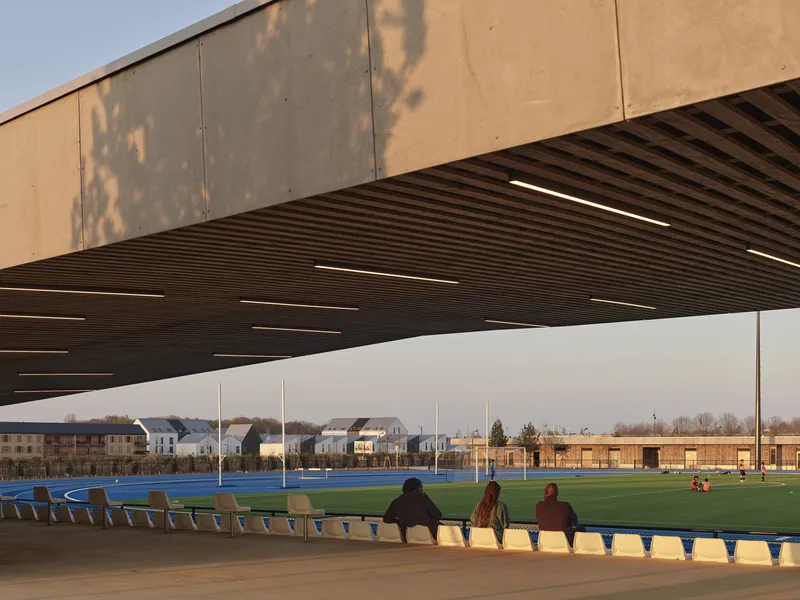
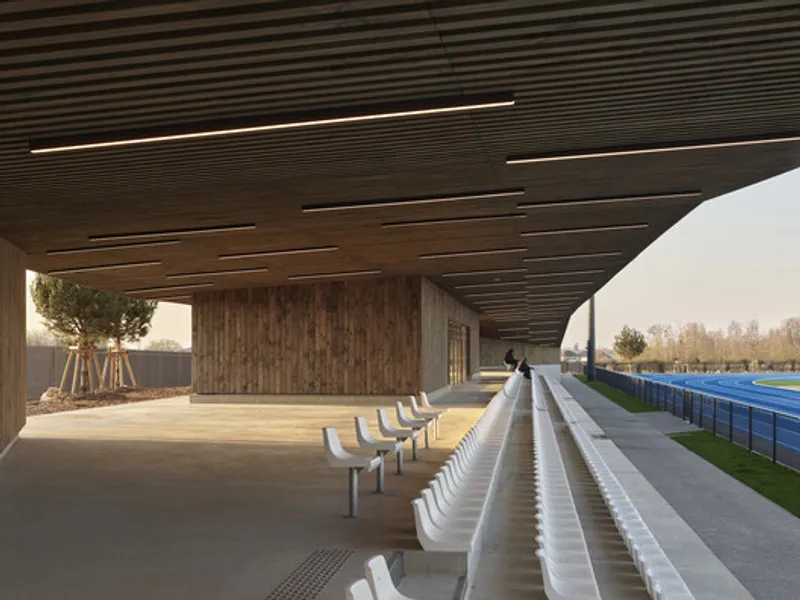
Architecturally, Montévrain Stadium showcases a restrained, elegant aesthetic. Both the grandstand and the changing-room building share a unified language: a concrete base made with recycled aggregates ensures durability, while a timber upper structure delivers high acoustic and thermal performance. The grandstand forms the sculptural centerpiece of the project—its stepped profile emerging directly from the terrain, offering a modern interpretation of traditional stadium seating. The canopy above shelters 502 seats arranged close to the pitch, ensuring unobstructed views and an immersive spectator experience. The elevated clubhouse extends outward as a flexible social hub and belvedere, designed for community events, meetings, and gatherings.


Landscape design plays a central role in shaping the project’s identity. Instead of a simple perimeter treatment, the planting strategy structures the entire site with three distinct ecological environments: a tree-lined permeable parking area, a sports meadow animated with flowered strips inspired by local agricultural patterns, and gentle landscaped valleys that manage stormwater naturally. Native Île-de-France species enhance biodiversity, seasonal interest, and ease of maintenance, while the grandstand’s green roof visually extends Mont Evrin Park, merging architecture and nature into a seamless whole.


All photographs are works of Stephane Chalmeau


Popular Articles
Popular articles from the community


Extended Shell: Retrofitting Kolkata's Balconies as Living Urban Thresholds
A modular retrofit system recovers the social and environmental intelligence of Kolkata's historic verandas for contemporary Park Street residents.

Cloaked Colonization: A Mobile Underwater Habitat That Moves Like a Fish
Micah Abaya's shortlisted EHC Pacific entry reimagines ocean settlement as a dispersed network of self-sustaining architectural organisms.
Temporary Home for Dogs: A Reversed Zoo Rethinks Animal Shelter Architecture
In Bucharest, a sinuous corridor and freed landscape flip the logic of containment, designing a shelter that works to make itself unnecessary.

The Amber Palace Opera: A Geological Fiction Surfaces on Tallinn's Baltic Waterfront
Pierre Brillard reimagines a Baltic legend as a public landscape, opera house, and waterfront promenade rooted in Tallinn's coastal identity.

Similar Reads
You might also enjoy these articles


Hodi-Mandai Geram
Project Function: Preservation and revitalization of the Intangible heritage and socio-spatial identity of the Hodi by Housing, Cultural Memory Center, Sacred Grove, landscape, local tourism economy


Olio Towers: A Mid-Rise for Performers That Fuses Housing, Rehearsal, and Stage
Located blocks from Houston's Theater District, this modular tower stacks living units around a central performance atrium.

Oasis: Modular Green Housing Carved into Dhaka's Urban Fabric
A shortlisted Plugin Housing entry reclaims unauthorized settlements in Dhaka with stepped concrete volumes, green roofs, and ventilation-driven design.

Black Hole: A Floating Megastructure for the Post-Physical Era
Emiliano Mazzarotto envisions a spherical, self-scaling arena where e-sports, digital hotels, and holographic stadiums replace traditional public space.

Explore Stadium Competitions
Discover active competitions in this discipline

Challenge to reimagine the Iron Throne

Photograph architecture without architects

Illustrate the lost glory of Angkor Wat - Render Challenge

Design challenge to reuse E-waste
Comments (0)
Please login or sign up to add comments
No comments yet. Be the first to comment!