
Moontrip Pantheon: A Vision of Contemporary Museum Architecture Inspired by the Roman Pantheon
A contemporary museum architecture concept blending lunar exploration, classical geometry, and immersive educational design.


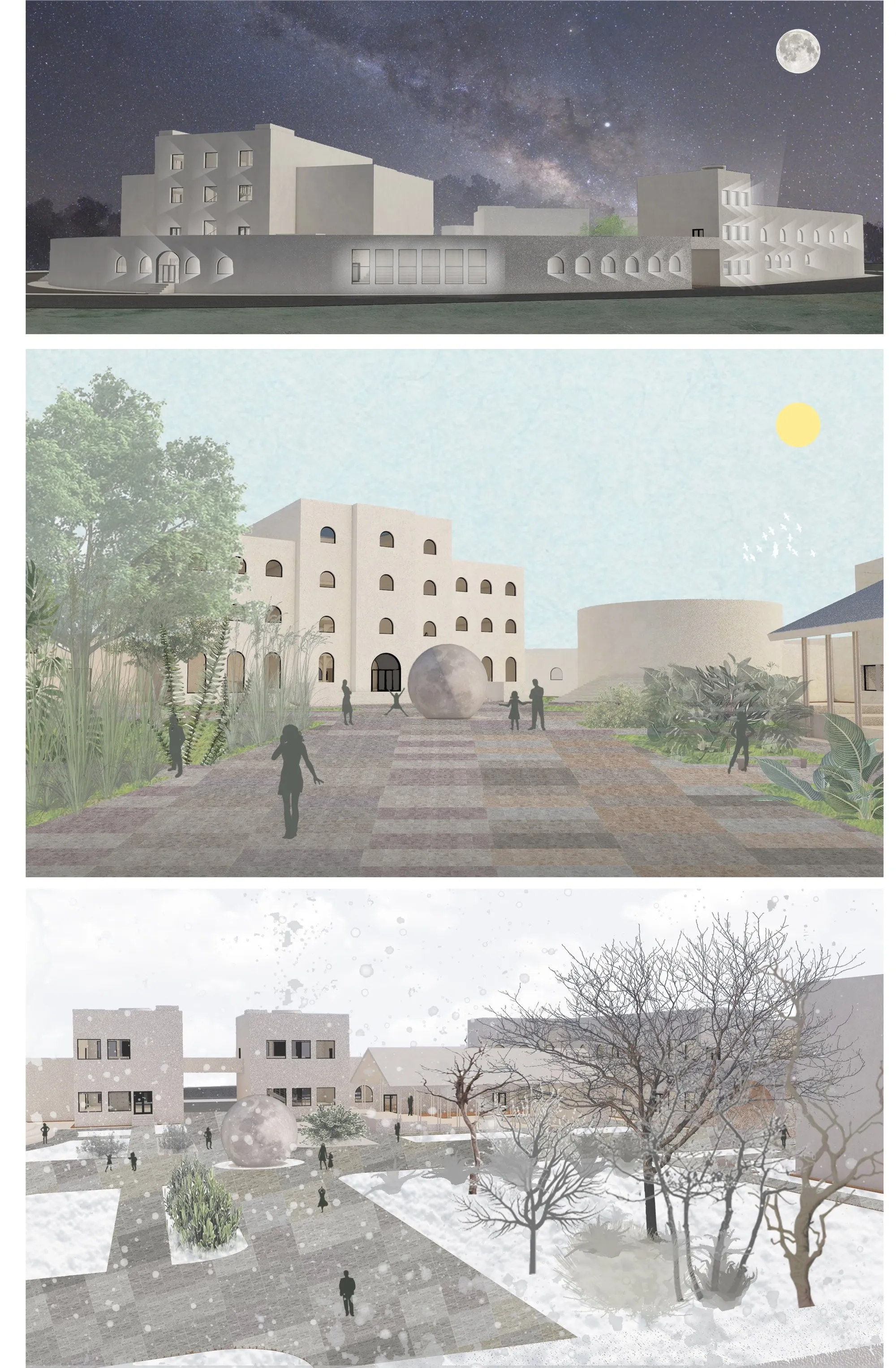
The Moontrip Pantheon is a visionary example of contemporary museum architecture that merges classical inspiration with futuristic educational spaces. Designed as a “temple” dedicated to lunar missions and the pioneers of space exploration, the project reinterprets the spatial language of the Roman Pantheon and the Acropolis of Athens through a modern architectural lens.
Conceptualized as a small town of lunar mission knowledge, the Moontrip Pantheon transforms cultural architecture into an immersive learning environment. The project by Mark Kuzin celebrates scientific achievement while redefining how museum architecture can foster curiosity, movement, and spatial continuity.
Architectural Concept: A Temple for Lunar Missions
The core idea originates from two monumental precedents: the Roman Pantheon and the Acropolis of Athens. Much like these historic landmarks, the Moontrip Pantheon embodies symbolism, geometry, and procession. However, instead of honoring ancient deities, this contemporary cultural complex honors astronauts, engineers, physicists, and all contributors to lunar missions.
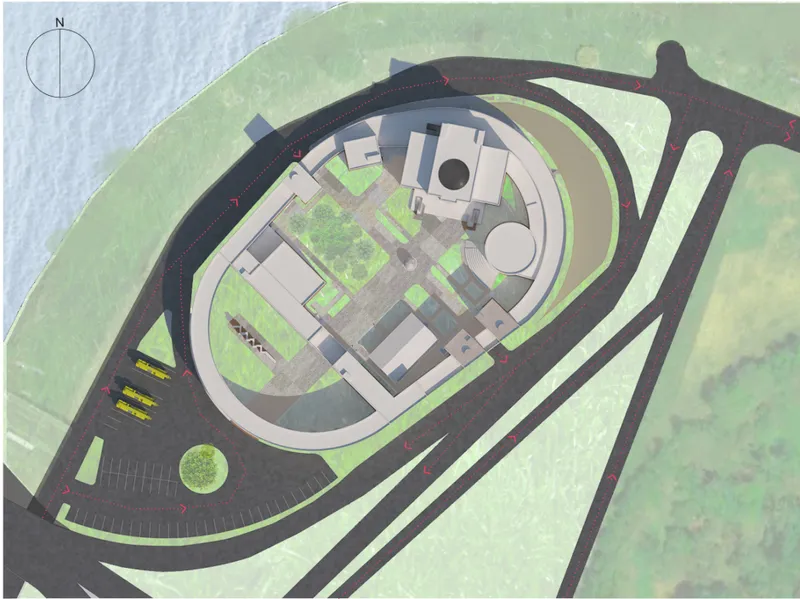
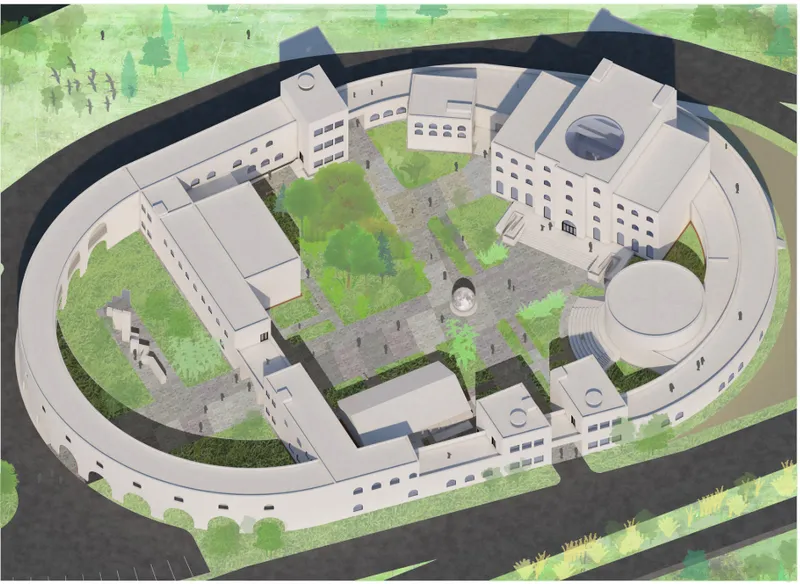
The project employs the golden ratio in its site planning, echoing the proportional harmony used in ancient architecture. This geometric rigor shapes the circular masterplan, enclosing a central courtyard that becomes the heart of the complex. The result is a spatially coherent ensemble that balances monumentality with accessibility.
Site Planning and Spatial Organization
The circular form defines both identity and movement. Visitors are invited to walk freely along the second-floor perimeter, experiencing uninterrupted circulation around the entire architectural ensemble. This elevated promenade reinforces continuity, allowing guests to choose their own journey through the space.
The masterplan integrates:
- A main entrance axis leading into the central courtyard
- A museum hall dedicated to lunar exploration
- Interactive halls for mathematics, geology, chemistry, and astronaut training
- A movie theatre and lecture room
- Recreational and educational zones
- A dedicated Moon Room for children
- Café, library, shop, and community spaces
- An open-air street theatre
This programmatic diversity positions the project firmly within the realm of innovative educational and cultural architecture, where architecture acts as both container and catalyst for knowledge.
Vertical Learning Journey: From Calculation to Moon Landing
Within the main building, the spatial narrative unfolds vertically. Rising from the first to the third floor, visitors explore a sequence of halls that trace humanity’s journey to the Moon, from early astronomical calculations to astronaut missions and geological data collection.
Each hall integrates interactive installations focused on physics, electronics, mathematics, and space sciences. The architectural design enhances this experience through carefully controlled volumes, light wells, and spatial compression and expansion. The building itself becomes a didactic device, guiding visitors through history and innovation.
The Moon Room: Immersive Educational Architecture for Children
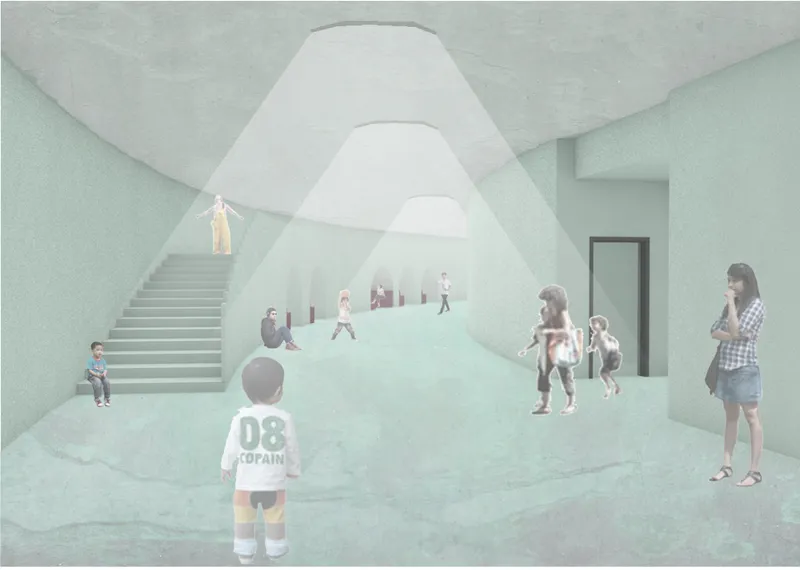
A standout feature of the Moontrip Pantheon is the dedicated Moon Room. Designed as an immersive environment, this space allows children to participate in small simulated missions within an atmosphere inspired by lunar landscapes.
Softly contoured interiors, diffused lighting, and sculpted walls create a playful yet educational environment. This approach demonstrates how contemporary museum architecture can blend storytelling with experiential design, ensuring engagement across age groups.
Courtyard as Civic Heart
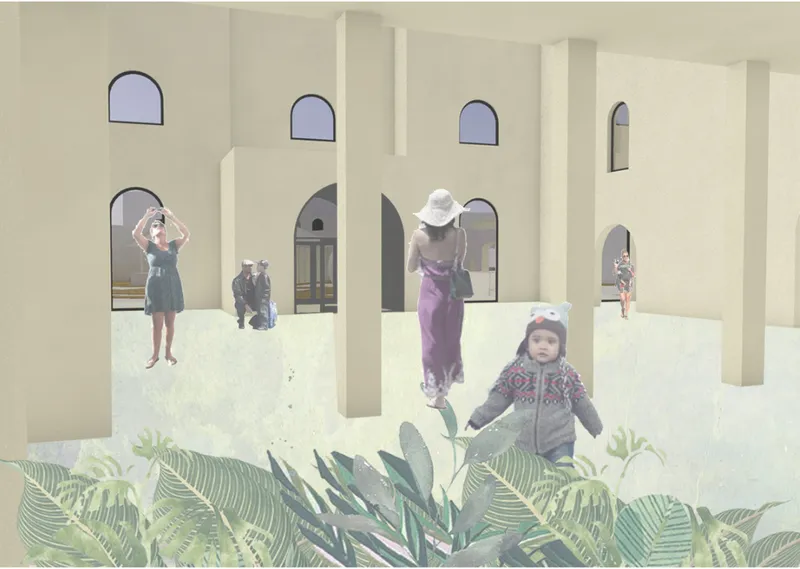
At the center lies a landscaped courtyard, a gathering space that reinforces the idea of a “project-city.” This courtyard encourages social interaction, relaxation, and reflection. Niches for reading and recreation, shaded walkways, and open seating areas transform the museum into a full-day destination.
The design emphasizes permeability and fluid transitions between indoor and outdoor spaces. Arched facades and rhythmic openings reference classical architecture, while simplified massing and clean surfaces maintain a contemporary identity.
Structural Expression and Architectural Language
The Moontrip Pantheon balances classical symbolism with modern execution. The facades reinterpret arches and colonnades through simplified geometries. Incisions within the main building reveal sectional clarity, exposing internal programs such as:
- Museum halls
- Chemistry and geology laboratories
- Astronaut training areas
- Lecture rooms and library spaces
Materiality remains understated, allowing proportion and form to dominate the architectural expression. The circular enclosure creates a protective boundary while reinforcing the symbolic idea of unity and continuity.
A Cultural Landmark for Scientific Enlightenment
More than a museum, the Moontrip Pantheon is conceived as a cultural landmark. It emphasizes the importance of lunar missions and scientific progress while creating a civic space where people can spend an entire day exploring, learning, and engaging.
By merging classical inspiration with innovative spatial planning, the project by Mark Kuzin exemplifies how contemporary museum architecture can celebrate knowledge, inspire future generations, and redefine cultural infrastructure.
The Moontrip Pantheon stands as a powerful statement in modern cultural architecture. Rooted in ancient proportional systems yet focused on future exploration, it bridges history and innovation. Through circular planning, immersive educational environments, and symbolic geometry, the project transforms architecture into a temple of scientific enlightenment.
In doing so, it not only honors the legacy of lunar missions but also demonstrates the transformative power of architecture as a medium of collective memory and inspiration.




Popular Articles
Popular articles from the community


Hill & Cross Opera: Sculptural Opera House Architecture Shaped by Tallinn’s Landscape and Identity
Hill & Cross Opera reimagines opera house architecture in Tallinn through its sculptural hill, civic plaza, glass wave and a luminous cross.

The Earth Pod: 3D Printed Homes for Resilient Refugee Communities
The Earth Pod reimagines refugee housing through 3D printed homes made from clay, combining resilience, self-sufficiency, and rapid shelter.

Co-Life: Senior Housing Design That Reconnects Older Adults With the City
Co-Life reimagines senior housing design through healing gardens, shared streets, workshops, and a sustainable community across generations.

Lunar Spiral: Space Architecture Shaped by the Mathematics of the Universe
Lunar Spiral reimagines space architecture through Fibonacci geometry, lunar regolith, levitating habitats, and self-sustaining Moon living.

Similar Reads
You might also enjoy these articles

Eco Chapel: A Green Architecture Pavilion Designed in Symbiosis with the Forest
Eco Chapel uses green architecture to weave prayer, learning and reuse into a forest pavilion shaped by modular hexagonal canopies for life.
Kaffeebühnen: Coffee Shop Architecture Designed as a Civic Stage Between Vienna’s City and Park
Kaffeebühnen turns coffee shop architecture into a civic stage, linking Vienna’s park edge, urban life, warm timber yards, and coffee craft.
Healing Façade: Sustainable Architecture for Reforestation, Community, and Sacred Ecology in Ethiopia
Healing Façade reimagines sustainable architecture as a living wall that restores soil, catches water and renews Ethiopia's forest churches.


Urban Forest: A Vertical Ecosystem for 5,000 Workers in Singapore's Changi Business Park
Radially stacked pods and layered green decks turn a 7-acre plot into 47 acres of ecological workspace projected for 2040.

Explore Architecture Competitions
Discover active competitions in this discipline



Challenge to reimagine the Iron Throne


Photograph architecture without architects


Illustrate the lost glory of Angkor Wat - Render Challenge


Design challenge to reuse E-waste
Comments (0)
Please login or sign up to add comments
No comments yet. Be the first to comment!