

Moontrip Pantheon: A Lunar Temple Reimagined as Immersive Learning Complex
Blending golden ratio geometry with interactive science halls, a circular campus transforms space exploration into spatial narrative.


What if a temple could teach you about the moon? The Moontrip Pantheon takes the formal vocabulary of the Roman Pantheon and the Acropolis of Athens and rebuilds it as something entirely different: an immersive educational campus organized around humanity's lunar explorations. Rather than enshrining relics behind glass, this circular urban complex places visitors inside the story, giving them agency over their own path through thematic science halls, a simulated lunar surface, a street theatre, and a library. It is architecture as active pedagogy, proportioned to the golden ratio and composed as a continuous spatial narrative.
Designed by Mark Kuzin, the project was shortlisted in Libgen 2019. The competition called for architectural concepts that push the boundaries of how we think about libraries, knowledge, and public learning. Kuzin's response sidesteps the conventional book repository altogether, proposing instead a mixed-use destination that weaves exhibition, recreation, cinema, and performance into a single campus. The result reads as both monument and playground.
A Circular Campus Built Around Choice
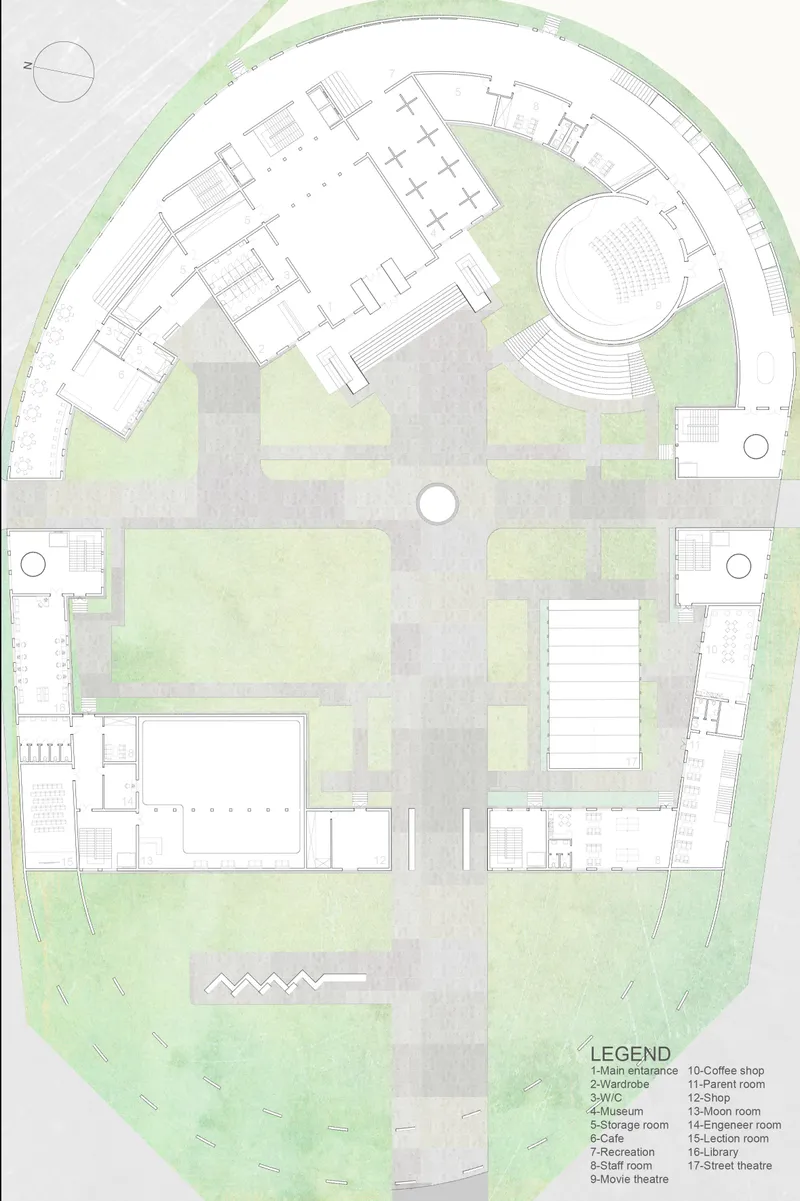

The site plan reveals the project's organizing logic: a curved campus of multiple buildings, courtyards, and an amphitheater set within generous green space. The circular arrangement is not decorative; it establishes a continuous loop that visitors can enter at multiple points and navigate freely. At the centre sits a three-storey main building containing thematic halls dedicated to distinct scientific disciplines: a Math Hall, Chemistry Hall, Geology Hall, and Astronaut Hall. Each is designed as an interactive environment rather than a passive gallery.
The composite drawing sheet reinforces how deliberate the spatial hierarchy is. Elevations, sections, and axonometric incision diagrams show how the second floor operates as an open loop, encouraging circulation without prescribed direction. Visitors choose their own path through the programme. It is a spatial configuration rooted in what Kuzin calls the "democratic spirit of knowledge," where architecture facilitates independent thinking by refusing to funnel movement through a single corridor.
Vaulted Interiors and the Moon Room
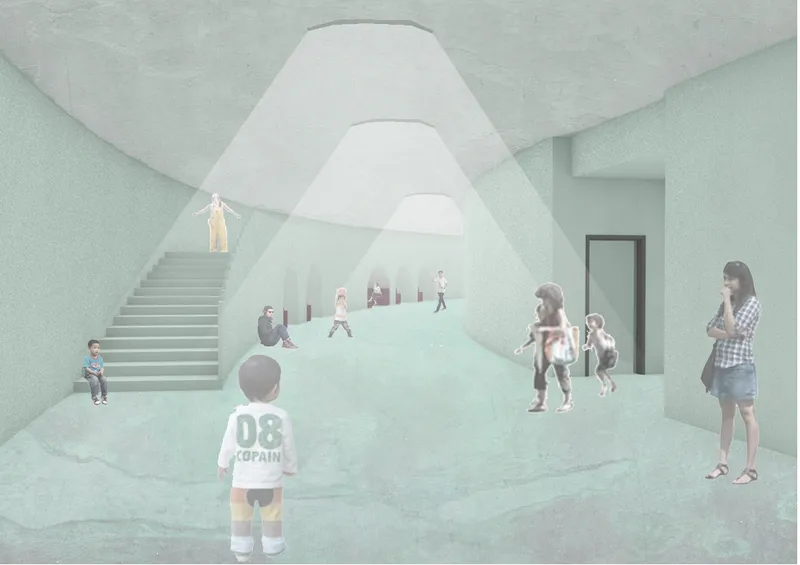
The interior atrium rendering captures the project's experiential ambition at its most vivid. Children play on a terraced platform beneath arched vaulted ceilings, the scale generous enough to feel monumental yet the detailing warm enough to invite interaction. This space points toward the Moon Room, the project's signature pedagogical environment: a simulated lunar surface where children receive small missions, blending play with structured learning. The strategy is less science museum, more architectural storytelling, placing users in an active role within the educational journey.
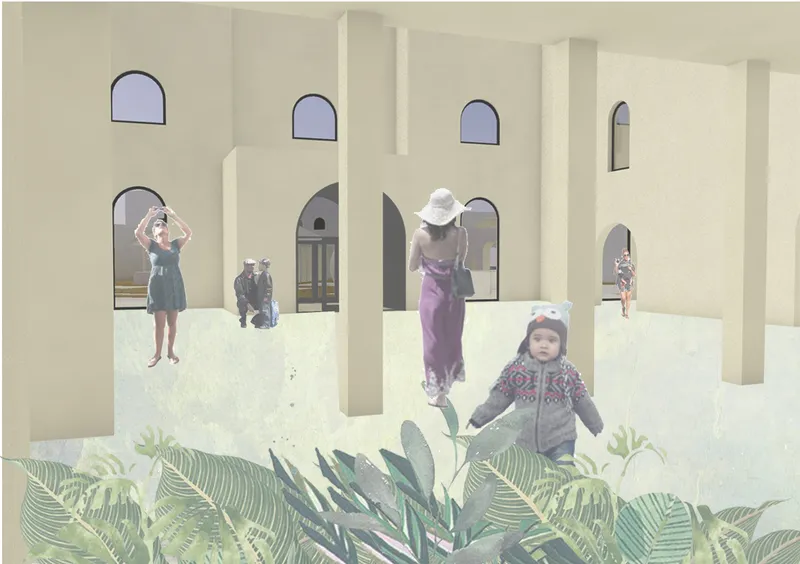
The courtyard rendering shifts the atmosphere outward. Arched openings punctuate stucco walls, framing views of visitors moving through the complex alongside tropical foliage in the foreground. The arches do double duty here, referencing the Pantheon's classical precedent while creating a rhythm of threshold and reveal that keeps the spatial sequence engaging. Soft daylight filters into reading alcoves and modular exhibition halls that wrap around the central plaza, extending the multi-sensory quality of the interiors into the landscape.
Night Sky, Morning Mist, and Falling Snow


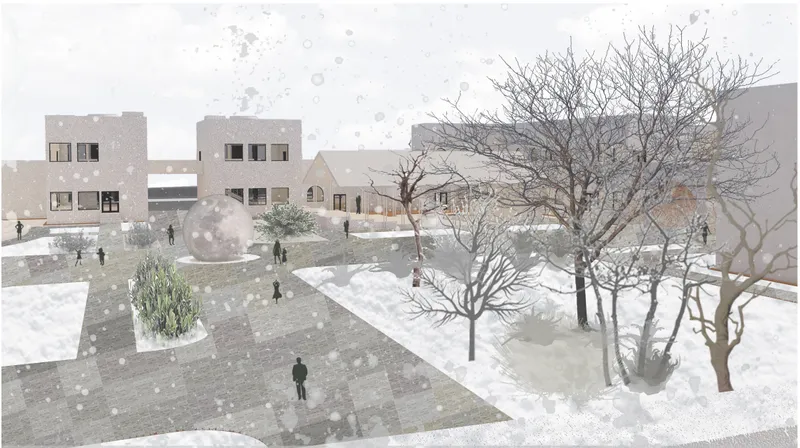
Three renderings make a quiet but powerful case for the project's seasonal resilience. The night elevation shows the white stucco complex glowing under a starlit sky with the moon visible above, a visual alignment that anchors the lunar theme in lived atmospheric experience. The approach view catches visitors walking toward an arched entrance beneath a yellow sun diffused through light mist, suggesting the building's ability to stage arrival as ceremony. And the aerial courtyard rendering, with bare trees and scattered figures under falling snow, confirms what Kuzin describes as a "conscious seasonal design" built for year-round usability.
Together these views demonstrate that the Moontrip Pantheon is not a fair-weather attraction. The mixed-use programme, which extends beyond exhibitions to include a movie theatre, library, coffee shops, recreation areas, and a street theatre, provides reasons to return regardless of season. Each atmospheric condition changes the reading of the stucco surfaces, the courtyard plantings, and the quality of light inside the vaulted halls. The campus becomes a different place in winter than it is in summer, and the architecture anticipates both.
Why This Project Matters
The Moontrip Pantheon works because it refuses to separate monument from programme. Where a lesser project might have used classical references as surface decoration, Kuzin integrates them structurally, turning the Pantheon's rotunda into a circulatory logic, the temple's procession into a sequence of interactive science halls. The golden ratio is not a styling choice; it is a proportional system that holds together a genuinely complex mix of uses across three floors and an extended campus.
More importantly, the project redefines what an educational building can feel like. By placing a simulated lunar surface alongside a street theatre and a library, it argues that learning is not a single mode but an ecosystem of experiences. Children receive missions in the Moon Room while adults read in daylit alcoves and everyone converges in the courtyard between programmes. Architecture here is not a container for content; it is the content, transforming space into story and users into participants.
View the Full Project
About the Designers
Designer: Mark Kuzin
Enter a Design Competition on uni.xyz
uni.xyz runs architecture and design competitions year-round that reward proposals with spatial conviction and real site intelligence.
Project credits: Moontrip by Mark Kuzin.


Popular Articles
Popular articles from the community


Architekt Andreas Gruber Scatters 23 Dark Timber Chalets Across a South Tyrolean Forest Edge
In Molini di Tures, Amonti Chalets breaks a resort into a hamlet of gabled timber houses, with parking, storage and services pushed into the slope.

LT2A and OPEN Architectes Thread a Brick and Glass High School Through a Wooded Belgian Campus
In Braine-l'Alleud, a 3,000 m² wing for Collège Cardinal Mercier pairs pale brick with a glazed colonnade, deferring to a small chapel and a dense wood.

Cube Design Draws an Ecological Corridor Between Two Shenzhen Hills with the Nankai Building
Beside Shenzhen's container docks, the Nankai Building pairs stacked balconies with a climbing green screen to connect two hillsides across its height.

David Ortega Stacks a Two-Story Mexico City Penthouse Around a Steel Stair and a Pergola-Shaded Roof Terrace
In Colonia Roma, a 300 m² penthouse uses oak joinery, a planted steel stair and a slatted roof pergola to make a new-build apartment feel like a house.

Similar Reads
You might also enjoy these articles


Vereda Arquitetos Renovates a 40-Square-Meter Apartment Inside Niemeyer's Copan Building
A compact unit in São Paulo's most iconic residential tower gets a material overhaul that pairs exposed concrete with bold blue Formica.

Shakur's House: Exposed Brick as an Interior Organiser in a 168 m² Mashhad Residence
Brick moves indoors in this Mashhad residence, where masonry walls, glass partitions and teal planes sequence a compact home without closing it off.

Day and Night Park: A Time-Based Urban Newsstand in Beijing
A temporary urban newsstand in Beijing blending travel, light, and reading through poetic colors, compact form, and community-focused design.

Modernist Patio Renovation in El Masnou, Barcelona by Oliver Segura Arquitectura + Cebrià Arquitectura
Modernist patio renovation blending tradition and innovation with a movable pool, leveled floors, and Catalan materials in El Masnou.

Explore Moontrip Competitions
Discover active competitions in this discipline

Challenge to design locus for the upliftment of human rights

Challenge to reimagine the Iron Throne

Photograph architecture without architects

Illustrate the lost glory of Angkor Wat - Render Challenge
Comments (0)
Please login or sign up to add comments
No comments yet. Be the first to comment!