
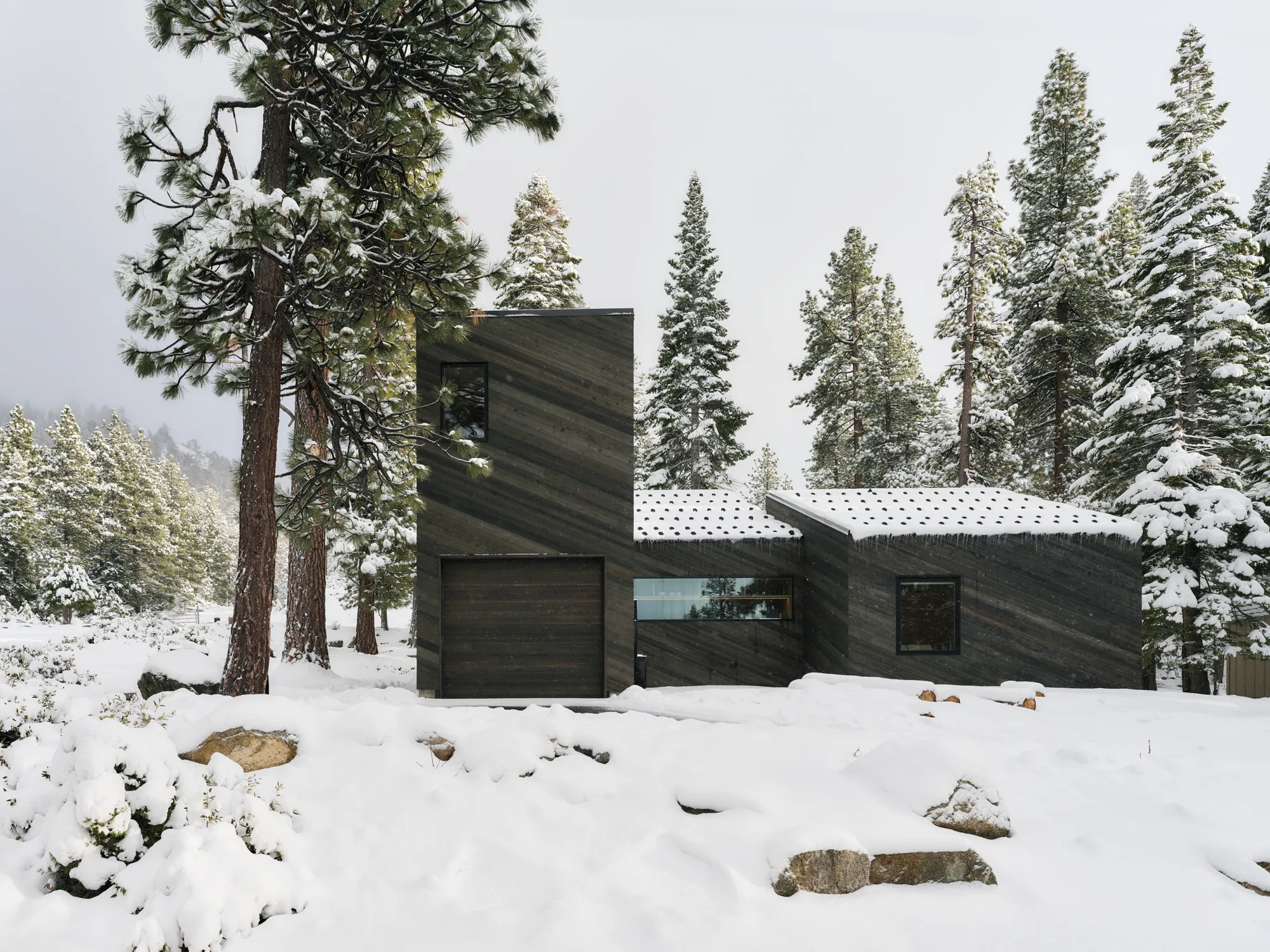
Mork-Ulnes Architects Fragments a Tahoe Cabin into Four Shed-Roofed Volumes That Step Down a Forested Slope
At 6,000 feet in South Lake Tahoe, dark-stained cedar volumes wrap around boulders, pines, and gravity to form a compact mountain home.


Most mountain cabins treat a slope as something to overcome. A concrete retaining wall gets poured, the hillside gets carved flat, and a single wide footprint lands on top. Mork-Ulnes Architects inverts that logic with Staggered Cabin, a 110-square-meter retreat in South Lake Tahoe that breaks its program into four compact shed-roofed volumes and lets each one find its own footing on the hill. The result is a house that descends with the terrain rather than fighting it, leaving granite boulders, mature Jeffrey pines, and existing soil conditions almost entirely in place.
What makes the project worth studying is not just its environmental sensitivity but the spatial consequences of fragmentation. By distributing the domestic program across separate volumes, the architects eliminate long hallways and instead generate a sequence of interstitial courtyards with varying degrees of enclosure and sunlight. The house becomes a small settlement rather than a single object: a distributed domestic landscape where stepping outside is part of moving between rooms, and the forest is never more than a glance away.
Four Volumes, One Hillside


Seen from a distance, Staggered Cabin reads as a cluster rather than a building. Four dark-stained cedar volumes stagger down the slope, each capped with a standing-seam metal shed roof whose pitch echoes the grade of the hill. The diagonal orientation of the exterior cedar boards reinforces this sense of directional movement, pulling the eye downhill and tying each volume to the topography rather than to a single horizontal datum.
The staggered configuration is not ornamental. Breaking the footprint into compact plates means the architects could avoid a single large excavation and instead calibrate each volume's foundation to the terrain immediately beneath it. Boulders that would have been blasted out of a conventional foundation pit simply sit between the volumes, becoming courtyard features. Felled trees from the minimal clearing were repurposed into furniture or left to decompose on the forest floor, and stormwater is directed into localized infiltration elements designed to protect the clarity of Lake Tahoe.
A Central Room That Hinges Everything
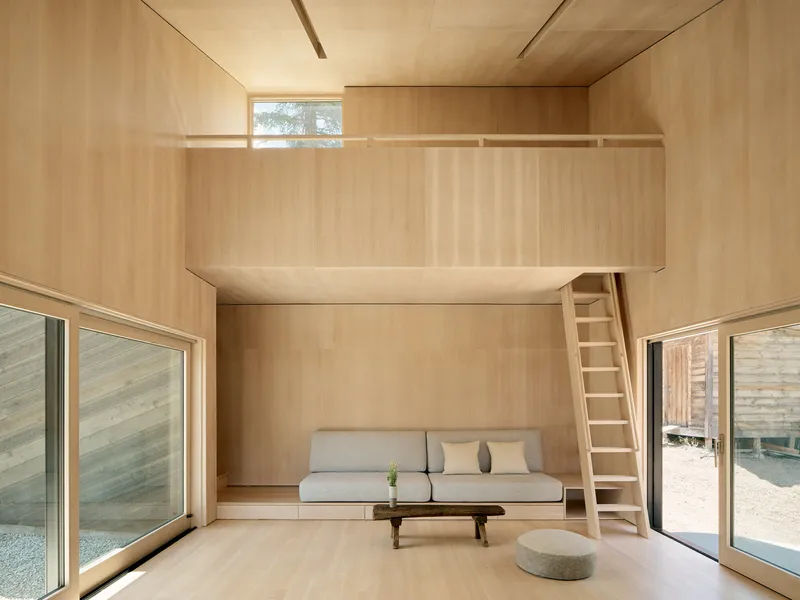

Inside, the sleeping quarters are distributed around a central living and dining space that serves as the spatial hinge of the house. Large sliding openings on opposing sides establish cross-views through the forest and pull natural light deep into the plan. The great room concentrates circulation, which means hallways are almost nonexistent. You move from bedroom to kitchen by passing through a shared social space, a decision that makes 110 square meters feel far more generous than the number suggests.
Douglas fir plywood lines the walls and ceilings throughout, lending a warm, uniform grain that contrasts with the darker exterior cladding. The material is honest: face-framed cabinets with flush fronts, concealed lighting, and joinery that reads as part of the architecture rather than an aftermarket addition. A deep window sill in the primary bedroom doubles as a reading nook; a climbing wall occupies a children's room; a plywood ladder rises to a mezzanine office tucked under the steep pitch of the shed roof. Every steep angle overhead becomes usable volume rather than wasted attic.
Steep Roofs as Climate Instruments


At 6,000 feet, snow is not a seasonal inconvenience but a defining condition. The steeply pitched shed roofs do more than shed load. Engineered snow guards hold a continuous layer of snow in place, adding a blanket of insulation over the roof assembly and moderating melt so water does not cascade off in destructive sheets. The stepped arrangement and varied roof orientations manage snow accumulation, runoff, and pedestrian access without mechanical intervention, a strategy that treats winter as an asset rather than a threat.
In summer, the narrow floor plates ensure daylight reaches every corner, and paired operable windows on opposing facades facilitate cross-ventilation. The interstitial courtyards between volumes amplify this effect, functioning as outdoor rooms with varying solar exposure. The cabin essentially breathes through its gaps, cooling passively in warm months and insulating under snowpack in cold ones.
Dark Cedar Among the Pines

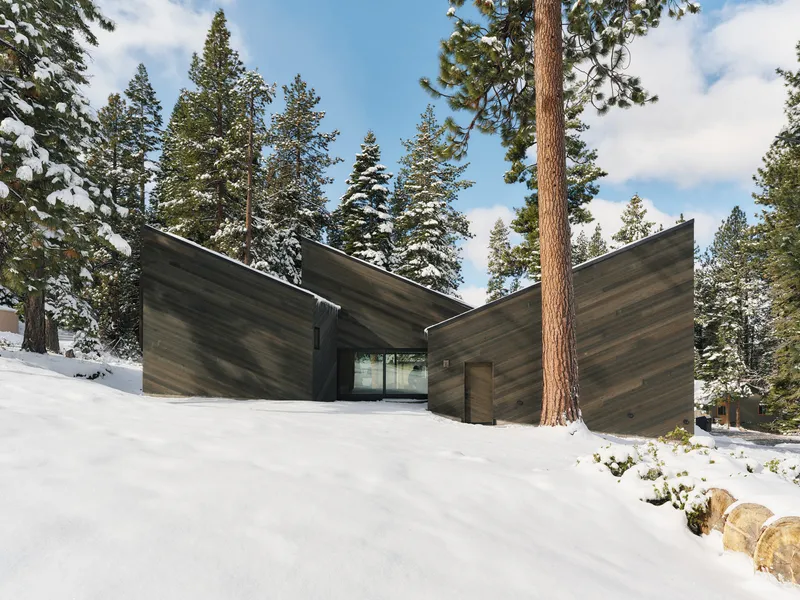
The rough-sawn western red cedar cladding, darkened with stain, disappears against the bark of the surrounding Jeffrey pines at certain times of day and glows warm under interior light at dusk. The material palette is deliberately restrained: dark cedar and standing-seam metal outside, pale Douglas fir plywood inside. That binary keeps the project legible. You always know whether you are looking at the forest side of the wall or the domestic side, and the transition between the two is abrupt enough to register.
Mork-Ulnes Architects are known for bridging Scandinavian and Northern Californian sensibilities, and the material choices here sit precisely at that intersection. The shed-roof silhouettes recall Nordic cabins and the A-frame lineage common to the Sierra, while the light-filled plywood interiors owe more to a Scandinavian tradition of bright, minimal domestic spaces. Neither reference dominates; they fuse into something specific to this site and this elevation.
Living Between the Volumes
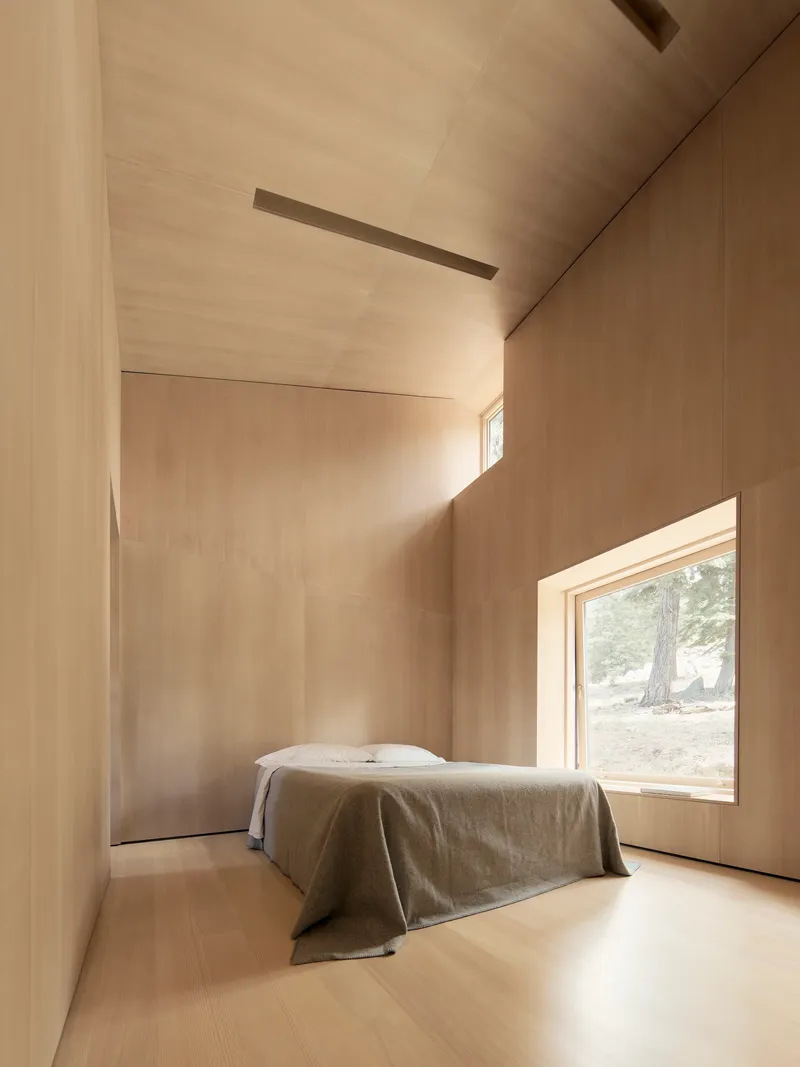
The bedroom volumes reward close attention. Pale timber surfaces wrap floor, wall, and ceiling in a continuous skin, and low windows are positioned to frame specific views: a single pine trunk, a boulder, a patch of sky. The scale is deliberately compressed compared to the double-height great room, which makes moving between sleeping quarters and communal space feel like a shift in altitude as much as a shift in program.
Originally conceived as a weekend ski retreat for an Australian couple, the cabin evolved during design into a permanent family home. That shift is legible in the built-in details: the storage sofa, the mezzanine office, the climbing wall. These are not weekend gestures. They embed daily life into the architecture, making the compact footprint work not just for long weekends but for school nights and remote work and the slow accumulation of routine.
Plans and Drawings
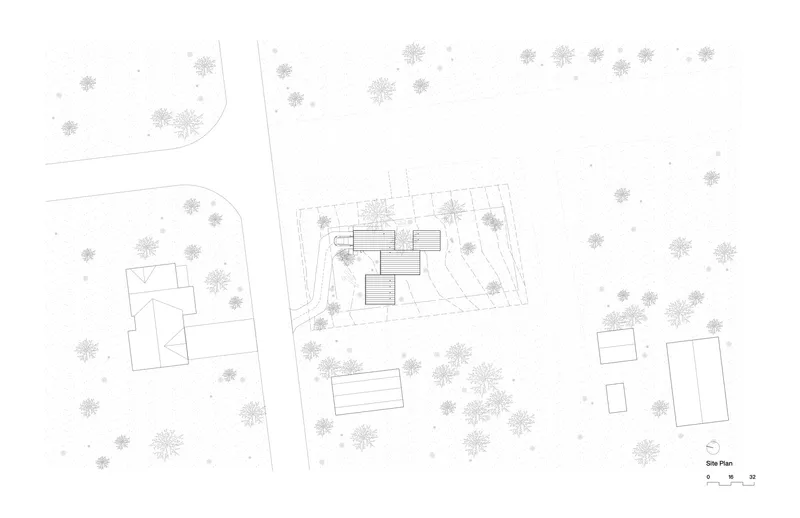



The site plan reveals how tightly the volumes are calibrated to the existing tree canopy and neighboring structures. Rather than a pinwheel on paper, the plan is a pinwheel negotiated with rocks and roots. Each volume's footprint is compact enough to slip between mature pines, and the stagger produces covered thresholds and outdoor alcoves that the plan alone does not fully communicate. The sections are more revealing: split-level interior floors follow the grade, and the steep shed roofs open up mezzanine zones that nearly double the usable volume of each wing.
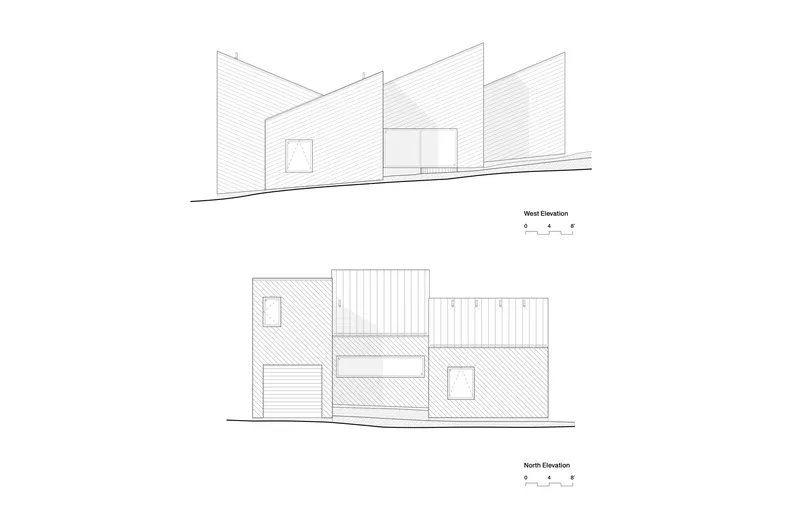
The elevation drawings show how the cladding pattern shifts direction at volume boundaries, reinforcing the reading of each piece as an independent element. Hatched surfaces and varied board orientations make it clear that this is not a single building wearing a mask of complexity. The fragmentation is structural, spatial, and tectonic all at once.
Why This Project Matters
Staggered Cabin belongs to a growing body of work that treats site preservation not as constraint but as generative strategy. By refusing to flatten the hillside, Mork-Ulnes Architects gained a richer set of spatial conditions than any single-volume house could produce: courtyards, cross-views, mezzanines, and a constantly shifting relationship between interior and forest floor. The lesson is that working with less ground can yield more architecture, particularly in fragile alpine landscapes where the temptation to grade and pour is strongest.
It also demonstrates that the cabin typology still has room to evolve. The shed roof, the dark wood cladding, the compact plan: none of these elements are new. What is new is the decision to multiply them, to treat each domestic function as its own small building and let the gaps between them become the most memorable spaces in the house. In a region saturated with oversized trophy chalets, that restraint is its own kind of ambition.
Staggered Cabin by Mork-Ulnes Architects. South Lake Tahoe, United States. 110 m². Completed 2025. Photography by Joe Fletcher.
About the Studio
Share Your Own Work on uni.xyz
If projects like this are the kind of work you want to make, uni.xyz is a place to publish your own, find collaborators, and enter design competitions.



Popular Articles
Popular articles from the community


The Musturak Paradise: Senior Living Architecture for a Connected Future in Temara, Morocco
The Musturak Paradise reimagines senior living architecture in Temara via private homes, social spaces, culture, community, and shared care.

Riyadh For All: Intergenerational Urban Design for Active Aging in Rabat
Riyadh For All reimagines urban design in Rabat with intergenerational co-living, adaptive courtyards, and Moroccan cultural exchange today.
EW PARK: Sustainable Architecture Reimagines the Future of Urban Parking
EW PARK reimagines city parking as a modular wooden tower combining automation, solar energy, electric mobility, and adaptable urban design.

Hill & Cross Opera: Sculptural Opera House Architecture Shaped by Tallinn’s Landscape and Identity
Hill & Cross Opera reimagines opera house architecture in Tallinn through its sculptural hill, civic plaza, glass wave and a luminous cross.


Similar Reads
You might also enjoy these articles

Bao Huynh Watercolor Atelier: A Serene Art Retreat in Hội An
Bao Huynh Watercolor Atelier in Hội An blends multifunctional art spaces, sustainable design, local materials, and family-friendly living in a serene environment.

Atelier Macri Concept Store Interior Design by CASE-REAL
Atelier Macri store features a "ko" counter, walnut wood details, cork displays, blending retail, gallery, and seamless customer experiences.

Manuel Vargas Izquierdo Stadium and High-Performance Sports Center: Architectural Excellence in Jalpa de Méndez
The Manuel Vargas Izquierdo Stadium blends sustainable design, inclusive sports facilities, and cultural-inspired architecture, revitalizing Jalpa de Méndez’s public spaces.

KAKR Buluh Awar Hall: Revitalizing Community and Ecology Through Bamboo Architecture
Community built bamboo hall revitalizes Buluh Awar village, empowering youth, restoring ecology, celebrating vernacular craftsmanship through sustainable architecture and culture.




Comments (0)
Please login or sign up to add comments
No comments yet. Be the first to comment!