
Mulan Warm Village Persimmon House by UAO Design: A Contemporary Homestay Rooted in Landscape and Tradition
A nature-centered homestay blending hexagonal concrete forms, courtyards, and preserved persimmon trees to create serene, light-filled rural retreat spaces.


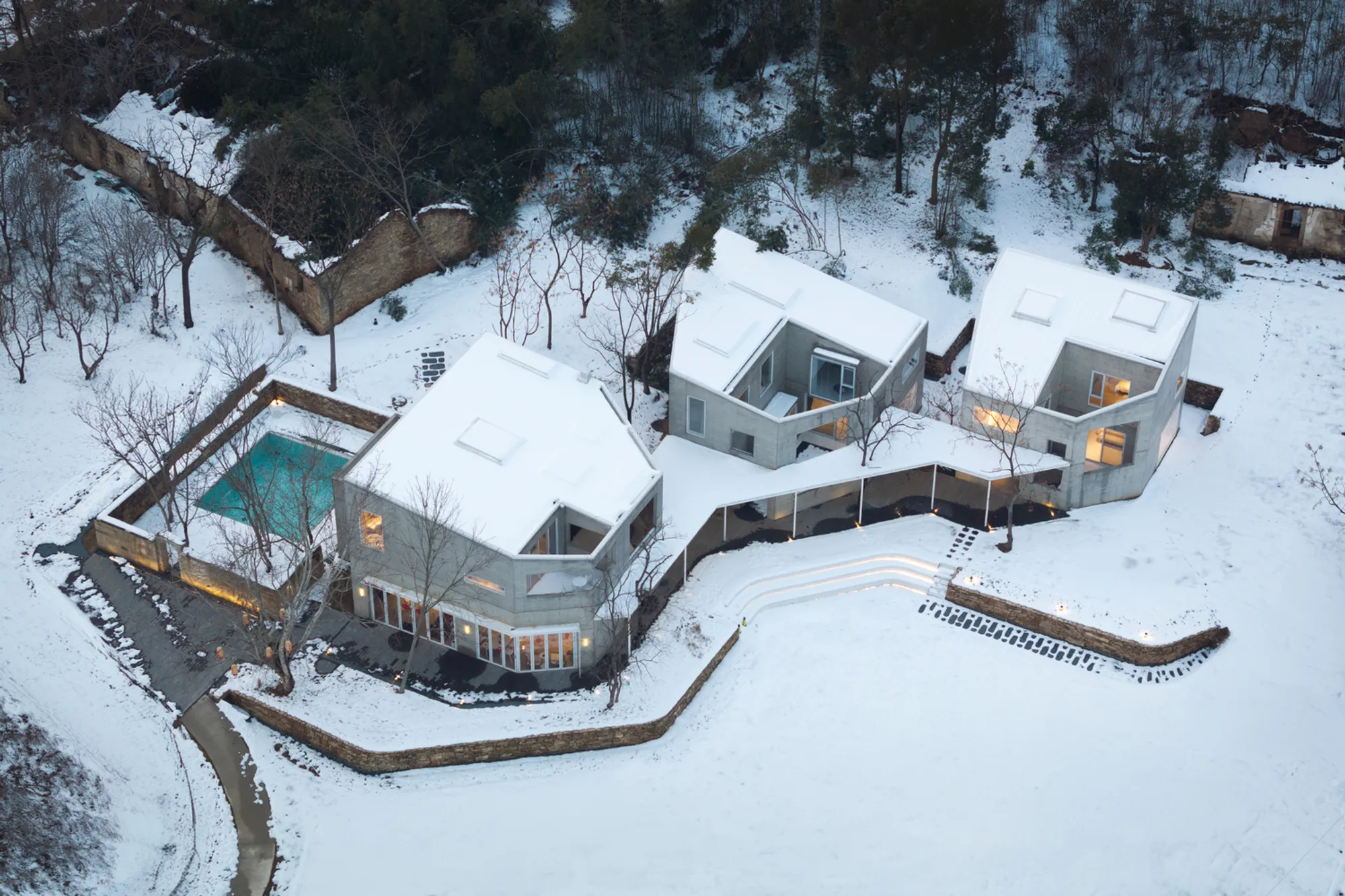
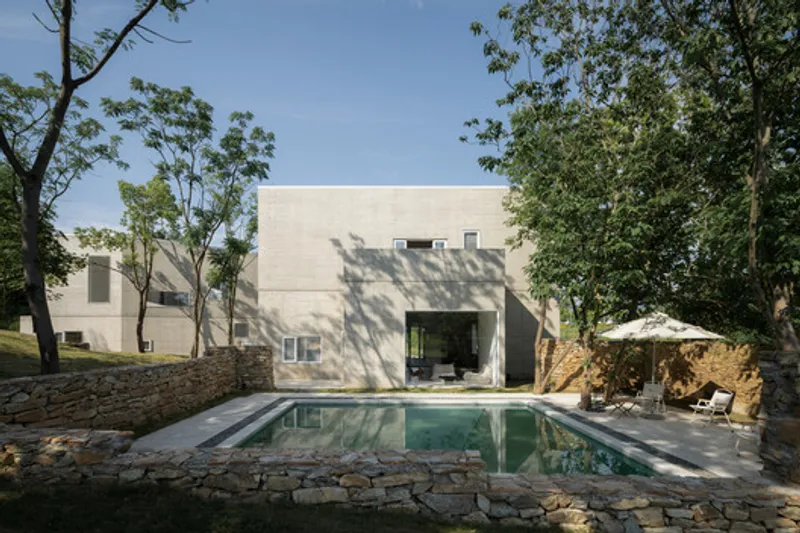
The Mulan Warm Village Persimmon House, designed by UAO Design and completed in 2023, is a 607-square-meter rural homestay located in Wuhan, China. Surrounded by a pond, lawn, and mature persimmon trees, the project reimagines village hospitality architecture through sensitive site integration, sculpted concrete forms, and immersive landscape experiences. Led by architect Tao Li, the design honors the memory of the original site while offering a refined, nature-oriented retreat.
Preserving the Persimmon Trees: The Origin of the Design
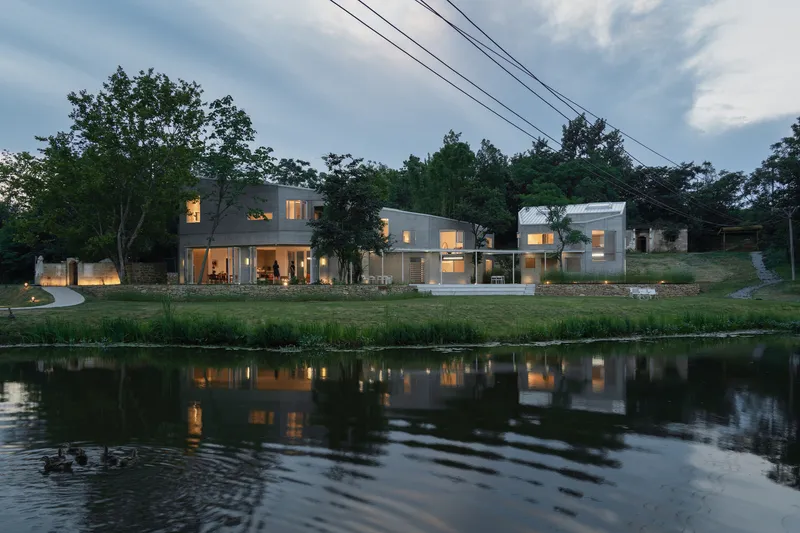
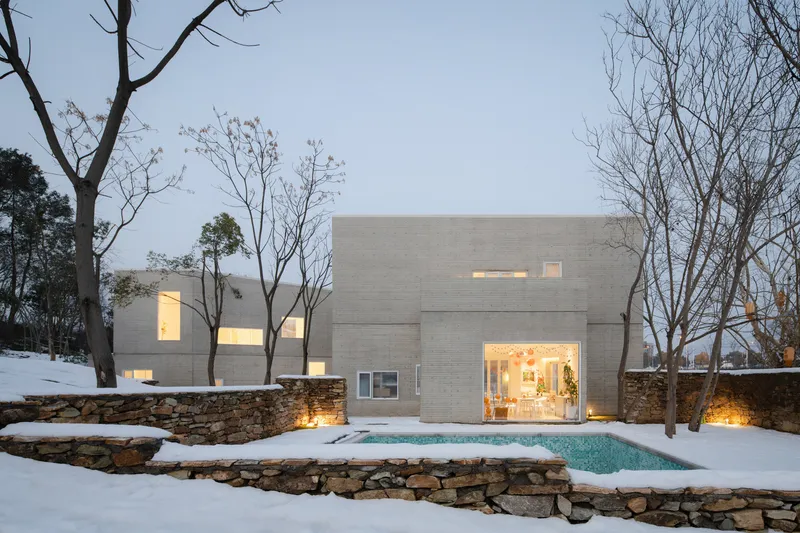
When first visiting the site, the architect saw several persimmon trees heavy with fruit. Instead of removing them, the team shaped the project around them. The three guest buildings—named A, B, and C—were carved and repositioned so that each tree could remain undisturbed. These trees later became architectural focal points, celebrated through framed views, terraces, skylights, and openings throughout the complex.
A Courtyard-Oriented Layout Facing Lawn and Water
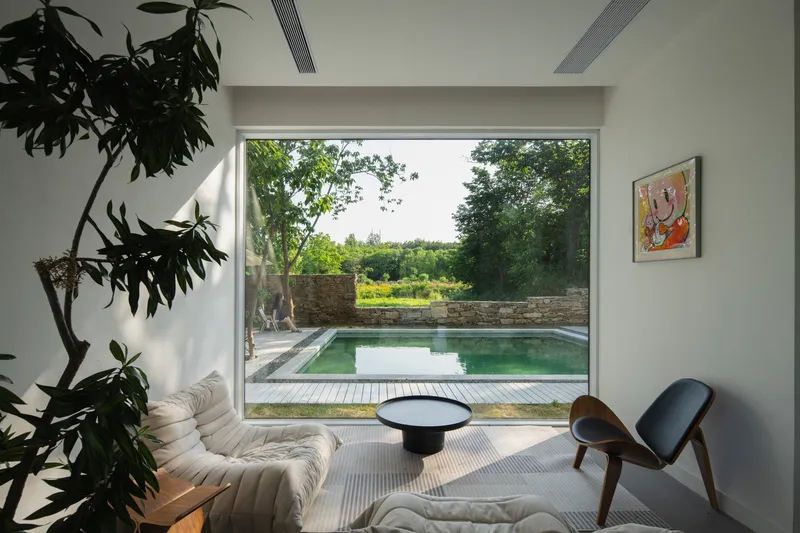
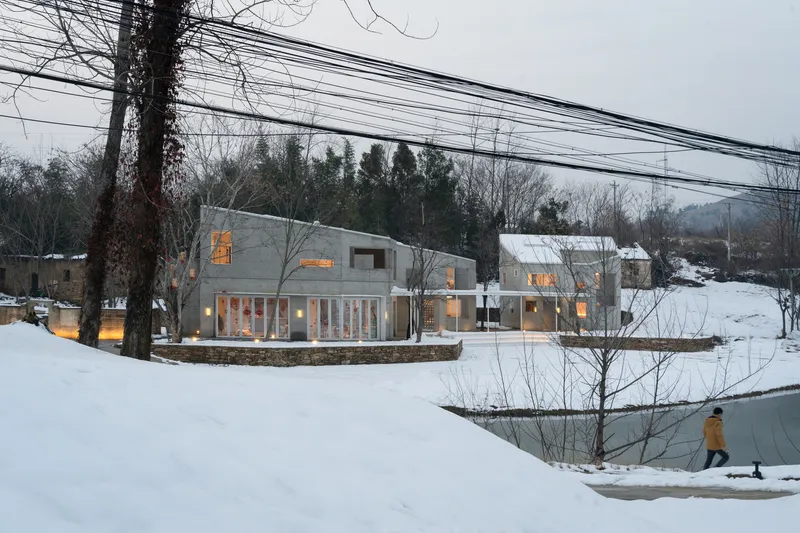
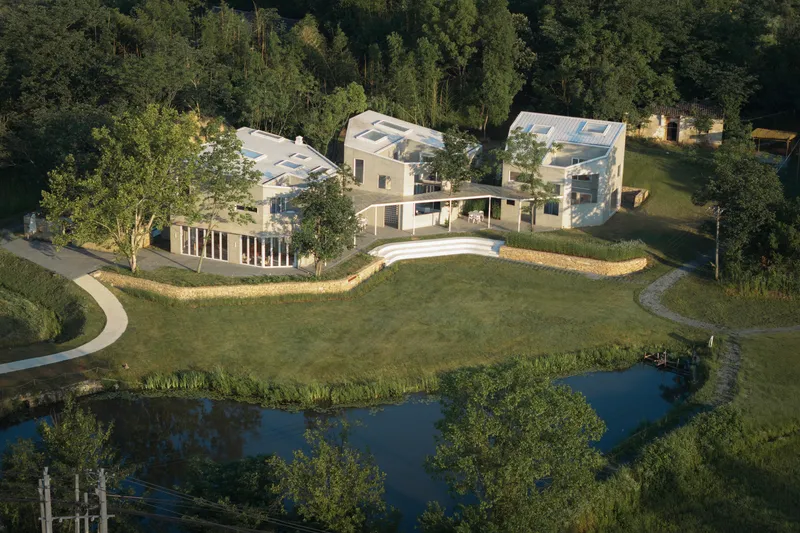
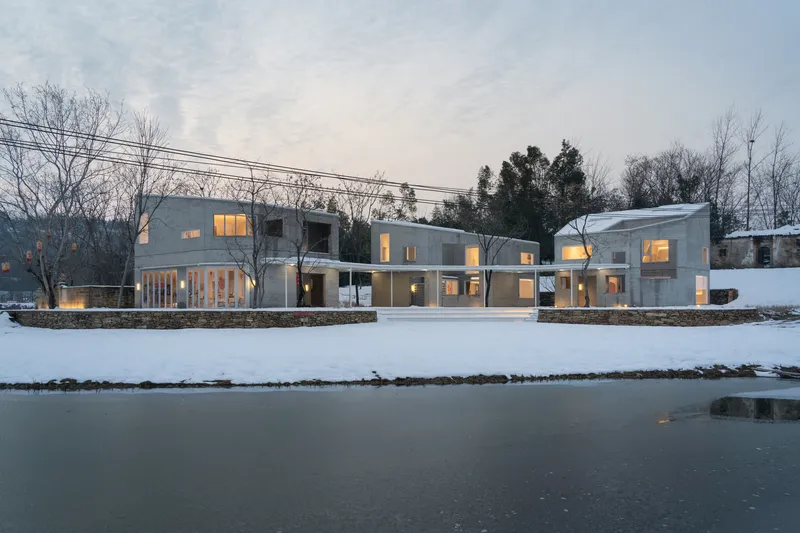
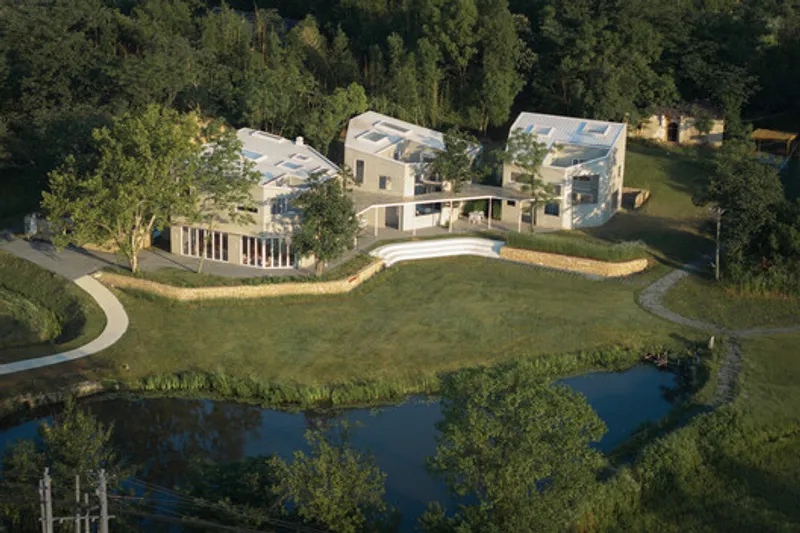
The homestay is organized as a cluster of three volumes forming an enclosure around the lawn and pond. Each building features chamfered geometries that create a centripetal spatial relationship, strengthening unity across the ensemble. A slender steel-column corridor connects the buildings while allowing the remains of the original masonry house to stay visible on site.
The cluster sits at the same elevation as the old house, while the drop to the south lawn is resolved with grandstand steps crafted from rubble salvaged from collapsed village homes—an approach that reinforces sustainable, circular construction and site memory.
Architectural Geometry: Hexagonal Forms With Carved Openings
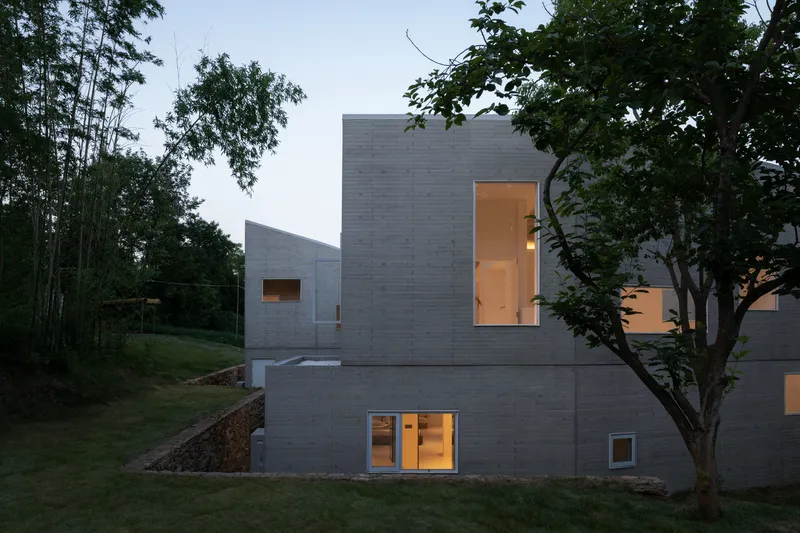
Each of the three buildings originates from a hexagonal prism with a beveled roof, carved with irregular voids, apertures, and skylights. Though they share a consistent architectural language, each unit features a distinct spatial strategy:
Building A
- The largest of the three volumes
- Elevated ground floor functioning as the shared dining and living space
- Expansive floor-to-ceiling glass folding doors open completely to the pond
- Remaining trees emerge through the wooden floor
- Second floor houses a two-bedroom suite with framed views of preserved persimmon trees
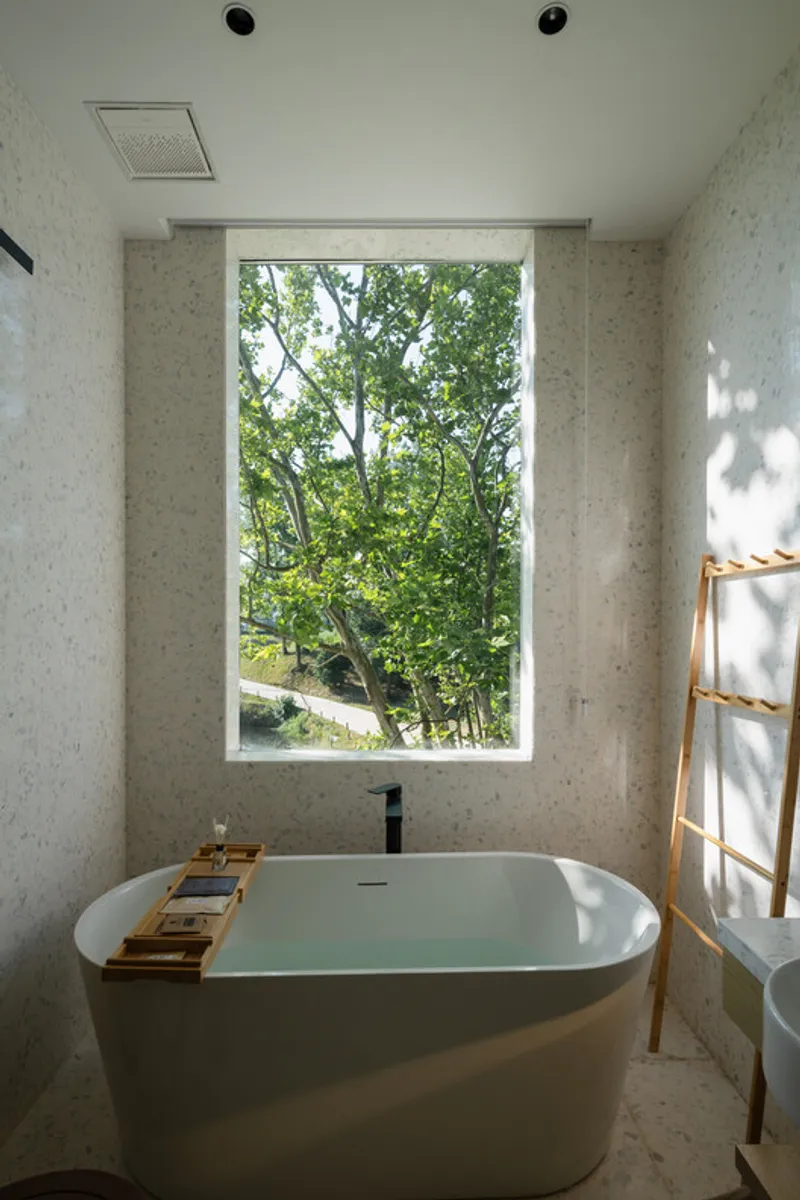
- Bathroom equipped with a large frameless window overlooking a mature plane tree
Building B
- Defined by a double-height living room with perforated openings across walls and roof
- Features a dramatic circular freestanding bathtub beside a floor-to-ceiling window
- Skylights introduce shifting natural light throughout the day
Building C
- Ground floor with a soft pink palette
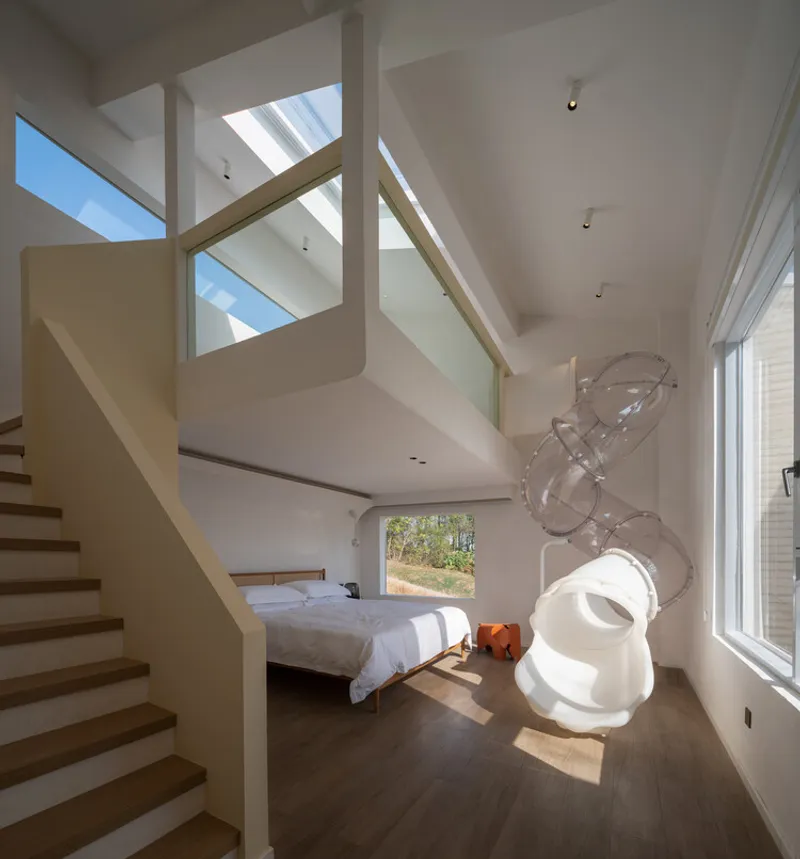
- Second floor incorporates a children’s slide, using the taller ceiling height
- A horizontal bathroom window frames landscape views perfectly from eye level
Courtyard Variations: Different Interpretations of Indoor-Outdoor Experience
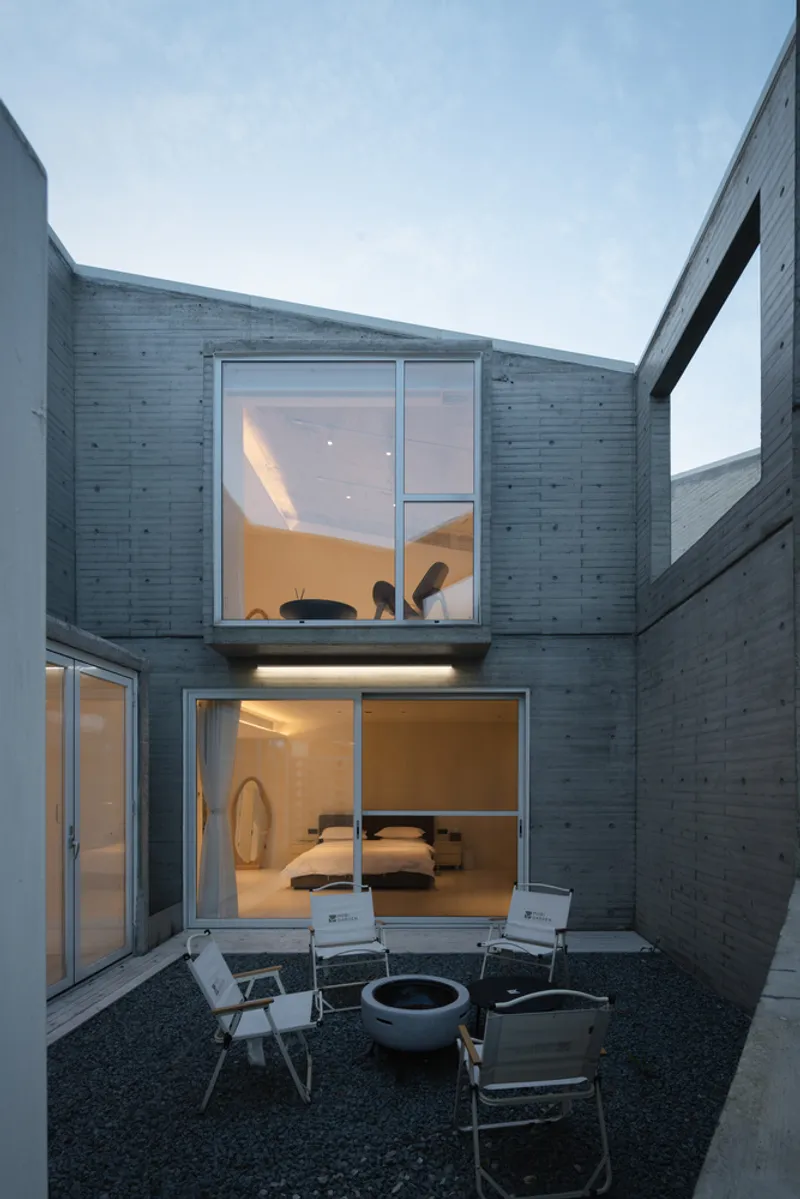
All buildings use a similar spatial matrix: an L-shaped plan paired with an internal courtyard. However, each courtyard responds differently to use and site conditions:
- Building A: Courtyard enclosed with a roof and skylight, functioning as a semi-outdoor grey space.
- Buildings B & C: Open-air courtyards that strengthen the building’s connection to the changing seasons.
These variations create a series of spatial atmospheres, giving each unit its own identity within a unified design system.
Material Expression: Wood-Grain Fair-Faced Concrete
A defining feature of the Persimmon House is the use of wood-grain fair-faced concrete, applied in varying configurations depending on thermal requirements:
- Non-insulated areas (courtyards, stairwells): double-sided fair-faced concrete
- Insulated rooms: single-sided fair-faced concrete with internal insulation
This material strategy creates continuity across interior and exterior surfaces while showcasing craftsmanship through carefully planned casting sequences. Each pour is separated by a controlled process seam, celebrating the construction method rather than concealing it.
Human Scale, Natural Light, and Sensory Comfort
At its core, the project emphasizes human-centered scale, material warmth, and direct engagement with nature. Openings are positioned to frame trees, sky, and water; skylights animate the spaces with changing daylight; and the natural textures of concrete, wood, and stone anchor visitors in a serene rural environment.
UAO Design’s ongoing architectural philosophy—rooted in nature, materials, and the human body—is evident throughout the project. The Persimmon House is not only a place to stay but an immersive, site-based spatial narrative.
The Mulan Warm Village Persimmon House stands as a compelling example of rural revitalization architecture, merging traditional landscapes, local construction materials, and contemporary design language. Its thoughtful approach to preserving existing trees, reusing village materials, and crafting intimate, light-filled spaces makes it a model for future eco-sensitive tourism developments in China and beyond.
All photographs are works of
Naturespace Photography




Popular Articles
Popular articles from the community


Hill & Cross Opera: Sculptural Opera House Architecture Shaped by Tallinn’s Landscape and Identity
Hill & Cross Opera reimagines opera house architecture in Tallinn through its sculptural hill, civic plaza, glass wave and a luminous cross.

Conexión: Biophilic Design Reimagines High-Rise Living in Hong Kong
Conexión reimagines high-rise living in Hong Kong through biophilic design, green facades, shared spaces, daylight, water and nature within.

Riyadh For All: Intergenerational Urban Design for Active Aging in Rabat
Riyadh For All reimagines urban design in Rabat with intergenerational co-living, adaptive courtyards, and Moroccan cultural exchange today.

Co-life: Sustainable Architecture for Age-Friendly Community Living
Co-life reimagines sustainable architecture for seniors through courtyards, rammed earth, shared gardens, and spaces designed for belonging.

Similar Reads
You might also enjoy these articles


Hodi-Mandai Geram
Project Function: Preservation and revitalization of the Intangible heritage and socio-spatial identity of the Hodi by Housing, Cultural Memory Center, Sacred Grove, landscape, local tourism economy


Olio Towers: A Mid-Rise for Performers That Fuses Housing, Rehearsal, and Stage
Located blocks from Houston's Theater District, this modular tower stacks living units around a central performance atrium.

Oasis: Modular Green Housing Carved into Dhaka's Urban Fabric
A shortlisted Plugin Housing entry reclaims unauthorized settlements in Dhaka with stepped concrete volumes, green roofs, and ventilation-driven design.

Black Hole: A Floating Megastructure for the Post-Physical Era
Emiliano Mazzarotto envisions a spherical, self-scaling arena where e-sports, digital hotels, and holographic stadiums replace traditional public space.


Explore Architecture Competitions
Discover active competitions in this discipline



Challenge to reimagine the Iron Throne


Photograph architecture without architects


Illustrate the lost glory of Angkor Wat - Render Challenge


Design challenge to reuse E-waste
Comments (0)
Please login or sign up to add comments
No comments yet. Be the first to comment!