
Finkelman and Hasson Restore a Tel Aviv Music Center as a Shared Cultural Hub for Jewish and Arab Youth
Nestled in Groningen Garden, this 2,300-square-meter renovation peels back decades of additions to reveal a building that sounds as good as it looks.


Buildings accumulate scar tissue. Drop ceilings get bolted under structural beams, provisional galleries eat into sightlines, and blocked windows slowly erase a plan's original logic. The Music Center Tel Aviv-Yafo, originally built as the "Orchestra House" in 1965 and extended with a 385-seat concert hall in 1992, had endured exactly that kind of slow burial. Ifat Finkelman and Dan Hasson took the project not as a blank canvas but as an archaeological dig: strip away the non-original layers, restore the exposed concrete beams and silicate walls, and then tune every room, individually, for sound.
What makes the 2,300-square-meter renovation genuinely interesting is its double agenda. On one level it is a precise acoustic exercise, treating each classroom and rehearsal hall as an independent sonic volume with its own ceiling geometry, wall treatment, and flooring. On another level it is an act of social engineering, repositioning the center as a place where Jewish and Arab young people from Tel Aviv-Jaffa's southern neighborhoods share stages, rehearsal time, and a lobby bench. The architecture does not grandstand about coexistence; it simply makes it spatial.
Surgical Demolition, Then Color
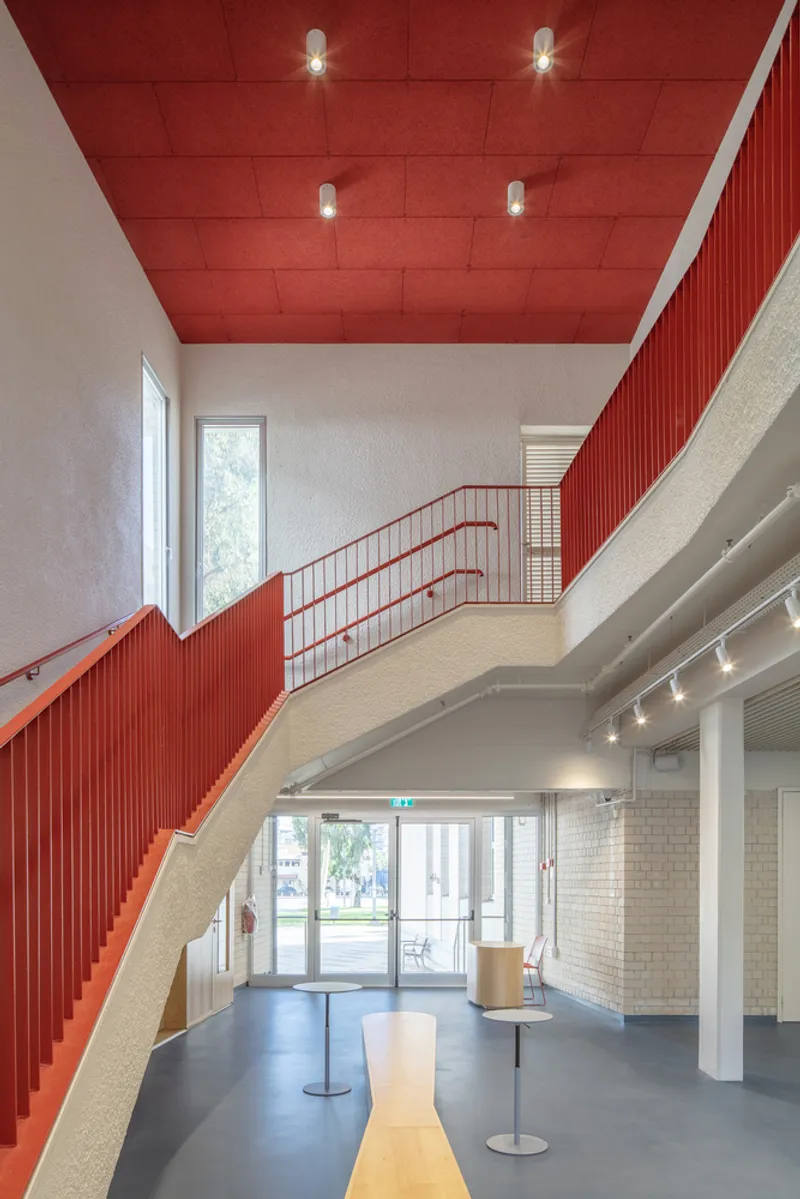
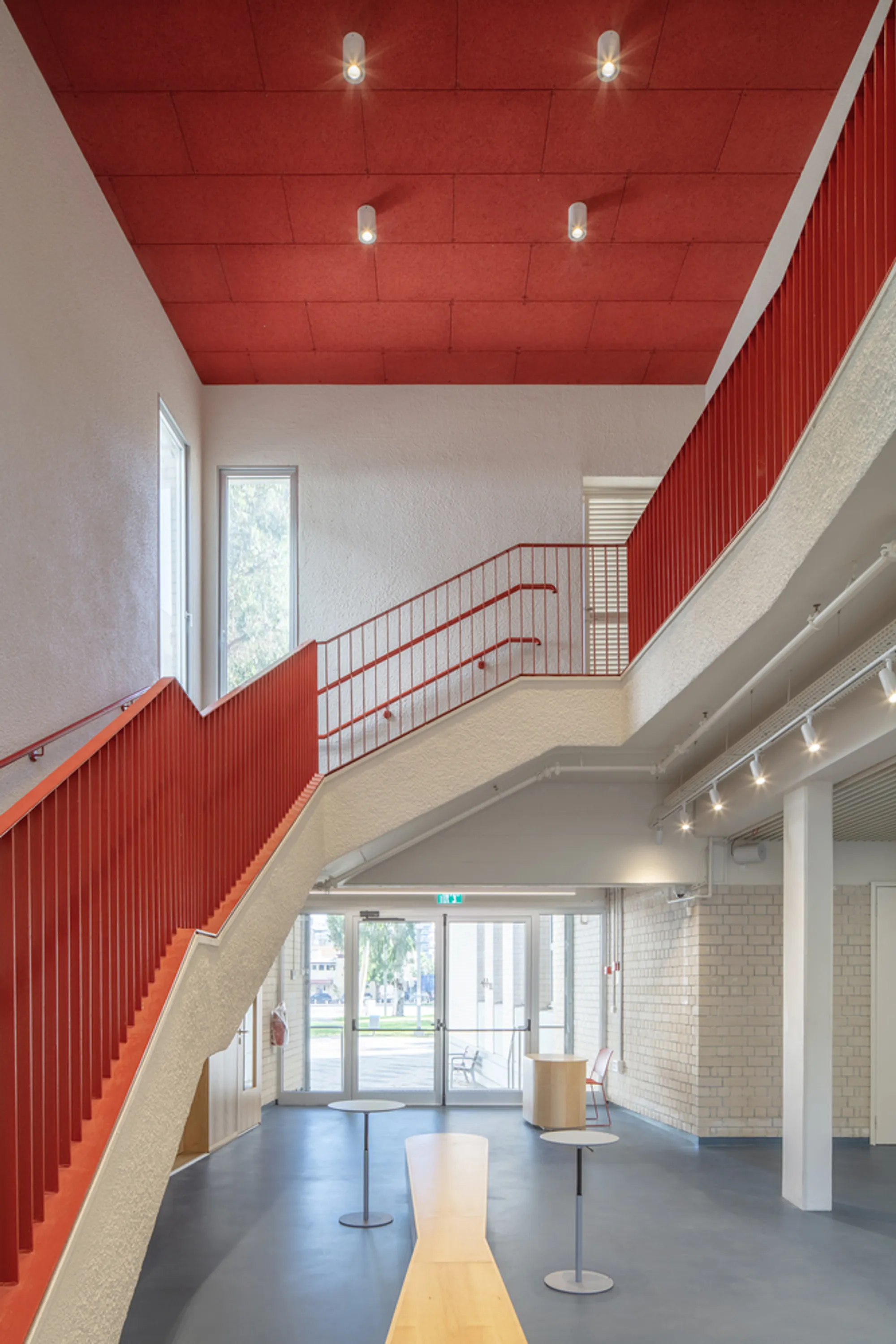
The renovation's first move was subtractive. Finkelman and Hasson ordered a careful demolition that stripped the building back to its structural bones: poured concrete frames, silicate masonry, the original column grid. What went back in was deliberate and legible. A red-paneled staircase punches through the double-height foyer, acting simultaneously as vertical circulation and as a wayfinding landmark visible from the glazed entrance below. The color is not decorative. It is organizational, pulling your eye through a sequence of otherwise neutral corridors and lobbies.
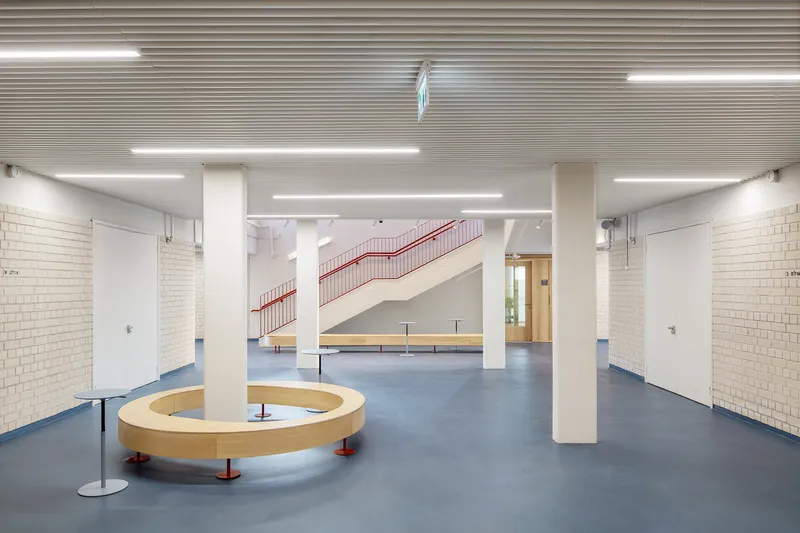
The lobby itself is restrained: white columns, a long curved timber bench, and enough open floor area to function as a social gathering space during evening concerts or community events. The architects clearly understood that the foyer's job is not to compete with the performance halls but to decompress visitors before they enter tighter acoustic environments.
The Concert Hall as Black Box
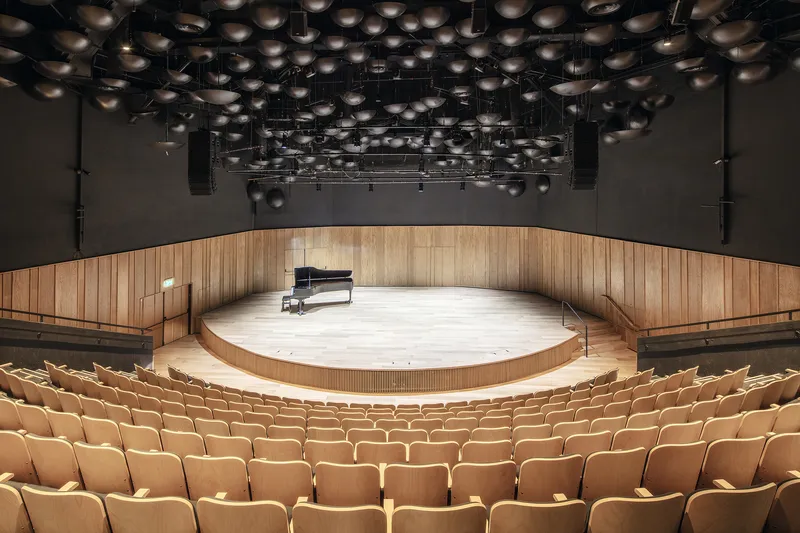
The 385-seat concert hall occupies the 1992 wing and operates on black-box principles. The circular timber stage sits at the center, surrounded by raked seating, while an overhead array of acoustic reflectors floats above the performers like a constellation of tuning devices. The palette is intentionally dark, focusing attention on the musicians and allowing the reflectors to do their work without visual distraction.
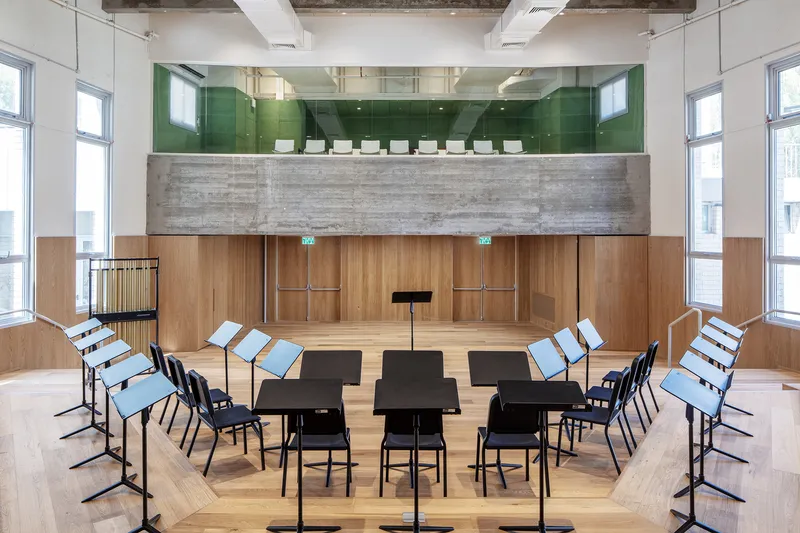
Adjacent to the main hall, a larger orchestra rehearsal space operates under a different acoustic logic. Music stands fill the floor in rows beneath a green glass upper balcony, and the room is bathed in more natural light than the concert hall receives. The contrast is purposeful: rehearsal demands visibility and a certain informality, while performance demands focus and controlled atmosphere. Finkelman and Hasson treat these as fundamentally different spatial problems, not variations on one template.
Rooms Shaped by Sound
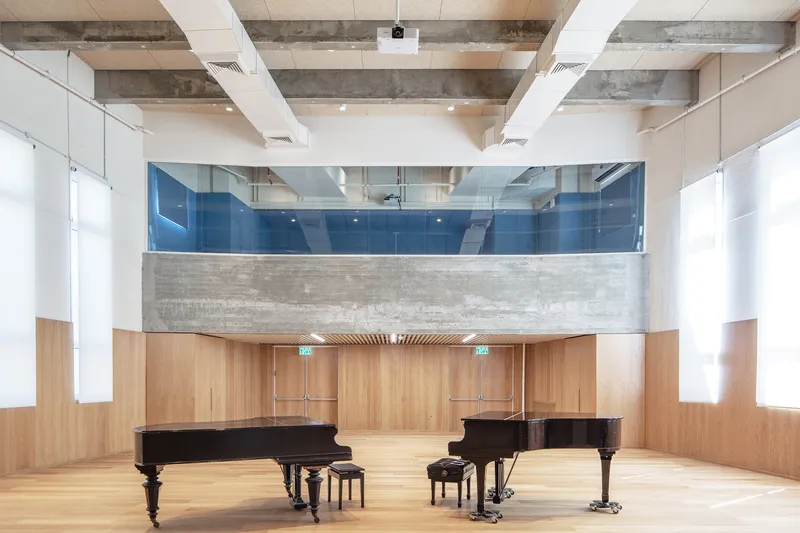
The 1965 wing houses the classrooms and smaller rehearsal rooms, and this is where the architects' "shell and volume" strategy becomes most visible. Each room is conceived as an independent acoustic enclosure. Ceilings slope to match trapezoidal floor plans, scattering sound reflections and preventing the standing waves that plague rectangular practice rooms. In one rehearsal space, exposed concrete beams are left unclad above two grand pianos, while a blue glass observation gallery on the upper level allows teachers to monitor sessions without entering the room and disturbing the acoustics.
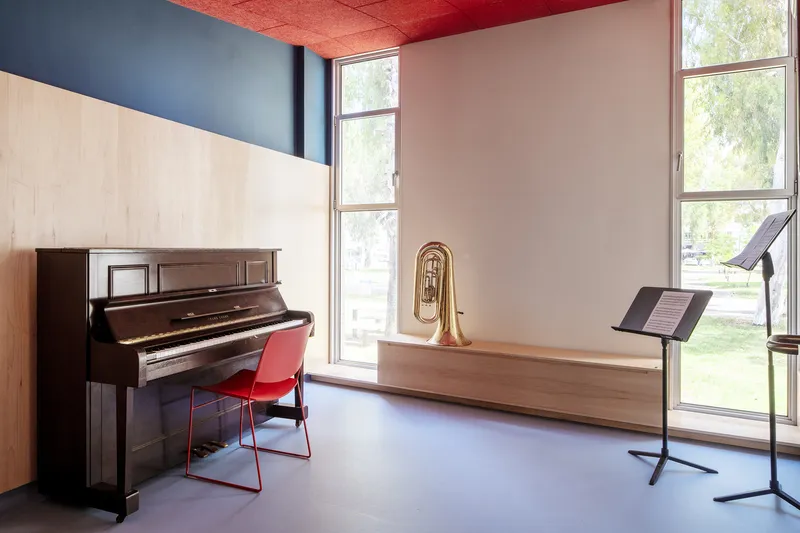
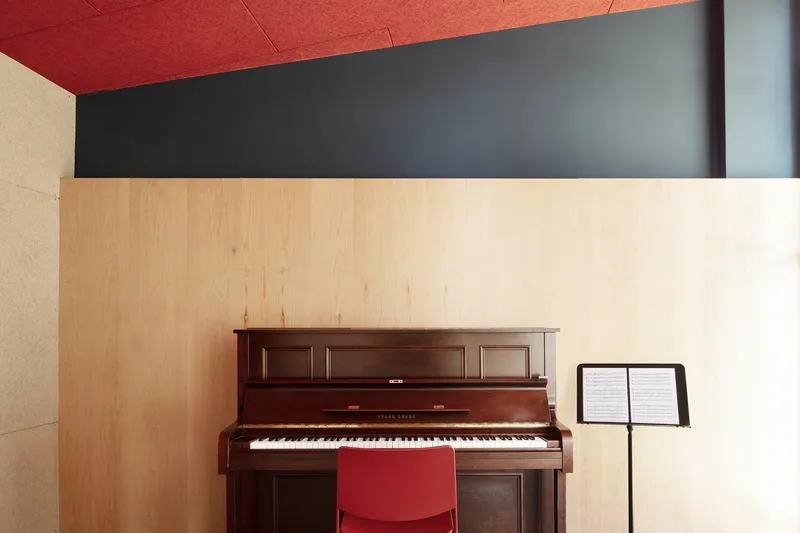
Smaller music rooms face full-height windows overlooking the eucalyptus trees of Groningen Garden. An upright piano sits against a plywood wall beneath red acoustic ceiling panels, a composition of budget-conscious materials (wood wool paneling, linoleum, rubber flooring) that punch well above their price point. Custom-built timber benches double as storage, a move born from necessity in a tight floor plan but executed with enough care that it reads as designed rather than improvised.
Corridors and Thresholds
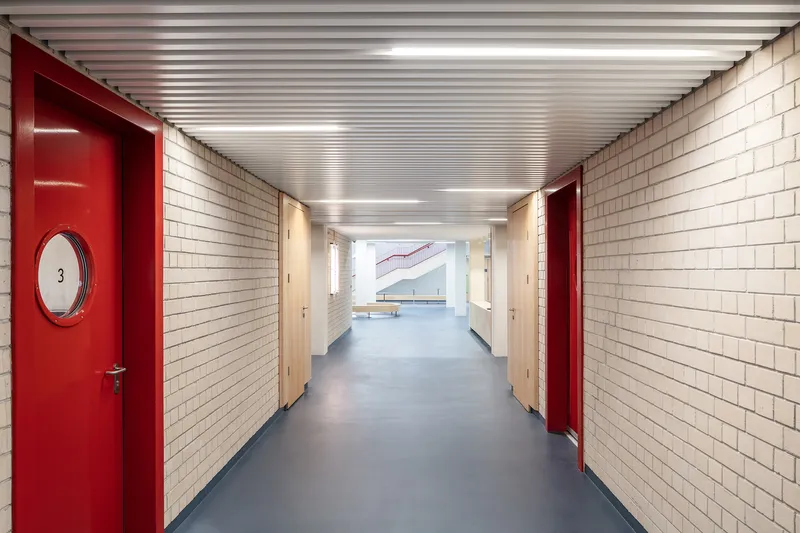
Circulation spaces in music buildings are often afterthoughts, but here they carry real weight. The corridor linking the two wings is lined with white tile and punctuated by red doors fitted with circular porthole windows, a nautical detail that lets occupants check whether a room is in use before opening the door and interrupting a lesson. A linear ceiling lighting strip runs the full length, transforming what could be a utilitarian hallway into a visual axis.
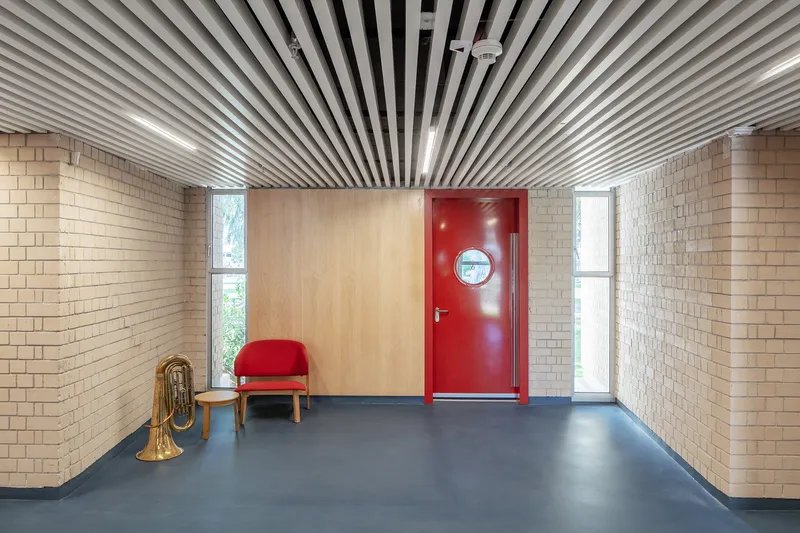
The entry vestibule takes a different approach entirely. Radiating timber slats fan across the ceiling from a central point, lending a sense of compression and release as visitors step from the garden into the building. The cream brick walls and a single red door with a porthole window complete a threshold that announces, without signage, that you are moving from a park into a place of focused activity.
Practice Rooms and the Garden
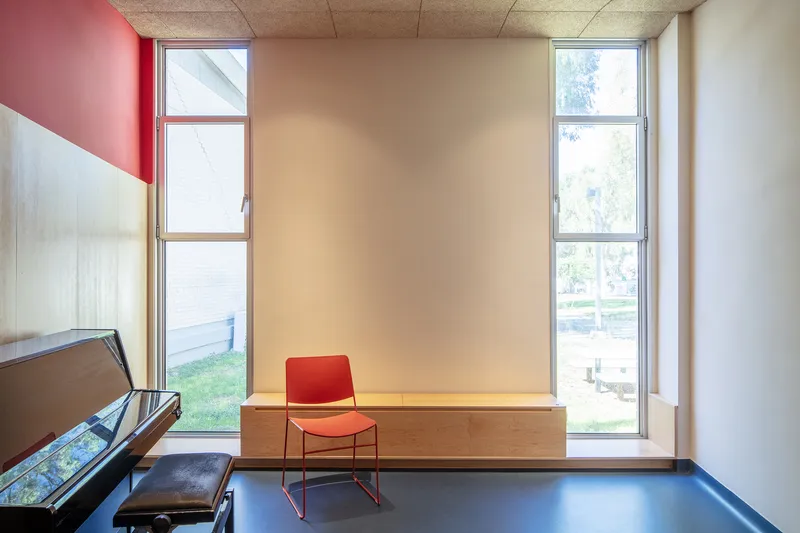
The smallest rooms in the center are perhaps its most considered. Individual practice rooms are fitted with timber bench seating, a single red chair, and floor-to-ceiling windows that frame the surrounding garden. There is something deliberately generous about giving a student practicing scales the same quality of light and view that a principal might expect in a corner office. The landscape strategy is simple: the eucalyptus canopy does much of the work, filtering light and providing a visual buffer between the building and the surrounding urban fabric.
Finkelman and Hasson describe the building as a "garden building," and the label holds. The center does not sit on the site so much as it sits within it, its low profile deferring to the tree line. For a facility serving diverse and often underprivileged communities, this relationship to landscape is not a luxury. It is a signal that the institution values the experience of its users at every scale, from the concert stage to the smallest practice room.
Why This Project Matters
Renovation projects rarely attract the same attention as new builds, and low-budget renovations attract even less. But the Music Center Tel Aviv-Yafo demonstrates what architectural intelligence can do when money is tight and the stakes are social rather than commercial. Finkelman and Hasson did not invent new forms here. They uncovered old ones, restored structural clarity, and then layered in a palette of affordable acoustic materials with enough precision that each room feels specific to its purpose. The result is a building that works harder per square meter than most cultural centers twice its size.
More importantly, the project reframes what a music school can be in a divided city. By designing flexible spaces that accommodate orchestra rehearsals, dance performances, preschool activities, and conference rentals under one roof, the architects ensured the building stays active from morning to evening, pulling in users who might never set foot in a traditional concert hall. The architecture does not preach coexistence. It simply makes sharing a room feel natural, and that is a harder thing to design than it sounds.
Music Center Tel Aviv-Yafo by Ifat Finkelman and Dan Hasson. Tel Aviv-Yafo, Israel. 2,300 m². Completed 2023. Photography by Aviad Bar Ness.
About the Studio
Share Your Own Work on uni.xyz
If projects like this are the kind of work you want to make, uni.xyz is a place to publish your own, find collaborators, and enter design competitions.




Popular Articles
Popular articles from the community


The Ocean Hive: Sustainable Architecture for a Self-Sufficient Civilization at Sea
The Ocean Hive imagines sustainable architecture at sea, where modular habitats, algae, wave power and ocean waste sustain a growing colony.

Hill & Cross Opera: Sculptural Opera House Architecture Shaped by Tallinn’s Landscape and Identity
Hill & Cross Opera reimagines opera house architecture in Tallinn through its sculptural hill, civic plaza, glass wave and a luminous cross.

Co-life: Sustainable Architecture for Age-Friendly Community Living
Co-life reimagines sustainable architecture for seniors through courtyards, rammed earth, shared gardens, and spaces designed for belonging.

Lunar Spiral: Space Architecture Shaped by the Mathematics of the Universe
Lunar Spiral reimagines space architecture through Fibonacci geometry, lunar regolith, levitating habitats, and self-sustaining Moon living.


Similar Reads
You might also enjoy these articles


Hodi-Mandai Geram
Project Function: Preservation and revitalization of the Intangible heritage and socio-spatial identity of the Hodi by Housing, Cultural Memory Center, Sacred Grove, landscape, local tourism economy


Olio Towers: A Mid-Rise for Performers That Fuses Housing, Rehearsal, and Stage
Located blocks from Houston's Theater District, this modular tower stacks living units around a central performance atrium.

Oasis: Modular Green Housing Carved into Dhaka's Urban Fabric
A shortlisted Plugin Housing entry reclaims unauthorized settlements in Dhaka with stepped concrete volumes, green roofs, and ventilation-driven design.

Black Hole: A Floating Megastructure for the Post-Physical Era
Emiliano Mazzarotto envisions a spherical, self-scaling arena where e-sports, digital hotels, and holographic stadiums replace traditional public space.


Explore Cultural Architecture Competitions
Discover active competitions in this discipline



Challenge to reimagine the Iron Throne


Photograph architecture without architects


Illustrate the lost glory of Angkor Wat - Render Challenge


Bring back Drive In's
Comments (0)
Please login or sign up to add comments
No comments yet. Be the first to comment!