
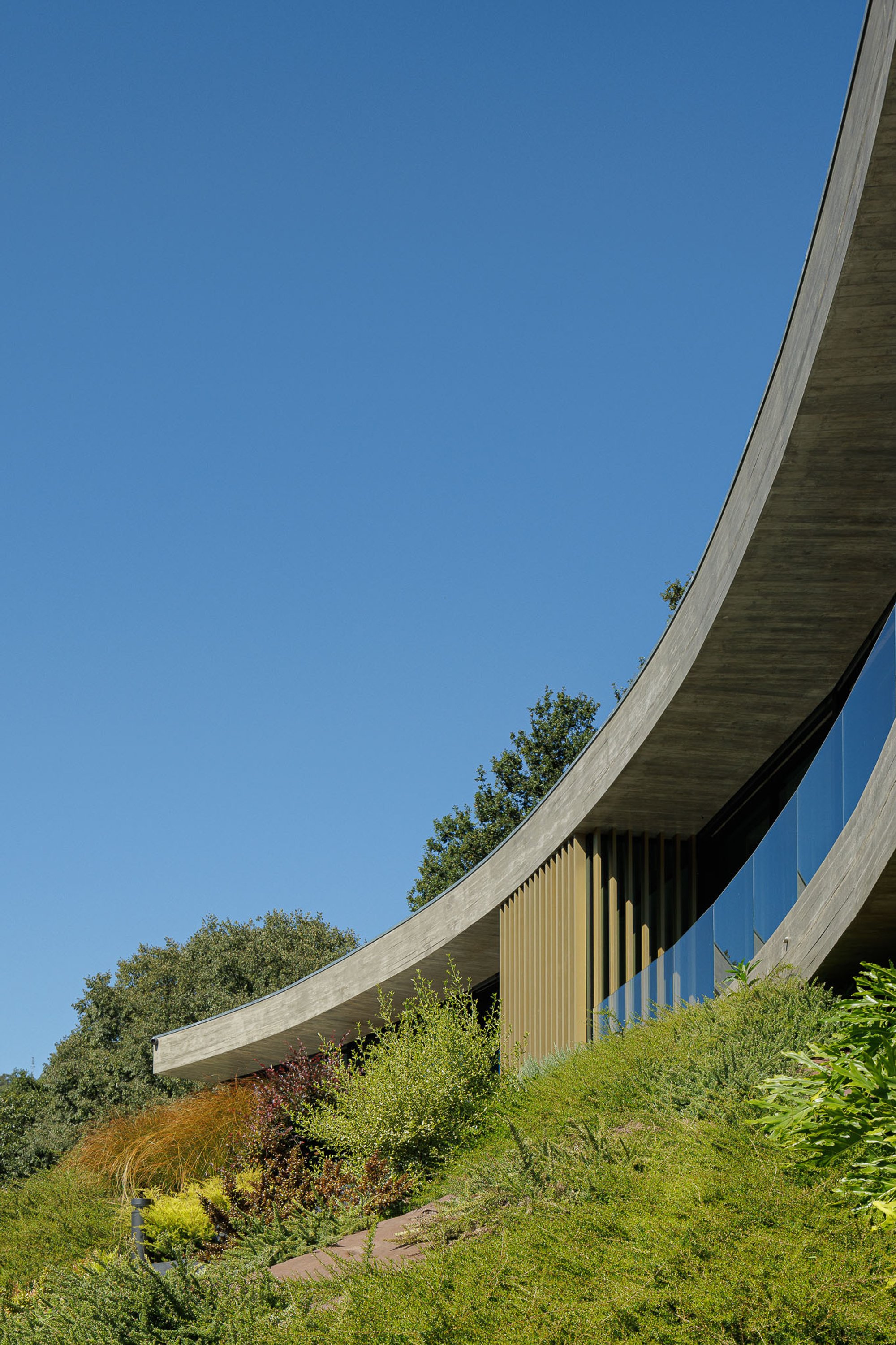
MUTANT Architecture Bends a Concrete Slab into a Hillside Embrace at Casa De Bouro
A 450-square-meter house in rural Portugal wraps its board-formed concrete body around a south-facing patio, pool, and waterfall.

Most houses sit on their sites. Casa De Bouro wraps around its. Designed by MUTANT Architecture & Design and completed in 2022 in Terras de Bouro, Portugal, the 450-square-meter residence begins as a rectangular concrete volume and then deforms, bending to create a south-facing patio at its center. The gesture is literal: the building hugs the land, curving its roof slab and glazed walls to follow the contour of a sloped, forested hillside. The result is a house whose plan reads like a parenthesis, open to the sun and the valley beyond.
What makes this project worth studying is not the metaphor of the embrace but the engineering required to deliver it. The entire upper volume is a cantilevered concrete plane, poured using traditional nailed wooden formwork that leaves its texture visible on every surface. A swimming pool is integrated directly into the building's structure, its first-floor slab rotated southwest to bridge the gap between living room and water. That rotation produces a suspended pool volume, which in turn creates a waterfall, introducing an auditory element that is as deliberate as any wall or window. Lead architect Daniel Capela Duarte, working with builder Amaro Sousa Construções and engineers Massa Cinza, has produced a house that is structurally aggressive and domestically quiet at the same time.
The Curve That Organizes Everything
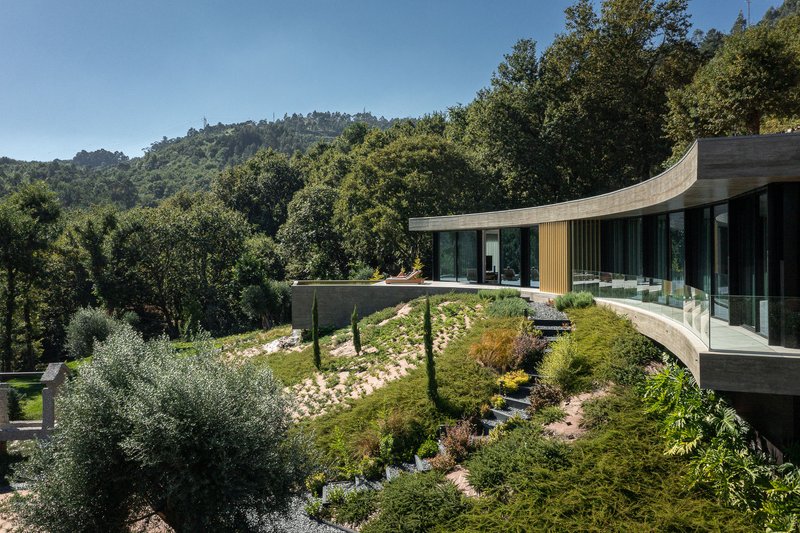
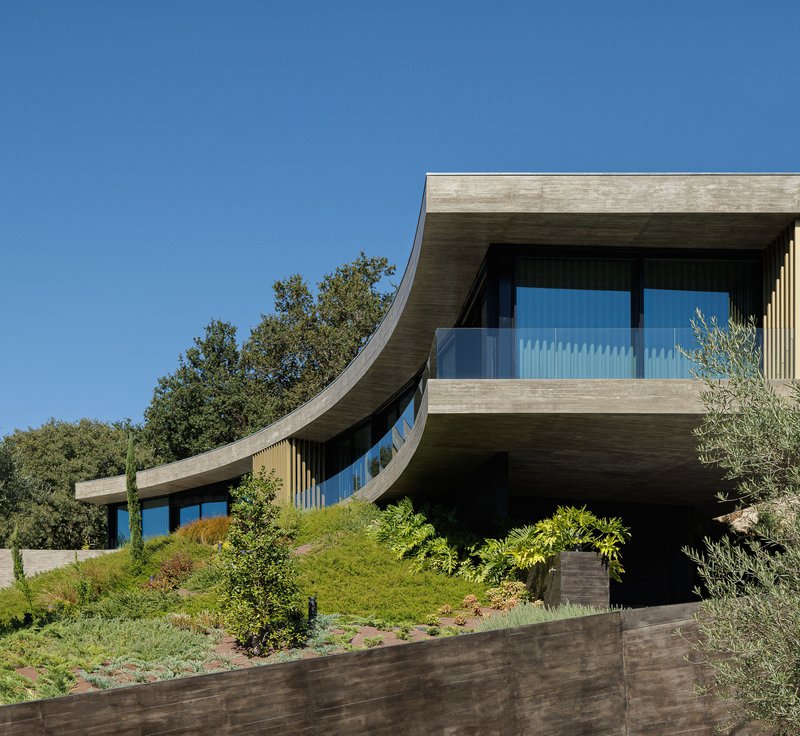
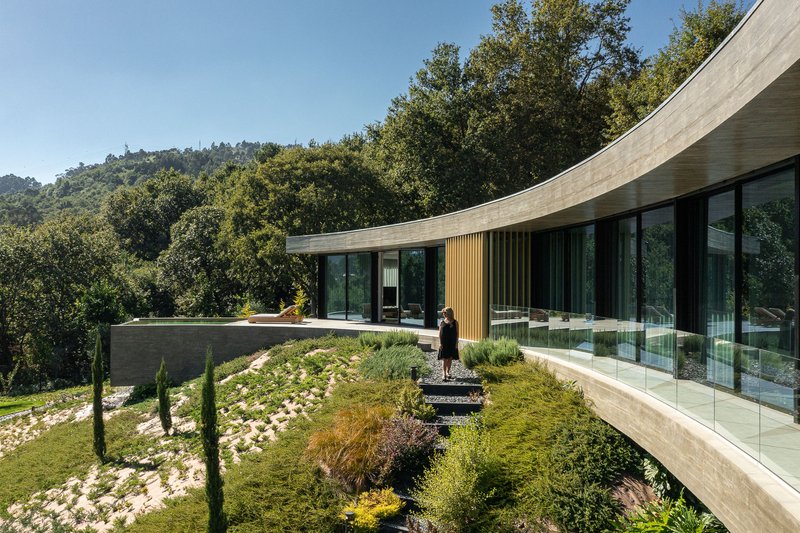
From a distance, the house reads as a single sweeping roof plane hovering above a glass band. The curve is the organizing principle: it determines room sequence, patio orientation, and the path of natural light through the interior. Viewed from the hillside, the concrete canopy extends well beyond the glazed enclosure beneath it, producing deep overhangs that shade the full-height windows from direct summer sun while framing panoramic views of forested mountains.
The curvature is not arbitrary. It follows the southern orientation of the land, capturing warmth and daylight across the living spaces while the north side, where the natural slope rises, remains more closed and private. The entrance is defined at the center of the volume, marking the inflection point where the house pivots from its private wing to the east and south toward its social spaces to the south and west.
Concrete as Character
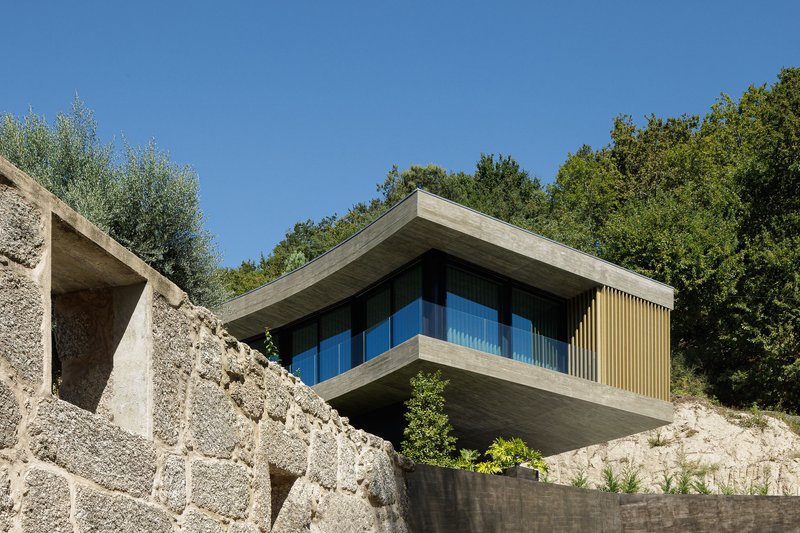
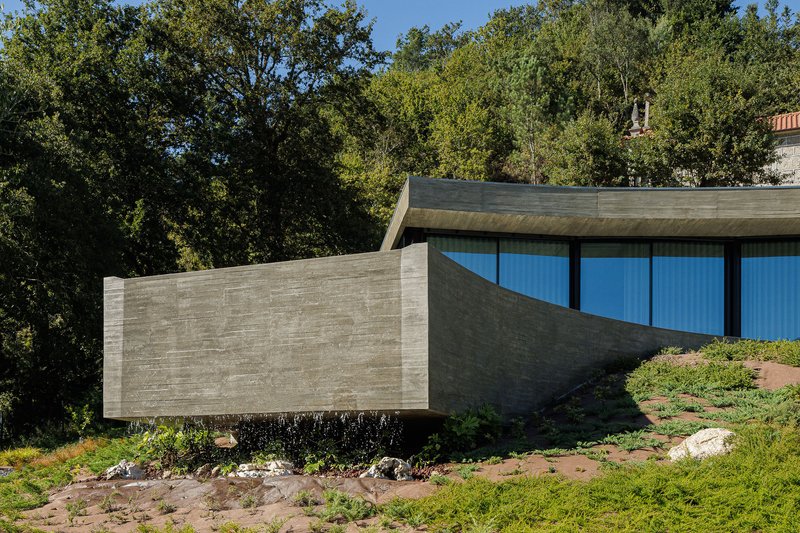
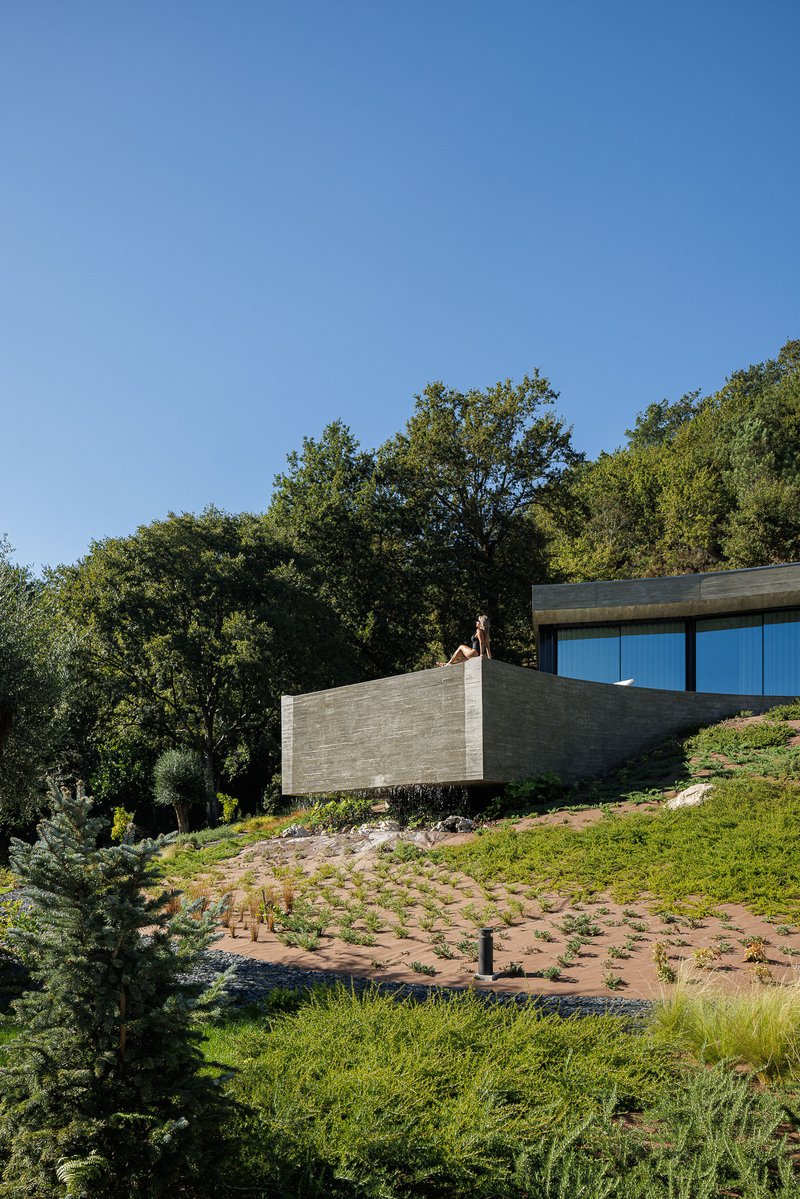
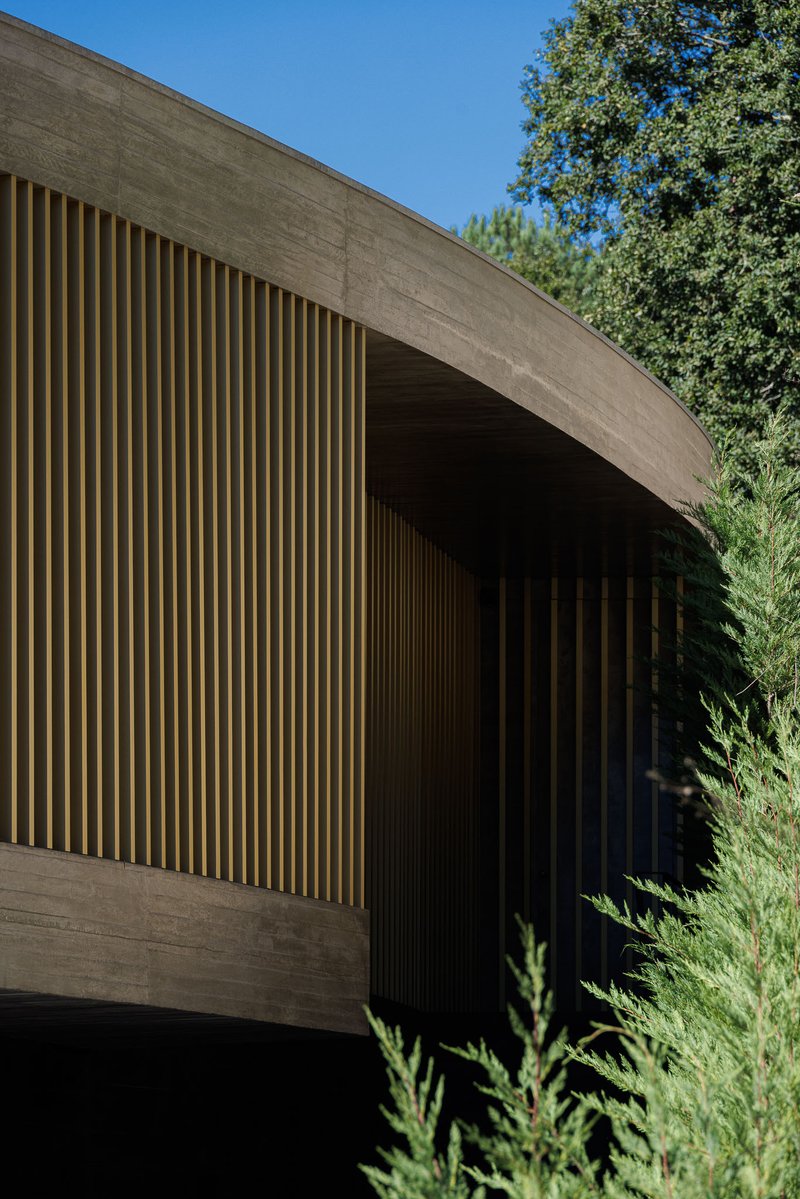
The exposed concrete is the dominant material, and the decision to use traditional nailed wooden formwork gives every surface a grain that is rough, directional, and specific to this building. It is the opposite of the polished concrete aesthetic that has become ubiquitous in high-end residential work. Here, the marks of construction are left visible as a record of process. The formwork pattern runs horizontally across the cantilevers and retaining walls, tying the building's mass to the horizontal lines of the terraced landscape.
Gold metal accents punctuate the concrete at key moments, catching light and signaling transitions. Against the grey mass, these elements feel earned rather than decorative. The stone retaining walls at the lower levels, built from local granite, root the contemporary concrete volume in the material vocabulary of the surrounding village, where traditional tile-roofed houses still define the streetscape.
The Cantilever and the Suspended Pool
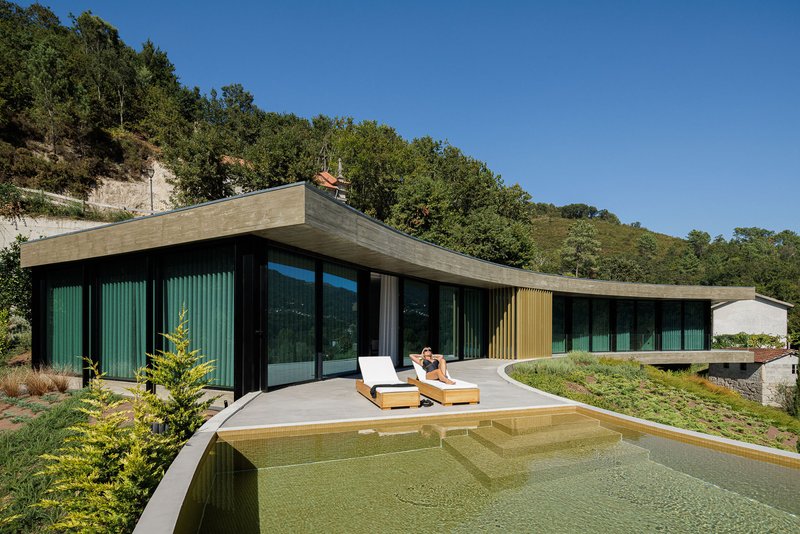
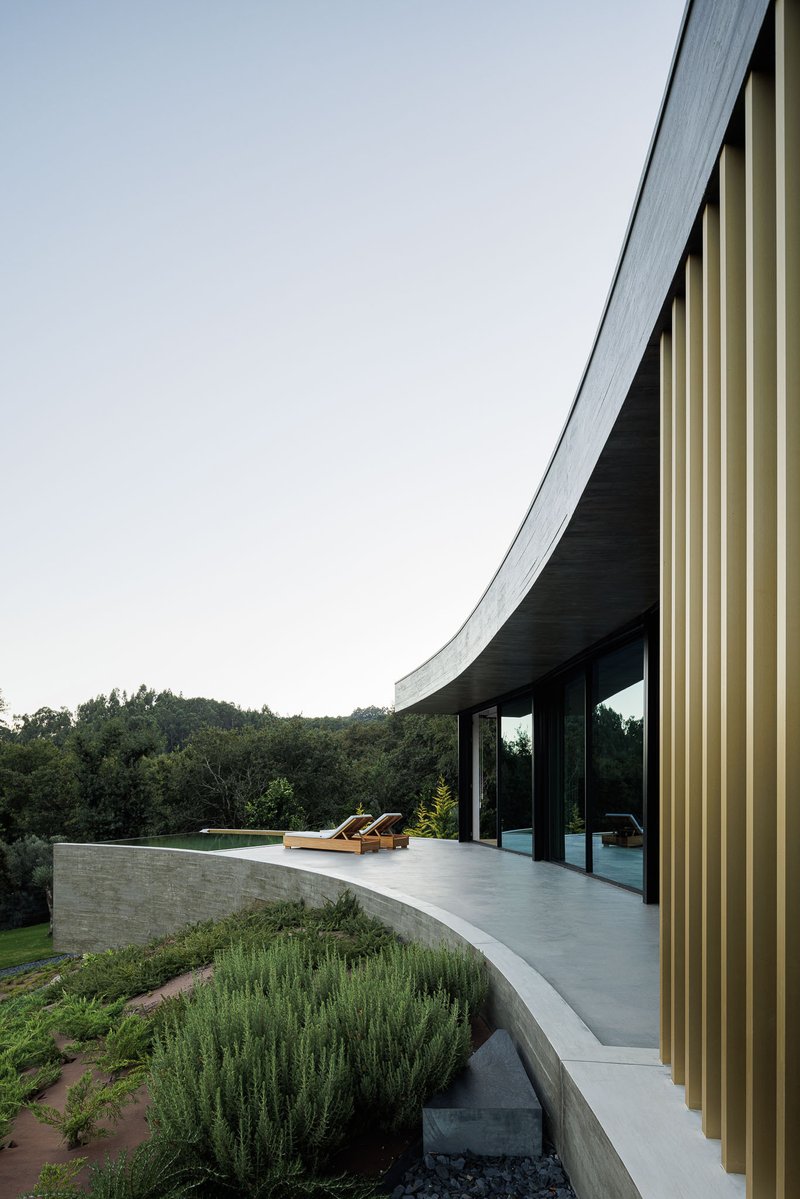
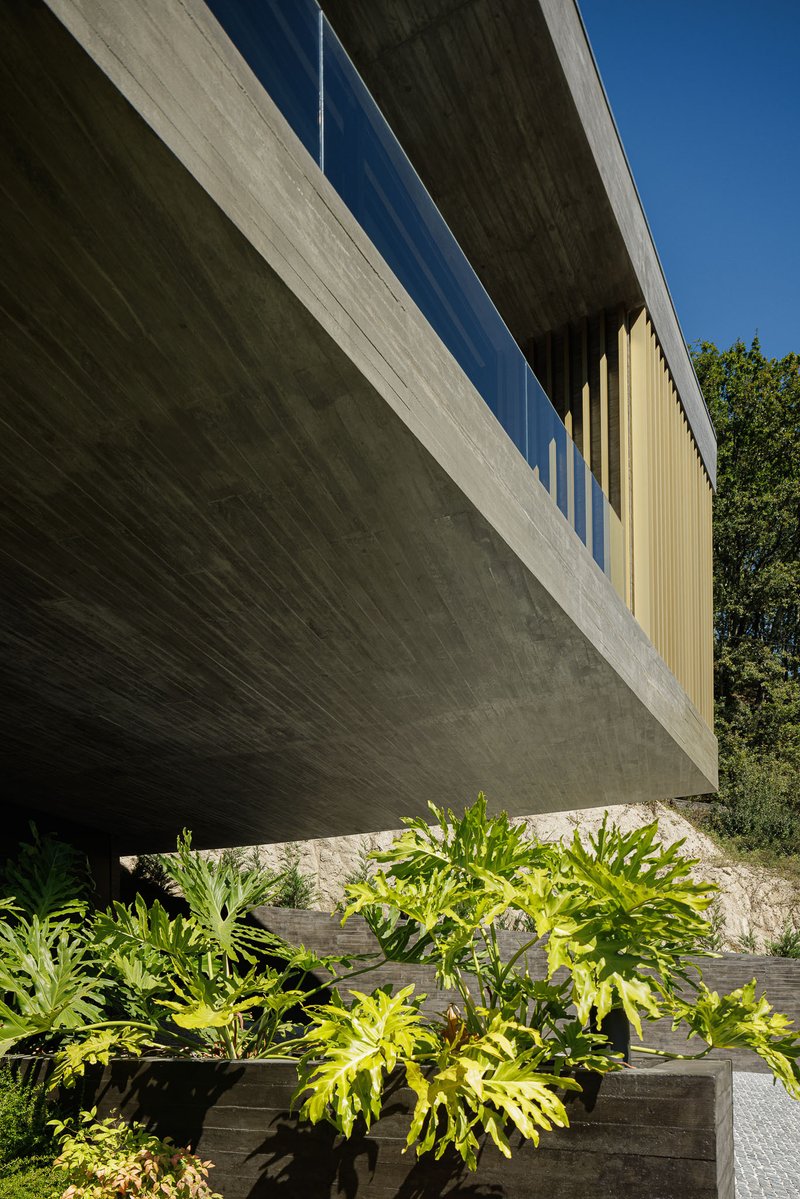
The most dramatic structural move is the cantilever that extends the upper volume over the hillside. Beneath it, a swimming pool sits at terrace level, its water edge aligned with the living room glazing. The pool is not a separate object placed on the ground; it is integrated into the building's structural slab, rotated southwest to create a physical and visual connection between interior and exterior. Lounge chairs on the deck face the valley, shaded by the concrete plane above.
The suspended pool volume also serves an atmospheric function. Water spilling from it produces a small waterfall, adding sound to an otherwise silent hillside setting. It is a considered detail: the architects understood that a house this open to its landscape needed to engage senses beyond sight. At twilight, the cantilevered roof becomes a dark datum line against the sky, and the lit interior glows through the glass band beneath it.
Arrival and Threshold
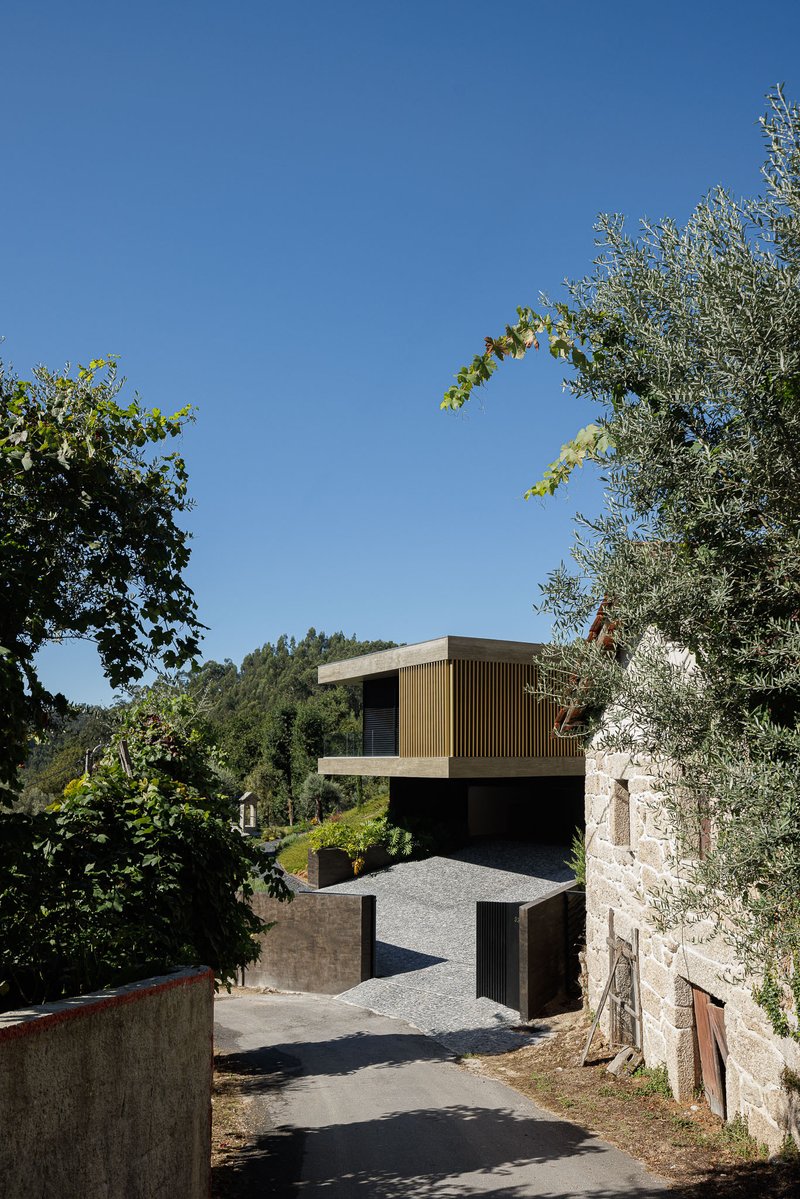
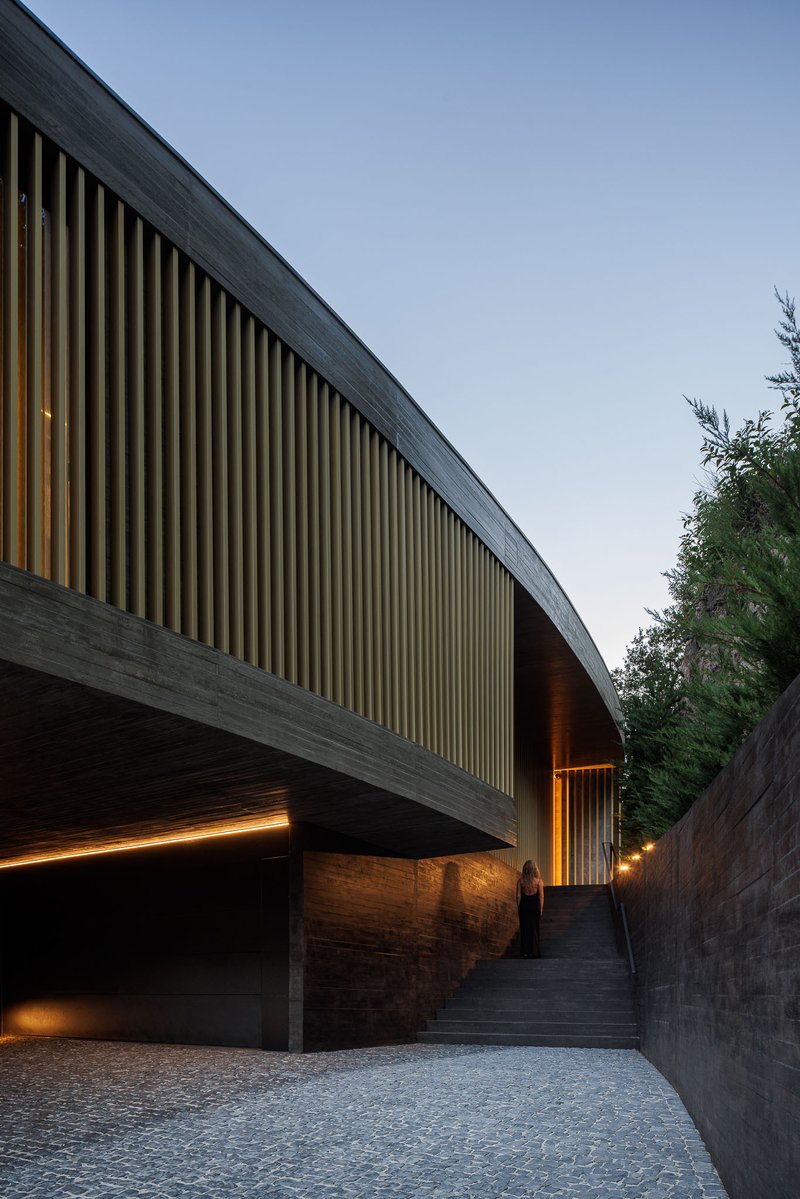
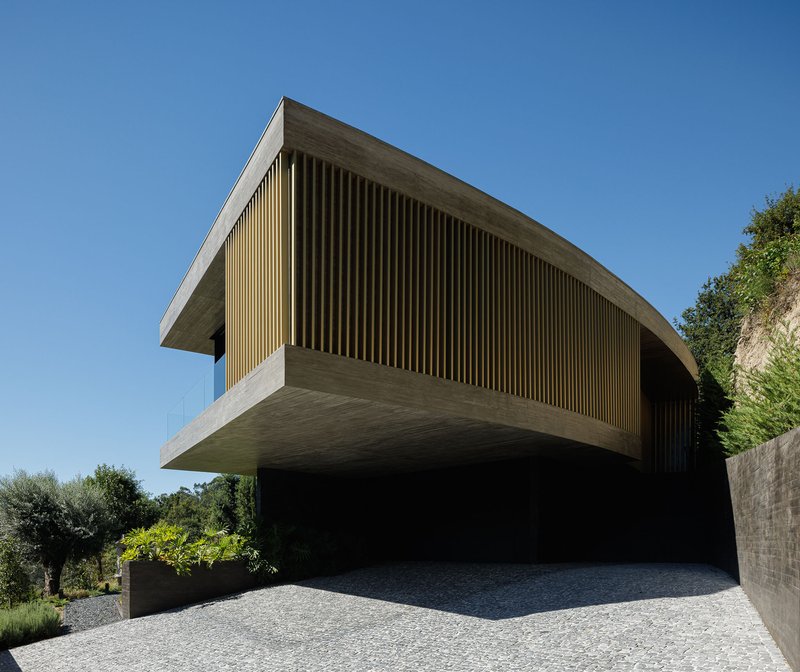
The approach to the house is orchestrated through a sequence of concrete retaining walls and an existing stone granary that serves as the arrival marker. The entry courtyard is carved between the old barn and the new volume, creating a compressed threshold before the house opens to the valley. An exterior stairway descends between board-formed concrete walls, reinforcing the sense of moving into the earth before emerging into light and view.
From the lower level, which houses the garage and technical spaces, a granary-level arrival point provides direct access upward to the private rooms to the east and south or to the social spaces to the south and west. The section of the house works as hard as the plan, using the natural slope to separate functions vertically while keeping the upper living level on a single continuous floor.
Interior Light and Restraint
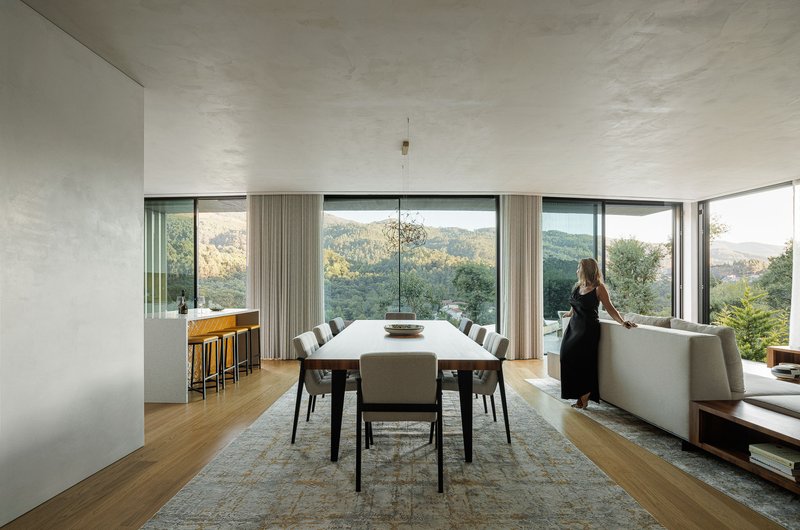
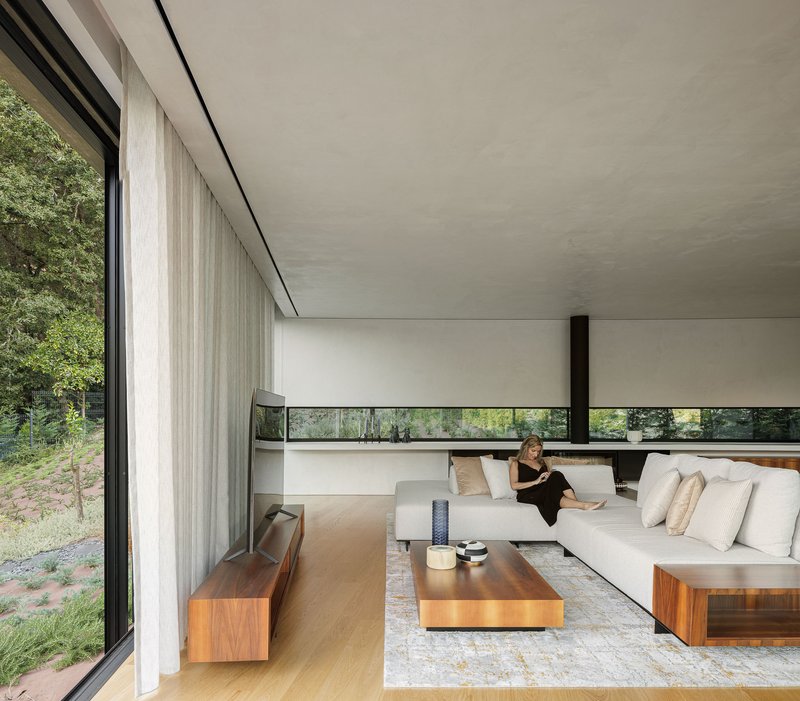
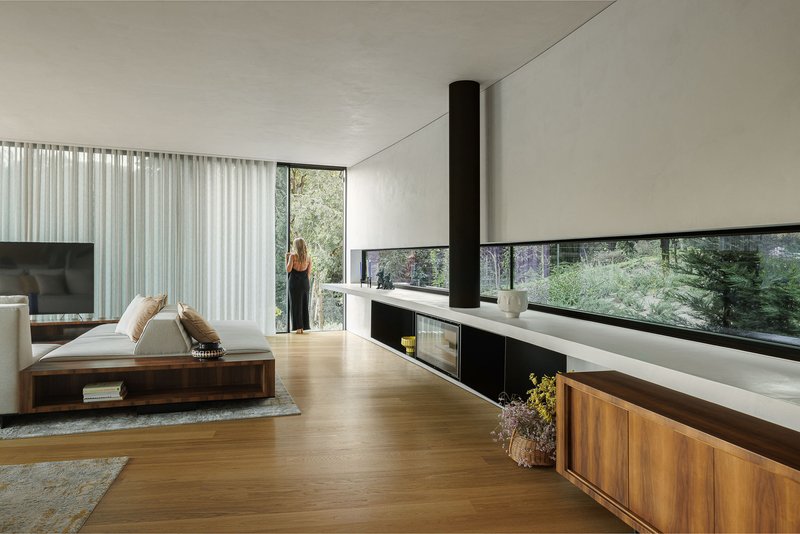
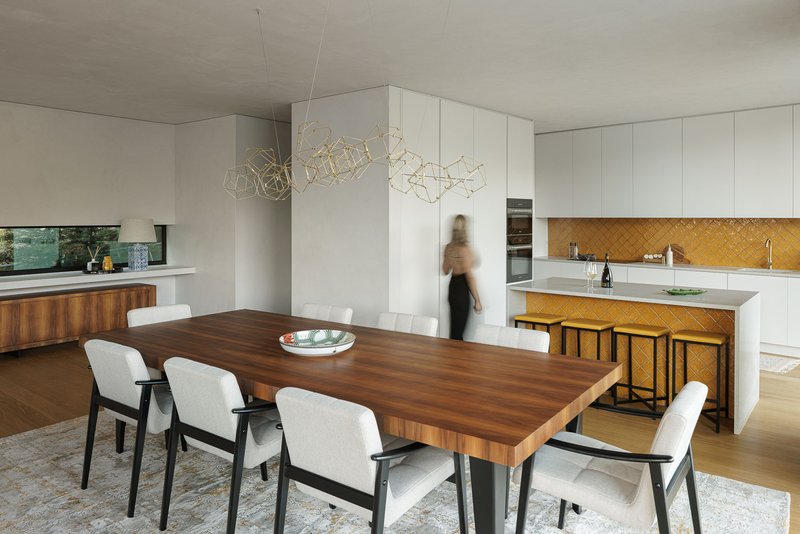
Inside, the material palette shifts to pale plaster, blonde timber, and white furnishings, a deliberate counterpoint to the heavy concrete exterior. The living room is anchored by a black cylindrical flue and defined by floor-to-ceiling glazing that makes the forest feel like wallpaper. Sheer curtains soften direct light without blocking the view. The dining area opens through continuous glass walls to the forested hills, and the kitchen, with its walnut table and yellow tile backsplash, introduces the only strong color note in the house.
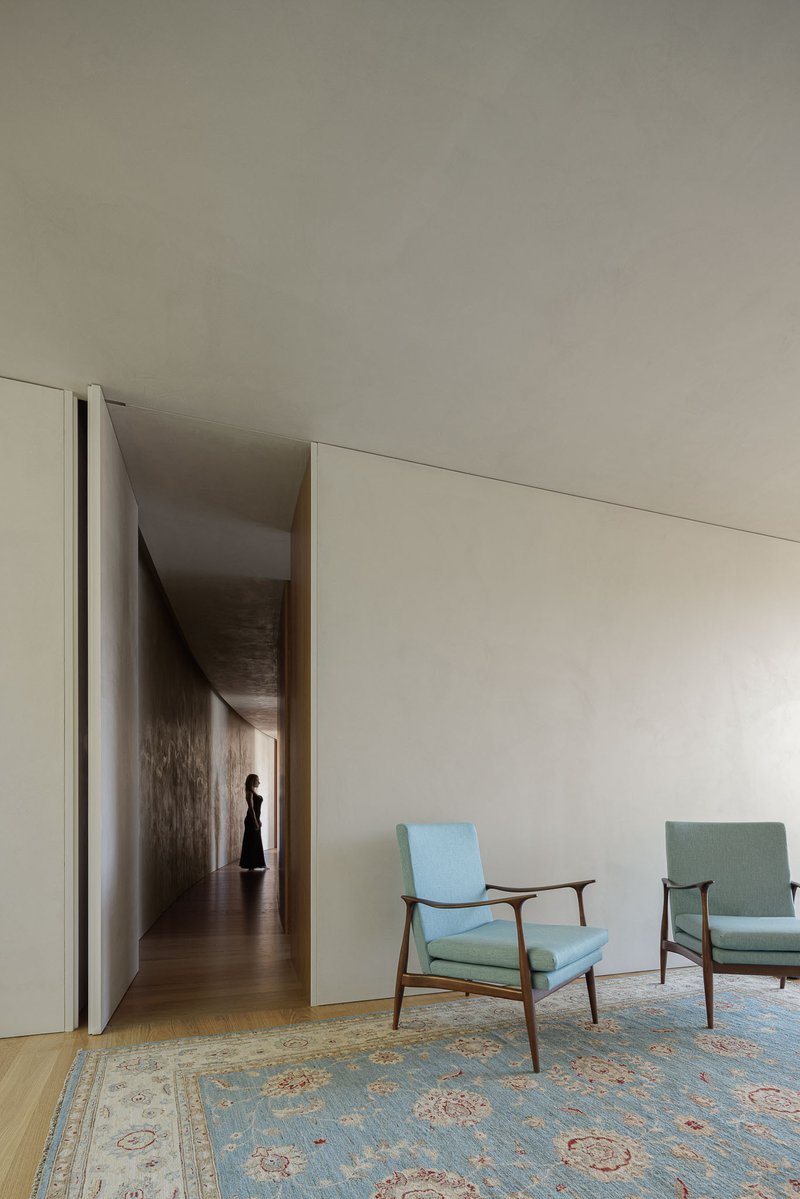
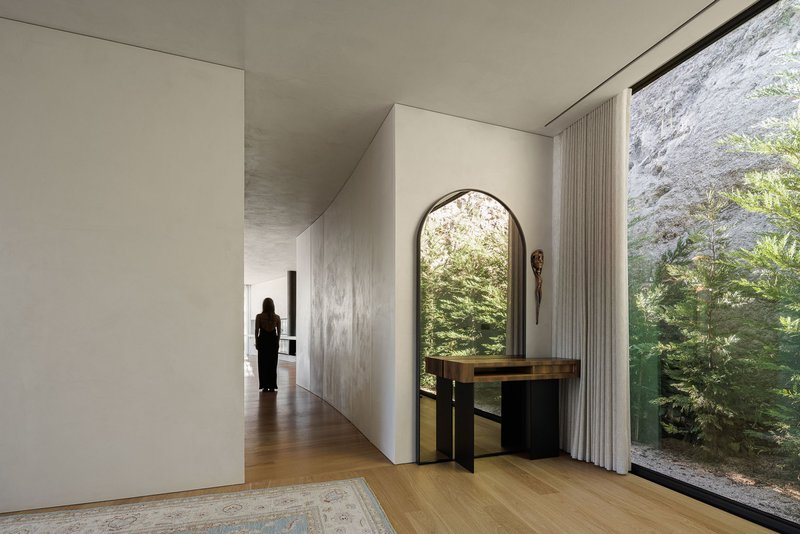
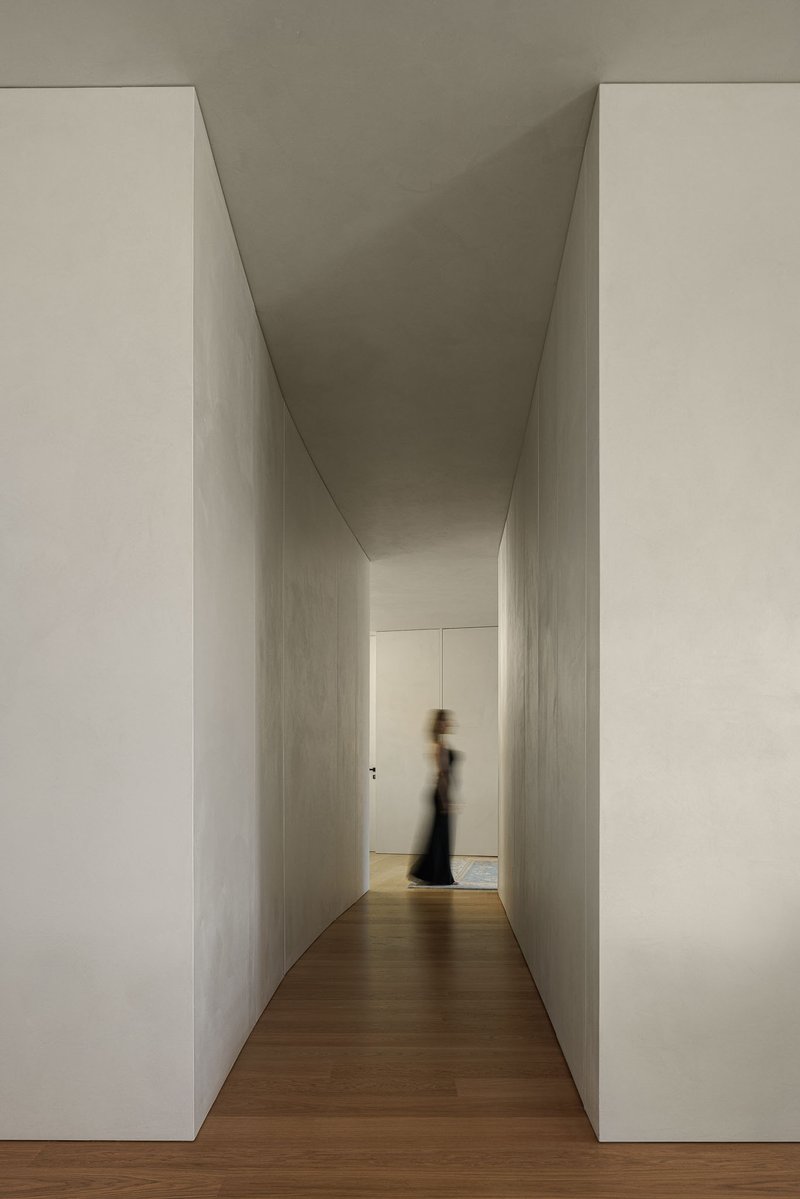
The corridors are where the board-formed concrete returns, creating moments of compression and shadow between the open, light-filled rooms. A curved plaster ceiling in one hallway mirrors the exterior roof geometry, while an arched mirror above a console table plays with depth and reflection. Midcentury armchairs and minimal furnishing keep the interior from competing with the architecture.
Private Rooms and Vertical Circulation
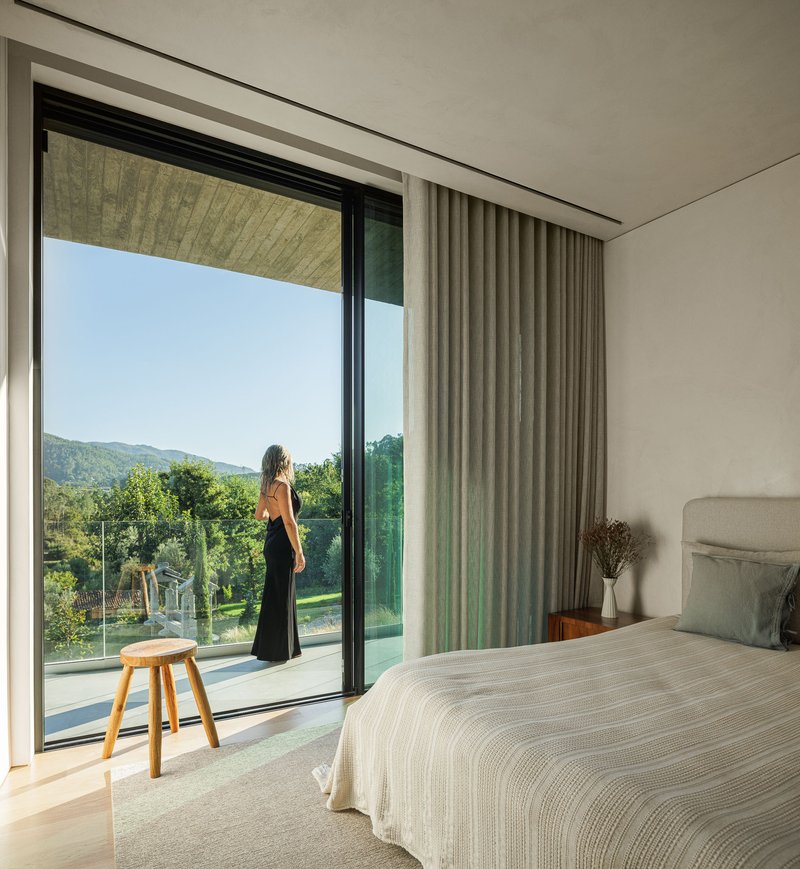
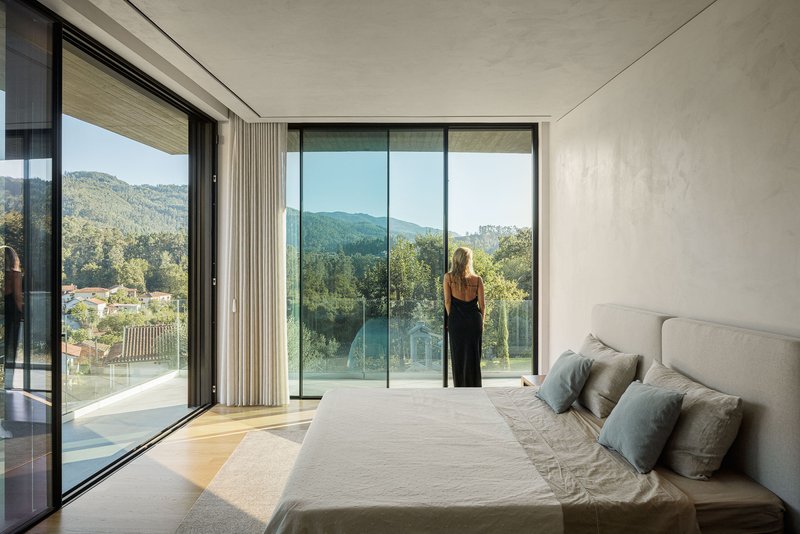
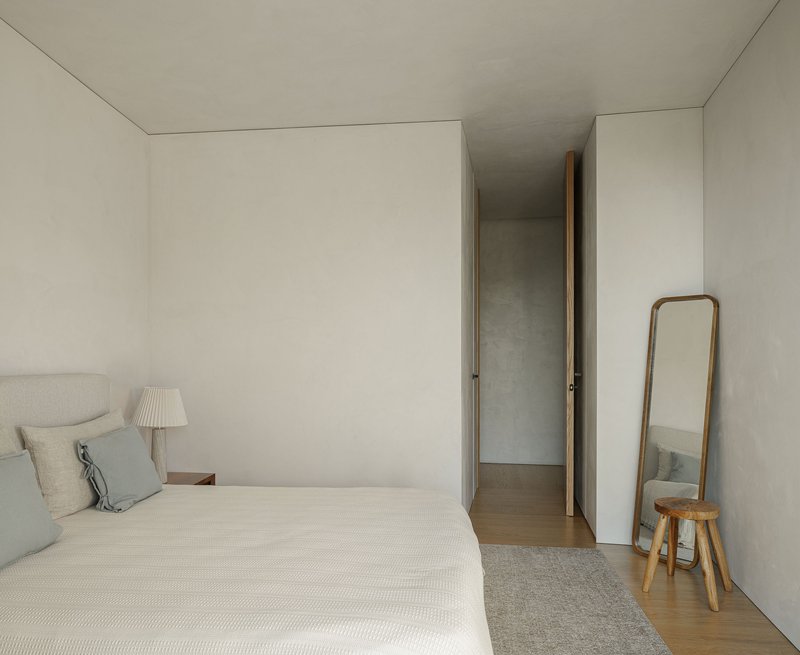
Four suites line the eastern and southern edges of the plan, each with sliding glass doors that open onto balconies overlooking the valley. The bedrooms are calm, spare spaces: pale plaster walls, timber floors, minimal furniture. One suite includes a walk-in closet. The narrowness of some connecting doorways and corridors produces a deliberate rhythm of constriction and release that rewards movement through the house.
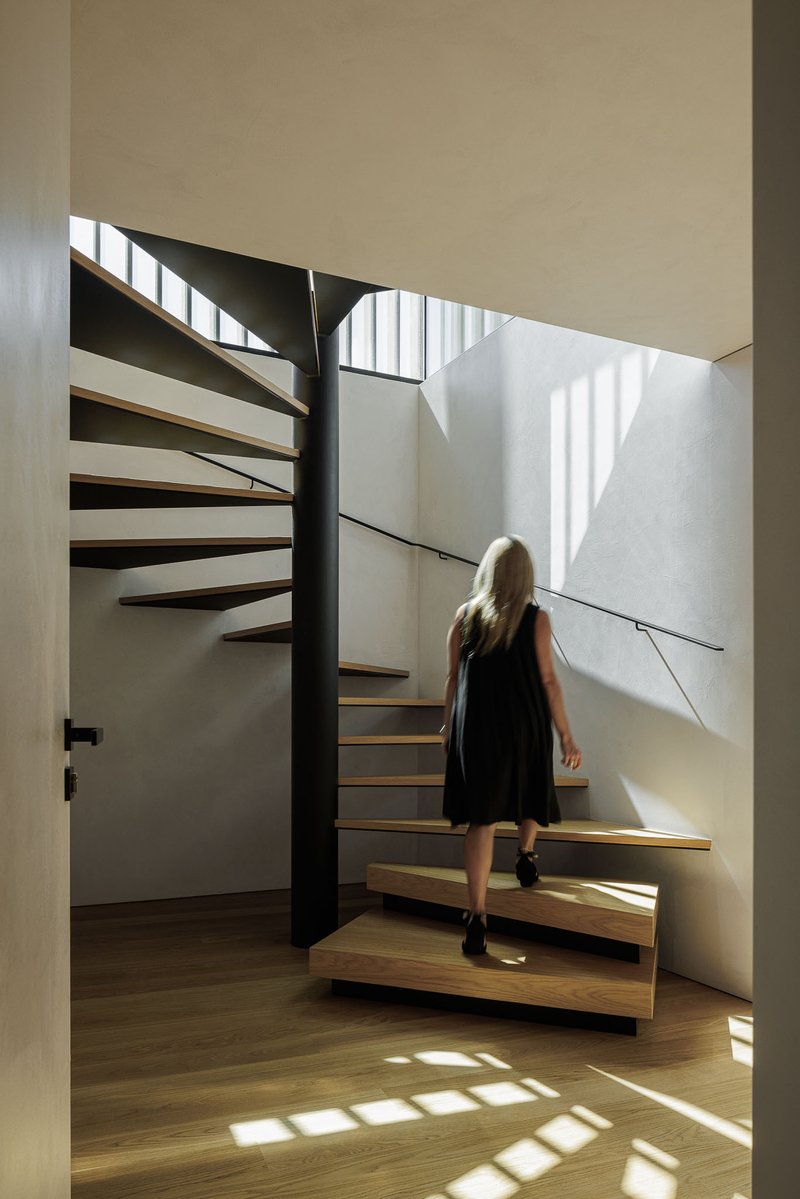
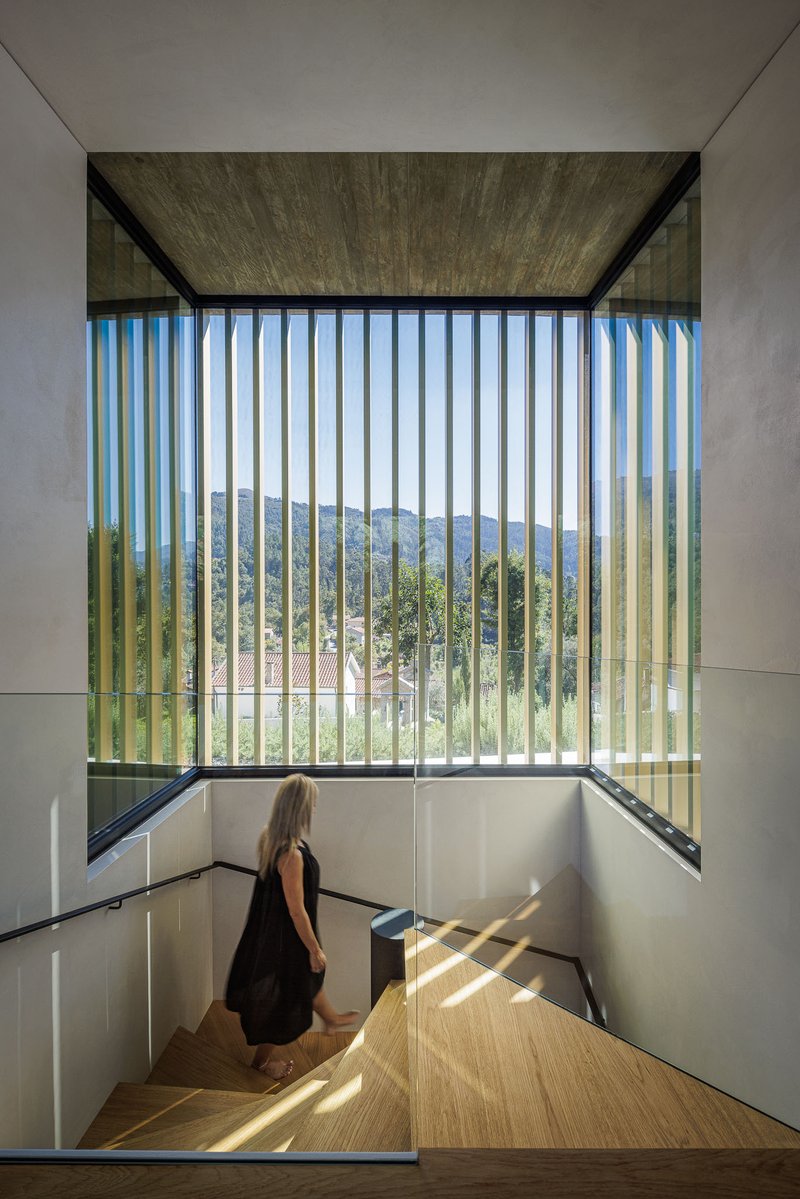
The staircase connecting the lower and upper levels is a sculptural moment. Timber treads and steel structure rise beneath a skylight that casts geometric shadows across white walls. At one landing, vertical timber sunscreens frame a distant view of the hills, their shadow stripes falling across the blonde wood steps. It is one of the most photogenic details in the house, but it also performs real work, filtering western light and providing privacy from the hillside.
Landscape as Material
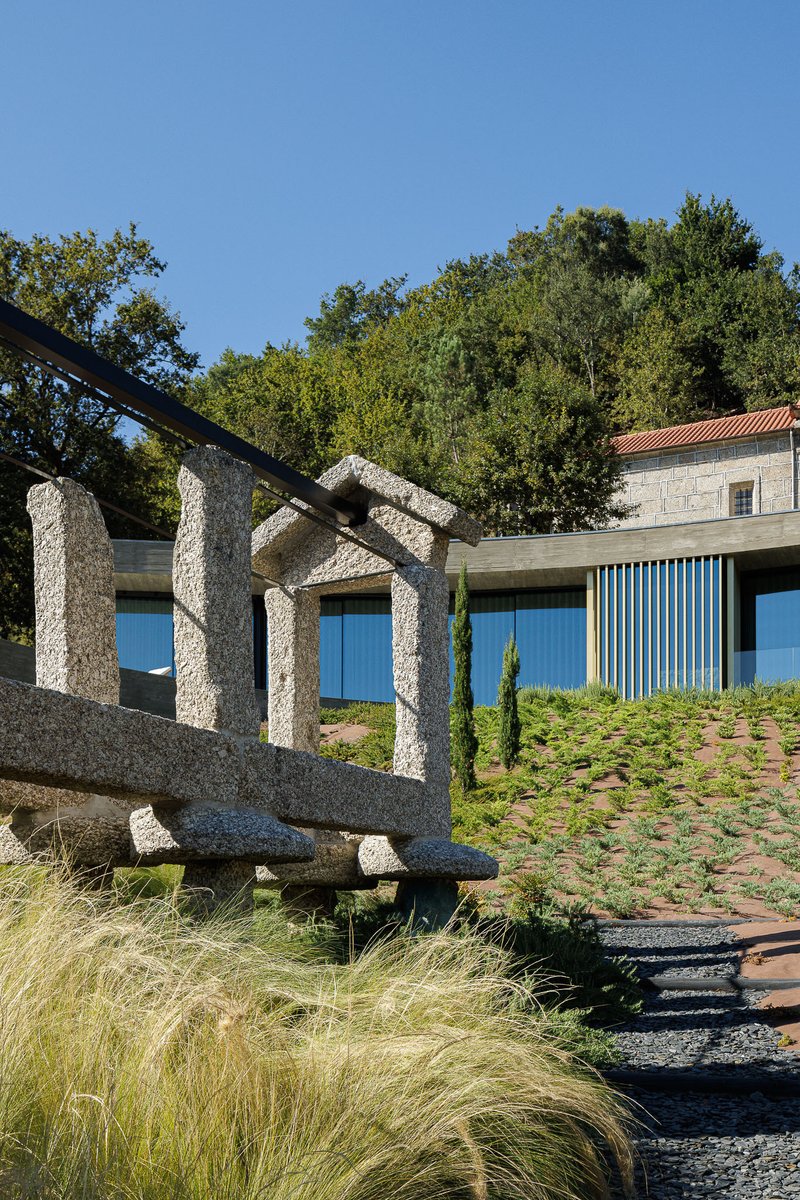
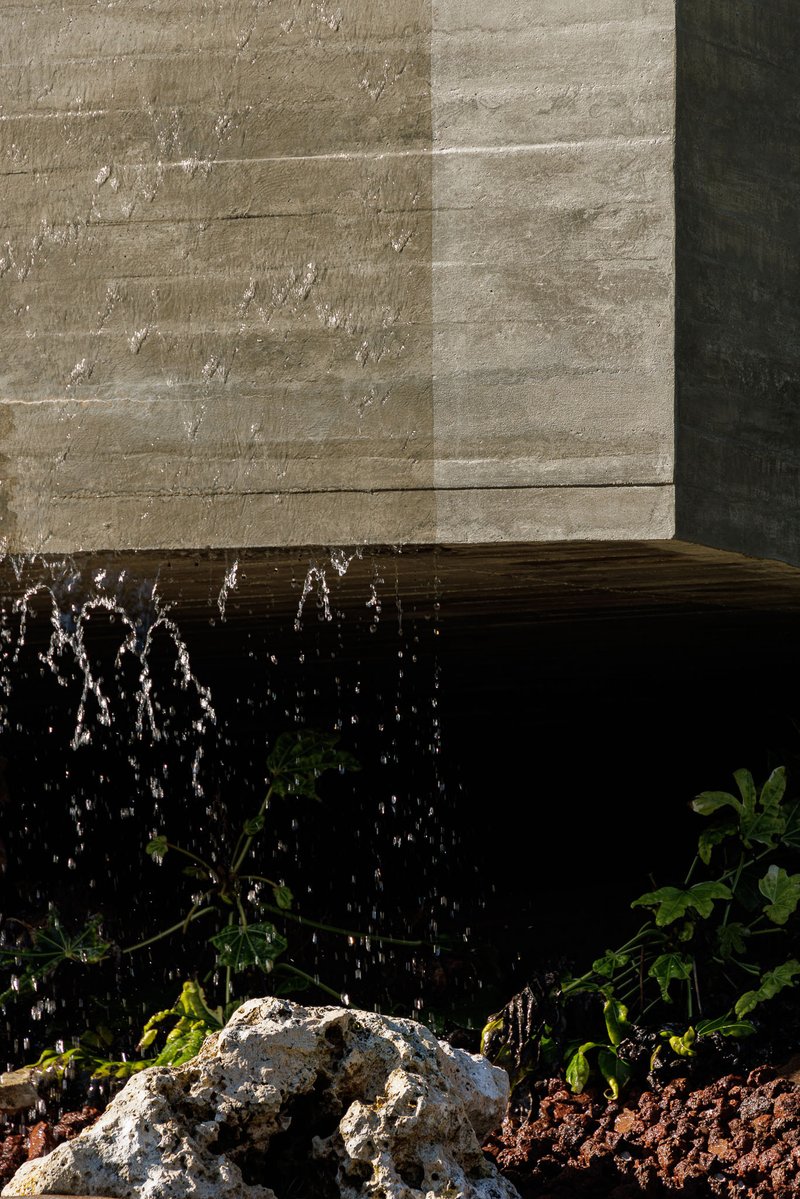
The landscape strategy is integral. Granite water features with carved channels, gravel paths, planted slopes of native grasses, and terracotta erosion-control grids all work to stabilize and animate the hillside. A split-leaf philodendron beneath the cantilever, volcanic rock along the concrete walls, and olive trees on the terraces extend the material palette outdoors. The architects chose to preserve the land's organic structure rather than flatten it, which is why the pool is suspended within the building volume rather than excavated from the slope.
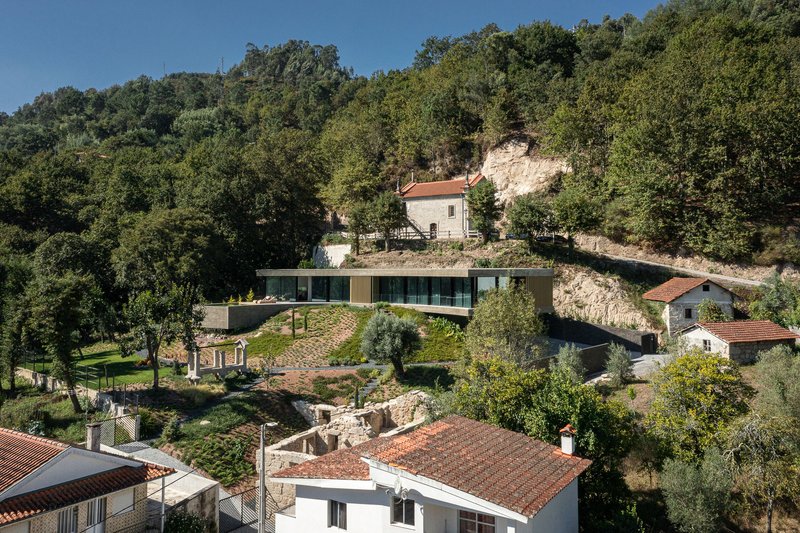
Seen from a wider vantage, the house steps down the terraced landscape in horizontal bands of glass and concrete, sitting among the tile-roofed village houses without mimicking them. Its scale is generous but its profile is low, hugging the terrain rather than rising above it. The green roof, planted with grasses and shrubs, further dissolves the boundary between building and hillside.
Timber Screens and the Filter Layer
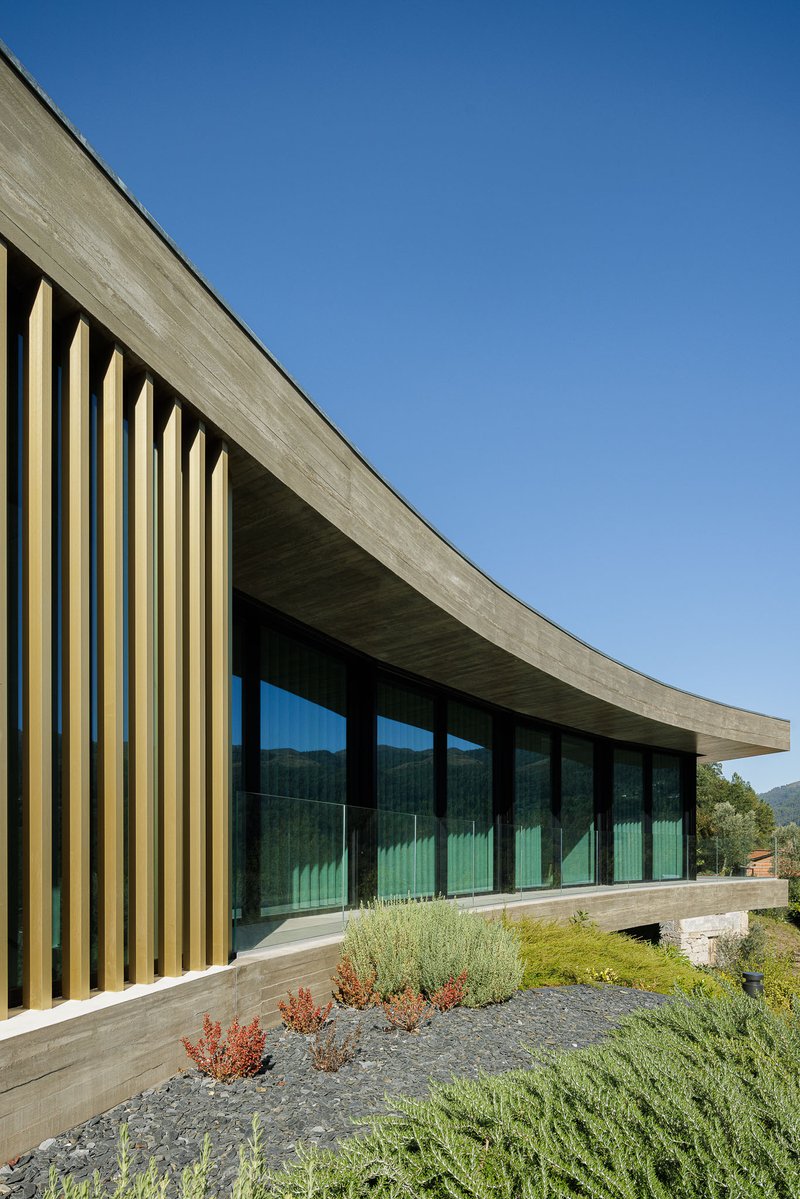
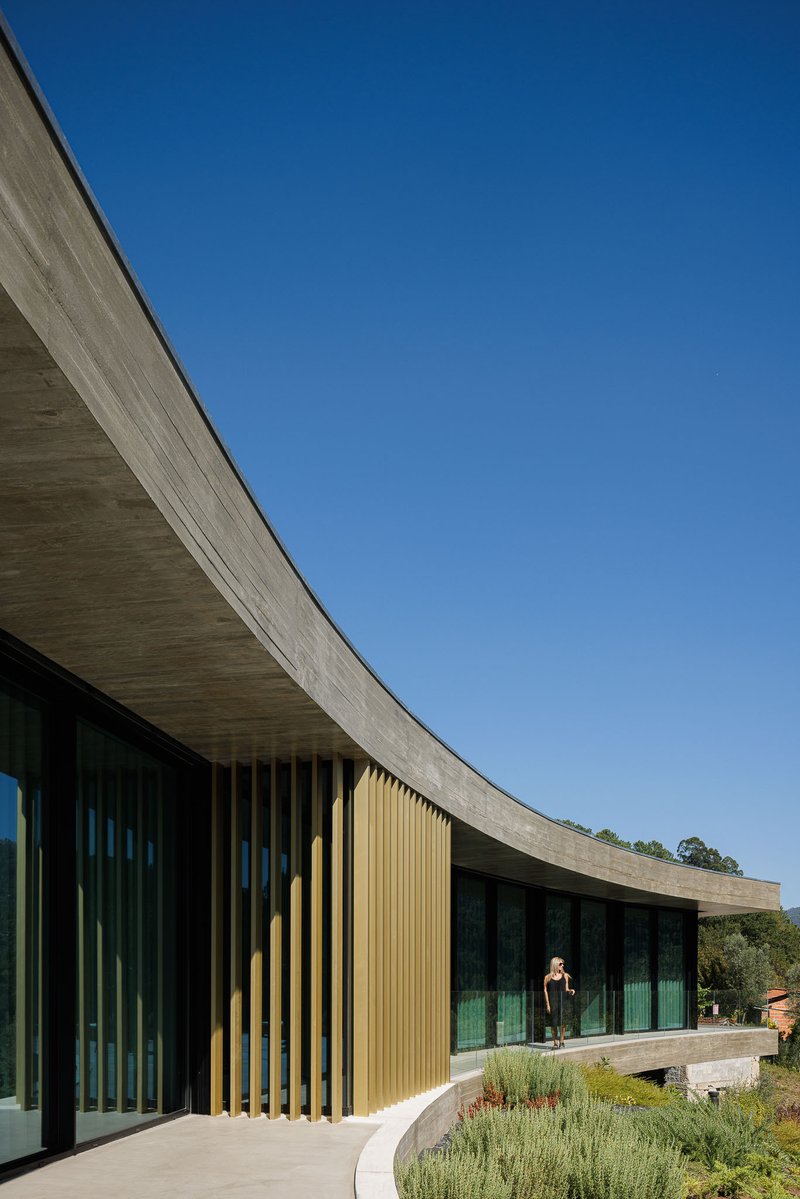
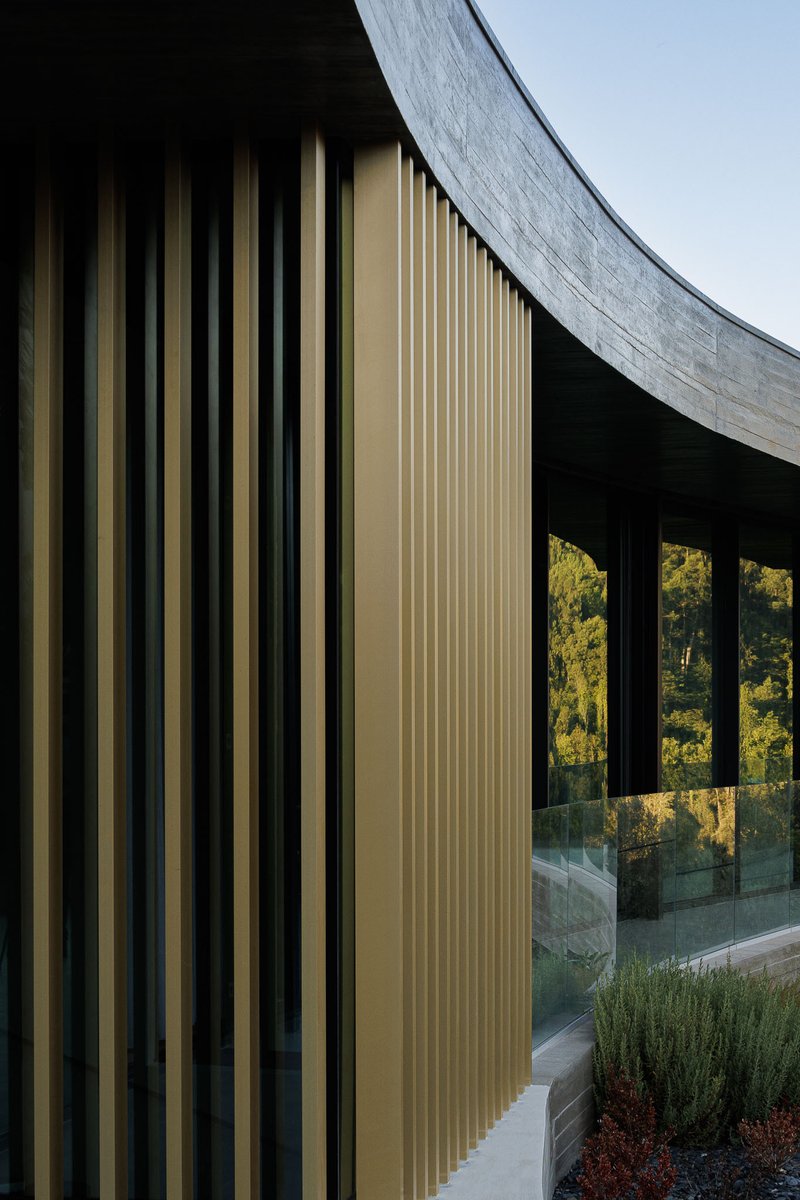
Between the concrete roof and the glass enclosure, a layer of vertical timber battens acts as a brise-soleil and privacy screen. These fins mediate between the heaviness of the concrete and the transparency of the glass, creating a middle register that changes character with the angle of the sun. At dusk, they glow warm against the darkening concrete above. During the day, they cast rhythmic shadows across the interior floors.
The timber screens also break down the building's scale. Without them, the glass band would read as a single continuous surface. With them, the facade gains a human-scaled texture and a visual depth that rewards close observation. It is a straightforward device, but its consistency around the curve of the plan gives it cumulative power.
Plans and Drawings
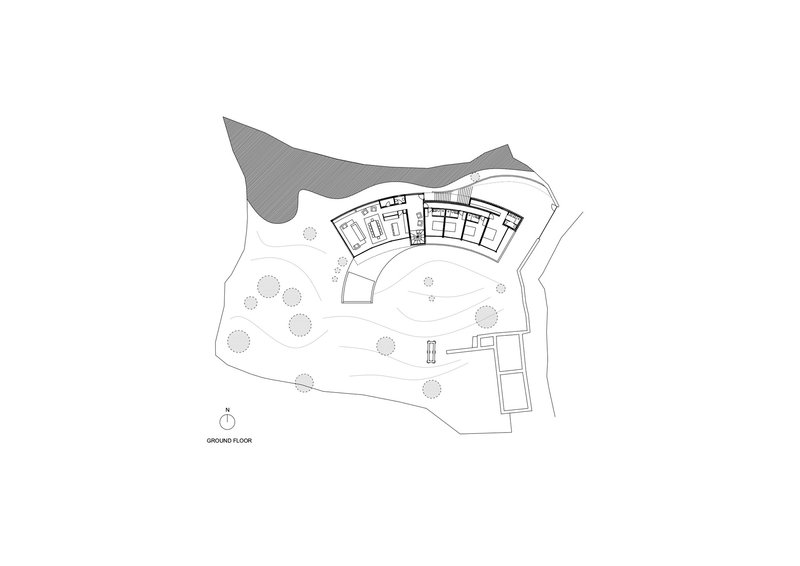
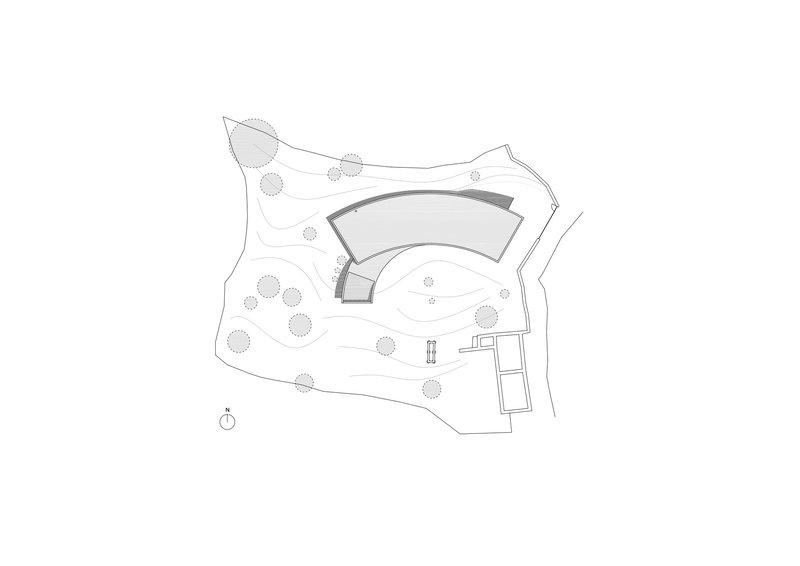
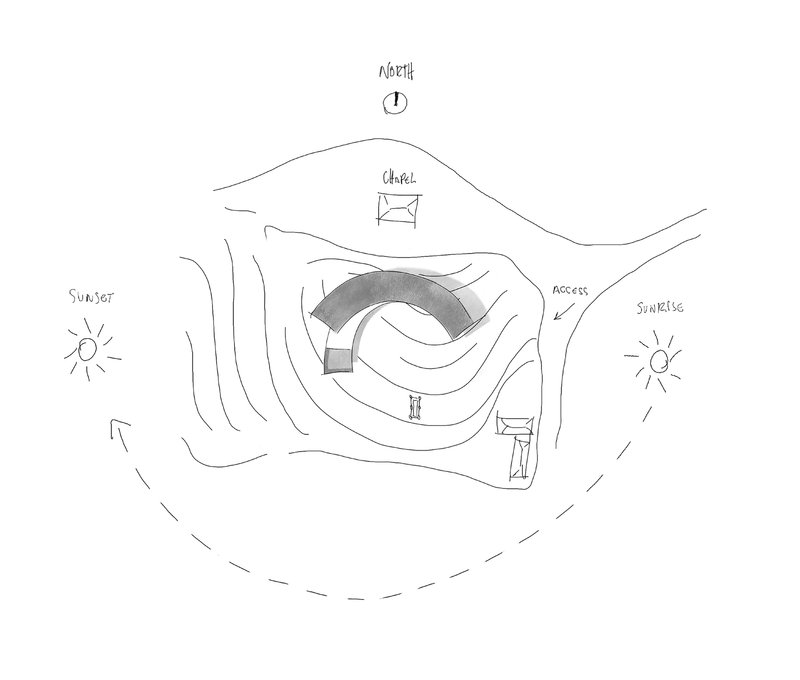
The ground floor plan reveals the full logic of the curve: a single bent volume wrapping around the south-facing patio, with rooms arranged sequentially along its inner edge. The roof plan shows the concrete canopy extending well beyond the enclosed rooms, its shape responsive to the irregular site boundary. A site sketch indicates the solar orientation, confirming that the curve opens toward sunset and sunrise, maximizing daylight throughout the day.
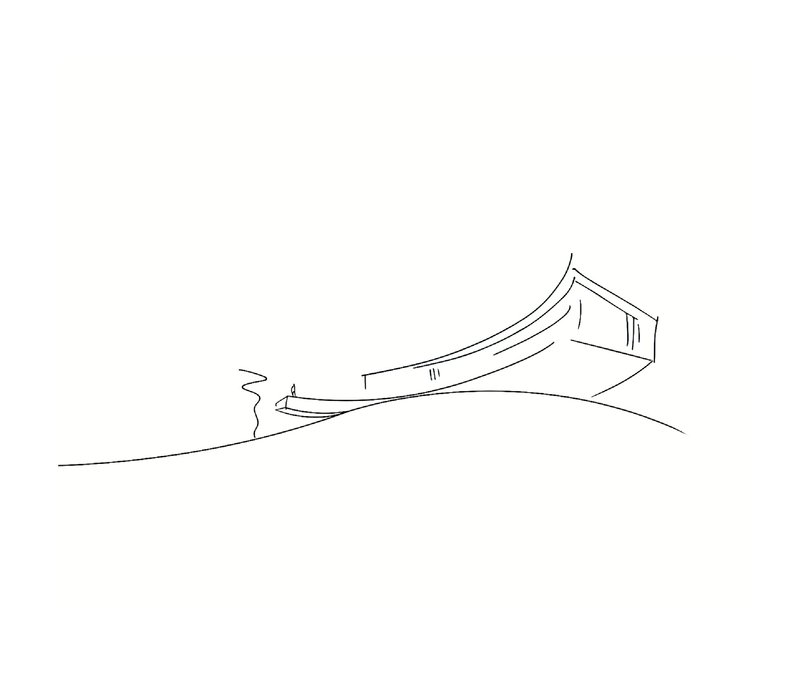
The section drawing is perhaps the most revealing. It shows the cantilevered upper volume hovering above the sloping terrain, with the lower garage level embedded in the hillside. The vertical distance between the roof slab and the ground shifts dramatically from one end to the other, a consequence of building on a slope without leveling it. A human figure provides scale, confirming that the cantilever extends several meters beyond the last interior wall.
Why This Project Matters
Casa De Bouro succeeds because its central idea, bending a rigid material to conform to a landscape, is pursued with structural honesty and material discipline. The nailed wooden formwork, the integrated pool, the suspended waterfall, the granite water channels: each detail reinforces the same commitment to treating the building as an extension of its terrain rather than an imposition on it. In a region where new construction often ignores topography, this house argues that the slope, the sun path, and the existing granary are not constraints but the raw material of design.
It also demonstrates that expressive form need not come at the expense of domestic comfort. The interiors are calm, well-proportioned, and generous with natural light. The four suites each have direct contact with the landscape. The living spaces flow into each other and out to the patio and pool without friction. MUTANT Architecture & Design has delivered a house that is photogenic from the hillside and livable from within, and that tension, between spectacle and shelter, is precisely what good residential architecture should negotiate.
Casa De Bouro by MUTANT Architecture & Design. Located in Terras de Bouro, Portugal. 450 m². Completed in 2022. Lead Architect: Daniel Capela Duarte. Builder: Amaro Sousa Construções. Engineering: Massa Cinza. Photography by Ivo Tavares Studio.
About the Studio
Share Your Own Work on uni.xyz
If projects like this are the kind of work you want to make, uni.xyz is a place to publish your own, find collaborators, and enter design competitions.




Popular Articles
Popular articles from the community

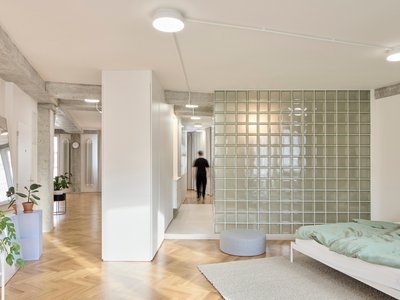
RDTH architekti Rips Out Nearly Every Wall in a Prague Apartment and Replaces Them with Furniture
A 101-square-meter post-war flat in Prague trades rigid partitions for a single rotated furniture block, curtains, and glass concrete.
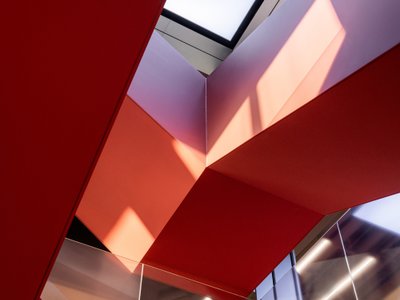
Ippolito Fleitz Group Identity Architects Turn Eight Floors in Shanghai into a Vertical Creative City
Publicis Groupe's new headquarters in Xintiandi reimagines the office as a courtyard-driven urban landscape stacked across eight floors.
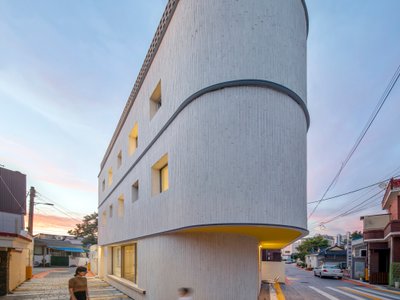
YOAP Architects Round a Corner in Yeongcheon with a Cylindrical Community Hub
A 197-square-meter brick and ribbed-clad tower turns a forgotten alley corner in South Korea into a public garden with a low threshold.
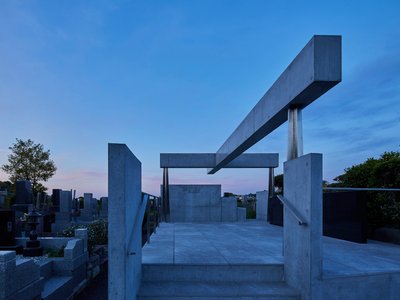
Takeshi Hosaka Architects Suspends a Concrete Cross Above a Yokohama Cemetery
A 28-square-meter burial renovation in Yokohama lifts the symbol of resurrection into the sky so mourners see it against heaven.


Similar Reads
You might also enjoy these articles

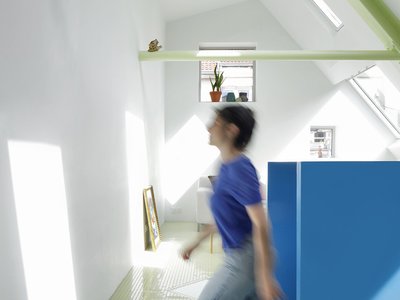
127af Flips a Tiny Bagnolet Rowhouse Upside Down with a Handcrafted Roof Extension
A 55-square-meter terraced house on the edge of Paris gains a luminous upper living floor through lightweight timber and steel.
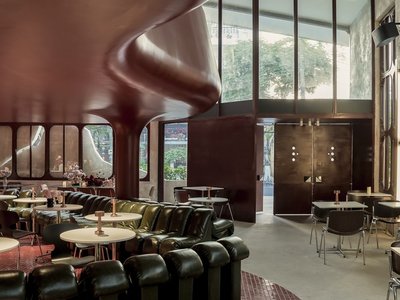
1.61 Design Workshop Wraps a 600-Square-Meter Café in Vietnam in Sculptural Burgundy Drama
Reden Café & Bistro pairs a helical staircase, mosaic floors, and deep red interiors to rethink Vietnamese hospitality space.

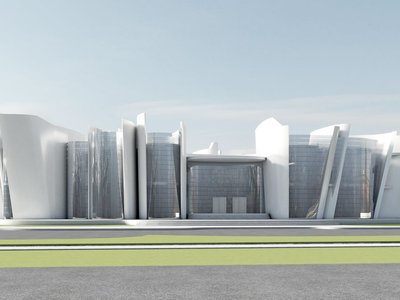
The Unbound Brain: A School Shaped by Cognitive Architecture
Cylindrical learning pods radiate like neurons from a central cortex, turning the floor plan into a spatial model of human thought.
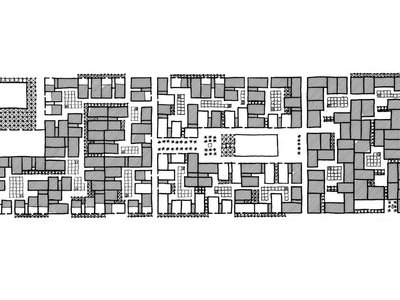
Revival Vernacular Architecture: Rammed Earth Settlements for the Sahara
A modular desert community in Mauritania that fuses passive cooling techniques with earthen construction and local craftsmanship.


Explore Sports Architecture Competitions
Discover active competitions in this discipline




The Global Benchmark for Architecture Dissertation Awards


The Global Benchmark for Graduation Excellence


Challenge to design a barrier free sports center


Challenge to design an outdoor ice-rink and park
Comments (0)
Please login or sign up to add comments
No comments yet. Be the first to comment!